Question bank

Q&A: practice questions with answers

Search questions on any topic. Filter by exam category, exam, subject and topic, try the question, then open the answer and explanation.

Courses – airGurukul

2,400 questions found.

Q261.
At what rate per annum will a sum of money become five times itself in 6 years under simple interest?
साधारण ब्याज पर कोई धनराशि 6 वर्षों में अपने से पाँच गुनी किस वार्षिक दर पर हो जाएगी?
  1. A6423%
  2. B6623%
  3. C13313%
  4. D6813%
Show answer

Concept: If a sum becomes n times in T years at simple interest, R=(n−1)×100T%.

  1. Amount =5P → SI =4P.
  2. R=4P×100P×6=4006=6623%.

Trick: "n times" means interest is (n−1) times the principal – never use n directly.

Answer: (B) 6623%

अवधारणा: साधारण ब्याज पर राशि T वर्षों में n गुना हो तो R=(n−1)×100T%।

  1. मिश्रधन =5P → ब्याज =4P।
  2. R=4P×100P×6=4006=6623%।

ट्रिक: "n गुना" का मतलब ब्याज मूलधन का (n−1) गुना है – सीधे n कभी न लें।

उत्तर: (B) 6623%

RRB NTPC Graduate CBT 1MathematicsSimple InterestRRB NTPC Graduate CBT 1 2025 · 27 Mar Shift 1 →
Q262.
What should come in place of ‘?’ in the given series?
44 50 62 80 104 ?
दी गई श्रेणी में ‘?’ के स्थान पर क्या आना चाहिए?
44 50 62 80 104 ?
  1. A132
  2. B136
  3. C138
  4. D134
Show answer

Concept: Check the differences; if they form a simple pattern (multiples of 6 here), extend it.

  1. 50−44=6, 62−50=12, 80−62=18, 104−80=24.
  2. Differences 6,12,18,24 → next difference 30.
  3. ?=104+30=134.

Trick: Differences increasing by a constant = second-level AP; just add the next multiple.

Answer: (D) 134

अवधारणा: अंतर देखें; यदि वे सरल पैटर्न (यहाँ 6 के गुणज) बनाते हैं तो उसे आगे बढ़ाएँ।

  1. 50−44=6, 62−50=12, 80−62=18, 104−80=24।
  2. अंतर 6,12,18,24 → अगला अंतर 30।
  3. ?=104+30=134।

ट्रिक: समान वृद्धि वाले अंतर = द्वितीय-स्तर समांतर श्रेणी; बस अगला गुणज जोड़ें।

उत्तर: (D) 134

RRB NTPC Graduate CBT 1MathematicsNumber SeriesRRB NTPC Graduate CBT 1 2025 · 27 Mar Shift 1 →
Q263.
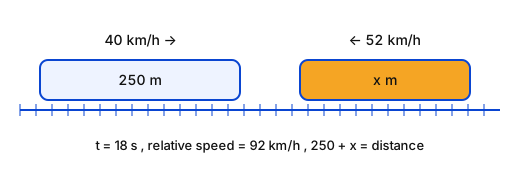
Two trains running in opposite directions at 40 km/hr and 52 km/hr cross each other in 18 seconds . If one train is 250 m long, then find the length of the other train.
विपरीत दिशाओं में 40 km/hr और 52 km/hr की चाल से चल रही दो रेलगाड़ियाँ एक-दूसरे को 18 सेकंड में पार करती हैं। यदि एक रेलगाड़ी 250 m लंबी है, तो दूसरी रेलगाड़ी की लंबाई ज्ञात कीजिए।
  1. A190 m
  2. B220 m
  3. C200 m
  4. D210 m
Show answer

Concept: Opposite directions → relative speed = sum of speeds; distance covered while crossing = sum of lengths.

  1. Relative speed =40+52=92km/h=92×518=2309m/s.
  2. Distance in 18 s =2309×18=460m.
  3. Other train =460−250=210m.

Trick: 92×18×518=92×5=460 – the 18 cancels, so no fraction work needed.

Answer: (D) 210 m

अवधारणा: विपरीत दिशा → सापेक्ष चाल = चालों का योग; पार करते समय तय दूरी = लंबाइयों का योग।

  1. सापेक्ष चाल =40+52=92km/h=92×518=2309m/s।
  2. 18 s में दूरी =2309×18=460m।
  3. दूसरी रेलगाड़ी =460−250=210m।

ट्रिक: 92×18×518=92×5=460 – 18 कट जाता है, भिन्न का काम ही नहीं।

उत्तर: (D) 210 m

RRB NTPC Graduate CBT 1MathematicsTrains – Relative SpeedRRB NTPC Graduate CBT 1 2025 · 27 Mar Shift 1 →
Q264.
Find the value of y, satisfying 26×5×715÷3025=y+913
y का वह मान ज्ञात कीजिए, जो 26×5×715÷3025=y+913 को संतुष्ट करता है
  1. A777
  2. B772
  3. C771
  4. D780
Show answer

Concept: Evaluate the root, then do × and ÷ from left to right, then solve for y.

  1. 3025=55.
  2. 26×5×715÷55=130×13=1690 (since 715÷55=13).
  3. y=1690−913=777.

Trick: Divide first where it cancels cleanly: 715=55×13 saves a big multiplication.

Answer: (A) 777

अवधारणा: पहले मूल निकालें, फिर बाएँ से दाएँ × और ÷ करें, फिर y निकालें।

  1. 3025=55।
  2. 26×5×715÷55=130×13=1690 (क्योंकि 715÷55=13)।
  3. y=1690−913=777।

ट्रिक: जहाँ साफ कटे वहाँ पहले भाग करें: 715=55×13 से बड़ा गुणा बच जाता है।

उत्तर: (A) 777

RRB NTPC Graduate CBT 1MathematicsSimplification (BODMAS)RRB NTPC Graduate CBT 1 2025 · 27 Mar Shift 1 →
Q265.
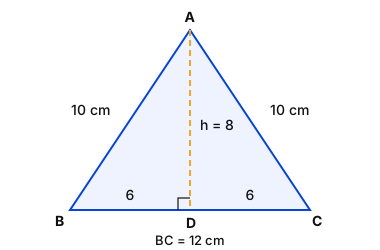
In an isosceles triangle ABC, the equal sides AB and AC are each 10 cm, and the base BC is 12 cm. Find the area of the triangle.
एक समद्विबाहु त्रिभुज ABC में, समान भुजाएँ AB और AC प्रत्येक 10 cm हैं, और आधार BC 12 cm है। त्रिभुज का क्षेत्रफल ज्ञात कीजिए।
  1. A40 cm2
  2. B45 cm2
  3. C48 cm2
  4. D36 cm2
Show answer

Concept: In an isosceles triangle the altitude from the apex bisects the base; use Pythagoras to get the height.

  1. BD=DC=122=6 cm.
  2. AD=102−62=64=8 cm.
  3. Area =12×12×8=48cm2.

Trick: 6-8-10 is a 3-4-5 triple – spot it and skip the square root.

Answer: (C) 48 cm2

अवधारणा: समद्विबाहु त्रिभुज में शीर्ष से डाला गया लंब आधार को समद्विभाजित करता है; पाइथागोरस से ऊँचाई निकालें।

  1. BD=DC=122=6 cm।
  2. AD=102−62=64=8 cm।
  3. क्षेत्रफल =12×12×8=48cm2।

ट्रिक: 6-8-10, 3-4-5 का त्रिक है – पहचानें और वर्गमूल छोड़ दें।

उत्तर: (C) 48 cm2

RRB NTPC Graduate CBT 1MathematicsArea of Isosceles TriangleRRB NTPC Graduate CBT 1 2025 · 27 Mar Shift 1 →
Q266.
There are 85 members in group A, 23 members in group B and 42 members in group C. All the members of these groups went to a restaurant. The average amounts spent on each member of groups A, B and C are ₹407, ₹365 and ₹280, respectively. The overall average amount (in ₹) spent per member is:
समूह A में 85 सदस्य, समूह B में 23 सदस्य और समूह C में 42 सदस्य हैं। इन समूहों के सभी सदस्य एक रेस्तरां में गए। समूह A, B और C के प्रत्येक सदस्य पर खर्च की गई औसत राशि क्रमशः ₹407, ₹365 और ₹280 है। प्रति सदस्य खर्च की गई समग्र औसत राशि (₹ में) है:
  1. A362
  2. B363
  3. C368
  4. D365
Show answer

Concept: Overall average =total amounttotal members (weighted mean).

  1. Total =85×407+23×365+42×280=34595+8395+11760=54750.
  2. Members =85+23+42=150.
  3. Average =54750150=365.

Trick: Take 365 as base: deviations 85×42=3570 and 42×(−85)=−3570 cancel exactly, B is at the base → answer 365 without division.

Answer: (D) 365

अवधारणा: कुल औसत =कुल राशिकुल सदस्य (भारित माध्य)।

  1. कुल =85×407+23×365+42×280=34595+8395+11760=54750।
  2. सदस्य =85+23+42=150।
  3. औसत =54750150=365।

ट्रिक: 365 को आधार लें: विचलन 85×42=3570 और 42×(−85)=−3570 पूरी तरह कट जाते हैं, B आधार पर ही है → बिना भाग किए उत्तर 365।

उत्तर: (D) 365

RRB NTPC Graduate CBT 1MathematicsWeighted AverageRRB NTPC Graduate CBT 1 2025 · 27 Mar Shift 1 →
Q267.
The ages (in years) of patients in a clinic are recorded as follows: 15 , 18 , 21 , 21 , 23 , 25 , 28 , 30 , 35 , 40 , 45 , 50 , 55. Calculate the difference between the median age now and after removing the oldest patient (55 years) from the data set.
एक क्लिनिक में रोगियों की आयु (वर्षों में) निम्न प्रकार दर्ज की गई है: 15 , 18 , 21 , 21 , 23 , 25 , 28 , 30 , 35 , 40 , 45 , 50 , 55। वर्तमान माध्यिका आयु और आँकड़ों से सबसे वृद्ध रोगी (55 वर्ष) को हटाने के बाद की माध्यिका आयु के बीच का अंतर परिकलित कीजिए।
  1. A1.75 years1.75 वर्ष
  2. B1.5 years1.5 वर्ष
  3. C2.5 years2.5 वर्ष
  4. D1.25 years1.25 वर्ष
Show answer

Concept: For n sorted values the median is the n+12-th value (odd n) or the mean of the two middle values (even n).

  1. 13 values (already sorted): median = 7th value = 28.
  2. Remove 55 → 12 values: median =6th+7th2=25+282=26.5.
  3. Difference =28−26.5=1.5 years.

Trick: Removing the largest value shifts the median down by half the gap between the two middle values – here 28−252=1.5.

Answer: (B) 1.5 years

अवधारणा: n क्रमबद्ध मानों की माध्यिका n+12-वाँ मान (विषम n) या बीच के दो मानों का औसत (सम n) होती है।

  1. 13 मान (पहले से क्रम में): माध्यिका = 7वाँ मान = 28।
  2. 55 हटाने पर 12 मान: माध्यिका =6वाँ+7वाँ2=25+282=26.5।
  3. अंतर =28−26.5=1.5 वर्ष।

ट्रिक: सबसे बड़ा मान हटाने पर माध्यिका बीच के दो मानों के अंतर के आधे से नीचे खिसकती है – यहाँ 28−252=1.5।

उत्तर: (B) 1.5 years

RRB NTPC Graduate CBT 1MathematicsMedianRRB NTPC Graduate CBT 1 2025 · 27 Mar Shift 1 →
Q268.
If x4=322−1x4 and x≥1, then the value of x3−1x3 is:
यदि x4=322−1x4 और x≥1 है, तो x3−1x3 का मान है:
  1. A76
  2. B72
  3. C64
  4. D62
Show answer

Concept: Step down from x4+1x4 to x−1x using (x2+1x2)2=x4+1x4+2 and (x−1x)2=x2+1x2−2.

  1. x4+1x4=322 → x2+1x2=324=18.
  2. (x−1x)2=18−2=16 → x−1x=4 (positive as x≥1).
  3. x3−1x3=(x−1x)3+3(x−1x)=64+12=76.

Trick: Remember the chain 322→18→4: each step is "add or subtract 2, then square-root".

Answer: (A) 76

अवधारणा: (x2+1x2)2=x4+1x4+2 और (x−1x)2=x2+1x2−2 से x4+1x4 से x−1x तक उतरें।

  1. x4+1x4=322 → x2+1x2=324=18।
  2. (x−1x)2=18−2=16 → x−1x=4 (x≥1 से धनात्मक)।
  3. x3−1x3=(x−1x)3+3(x−1x)=64+12=76।

ट्रिक: शृंखला 322→18→4 याद रखें: हर कदम "2 जोड़ें/घटाएँ, फिर वर्गमूल"।

उत्तर: (A) 76

RRB NTPC Graduate CBT 1MathematicsAlgebraic IdentitiesRRB NTPC Graduate CBT 1 2025 · 27 Mar Shift 1 →
Q269.
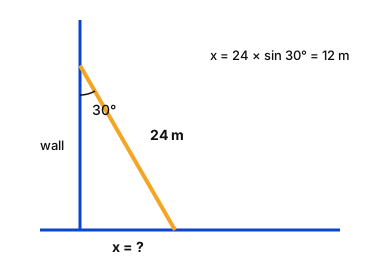
A 24 m long ladder is leaning against a wall. If the ladder makes an angle of 30o with the wall, what is the distance (in m) of the foot of the ladder from the wall?
24 m लंबी एक सीढ़ी एक दीवार के सहारे झुकी हुई है। यदि सीढ़ी दीवार के साथ 30o का कोण बनाती है, तो सीढ़ी के पाद की दीवार से दूरी (m में) क्या है?
  1. A12
  2. B122
  3. C123
  4. D123
Show answer

Concept: The ladder, wall and ground form a right triangle; the side opposite the angle at the top (between ladder and wall) is the foot-to-wall distance, so use sin.

  1. Angle with the wall =30∘, hypotenuse (ladder) =24 m.
  2. Distance from wall =24sin30∘=24×12=12 m.

Trick: Angle with the wall → sin gives the ground distance; angle with the ground → cos gives it. Here it is simply half the ladder.

Answer: (A) 12

अवधारणा: सीढ़ी, दीवार और ज़मीन समकोण त्रिभुज बनाते हैं; ऊपर के कोण (सीढ़ी और दीवार के बीच) की सम्मुख भुजा ही पाद-से-दीवार दूरी है, अतः sin लगाएँ।

  1. दीवार से कोण =30∘, कर्ण (सीढ़ी) =24 m।
  2. दीवार से दूरी =24sin30∘=24×12=12 m।

ट्रिक: दीवार से कोण → sin से ज़मीनी दूरी; ज़मीन से कोण → cos से। यहाँ यह सीढ़ी की आधी है।

उत्तर: (A) 12

RRB NTPC Graduate CBT 1MathematicsHeights and DistancesRRB NTPC Graduate CBT 1 2025 · 27 Mar Shift 1 →
Q270.
The radius of a right circular cone is increased by 8% and slant height is decreased by 15%. Find the percentage change in curved surface area of the cone.
एक लंब वृत्तीय शंकु की त्रिज्या में 8% की वृद्धि की जाती है और तिर्यक ऊँचाई में 15% की कमी की जाती है। शंकु के वक्र पृष्ठीय क्षेत्रफल में प्रतिशत परिवर्तन ज्ञात कीजिए।
  1. Adecreases by 8.2%8.2% की कमी
  2. Bincreases by 7%7% की वृद्धि
  3. Cdecreases by 11.5%11.5% की कमी
  4. Ddecreases by 7%7% की कमी
Show answer

Concept: CSA of a cone =πrl; when r and l change by a% and b%, net change =a+b+ab100%.

  1. a=+8, b=−15: net =8−15+8×(−15)100=−7−1.2=−8.2%.
  2. Check: 1.08×0.85=0.918 → a 8.2% decrease.

Trick: For a product of two quantities, use the successive-percentage formula; the sign of ab100 is negative when one rises and the other falls.

Answer: (A) decreases by 8.2%

अवधारणा: शंकु का वक्र पृष्ठ =πrl; r और l में a% और b% परिवर्तन पर शुद्ध परिवर्तन =a+b+ab100%।

  1. a=+8, b=−15: शुद्ध =8−15+8×(−15)100=−7−1.2=−8.2%।
  2. जाँच: 1.08×0.85=0.918 → 8.2% की कमी।

ट्रिक: दो राशियों के गुणनफल के लिए क्रमिक-प्रतिशत सूत्र लगाएँ; एक बढ़े और दूसरी घटे तो ab100 ऋणात्मक होता है।

उत्तर: (A) decreases by 8.2%

RRB NTPC Graduate CBT 1MathematicsPercentage Change – CSA of ConeRRB NTPC Graduate CBT 1 2025 · 27 Mar Shift 1 →
Q271.
A trader marks an article at a certain price and offers a 20% discount on it. Additionally, for every 120 articles purchased, he gives 3 more articles free of cost. If his overall profit on the transaction is 28%, find the percentage by which the marked price of an article exceeds its cost price. Assume the customer pays for only 120 articles.
एक व्यापारी किसी वस्तु पर एक निश्चित मूल्य अंकित करता है और उस पर 20% की छूट देता है। इसके अतिरिक्त, खरीदी गई प्रत्येक 120 वस्तुओं पर वह 3 और वस्तुएँ निःशुल्क देता है। यदि इस लेन-देन पर उसका कुल लाभ 28% है, तो ज्ञात कीजिए कि वस्तु का अंकित मूल्य उसके क्रय मूल्य से कितने प्रतिशत अधिक है। मान लीजिए कि ग्राहक केवल 120 वस्तुओं का भुगतान करता है।
  1. A64%
  2. B68%
  3. C72%
  4. D60%
Show answer

Concept: Let CP of each article be ₹1 and MP be ₹m. The customer pays for 120 articles at the discounted price but receives 123.

  1. Cost to trader =123×1=123; revenue =120×0.8m=96m.
  2. Profit 28% → 96m=1.28×123=157.44 → m=1.64.
  3. MP exceeds CP by 64%.

Trick: MPCP=(1+profit)(1−discount)×articles givenarticles paid=1.280.8×123120=1.6×1.025=1.64.

Answer: (A) 64%

अवधारणा: हर वस्तु का क्रय मूल्य ₹1 और अंकित मूल्य ₹m मानें। ग्राहक 120 वस्तुओं का छूट वाला दाम देता है पर 123 वस्तुएँ पाता है।

  1. व्यापारी की लागत =123×1=123; प्राप्ति =120×0.8m=96m।
  2. लाभ 28% → 96m=1.28×123=157.44 → m=1.64।
  3. अंकित मूल्य, क्रय मूल्य से 64% अधिक।

ट्रिक: MPCP=(1+लाभ)(1−छूट)×दी गई वस्तुएँभुगतान वाली वस्तुएँ=1.280.8×123120=1.6×1.025=1.64।

उत्तर: (A) 64%

RRB NTPC Graduate CBT 1MathematicsProfit, Discount and Free ArticlesRRB NTPC Graduate CBT 1 2025 · 27 Mar Shift 1 →
Q272.
Which of the following letter-number clusters will replace the question mark (?) in the given series to make it logically complete?
XVW 26 TRS 22 PNO 18 LJK 14 ?
निम्नलिखित में से कौन-सा अक्षर-संख्या समूह दी गई श्रेणी में प्रश्नचिह्न (?) के स्थान पर आकर इसे तार्किक रूप से पूर्ण करेगा?
XVW 26 TRS 22 PNO 18 LJK 14 ?
  1. AHKO 9
  2. BHEF 9
  3. CHGF 10
  4. DHFG 10
Show answer

Concept: Treat the letters and the number separately; each follows its own fixed jump.

  1. First letters: X(24), T(20), P(16), L(12) → each −4, next is H(8).
  2. Inside each cluster the 2nd letter is first letter −2 and the 3rd is first letter −1: XVW, TRS, PNO, LJK → HFG.
  3. Numbers: 26, 22, 18, 14 → −4 each, next 10. (Also number = first letter position +2.)

Trick: In such series the number is usually tied to the first letter – here 26=24+2, so for H it must be 8+2=10.

Answer: (D) HFG 10

अवधारणा: अक्षरों और संख्या को अलग-अलग देखें; हर एक का अपना नियत अंतर है।

  1. पहले अक्षर: X(24), T(20), P(16), L(12) → हर बार −4, अगला H(8)।
  2. हर समूह में दूसरा अक्षर = पहला −2, तीसरा = पहला −1: XVW, TRS, PNO, LJK → HFG।
  3. संख्याएँ: 26, 22, 18, 14 → −4, अगली 10 (संख्या = पहले अक्षर का स्थान +2)।

ट्रिक: ऐसी शृंखला में संख्या प्रायः पहले अक्षर से जुड़ी होती है – यहाँ 26=24+2, तो H के लिए 8+2=10।

उत्तर: (D) HFG 10

RRB NTPC Graduate CBT 1General Intelligence and ReasoningLetter–number seriesRRB NTPC Graduate CBT 1 2025 · 27 Mar Shift 1 →
Q273.
This question is based on the five, three-digit numbers given below.
(Left) 235 879 584 635 159 (Right)
(Example- 697 – First digit = 6, second digit = 9 and third digit = 7)
NOTE - All operations to be done from left to right.
What will be the resultant if third digit of the highest number is added to the second digit of lowest number?
यह प्रश्न नीचे दी गई पाँच तीन-अंकीय संख्याओं पर आधारित है।
(बाएँ) 235 879 584 635 159 (दाएँ)
(उदाहरण- 697 – पहला अंक = 6, दूसरा अंक = 9 और तीसरा अंक = 7)
नोट - सभी संक्रियाएँ बाएँ से दाएँ की जानी हैं।
यदि सबसे बड़ी संख्या के तीसरे अंक को सबसे छोटी संख्या के दूसरे अंक में जोड़ा जाए, तो परिणाम क्या होगा?
  1. A17
  2. B16
  3. C18
  4. D14
Show answer

Concept: Identify the required numbers first, then pick the digits by position.

  1. Numbers: 235, 879, 584, 635, 159. Highest =879, lowest =159.
  2. Third digit of 879 =9; second digit of 159 =5.
  3. Sum =9+5=14.

Trick: Underline the max and min numbers before reading the digit instruction – it prevents mixing up "second" and "third" digits.

Answer: (D) 14

अवधारणा: पहले आवश्यक संख्याएँ पहचानें, फिर स्थान के अनुसार अंक चुनें।

  1. संख्याएँ: 235, 879, 584, 635, 159। सबसे बड़ी =879, सबसे छोटी =159।
  2. 879 का तीसरा अंक =9; 159 का दूसरा अंक =5।
  3. योग =9+5=14।

ट्रिक: अंकों का निर्देश पढ़ने से पहले सबसे बड़ी और सबसे छोटी संख्या को रेखांकित कर लें – "दूसरा/तीसरा अंक" की गड़बड़ी नहीं होगी।

उत्तर: (D) 14

RRB NTPC Graduate CBT 1General Intelligence and ReasoningNumber-based operationsRRB NTPC Graduate CBT 1 2025 · 27 Mar Shift 1 →
Q274.
Refer to the following letter, number and symbol series and answer the question that follows.
(NOTE: All numbers are single-digit numbers only.)
(Left) H 2 @ Q I 3 L © £ R S 4 4 U © 9 1 W Y % 6 £ (Right)
If all the symbols are dropped from the series, which of the following will be fifth from the left?
निम्नलिखित अक्षर, संख्या और प्रतीक श्रेणी को देखिए और उसके बाद दिए गए प्रश्न का उत्तर दीजिए।
(नोट: सभी संख्याएँ केवल एक-अंकीय संख्याएँ हैं।)
(बाएँ) H 2 @ Q I 3 L © £ R S 4 4 U © 9 1 W Y % 6 £ (दाएँ)
यदि श्रेणी से सभी प्रतीकों को हटा दिया जाए, तो निम्नलिखित में से कौन-सा बाएँ से पाँचवाँ होगा?
  1. A3
  2. BR
  3. CL
  4. DI
Show answer

Concept: Remove every symbol (@, ©, £, %) and count from the left in the remaining series.

  1. Original: H 2 @ Q I 3 L © £ R S 4 4 U © 9 1 W Y % 6 £.
  2. After dropping symbols: H 2 Q I 3 L R S 4 4 U 9 1 W Y 6.
  3. Fifth from the left =3.

Trick: Only the first few elements matter for "fifth from left" – scan until you have counted 5 non-symbols: H, 2, Q, I, 3.

Answer: (A) 3

अवधारणा: सभी प्रतीक (@, ©, £, %) हटाएँ और बची शृंखला में बाएँ से गिनें।

  1. मूल: H 2 @ Q I 3 L © £ R S 4 4 U © 9 1 W Y % 6 £।
  2. प्रतीक हटाने पर: H 2 Q I 3 L R S 4 4 U 9 1 W Y 6।
  3. बाएँ से पाँचवाँ =3।

ट्रिक: "बाएँ से पाँचवाँ" के लिए पूरी शृंखला नहीं लिखनी – बस 5 गैर-प्रतीक गिनें: H, 2, Q, I, 3।

उत्तर: (A) 3

RRB NTPC Graduate CBT 1General Intelligence and ReasoningMixed series – dropping symbolsRRB NTPC Graduate CBT 1 2025 · 27 Mar Shift 1 →
Q275.
If 1 is added to each odd digit and 1 is subtracted from each even digit in the number 53764821, what will be the product of the greatest and smallest digit in the new number thus formed?
यदि संख्या 53764821 के प्रत्येक विषम अंक में 1 जोड़ा जाए और प्रत्येक सम अंक से 1 घटाया जाए, तो इस प्रकार बनी नई संख्या के सबसे बड़े और सबसे छोटे अंक का गुणनफल क्या होगा?
  1. A16
  2. B18
  3. C8
  4. D0
Show answer

Concept: Apply the rule digit by digit, then read off the largest and smallest new digits.

  1. 53764821: odd digits 5,3,7,1 → 6,4,8,2; even digits 6,4,8,2 → 5,3,7,1.
  2. New number: 6 4 8 5 3 7 1 2 → digits {6,4,8,5,3,7,1,2}.
  3. Greatest =8, smallest =1; product =8×1=8.

Trick: Odd +1 gives even, even −1 gives odd – so a 9 becomes 10 only if present (not here), and a 0 would appear only from a 1 under subtraction (not applicable).

Answer: (C) 8

अवधारणा: नियम हर अंक पर लगाएँ, फिर नए अंकों में सबसे बड़ा और सबसे छोटा देखें।

  1. 53764821: विषम अंक 5,3,7,1 → 6,4,8,2; सम अंक 6,4,8,2 → 5,3,7,1।
  2. नई संख्या: 6 4 8 5 3 7 1 2 → अंक {6,4,8,5,3,7,1,2}।
  3. सबसे बड़ा =8, सबसे छोटा =1; गुणनफल =8×1=8।

ट्रिक: विषम +1 = सम, सम −1 = विषम – अंक 0 तभी बनेगा जब 1 में से घटाया जाए, जो यहाँ नहीं है; इसलिए विकल्प 0 तुरंत हटता है।

उत्तर: (C) 8

RRB NTPC Graduate CBT 1General Intelligence and ReasoningDigit operationsRRB NTPC Graduate CBT 1 2025 · 27 Mar Shift 1 →
Q276.
What should come in place of ‘?’ in the given series?
80 55 39 30 26 ?
दी गई श्रेणी में ‘?’ के स्थान पर क्या आना चाहिए?
80 55 39 30 26 ?
  1. A28
  2. B23
  3. C26
  4. D25
Show answer

Concept: Look at the differences between consecutive terms – they themselves form a pattern.

  1. 80→55→39→30→26: differences 25,16,9,4.
  2. These are 52,42,32,22; next difference =12=1.
  3. 26−1=25.

Trick: Decreasing differences that are perfect squares are a favourite – write 52,42,32,… as soon as you see 25, 16, 9.

Answer: (D) 25

अवधारणा: क्रमागत पदों के अंतर देखें – वे स्वयं एक पैटर्न बनाते हैं।

  1. 80→55→39→30→26: अंतर 25,16,9,4।
  2. ये 52,42,32,22 हैं; अगला अंतर =12=1।
  3. 26−1=25।

ट्रिक: 25, 16, 9 दिखते ही पूर्ण वर्गों वाला घटता अंतर पहचान लें।

उत्तर: (D) 25

RRB NTPC Graduate CBT 1General Intelligence and ReasoningNumber seriesRRB NTPC Graduate CBT 1 2025 · 27 Mar Shift 1 →
Q277.
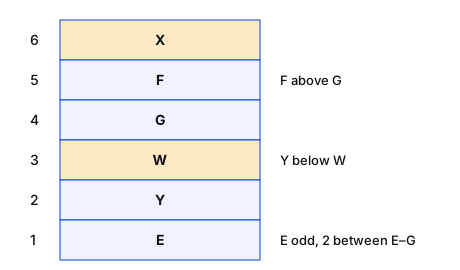
E, F, G, W, X and Y live on six different floors of the same building. The lowermost floor in the building is numbered 1, the floor above it is numbered 2 and so on till the topmost floor is numbered 6. F lives immediately above G. Only two people live between E and G. E lives on an odd numbered floor. Y lives immediately below W. How many people live between X and W?
E, F, G, W, X और Y एक ही भवन की छह अलग-अलग मंज़िलों पर रहते हैं। भवन की सबसे निचली मंज़िल की संख्या 1 है, उसके ऊपर की मंज़िल की संख्या 2 है और इसी प्रकार सबसे ऊपरी मंज़िल की संख्या 6 है। F, G के ठीक ऊपर रहता है। E और G के बीच केवल दो व्यक्ति रहते हैं। E विषम संख्या वाली मंज़िल पर रहता है। Y, W के ठीक नीचे रहता है। X और W के बीच कितने व्यक्ति रहते हैं?
  1. AOneएक
  2. BTwoदो
  3. CFourचार
  4. DThreeतीन
Show answer

Concept: Place the pair with a fixed gap first, test each position against the odd-floor condition, then fit the remaining pair.

  1. F is immediately above G; E is 3 floors away from G (two people between) and on an odd floor. Try G = 4, F = 5 → E = 1 (odd ✓). (G = 2 gives E = 5 but then Y–W cannot be consecutive in 1, 4, 6; other G values fail.)
  2. Remaining floors 2, 3, 6 for W, X, Y with Y immediately below W → Y = 2, W = 3, X = 6.
  3. Between X (6) and W (3) are floors 5 and 4 → two people (F, G).

Trick: With 6 floors, "two people between" the pair forces (1,4), (2,5) or (3,6); check the odd-floor clue against these three only.

Answer: (B) Two

अवधारणा: पहले निश्चित अंतर वाले जोड़े को रखें, विषम-मंज़िल शर्त से हर स्थिति जाँचें, फिर बचा जोड़ा बिठाएँ।

  1. F, G के ठीक ऊपर; E, G से 3 मंज़िल दूर (बीच में दो) और विषम मंज़िल पर। G = 4, F = 5 → E = 1 (विषम ✓)। (G = 2 से E = 5, पर तब 1, 4, 6 में Y–W लगातार नहीं हो सकते; अन्य मान भी असफल।)
  2. शेष मंज़िलें 2, 3, 6 में Y, W के ठीक नीचे → Y = 2, W = 3, X = 6।
  3. X (6) और W (3) के बीच मंज़िल 5 और 4 → दो लोग (F, G)।

ट्रिक: 6 मंज़िलों में "बीच में दो लोग" का अर्थ जोड़ा (1,4), (2,5) या (3,6) – केवल इन तीन पर विषम-मंज़िल सुराग जाँचें।

उत्तर: (B) दो

RRB NTPC Graduate CBT 1General Intelligence and ReasoningFloor puzzleRRB NTPC Graduate CBT 1 2025 · 27 Mar Shift 1 →
Q278.
In this question, a question is followed by two statements numbered (I) and (II). You have to decide whether the data provided in the statements are sufficient to answer the question. Read both the statements and decide the appropriate answer.
Question:
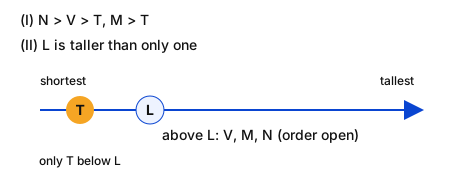
Among 5 trees, L, M, N, T and V each having a different height, which tree is the shortest?
Statements:
(I) V is shorter than N but taller than T. M is taller than T.
(II) L is taller than only one tree.
इस प्रश्न में, एक प्रश्न के बाद दो कथन (I) और (II) दिए गए हैं। आपको यह निर्णय करना है कि कथनों में दिए गए आँकड़े प्रश्न का उत्तर देने के लिए पर्याप्त हैं या नहीं। दोनों कथनों को पढ़िए और उचित उत्तर का चयन कीजिए।
प्रश्न:
5 पेड़ों L, M, N, T और V में, जिनमें से प्रत्येक की ऊँचाई अलग-अलग है, कौन-सा पेड़ सबसे छोटा है?
कथन:
(I) V, N से छोटा है लेकिन T से लंबा है। M, T से लंबा है।
(II) L केवल एक पेड़ से लंबा है।
  1. ABoth statements I and II together (and not statement 1 alone or statement II alone) are sufficient to answer the questionकथन I और II दोनों मिलकर (न कि केवल कथन I या केवल कथन II) प्रश्न का उत्तर देने के लिए पर्याप्त हैं
  2. BData in Statement I alone is sufficient to answer the question while data in statement II is notकेवल कथन I के आँकड़े प्रश्न का उत्तर देने के लिए पर्याप्त हैं जबकि कथन II के आँकड़े पर्याप्त नहीं हैं
  3. CData in Statement II alone is sufficient to answer the question while data in statement I is notकेवल कथन II के आँकड़े प्रश्न का उत्तर देने के लिए पर्याप्त हैं जबकि कथन I के आँकड़े पर्याप्त नहीं हैं
  4. DBoth statements I and II together are NOT sufficient to answer the questionकथन I और II दोनों मिलकर भी प्रश्न का उत्तर देने के लिए पर्याप्त नहीं हैं
Show answer

Concept: Check each statement alone; combine only if neither alone pins down the shortest tree.

  1. (I): N > V > T and M > T. L is not placed, so the shortest could be T or L – not sufficient.
  2. (II): L is taller than exactly one tree → L is 2nd shortest, but who is below L is unknown – not sufficient.
  3. Together: L is 2nd shortest and T is below V, N and M, so the only tree below L is T → T is shortest. Sufficient.

Trick: In "who is shortest" questions, a statement is sufficient only if every other member is shown to be taller than one candidate.

Answer: (A) Both statements together are sufficient

अवधारणा: हर कथन अकेले जाँचें; दोनों को तभी मिलाएँ जब कोई अकेला सबसे छोटा पेड़ तय न कर पाए।

  1. (I): N > V > T और M > T। L का स्थान नहीं, अतः सबसे छोटा T या L हो सकता है – अपर्याप्त।
  2. (II): L केवल एक से लंबा → L दूसरा सबसे छोटा, पर उसके नीचे कौन – अज्ञात – अपर्याप्त।
  3. दोनों मिलाकर: L दूसरा सबसे छोटा और T, V-N-M सबसे नीचे, तो L के नीचे केवल T → T सबसे छोटा। पर्याप्त।

ट्रिक: "सबसे छोटा कौन" में कथन तभी पर्याप्त है जब बाकी सभी सदस्य किसी एक से लंबे सिद्ध हों।

उत्तर: (A) दोनों कथन मिलकर पर्याप्त हैं

RRB NTPC Graduate CBT 1General Intelligence and ReasoningData sufficiency – orderingRRB NTPC Graduate CBT 1 2025 · 27 Mar Shift 1 →
Q279.
Based on the English alphabetical order, three of the following four letter cluster pairs are alike in a certain way and thus form a group. Which is the one that does not belong to that group? (Note: The odd man out is not based on the number of
consonants/vowels or their position in the letter cluster)
अंग्रेज़ी वर्णमाला क्रम के आधार पर, निम्नलिखित चार अक्षर-समूह युग्मों में से तीन किसी निश्चित प्रकार से समान हैं और इस प्रकार एक समूह बनाते हैं। वह कौन-सा है जो उस समूह से संबंधित नहीं है? (नोट: विषम युग्म व्यंजनों/स्वरों की संख्या या
अक्षर-समूह में उनकी स्थिति पर आधारित नहीं है)
  1. AGI-JM
  2. BHJ-KM
  3. CMO-PR
  4. DCE-FH
Show answer

Concept: Compare the position jump of each letter from the first cluster to the second.

  1. HJ-KM: H→K +3, J→M +3. MO-PR: +3,+3. CE-FH: +3,+3.
  2. GI-JM: G→J +3 but I→M +4 – breaks the pattern.

Trick: Write positions quickly (G7 I9 J10 M13): differences 3 and 4 jump out immediately.

Answer: (A) GI-JM

अवधारणा: पहले समूह से दूसरे समूह तक हर अक्षर की स्थिति का अंतर तुलना करें।

  1. HJ-KM: H→K +3, J→M +3। MO-PR: +3,+3। CE-FH: +3,+3।
  2. GI-JM: G→J +3 पर I→M +4 – पैटर्न टूटता है।

ट्रिक: स्थान लिखें (G7 I9 J10 M13): अंतर 3 और 4 तुरंत दिख जाते हैं।

उत्तर: (A) GI-JM

RRB NTPC Graduate CBT 1General Intelligence and ReasoningLetter cluster analogy – odd one outRRB NTPC Graduate CBT 1 2025 · 27 Mar Shift 1 →
Q280.
Based on the English alphabetical order, three of the following four letter cluster pairs are alike in a certain way and thus form a group. Which is the one that does not belong to that group? (Note: The odd man out is not based on the number of
consonants/vowels or their position in the letter cluster)
अंग्रेज़ी वर्णमाला क्रम के आधार पर, निम्नलिखित चार अक्षर-समूह युग्मों में से तीन किसी निश्चित प्रकार से समान हैं और इस प्रकार एक समूह बनाते हैं। वह कौन-सा है जो उस समूह से संबंधित नहीं है? (नोट: विषम युग्म व्यंजनों/स्वरों की संख्या या
अक्षर-समूह में उनकी स्थिति पर आधारित नहीं है)
  1. AMN-QR
  2. BFG-IJ
  3. CCD-FG
  4. DPQ-ST
Show answer

Concept: Each pair is two consecutive letters mapped to two consecutive letters; check the size of the jump.

  1. FG-IJ: F→I +3, G→J +3. CD-FG: +3,+3. PQ-ST: +3,+3.
  2. MN-QR: M→Q +4, N→R +4 – a different jump.

Trick: Count the letters skipped between the clusters: three pairs skip two letters (H, I / D, E / Q, R), MN-QR skips three (N, O, P).

Answer: (A) MN-QR

अवधारणा: हर जोड़े में दो क्रमागत अक्षर दो क्रमागत अक्षरों पर जाते हैं; छलांग का आकार देखें।

  1. FG-IJ: F→I +3, G→J +3। CD-FG: +3,+3। PQ-ST: +3,+3।
  2. MN-QR: M→Q +4, N→R +4 – भिन्न छलांग।

ट्रिक: समूहों के बीच छोड़े गए अक्षर गिनें: तीन जोड़े दो अक्षर छोड़ते हैं, MN-QR तीन (N, O, P)।

उत्तर: (A) MN-QR

RRB NTPC Graduate CBT 1General Intelligence and ReasoningLetter cluster analogy – odd one outRRB NTPC Graduate CBT 1 2025 · 27 Mar Shift 1 →