Question bank

Q&A: practice questions with answers

Search questions on any topic. Filter by exam category, exam, subject and topic, try the question, then open the answer and explanation.

Courses – airGurukul

2,400 questions found.

Q281.
Read the given statements and conclusions carefully. Assuming that the information given in the statements is true, even if it appears to be at variance with commonly known facts, decide which of the given conclusions logically follow(s) from the statements.
Statements:
All grapes are lemons. No grape is a melon. No melon is a strawberry.
Conclusions:
(I) No lemon is a melon.
(II) No grape is a strawberry.
दिए गए कथनों और निष्कर्षों को ध्यानपूर्वक पढ़िए। यह मानते हुए कि कथनों में दी गई जानकारी सत्य है, भले ही वह सामान्यतः ज्ञात तथ्यों से भिन्न प्रतीत होती हो, निर्णय कीजिए कि दिए गए निष्कर्षों में से कौन-सा/कौन-से कथनों का तार्किक रूप से अनुसरण करता है/करते हैं।
कथन:
सभी अंगूर नींबू हैं। कोई अंगूर खरबूजा नहीं है। कोई खरबूजा स्ट्रॉबेरी नहीं है।
निष्कर्ष:
(I) कोई नींबू खरबूजा नहीं है।
(II) कोई अंगूर स्ट्रॉबेरी नहीं है।
  1. AOnly conclusion (I) followsकेवल निष्कर्ष (I) अनुसरण करता है
  2. BBoth conclusions (I) and (II) followनिष्कर्ष (I) और (II) दोनों अनुसरण करते हैं
  3. CNeither conclusion (I) nor (II) followsन तो निष्कर्ष (I) और न ही (II) अनुसरण करता है
  4. DOnly conclusion (II) followsकेवल निष्कर्ष (II) अनुसरण करता है
Show answer

Concept: Draw the sets; a conclusion follows only if it is true in every possible diagram.
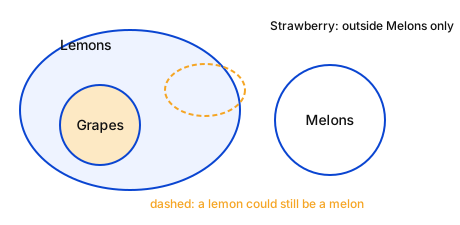
  1. All grapes are lemons; no grape is a melon. Lemons that are not grapes may still be melons → "No lemon is a melon" need not be true. (I) does not follow.
  2. No melon is a strawberry says nothing about grapes; a strawberry can be a grape → (II) does not follow.

Trick: Two negative statements (No A is B, No B is C) never give a conclusion about A and C.

Answer: (C) Neither conclusion (I) nor (II) follows

अवधारणा: समुच्चय बनाएँ; निष्कर्ष तभी निकलता है जब वह हर संभव आरेख में सत्य हो।

  1. सभी अंगूर नींबू हैं; कोई अंगूर खरबूजा नहीं। जो नींबू अंगूर नहीं हैं वे खरबूजा हो सकते हैं → "कोई नींबू खरबूजा नहीं" आवश्यक नहीं। (I) नहीं निकलता।
  2. "कोई खरबूजा स्ट्रॉबेरी नहीं" अंगूर के बारे में कुछ नहीं कहता; स्ट्रॉबेरी अंगूर हो सकती है → (II) नहीं निकलता।

ट्रिक: दो नकारात्मक कथनों (कोई A, B नहीं; कोई B, C नहीं) से A और C के बीच कोई निष्कर्ष नहीं निकलता।

उत्तर: (C) न (I) न (II) निकलता है
RRB NTPC Graduate CBT 1General Intelligence and ReasoningSyllogismRRB NTPC Graduate CBT 1 2025 · 27 Mar Shift 1 →
Q282.
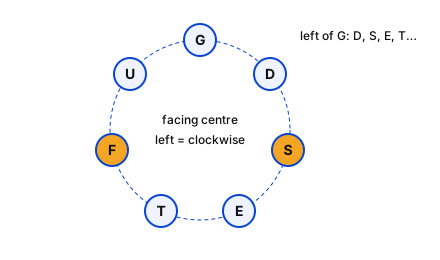
D, E, F, G, S, T and U are sitting around a circular table facing the centre. U sits to the immediate right of G. Only three people sit between U and E when counted from the left of U. Only three people sit between G and T when counted from the left of G. D sits to the immediate right of S. How many people sit between F and S when counted from the left of S?
D, E, F, G, S, T और U एक वृत्ताकार मेज़ के चारों ओर केंद्र की ओर मुख करके बैठे हैं। U, G के ठीक दाएँ बैठा है। U के बाएँ से गिनने पर U और E के बीच केवल तीन व्यक्ति बैठे हैं। G के बाएँ से गिनने पर G और T के बीच केवल तीन व्यक्ति बैठे हैं। D, S के ठीक दाएँ बैठा है। S के बाएँ से गिनने पर F और S के बीच कितने व्यक्ति बैठे हैं?
  1. AThreeतीन
  2. BTwoदो
  3. CFourचार
  4. DOneएक
Show answer

Concept: Facing the centre, a person's left is clockwise and right is anticlockwise. Fix one person and place the rest.

  1. Put G at the top; U is immediately right (anticlockwise) of G.
  2. Three people between U and E counted from U's left (clockwise): U → G, _, _, E – so E is 4th clockwise from U. Three between G and T from G's left → T is next to E (clockwise).
  3. Remaining seats: two between G and E, one between T and U. D immediately right of S → S and D occupy the two seats between G and E (D nearer G, S nearer E); F takes the seat between T and U.
  4. From S's left (clockwise): E, T, then F → two people between.

Trick: "Counted from the left of X" fixes the direction – always count clockwise for people facing the centre.

Answer: (B) Two

अवधारणा: केंद्र की ओर मुख होने पर बायाँ = दक्षिणावर्त (clockwise), दायाँ = वामावर्त। एक व्यक्ति को स्थिर रखकर बाकी बिठाएँ।

  1. G को ऊपर रखें; U, G के ठीक दाएँ (वामावर्त)।
  2. U के बाएँ से गिनने पर U और E के बीच तीन: U → G, _, _, E – E, U से दक्षिणावर्त चौथा। G के बाएँ से G और T के बीच तीन → T, E के ठीक बाद (दक्षिणावर्त)।
  3. शेष सीटें: G–E के बीच दो, T–U के बीच एक। D, S के ठीक दाएँ → S और D, G–E के बीच की दो सीटों पर (D, G के पास; S, E के पास); F, T–U के बीच।
  4. S के बाएँ से: E, T, फिर F → बीच में दो लोग।

ट्रिक: "X के बाएँ से गिनें" दिशा तय करता है – केंद्र की ओर मुख वालों के लिए हमेशा दक्षिणावर्त गिनें।

उत्तर: (B) दो

RRB NTPC Graduate CBT 1General Intelligence and ReasoningCircular seatingRRB NTPC Graduate CBT 1 2025 · 27 Mar Shift 1 →
Q283.
If 1 is added to each odd digit and 2 is subtracted from each even digit in the number 6587134, which of the following digits will be second from the left end in the new number thus formed?
यदि संख्या 6587134 के प्रत्येक विषम अंक में 1 जोड़ा जाए और प्रत्येक सम अंक से 2 घटाया जाए, तो इस प्रकार बनी नई संख्या में निम्नलिखित में से कौन-सा अंक बाएँ छोर से दूसरा होगा?
  1. A4
  2. B8
  3. C6
  4. D5
Show answer

Concept: Apply the rule digit by digit: odd digit +1, even digit −2, then read the new number.

  1. 6587134 → 6 is even → 4; 5 odd → 6; 8 even → 6; 7 odd → 8; 1 odd → 2; 3 odd → 4; 4 even → 2.
  2. New number = 4668242.
  3. Second digit from the left = 6.

Trick: Write the original digits in a row and the changed digits directly below them – no digit gets skipped or mixed up.

Answer: (C) 6

अवधारणा: हर अंक पर नियम लगाएँ: विषम अंक +1, सम अंक −2, फिर नई संख्या पढ़ें।

  1. 6587134 → 6 सम → 4; 5 विषम → 6; 8 सम → 6; 7 विषम → 8; 1 विषम → 2; 3 विषम → 4; 4 सम → 2।
  2. नई संख्या = 4668242।
  3. बाएँ से दूसरा अंक = 6।

ट्रिक: मूल अंकों को एक पंक्ति में लिखें और बदले हुए अंक ठीक नीचे लिखें – कोई अंक छूटेगा या गड़बड़ नहीं होगा।

उत्तर: (C) 6

RRB NTPC Graduate CBT 1General Intelligence and ReasoningNumber OperationsRRB NTPC Graduate CBT 1 2025 · 27 Mar Shift 1 →
Q284.
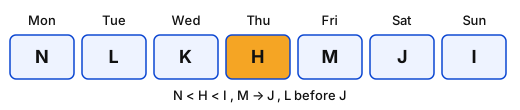
Seven people – H, I, J, K, L, M, and N – attend workshops on different days of the week starting from Monday and ending on Sunday. K’s workshop is on Wednesday. Only one person attends between K and M. J attends workshop immediately after M. H attends on one of the days before I but after N.
L attends the workshop before J but not on Monday.
On which day does H attend the workshop?
सात व्यक्ति – H, I, J, K, L, M और N – सोमवार से शुरू होकर रविवार को समाप्त होने वाले सप्ताह के अलग-अलग दिनों में कार्यशालाओं में भाग लेते हैं। K की कार्यशाला बुधवार को है। K और M के बीच केवल एक व्यक्ति भाग लेता है। J, M के ठीक बाद कार्यशाला में भाग लेता है। H, I से पहले लेकिन N के बाद के किसी दिन भाग लेता है।
L, J से पहले कार्यशाला में भाग लेता है लेकिन सोमवार को नहीं।
H किस दिन कार्यशाला में भाग लेता है?
  1. AWednesdayबुधवार
  2. BFridayशुक्रवार
  3. CSundayरविवार
  4. DThursdayगुरुवार
Show answer

Concept: Fix the definite clue first (K = Wednesday), then test the two cases for M.

  1. Only one person between K and M → M = Monday or Friday. J is immediately after M, and L is before J but not on Monday – if M = Monday then J = Tuesday and L would have to be Monday, impossible. So M = Friday, J = Saturday.
  2. Order N → H → I: with Mon, Tue, Thu, Sun left for N, H, I, L, N must be Monday and I must be Sunday.
  3. L takes Tuesday or Thursday; H takes the other. Among the options only Thursday is offered, so H = Thursday (N, L, K, H, M, J, I).

Trick: In day puzzles, "only one person between" gives just two candidates – test both and one usually dies with the next clue.

Answer: (D) Thursday

अवधारणा: पहले निश्चित सूचना रखें (K = बुधवार), फिर M के दो मामलों की जाँच करें।

  1. K और M के बीच केवल एक व्यक्ति → M = सोमवार या शुक्रवार। J, M के ठीक बाद है और L, J से पहले पर सोमवार को नहीं – यदि M = सोमवार तो J = मंगलवार और L को सोमवार होना पड़ेगा, असंभव। अतः M = शुक्रवार, J = शनिवार।
  2. क्रम N → H → I: N, H, I, L के लिए सोम, मंगल, गुरु, रवि बचे; N = सोमवार और I = रविवार।
  3. L मंगलवार या गुरुवार लेता है, H दूसरा दिन। विकल्पों में केवल गुरुवार दिया है, अतः H = गुरुवार (N, L, K, H, M, J, I)।

ट्रिक: "बीच में केवल एक व्यक्ति" से सिर्फ दो संभावनाएँ बनती हैं – दोनों जाँचें, अगली सूचना से एक खत्म हो जाती है।

उत्तर: (D) Thursday

RRB NTPC Graduate CBT 1General Intelligence and ReasoningScheduling Puzzle (Days)RRB NTPC Graduate CBT 1 2025 · 27 Mar Shift 1 →
Q285.
Read the given statements and conclusions carefully. Assuming that the information given in the statements is true, even if it appears to be at variance with commonly known facts, decide which of the given conclusions logically follow(s) from the statements.
Statements:
Some leaves are roots.
All roots are flowers.
Some flowers are stems.
Conclusions:
(I) All stems are roots.
(II) All flowers are leaves.
दिए गए कथनों और निष्कर्षों को ध्यानपूर्वक पढ़िए। यह मानते हुए कि कथनों में दी गई जानकारी सत्य है, भले ही वह सामान्यतः ज्ञात तथ्यों से भिन्न प्रतीत होती हो, निर्णय कीजिए कि दिए गए निष्कर्षों में से कौन-सा/कौन-से कथनों का तार्किक रूप से अनुसरण करता है/करते हैं।
कथन:
कुछ पत्तियाँ जड़ें हैं।
सभी जड़ें फूल हैं।
कुछ फूल तने हैं।
निष्कर्ष:
(I) सभी तने जड़ें हैं।
(II) सभी फूल पत्तियाँ हैं।
  1. AOnly conclusion (II) followsकेवल निष्कर्ष (II) अनुसरण करता है
  2. BNeither conclusion (I) nor (II) followsन तो निष्कर्ष (I) और न ही (II) अनुसरण करता है
  3. COnly conclusion (I) followsकेवल निष्कर्ष (I) अनुसरण करता है
  4. DBoth conclusions (I) and (II) followनिष्कर्ष (I) और (II) दोनों अनुसरण करते हैं
Show answer

Concept: A conclusion follows only if it is true in every possible Venn diagram of the statements; "some" never proves "all".

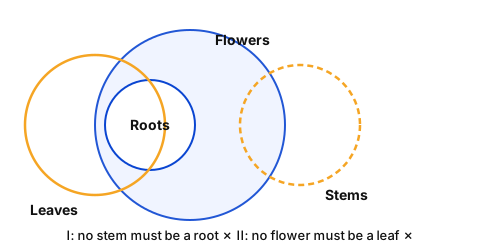
  1. Draw: Roots fully inside Flowers; Leaves overlaps Roots; Stems overlaps Flowers (position otherwise free).
  2. (I) All stems are roots – stems only share "some" with flowers; they need not touch roots at all → does not follow.
  3. (II) All flowers are leaves – flowers is the bigger set; only some of it is leaves → does not follow.

Trick: Two "Some" statements and one "All" can never produce an "All" conclusion about the outer set – reject universal conclusions quickly.

Answer: (B) Neither conclusion (I) nor (II) follows

अवधारणा: निष्कर्ष तभी सही है जब वह कथनों के हर संभव वेन आरेख में सत्य हो; "कुछ" से कभी "सभी" सिद्ध नहीं होता।

  1. आरेख: Roots पूरी तरह Flowers के अंदर; Leaves, Roots को काटता है; Stems, Flowers को काटता है (बाकी स्थिति स्वतंत्र)।
  2. (I) सभी stems, roots हैं – stems का flowers से केवल "कुछ" संबंध है; roots को छूना ज़रूरी नहीं → अनुसरण नहीं करता।
  3. (II) सभी flowers, leaves हैं – flowers बड़ा समूह है; उसका केवल कुछ भाग leaves है → अनुसरण नहीं करता।

ट्रिक: दो "कुछ" और एक "सभी" कथन से बाहरी समूह के बारे में "सभी" वाला निष्कर्ष कभी नहीं निकलता – ऐसे निष्कर्ष तुरंत खारिज करें।

उत्तर: (B) Neither conclusion (I) nor (II) follows

RRB NTPC Graduate CBT 1General Intelligence and ReasoningSyllogismRRB NTPC Graduate CBT 1 2025 · 27 Mar Shift 1 →
Q286.
MELD is related to QHHA in a certain way based on the English alphabetical order. In the same way, UKDX is related to YNZU. To which of the following is CQVR related to, following the same logic?
अंग्रेज़ी वर्णमाला क्रम के आधार पर MELD किसी निश्चित प्रकार से QHHA से संबंधित है। इसी प्रकार, UKDX, YNZU से संबंधित है। समान तर्क का अनुसरण करते हुए CQVR निम्नलिखित में से किससे संबंधित है?
  1. AHSQP
  2. BGTRO
  3. CFUSN
  4. DHTSO
Show answer

Concept: Find the position shift of each letter in the first pair and apply the same shift to the new cluster.

  1. MELD → QHHA: M+4 = Q, E+3 = H, L−4 = H, D−3 = A. Pattern (+4,+3,−4,−3).
  2. Check UKDX → YNZU: U+4 = Y, K+3 = N, D−4 = Z, X−3 = U ✓.
  3. CQVR: C+4 = G, Q+3 = T, V−4 = R, R−3 = O → GTRO.

Trick: Write ± shifts above each letter of the given pair; always verify with the second pair before applying.

Answer: (B) GTRO

अवधारणा: पहले जोड़े के हर अक्षर का स्थान-परिवर्तन निकालें और वही नए समूह पर लगाएँ।

  1. MELD → QHHA: M+4 = Q, E+3 = H, L−4 = H, D−3 = A। पैटर्न (+4,+3,−4,−3)।
  2. जाँच UKDX → YNZU: U+4 = Y, K+3 = N, D−4 = Z, X−3 = U ✓।
  3. CQVR: C+4 = G, Q+3 = T, V−4 = R, R−3 = O → GTRO।

ट्रिक: दिए जोड़े के हर अक्षर के ऊपर ± अंतर लिखें; लागू करने से पहले दूसरे जोड़े से ज़रूर जाँचें।

उत्तर: (B) GTRO

RRB NTPC Graduate CBT 1General Intelligence and ReasoningLetter-Cluster AnalogyRRB NTPC Graduate CBT 1 2025 · 27 Mar Shift 1 →
Q287.
Which of the following letter-clusters should replace # and % so that the pattern and relationship followed between the letter-cluster pair on the left side of :: is the same as that on the right side of :: ?
# : XHP :: UEM : %
निम्नलिखित में से कौन-से अक्षर-समूह # और % के स्थान पर आने चाहिए ताकि :: के बाईं ओर के अक्षर-समूह युग्म के बीच का पैटर्न और संबंध वही हो जो :: के दाईं ओर है?
# : XHP :: UEM : %
  1. A# = NXF % = EKW
  2. B# = NOF % = EOW
  3. C# = NXF % = EOO
  4. D# = NXF % = EOW
Show answer

Concept: Options give # = NXF in three cases; find the rule NXF → XHP and apply it to UEM.

  1. N(14)+10 = X(24); X(24)+10 = 34 → 34−26=8 = H; F(6)+10 = P(16). Rule: each letter +10 (wrapping after Z).
  2. UEM: U(21)+10 = 31 → 5 = E; E(5)+10 = O(15); M(13)+10 = W(23) → % = EOW.
  3. So # = NXF, % = EOW.

Trick: When options agree on #, use that agreed value to extract the rule and spend time only on %.

Answer: (D) # = NXF, % = EOW

अवधारणा: तीन विकल्पों में # = NXF है; NXF → XHP का नियम निकालकर UEM पर लगाएँ।

  1. N(14)+10 = X(24); X(24)+10 = 34 → 34−26=8 = H; F(6)+10 = P(16)। नियम: हर अक्षर +10 (Z के बाद फिर से A से)।
  2. UEM: U(21)+10 = 31 → 5 = E; E(5)+10 = O(15); M(13)+10 = W(23) → % = EOW।
  3. अतः # = NXF, % = EOW।

ट्रिक: जब विकल्प # पर सहमत हों, उसी से नियम निकालें और समय केवल % पर लगाएँ।

उत्तर: (D) # = NXF, % = EOW

RRB NTPC Graduate CBT 1General Intelligence and ReasoningLetter-Cluster AnalogyRRB NTPC Graduate CBT 1 2025 · 27 Mar Shift 1 →
Q288.
Which of the following letter-clusters should replace # and % so that the pattern and relationship followed between the letter-cluster pair on the left side of :: is the same as that on the right side of :: ?
# : NSO :: SXT : %
निम्नलिखित में से कौन-से अक्षर-समूह # और % के स्थान पर आने चाहिए ताकि :: के बाईं ओर के अक्षर-समूह युग्म के बीच का पैटर्न और संबंध वही हो जो :: के दाईं ओर है?
# : NSO :: SXT : %
  1. A# = PUQ , % = QVR
  2. B# = PUR , % = QVS
  3. C# = PUQ , % = QVS
  4. D# = PUQ , % = QWS
Show answer

Concept: # is PUQ in three options; find how PUQ becomes NSO and apply the same to SXT.

  1. P(16) → N(14): −2; U(21) → S(19): −2; Q(17) → O(15): −2. Rule: each letter −2.
  2. SXT: S(19)−2 = Q; X(24)−2 = V; T(20)−2 = R → % = QVR.
  3. So # = PUQ, % = QVR.

Trick: Note the direction: # → NSO is −2, so the same arrow SXT → % must also be −2 (not +2).

Answer: (A) # = PUQ, % = QVR

अवधारणा: तीन विकल्पों में # = PUQ है; PUQ से NSO बनने का नियम निकालकर SXT पर लगाएँ।

  1. P(16) → N(14): −2; U(21) → S(19): −2; Q(17) → O(15): −2। नियम: हर अक्षर −2।
  2. SXT: S(19)−2 = Q; X(24)−2 = V; T(20)−2 = R → % = QVR।
  3. अतः # = PUQ, % = QVR।

ट्रिक: दिशा ध्यान रखें: # → NSO में −2 है, इसलिए SXT → % में भी −2 ही लगेगा (+2 नहीं)।

उत्तर: (A) # = PUQ, % = QVR

RRB NTPC Graduate CBT 1General Intelligence and ReasoningLetter-Cluster AnalogyRRB NTPC Graduate CBT 1 2025 · 27 Mar Shift 1 →
Q289.
This question is based on the five, three-digit numbers given below.
(Left) 571 769 642 598 796 (Right)
(Example- 697 – First digit = 6, second digit = 9 and third digit = 7)
NOTE - All operations to be done from left to right.
What will be the resultant if the third digit of the highest number is added to the second digit of the lowest number?
यह प्रश्न नीचे दी गई पाँच तीन-अंकीय संख्याओं पर आधारित है।
(बाएँ) 571 769 642 598 796 (दाएँ)
(उदाहरण- 697 – पहला अंक = 6, दूसरा अंक = 9 और तीसरा अंक = 7)
नोट - सभी संक्रियाएँ बाएँ से दाएँ की जानी हैं।
यदि सबसे बड़ी संख्या के तीसरे अंक को सबसे छोटी संख्या के दूसरे अंक में जोड़ा जाए, तो परिणाम क्या होगा?
  1. A13
  2. B11
  3. C16
  4. D10
Show answer

Concept: Identify the required numbers first, then pick the stated digits.

  1. Numbers: 571, 769, 642, 598, 796. Highest = 796, lowest = 571.
  2. Third digit of 796 = 6; second digit of 571 = 7.
  3. 6+7=13.

Trick: Underline highest and lowest before reading the operation – most errors come from picking 769 instead of 796.

Answer: (A) 13

अवधारणा: पहले आवश्यक संख्याएँ पहचानें, फिर बताए गए अंक चुनें।

  1. संख्याएँ: 571, 769, 642, 598, 796। सबसे बड़ी = 796, सबसे छोटी = 571।
  2. 796 का तीसरा अंक = 6; 571 का दूसरा अंक = 7।
  3. 6+7=13।

ट्रिक: संक्रिया पढ़ने से पहले सबसे बड़ी और छोटी संख्या रेखांकित करें – ज़्यादातर गलती 796 की जगह 769 चुनने से होती है।

उत्तर: (A) 13

RRB NTPC Graduate CBT 1General Intelligence and ReasoningNumber-Based OperationsRRB NTPC Graduate CBT 1 2025 · 27 Mar Shift 1 →
Q290.
12 is related to 63 following a certain logic. Following the same logic, 21 is related to 108. To which of the following is 26 related, following the same logic?
(NOTE: Operations should be performed on the whole numbers, without breaking down the numbers into their constituent digits. E.g. 13 – Operations on 13 such as adding/ subtracting /multiplying to 13 can be performed. Breaking down 13 into 1 and 3 and then performing mathematical operations on 1 and 3 is not allowed.)
12 किसी निश्चित तर्क के आधार पर 63 से संबंधित है। समान तर्क का अनुसरण करते हुए, 21, 108 से संबंधित है। समान तर्क का अनुसरण करते हुए 26 निम्नलिखित में से किससे संबंधित है?
(नोट: संक्रियाएँ पूर्ण संख्याओं पर की जानी चाहिए, संख्याओं को उनके घटक अंकों में तोड़े बिना। उदाहरण के लिए 13 – 13 पर संक्रियाएँ जैसे 13 में जोड़ना/घटाना/गुणा करना की जा सकती हैं। 13 को 1 और 3 में तोड़कर फिर 1 और 3 पर गणितीय संक्रियाएँ करने की अनुमति नहीं है।)
  1. A103
  2. B133
  3. C116
  4. D127
Show answer

Concept: Try a×k+c on both given pairs; the same k and c must fit.

  1. 12×5+3=63 ✓ and 21×5+3=108 ✓ → rule: ×5+3.
  2. 26×5+3=130+3=133.

Trick: Difference of outputs ÷ difference of inputs gives the multiplier: 108−6321−12=459=5.

Answer: (B) 133

अवधारणा: दोनों दिए जोड़ों पर a×k+c आज़माएँ; एक ही k और c फिट होने चाहिए।

  1. 12×5+3=63 ✓ और 21×5+3=108 ✓ → नियम: ×5+3।
  2. 26×5+3=130+3=133।

ट्रिक: परिणामों का अंतर ÷ इनपुट का अंतर = गुणक: 108−6321−12=459=5।

उत्तर: (B) 133

RRB NTPC Graduate CBT 1General Intelligence and ReasoningNumber AnalogyRRB NTPC Graduate CBT 1 2025 · 27 Mar Shift 1 →
Q291.
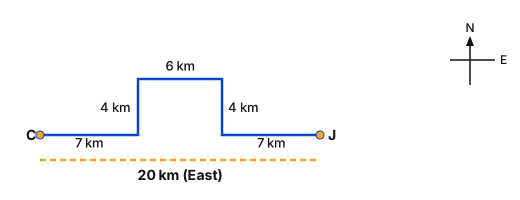
Shivani walks 7 km towards East from Point C. She then turns left and walks 4 km. After that, she takes a right turn and walks 6 km. Then, she turns right again and walks 4 km. Finally, she takes a left turn and walks 7 km to reach Point J. How far and in which direction is Point J from Point C ? (All turns are 90-degree turns only, unless specified.)
शिवानी बिंदु C से पूर्व की ओर 7 km चलती है। फिर वह बाएँ मुड़ती है और 4 km चलती है। इसके बाद, वह दाएँ मुड़ती है और 6 km चलती है। फिर, वह पुनः दाएँ मुड़ती है और 4 km चलती है। अंत में, वह बाएँ मुड़ती है और 7 km चलकर बिंदु J पर पहुँचती है। बिंदु J, बिंदु C से कितनी दूर और किस दिशा में है? (जब तक अन्यथा निर्दिष्ट न हो, सभी मोड़ केवल 90-डिग्री के मोड़ हैं।)
  1. A20 km, east20 km, पूर्व
  2. B18 km, west18 km, पश्चिम
  3. C21 km, north21 km, उत्तर
  4. D24 km, west24 km, पश्चिम
Show answer

Concept: Plot each move on a grid with C at the origin; the net east–west and north–south displacements give the answer.

  1. East 7 → (7, 0); left (North) 4 → (7, 4); right (East) 6 → (13, 4); right (South) 4 → (13, 0); left (East) 7 → (20, 0) = J.
  2. North 4 and South 4 cancel; east moves add: 7+6+7=20 km.
  3. J is 20 km east of C.

Trick: Equal and opposite legs (4 N, 4 S) cancel – just total the remaining eastward legs.

Answer: (A) 20 km, east

अवधारणा: C को मूल बिंदु मानकर हर चाल ग्रिड पर बनाएँ; पूर्व–पश्चिम और उत्तर–दक्षिण का शुद्ध विस्थापन उत्तर देता है।

  1. पूर्व 7 → (7, 0); बाएँ (उत्तर) 4 → (7, 4); दाएँ (पूर्व) 6 → (13, 4); दाएँ (दक्षिण) 4 → (13, 0); बाएँ (पूर्व) 7 → (20, 0) = J।
  2. उत्तर 4 और दक्षिण 4 कट जाते हैं; पूर्व की चालें जुड़ती हैं: 7+6+7=20 km।
  3. J, C से 20 km पूर्व में है।

ट्रिक: बराबर और विपरीत चालें (4 उत्तर, 4 दक्षिण) कट जाती हैं – बची पूर्व की चालें जोड़ लें।

उत्तर: (A) 20 km, east

RRB NTPC Graduate CBT 1General Intelligence and ReasoningDirection and DistanceRRB NTPC Graduate CBT 1 2025 · 27 Mar Shift 1 →
Q292.
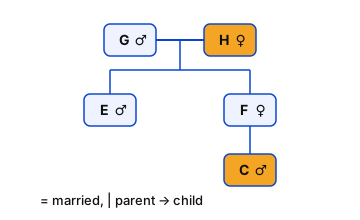
C is the son of F. F is the sister of E. E is the son of G. G is the husband of H. How is C related to H?
C, F का पुत्र है। F, E की बहन है। E, G का पुत्र है। G, H का पति है। C, H से किस प्रकार संबंधित है?
  1. ASon's wife's brotherपुत्र की पत्नी का भाई
  2. BSon's sonपुत्र का पुत्र
  3. CDaughter's husbandपुत्री का पति
  4. DDaughter's sonपुत्री का पुत्र
Show answer

Concept: Build the family tree generation by generation, marking gender.

  1. G is husband of H → G, H are a couple. E is son of G → E is their son.
  2. F is sister of E → F is daughter of G and H.
  3. C is son of F → C is the son of H's daughter → daughter's son (grandson).

Trick: Start from the oldest couple and hang the others below – the relation of the lowest person to the top one reads straight off the tree.

Answer: (D) Daughter's son

अवधारणा: लिंग चिह्नित करते हुए पीढ़ी-दर-पीढ़ी वंश-वृक्ष बनाएँ।

  1. G, H का पति → G, H दंपति। E, G का पुत्र → E उनका बेटा।
  2. F, E की बहन → F, G और H की बेटी।
  3. C, F का पुत्र → C, H की बेटी का बेटा → daughter's son (नाती)।

ट्रिक: सबसे बड़े दंपति से शुरू करके बाकी को नीचे लटकाएँ – सबसे नीचे वाले का ऊपर वाले से संबंध सीधे पेड़ से पढ़ लें।

उत्तर: (D) Daughter's son

RRB NTPC Graduate CBT 1General Intelligence and ReasoningBlood RelationsRRB NTPC Graduate CBT 1 2025 · 27 Mar Shift 1 →
Q293.
In a certain code language,
A + B means ‘A is the daughter of B’
A – B means ‘A is the brother of B’
A x B means ‘A is the wife of B’
A ÷ B means ‘A is the father of B’
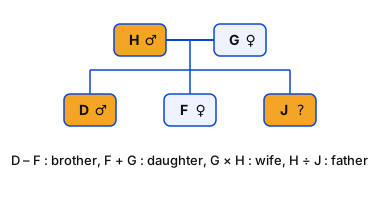
Based on the above, how is D related to J if ‘D – F + G x H ÷ J’?
एक निश्चित कूट भाषा में,
A + B का अर्थ है ‘A, B की पुत्री है’
A – B का अर्थ है ‘A, B का भाई है’
A x B का अर्थ है ‘A, B की पत्नी है’
A ÷ B का अर्थ है ‘A, B का पिता है’
उपर्युक्त के आधार पर, यदि ‘D – F + G x H ÷ J’ है, तो D, J से किस प्रकार संबंधित है?
  1. AFatherपिता
  2. BSonपुत्र
  3. CHusbandपति
  4. DBrotherभाई
Show answer

Concept: Decode each symbol pair-wise from left to right and place everyone on a tree.

  1. D – F: D is brother of F (D male). F + G: F is daughter of G. G × H: G is wife of H → H is father of F.
  2. H ÷ J: H is father of J → J is a child of H and G, hence sibling of F and D.
  3. D (male) is a sibling of J → D is J's brother.

Trick: Decode from the end backwards (H ÷ J first) when the asked person is at the right – you reach the common parents fastest.

Answer: (D) Brother

अवधारणा: हर प्रतीक को बाएँ से दाएँ जोड़ी-वार डिकोड करें और सबको पेड़ पर रखें।

  1. D – F: D, F का भाई (D पुरुष)। F + G: F, G की बेटी। G × H: G, H की पत्नी → H, F का पिता।
  2. H ÷ J: H, J का पिता → J, H और G की संतान, अतः F और D का भाई/बहन।
  3. D (पुरुष), J का सहोदर → D, J का भाई।

ट्रिक: जब पूछा गया व्यक्ति दाईं ओर हो तो अंत से (H ÷ J पहले) डिकोड करें – साझा माता-पिता तक सबसे जल्दी पहुँचेंगे।

उत्तर: (D) Brother

RRB NTPC Graduate CBT 1General Intelligence and ReasoningCoded Blood RelationsRRB NTPC Graduate CBT 1 2025 · 27 Mar Shift 1 →
Q294.
In the following number-pairs, the second number is obtained by applying certain mathematical operations to the first number. Select the set in which the numbers are related in the same way as are the numbers of the following sets.
(NOTE : Operations should be performed on the whole numbers, without breaking down the numbers into its constituent digits. E.g. 13 – Operations on 13 such as adding / subtracting /multiplying etc. to 13 can be performed. Breaking down 13 into 1 and 3 and then performing mathematical operations on 1 and 3 is not allowed)
19, 78
24, 98
निम्नलिखित संख्या-युग्मों में, पहली संख्या पर कुछ गणितीय संक्रियाएँ करके दूसरी संख्या प्राप्त की जाती है। उस समुच्चय का चयन कीजिए जिसमें संख्याएँ उसी प्रकार संबंधित हैं जिस प्रकार निम्नलिखित समुच्चयों की संख्याएँ संबंधित हैं।
(नोट : संक्रियाएँ पूर्ण संख्याओं पर की जानी चाहिए, संख्याओं को उनके घटक अंकों में तोड़े बिना। उदाहरण के लिए 13 – 13 पर संक्रियाएँ जैसे 13 में जोड़ना / घटाना / गुणा करना आदि की जा सकती हैं। 13 को 1 और 3 में तोड़कर फिर 1 और 3 पर गणितीय संक्रियाएँ करने की अनुमति नहीं है)
19, 78
24, 98
  1. A26, 112
  2. B26, 110
  3. C27, 112
  4. D27, 110
Show answer

Concept: Find one rule that fits both given pairs, then test the options.

  1. 19×4+2=78 ✓, 24×4+2=98 ✓ → rule: ×4+2.
  2. 26×4+2=106 (options A, B fail); 27×4+2=110 ✓.

Trick: Multiplier =98−7824−19=205=4; then the constant is 78−76=2.

Answer: (D) 27, 110

अवधारणा: दोनों दिए जोड़ों पर फिट होने वाला एक नियम खोजें, फिर विकल्प जाँचें।

  1. 19×4+2=78 ✓, 24×4+2=98 ✓ → नियम: ×4+2।
  2. 26×4+2=106 (विकल्प A, B गलत); 27×4+2=110 ✓।

ट्रिक: गुणक =98−7824−19=205=4; फिर स्थिरांक 78−76=2।

उत्तर: (D) 27, 110

RRB NTPC Graduate CBT 1General Intelligence and ReasoningNumber-Pair AnalogyRRB NTPC Graduate CBT 1 2025 · 27 Mar Shift 1 →
Q295.
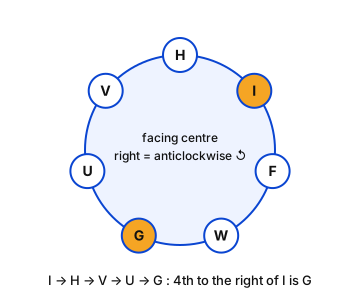
Seven people F, G, H, I, U, V, and W are sitting around a circular table facing the centre of the table. U sits second to the right of H. Only one person sits between U and W. Only one person sits between H and F. Only two people sit between V and W. Only one person sits between G and F. Who sits fourth to the right of I?
सात व्यक्ति F, G, H, I, U, V और W एक वृत्ताकार मेज़ के चारों ओर मेज़ के केंद्र की ओर मुख करके बैठे हैं। U, H के दाएँ दूसरे स्थान पर बैठा है। U और W के बीच केवल एक व्यक्ति बैठा है। H और F के बीच केवल एक व्यक्ति बैठा है। V और W के बीच केवल दो व्यक्ति बैठे हैं। G और F के बीच केवल एक व्यक्ति बैठा है। I के दाएँ चौथे स्थान पर कौन बैठा है?
  1. AV
  2. BW
  3. CG
  4. DU
Show answer

Concept: Facing the centre, a person's right is anticlockwise. Fix H and place the others clue by clue.

  1. U is 2nd to the right of H → U two seats anticlockwise from H. Only one between U and W (not H's side) → W is between F-side and U; only one between H and F → F is 2nd clockwise from H.
  2. Two between V and W → V sits immediately anticlockwise of H; one between G and F → G sits between W and U; I takes the last seat. Clockwise order: H, I, F, W, G, U, V.
  3. 4th to the right (anticlockwise) of I: H, V, U, G → G.

Trick: Draw 7 dots, mark H at the top, and count anticlockwise for "right" – never reverse the direction mid-puzzle.

Answer: (C) G

अवधारणा: केंद्र की ओर मुख होने पर दाईं ओर = वामावर्त (anticlockwise)। H को स्थिर रखकर बाकी को सूचना-दर-सूचना बैठाएँ।

  1. U, H के दाएँ दूसरा → H से दो सीट वामावर्त। U और W के बीच केवल एक (H की तरफ नहीं) → W, F की तरफ; H और F के बीच केवल एक → F, H से दो सीट दक्षिणावर्त।
  2. V और W के बीच दो → V, H के ठीक वामावर्त; अंतिम दक्षिणावर्त क्रम: H, I, F, W, G, U, V (G "G और F के बीच एक" से तय, I अंतिम सीट लेता है)।
  3. I के दाएँ (वामावर्त) चौथा: H, V, U, G → G।

ट्रिक: 7 बिंदु बनाएँ, H ऊपर रखें और "दाएँ" के लिए वामावर्त गिनें – बीच में दिशा कभी न बदलें।

उत्तर: (C) G

RRB NTPC Graduate CBT 1General Intelligence and ReasoningCircular Seating ArrangementRRB NTPC Graduate CBT 1 2025 · 27 Mar Shift 1 →
Q296.
48 is related to 192 following a certain logic. Following the same logic, 52 is related to 208. To which of the following is 61 related, following the same logic?
(NOTE: Operations should be performed on the whole numbers, without breaking down the numbers into their constituent digits. E.g. 13 – Operations on 13 such as adding /subtracting /multiplying, etc. to 13 can be performed. Breaking down 13 into 1 and 3 and then performing mathematical operations on 1 and 3 is not allowed.)
48 किसी निश्चित तर्क के आधार पर 192 से संबंधित है। समान तर्क का अनुसरण करते हुए, 52, 208 से संबंधित है। समान तर्क का अनुसरण करते हुए 61 निम्नलिखित में से किससे संबंधित है?
(नोट: संक्रियाएँ पूर्ण संख्याओं पर की जानी चाहिए, संख्याओं को उनके घटक अंकों में तोड़े बिना। उदाहरण के लिए 13 – 13 पर संक्रियाएँ जैसे 13 में जोड़ना/घटाना/गुणा करना की जा सकती हैं। 13 को 1 और 3 में तोड़कर फिर 1 और 3 पर गणितीय संक्रियाएँ करने की अनुमति नहीं है।)
  1. A244
  2. B234
  3. C254
  4. D264
Show answer

Concept: Check the ratio of each pair; a constant ratio means the rule is multiplication.

  1. 19248=4 and 20852=4 → rule: second number = first ×4.
  2. 61×4=244.

Trick: Test ×k first when both outputs are exact multiples of the inputs; it fits here, so no +c is needed.

Answer: (A) 244

अवधारणा: हर जोड़े का अनुपात देखें; स्थिर अनुपात का अर्थ नियम गुणा है।

  1. 19248=4 और 20852=4 → नियम: दूसरी संख्या = पहली ×4।
  2. 61×4=244।

ट्रिक: जब दोनों परिणाम इनपुट के पूर्ण गुणज हों तो पहले ×k जाँचें; यहाँ फिट है, +c की ज़रूरत नहीं।

उत्तर: (A) 244

RRB NTPC Graduate CBT 1General Intelligence and ReasoningNumber AnalogyRRB NTPC Graduate CBT 1 2025 · 27 Mar Shift 1 →
Q297.
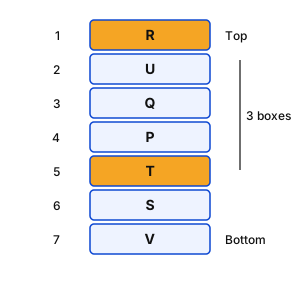
Seven boxes P, Q, R, S, T, U and V are kept one over the other but not necessarily in the same order.
Q is kept immediately above P. S is kept immediately above V. Only R is kept above U. Only two boxes are kept above Q. S is not kept at third position from the bottom. How many boxes are kept between R and T?
सात बक्से P, Q, R, S, T, U और V एक के ऊपर एक रखे गए हैं, लेकिन आवश्यक नहीं कि इसी क्रम में हों।
Q, P के ठीक ऊपर रखा है। S, V के ठीक ऊपर रखा है। U के ऊपर केवल R रखा है। Q के ऊपर केवल दो बक्से रखे हैं। S नीचे से तीसरे स्थान पर नहीं रखा है। R और T के बीच कितने बक्से रखे हैं?
  1. A3
  2. B2
  3. C4
  4. D1
Show answer

Concept: Number positions 1 (top) to 7 (bottom) and fill the definite clues first.

  1. Only R above U → R = 1, U = 2. Only two boxes above Q → Q = 3; Q immediately above P → P = 4.
  2. Positions 5, 6, 7 remain for S, V, T with S immediately above V. S cannot be at position 5 (3rd from bottom) → S = 6, V = 7, T = 5.
  3. Stack: R, U, Q, P, T, S, V. Between R (1) and T (5): U, Q, P = 3 boxes.

Trick: "Only X is above Y" fixes two positions at once – always start there.

Answer: (A) 3

अवधारणा: स्थान 1 (ऊपर) से 7 (नीचे) तक क्रमांकित करें और पहले निश्चित सूचनाएँ भरें।

  1. U के ऊपर केवल R → R = 1, U = 2। Q के ऊपर केवल दो बॉक्स → Q = 3; Q, P के ठीक ऊपर → P = 4।
  2. S, V, T के लिए स्थान 5, 6, 7 बचे, S, V के ठीक ऊपर। S स्थान 5 (नीचे से तीसरा) पर नहीं → S = 6, V = 7, T = 5।
  3. ढेर: R, U, Q, P, T, S, V। R (1) और T (5) के बीच: U, Q, P = 3 बॉक्स।

ट्रिक: "Y के ऊपर केवल X" से एक साथ दो स्थान तय हो जाते हैं – हमेशा वहीं से शुरू करें।

उत्तर: (A) 3

RRB NTPC Graduate CBT 1General Intelligence and ReasoningBox Arrangement (Stacking)RRB NTPC Graduate CBT 1 2025 · 27 Mar Shift 1 →
Q298.
In a certain code language, ‘KITE’ is coded as ‘5871’ and ‘TIME’ is coded as ‘7853’. What is the code for ‘M’ in the given code language?
एक निश्चित कूट भाषा में, ‘KITE’ को ‘5871’ के रूप में और ‘TIME’ को ‘7853’ के रूप में कूटबद्ध किया जाता है। दी गई कूट भाषा में ‘M’ का कूट क्या है?
  1. A3
  2. B8
  3. C5
  4. D7
Show answer

Concept: Compare the two words – the common letters share the common digits; the leftover letter gets the leftover digit.

  1. KITE → 5871 and TIME → 7853 share T, I, E; the codes share 5, 7, 8.
  2. Letter not common in TIME is M; digit not common in 7853 is 3.
  3. So M = 3.

Trick: Elimination coding – cross out common letters and common digits; what remains pairs up.

Answer: (A) 3

अवधारणा: दोनों शब्दों की तुलना करें – समान अक्षरों के कोड समान अंक हैं; बचा अक्षर बचे अंक से जुड़ता है।

  1. KITE → 5871 और TIME → 7853 में T, I, E समान; कोड में 5, 7, 8 समान।
  2. TIME में असमान अक्षर M; 7853 में असमान अंक 3।
  3. अतः M = 3।

ट्रिक: विलोपन कोडिंग – समान अक्षर और समान अंक काट दें; जो बचे वे जोड़ी बनाते हैं।

उत्तर: (A) 3

RRB NTPC Graduate CBT 1General Intelligence and ReasoningCoding-DecodingRRB NTPC Graduate CBT 1 2025 · 27 Mar Shift 1 →
Q299.
Which of the following letter-number clusters will replace the question mark (?) in the given series to make it logically complete?
AZA 27 XWX 36 UTU 45 RQR 54 ?
निम्नलिखित में से कौन-सा अक्षर-संख्या समूह दी गई श्रेणी में प्रश्नचिह्न (?) के स्थान पर आकर इसे तार्किक रूप से पूर्ण करेगा?
AZA 27 XWX 36 UTU 45 RQR 54 ?
  1. AOMN 62
  2. BONO 63
  3. COTZ 62
  4. DOON 63
Show answer

Concept: Treat the letter part and the number part as two separate series.

  1. Letters: AZA, XWX, UTU, RQR – first/third letter A→X→U→R (−3 each) → next O; middle letter Z→W→T→Q (−3) → next N. So ONO.
  2. Numbers: 27, 36, 45, 54 (+9) → 63.
  3. Term = ONO 63.

Trick: Each cluster is a palindrome with the middle letter one step behind the outer one (A–Z, X–W…) – O–N fits, so ONO.

Answer: (B) ONO 63

अवधारणा: अक्षर भाग और संख्या भाग को दो अलग श्रेणियाँ मानें।

  1. अक्षर: AZA, XWX, UTU, RQR – पहला/तीसरा अक्षर A→X→U→R (हर बार −3) → अगला O; बीच का अक्षर Z→W→T→Q (−3) → अगला N। अतः ONO।
  2. संख्याएँ: 27, 36, 45, 54 (+9) → 63।
  3. पद = ONO 63।

ट्रिक: हर समूह पैलिंड्रोम है और बीच का अक्षर बाहरी से एक पीछे (A–Z, X–W…) – O–N फिट है, अतः ONO।

उत्तर: (B) ONO 63

RRB NTPC Graduate CBT 1General Intelligence and ReasoningLetter-Number SeriesRRB NTPC Graduate CBT 1 2025 · 27 Mar Shift 1 →
Q300.
In a certain code language, ‘TIME’ is coded as ‘3519’ and ‘EARS’ is coded as ‘6894’. What is the code for ‘E’ in that language?
एक निश्चित कूट भाषा में, ‘TIME’ को ‘3519’ के रूप में और ‘EARS’ को ‘6894’ के रूप में कूटबद्ध किया जाता है। उस भाषा में ‘E’ का कूट क्या है?
  1. A4
  2. B6
  3. C8
  4. D9
Show answer

Concept: The only letter common to both words gets the only digit common to both codes.

  1. TIME → 3519 and EARS → 6894: common letter = E.
  2. Common digit in 3519 and 6894 = 9.
  3. So E = 9.

Trick: With one shared letter, just spot the one shared digit – no need to decode the rest.

Answer: (D) 9

अवधारणा: दोनों शब्दों में एकमात्र समान अक्षर को दोनों कोडों का एकमात्र समान अंक मिलता है।

  1. TIME → 3519 और EARS → 6894: समान अक्षर = E।
  2. 3519 और 6894 में समान अंक = 9।
  3. अतः E = 9।

ट्रिक: एक ही साझा अक्षर हो तो बस साझा अंक पहचानें – बाकी डिकोड करने की ज़रूरत नहीं।

उत्तर: (D) 9

RRB NTPC Graduate CBT 1General Intelligence and ReasoningCoding-DecodingRRB NTPC Graduate CBT 1 2025 · 27 Mar Shift 1 →