Question bank

Q&A: practice questions with answers

Search questions on any topic. Filter by exam category, exam, subject and topic, try the question, then open the answer and explanation.

Courses – airGurukul

7,077 questions found.

Q3161.
If ‘P’ stands for ‘÷’, ‘Q’ stands for ‘×’, ‘R’ stands for ‘+’ and ‘S’ stands for ‘−’, then the resultant of which of the following would be 200?
यदि ‘P’ का अर्थ ‘÷’, ‘Q’ का अर्थ ‘×’, ‘R’ का अर्थ ‘+’ और ‘S’ का अर्थ ‘−’ है, तो निम्नलिखित में से किसका परिणाम 200 होगा?
  1. A64 P 16 S 60 R 32 Q 8
  2. B64 R 16 Q 32 S 60 P 8
  3. C64 Q 16 P 60 R 32 S 8
  4. D64 S 16 R 60 P 32 Q 8
Show answer

Concept: Replace letters by signs and apply BODMAS.

  1. (A): 64÷16−60+32×8.
  2. =4−60+256=200 ✓.
  3. (B) gives 64+512−7.5=568.5, so not 200.

Trick: Do ÷ and × first; the big product 32×8=256 already hints at 200.

Answer: (A) 64 P 16 S 60 R 32 Q 8

अवधारणा: अक्षरों को चिह्नों से बदलें और BODMAS लगाएँ।

  1. (A): 64÷16−60+32×8।
  2. =4−60+256=200 ✓।
  3. (B) से 568.5 आता है, 200 नहीं।

ट्रिक: पहले ÷ और ×; 32×8=256 से ही 200 का संकेत मिलता है।

उत्तर: (A) 64 P 16 S 60 R 32 Q 8
RRB NTPC Graduate CBT 1General Intelligence and ReasoningSymbol SubstitutionRRB NTPC Graduate CBT 1 2024 · 12 Jun Shift 1 →
Q3162.
Which of the following letter-clusters should replace # and % so that the pattern and relationship followed between the letter-cluster pair on the left side of :: is the same as that on the right side of ::?
# : TVS :: IKH : %
निम्नलिखित में से कौन-से अक्षर-समूह # और % को प्रतिस्थापित करने चाहिए ताकि :: के बाईं ओर के अक्षर-समूह युग्म के बीच अनुसरण किया गया पैटर्न और संबंध वही हो, जो :: के दाईं ओर के अक्षर-समूह युग्म के बीच है?
# : TVS :: IKH : %
  1. A# = WYV, % = FHE
  2. B# = IOV, % = WEE
  3. C# = WOZ, % = UQE
  4. D# = KNV, % = FXC
Show answer

Concept: Find the rule linking # to TVS and apply it to IKH.

  1. (A): WYV → TVS: W−3=T, Y−3=V, V−3=S.
  2. IKH → each −3: I−3=F, K−3=H, H−3=E → FHE ✓.

Trick: Check the right pair first with the same rule (−3 each).

Answer: (A) # = WYV, % = FHE

अवधारणा: # से TVS का नियम खोजकर IKH पर लगाएँ।

  1. (A): WYV → TVS: हर अक्षर −3।
  2. IKH → −3: F, H, E → FHE ✓।

ट्रिक: हर अक्षर में −3 का समान नियम।

उत्तर: (A) # = WYV, % = FHE

RRB NTPC Graduate CBT 1General Intelligence and ReasoningLetter AnalogyRRB NTPC Graduate CBT 1 2024 · 12 Jun Shift 1 →
Q3163.
Which of the following letter-clusters should replace # and % so that the pattern and relationship followed between the letter-cluster pair on the left side of :: is the same as that on the right side of :: ?
# : OJR :: QLT : %
निम्नलिखित में से कौन-से अक्षर-समूह # और % को प्रतिस्थापित करने चाहिए ताकि :: के बाईं ओर के अक्षर-समूह युग्म के बीच अनुसरण किया गया पैटर्न और संबंध वही हो, जो :: के दाईं ओर के अक्षर-समूह युग्म के बीच है?
# : OJR :: QLT : %
  1. A# = NIQ, % = RMU
  2. B# = NIQ, % = RNU
  3. C# = NIQ, % = RMV
  4. D# = NIR, % = RMU
Show answer

Concept: Find the rule from # to OJR and apply it to QLT.

  1. NIQ → OJR: each letter +1.
  2. QLT +1 each: R, M, U → RMU ✓.

Trick: All options share # = NIQ (except D); only check % for +1 shift.

Answer: (A) # = NIQ, % = RMU

अवधारणा: # से OJR का नियम खोजकर QLT पर लगाएँ।

  1. NIQ → OJR: हर अक्षर +1।
  2. QLT +1: R, M, U → RMU ✓।

ट्रिक: केवल % के लिए +1 नियम जाँचें।

उत्तर: (A) # = NIQ, % = RMU

RRB NTPC Graduate CBT 1General Intelligence and ReasoningLetter AnalogyRRB NTPC Graduate CBT 1 2024 · 12 Jun Shift 1 →
Q3164.
If 2 is added to each even digit and 1 is subtracted from each odd digit in the number 6193425, how many digits will appear more than once in the new number thus formed?
यदि संख्या 6193425 में प्रत्येक सम अंक में 2 जोड़ा जाए और प्रत्येक विषम अंक में से 1 घटाया जाए, तो इस प्रकार बनी नई संख्या में कितने अंक एक से अधिक बार आएँगे?
  1. ATwoदो
  2. BThreeतीन
  3. CNoneकोई नहीं
  4. DOneएक
Show answer

Concept: Apply +2 to even digits and −1 to odd digits one by one.

  1. 6193425 → 6→8, 1→0, 9→8, 3→2, 4→6, 2→4, 5→4.
  2. New number: 8082644.
  3. 8 appears twice, 4 appears twice; 0, 2, 6 once → two digits repeat.

Trick: Write the new digits under the old ones to avoid slips.

Answer: (A) Two

अवधारणा: सम अंकों में +2 और विषम अंकों में −1 एक-एक करके लगाएँ।

  1. 6193425 → 8, 0, 8, 2, 6, 4, 4।
  2. नई संख्या: 8082644।
  3. 8 दो बार, 4 दो बार; 0, 2, 6 एक बार → दो अंक दोहराए।

ट्रिक: पुराने अंकों के नीचे नए अंक लिखें।

उत्तर: (A) दो

RRB NTPC Graduate CBT 1General Intelligence and ReasoningDigit OperationsRRB NTPC Graduate CBT 1 2024 · 12 Jun Shift 1 →
Q3165.
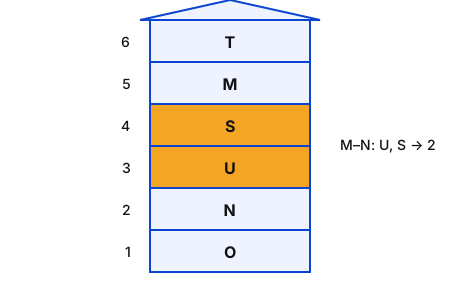
M, N, O, S, T and U live on six different floors of the same building. The lowermost floor in the building is numbered 1, the floor above it, number 2 and so on till the topmost floor is numbered 6. T lives on the topmost floor. Only three people live between T and N. O lives on a floor below N. S lives on an even numbered floor. U lives on an odd numbered floor but not on floor number 5. How many people live between M and N?
M, N, O, S, T और U एक ही इमारत की छह अलग-अलग मंज़िलों पर रहते हैं। इमारत की सबसे निचली मंज़िल की संख्या 1 है, उसके ऊपर वाली मंज़िल की संख्या 2 है और इसी प्रकार आगे सबसे ऊपरी मंज़िल की संख्या 6 है। T सबसे ऊपरी मंज़िल पर रहता है। T और N के बीच केवल तीन व्यक्ति रहते हैं। O, N से नीचे की किसी मंज़िल पर रहता है। S एक सम संख्या वाली मंज़िल पर रहता है। U एक विषम संख्या वाली मंज़िल पर रहता है, लेकिन मंज़िल संख्या 5 पर नहीं। M और N के बीच कितने व्यक्ति रहते हैं?
  1. ATwoदो
  2. BFourचार
  3. CThreeतीन
  4. DOneएक
Show answer

Concept: Fix definite positions first, then use odd/even clues.

  1. T = 6; three people between T and N → N = 2.
  2. O below N → O = 1.
  3. S even → S = 4; U odd, not 5 → U = 3; M = 5.
  4. Between M (5) and N (2): U and S → two.

Trick: "Only three between" from the top floor fixes N immediately.

Answer: (A) Two

अवधारणा: पहले निश्चित स्थान तय करें, फिर सम/विषम संकेत लगाएँ।

  1. T = 6; T और N के बीच तीन → N = 2।
  2. O, N से नीचे → O = 1।
  3. S सम → S = 4; U विषम, 5 नहीं → U = 3; M = 5।
  4. M (5) और N (2) के बीच U और S → दो।

ट्रिक: ऊपरी मंज़िल से "बीच में तीन" से N तुरंत तय।

उत्तर: (A) दो

RRB NTPC Graduate CBT 1General Intelligence and ReasoningFloor PuzzleRRB NTPC Graduate CBT 1 2024 · 12 Jun Shift 1 →
Q3166.
Which of the following letter-clusters should replace # and % so that the pattern and relationship followed between the letter-cluster pair on the left side of :: is the same as that on the right side of ::?
# : NQP :: HKJ : %
निम्नलिखित में से कौन-से अक्षर-समूह # और % को प्रतिस्थापित करने चाहिए ताकि :: के बाईं ओर के अक्षर-समूह युग्म के बीच अनुसरण किया गया पैटर्न और संबंध वही हो, जो :: के दाईं ओर के अक्षर-समूह युग्म के बीच है?
# : NQP :: HKJ : %
  1. A# = QTO, % = EEG
  2. B# = YTS, % = EUG
  3. C# = OMS, % = ERG
  4. D# = QTS, % = EHG
Show answer

Concept: Find the rule from # to NQP and apply it to HKJ.

  1. (D): QTS → NQP: Q−3=N, T−3=Q, S−3=P.
  2. HKJ −3 each: E, H, G → EHG ✓.

Trick: Same −3 shift on every letter.

Answer: (D) # = QTS, % = EHG

अवधारणा: # से NQP का नियम खोजकर HKJ पर लगाएँ।

  1. (D): QTS → NQP: हर अक्षर −3।
  2. HKJ −3: E, H, G → EHG ✓।

ट्रिक: हर अक्षर में −3।

उत्तर: (D) # = QTS, % = EHG

RRB NTPC Graduate CBT 1General Intelligence and ReasoningLetter AnalogyRRB NTPC Graduate CBT 1 2024 · 12 Jun Shift 1 →
Q3167.
What should come in place of the question mark (?) in the given series?
972 970 966 960 952 ?
दी गई श्रृंखला में प्रश्न चिह्न (?) के स्थान पर क्या आना चाहिए?
972 970 966 960 952 ?
  1. A942
  2. B940
  3. C438
  4. D941
Show answer

Concept: Look at the differences.

  1. Differences: −2, −4, −6, −8 (even numbers increasing).
  2. Next difference −10: 952−10=942.

Trick: Differences in AP → continue the AP.

Answer: (A) 942

अवधारणा: अंतर देखें।

  1. अंतर: −2, −4, −6, −8।
  2. अगला अंतर −10: 952−10=942।

ट्रिक: अंतर समांतर श्रेणी में हों तो उसी क्रम को बढ़ाएँ।

उत्तर: (A) 942

RRB NTPC Graduate CBT 1General Intelligence and ReasoningNumber SeriesRRB NTPC Graduate CBT 1 2024 · 12 Jun Shift 1 →
Q3168.
In a certain code language, ‘PREY’ is coded as ‘6482’ and ‘YOLK’ is coded as ‘3671’. What is the code for ‘Y’ in the given code language?
एक निश्चित कूट भाषा में, ‘PREY’ को ‘6482’ के रूप में कूटबद्ध किया जाता है और ‘YOLK’ को ‘3671’ के रूप में कूटबद्ध किया जाता है। दी गई कूट भाषा में ‘Y’ के लिए कूट क्या है?
  1. A3
  2. B6
  3. C1
  4. D2
Show answer

Concept: A letter common to both words takes the digit common to both codes.

  1. PREY → 6482 and YOLK → 3671.
  2. Only Y is common to both words; only 6 is common to both codes.
  3. So Y = 6.

Trick: Common letter ↔ common digit.

Answer: (B) 6

अवधारणा: दोनों शब्दों का साझा अक्षर = दोनों कोड का साझा अंक।

  1. PREY → 6482 तथा YOLK → 3671।
  2. साझा अक्षर केवल Y; साझा अंक केवल 6।
  3. अतः Y = 6।

ट्रिक: साझा अक्षर ↔ साझा अंक।

उत्तर: (B) 6

RRB NTPC Graduate CBT 1General Intelligence and ReasoningCoding-DecodingRRB NTPC Graduate CBT 1 2024 · 12 Jun Shift 1 →
Q3169.
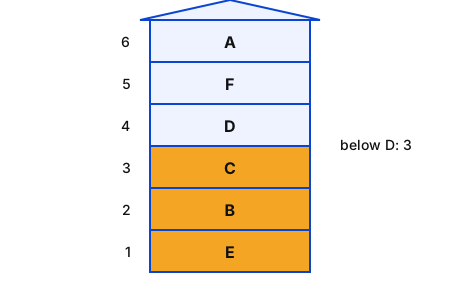
A, B, C, D, E and F live on six different floors of the same building. The lowermost floor in the building is numbered 1, the floor above it, number 2 and so on, till the topmost floor is numbered 6. B lives on an even numbered floor but not 6. The sum of floors on which F and B live is 7. D lives immediately above C. The sum of floors on which B and E live is 3. How many people live below D?
A, B, C, D, E और F एक ही इमारत की छह अलग-अलग मंज़िलों पर रहते हैं। इमारत की सबसे निचली मंज़िल की संख्या 1 है, उसके ऊपर वाली मंज़िल की संख्या 2 है और इसी प्रकार आगे, सबसे ऊपरी मंज़िल की संख्या 6 है। B एक सम संख्या वाली मंज़िल पर रहता है, लेकिन 6 पर नहीं। F और B जिन मंज़िलों पर रहते हैं, उनका योग 7 है। D, C के ठीक ऊपर रहता है। B और E जिन मंज़िलों पर रहते हैं, उनका योग 3 है। D से नीचे कितने व्यक्ति रहते हैं?
  1. A3
  2. B2
  3. C1
  4. D4
Show answer

Concept: Use the sum clues to fix exact floors.

  1. B even, not 6 → 2 or 4. B + E = 3 → B = 2, E = 1.
  2. F + B = 7 → F = 5.
  3. Left floors 3, 4, 6; D immediately above C → C = 3, D = 4; A = 6.
  4. Below D: E, B, C → 3 people.

Trick: A small sum like 3 fixes both floors (1 and 2) at once.

Answer: (A) 3

अवधारणा: योग वाले संकेतों से सटीक मंज़िल तय करें।

  1. B सम, 6 नहीं → 2 या 4। B + E = 3 → B = 2, E = 1।
  2. F + B = 7 → F = 5।
  3. बची मंज़िलें 3, 4, 6; D, C के ठीक ऊपर → C = 3, D = 4; A = 6।
  4. D से नीचे: E, B, C → 3 लोग।

ट्रिक: छोटा योग 3 तुरंत 1 और 2 तय कर देता है।

उत्तर: (A) 3

RRB NTPC Graduate CBT 1General Intelligence and ReasoningFloor PuzzleRRB NTPC Graduate CBT 1 2024 · 12 Jun Shift 1 →
Q3170.
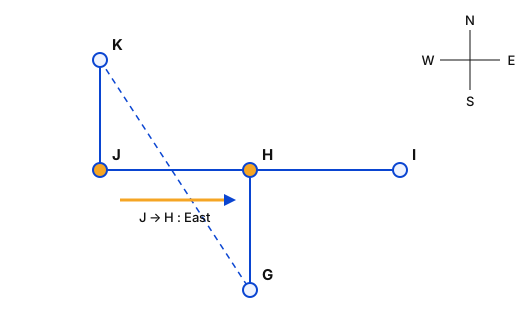
Town G is to the south of Town H. Town I is to the east of Town H. Town J is to the west of Town I. Town K is to the north of Town J. Town G is to the south-east of Town K. What is the position of Town H with respect to Town J?
नगर G, नगर H के दक्षिण में है। नगर I, नगर H के पूर्व में है। नगर J, नगर I के पश्चिम में है। नगर K, नगर J के उत्तर में है। नगर G, नगर K के दक्षिण-पूर्व में है। नगर J के सापेक्ष नगर H की स्थिति क्या है?
  1. AWestपश्चिम
  2. BNorthउत्तर
  3. CEastपूर्व
  4. DSouthदक्षिण
Show answer

Concept: Place towns on a grid and test both possible positions of J.

  1. H and I are on one east–west line; J is west of I, so J is on the same line.
  2. K is north of J and G is south of H.
  3. If J were east of H, G would be south-west of K. For G to be south-east of K, J must be west of H.
  4. So H is to the East of J.

Trick: Use the last clue (south-east) to decide the order of J and H.

Answer: (C) East

अवधारणा: नगरों को ग्रिड पर रखें और J की दोनों संभावित स्थितियाँ जाँचें।

  1. H और I एक पूर्व–पश्चिम रेखा पर; J, I के पश्चिम में — उसी रेखा पर।
  2. K, J के उत्तर में; G, H के दक्षिण में।
  3. यदि J, H के पूर्व में हो तो G, K के दक्षिण-पश्चिम में होगा। G को K के दक्षिण-पूर्व में रखने हेतु J, H के पश्चिम में।
  4. अतः H, J के पूर्व में है।

ट्रिक: अंतिम संकेत (दक्षिण-पूर्व) से J और H का क्रम तय करें।

उत्तर: (C) पूर्व (East)

RRB NTPC Graduate CBT 1General Intelligence and ReasoningDirection SenseRRB NTPC Graduate CBT 1 2024 · 12 Jun Shift 1 →
Q3171.
If 1 is added to each odd digit and 2 is subtracted from each even digit in the number 3678154, what will be difference between the highest and lowest digits in the number thus formed?
यदि संख्या 3678154 में प्रत्येक विषम अंक में 1 जोड़ा जाए और प्रत्येक सम अंक में से 2 घटाया जाए, तो इस प्रकार बनी संख्या में सबसे बड़े और सबसे छोटे अंकों के बीच का अंतर क्या होगा?
  1. A5
  2. B6
  3. C4
  4. D7
Show answer

Concept: Apply the rule to every digit separately, then compare the new digits.

  1. Number: 3 6 7 8 1 5 4.
  2. Odd digits +1: 3→4, 7→8, 1→2, 5→6. Even digits −2: 6→4, 8→6, 4→2.
  3. New number: 4 4 8 6 2 6 2.
  4. Highest = 8, lowest = 2 → 8−2=6.

Trick: Only the biggest and smallest new digits matter – no need to write the full number in the exam.

Answer: (B) 6

अवधारणा: नियम हर अंक पर अलग-अलग लगाएँ, फिर नए अंकों की तुलना करें।

  1. संख्या: 3 6 7 8 1 5 4।
  2. विषम अंक +1: 3→4, 7→8, 1→2, 5→6। सम अंक −2: 6→4, 8→6, 4→2।
  3. नई संख्या: 4 4 8 6 2 6 2।
  4. सबसे बड़ा = 8, सबसे छोटा = 2 → 8−2=6।

ट्रिक: केवल सबसे बड़ा और सबसे छोटा नया अंक चाहिए।

उत्तर: (B) 6

RRB NTPC Graduate CBT 1General Intelligence and ReasoningNumber operations – digit changeRRB NTPC Graduate CBT 1 2024 · 12 Jun Shift 1 →
Q3172.
If 2 is added to each even digit and 1 is subtracted from each odd digit in the number 571649, what will be the sum of the last three digits from the left in the new number thus formed?
यदि संख्या 571649 में प्रत्येक सम अंक में 2 जोड़ा जाए और प्रत्येक विषम अंक में से 1 घटाया जाए, तो इस प्रकार बनी नई संख्या में बाएँ से अंतिम तीन अंकों का योग क्या होगा?
  1. A14
  2. B24
  3. C18
  4. D22
Show answer

Concept: Change each digit as per its type (odd/even), then pick the required positions.

  1. Number: 5 7 1 6 4 9.
  2. Even +2: 6→8, 4→6. Odd −1: 5→4, 7→6, 1→0, 9→8.
  3. New number: 4 6 0 8 6 8.
  4. Last three digits: 8, 6, 8 → 8+6+8=22.

Trick: Only the last three digits (6, 4, 9) need changing: 8+6+8=22.

Answer: (D) 22

अवधारणा: हर अंक को उसके प्रकार (विषम/सम) के अनुसार बदलें, फिर आवश्यक स्थान चुनें।

  1. संख्या: 5 7 1 6 4 9।
  2. सम +2: 6→8, 4→6। विषम −1: 5→4, 7→6, 1→0, 9→8।
  3. नई संख्या: 4 6 0 8 6 8।
  4. अंतिम तीन अंक: 8, 6, 8 → 8+6+8=22।

ट्रिक: केवल अंतिम तीन अंक (6, 4, 9) बदलें: 8+6+8=22।

उत्तर: (D) 22

RRB NTPC Graduate CBT 1General Intelligence and ReasoningNumber operations – digit changeRRB NTPC Graduate CBT 1 2024 · 12 Jun Shift 1 →
Q3173.
Refer to the following number and symbol series and answer the question that follows. Counting to be done from left to right only.
(Left) 2 6 % 2 6 4 € 7 * 9 $ 3 € 6 1 2 @ 8 % € 9 2 (Right)
How many such symbols are there each of which is immediately preceded by a number and also immediately followed by a symbol?
निम्नलिखित संख्या और प्रतीक श्रृंखला को देखिए और उसके बाद दिए गए प्रश्न का उत्तर दीजिए। गणना केवल बाएँ से दाएँ की जानी है।
(बाएँ) 2 6 % 2 6 4 € 7 * 9 $ 3 € 6 1 2 @ 8 % € 9 2 (दाएँ)
ऐसे कितने प्रतीक हैं जिनमें से प्रत्येक के ठीक पहले एक संख्या है और ठीक बाद भी एक प्रतीक है?
  1. A0
  2. B1
  3. C3
  4. D2
Show answer

Concept: Look for the pattern Number – Symbol – Symbol and count the middle symbol.

  1. Check each symbol: % (6 before, 2 after) ✗; € (4 before, 7 after) ✗; * (7, 9) ✗; $ (9, 3) ✗; € (3, 6) ✗; @ (2, 8) ✗.
  2. % after 8 is followed by € → 8 % € ✓.
  3. The last € is preceded by a symbol (%) ✗. So only one such symbol.

Trick: Scan for two symbols side by side, then check the item before the first one.

Answer: (B) 1

अवधारणा: पैटर्न संख्या – प्रतीक – प्रतीक खोजें और बीच वाला प्रतीक गिनें।

  1. हर प्रतीक जाँचें: % (पहले 6, बाद में 2) ✗; € (4, 7) ✗; * (7, 9) ✗; $ (9, 3) ✗; € (3, 6) ✗; @ (2, 8) ✗।
  2. 8 के बाद वाला % और उसके बाद € → 8 % € ✓।
  3. अंतिम € से पहले प्रतीक (%) है ✗। अतः केवल एक।

ट्रिक: पहले लगातार दो प्रतीक ढूँढ़ें, फिर पहले प्रतीक से पहले संख्या है या नहीं देखें।

उत्तर: (B) 1

RRB NTPC Graduate CBT 1General Intelligence and ReasoningSymbol-number seriesRRB NTPC Graduate CBT 1 2024 · 12 Jun Shift 1 →
Q3174.
What should come in place of the question mark (?) in the given series based on the English alphabetical order?
YSM CWQ GAU KEY ?
अंग्रेज़ी वर्णमाला क्रम के आधार पर दी गई श्रृंखला में प्रश्न चिह्न (?) के स्थान पर क्या आना चाहिए?
YSM CWQ GAU KEY ?
  1. ACOI
  2. BOIC
  3. COCI
  4. DCIO
Show answer

Concept: Check each letter position separately; here every letter moves +4.

  1. 1st letters: Y → C → G → K → O (+4 each).
  2. 2nd letters: S → W → A → E → I (+4).
  3. 3rd letters: M → Q → U → Y → C (+4).

Trick: Positions: O = 15, I = 9, C = 3; after Z continue from A.

Answer: (B) OIC

अवधारणा: हर स्थान का अक्षर अलग से जाँचें; यहाँ हर अक्षर +4 बढ़ता है।

  1. पहला अक्षर: Y → C → G → K → O (+4)।
  2. दूसरा अक्षर: S → W → A → E → I (+4)।
  3. तीसरा अक्षर: M → Q → U → Y → C (+4)।

ट्रिक: O = 15, I = 9, C = 3; Z के बाद फिर A से गिनें।

उत्तर: (B) OIC

RRB NTPC Graduate CBT 1General Intelligence and ReasoningLetter seriesRRB NTPC Graduate CBT 1 2024 · 12 Jun Shift 1 →
Q3175.
Based on the English alphabetical order, three of the following four letter-clusters are alike in a certain way and thus form a group. Which letter-cluster DOES NOT belong to that group?
(Note: The odd one out is not based on the number of consonants/vowels or their position in the letter-cluster.)
अंग्रेज़ी वर्णमाला क्रम के आधार पर, निम्नलिखित चार अक्षर-समूहों में से तीन किसी निश्चित प्रकार से एकसमान हैं और इस प्रकार एक समूह बनाते हैं। कौन-सा अक्षर-समूह उस समूह से संबंधित नहीं है?
(ध्यान दें: असंगत अक्षर-समूह, उस अक्षर-समूह में व्यंजनों/स्वरों की संख्या या उनके स्थान पर आधारित नहीं है।)
  1. ASYT
  2. BQWR
  3. CNTO
  4. DLRN
Show answer

Concept: Find the gaps between consecutive letters of each cluster.

  1. SYT: S +6 → Y, Y −5 → T.
  2. QWR: Q +6 → W, W −5 → R.
  3. NTO: N +6 → T, T −5 → O.
  4. LRN: L +6 → R, but R −4 → N (not −5). So LRN is odd.

Trick: Pattern +6, −5 means 3rd letter = 1st letter +1 (S-T, Q-R, N-O); LRN breaks it.

Answer: (D) LRN

अवधारणा: हर समूह के क्रमागत अक्षरों का अंतर देखें।

  1. SYT: S +6 → Y, Y −5 → T।
  2. QWR: Q +6 → W, W −5 → R।
  3. NTO: N +6 → T, T −5 → O।
  4. LRN: L +6 → R, पर R −4 → N (−5 नहीं)। अतः LRN विषम।

ट्रिक: +6, −5 का अर्थ: तीसरा अक्षर = पहला अक्षर +1 (S-T, Q-R, N-O); LRN में नहीं।

उत्तर: (D) LRN

RRB NTPC Graduate CBT 1General Intelligence and ReasoningOdd one out – letter clustersRRB NTPC Graduate CBT 1 2024 · 12 Jun Shift 1 →
Q3176.
This question is based on the five, three-digit numbers given below.
(Left) 823 664 309 431 175 (Right)
(Example- 697 – First digit = 6, second digit = 9 and third digit = 7)
(NOTE: All operations to be done from left to right.)
What will be the resultant if the first digit of the highest number is added to the third digit of the lowest number?
यह प्रश्न नीचे दी गई तीन अंकों वाली पाँच संख्याओं पर आधारित है।
(बाएँ) 823 664 309 431 175 (दाएँ)
(उदाहरण- 697 – पहला अंक = 6, दूसरा अंक = 9 और तीसरा अंक = 7)
(ध्यान दें: सभी संक्रियाएँ बाएँ से दाएँ की जानी हैं।)
यदि सबसे बड़ी संख्या के पहले अंक को सबसे छोटी संख्या के तीसरे अंक में जोड़ा जाए, तो परिणाम क्या होगा?
  1. A13
  2. B16
  3. C12
  4. D14
Show answer

Concept: Identify the highest and lowest numbers, then pick the required digits.

  1. Numbers: 823, 664, 309, 431, 175.
  2. Highest = 823 → first digit = 8.
  3. Lowest = 175 → third digit = 5.
  4. 8+5=13.

Trick: Compare first digits only: 8 is largest, 1 is smallest.

Answer: (A) 13

अवधारणा: सबसे बड़ी और सबसे छोटी संख्या पहचानें, फिर आवश्यक अंक लें।

  1. संख्याएँ: 823, 664, 309, 431, 175।
  2. सबसे बड़ी = 823 → पहला अंक = 8।
  3. सबसे छोटी = 175 → तीसरा अंक = 5।
  4. 8+5=13।

ट्रिक: केवल पहले अंक देखें: 8 सबसे बड़ा, 1 सबसे छोटा।

उत्तर: (A) 13

RRB NTPC Graduate CBT 1General Intelligence and ReasoningNumber puzzle – three-digit numbersRRB NTPC Graduate CBT 1 2024 · 12 Jun Shift 1 →
Q3177.
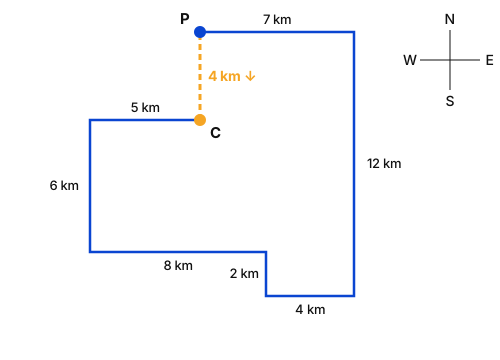
Mr. P starts from Point C and drives 5 km towards the west. He then takes a left turn, drives 6 km, turns left and drives 8 km. He then takes a right turn, drives 2 km, turns left and drives 4 km. He then takes left turn and drives 12 km. He takes a final left turn drives 7 km and stops at Point P. How far (shortest distance) and towards which direction should he drive in order to reach Point C again? (All turns are 90 degree turns only unless specified.)
श्री P बिंदु C से चलना शुरू करते हैं और पश्चिम की ओर 5 km गाड़ी चलाते हैं। फिर वे बाएँ मुड़ते हैं, 6 km गाड़ी चलाते हैं, बाएँ मुड़ते हैं और 8 km गाड़ी चलाते हैं। फिर वे दाएँ मुड़ते हैं, 2 km गाड़ी चलाते हैं, बाएँ मुड़ते हैं और 4 km गाड़ी चलाते हैं। फिर वे बाएँ मुड़ते हैं और 12 km गाड़ी चलाते हैं। वे अंतिम बार बाएँ मुड़ते हैं, 7 km गाड़ी चलाते हैं और बिंदु P पर रुक जाते हैं। पुनः बिंदु C तक पहुँचने के लिए उन्हें कितनी दूर (न्यूनतम दूरी) और किस दिशा में गाड़ी चलानी चाहिए? (जब तक निर्दिष्ट न हो, सभी मोड़ केवल 90 डिग्री के मोड़ हैं।)
  1. A4 km towards the northउत्तर की ओर 4 km
  2. B2 km towards the eastपूर्व की ओर 2 km
  3. C2 km towards the westपश्चिम की ओर 2 km
  4. D4 km towards the southदक्षिण की ओर 4 km
Show answer

Concept: Track the coordinates; take C as the origin, east = +x, north = +y.

  1. West 5 → (−5, 0); left (south) 6 → (−5, −6); left (east) 8 → (3, −6).
  2. Right (south) 2 → (3, −8); left (east) 4 → (7, −8).
  3. Left (north) 12 → (7, 4); left (west) 7 → P = (0, 4).
  4. P is 4 km directly north of C, so he must drive 4 km towards the south.

Trick: Net east-west: −5+8+4−7=0; net north-south: −6−2+12=+4.

Answer: (D) 4 km towards the south

अवधारणा: निर्देशांक लिखते चलें; C को मूल बिंदु मानें, पूर्व = +x, उत्तर = +y।

  1. पश्चिम 5 → (−5, 0); बाएँ (दक्षिण) 6 → (−5, −6); बाएँ (पूर्व) 8 → (3, −6)।
  2. दाएँ (दक्षिण) 2 → (3, −8); बाएँ (पूर्व) 4 → (7, −8)।
  3. बाएँ (उत्तर) 12 → (7, 4); बाएँ (पश्चिम) 7 → P = (0, 4)।
  4. P, C से ठीक 4 km उत्तर में है, अतः उसे 4 km दक्षिण जाना होगा।

ट्रिक: कुल पूर्व-पश्चिम: −5+8+4−7=0; कुल उत्तर-दक्षिण: −6−2+12=+4।

उत्तर: (D) दक्षिण की ओर 4 km

RRB NTPC Graduate CBT 1General Intelligence and ReasoningDirection senseRRB NTPC Graduate CBT 1 2024 · 12 Jun Shift 1 →
Q3178.
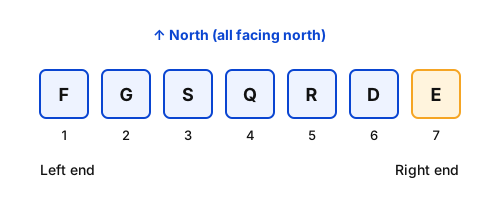
Seven people, D, E, F, G, Q, R and S, are sitting in a row facing north. No one sits to the left of F. Only four people sit between F and D. Only three people sit to the right of Q. G sits to the immediate left of S. E is not an immediate neighbour of Q. Who sits at the rightmost end of the line?
सात व्यक्ति, D, E, F, G, Q, R और S, उत्तर की ओर मुख करके एक पंक्ति में बैठे हैं। F के बाईं ओर कोई नहीं बैठा है। F और D के बीच केवल चार व्यक्ति बैठे हैं। Q के दाईं ओर केवल तीन व्यक्ति बैठे हैं। G, S के ठीक बाईं ओर बैठा है। E, Q का निकटतम पड़ोसी नहीं है। पंक्ति के सबसे दाएँ छोर पर कौन बैठा है?
  1. AE
  2. BS
  3. CD
  4. DF
Show answer

Concept: Fix the definite positions first (seven seats, 1 = left end, all facing north).

  1. No one left of F → F = 1. Four people between F and D → D = 6.
  2. Three people right of Q → Q = 4.
  3. G immediately left of S needs two adjacent free seats → G = 2, S = 3.
  4. E and R take 5 and 7; E is not next to Q, so E ≠ 5 → E = 7, R = 5.

Trick: Order: F G S Q R D E – rightmost is E.

Answer: (A) E

अवधारणा: पहले निश्चित स्थान तय करें (सात सीटें, 1 = बायाँ छोर, सभी उत्तर की ओर)।

  1. F के बाएँ कोई नहीं → F = 1। F और D के बीच चार → D = 6।
  2. Q के दाएँ तीन → Q = 4।
  3. G, S के ठीक बाएँ – दो लगातार खाली सीटें → G = 2, S = 3।
  4. E और R के लिए 5 और 7; E, Q का पड़ोसी नहीं → E = 7, R = 5।

ट्रिक: क्रम: F G S Q R D E – दाएँ छोर पर E।

उत्तर: (A) E

RRB NTPC Graduate CBT 1General Intelligence and ReasoningLinear seating arrangementRRB NTPC Graduate CBT 1 2024 · 12 Jun Shift 1 →
Q3179.
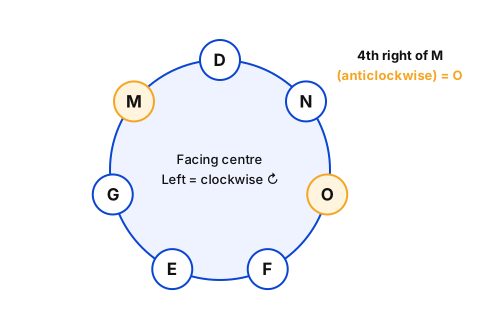
D, E, F, G, M, N and O are sitting around a circular table, facing the centre of the table. N sits to the immediate left of D. G sits to the immediate left of E. E sits second to the left of O. F sits third to the left of D. Who sits fourth to the right of M?
D, E, F, G, M, N और O एक वृत्ताकार मेज़ के चारों ओर मेज़ के केंद्र की ओर मुख करके बैठे हैं। N, D के ठीक बाईं ओर बैठा है। G, E के ठीक बाईं ओर बैठा है। E, O के बाईं ओर दूसरे स्थान पर बैठा है। F, D के बाईं ओर तीसरे स्थान पर बैठा है। M के दाईं ओर चौथे स्थान पर कौन बैठा है?
  1. AG
  2. BO
  3. CF
  4. DD
Show answer

Concept: Facing the centre: left = clockwise, right = anticlockwise.

  1. Place D. N is immediate left of D; F is third to the left of D.
  2. E is second left of O and G is immediate left of E; the only free seats that fit give O, then E two places clockwise, then G.
  3. The last seat goes to M (immediate right of D).
  4. Count 4 places anticlockwise from M: G, E, F, O.

Trick: 4th to the right in a 7-seat circle = 3rd to the left.

Answer: (B) O

अवधारणा: केंद्र की ओर मुख होने पर: बायाँ = दक्षिणावर्त (clockwise), दायाँ = वामावर्त (anticlockwise)।

  1. D को रखें। N, D के ठीक बाएँ; F, D के बाएँ से तीसरा।
  2. E, O के बाएँ से दूसरा और G, E के ठीक बाएँ; खाली सीटों में केवल एक व्यवस्था बैठती है – O, फिर दो स्थान आगे E, फिर G।
  3. बची सीट M की (D के ठीक दाएँ)।
  4. M से 4 स्थान वामावर्त गिनें: G, E, F, O।

ट्रिक: 7 सीटों के वृत्त में दाएँ से चौथा = बाएँ से तीसरा।

उत्तर: (B) O

RRB NTPC Graduate CBT 1General Intelligence and ReasoningCircular seating arrangementRRB NTPC Graduate CBT 1 2024 · 12 Jun Shift 1 →
Q3180.
Read the given statements and conclusions carefully. Assuming that the information given in the statements is true, even if it appears to be at variance with commonly known facts, decide which of the given conclusion(s) logically follow(s) from the statements.
Statements:
All trucks are big.
All big are cars.
All cars are long.
Conclusions:
(I) All big are trucks.
(II) All cars are big.
दिए गए कथनों और निष्कर्षों को ध्यानपूर्वक पढ़िए। यह मानते हुए कि कथनों में दी गई जानकारी सत्य है, भले ही वह सामान्य रूप से ज्ञात तथ्यों से भिन्न प्रतीत होती हो, निर्णय लीजिए कि दिए गए निष्कर्षों में से कौन-सा/कौन-से निष्कर्ष तार्किक रूप से कथनों का अनुसरण करता है/करते हैं।
कथन:
सभी ट्रक, बड़े हैं।
सभी बड़े, कारें हैं।
सभी कारें, लंबी हैं।
निष्कर्ष:
(I) सभी बड़े, ट्रक हैं।
(II) सभी कारें, बड़ी हैं।
  1. AOnly conclusion (II) follows.केवल निष्कर्ष (II) अनुसरण करता है।
  2. BBoth conclusions (I) and (II) follow.निष्कर्ष (I) और (II) दोनों अनुसरण करते हैं।
  3. COnly conclusion (I) follows.केवल निष्कर्ष (I) अनुसरण करता है।
  4. DNeither conclusion (I) nor (II) follows.न तो निष्कर्ष (I) और न ही (II) अनुसरण करता है।
Show answer

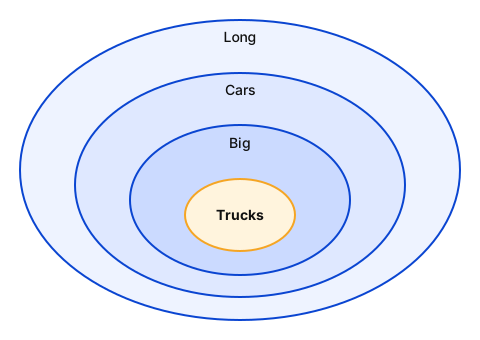
Concept: Draw the smallest possible (nested) Venn diagram and test each conclusion.

  1. Trucks ⊂ Big ⊂ Cars ⊂ Long.
  2. I: 'All big are trucks' – Big is larger than Trucks; not certain ✗.
  3. II: 'All cars are big' – Cars is larger than Big; not certain ✗.
  4. 'All A are B' cannot be reversed to 'All B are A'.

Trick: 'All' statements only flow forward (Truck → Big → Car → Long), never backward.

Answer: (D) Neither conclusion (I) nor (II) follows.

अवधारणा: न्यूनतम (एक-के-अंदर-एक) वेन आरेख बनाकर हर निष्कर्ष जाँचें।

  1. ट्रक ⊂ बड़े ⊂ कार ⊂ लंबे।
  2. I: 'सभी बड़े ट्रक हैं' – बड़े का घेरा ट्रक से बड़ा है; निश्चित नहीं ✗।
  3. II: 'सभी कार बड़ी हैं' – कार का घेरा बड़े से बड़ा है; निश्चित नहीं ✗।
  4. 'सभी A, B हैं' को उलटकर 'सभी B, A हैं' नहीं कह सकते।

ट्रिक: 'सभी' वाले कथन केवल आगे चलते हैं (ट्रक → बड़े → कार → लंबे), पीछे नहीं।

उत्तर: (D) न तो निष्कर्ष (I) और न ही (II) अनुसरण करता है।

RRB NTPC Graduate CBT 1General Intelligence and ReasoningSyllogismRRB NTPC Graduate CBT 1 2024 · 12 Jun Shift 1 →