Question bank

Q&A: practice questions with answers

Search questions on any topic. Filter by exam category, exam, subject and topic, try the question, then open the answer and explanation.

Courses – airGurukul

7,077 questions found.

Q3261.
CK 17 is related to EG 29 in a certain way. In the same way, KM 12 is related to MI 24. To which of the given options is PQ 16 related, following the same logic?
CK 17 एक निश्चित प्रकार से EG 29 से संबंधित है। उसी प्रकार, KM 12, MI 24 से संबंधित है। उसी तर्क का अनुसरण करते हुए, PQ 16 दिए गए विकल्पों में से किससे संबंधित है?
  1. ARM 28
  2. BSP 33
  3. CPR 11
  4. DTV 29
Show answer

Concept: Find separate rules for the 1st letter, 2nd letter and number.

  1. CK 17 → EG 29: C +2 = E, K −4 = G, 17+12=29
  2. KM 12 → MI 24: K +2 = M, M −4 = I, 12+12=24
  3. PQ 16: P +2 = R, Q −4 = M, 16+12=28 → RM 28

Trick: Confirm the rule on the second pair before applying it.

Answer: (A) RM 28

अवधारणा: पहले अक्षर, दूसरे अक्षर और संख्या के अलग-अलग नियम खोजें।

  1. CK 17 → EG 29: C +2 = E, K −4 = G, 17+12=29
  2. KM 12 → MI 24: K +2 = M, M −4 = I, 12+12=24
  3. PQ 16: P +2 = R, Q −4 = M, 16+12=28 → RM 28

ट्रिक: नियम को दूसरे जोड़े पर जाँचकर ही लागू करें।

उत्तर: (A) RM 28
RRB NTPC Graduate CBT 1General Intelligence and ReasoningAnalogy (Alphanumeric)RRB NTPC Graduate CBT 1 2024 · 11 Jun Shift 3 →
Q3262.
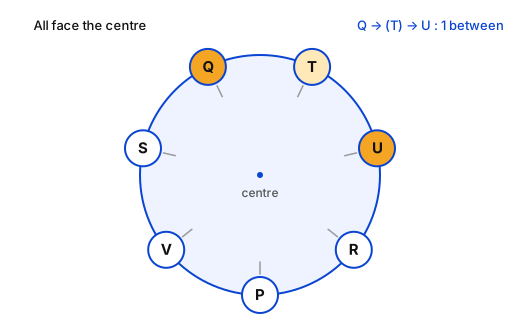
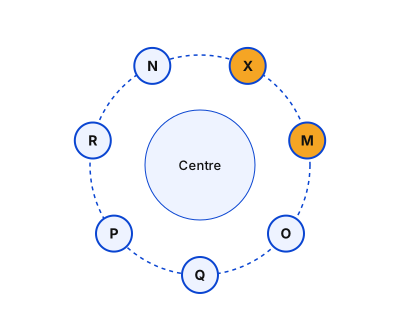
M, N, O, P, Q, R and X are sitting around a circular table facing the centre of the table. Only four people sit between Q and R when counted from the right of Q. Q sits third to the left of X. P sits third to the left of M. N is an immediate neighbour of R and X. How many people sit between O and N when counted from the right of O?
M, N, O, P, Q, R और X एक वृत्ताकार मेज़ के चारों ओर मेज़ के केंद्र की ओर मुख करके बैठे हैं। Q के दाएँ से गिनने पर Q और R के बीच केवल चार व्यक्ति बैठे हैं। Q, X के बाएँ से तीसरे स्थान पर बैठा है। P, M के बाएँ से तीसरे स्थान पर बैठा है। N, R और X दोनों का निकटतम पड़ोसी है। O के दाएँ से गिनने पर O और N के बीच कितने व्यक्ति बैठे हैं?
  1. AThreeतीन
  2. BOneएक
  3. CFourचार
  4. DTwoदो
Show answer

Concept: Facing the centre, 'right' is anticlockwise and 'left' is clockwise. Fix Q first.

  1. Four people between Q and R from Q's right → R is 5th to the right of Q.
  2. Q is 3rd to the left of X → X is 3rd to the right of Q; N, neighbour of both R and X, sits between them.
  3. Remaining seats for M, O, P: only M 2nd to the right of Q with P 3rd to the left of M works; O is right of Q.
  4. From O going right: M, X, then N → two people between.

Trick: In 7-seat circles, 'k people between' from one side = 6 − k from the other side.

Answer: (D) Two

अवधारणा: केंद्र की ओर मुख होने पर 'दाएँ' = वामावर्त और 'बाएँ' = दक्षिणावर्त। पहले Q को स्थिर करें।

  1. Q के दाएँ से Q और R के बीच चार व्यक्ति → R, Q के दाएँ 5वाँ।
  2. Q, X के बाएँ तीसरा → X, Q के दाएँ तीसरा; R और X दोनों का पड़ोसी N उनके बीच।
  3. बची सीटों में केवल M (Q के दाएँ दूसरा) और P (M के बाएँ तीसरा) संभव; O, Q के ठीक दाएँ।
  4. O के दाएँ से: M, X, फिर N → बीच में दो व्यक्ति।

ट्रिक: 7 सीटों वाले वृत्त में एक ओर से k बीच में = दूसरी ओर से 6 − k।

उत्तर: (D) दो

RRB NTPC Graduate CBT 1General Intelligence and ReasoningCircular Seating ArrangementRRB NTPC Graduate CBT 1 2024 · 11 Jun Shift 3 →
Q3263.
GQCN is related to LNHK in a certain way based on the English alphabetical order. In the same way, QKMH is related to VHRE. To which of the given options is AEWB related, following the same logic?
अंग्रेज़ी वर्णमाला क्रम के आधार पर GQCN एक निश्चित प्रकार से LNHK से संबंधित है। उसी प्रकार, QKMH, VHRE से संबंधित है। उसी तर्क का अनुसरण करते हुए, AEWB दिए गए विकल्पों में से किससे संबंधित है?
  1. AFABX
  2. BGCAZ
  3. CEBCX
  4. DFBBY
Show answer

Concept: Find the shift applied to each letter position.

  1. GQCN → LNHK: G+5=L, Q−3=N, C+5=H, N−3=K
  2. QKMH → VHRE: Q+5=V, K−3=H, M+5=R, H−3=E (same rule)
  3. AEWB: A+5=F, E−3=B, W+5=B (wrap after Z), B−3=Y → FBBY

Trick: Pattern +5,−3,+5,−3; remember the circular alphabet.

Answer: (D) FBBY

अवधारणा: हर स्थान के अक्षर पर लगा अंतर खोजें।

  1. GQCN → LNHK: G+5=L, Q−3=N, C+5=H, N−3=K
  2. QKMH → VHRE: वही नियम
  3. AEWB: A+5=F, E−3=B, W+5=B (Z के बाद चक्र), B−3=Y → FBBY

ट्रिक: पैटर्न +5,−3,+5,−3; वर्णमाला चक्रीय मानें।

उत्तर: (D) FBBY

RRB NTPC Graduate CBT 1General Intelligence and ReasoningAnalogy (Letters)RRB NTPC Graduate CBT 1 2024 · 11 Jun Shift 3 →
Q3264.
What should come in place of the question mark (?) in the given series?
222 194 166 138 110 82 ?
दी गई श्रृंखला में प्रश्न चिह्न (?) के स्थान पर क्या आना चाहिए?
222 194 166 138 110 82 ?
  1. A60
  2. B66
  3. C42
  4. D54
Show answer

Concept: Check the differences between consecutive terms.

  1. 222−194=28, 194−166=28, 166−138=28 …
  2. Each term is 28 less than the previous.
  3. 82−28=54

Trick: Constant difference → arithmetic series.

Answer: (D) 54

अवधारणा: क्रमागत पदों का अंतर देखें।

  1. 222−194=28, 194−166=28 …
  2. हर पद पिछले से 28 कम।
  3. 82−28=54

ट्रिक: स्थिर अंतर → समांतर श्रेणी।

उत्तर: (D) 54

RRB NTPC Graduate CBT 1General Intelligence and ReasoningNumber SeriesRRB NTPC Graduate CBT 1 2024 · 11 Jun Shift 3 →
Q3265.
Select the set in which the numbers are related in the same way as are the numbers of the following sets.
(NOTE: Operations should be performed on the whole numbers, without breaking down the numbers into their constituent digits. E.g. 13 – Operations on 13 such as
adding/subtracting/multiplying to 13 can be performed. Breaking down 13 into 1 and 3 and then performing mathematical operations on 1 and 3 is not allowed.)
(19, 354, 7)
(9, 73, 8)
उस समुच्चय का चयन कीजिए जिसमें संख्याएँ उसी प्रकार संबंधित हैं जिस प्रकार निम्नलिखित समुच्चयों की संख्याएँ संबंधित हैं।
(ध्यान दें: संक्रियाएँ संख्याओं को उनके घटक अंकों में तोड़े बिना, पूर्ण संख्याओं पर की जानी चाहिए। उदाहरण के लिए 13 – 13 पर संक्रियाएँ जैसे
13 में जोड़ना/घटाना/गुणा करना आदि किया जा सकता है। 13 को 1 और 3 में तोड़ना और फिर 1 और 3 पर गणितीय संक्रियाएँ करना वर्जित है।)
(19, 354, 7)
(9, 73, 8)
  1. A(39, 1510, 10)
  2. B(28, 778, 5)
  3. C(22, 481, 2)
  4. D(3, −10, 19)
Show answer

Concept: Rule: (first)2 − third = second.

  1. (19,354,7): 192−7=361−7=354 ✓
  2. (9,73,8): 81−8=73 ✓
  3. (D) (3,−10,19): 9−19=−10 ✓
  4. Others fail: 392−10=1511, 282−5=779, 222−2=482.

Trick: A negative middle number hints at subtraction of a larger third number.

Answer: (D) (3,−10,19)

अवधारणा: नियम: (पहली)2 − तीसरी = दूसरी।

  1. (19,354,7): 361−7=354 ✓
  2. (9,73,8): 81−8=73 ✓
  3. (D) (3,−10,19): 9−19=−10 ✓
  4. अन्य: 392−10=1511, 282−5=779, 222−2=482 – मेल नहीं।

ट्रिक: बीच की ऋणात्मक संख्या बड़ी तीसरी संख्या घटाने का संकेत है।

उत्तर: (D) (3,−10,19)

RRB NTPC Graduate CBT 1General Intelligence and ReasoningNumber Analogy (Sets)RRB NTPC Graduate CBT 1 2024 · 11 Jun Shift 3 →
Q3266.
In this question, a group of numbers is coded by using letters and symbols as per the table given below and the conditions which follow.
Number7823456
CodeZQ*@%$T
Conditions:
1. If the 1st and 2nd digits are even, both are to be coded as ‘A’.
2. If the 1st and last digits are odd, both are to be coded as the code for the 1st digit.
3. If the 3rd and 4th digits are even, their codes are to be interchanged.
What is the correct combination of codes (by following only the applicable condition(s)) for the following?
71628
इस प्रश्न में, संख्याओं के एक समूह को नीचे दी गई तालिका और उसके बाद दी गई शर्तों के अनुसार अक्षरों और प्रतीकों का उपयोग करके कूटबद्ध किया गया है।
संख्या7823456
कूटZQ*@%$T
शर्तें:
1. यदि पहला और दूसरा अंक सम हैं, तो दोनों को ‘A’ के रूप में कूटबद्ध किया जाना है।
2. यदि पहला और अंतिम अंक विषम हैं, तो दोनों को पहले अंक के कूट के रूप में कूटबद्ध किया जाना है।
3. यदि तीसरा और चौथा अंक सम हैं, तो उनके कूटों को आपस में बदल दिया जाना है।
निम्नलिखित के लिए कूटों का सही संयोजन (केवल लागू होने वाली शर्त/शर्तों का पालन करते हुए) क्या है?
71628
  1. AZ J * * Q
  2. BZ J T T Q
  3. CZ J * T Q
  4. DZ J T * Q
Show answer

Concept: Check every condition on 7 1 6 2 8, then write the codes.

  1. Condition 1: 7 and 1 are odd → not applicable.
  2. Condition 2: last digit 8 is even → not applicable.
  3. Condition 3: 3rd digit 6 and 4th digit 2 are even → their codes T and * interchange.
  4. Codes: 7 → Z, 1 → J, then * , T, 8 → Q → Z J * T Q.

Trick: Test all conditions first; usually only one applies.

Answer: (C) Z J * T Q

अवधारणा: 7 1 6 2 8 पर हर शर्त जाँचें, फिर कोड लिखें।

  1. शर्त 1: 7 और 1 विषम → लागू नहीं।
  2. शर्त 2: अंतिम अंक 8 सम → लागू नहीं।
  3. शर्त 3: तीसरा अंक 6 और चौथा अंक 2 सम → उनके कोड T और * आपस में बदलेंगे।
  4. कोड: 7 → Z, 1 → J, फिर *, T, 8 → Q → Z J * T Q।

ट्रिक: पहले सभी शर्तें जाँचें; प्रायः एक ही लागू होती है।

उत्तर: (C) Z J * T Q

RRB NTPC Graduate CBT 1General Intelligence and ReasoningCoding with ConditionsRRB NTPC Graduate CBT 1 2024 · 11 Jun Shift 3 →
Q3267.
In a certain code language,
'A + B' means 'A is the sister of B'
'A − B' means 'A is the brother of B'
'A × B' means 'A is the wife of B'
'A ÷ B' means 'A is the father of B'
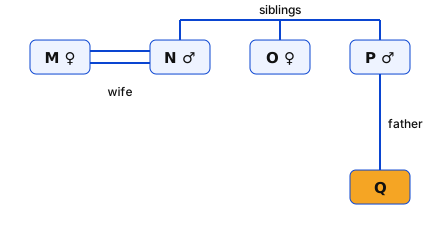
Based on the above, how is M related to Q if 'M × N − O + P ÷ Q'?
एक निश्चित कूट भाषा में,
'A + B' का अर्थ है 'A, B की बहन है'
'A − B' का अर्थ है 'A, B का भाई है'
'A × B' का अर्थ है 'A, B की पत्नी है'
'A ÷ B' का अर्थ है 'A, B का पिता है'
उपर्युक्त के आधार पर, यदि 'M × N − O + P ÷ Q' है, तो M, Q से किस प्रकार संबंधित है?
  1. AFather's Brother's Wifeपिता के भाई की पत्नी
  2. B​Mother's Brother's Daughterमाँ के भाई की पुत्री
  3. CFather's Brother's Daughterपिता के भाई की पुत्री
  4. DMother's Brother's Wifeमाँ के भाई की पत्नी
Show answer

Concept: Decode each symbol and draw the family tree.

  1. M × N: M is the wife of N.
  2. N − O: N is the brother of O; O + P: O is the sister of P → N, O, P are siblings (P male as he is a father).
  3. P ÷ Q: P is the father of Q → N is Q's father's brother.
  4. M, wife of N → Q's father's brother's wife.

Trick: Go step by step from Q back to M: father → brother → wife.

Answer: (A) Father's Brother's Wife

अवधारणा: हर चिह्न को डिकोड करके वंश-वृक्ष बनाएँ।

  1. M × N: M, N की पत्नी है।
  2. N − O: N, O का भाई; O + P: O, P की बहन → N, O, P भाई-बहन (P पिता है अतः पुरुष)।
  3. P ÷ Q: P, Q का पिता → N, Q के पिता का भाई।
  4. M, N की पत्नी → Q के पिता के भाई की पत्नी (चाची)।

ट्रिक: Q से M तक क्रम से चलें: पिता → भाई → पत्नी।

उत्तर: (A) पिता के भाई की पत्नी (Father's Brother's Wife)

RRB NTPC Graduate CBT 1General Intelligence and ReasoningBlood Relations (Coded)RRB NTPC Graduate CBT 1 2024 · 11 Jun Shift 3 →
Q3268.
Which of the following letter-clusters should replace # and % so that the pattern and relationship followed between the letter-cluster pair on the left side of :: is the same as that on the right side of :: ?
# : IPJ :: NUO : %
निम्नलिखित में से कौन-से अक्षर-समूह # और % को प्रतिस्थापित करेंगे ताकि :: के बाईं ओर के अक्षर-समूह युग्म के बीच का पैटर्न और संबंध वही हो जो :: के दाईं ओर है?
# : IPJ :: NUO : %
  1. A# = KRJ, % = NSM
  2. B# = KRL, % = NSL
  3. C# = KRL, % = NRM
  4. D# = KRL, % = LSM
Show answer

Concept: Find the rule from a pair and test the options; each letter moves by the same step.

  1. Try # = KRL: K−2=I, R−2=P, L−2=J → KRL : IPJ means each letter −2.
  2. Apply to NUO: N−2=L, U−2=S, O−2=M → LSM.
  3. So # = KRL and % = LSM.

Trick: When three options share #, test the common one first, then match %.

Answer: (D) # = KRL, % = LSM

अवधारणा: एक जोड़ी से नियम निकालें और विकल्प जाँचें; हर अक्षर समान रूप से खिसकता है।

  1. # = KRL लें: K−2=I, R−2=P, L−2=J → हर अक्षर −2।
  2. NUO पर लागू: N−2=L, U−2=S, O−2=M → LSM।
  3. अतः # = KRL और % = LSM।

ट्रिक: जब तीन विकल्पों में # समान हो, पहले उसे जाँचें, फिर % मिलाएँ।

उत्तर: (D) # = KRL, % = LSM

RRB NTPC Graduate CBT 1General Intelligence and ReasoningLetter AnalogyRRB NTPC Graduate CBT 1 2024 · 11 Jun Shift 3 →
Q3269.
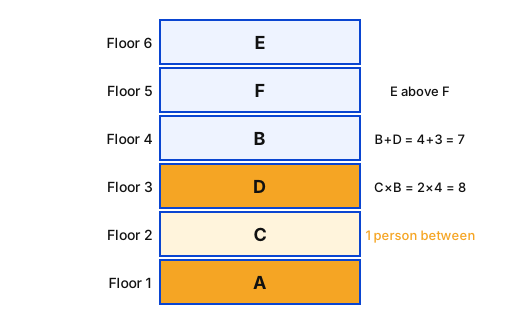
A, B, C, D, E and F live on six different floors of the same building. The lowermost floor in the building is numbered 1, the floor above it, number 2 and so on, till the topmost floor is numbered 6. C lives on a floor that is a prime number. The product of floors on which C and B live is 8. E lives immediately above F. The sum of floors on which B and D live is 7. How many people live between A and D?
A, B, C, D, E और F एक ही इमारत की छह अलग-अलग मंज़िलों पर रहते हैं। इमारत की सबसे निचली मंज़िल की संख्या 1 है, उसके ऊपर की मंज़िल की संख्या 2 है और इसी प्रकार आगे, सबसे ऊपरी मंज़िल की संख्या 6 है। C एक ऐसी मंज़िल पर रहता है जो अभाज्य संख्या है। C और B जिन मंज़िलों पर रहते हैं उनका गुणनफल 8 है। E, F के ठीक ऊपर रहता है। B और D जिन मंज़िलों पर रहते हैं उनका योग 7 है। A और D के बीच कितने व्यक्ति रहते हैं?
  1. A1
  2. B4
  3. C3
  4. D2
Show answer

Concept: Fix the definite clues (product, sum) first, then place the pair.

  1. C is on a prime floor and C×B=8: only C=2,B=4 works (8=2×4; 1×8 not possible).
  2. B+D=7⇒D=3.
  3. Free floors: 1, 5, 6. E immediately above F ⇒ F = 5, E = 6, so A = 1.
  4. Between A (1) and D (3) lives only C (floor 2) ⇒ 1 person.

Trick: Product clues with floors 1–6 have very few factor pairs – start there.

Answer: (A) 1

अवधारणा: पहले निश्चित संकेत (गुणनफल, योग) लगाएँ, फिर जोड़ी वाले।

  1. C अभाज्य मंज़िल पर और C×B=8: केवल C=2,B=4
  2. B+D=7⇒D=3
  3. बची मंज़िलें 1, 5, 6; E, F के ठीक ऊपर ⇒ F = 5, E = 6, A = 1
  4. A (1) और D (3) के बीच केवल C ⇒ 1 व्यक्ति

ट्रिक: 1–6 मंज़िलों में गुणनफल वाले संकेत के बहुत कम विकल्प होते हैं — वहीं से शुरू करें।

उत्तर: (A) 1

RRB NTPC Graduate CBT 1General Intelligence and ReasoningFloor puzzleRRB NTPC Graduate CBT 1 2024 · 11 Jun Shift 3 →
Q3270.
Refer to the following number and symbol series and answer the question that follows. Counting to be done from left to right only.
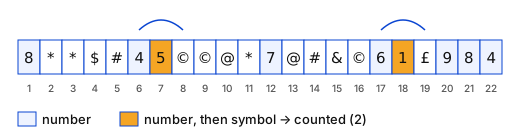
(Left) 8 * * $ # 4 5 © © @ * 7 @ # & © 6 1 £ 9 8 4 (Right)
How many such numbers are there each of which is immediately preceded by a number and also immediately followed by a symbol?
निम्नलिखित संख्या और प्रतीक श्रृंखला को देखिए और नीचे दिए गए प्रश्न का उत्तर दीजिए। गणना केवल बाएँ से दाएँ की जानी है।
(बाएँ) 8 * * $ # 4 5 © © @ * 7 @ # & © 6 1 £ 9 8 4 (दाएँ)
ऐसी कितनी संख्याएँ हैं, जिनमें से प्रत्येक के ठीक पहले एक संख्या है और ठीक बाद में एक प्रतीक है?
  1. A3
  2. B1
  3. C4
  4. D2
Show answer

Concept: Check each number: the element just before it must be a number and the one just after it a symbol.

  1. Number 5 (7th place): preceded by 4, followed by © ✔.
  2. Number 1 (18th place): preceded by 6, followed by £ ✔.
  3. Others fail, e.g. 4 (6th) is preceded by #, 8 (21st) is followed by 4, and the last 4 has nothing after it.

Trick: Scan only the number-number pairs (4 5, 6 1, 9 8, 8 4) and look at what follows the second number.

Answer: (D) 2

अवधारणा: हर संख्या जाँचें: ठीक पहले संख्या और ठीक बाद प्रतीक होना चाहिए।

  1. संख्या 5 (7वाँ स्थान): पहले 4, बाद में © ✔
  2. संख्या 1 (18वाँ स्थान): पहले 6, बाद में £ ✔
  3. बाकी असफल, जैसे 8 (21वाँ) के बाद 4 है, अंतिम 4 के बाद कुछ नहीं।

ट्रिक: केवल संख्या-संख्या जोड़ियाँ (4 5, 6 1, 9 8, 8 4) देखें और दूसरी संख्या के बाद क्या है, जाँचें।

उत्तर: (D) 2

RRB NTPC Graduate CBT 1General Intelligence and ReasoningNumber–symbol seriesRRB NTPC Graduate CBT 1 2024 · 11 Jun Shift 3 →
Q3271.
What should come in place of the question mark (?) in the given series?
302 300 296 290 282 ?
दी गई श्रृंखला में प्रश्न चिह्न (?) के स्थान पर क्या आना चाहिए?
302 300 296 290 282 ?
  1. A268
  2. B272
  3. C270
  4. D274
Show answer

Concept: Look at successive differences.

  1. 302−300=2, 300−296=4, 296−290=6, 290−282=8.
  2. Differences increase by 2, so next difference = 10.
  3. 282−10=272.

Trick: Even numbers subtracted: −2, −4, −6, −8, −10.

Answer: (B) 272

अवधारणा: क्रमागत अंतर देखें।

  1. अंतर: 2,4,6,8
  2. अंतर 2-2 बढ़ रहा है, अगला 10
  3. 282−10=272

ट्रिक: सम संख्याएँ घटाई जा रही हैं: −2, −4, −6, −8, −10।

उत्तर: (B) 272

RRB NTPC Graduate CBT 1General Intelligence and ReasoningNumber seriesRRB NTPC Graduate CBT 1 2024 · 11 Jun Shift 3 →
Q3272.
Based on the English alphabetical order, three of the following four letter-cluster pairs are alike in a certain way and thus form a group. Which letter-cluster pair DOES NOT belong to that group?
(Note: The odd one out is not based on the number of consonants/vowels or their position in the letter-cluster.)
अंग्रेज़ी वर्णमाला क्रम के आधार पर, निम्नलिखित चार अक्षर-समूह युग्मों में से तीन किसी निश्चित प्रकार से एकसमान हैं और इस प्रकार एक समूह बनाते हैं। कौन-सा अक्षर-समूह युग्म उस समूह से संबंधित नहीं है?
(ध्यान दें: असंगत अक्षर-समूह, उस अक्षर-समूह में व्यंजनों/स्वरों की संख्या या उनके स्थान पर आधारित नहीं है।)
  1. ABI-GN
  2. BGN-LS
  3. CHO-MT
  4. DTA-YE
Show answer

Concept: Compare the letter shift from first cluster to second, letter by letter.

  1. BI → GN: B+5 = G, I+5 = N.
  2. GN → LS: G+5 = L, N+5 = S; HO → MT: H+5 = M, O+5 = T.
  3. TA → YE: T+5 = Y but A+4 = E ✘.

Trick: Use positions: T(20)→Y(25) is +5, A(1)→E(5) is only +4.

Answer: (D) TA-YE

अवधारणा: पहले से दूसरे समूह तक हर अक्षर का खिसकाव देखें।

  1. BI → GN: B+5 = G, I+5 = N
  2. GN → LS और HO → MT में भी दोनों +5
  3. TA → YE: T+5 = Y पर A+4 = E ✘

ट्रिक: स्थान मान: A(1)→E(5) केवल +4।

उत्तर: (D) TA-YE

RRB NTPC Graduate CBT 1General Intelligence and ReasoningLetter-cluster odd one outRRB NTPC Graduate CBT 1 2024 · 11 Jun Shift 3 →
Q3273.
In a certain code language ‘QBOE’ is coded as ‘76’ and ‘DWIJ’ is coded as ‘69’. What is the code for ‘YAPC’ in the given language?
एक निश्चित कूट भाषा में ‘QBOE’ को ‘76’ के रूप में कूटबद्ध किया जाता है और ‘DWIJ’ को ‘69’ के रूप में कूटबद्ध किया जाता है। दी गई भाषा में ‘YAPC’ के लिए कूट क्या है?
  1. A74
  2. B69
  3. C72
  4. D70
Show answer

Concept: Code = sum of reverse alphabet positions of the letters + 7 (reverse position: A = 26 … Z = 1).

  1. QBOE: 10+25+12+22=69, 69+7=76 ✔.
  2. DWIJ: 23+4+18+17=62, 62+7=69 ✔.
  3. YAPC: 2+26+11+24=63, 63+7=70.

Trick: Equivalent shortcut: code =115−(sum of forward positions); YAPC: 115−45=70.

Answer: (D) 70

अवधारणा: कोड = अक्षरों के उल्टे वर्णमाला स्थानों का योग + 7 (उल्टा स्थान: A = 26 … Z = 1)।

  1. QBOE: 10+25+12+22=69, 69+7=76 ✔
  2. DWIJ: 23+4+18+17=62, 62+7=69 ✔
  3. YAPC: 2+26+11+24=63, 63+7=70

ट्रिक: शॉर्टकट: कोड =115−(सीधे स्थानों का योग); YAPC: 115−45=70।

उत्तर: (D) 70

RRB NTPC Graduate CBT 1General Intelligence and ReasoningCoding–decoding (letter values)RRB NTPC Graduate CBT 1 2024 · 11 Jun Shift 3 →
Q3274.
P, Q, R, S, T, U and V are sitting around a circular table facing the centre. Only two people sit between P and T when counted from the right of P. Only two people sit between T and V. Only three people sit between P and Q. R sits to the immediate left of U. How many people sit between Q and U when counted from the left of Q?
P, Q, R, S, T, U और V एक वृत्ताकार मेज़ के चारों ओर केंद्र की ओर मुख करके बैठे हैं। P के दाएँ से गिनने पर P और T के बीच केवल दो व्यक्ति बैठे हैं। T और V के बीच केवल दो व्यक्ति बैठे हैं। P और Q के बीच केवल तीन व्यक्ति बैठे हैं। R, U के ठीक बाएँ बैठा है। Q के बाएँ से गिनने पर Q और U के बीच कितने व्यक्ति बैठे हैं?
  1. A2
  2. B3
  3. C1
  4. D4
Show answer

Concept: Facing the centre: right = anticlockwise, left = clockwise.

  1. Fix P. Going right of P, two people between ⇒ T is 3rd seat to P's right.
  2. Two between T and V (V cannot be P) ⇒ V is immediately left of P. Three between P and Q ⇒ Q is 4th to P's right (next to T).
  3. Seats left: R, U, S. R immediately left of U ⇒ R is right next to P, U next to R, S between Q and V.
  4. Counting from Q's left: Q → T → U ⇒ only T between.

Trick: In a 7-seat circle, 'two between' one way means 'three between' the other way – use it to fix seats fast.

Answer: (C) 1

अवधारणा: केंद्र की ओर मुख: दायाँ = वामावर्त (anticlockwise), बायाँ = दक्षिणावर्त।

  1. P तय करें; P के दाएँ से दो के बाद T (P के दाएँ तीसरा)।
  2. T–V के बीच दो (V ≠ P) ⇒ V, P के ठीक बाएँ। P–Q के बीच तीन ⇒ Q, T के बगल में।
  3. R, U के ठीक बाएँ ⇒ P के दाएँ R, फिर U; S, Q और V के बीच।
  4. Q के बाएँ से गिनें: Q → T → U ⇒ बीच में केवल T।

ट्रिक: 7 सीटों में एक ओर 'दो बीच' = दूसरी ओर 'तीन बीच'।

उत्तर: (C) 1

RRB NTPC Graduate CBT 1General Intelligence and ReasoningCircular seating arrangementRRB NTPC Graduate CBT 1 2024 · 11 Jun Shift 3 →
Q3275.
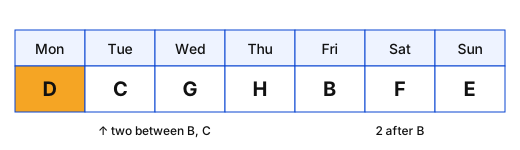
Each of B, C, D, E, F, G and H has an exam on a different day of a week starting from Monday and ending on Sunday of the same week. Only two people have exams after B. Only two people have exams between B and C. F has an exam immediately before E and H has an exam immediately after G. H has an exam on some days before F. On which day D has an exam?
B, C, D, E, F, G और H में से प्रत्येक की परीक्षा एक ही सप्ताह के सोमवार से शुरू होकर रविवार को समाप्त होने वाले सप्ताह के एक अलग दिन है। B के बाद केवल दो व्यक्तियों की परीक्षा है। B और C के बीच केवल दो व्यक्तियों की परीक्षा है। F की परीक्षा E से ठीक पहले है और H की परीक्षा G के ठीक बाद है। H की परीक्षा F से कुछ दिन पहले है। D की परीक्षा किस दिन है?
  1. AThursdayगुरुवार
  2. BMondayसोमवार
  3. CSundayरविवार
  4. DTuesdayमंगलवार
Show answer

Concept: Place the person with a fixed position first, then fit the consecutive pairs.

  1. Only two after B ⇒ B = Friday.
  2. Two between B and C ⇒ C = Tuesday.
  3. Left: Mon, Wed, Thu, Sat, Sun. Pairs G-H and F-E need consecutive days with H before F ⇒ G-H = Wed-Thu, F-E = Sat-Sun.
  4. Remaining day Monday ⇒ D.

Trick: Only two consecutive gaps remain (Wed-Thu, Sat-Sun) – the order clue decides which pair goes where.

Answer: (B) Monday

अवधारणा: पहले निश्चित स्थान वाले को रखें, फिर लगातार दिनों वाली जोड़ियाँ।

  1. B के बाद केवल दो ⇒ B = शुक्रवार
  2. B और C के बीच दो ⇒ C = मंगलवार
  3. बचे: सोम, बुध, गुरु, शनि, रवि; G-H, F-E लगातार और H, F से पहले ⇒ G-H = बुध-गुरु, F-E = शनि-रवि
  4. बचा सोमवार ⇒ D

ट्रिक: केवल दो लगातार खाली जोड़े बचते हैं — क्रम वाला संकेत तय करता है।

उत्तर: (B) Monday (सोमवार)

RRB NTPC Graduate CBT 1General Intelligence and ReasoningScheduling puzzle – days of weekRRB NTPC Graduate CBT 1 2024 · 11 Jun Shift 3 →
Q3276.
In the following triads, each group of letters is related to the subsequent one following a certain logic. Select from the given options, the one that follows the same logic. BORE - EOBR - ORBE
RUST - TURS - USRT
निम्नलिखित त्रिकों में, अक्षरों का प्रत्येक समूह एक निश्चित तर्क का अनुसरण करते हुए अगले समूह से संबंधित है। दिए गए विकल्पों में से उस विकल्प का चयन कीजिए जो उसी तर्क का अनुसरण करता है। BORE - EOBR - ORBE
RUST - TURS - USRT
  1. ATORN - NOTR - ROTN
  2. BJUSL - LUJS - USJL
  3. CDOIR - DIOR - RIOD
  4. DCALE - ACLE - EALC
Show answer

Concept: Number the letters 1-2-3-4 and track their positions.

  1. BORE → EOBR = 4-2-1-3; EOBR → ORBE = 2-4-3-1. RUST → TURS → USRT follows the same.
  2. JUSL → 4-2-1-3 = LUJS ✔; LUJS → 2-4-3-1 = USJL ✔.
  3. TORN → NOTR fits, but NOTR → 2-4-3-1 gives ORTN, not ROTN, so (A) fails; (C), (D) fail at the first step.

Trick: Test only step 1 (4-2-1-3) first – it eliminates most options.

Answer: (B) JUSL - LUJS - USJL

अवधारणा: अक्षरों को 1-2-3-4 क्रमांक देकर स्थान देखें।

  1. BORE → EOBR = 4-2-1-3; EOBR → ORBE = 2-4-3-1; RUST वाला भी यही।
  2. JUSL → LUJS ✔; LUJS → USJL ✔
  3. TORN → NOTR सही, पर अगला ‘ORTN’ होगा, ROTN नहीं; (C), (D) पहले चरण में ही गलत।

ट्रिक: पहले केवल चरण 1 (4-2-1-3) जाँचें — अधिकांश विकल्प हट जाते हैं।

उत्तर: (B) JUSL - LUJS - USJL

RRB NTPC Graduate CBT 1General Intelligence and ReasoningLetter rearrangement analogyRRB NTPC Graduate CBT 1 2024 · 11 Jun Shift 3 →
Q3277.
If 3 is added to each even digit and 2 is added to each odd digit in the number 7135624, what will be the sum of the last two and first two digits in the new number thus formed?
यदि संख्या 7135624 में प्रत्येक सम अंक में 3 जोड़ दिया जाए और प्रत्येक विषम अंक में 2 जोड़ दिया जाए, तो इस प्रकार बनी नई संख्या के अंतिम दो और पहले दो अंकों का योग क्या होगा?
  1. A24
  2. B18
  3. C20
  4. D22
Show answer

Concept: Change each digit by the rule, then add the required digits.

  1. 7135624: odd digits +2 (7→9, 1→3, 3→5, 5→7), even digits +3 (6→9, 2→5, 4→7).
  2. New number: 9357957.
  3. First two: 9+3=12; last two: 5+7=12; total =24.

Trick: Only the four end digits matter: 7, 1 and 2, 4 → 9, 3 and 5, 7.

Answer: (A) 24

अवधारणा: नियम से हर अंक बदलें, फिर आवश्यक अंक जोड़ें।

  1. 7135624: विषम +2 (7→9, 1→3, 3→5, 5→7), सम +3 (6→9, 2→5, 4→7)
  2. नई संख्या: 9357957
  3. पहले दो: 9+3=12; अंतिम दो: 5+7=12; कुल =24

ट्रिक: केवल किनारे के चार अंक बदलें: 7, 1 और 2, 4।

उत्तर: (A) 24

RRB NTPC Graduate CBT 1General Intelligence and ReasoningDigit operationsRRB NTPC Graduate CBT 1 2024 · 11 Jun Shift 3 →
Q3278.
What should come in place of the question mark (?) in the given series based on the English alphabetical order?
TCL ZIR FOX LUD ?
अंग्रेज़ी वर्णमाला क्रम के आधार पर दी गई श्रृंखला में प्रश्न चिह्न (?) के स्थान पर क्या आना चाहिए?
TCL ZIR FOX LUD ?
  1. ARAJ
  2. BAJR
  3. CRJA
  4. DARJ
Show answer

Concept: Track each letter position of the 3-letter groups separately.

  1. 1st letters: T → Z → F → L → R (+6 each, wrapping Z → F).
  2. 2nd letters: C → I → O → U → A (+6).
  3. 3rd letters: L → R → X → D → J (+6).

Trick: All three letters move +6 – shift the last term LUD by 6: RAJ.

Answer: (A) RAJ

अवधारणा: तीन-अक्षर समूहों में हर स्थान अलग देखें।

  1. पहला अक्षर: T → Z → F → L → R (+6, Z के बाद फिर A से)
  2. दूसरा: C → I → O → U → A (+6)
  3. तीसरा: L → R → X → D → J (+6)

ट्रिक: तीनों अक्षर +6 — LUD को 6 आगे खिसकाएँ: RAJ।

उत्तर: (A) RAJ

RRB NTPC Graduate CBT 1General Intelligence and ReasoningLetter seriesRRB NTPC Graduate CBT 1 2024 · 11 Jun Shift 3 →
Q3279.
If + means −, − means ×, × means ÷, and ÷ means +, what will come in place of the question mark (?) in the following equation?
45 – 2 ÷ 9 + 16 × 8 = ?
यदि + का अर्थ −, − का अर्थ ×, × का अर्थ ÷ और ÷ का अर्थ + है, तो निम्नलिखित समीकरण में प्रश्न चिह्न (?) के स्थान पर क्या आएगा?
45 – 2 ÷ 9 + 16 × 8 = ?
  1. A80
  2. B87
  3. C97
  4. D100
Show answer

Concept: Replace each sign by its meaning, then apply BODMAS.

  1. 45−2÷9+16×8 becomes 45×2+9−16÷8.
  2. =90+9−2.
  3. =97.

Trick: Do the swap carefully in one go: −→×, ÷→+, +→−, ×→÷.

Answer: (C) 97

अवधारणा: हर चिह्न को उसके अर्थ से बदलें, फिर BODMAS लगाएँ।

  1. 45−2÷9+16×8→45×2+9−16÷8
  2. =90+9−2
  3. =97

ट्रिक: एक बार में बदलें: −→×, ÷→+, +→−, ×→÷।

उत्तर: (C) 97

RRB NTPC Graduate CBT 1General Intelligence and ReasoningMathematical operations – symbol substitutionRRB NTPC Graduate CBT 1 2024 · 11 Jun Shift 3 →
Q3280.
If 1 is added to each odd digit and 1 is subtracted from each even digit in the number 753814, what will be the sum of all the even digits in the new number thus formed?
यदि संख्या 753814 में प्रत्येक विषम अंक में 1 जोड़ दिया जाए और प्रत्येक सम अंक में से 1 घटा दिया जाए, तो इस प्रकार बनी नई संख्या के सभी सम अंकों का योग क्या होगा?
  1. A20
  2. B24
  3. C16
  4. D18
Show answer

Concept: Apply the rule digit by digit, then pick the even digits of the new number.

  1. 753814: 7→8, 5→6, 3→4, 8→7, 1→2, 4→3.
  2. New number: 864723.
  3. Even digits: 8+6+4+2=20.

Trick: Odd +1 always becomes even and even −1 becomes odd – so the even digits are just (old odd digits + 1).

Answer: (A) 20

अवधारणा: नियम से हर अंक बदलें, फिर नई संख्या के सम अंक जोड़ें।

  1. 753814: 7→8, 5→6, 3→4, 8→7, 1→2, 4→3
  2. नई संख्या: 864723
  3. सम अंक: 8+6+4+2=20

ट्रिक: विषम +1 सदा सम बनता है — नए सम अंक = पुराने विषम अंक + 1।

उत्तर: (A) 20

RRB NTPC Graduate CBT 1General Intelligence and ReasoningDigit operationsRRB NTPC Graduate CBT 1 2024 · 11 Jun Shift 3 →