Question bank

Q&A: practice questions with answers

Search questions on any topic. Filter by exam category, exam, subject and topic, try the question, then open the answer and explanation.

Courses – airGurukul

7,077 questions found.

Q3341.
The product of two consecutive positive integers is 960. If the smaller of these two integers is represented by x, which of the options below will correspond to the equation for finding the value of x?
दो क्रमागत धनात्मक पूर्णांकों का गुणनफल 960 है। यदि इन दोनों पूर्णांकों में से छोटे पूर्णांक को x द्वारा दर्शाया जाए, तो नीचे दिए गए विकल्पों में से कौन-सा x का मान ज्ञात करने के समीकरण के संगत होगा?
  1. Ax2 − x + 960 = 0
  2. Bx2 + x − 960 = 0
  3. Cx2 − x − 960 = 0
  4. Dx2 + x + 960 = 0
Show answer

Concept: Two consecutive integers are x and x+1.

  1. Product: x(x+1)=960.
  2. x2+x=960⇒x2+x−960=0.
  3. Only the form of the equation is asked, so no need to solve it.

Trick: Consecutive → x(x+1); move the constant to the left with a minus sign.

Answer: (B) x2+x−960=0

अवधारणा: दो क्रमागत पूर्णांक x और x+1 हैं।

  1. गुणनफल: x(x+1)=960।
  2. x2+x=960⇒x2+x−960=0।
  3. प्रश्न केवल समीकरण का रूप पूछ रहा है।

ट्रिक: क्रमागत → x(x+1); अचर को बाईं ओर ऋण चिह्न के साथ ले जाएँ।

उत्तर: (B) x2+x−960=0
RRB NTPC Graduate CBT 1MathematicsQuadratic equationsRRB NTPC Graduate CBT 1 2024 · 11 Jun Shift 2 →
Q3342.
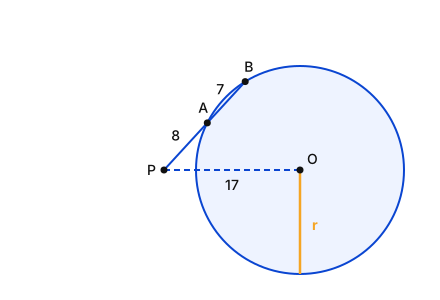
P is a point outside a circle and is 17 cm away from its centre. A secant drawn from the point P intersects the circle at points A and B in such a way that PA = 8 cm and AB = 7 cm, where PB > PA. The radius of the circle is:
P एक वृत्त के बाहर स्थित एक बिंदु है और इसके केंद्र से 17 cm दूर है। बिंदु P से खींची गई एक छेदक रेखा वृत्त को बिंदुओं A और B पर इस प्रकार प्रतिच्छेद करती है कि PA = 8 cm और AB = 7 cm है, जहाँ PB > PA है। वृत्त की त्रिज्या है:
  1. A13 cm
  2. B12 cm
  3. C15 cm
  4. D14 cm
Show answer

Concept: Secant–power theorem: for external point P, PA×PB=PO2−r2.

  1. PB=PA+AB=8+7=15cm.
  2. PA×PB=8×15=120.
  3. 172−r2=120⇒r2=289−120=169⇒r=13cm.

Trick: PA·PB = (tangent length)2 = d2−r2.

Answer: (A) 13 cm

अवधारणा: छेदक प्रमेय: बाह्य बिन्दु P के लिए PA×PB=PO2−r2।

  1. PB=PA+AB=8+7=15cm।
  2. PA×PB=8×15=120।
  3. 172−r2=120⇒r2=169⇒r=13cm।

ट्रिक: PA·PB = (स्पर्श रेखा की लंबाई)2 = d2−r2।

उत्तर: (A) 13 cm

RRB NTPC Graduate CBT 1MathematicsGeometry – circlesRRB NTPC Graduate CBT 1 2024 · 11 Jun Shift 2 →
Q3343.
Simplify: 34÷{4×(99 of 98)}
सरल कीजिए: 34÷{4×(99 of 98)}
  1. A689
  2. B619
  3. C719
  4. D769
Show answer

Concept: Follow BODMAS: brackets (with 'of') first, then division.

  1. 99 of 98=1×98=98.
  2. 4×98=92.
  3. 34÷92=34×29=689.

Trick: 99=1 – spot such simplifications at a glance.

Answer: (A) 689

अवधारणा: BODMAS: पहले कोष्ठक ('of' सहित), फिर भाग।

  1. 99 of 98=98।
  2. 4×98=92।
  3. 34÷92=34×29=689।

ट्रिक: 99=1 जैसे सरलीकरण तुरंत पहचानें।

उत्तर: (A) 689

RRB NTPC Graduate CBT 1MathematicsSimplificationRRB NTPC Graduate CBT 1 2024 · 11 Jun Shift 2 →
Q3344.
The average of three numbers is 23. If two numbers are 11 and 25, the third number is:
तीन संख्याओं का औसत 23 है। यदि दो संख्याएँ 11 और 25 हैं, तो तीसरी संख्या है:
  1. A34
  2. B32
  3. C35
  4. D33
Show answer

Concept: Sum of numbers = average × count.

  1. Sum =23×3=69.
  2. Third number =69−(11+25)=69−36=33.

Trick: Deviation method: 11 is −12, 25 is +2 from 23 → third =23+10=33.

Answer: (D) 33

अवधारणा: संख्याओं का योग = औसत × संख्या।

  1. योग =23×3=69।
  2. तीसरी संख्या =69−36=33।

ट्रिक: विचलन विधि: 11 का −12, 25 का +2 → तीसरी =23+10=33।

उत्तर: (D) 33

RRB NTPC Graduate CBT 1MathematicsAverageRRB NTPC Graduate CBT 1 2024 · 11 Jun Shift 2 →
Q3345.
A trader lost 5% by selling a shirt for ₹950. He will gain x% by selling it for ₹1,360. The value of x is:
एक व्यापारी को एक कमीज़ ₹950 में बेचने पर 5% की हानि हुई। इसे ₹1,360 में बेचने पर उसे x% का लाभ होगा। x का मान है:
  1. A51
  2. B46
  3. C36
  4. D26
Show answer

Concept: SP at loss =CP×100−loss%100.

  1. CP=950×10095=1000.
  2. Gain =1360−1000=360.
  3. x=3601000×100=36%.

Trick: 5% loss on ₹950 → CP is a round ₹1000; gain is then read directly.

Answer: (C) 36

अवधारणा: हानि पर SP =CP×100−हानि%100।

  1. CP=950×10095=1000।
  2. लाभ =1360−1000=360।
  3. x=3601000×100=36%।

ट्रिक: ₹950 पर 5% हानि → CP = ₹1000; लाभ% सीधे पढ़ें।

उत्तर: (C) 36

RRB NTPC Graduate CBT 1MathematicsProfit and lossRRB NTPC Graduate CBT 1 2024 · 11 Jun Shift 2 →
Q3346.
The sum of the age of A and 4 times the age of B is 34 years. When 3 times the age of A is added to 7 times the age of B, the result is 97 years. The sum of the ages (in years) of A and B is:
A की आयु और B की आयु के 4 गुने का योग 34 वर्ष है। जब A की आयु के 3 गुने में B की आयु के 7 गुने को जोड़ा जाता है, तो परिणाम 97 वर्ष होता है। A और B की आयु का योग (वर्षों में) है:
  1. A28
  2. B31
  3. C33
  4. D30
Show answer

Concept: Form two equations and eliminate one variable.

  1. A+4B=34 … (i); 3A+7B=97 … (ii).
  2. (i) ×3: 3A+12B=102; subtract (ii): 5B=5⇒B=1.
  3. A=34−4=30; A+B=31.

Trick: Multiply the equation with coefficient 1 to match the other's A.

Answer: (B) 31

अवधारणा: दो समीकरण बनाकर एक चर हटाएँ।

  1. A+4B=34 … (i); 3A+7B=97 … (ii)।
  2. (i) ×3: 3A+12B=102; (ii) घटाने पर 5B=5⇒B=1।
  3. A=30; A+B=31।

ट्रिक: जिस समीकरण में गुणांक 1 है उसे गुणा कर दूसरे से मिलाएँ।

उत्तर: (B) 31

RRB NTPC Graduate CBT 1MathematicsLinear equations – agesRRB NTPC Graduate CBT 1 2024 · 11 Jun Shift 2 →
Q3347.
The population of a village was 1,10,000. It increased by 5% in the first year and increased by 25% in the second year. Its population after two years is _______.
एक गाँव की जनसंख्या 1,10,000 थी। पहले वर्ष में इसमें 5% की वृद्धि हुई और दूसरे वर्ष में 25% की वृद्धि हुई। दो वर्ष बाद इसकी जनसंख्या _______ है।
  1. A1,44,375
  2. B1,37,500
  3. C1,15,500
  4. D1,43,000
Show answer

Concept: Successive increases multiply: P×(1+r1100)(1+r2100).

  1. After year 1: 110000×105100=115500.
  2. After year 2: 115500×125100=144375.

Trick: 25%=14: add a quarter, 115500+28875=144375.

Answer: (A) 1,44,375

अवधारणा: क्रमागत वृद्धि गुणा होती है: P×(1+r1100)(1+r2100)।

  1. पहले वर्ष बाद: 110000×105100=115500।
  2. दूसरे वर्ष बाद: 115500×125100=144375।

ट्रिक: 25%=14: चौथाई जोड़ें, 115500+28875=144375।

उत्तर: (A) 1,44,375

RRB NTPC Graduate CBT 1MathematicsPopulation growthRRB NTPC Graduate CBT 1 2024 · 11 Jun Shift 2 →
Q3348.
T travelled 576 km, 630 km and 315 km at the speeds of 16 km/hr, 7 km/hr and 9 km/hr, respectively. Find his average speed in km/hr.
T ने क्रमशः 16 km/hr, 7 km/hr और 9 km/hr की चाल से 576 km, 630 km और 315 km की यात्रा की। km/hr में उसकी औसत चाल ज्ञात कीजिए।
  1. A1078161
  2. B1070161
  3. C972161
  4. D973161
Show answer

Concept: Average speed =total distancetotal time.

  1. Times: 57616=36, 6307=90, 3159=35 → total 161h.
  2. Distance =576+630+315=1521km.
  3. 1521161=972161km/h (since 161×9=1449).

Trick: Never average the speeds; compute each time separately.

Answer: (C) 972161

अवधारणा: औसत चाल =कुल दूरीकुल समय।

  1. समय: 57616=36, 6307=90, 3159=35 → कुल 161h।
  2. दूरी =1521km।
  3. 1521161=972161km/h (161×9=1449)।

ट्रिक: चालों का सीधा औसत कभी न लें; हर भाग का समय अलग निकालें।

उत्तर: (C) 972161

RRB NTPC Graduate CBT 1MathematicsAverage speedRRB NTPC Graduate CBT 1 2024 · 11 Jun Shift 2 →
Q3349.
After allowing a discount of 80%, the value of an oven is ₹5,180. If no discount is allowed, then the shopkeeper gains 48%. Find the cost price (in ₹) of the oven.
80% की छूट देने के बाद, एक ओवन का मूल्य ₹5,180 है। यदि कोई छूट न दी जाए, तो दुकानदार को 48% का लाभ होता है। ओवन का क्रय मूल्य (₹ में) ज्ञात कीजिए।
  1. A17,502
  2. B17,503
  3. C17,501
  4. D17,500
Show answer

Concept: SP =MP×100−d100; without discount SP = MP.

  1. MP=51800.20=25900.
  2. Selling at MP gives 48% gain: CP×1.48=25900.
  3. CP=259001.48=17500.

Trick: 1.48=3725: 25900×2537=700×25=17500.

Answer: (D) 17,500

अवधारणा: SP =MP×100−d100; बिना छूट SP = MP।

  1. MP=51800.20=25900।
  2. MP पर 48% लाभ: CP×1.48=25900।
  3. CP=259001.48=17500।

ट्रिक: 1.48=3725: 25900×2537=17500।

उत्तर: (D) 17,500

RRB NTPC Graduate CBT 1MathematicsDiscount and profitRRB NTPC Graduate CBT 1 2024 · 11 Jun Shift 2 →
Q3350.
The mean proportional between (18+82) and (15−22) is:
(18+82) और (15−22) का मध्यानुपाती है:
  1. A238+842
  2. B238+362
  3. C238+1102
  4. D238+1202
Show answer

Concept: Mean proportional of a and b is ab.

  1. (18+82)(15−22)=270−362+1202−16×2.
  2. =270−32+842=238+842.
  3. Mean proportional =238+842.

Trick: All options share 238; only the 2 term matters: 120−36=84.

Answer: (A) 238+842

अवधारणा: a व b का मध्यानुपाती ab होता है।

  1. (18+82)(15−22)=270−362+1202−32।
  2. =238+842।
  3. मध्यानुपाती =238+842।

ट्रिक: सभी विकल्पों में 238 है; केवल 2 पद देखें: 120−36=84।

उत्तर: (A) 238+842

RRB NTPC Graduate CBT 1MathematicsSurds – mean proportionalRRB NTPC Graduate CBT 1 2024 · 11 Jun Shift 2 →
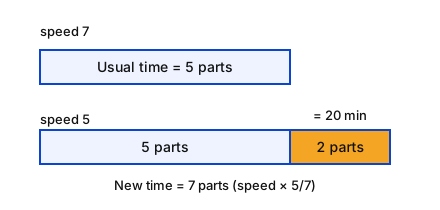
Q3351.
Walking at 57 of his normal speed, Manish is 20 minutes late in reaching his office.
The usual time taken by him to cover the distance between his home and his office is:
अपनी सामान्य चाल की 57 चाल से चलने पर, मनीष अपने कार्यालय पहुँचने में 20 मिनट देरी से पहुँचता है।
उसके द्वारा अपने घर और कार्यालय के बीच की दूरी तय करने में लगने वाला सामान्य समय है:
  1. A56 minutes56 मिनट
  2. B42 minutes42 मिनट
  3. C50 minutes50 मिनट
  4. D49 minutes49 मिनट
Show answer

Concept: For fixed distance, time ∝1speed.

  1. Speed ratio new : usual =5:7, so time ratio =7:5.
  2. Extra time =7−5=2 parts =20 minutes → 1 part =10 minutes.
  3. Usual time =5 parts =50 minutes.

Trick: Speed ab of normal and late by t → usual time =atb−a=5×202.

Answer: (C) 50 minutes

अवधारणा: दूरी स्थिर हो तो समय ∝1चाल।

  1. चाल अनुपात नई : सामान्य =5:7, अतः समय अनुपात =7:5।
  2. अतिरिक्त समय =2 भाग =20 मिनट → 1 भाग =10 मिनट।
  3. सामान्य समय =5 भाग =50 मिनट।

ट्रिक: सामान्य चाल का ab और t देर → सामान्य समय =atb−a=5×202।

उत्तर: (C) 50 मिनट

RRB NTPC Graduate CBT 1MathematicsSpeed, time and distanceRRB NTPC Graduate CBT 1 2024 · 11 Jun Shift 2 →
Q3352.
Given that 1460.93 = x, 1460.22 = y and xz = y7, then the value of z is close to:
यदि 1460.93 = x, 1460.22 = y और xz = y7 है, तो z का मान लगभग है:
  1. A2.61
  2. B3.6
  3. C1.66
  4. D5.05
Show answer

Concept: Write everything as powers of 146 and compare exponents.

  1. xz=1460.93z and y7=1460.22×7=1461.54.
  2. 0.93z=1.54⇒z=1.540.93≈1.66.

Trick: Same base → equate exponents.

Answer: (C) 1.66

अवधारणा: सबको 146 की घात के रूप में लिखें और घातांक बराबर करें।

  1. xz=1460.93z और y7=1461.54।
  2. 0.93z=1.54⇒z=1.540.93≈1.66।

ट्रिक: समान आधार → घातांक बराबर।

उत्तर: (C) 1.66

RRB NTPC Graduate CBT 1MathematicsIndicesRRB NTPC Graduate CBT 1 2024 · 11 Jun Shift 2 →
Q3353.
The average of Anwar's marks in seven subjects is 75. His average in six subjects excluding Science is 70. How many marks did he get in Science?
सात विषयों में अनवर के अंकों का औसत 75 है। विज्ञान को छोड़कर छह विषयों में उसका औसत 70 है। उसे विज्ञान में कितने अंक प्राप्त हुए?
  1. A105
  2. B107
  3. C104
  4. D106
Show answer

Concept: Total = average × count; difference of totals gives the excluded value.

  1. Total of 7 subjects =75×7=525.
  2. Total of 6 subjects =70×6=420.
  3. Science =525−420=105.

Trick: Science =75+6×(75−70)=105.

Answer: (A) 105

अवधारणा: कुल = औसत × संख्या; दोनों कुल का अंतर हटाया गया मान है।

  1. 7 विषयों का कुल =525।
  2. 6 विषयों का कुल =420।
  3. विज्ञान =525−420=105।

ट्रिक: विज्ञान =75+6×(75−70)=105।

उत्तर: (A) 105

RRB NTPC Graduate CBT 1MathematicsAverageRRB NTPC Graduate CBT 1 2024 · 11 Jun Shift 2 →
Q3354.
Which of the following ratios is the greatest?
निम्नलिखित में से कौन-सा अनुपात सबसे बड़ा है?
  1. A33 : 51
  2. B37 : 64
  3. C32 : 86
  4. D26 : 59
Show answer

Concept: Convert each ratio to a decimal (or compare with 12).

  1. 3351≈0.647, 3764≈0.578.
  2. 3286≈0.372, 2659≈0.441.
  3. Greatest: 33:51.

Trick: 3286 and 2659 are below 12; between the other two, 33:51 has larger numerator and smaller denominator.

Answer: (A) 33:51

अवधारणा: प्रत्येक अनुपात को दशमलव में बदलें (या 12 से तुलना करें)।

  1. 3351≈0.647, 3764≈0.578।
  2. 3286≈0.372, 2659≈0.441।
  3. सबसे बड़ा: 33:51।

ट्रिक: 3286, 2659 आधे से कम; शेष में 33:51 का अंश लगभग बराबर, हर छोटा।

उत्तर: (A) 33:51

RRB NTPC Graduate CBT 1MathematicsComparison of ratiosRRB NTPC Graduate CBT 1 2024 · 11 Jun Shift 2 →
Q3355.
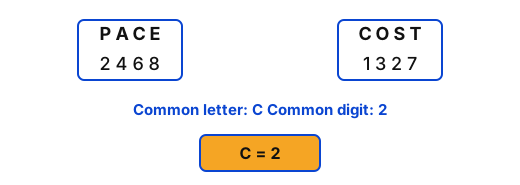
In a certain code language, ‘PACE’ is coded as ‘2468’ and ‘COST’ is coded as ‘1327’. What is the code for ‘C’ in the given code language?
एक निश्चित कूट भाषा में, ‘PACE’ को ‘2468’ के रूप में कूटबद्ध किया जाता है और ‘COST’ को ‘1327’ के रूप में कूटबद्ध किया जाता है। दी गई कूट भाषा में ‘C’ के लिए कूट क्या है?
  1. A6
  2. B1
  3. C7
  4. D2
Show answer

Concept: A letter common to two words gets the digit common to both codes.

  1. PACE → 2468 and COST → 1327.
  2. Common letter: C. Common digit: 2.
  3. So C = 2.

Trick: Match common letters with common digits – no need to decode the full word.

Answer: (D) 2

अवधारणा: दोनों शब्दों में उभयनिष्ठ अक्षर का कोड, दोनों कोडों में उभयनिष्ठ अंक होता है।

  1. PACE → 2468 और COST → 1327।
  2. उभयनिष्ठ अक्षर: C; उभयनिष्ठ अंक: 2।
  3. अतः C = 2।

ट्रिक: उभयनिष्ठ अक्षर को उभयनिष्ठ अंक से मिलाइए – पूरा शब्द डिकोड करने की ज़रूरत नहीं।

उत्तर: (D) 2

RRB NTPC Graduate CBT 1General Intelligence and ReasoningCoding–DecodingRRB NTPC Graduate CBT 1 2024 · 11 Jun Shift 2 →
Q3356.
If '+' means '−', '−' means '×', '×' means '÷' and '÷' means '+', then what will come in place of the question mark (?) in the following equation?
55 – 8 ÷ 3 + 15 × 5 = ?
यदि ‘+’ का अर्थ ‘−’ है, ‘−’ का अर्थ ‘×’ है, ‘×’ का अर्थ ‘÷’ है और ‘÷’ का अर्थ ‘+’ है, तो निम्नलिखित समीकरण में प्रश्न चिह्न (?) के स्थान पर क्या आएगा?
55 – 8 ÷ 3 + 15 × 5 = ?
  1. A440
  2. B400
  3. C420
  4. D450
Show answer

Concept: Replace each sign as instructed, then apply BODMAS.

  1. 55−8÷3+15×5 becomes 55×8+3−15÷5.
  2. =440+3−3.
  3. =440.

Trick: Write the new expression fully before calculating – most errors come from mixing old and new signs.

Answer: (A) 440

अवधारणा: निर्देशानुसार चिह्न बदलें, फिर BODMAS लगाएँ।

  1. 55−8÷3+15×5 बदलकर 55×8+3−15÷5।
  2. =440+3−3।
  3. =440।

ट्रिक: गणना से पहले नया व्यंजक पूरा लिख लें – पुराने व नए चिह्न मिलाने से गलती होती है।

उत्तर: (A) 440

RRB NTPC Graduate CBT 1General Intelligence and ReasoningMathematical OperationsRRB NTPC Graduate CBT 1 2024 · 11 Jun Shift 2 →
Q3357.
This question is based on the five, three-digit numbers given below.
(Left) 236 758 230 563 263 (Right)
(Example- 697 – First digit = 6, second digit = 9 and third digit = 7)
(NOTE: All operations to be done from left to right.)
What will be the resultant if the first digit of the lowest number is subtracted from the first digit of the highest number?
यह प्रश्न नीचे दी गई तीन-अंकीय पाँच संख्याओं पर आधारित है।
(बाएँ) 236 758 230 563 263 (दाएँ)
(उदाहरण- 697 – पहला अंक = 6, दूसरा अंक = 9 और तीसरा अंक = 7)
(नोट: सभी संक्रियाएँ बाएँ से दाएँ की जानी हैं।)
यदि सबसे छोटी संख्या के पहले अंक को सबसे बड़ी संख्या के पहले अंक में से घटाया जाए, तो परिणाम क्या होगा?
  1. A5
  2. B6
  3. C8
  4. D4
Show answer

Concept: Identify the highest and lowest numbers, then pick the required digits.

  1. Numbers: 236, 758, 230, 563, 263.
  2. Highest = 758 (first digit 7); lowest = 230 (first digit 2).
  3. 7−2=5.

Trick: Compare only first digits to find the extremes; for ties (236 vs 230) look at the next digit.

Answer: (A) 5

अवधारणा: सबसे बड़ी और सबसे छोटी संख्या पहचानें, फिर आवश्यक अंक लें।

  1. संख्याएँ: 236, 758, 230, 563, 263।
  2. सबसे बड़ी = 758 (पहला अंक 7); सबसे छोटी = 230 (पहला अंक 2)।
  3. 7−2=5।

ट्रिक: पहले अंक से तुलना करें; बराबर हो (236 और 230) तो अगला अंक देखें।

उत्तर: (A) 5

RRB NTPC Graduate CBT 1General Intelligence and ReasoningNumber ArrangementRRB NTPC Graduate CBT 1 2024 · 11 Jun Shift 2 →
Q3358.
Which of the following letter-clusters should replace # and % so that the pattern and relationship followed between the letter-cluster pair on the left side of :: is the same as that on the right side of :: ?
# : NHP :: RLT : %
निम्नलिखित में से कौन-से अक्षर-समूह # और % को प्रतिस्थापित करेंगे ताकि :: के बाईं ओर के अक्षर-समूह युग्म के बीच अनुसरित पैटर्न और संबंध वही हो जो :: के दाईं ओर है?
# : NHP :: RLT : %
  1. A# = OIR , % = QKS
  2. B# = OIQ , % = QLS
  3. C# = OIQ , % = QKR
  4. D# = OIQ , % = QKS
Show answer

Concept: Find the letter shift from the complete pair and apply the same shift.

  1. RLT → %: try −1 on each letter: R→Q, L→K, T→S ⇒ % = QKS.
  2. So # → NHP also by −1: # must be O I Q (O−1=N, I−1=H, Q−1=P).
  3. # = OIQ, % = QKS.

Trick: Check the option whose % gives the same shift as # – only option D is consistent.

Answer: (D) # = OIQ, % = QKS

अवधारणा: युग्म में अक्षरों का खिसकाव (shift) ज्ञात करें और वही लागू करें।

  1. RLT → %: प्रत्येक अक्षर में −1: R→Q, L→K, T→S ⇒ % = QKS।
  2. # → NHP भी −1 से: # = OIQ (O−1=N, I−1=H, Q−1=P)।
  3. # = OIQ, % = QKS।

ट्रिक: वही विकल्प चुनें जिसमें # और % दोनों का shift समान हो – केवल विकल्प D।

उत्तर: (D) # = OIQ, % = QKS

RRB NTPC Graduate CBT 1General Intelligence and ReasoningLetter AnalogyRRB NTPC Graduate CBT 1 2024 · 11 Jun Shift 2 →
Q3359.
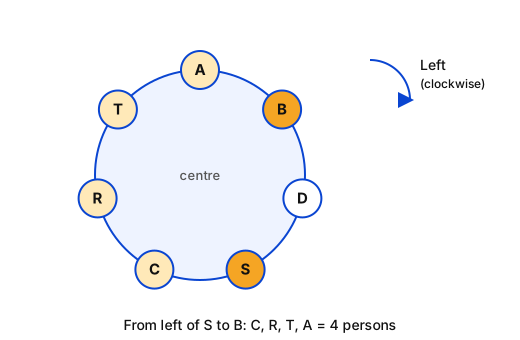
A, B, C, D, R, S and T are sitting around a circular table facing the centre of the table. B sits fourth to the right of R. Only two people sit between T and D when counted from the left of T. A sits third to the left of C. S is an immediate neighbour of C and D. How many people sit between B and S when counted from the left of S?
A, B, C, D, R, S और T एक वृत्ताकार मेज़ के चारों ओर मेज़ के केंद्र की ओर मुख करके बैठे हैं। B, R के दाईं ओर चौथे स्थान पर बैठा है। T के बाईं ओर से गिनने पर T और D के बीच केवल दो व्यक्ति बैठे हैं। A, C के बाईं ओर तीसरे स्थान पर बैठा है। S, C और D का निकटतम पड़ोसी है। S के बाईं ओर से गिनने पर B और S के बीच कितने व्यक्ति बैठे हैं?
  1. ATwoदो
  2. BOneएक
  3. CThreeतीन
  4. DFourचार
Show answer

Concept: Facing the centre, "left" means clockwise and "right" means anticlockwise.

  1. S is between C and D; A is third to the left of C.
  2. T and D have two people between them (from left of T); B is fourth to the right of R.
  3. Only arrangement (clockwise): A, B, D, S, C, R, T.
  4. From the left of S going to B: C, R, T, A ⇒ 4 people.

Trick: Start with fixed blocks (C–S–D) and place the others around them.

Answer: (D) Four

अवधारणा: केंद्र की ओर मुख होने पर "बाएँ" = घड़ी की दिशा (clockwise), "दाएँ" = घड़ी की विपरीत दिशा।

  1. S, C और D के बीच है; A, C के बाएँ तीसरे स्थान पर है।
  2. T के बाएँ से गिनने पर T और D के बीच दो व्यक्ति; B, R के दाएँ चौथे स्थान पर है।
  3. एकमात्र व्यवस्था (clockwise): A, B, D, S, C, R, T।
  4. S के बाएँ से B तक: C, R, T, A ⇒ 4 व्यक्ति।

ट्रिक: पहले निश्चित ब्लॉक (C–S–D) रखें, फिर बाकी को उसके चारों ओर बैठाएँ।

उत्तर: (D) चार

RRB NTPC Graduate CBT 1General Intelligence and ReasoningCircular Seating ArrangementRRB NTPC Graduate CBT 1 2024 · 11 Jun Shift 2 →
Q3360.
This question is based on the five, three-digit numbers given below.
(Left) 144 743 290 258 799 (Right)
(Example- 697 – First digit = 6, second digit = 9 and third digit = 7)
(NOTE: All operations to be done from left to right.)
What will be the resultant if the second digit of the highest number is subtracted from the third digit of the lowest number?
यह प्रश्न नीचे दी गई तीन-अंकीय पाँच संख्याओं पर आधारित है।
(बाएँ) 144 743 290 258 799 (दाएँ)
(उदाहरण- 697 – पहला अंक = 6, दूसरा अंक = 9 और तीसरा अंक = 7)
(नोट: सभी संक्रियाएँ बाएँ से दाएँ की जानी हैं।)
यदि सबसे बड़ी संख्या के दूसरे अंक को सबसे छोटी संख्या के तीसरे अंक में से घटाया जाए, तो परिणाम क्या होगा?
  1. A−5
  2. B−4
  3. C−6
  4. D−2
Show answer

Concept: Locate the highest and lowest numbers, then pick the digits asked.

  1. Numbers: 144, 743, 290, 258, 799.
  2. Highest = 799 → second digit 9. Lowest = 144 → third digit 4.
  3. 4−9=−5.

Trick: Read the order carefully: "A subtracted from B" means B−A.

Answer: (A) −5

अवधारणा: सबसे बड़ी और सबसे छोटी संख्या ढूँढें, फिर माँगे गए अंक लें।

  1. संख्याएँ: 144, 743, 290, 258, 799।
  2. सबसे बड़ी = 799 → दूसरा अंक 9; सबसे छोटी = 144 → तीसरा अंक 4।
  3. 4−9=−5।

ट्रिक: "A को B में से घटाया" का अर्थ है B−A।

उत्तर: (A) −5

RRB NTPC Graduate CBT 1General Intelligence and ReasoningNumber ArrangementRRB NTPC Graduate CBT 1 2024 · 11 Jun Shift 2 →