Question bank

Q&A: practice questions with answers

Search questions on any topic. Filter by exam category, exam, subject and topic, try the question, then open the answer and explanation.

Courses – airGurukul

7,077 questions found.

Q3361.
What should come in place of the question mark (?) in the given series?
402 400 396 390 382 ?
दी गई श्रृंखला में प्रश्न चिह्न (?) के स्थान पर क्या आना चाहिए?
402 400 396 390 382 ?
  1. A376
  2. B370
  3. C372
  4. D374
Show answer

Concept: Look at successive differences.

  1. 402−2=400, 400−4=396, 396−6=390, 390−8=382.
  2. Differences increase by 2: next is −10.
  3. 382−10=372.

Trick: Differences 2, 4, 6, 8, 10 – consecutive even numbers.

Answer: (C) 372

अवधारणा: क्रमागत अंतर देखें।

  1. 402−2=400, 400−4=396, 396−6=390, 390−8=382।
  2. अंतर 2-2 से बढ़ रहे हैं: अगला −10।
  3. 382−10=372।

ट्रिक: अंतर 2, 4, 6, 8, 10 – क्रमागत सम संख्याएँ।

उत्तर: (C) 372
RRB NTPC Graduate CBT 1General Intelligence and ReasoningNumber SeriesRRB NTPC Graduate CBT 1 2024 · 11 Jun Shift 2 →
Q3362.
In this question, a group of numbers is coded by using letters and symbols as per the table given below and the conditions which follow.
Number7823456
CodeZQ#@%$U
Conditions:
1. If the 1st and 2nd digits are even, both are to be coded as ‘A’.
2. If the 1st and last digits are odd, both are to be coded as the code for the 1st digit.
3. If the 3rd and 4th digits are even, their codes are to be interchanged.
What is the correct combination of codes (by following only the applicable condition(s)) for the given digits?
48719
इस प्रश्न में संख्याओं के एक समूह को नीचे दी गई तालिका और उसके बाद दी गई शर्तों के अनुसार अक्षरों और प्रतीकों द्वारा कूटबद्ध किया गया है।
Number7823456
CodeZQ#@%$U
शर्तें:
1. यदि पहला और दूसरा अंक सम हैं, तो दोनों को ‘A’ के रूप में कूटबद्ध किया जाना है।
2. यदि पहला और अंतिम अंक विषम हैं, तो दोनों को पहले अंक के कोड के रूप में कूटबद्ध किया जाना है।
3. यदि तीसरा और चौथा अंक सम हैं, तो उनके कोड आपस में बदल दिए जाने हैं।
दिए गए अंकों के लिए कोड का सही संयोजन (केवल लागू शर्त/शर्तों का पालन करते हुए) क्या है?
48719
  1. AQ Q Z J S
  2. B% Q Z J S
  3. CA A Z J S
  4. D% % Z J S
Show answer

Concept: Check each condition on the digits 4 8 7 1 9 and apply only the ones that fit; the codes for 1 and 9 (J and S) are read from the options.

  1. Condition 1: 1st digit 4 and 2nd digit 8 are both even → both coded as A. ✔
  2. Condition 2: 1st digit 4 is even → does not apply.
  3. Condition 3: 3rd digit 7 and 4th digit 1 are odd → does not apply.
  4. Remaining digits use the table: 7 → Z, 1 → J, 9 → S.
Digit48719
CodeAAZJS

Trick: Test the conditions first; usually only one fits – here the 'both even' start immediately gives A A, so only option (C) survives.

Answer: (C) A A Z J S

अवधारणा: अंक 4 8 7 1 9 पर हर शर्त जाँचें और केवल लागू शर्त अपनाएँ; 1 और 9 के कोड (J और S) विकल्पों से मिलते हैं।

  1. शर्त 1: पहला अंक 4 और दूसरा अंक 8 दोनों सम हैं → दोनों का कोड A। ✔
  2. शर्त 2: पहला अंक 4 सम है → लागू नहीं।
  3. शर्त 3: तीसरा अंक 7 और चौथा अंक 1 विषम हैं → लागू नहीं।
  4. बाकी अंक तालिका से: 7 → Z, 1 → J, 9 → S।
अंक48719
कोडAAZJS

ट्रिक: पहले शर्तें जाँचें – शुरू के दोनों अंक सम होने से तुरंत A A मिलता है, और केवल विकल्प (C) बचता है।

उत्तर: (C) A A Z J S

RRB NTPC Graduate CBT 1General Intelligence and ReasoningCoding-Decoding (Conditional)RRB NTPC Graduate CBT 1 2024 · 11 Jun Shift 2 →
Q3363.
What should come in place of the question mark (?) in the given series based on the English alphabetical order?
ZYB GFI NMP UTW ?
अंग्रेज़ी वर्णमाला क्रम के आधार पर दी गई श्रृंखला में प्रश्न चिह्न (?) के स्थान पर क्या आना चाहिए?
ZYB GFI NMP UTW ?
  1. ABDA
  2. BADB
  3. CBAD
  4. DABD
Show answer

Concept: Track each position of the clusters separately (A = 1 … Z = 26, cycling after Z).

  1. 1st letters: Z, G, N, U → each +7 ⇒ U + 7 = B.
  2. 2nd letters: Y, F, M, T → each +7 ⇒ T + 7 = A.
  3. 3rd letters: B, I, P, W → each +7 ⇒ W + 7 = D.
  4. Next term: BAD.

Trick: Inside each term, 2nd letter = 1st − 1 and 3rd = 1st + 2 (Z Y B, G F I). U + 7 = B ⇒ B A D.

Answer: (C) BAD

अवधारणा: प्रत्येक स्थान के अक्षर अलग-अलग देखें (A = 1 … Z = 26, Z के बाद फिर A)।

  1. पहले अक्षर: Z, G, N, U → हर बार +7 ⇒ U + 7 = B।
  2. दूसरे अक्षर: Y, F, M, T → +7 ⇒ T + 7 = A।
  3. तीसरे अक्षर: B, I, P, W → +7 ⇒ W + 7 = D।
  4. अगला पद: BAD।

ट्रिक: हर पद में दूसरा अक्षर = पहला − 1 और तीसरा = पहला + 2 (Z Y B, G F I)। U + 7 = B ⇒ B A D।

उत्तर: (C) BAD

RRB NTPC Graduate CBT 1General Intelligence and ReasoningLetter SeriesRRB NTPC Graduate CBT 1 2024 · 11 Jun Shift 2 →
Q3364.
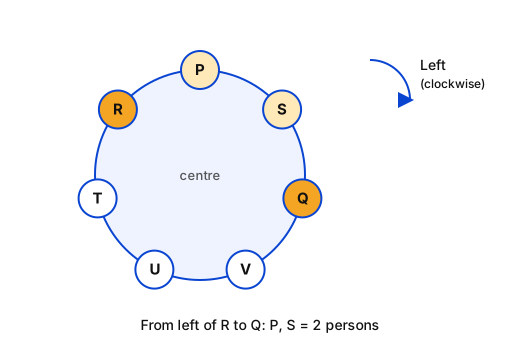
P, Q, R, S, T, U and V are sitting around a circular table facing the centre. Only two people sit between T and Q when counted from the left of Q. U sits third to the left of S. P sits to the immediate right of S. P sits second to the left of T. V is an immediate neighbour of U. How many people sit between Q and R when counted from the left of R?
P, Q, R, S, T, U और V एक वृत्ताकार मेज़ के चारों ओर केंद्र की ओर मुख करके बैठे हैं। Q के बाईं ओर से गिनने पर T और Q के बीच केवल दो व्यक्ति बैठे हैं। U, S के बाईं ओर तीसरे स्थान पर बैठा है। P, S के ठीक दाईं ओर बैठा है। P, T के बाईं ओर दूसरे स्थान पर बैठा है। V, U का निकटतम पड़ोसी है। R के बाईं ओर से गिनने पर Q और R के बीच कितने व्यक्ति बैठे हैं?
  1. A4
  2. B2
  3. C3
  4. D1
Show answer

Concept: Facing the centre, left = clockwise, right = anticlockwise.

  1. P is immediate right of S, and P is second to the left of T ⇒ (clockwise) P, S, _, _, _, T.
  2. U is third to the left of S ⇒ U sits just before T; V is next to U.
  3. Two people between T and Q from the left of Q ⇒ Q sits right after S; V then sits between Q and U; R fills the last seat.
  4. Clockwise: P, S, Q, V, U, T, R. From the left of R to Q: P, S ⇒ 2.

Trick: Fix S–P first because two statements link them with T.

Answer: (B) 2

अवधारणा: केंद्र की ओर मुख होने पर बाएँ = घड़ी की दिशा (clockwise), दाएँ = विपरीत दिशा।

  1. P, S के ठीक दाएँ और T के बाएँ दूसरे स्थान पर ⇒ (clockwise) P, S, _, _, _, T।
  2. U, S के बाएँ तीसरे स्थान पर ⇒ U, T के ठीक पहले; V, U का पड़ोसी।
  3. Q के बाएँ से T और Q के बीच दो व्यक्ति ⇒ Q, S के ठीक बाद; V, Q और U के बीच; R अंतिम सीट पर।
  4. Clockwise: P, S, Q, V, U, T, R। R के बाएँ से Q तक: P, S ⇒ 2।

ट्रिक: पहले S–P तय करें क्योंकि दो कथन उन्हें T से जोड़ते हैं।

उत्तर: (B) 2

RRB NTPC Graduate CBT 1General Intelligence and ReasoningCircular Seating ArrangementRRB NTPC Graduate CBT 1 2024 · 11 Jun Shift 2 →
Q3365.
Which of the following letter-number clusters will replace the question mark (?) in the given series to make it logically complete?
EK19, GM28, IO37, KQ46, ?
निम्नलिखित में से कौन-सा अक्षर-संख्या समूह दी गई श्रृंखला को तार्किक रूप से पूर्ण करने के लिए प्रश्न चिह्न (?) को प्रतिस्थापित करेगा?
EK19, GM28, IO37, KQ46, ?
  1. AMR56
  2. BMR55
  3. CMS55
  4. DMS56
Show answer

Concept: Treat the first letter, second letter and number as three separate series.

  1. 1st letter: E, G, I, K → +2 ⇒ M.
  2. 2nd letter: K, M, O, Q → +2 ⇒ S.
  3. Number: 19, 28, 37, 46 → +9 ⇒ 55.
  4. Next term: MS55.

Trick: Number part rules out 56; second letter Q + 2 = S rules out MR.

Answer: (C) MS55

अवधारणा: पहला अक्षर, दूसरा अक्षर और संख्या – तीनों को अलग श्रृंखला मानें।

  1. पहला अक्षर: E, G, I, K → +2 ⇒ M।
  2. दूसरा अक्षर: K, M, O, Q → +2 ⇒ S।
  3. संख्या: 19, 28, 37, 46 → +9 ⇒ 55।
  4. अगला पद: MS55।

ट्रिक: संख्या से 56 कटता है; Q + 2 = S से MR कटता है।

उत्तर: (C) MS55

RRB NTPC Graduate CBT 1General Intelligence and ReasoningAlpha-Numeric SeriesRRB NTPC Graduate CBT 1 2024 · 11 Jun Shift 2 →
Q3366.
Which of the following letter-clusters should replace # and % so that the pattern and relationship followed between the letter-cluster pair on the left side of :: is the same as that on the right side of :: ?
# : LIE :: SPL : %
निम्नलिखित में से कौन-से अक्षर-समूह # और % को प्रतिस्थापित करेंगे ताकि :: के बाईं ओर के अक्षर-समूह युग्म के बीच अनुसरित पैटर्न और संबंध वही हो जो :: के दाईं ओर है?
# : LIE :: SPL : %
  1. A# = OLH, % = PMI
  2. B# = PQH, % = GVI
  3. C# = OLT, % = OAI
  4. D# = OOI, % = PDF
Show answer

Concept: Find the shift that turns the first cluster into the second and apply it to both pairs.

  1. Try option A: OLH → LIE: O−3=L, L−3=I, H−3=E ✔.
  2. SPL → PMI: S−3=P, P−3=M, L−3=I ✔.
  3. Same rule (−3) on both sides.

Trick: % comes from SPL by the rule; S−3 = P and only option A starts % with P and also fits #.

Answer: (A) # = OLH, % = PMI

अवधारणा: पहले समूह से दूसरा बनाने वाला shift ज्ञात करें और दोनों युग्मों पर लगाएँ।

  1. विकल्प A: OLH → LIE: O−3=L, L−3=I, H−3=E ✔।
  2. SPL → PMI: S−3=P, P−3=M, L−3=I ✔।
  3. दोनों ओर एक ही नियम (−3)।

ट्रिक: % = SPL पर नियम; S−3 = P, और केवल विकल्प A में % P से शुरू होकर # भी फिट बैठता है।

उत्तर: (A) # = OLH, % = PMI

RRB NTPC Graduate CBT 1General Intelligence and ReasoningLetter AnalogyRRB NTPC Graduate CBT 1 2024 · 11 Jun Shift 2 →
Q3367.
Refer to the following number and symbol series and answer the question that follows. Counting to be done from left to right only.
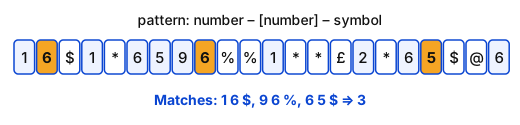
(Left) 1 6 $ 1 * 6 5 9 6 % % 1 * * £ 2 * 6 5 $ @ 6 (Right)
How many such numbers are there each of which is immediately preceded by a number and also immediately followed by a symbol?
निम्नलिखित संख्या और प्रतीक श्रृंखला को देखें और उसके बाद दिए गए प्रश्न का उत्तर दें। गिनती केवल बाएँ से दाएँ की जानी है।
(बाएँ) 1 6 $ 1 * 6 5 9 6 % % 1 * * £ 2 * 6 5 $ @ 6 (दाएँ)
ऐसी कितनी संख्याएँ हैं जिनमें से प्रत्येक के ठीक पहले एक संख्या है और ठीक बाद एक प्रतीक भी है?
  1. A3
  2. B4
  3. C2
  4. D5
Show answer

Concept: Look for the pattern: number – number – symbol; count the middle number.

  1. Scan left to right: "1 6 $" ✔, "9 6 %" ✔, "6 5 $" ✔.
  2. Other numbers fail (e.g. "6 5 9" – followed by a number; "* 2 *" – preceded by a symbol).
  3. Total = 3.

Trick: First mark every symbol, then check the two places just before it.

Answer: (A) 3

अवधारणा: पैटर्न खोजें: संख्या – संख्या – प्रतीक; बीच वाली संख्या गिनें।

  1. बाएँ से दाएँ: "1 6 $" ✔, "9 6 %" ✔, "6 5 $" ✔।
  2. बाकी संख्याएँ शर्त पूरी नहीं करतीं (जैसे "6 5 9" – बाद में संख्या; "* 2 *" – पहले प्रतीक)।
  3. कुल = 3।

ट्रिक: पहले हर प्रतीक पर निशान लगाएँ, फिर उसके ठीक पहले के दो स्थान देखें।

उत्तर: (A) 3

RRB NTPC Graduate CBT 1General Intelligence and ReasoningNumber–Symbol SeriesRRB NTPC Graduate CBT 1 2024 · 11 Jun Shift 2 →
Q3368.
What will come in the place of the question mark (?) in the following equation, if ‘+’ and ‘−’ are interchanged and ‘×’ and ‘÷’ are interchanged?
151 ÷ 3 + 168 × 8 − 145 = ?
यदि ‘+’ और ‘−’ को आपस में बदल दिया जाए तथा ‘×’ और ‘÷’ को आपस में बदल दिया जाए, तो निम्नलिखित समीकरण में प्रश्न चिह्न (?) के स्थान पर क्या आएगा?
151 ÷ 3 + 168 × 8 − 145 = ?
  1. A577
  2. B557
  3. C547
  4. D567
Show answer

Concept: Interchange the signs, then solve using BODMAS.

  1. 151÷3+168×8−145 becomes 151×3−168÷8+145.
  2. =453−21+145.
  3. =577.

Trick: Do × and ÷ first (453 and 21), then add/subtract left to right.

Answer: (A) 577

अवधारणा: चिह्न आपस में बदलें, फिर BODMAS से हल करें।

  1. 151÷3+168×8−145 बदलकर 151×3−168÷8+145।
  2. =453−21+145।
  3. =577।

ट्रिक: पहले × और ÷ (453 और 21), फिर बाएँ से दाएँ जोड़-घटाव।

उत्तर: (A) 577

RRB NTPC Graduate CBT 1General Intelligence and ReasoningMathematical OperationsRRB NTPC Graduate CBT 1 2024 · 11 Jun Shift 2 →
Q3369.
What will come in place of the question mark (?) in the following equation if '÷' and '–' are interchanged and '×' and '+' are interchanged?
56 + 41 ÷ 12054 – 123 × 891 = ?
यदि ‘÷’ और ‘–’ को आपस में बदल दिया जाए तथा ‘×’ और ‘+’ को आपस में बदल दिया जाए, तो निम्नलिखित समीकरण में प्रश्न चिह्न (?) के स्थान पर क्या आएगा?
56 + 41 ÷ 12054 – 123 × 891 = ?
  1. A811
  2. B3089
  3. C1307
  4. D1557
Show answer

Concept: Interchange the signs as told, then solve using BODMAS (÷ and × first, then + and −).

  1. After swapping ÷↔– and ×↔+: 56×41−12054÷123+891.
  2. 56×41=2296 and 12054÷123=98.
  3. 2296−98+891=3089.

Trick: Rewrite the whole expression first with new signs, then do division/multiplication before addition/subtraction.

Answer: (B) 3089

अवधारणा: चिह्नों को बदलकर BODMAS नियम से हल करें (पहले ÷ और ×, फिर + और −)।

  1. ÷↔– तथा ×↔+ बदलने पर: 56×41−12054÷123+891।
  2. 56×41=2296 तथा 12054÷123=98।
  3. 2296−98+891=3089।

ट्रिक: पहले पूरा व्यंजक नए चिह्नों के साथ लिखें, फिर भाग/गुणा पहले करें।

उत्तर: (B) 3089

RRB NTPC Graduate CBT 1General Intelligence and ReasoningMathematical operationsRRB NTPC Graduate CBT 1 2024 · 11 Jun Shift 2 →
Q3370.
What should come in place of the question mark (?) in the given series?
99 92 105 98 111 104 ? 110
दी गई श्रृंखला में प्रश्न चिह्न (?) के स्थान पर क्या आना चाहिए?
99 92 105 98 111 104 ? 110
  1. A117
  2. B92
  3. C125
  4. D97
Show answer

Concept: Check differences between consecutive terms.

  1. Differences: 99→92(−7), 92→105(+13), 105→98(−7), 98→111(+13), 111→104(−7).
  2. Pattern −7,+13 repeats, so next is 104+13=117.
  3. Check: 117−7=110 ✓ (last term).

Trick: Alternate up-down series → look for two alternating differences.

Answer: (A) 117

अवधारणा: क्रमागत पदों का अंतर देखें।

  1. अंतर: −7,+13,−7,+13,−7।
  2. अगला अंतर +13: 104+13=117।
  3. जाँच: 117−7=110 ✓।

ट्रिक: ऊपर-नीचे चलती श्रृंखला में दो वैकल्पिक अंतर खोजें।

उत्तर: (A) 117

RRB NTPC Graduate CBT 1General Intelligence and ReasoningNumber seriesRRB NTPC Graduate CBT 1 2024 · 11 Jun Shift 2 →
Q3371.
In a certain code language, ‘LATE’ is coded as ‘8054’ and ‘TEAM’ is coded as ‘4087’. What is the code for ‘M’ in the given code language?
एक निश्चित कूट भाषा में, ‘LATE’ को ‘8054’ के रूप में कूटबद्ध किया जाता है और ‘TEAM’ को ‘4087’ के रूप में कूटबद्ध किया जाता है। दी गई कूट भाषा में ‘M’ के लिए कूट क्या है?
  1. A4
  2. B8
  3. C0
  4. D7
Show answer

Concept: Letters common to both words share the common digits; the leftover letter gets the leftover digit.

  1. LATE = {8,0,5,4}; TEAM = {4,0,8,7}.
  2. Common letters T, E, A ↔ common digits 4, 0, 8.
  3. Left over: L ↔ 5 and M ↔ 7.

Trick: Cancel common letters and common digits; the unique letter matches the unique digit.

Answer: (D) 7

अवधारणा: दोनों शब्दों के उभयनिष्ठ अक्षरों के कोड भी उभयनिष्ठ अंक होते हैं।

  1. LATE = {8,0,5,4}; TEAM = {4,0,8,7}।
  2. उभयनिष्ठ T, E, A ↔ 4, 0, 8।
  3. शेष: L ↔ 5, M ↔ 7।

ट्रिक: समान अक्षर व समान अंक काटें; बचा अक्षर = बचा अंक।

उत्तर: (D) 7

RRB NTPC Graduate CBT 1General Intelligence and ReasoningCoding-decodingRRB NTPC Graduate CBT 1 2024 · 11 Jun Shift 2 →
Q3372.
35 is related to 70 following a certain logic. Following the same logic, 24 is related to 48. To which of the following is 11 related, following the same logic?
(NOTE: Operations should be performed on the whole numbers, without breaking down the numbers into their constituent digits. E.g. 13 – Operations on 13 such as
adding/subtracting/multiplying to 13 can be performed. Breaking down 13 into 1 and 3 and then performing mathematical operations on 1 and 3 is not allowed.)
एक निश्चित तर्क के अनुसार 35 का संबंध 70 से है। उसी तर्क के अनुसार 24 का संबंध 48 से है। उसी तर्क का अनुसरण करते हुए, 11 का संबंध निम्नलिखित में से किससे है?
(नोट: संख्याओं को उनके घटक अंकों में विभाजित किए बिना, पूर्ण संख्याओं पर संक्रियाएँ की जानी चाहिए। उदाहरण 13 – 13 पर संक्रियाएँ जैसे
13 में जोड़ना/घटाना/गुणा करना आदि किया जा सकता है। 13 को 1 और 3 में विभाजित करके फिर 1 और 3 पर गणितीय संक्रियाएँ करने की अनुमति नहीं है।)
  1. A23
  2. B20
  3. C21
  4. D22
Show answer

Concept: Find one operation that works for both given pairs.

  1. 35×2=70.
  2. 24×2=48.
  3. So 11×2=22.

Trick: When the second number is exactly double, the rule is ×2.

Answer: (D) 22

अवधारणा: ऐसा नियम खोजें जो दोनों युग्मों पर लागू हो।

  1. 35×2=70।
  2. 24×2=48।
  3. अतः 11×2=22।

ट्रिक: दूसरी संख्या ठीक दोगुनी हो तो नियम ×2 है।

उत्तर: (D) 22

RRB NTPC Graduate CBT 1General Intelligence and ReasoningNumber analogyRRB NTPC Graduate CBT 1 2024 · 11 Jun Shift 2 →
Q3373.
VBDP is related to ZWHK in a certain way based on the English alphabetical order. In the same way, DRLF is related to HMPA. To which of the following is LHTV related, following the same logic?
अंग्रेज़ी वर्णमाला क्रम के आधार पर VBDP एक निश्चित तरीके से ZWHK से संबंधित है। उसी प्रकार, DRLF, HMPA से संबंधित है। उसी तर्क का अनुसरण करते हुए, LHTV निम्नलिखित में से किससे संबंधित है?
  1. AOCWR
  2. BQBYR
  3. CQDYP
  4. DPCXQ
Show answer

Concept: Find the shift applied to each letter position.

  1. VBDP→ZWHK: V+4=Z, B−5=W, D+4=H, P−5=K.
  2. DRLF→HMPA follows the same +4,−5,+4,−5.
  3. LHTV: L+4=P, H−5=C, T+4=X, V−5=Q → PCXQ.

Trick: Write position numbers (V=22, Z=26) to get shifts quickly.

Answer: (D) PCXQ

अवधारणा: प्रत्येक अक्षर पर लगा खिसकाव (shift) खोजें।

  1. VBDP→ZWHK: V+4=Z, B−5=W, D+4=H, P−5=K।
  2. DRLF→HMPA में भी +4,−5,+4,−5।
  3. LHTV: L+4=P, H−5=C, T+4=X, V−5=Q → PCXQ।

ट्रिक: अक्षरों के स्थानीय मान (V=22, Z=26) लिखकर अंतर जल्दी निकालें।

उत्तर: (D) PCXQ

RRB NTPC Graduate CBT 1General Intelligence and ReasoningLetter analogyRRB NTPC Graduate CBT 1 2024 · 11 Jun Shift 2 →
Q3374.
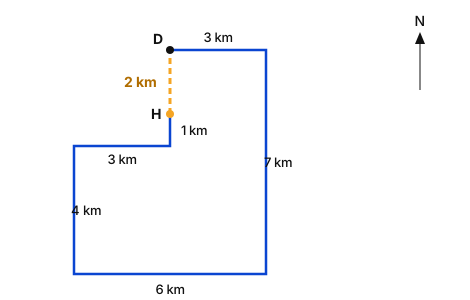
Mr. T starts from Point D and drives 3 km towards the east. He then takes a right turn, drives 7 km, turns right and drives 6 km. He then takes a right turn and drives 4 km, and then turns right and drives 3 km. He takes a final left turn, drives 1 km and stops at Point H. How far (shortest distance) and towards which direction should he drive in order to reach Point D again? (All turns are 90 degree turns only unless specified.)
श्री T बिंदु D से चलना शुरू करते हैं और पूर्व की ओर 3 km गाड़ी चलाते हैं। फिर वे दाएँ मुड़ते हैं, 7 km गाड़ी चलाते हैं, दाएँ मुड़ते हैं और 6 km गाड़ी चलाते हैं। फिर वे दाएँ मुड़ते हैं और 4 km गाड़ी चलाते हैं, और फिर दाएँ मुड़ते हैं और 3 km गाड़ी चलाते हैं। वे अंतिम बार बाएँ मुड़ते हैं, 1 km गाड़ी चलाते हैं और बिंदु H पर रुक जाते हैं। फिर से बिंदु D पर पहुँचने के लिए उन्हें कितनी दूर (न्यूनतम दूरी) और किस दिशा में गाड़ी चलानी चाहिए? (जब तक निर्दिष्ट न हो, सभी मोड़ केवल 90 डिग्री के मोड़ हैं।)
  1. A2 km towards the southदक्षिण की ओर 2 km
  2. B7 km towards the westपश्चिम की ओर 7 km
  3. C5 km towards the eastपूर्व की ओर 5 km
  4. D2 km towards the northउत्तर की ओर 2 km
Show answer

Concept: Track coordinates with D at origin (east +x, north +y).

  1. 3 km E → (3,0); right, 7 km S → (3,−7); right, 6 km W → (−3,−7).
  2. Right, 4 km N → (−3,−3); right, 3 km E → (0,−3); left, 1 km N → H (0,−2).
  3. H is 2 km directly south of D, so he must drive 2 km north.

Trick: Facing east, a right turn = south; facing north, a left turn = west.

Answer: (D) 2 km towards the north

अवधारणा: D को मूल बिन्दु मानकर निर्देशांक लिखें (पूर्व +x, उत्तर +y)।

  1. 3 km पूर्व → (3,0); दाएँ, 7 km दक्षिण → (3,−7); दाएँ, 6 km पश्चिम → (−3,−7)।
  2. दाएँ, 4 km उत्तर → (−3,−3); दाएँ, 3 km पूर्व → (0,−3); बाएँ, 1 km उत्तर → H (0,−2)।
  3. H, D से 2 km दक्षिण में है, अतः 2 km उत्तर जाना होगा।

ट्रिक: पूर्व की ओर मुख हो तो दायाँ मोड़ = दक्षिण।

उत्तर: (D) 2 km उत्तर की ओर

RRB NTPC Graduate CBT 1General Intelligence and ReasoningDirection senseRRB NTPC Graduate CBT 1 2024 · 11 Jun Shift 2 →
Q3375.
In a certain code language,
'A + B' means 'A is the mother of B',
'A – B' means 'A is the brother of B',
'A × B' means 'A is the wife of B' and
'A ÷ B' means 'A is the father of B'.
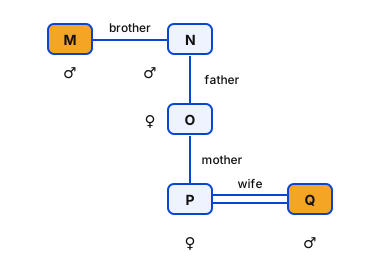
Based on the above, how is M related to Q if 'M – N ÷ O + P × Q'?
एक निश्चित कूट भाषा में,
‘A + B’ का अर्थ है ‘A, B की माँ है’,
‘A – B’ का अर्थ है ‘A, B का भाई है’,
‘A × B’ का अर्थ है ‘A, B की पत्नी है’ और
‘A ÷ B’ का अर्थ है ‘A, B का पिता है’।
उपर्युक्त के आधार पर, यदि ‘M – N ÷ O + P × Q’ है, तो M, Q से किस प्रकार संबंधित है?
  1. AWife's Father's Brotherपत्नी के पिता का भाई
  2. BWife's Mother's Fatherपत्नी की माँ के पिता
  3. CWife's Father's Fatherपत्नी के पिता के पिता
  4. DWife's Mother's Father's Brotherपत्नी की माँ के पिता का भाई
Show answer

Concept: Decode each symbol from left to right and build the family tree.

  1. M – N: M is brother of N; N ÷ O: N is father of O.
  2. O + P: O is mother of P; P × Q: P is wife of Q.
  3. From Q: wife (P) → her mother (O) → her father (N) → his brother (M).

Trick: Read the chain backwards from the person asked about (Q).

Answer: (D) Wife's Mother's Father's Brother

अवधारणा: प्रत्येक चिह्न को बाएँ से दाएँ डिकोड करके वंश-वृक्ष बनाएँ।

  1. M – N: M, N का भाई; N ÷ O: N, O का पिता।
  2. O + P: O, P की माता; P × Q: P, Q की पत्नी।
  3. Q से: पत्नी (P) → उसकी माता (O) → उसके पिता (N) → उनके भाई (M)।

ट्रिक: जिसके सापेक्ष पूछा गया (Q) उससे शृंखला उल्टी पढ़ें।

उत्तर: (D) पत्नी की माता के पिता का भाई (Wife's Mother's Father's Brother)

RRB NTPC Graduate CBT 1General Intelligence and ReasoningBlood relations (coded)RRB NTPC Graduate CBT 1 2024 · 11 Jun Shift 2 →
Q3376.
Read the given statements and conclusions carefully. Assuming that the information given in the statements is true, even if it appears to be at variance with commonly known facts, decide which of the given conclusion(s) logically follow(s) from the statements.
Statements:
Some water is pink.
All pink are buildings.
All buildings are tall.
Conclusions:
(I) Some pink is water.
(II) Some buildings are pink.
दिए गए कथनों और निष्कर्षों को ध्यानपूर्वक पढ़िए। यह मानते हुए कि कथनों में दी गई जानकारी सत्य है, भले ही वह सामान्यतः ज्ञात तथ्यों से भिन्न प्रतीत होती हो, निर्णय कीजिए कि दिए गए निष्कर्षों में से कौन-सा/से निष्कर्ष कथनों का तार्किक रूप से अनुसरण करता है/करते हैं।
कथन:
कुछ पानी गुलाबी हैं।
सभी गुलाबी इमारतें हैं।
सभी इमारतें ऊँची हैं।
निष्कर्ष:
(I) कुछ गुलाबी पानी हैं।
(II) कुछ इमारतें गुलाबी हैं।
  1. ABoth conclusions (I) and (II) follow.निष्कर्ष (I) और (II) दोनों अनुसरण करते हैं।
  2. BNeither conclusion (I) nor (II) follows.न तो निष्कर्ष (I) और न ही (II) अनुसरण करता है।
  3. COnly conclusion (II) follows.केवल निष्कर्ष (II) अनुसरण करता है।
  4. DOnly conclusion (I) follows.केवल निष्कर्ष (I) अनुसरण करता है।
Show answer

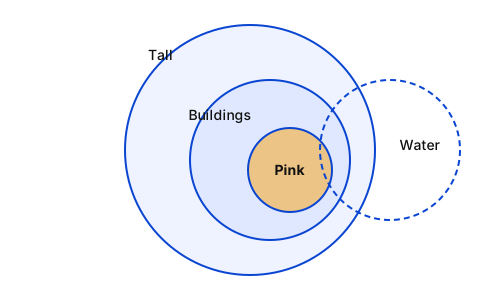
Concept: Draw the least-overlap Venn diagram and test each conclusion.

  1. Pink lies inside Buildings, which lie inside Tall; Water overlaps Pink.
  2. (I) 'Some water is pink' converts to 'Some pink is water' – follows.
  3. (II) 'All pink are buildings' gives 'Some buildings are pink' – follows.

Trick: Some A are B ⇔ Some B are A; All A are B ⇒ Some B are A.

Answer: (A) Both conclusions (I) and (II) follow.

अवधारणा: न्यूनतम ओवरलैप वाला वेन आरेख बनाकर निष्कर्ष जाँचें।

  1. Pink, Buildings के अंदर और Buildings, Tall के अंदर; Water, Pink को काटता है।
  2. (I) 'कुछ water pink हैं' ⇔ 'कुछ pink water हैं' – अनुसरण करता है।
  3. (II) 'सभी pink buildings हैं' ⇒ 'कुछ buildings pink हैं' – अनुसरण करता है।

ट्रिक: कुछ A, B हैं ⇔ कुछ B, A हैं; सभी A, B हैं ⇒ कुछ B, A हैं।

उत्तर: (A) दोनों निष्कर्ष (I) और (II) अनुसरण करते हैं।

RRB NTPC Graduate CBT 1General Intelligence and ReasoningSyllogismRRB NTPC Graduate CBT 1 2024 · 11 Jun Shift 2 →
Q3377.
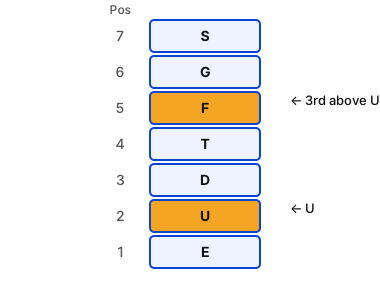
Seven boxes, D, E, F, G, S, T and U, are kept one over the other but not necessarily in the same order. Only two boxes are kept between T and E. Only S is kept above G. No box is kept below E. D is kept at some place below F but at some place above U. Which box is kept third above U?
सात डिब्बे, D, E, F, G, S, T और U, एक के ऊपर एक रखे गए हैं, परंतु आवश्यक नहीं कि इसी क्रम में हों। T और E के बीच केवल दो डिब्बे रखे गए हैं। G के ऊपर केवल S रखा गया है। E के नीचे कोई डिब्बा नहीं रखा गया है। D, F के नीचे किसी स्थान पर परंतु U के ऊपर किसी स्थान पर रखा गया है। U के ऊपर तीसरे स्थान पर कौन-सा डिब्बा रखा गया है?
  1. AG
  2. BD
  3. CT
  4. DF
Show answer

Concept: Number positions 1 (bottom) to 7 (top) and place fixed boxes first.

  1. No box below E → E = 1; two boxes between T and E → T = 4.
  2. Only S above G → S = 7, G = 6.
  3. Positions 2, 3, 5 left for D, F, U with F above D above U → U = 2, D = 3, F = 5.
  4. Third above U (2) is position 5 = F.

Trick: Start with 'no box below/above' clues – they fix ends.

Answer: (D) F

अवधारणा: स्थिति 1 (नीचे) से 7 (ऊपर) मानें, पहले निश्चित बॉक्स रखें।

  1. E के नीचे कोई नहीं → E = 1; T और E के बीच दो → T = 4।
  2. केवल S, G के ऊपर → S = 7, G = 6।
  3. शेष 2, 3, 5 में F > D > U → U = 2, D = 3, F = 5।
  4. U (2) से तीसरा ऊपर = 5 = F।

ट्रिक: 'नीचे/ऊपर कोई नहीं' वाले संकेत सिरों को तय करते हैं।

उत्तर: (D) F

RRB NTPC Graduate CBT 1General Intelligence and ReasoningBox arrangementRRB NTPC Graduate CBT 1 2024 · 11 Jun Shift 2 →
Q3378.
Based on the English alphabetical order, three of the following four letter-clusters are alike in a certain way and thus form a group. Which letter-cluster DOES NOT belong to that group?
(Note: The odd one out is not based on the number of consonants/vowels or their position in the letter-cluster.)
अंग्रेज़ी वर्णमाला क्रम के आधार पर, निम्नलिखित चार अक्षर-समूहों में से तीन किसी निश्चित प्रकार से एकसमान हैं और इस प्रकार एक समूह बनाते हैं। कौन-सा अक्षर-समूह उस समूह से संबंधित नहीं है?
(नोट: असंगत अक्षर-समूह, उस अक्षर-समूह में व्यंजनों/स्वरों की संख्या या उनके स्थान पर आधारित नहीं है।)
  1. ALKP
  2. BQRU
  3. CEFI
  4. DMNQ
Show answer

Concept: Find the gap pattern between letters of each cluster.

  1. QRU: +1,+3; EFI: +1,+3; MNQ: +1,+3.
  2. LKP: −1,+5 – different.

Trick: Write letter positions: Q17 R18 U21 → +1,+3.

Answer: (A) LKP

अवधारणा: प्रत्येक समूह में अक्षरों का अंतर देखें।

  1. QRU: +1,+3; EFI: +1,+3; MNQ: +1,+3।
  2. LKP: −1,+5 – भिन्न।

ट्रिक: स्थानीय मान लिखें: Q17 R18 U21 → +1,+3।

उत्तर: (A) LKP

RRB NTPC Graduate CBT 1General Intelligence and ReasoningOdd one out – lettersRRB NTPC Graduate CBT 1 2024 · 11 Jun Shift 2 →
Q3379.
Which of the following letter-clusters should replace # and % so that the pattern and relationship followed between the letter-cluster pair on the left side of :: is the same as that on the right side of :: ?
# : NHO :: SMT : %
निम्नलिखित में से कौन-से अक्षर-समूह # और % को प्रतिस्थापित करेंगे ताकि :: के बाईं ओर के अक्षर-समूह युग्म के बीच अनुसरित पैटर्न और संबंध वही हो जो :: के दाईं ओर है?
# : NHO :: SMT : %
  1. A# = PJQ, % = QKR
  2. B# = PJQ, % = QLR
  3. C# = PJO, % = QKR
  4. D# = PJQ, % = QKS
Show answer

Concept: The left pair and the right pair must follow the same letter shift.

  1. Try # = PJQ: P−2=N, J−2=H, Q−2=O → each letter −2.
  2. Apply −2 to SMT: S→Q, M→K, T→R → QKR.
  3. Only option A gives PJQ and QKR together.

Trick: Find the rule from the complete pair after testing an option.

Answer: (A) # = PJQ, % = QKR

अवधारणा: बाएँ और दाएँ युग्म में समान अक्षर-खिसकाव होना चाहिए।

  1. # = PJQ लें: P−2=N, J−2=H, Q−2=O → हर अक्षर −2।
  2. SMT पर −2: S→Q, M→K, T→R → QKR।
  3. केवल विकल्प A में PJQ व QKR दोनों हैं।

ट्रिक: एक विकल्प मानकर नियम निकालें, फिर दूसरे पर लगाएँ।

उत्तर: (A) # = PJQ, % = QKR

RRB NTPC Graduate CBT 1General Intelligence and ReasoningLetter analogyRRB NTPC Graduate CBT 1 2024 · 11 Jun Shift 2 →
Q3380.
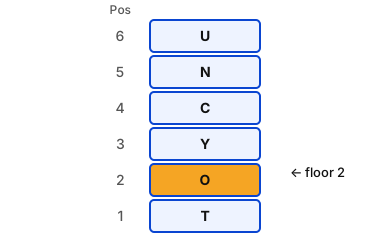
C, O, U, N, T, and Y live on six different floors of the same building. The lowermost floor in the building is numbered 1, the floor above it, number 2 and so on, till the topmost floor is numbered 6. Only two people live above C. Only two people live between C and T. Only N lives between C and U. Y lives immediately below C. Who lives on the floor, numbered 2?
C, O, U, N, T और Y एक ही इमारत की छह अलग-अलग मंज़िलों पर रहते हैं। इमारत की सबसे निचली मंज़िल की संख्या 1 है, उसके ऊपर वाली मंज़िल की संख्या 2 है और इसी प्रकार सबसे ऊपरी मंज़िल की संख्या 6 है। C के ऊपर केवल दो व्यक्ति रहते हैं। C और T के बीच केवल दो व्यक्ति रहते हैं। C और U के बीच केवल N रहता है। Y, C के ठीक नीचे रहता है। मंज़िल संख्या 2 पर कौन रहता है?
  1. AT
  2. BN
  3. CU
  4. DO
Show answer

Concept: Floors 1 (bottom) to 6 (top); place fixed people first.

  1. Only two above C → C = 4; Y immediately below C → Y = 3.
  2. Two between C and T → T = 1.
  3. Only N between C and U → N = 5, U = 6 (floor 3 is taken by Y).
  4. Remaining O → floor 2.

Trick: 'Only two above' in 6 floors → floor 4.

Answer: (D) O

अवधारणा: मंज़िल 1 (नीचे) से 6 (ऊपर); पहले निश्चित व्यक्ति रखें।

  1. C के ऊपर केवल दो → C = 4; Y ठीक नीचे → Y = 3।
  2. C और T के बीच दो → T = 1।
  3. C और U के बीच केवल N → N = 5, U = 6 (मंज़िल 3 पर Y है)।
  4. शेष O → मंज़िल 2।

ट्रिक: 6 मंज़िलों में 'ऊपर केवल दो' → मंज़िल 4।

उत्तर: (D) O

RRB NTPC Graduate CBT 1General Intelligence and ReasoningFloor puzzleRRB NTPC Graduate CBT 1 2024 · 11 Jun Shift 2 →