Question bank

Q&A: practice questions with answers

Search questions on any topic. Filter by exam category, exam, subject and topic, try the question, then open the answer and explanation.

Courses – airGurukul

7,077 questions found.

Q3461.
Based on the English alphabetical order, three of the following four letter-cluster pairs are alike in a certain way and thus form a group. Which letter-cluster pair DOES NOT belong to that group?
(Note: The odd one out is not based on the number of consonants/vowels or their position in the letter-cluster.)
अंग्रेज़ी वर्णमाला क्रम के आधार पर, निम्नलिखित चार अक्षर-समूह युग्मों में से तीन किसी निश्चित प्रकार से एकसमान हैं और इस प्रकार एक समूह बनाते हैं। कौन-सा अक्षर-समूह युग्म उस समूह से संबंधित नहीं है?
(नोट: असंगत अक्षर-समूह, उस अक्षर-समूह में व्यंजनों/स्वरों की संख्या या उनके स्थान पर आधारित नहीं है।)
  1. AGZ-LS
  2. BMF-RY
  3. CYR-EK
  4. DAT-FM
Show answer

Concept: Compare first letters across the pair and second letters across the pair.

  1. GZ-LS: G+5 = L, Z−7 = S.
  2. MF-RY: M+5 = R, F−7 = Y (counting backwards past A).
  3. AT-FM: A+5 = F, T−7 = M.
  4. YR-EK: Y+6 = E, R−7 = K → first letters move +6, not +5.

Trick: Check one rule (first letter +5) on all four — the one that fails is odd.

Answer: (C) YR-EK

अवधारणा: युग्म में पहले अक्षरों की आपस में और दूसरे अक्षरों की आपस में तुलना करें।

  1. GZ-LS: G+5 = L, Z−7 = S।
  2. MF-RY: M+5 = R, F−7 = Y (A के बाद पीछे से गिनती)।
  3. AT-FM: A+5 = F, T−7 = M।
  4. YR-EK: Y+6 = E, R−7 = K → पहला अक्षर +6 चला, +5 नहीं।

ट्रिक: एक नियम (पहला अक्षर +5) चारों पर जाँचें — जो न माने वही विषम।

उत्तर: (C) YR-EK
RRB NTPC Graduate CBT 1General Intelligence and ReasoningOdd one out – letter pairsRRB NTPC Graduate CBT 1 2024 · 11 Jun Shift 1 →
Q3462.
Based on the English alphabetical order, three of the following four letter-cluster pairs are alike in a certain way and thus form a group. Which letter-cluster pair DOES NOT belong to that group?
(Note: The odd one out is not based on the number of consonants/vowels or their position in the letter-cluster.)
अंग्रेज़ी वर्णमाला क्रम के आधार पर, निम्नलिखित चार अक्षर-समूह युग्मों में से तीन किसी निश्चित प्रकार से एकसमान हैं और इस प्रकार एक समूह बनाते हैं। कौन-सा अक्षर-समूह युग्म उस समूह से संबंधित नहीं है?
(नोट: असंगत अक्षर-समूह, उस अक्षर-समूह में व्यंजनों/स्वरों की संख्या या उनके स्थान पर आधारित नहीं है।)
  1. AUX−YB
  2. BGJ−JP
  3. CPS−TW
  4. DYB−CF
Show answer

Concept: Check the gap inside each cluster.

  1. UX−YB: U+3 = X, Y+3 = B.
  2. PS−TW: P+3 = S, T+3 = W.
  3. YB−CF: Y+3 = B, C+3 = F.
  4. GJ−JP: G+3 = J but J+6 = P → breaks the +3 pattern.

Trick: Every pair should show +3 inside both clusters; GJ−JP has a +6.

Answer: (B) GJ−JP

अवधारणा: हर क्लस्टर के भीतर का अंतर देखें।

  1. UX−YB: U+3 = X, Y+3 = B।
  2. PS−TW: P+3 = S, T+3 = W।
  3. YB−CF: Y+3 = B, C+3 = F।
  4. GJ−JP: G+3 = J पर J+6 = P → +3 का नियम टूटा।

ट्रिक: सभी में दोनों क्लस्टर के भीतर +3 होना चाहिए; GJ−JP में +6 है।

उत्तर: (B) GJ−JP

RRB NTPC Graduate CBT 1General Intelligence and ReasoningOdd one out – letter pairsRRB NTPC Graduate CBT 1 2024 · 11 Jun Shift 1 →
Q3463.
In a certain code language,
'A + B' means 'A is the sister of B'
'A − B' means 'A is the brother of B'
'A × B' means 'A is the wife of B'
'A ÷ B' means 'A is the father of B'
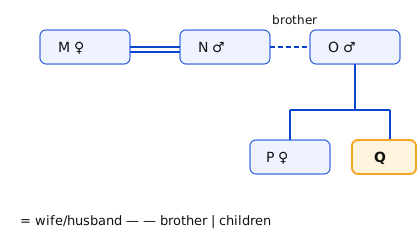
Based on the above, how is M related to Q if 'M × N − O ÷ P + Q'?
एक निश्चित कूट भाषा में,
'A + B' का अर्थ है 'A, B की बहन है'
'A − B' का अर्थ है 'A, B का भाई है'
'A × B' का अर्थ है 'A, B की पत्नी है'
'A ÷ B' का अर्थ है 'A, B का पिता है'
उपर्युक्त के आधार पर, यदि 'M × N − O ÷ P + Q' है, तो M, Q से किस प्रकार संबंधित है?
  1. AFather's Brother's Wifeपिता के भाई की पत्नी
  2. BMother's Brother's Wifeमाता के भाई की पत्नी
  3. CFather's Brother's Daughterपिता के भाई की पुत्री
  4. D​Mother's Brother's Daughterमाता के भाई की पुत्री
Show answer

Concept: Decode each symbol and build the family tree.

  1. M × N: M is the wife of N.
  2. N − O: N is the brother of O.
  3. O ÷ P: O is the father of P; P + Q: P is the sister of Q → O is Q's father.
  4. N is Q's father's brother, and M is N's wife.

Trick: Read the chain from Q upward: Father (O) → his brother (N) → N's wife (M).

Answer: (A) Father's Brother's Wife

अवधारणा: हर चिह्न का अर्थ निकालें और वंश-वृक्ष बनाएँ।

  1. M × N: M, N की पत्नी है।
  2. N − O: N, O का भाई है।
  3. O ÷ P: O, P का पिता है; P + Q: P, Q की बहन है → O, Q का पिता है।
  4. N, Q के पिता का भाई है और M, N की पत्नी है।

ट्रिक: Q से ऊपर पढ़ें: पिता (O) → उनका भाई (N) → N की पत्नी (M) = चाची।

उत्तर: (A) पिता के भाई की पत्नी

RRB NTPC Graduate CBT 1General Intelligence and ReasoningBlood relation – codedRRB NTPC Graduate CBT 1 2024 · 11 Jun Shift 1 →
Q3464.
This question is based on the five, three-digit numbers given below.
(Left) 194 932 446 225 493 (Right)
(Example- 697 – First digit = 6, second digit = 9 and third digit = 7)
(NOTE: All operations to be done from left to right.)
What will be the resultant if the first digit of the highest number is added to the second digit of the lowest number?
यह प्रश्न नीचे दी गई तीन अंकों वाली पाँच संख्याओं पर आधारित है।
(बाएँ) 194 932 446 225 493 (दाएँ)
(उदाहरण- 697 – पहला अंक = 6, दूसरा अंक = 9 और तीसरा अंक = 7)
(नोट: सभी संक्रियाएँ बाएँ से दाएँ की जानी हैं।)
यदि सबसे बड़ी संख्या के पहले अंक को सबसे छोटी संख्या के दूसरे अंक में जोड़ा जाए, तो परिणाम क्या होगा?
  1. A17
  2. B16
  3. C15
  4. D18
Show answer

Concept: Find the highest and lowest numbers, then pick the required digits.

  1. Numbers: 194, 932, 446, 225, 493.
  2. Highest = 932 → first digit 9.
  3. Lowest = 194 → second digit 9.
  4. 9+9=18.

Trick: Compare hundreds digits first — 9 is the largest, 1 the smallest.

Answer: (D) 18

अवधारणा: सबसे बड़ी और सबसे छोटी संख्या ढूँढें, फिर माँगे गए अंक लें।

  1. संख्याएँ: 194, 932, 446, 225, 493।
  2. सबसे बड़ी = 932 → पहला अंक 9।
  3. सबसे छोटी = 194 → दूसरा अंक 9।
  4. 9+9=18।

ट्रिक: पहले सैकड़े के अंक देखें — 9 सबसे बड़ा, 1 सबसे छोटा।

उत्तर: (D) 18

RRB NTPC Graduate CBT 1General Intelligence and ReasoningNumber puzzle – digitsRRB NTPC Graduate CBT 1 2024 · 11 Jun Shift 1 →
Q3465.
What should come in place of the question mark (?) in the given series?
992 990 986 980 972 ?
दी गई शृंखला में प्रश्नचिह्न (?) के स्थान पर क्या आना चाहिए?
992 990 986 980 972 ?
  1. A961
  2. B958
  3. C959
  4. D962
Show answer

Concept: Look at the differences between consecutive terms.

  1. 992−990=2, 990−986=4, 986−980=6, 980−972=8.
  2. Next difference =10.
  3. 972−10=962.

Trick: Differences in even steps 2, 4, 6, 8, 10.

Answer: (D) 962

अवधारणा: लगातार पदों का अंतर देखें।

  1. 992−990=2, 990−986=4, 986−980=6, 980−972=8।
  2. अगला अंतर =10।
  3. 972−10=962।

ट्रिक: अंतर सम संख्याएँ: 2, 4, 6, 8, 10।

उत्तर: (D) 962

RRB NTPC Graduate CBT 1General Intelligence and ReasoningNumber seriesRRB NTPC Graduate CBT 1 2024 · 11 Jun Shift 1 →
Q3466.
Two sets of numbers are given below. In each set of numbers, certain mathematical operation(s) on the first number result(s) in the second number. Similarly, certain mathematical operation(s) on the second number result(s) in the third number and so on. Which of the given options follows the same set of operations as in the given sets? (NOTE: Operations should be performed on the whole numbers, without breaking down the numbers into their constituent digits. E.g. 13 – Operations on 13 such as adding / subtracting /multiplying to 13 can be performed. Breaking down 13 into 1 and 3 and then performing mathematical operations on 1 and 3 is not allowed.)
13 - 15 - 30 - 60 ; 3 - 5 - 10 - 20
नीचे संख्याओं के दो समुच्चय दिए गए हैं। संख्याओं के प्रत्येक समुच्चय में, पहली संख्या पर कुछ गणितीय संक्रिया/संक्रियाएँ करने पर दूसरी संख्या प्राप्त होती है। इसी प्रकार, दूसरी संख्या पर कुछ गणितीय संक्रिया/संक्रियाएँ करने पर तीसरी संख्या प्राप्त होती है और इसी तरह आगे भी। दिए गए विकल्पों में से कौन-सा विकल्प दिए गए समुच्चयों के समान संक्रियाओं के समुच्चय का अनुसरण करता है? (नोट: संख्याओं को उनके घटक अंकों में विभाजित किए बिना, संक्रियाएँ पूर्ण संख्याओं पर की जानी चाहिए। उदाहरण के लिए, 13 – 13 पर संक्रियाएँ जैसे 13 में जोड़ना/घटाना/गुणा करना आदि की जा सकती हैं। 13 को 1 और 3 में विभाजित करना और फिर 1 और 3 पर गणितीय संक्रियाएँ करने की अनुमति नहीं है।)
13 - 15 - 30 - 60 ; 3 - 5 - 10 - 20
  1. A5 - 7 - 14 - 24
  2. B10 - 12 - 24 - 42
  3. C15 - 17 - 34 - 44
  4. D8 - 10 - 20 - 40
Show answer

Concept: Find the operations between terms.

  1. 13 → 15 (+2) → 30 (×2) → 60 (×2).
  2. 3 → 5 (+2) → 10 (×2) → 20 (×2).
  3. 8 → 10 (+2) → 20 (×2) → 40 (×2) ✓.

Trick: Last term must be double the third — only 20→40 fits.

Answer: (D) 8 - 10 - 20 - 40

अवधारणा: पदों के बीच संक्रियाएँ ज्ञात करें।

  1. 13 → 15 (+2) → 30 (×2) → 60 (×2)।
  2. 3 → 5 (+2) → 10 (×2) → 20 (×2)।
  3. 8 → 10 (+2) → 20 (×2) → 40 (×2) ✓।

ट्रिक: अंतिम पद तीसरे का दोगुना होना चाहिए — केवल 20→40 सही।

उत्तर: (D) 8 - 10 - 20 - 40

RRB NTPC Graduate CBT 1General Intelligence and ReasoningNumber set patternRRB NTPC Graduate CBT 1 2024 · 11 Jun Shift 1 →
Q3467.
This question is based on the five, three-digit numbers given below.
(Left) 740 636 787 884 316 (Right)
(Example- 697 – First digit = 6, second digit = 9 and third digit = 7)
(NOTE: All operations to be done from left to right.)
What will be the resultant if the second digit of the highest number is added to the third digit of the lowest number?
यह प्रश्न नीचे दी गई तीन अंकों वाली पाँच संख्याओं पर आधारित है।
(बाएँ) 740 636 787 884 316 (दाएँ)
(उदाहरण- 697 – पहला अंक = 6, दूसरा अंक = 9 और तीसरा अंक = 7)
(नोट: सभी संक्रियाएँ बाएँ से दाएँ की जानी हैं।)
यदि सबसे बड़ी संख्या के दूसरे अंक को सबसे छोटी संख्या के तीसरे अंक में जोड़ा जाए, तो परिणाम क्या होगा?
  1. A14
  2. B15
  3. C17
  4. D13
Show answer

Concept: Identify the highest and lowest numbers, then take the required digits.

  1. Numbers: 740, 636, 787, 884, 316.
  2. Highest = 884 → second digit 8.
  3. Lowest = 316 → third digit 6.
  4. 8+6=14.

Trick: Sort by hundreds digit: 8 (884) is the largest, 3 (316) the smallest.

Answer: (A) 14

अवधारणा: सबसे बड़ी और सबसे छोटी संख्या पहचानें, फिर माँगे गए अंक लें।

  1. संख्याएँ: 740, 636, 787, 884, 316।
  2. सबसे बड़ी = 884 → दूसरा अंक 8।
  3. सबसे छोटी = 316 → तीसरा अंक 6।
  4. 8+6=14।

ट्रिक: सैकड़े के अंक से क्रम लगाएँ: 884 सबसे बड़ी, 316 सबसे छोटी।

उत्तर: (A) 14

RRB NTPC Graduate CBT 1General Intelligence and ReasoningNumber puzzle – digitsRRB NTPC Graduate CBT 1 2024 · 11 Jun Shift 1 →
Q3468.
Select the triad that follows the same pattern as that followed by the two triads given below. Both triads follow the same pattern.
NJ-QM-TV
QM-TP-WY
उस त्रिक का चयन कीजिए जो उसी पैटर्न का अनुसरण करता है जिसका अनुसरण नीचे दिए गए दो त्रिक करते हैं। दोनों त्रिक एक ही पैटर्न का अनुसरण करते हैं।
NJ-QM-TV
QM-TP-WY
  1. AMH-PK-RU
  2. BLH-OK-RT
  3. CLH-OK-RU
  4. DMH-OK-RU
Show answer

Concept: Track the first letters and second letters of the three pairs separately.

  1. NJ-QM-TV: N→Q→T (+3, +3); J→M→V (+3, +9).
  2. QM-TP-WY: Q→T→W (+3, +3); M→P→Y (+3, +9) ✓.
  3. LH-OK-RT: L→O→R (+3, +3); H→K→T (+3, +9) ✓.
  4. LH-OK-RU fails (K+10 = U).

Trick: Last step of the second letter is always +9.

Answer: (B) LH-OK-RT

अवधारणा: तीनों युग्मों के पहले और दूसरे अक्षरों को अलग-अलग देखें।

  1. NJ-QM-TV: N→Q→T (+3, +3); J→M→V (+3, +9)।
  2. QM-TP-WY: Q→T→W (+3, +3); M→P→Y (+3, +9) ✓।
  3. LH-OK-RT: L→O→R (+3, +3); H→K→T (+3, +9) ✓।
  4. LH-OK-RU गलत (K+10 = U)।

ट्रिक: दूसरे अक्षर का अंतिम चरण हमेशा +9।

उत्तर: (B) LH-OK-RT

RRB NTPC Graduate CBT 1General Intelligence and ReasoningLetter triads – patternRRB NTPC Graduate CBT 1 2024 · 11 Jun Shift 1 →
Q3469.
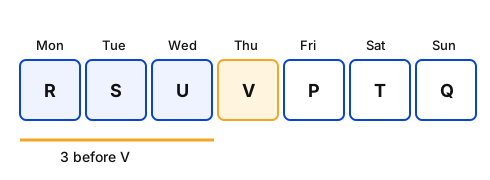
Each of P, Q, R, S, T, U and V has an exam on a different day of a week starting from Monday and ending on Sunday of the same week. P has an exam on Friday. Only 2 people have an exam between P and S. U has an exam immediately before V, and Q has an exam immediately after T. Only 2 people have an exam between R and V.
How many people have an exam before V?
P, Q, R, S, T, U और V में से प्रत्येक की परीक्षा एक ही सप्ताह के सोमवार से आरंभ होकर रविवार को समाप्त होने वाले सप्ताह के एक अलग-अलग दिन है। P की परीक्षा शुक्रवार को है। P और S के बीच केवल 2 लोगों की परीक्षा है। U की परीक्षा V से ठीक पहले है, और Q की परीक्षा T के ठीक बाद है। R और V के बीच केवल 2 लोगों की परीक्षा है।
V से पहले कितने लोगों की परीक्षा है?
  1. A4
  2. B1
  3. C2
  4. D3
Show answer

Concept: Fix the definite positions first, then fit the pairs.

  1. P = Friday; two between P and S → S = Tuesday.
  2. Free days: Mon, Wed, Thu, Sat, Sun. Pairs U-V and T-Q need consecutive days → (Wed, Thu) and (Sat, Sun); so R = Monday.
  3. Two between R and V → V = Thursday, U = Wednesday; T = Saturday, Q = Sunday.
  4. Before V: R, S, U = 3 people.

Trick: Only two consecutive free slots exist — they decide both pairs at once.

Answer: (D) 3

अवधारणा: पहले निश्चित स्थान तय करें, फिर जोड़ियाँ बैठाएँ।

  1. P = शुक्रवार; P और S के बीच दो → S = मंगलवार।
  2. खाली दिन: सोम, बुध, गुरु, शनि, रवि। U-V और T-Q को लगातार दिन चाहिए → (बुध, गुरु) और (शनि, रवि); अतः R = सोमवार।
  3. R और V के बीच दो → V = गुरुवार, U = बुधवार; T = शनिवार, Q = रविवार।
  4. V से पहले: R, S, U = 3 लोग।

ट्रिक: केवल दो लगातार खाली जोड़े हैं — दोनों जोड़ियाँ वहीं तय होती हैं।

उत्तर: (D) 3

RRB NTPC Graduate CBT 1General Intelligence and ReasoningScheduling puzzleRRB NTPC Graduate CBT 1 2024 · 11 Jun Shift 1 →
Q3470.
Which of the following letter-number clusters will replace the question mark (?) in the given series to make it logically complete?
MR25, NS33, OT41, PU49, ?
दी गई शृंखला को तार्किक रूप से पूर्ण करने के लिए निम्नलिखित में से कौन-सा अक्षर-संख्या समूह प्रश्नचिह्न (?) का स्थान लेगा?
MR25, NS33, OT41, PU49, ?
  1. AQU57
  2. BQV58
  3. CQV57
  4. DQU58
Show answer

Concept: Treat the first letter, second letter and number as three separate series.

  1. First letters: M, N, O, P → Q (+1).
  2. Second letters: R, S, T, U → V (+1).
  3. Numbers: 25, 33, 41, 49 → 57 (+8).

Trick: Number goes up by 8: 49+8=57; only QV57 has V and 57.

Answer: (C) QV57

अवधारणा: पहला अक्षर, दूसरा अक्षर और संख्या — तीन अलग श्रृंखलाएँ मानें।

  1. पहले अक्षर: M, N, O, P → Q (+1)।
  2. दूसरे अक्षर: R, S, T, U → V (+1)।
  3. संख्याएँ: 25, 33, 41, 49 → 57 (+8)।

ट्रिक: संख्या 8 बढ़ती है: 49+8=57; केवल QV57 में V और 57 दोनों।

उत्तर: (C) QV57

RRB NTPC Graduate CBT 1General Intelligence and ReasoningAlphanumeric seriesRRB NTPC Graduate CBT 1 2024 · 11 Jun Shift 1 →
Q3471.
This question is based on the five, three-digit numbers given below.
(Left) 205 712 237 862 578 (Right)
(Example- 697 – First digit = 6, second digit = 9 and third digit = 7)
(NOTE: All operations to be done from left to right.)
What will be the resultant if the third digit of the highest number is added to the first digit of the lowest number?
यह प्रश्न नीचे दी गई तीन अंकों वाली पाँच संख्याओं पर आधारित है।
(बाएँ) 205 712 237 862 578 (दाएँ)
(उदाहरण- 697 – पहला अंक = 6, दूसरा अंक = 9 और तीसरा अंक = 7)
(नोट: सभी संक्रियाएँ बाएँ से दाएँ की जानी हैं।)
यदि सबसे बड़ी संख्या के तीसरे अंक को सबसे छोटी संख्या के पहले अंक में जोड़ा जाए, तो परिणाम क्या होगा?
  1. A5
  2. B4
  3. C3
  4. D7
Show answer

Concept: Find the highest and lowest of the five numbers, then pick the required digits.

  1. Numbers: 205, 712, 237, 862, 578.
  2. Highest = 862 → third digit = 2.
  3. Lowest = 205 → first digit = 2.
  4. Sum =2+2=4.

Trick: Compare hundreds digits first: 8 is the largest, 2 the smallest (205 vs 237 → 205 is smaller).

Answer: (B) 4

अवधारणा: पाँचों संख्याओं में सबसे बड़ी और सबसे छोटी संख्या पहचानें, फिर आवश्यक अंक लें।

  1. संख्याएँ: 205, 712, 237, 862, 578।
  2. सबसे बड़ी = 862 → तीसरा अंक = 2।
  3. सबसे छोटी = 205 → पहला अंक = 2।
  4. योग =2+2=4।

ट्रिक: पहले सैकड़े का अंक देखें: 8 सबसे बड़ा, 2 सबसे छोटा (205 और 237 में 205 छोटी)।

उत्तर: (B) 4

RRB NTPC Graduate CBT 1General Intelligence and ReasoningNumber arrangement (digits)RRB NTPC Graduate CBT 1 2024 · 11 Jun Shift 1 →
Q3472.
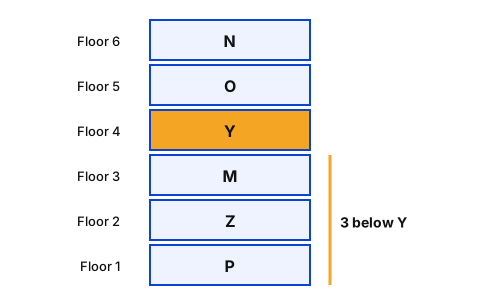
M, N, O, P, Y and Z live on six different floors of the same building. The lowermost floor in the building is numbered 1, the floor above it, number 2 and so on till the topmost floor is numbered 6. Only two people live between O and Z. Only two people live between N and M. Only one person lives between P and M. P lives on floor numbered 1. O lives above M. How many people live below Y?
M, N, O, P, Y और Z एक ही इमारत की छह अलग-अलग मंज़िलों पर रहते हैं। इमारत की सबसे निचली मंज़िल की संख्या 1 है, उसके ऊपर वाली मंज़िल की संख्या 2 है और इसी प्रकार सबसे ऊपरी मंज़िल की संख्या 6 है। O और Z के बीच केवल दो लोग रहते हैं। N और M के बीच केवल दो लोग रहते हैं। P और M के बीच केवल एक व्यक्ति रहता है। P मंज़िल संख्या 1 पर रहता है। O, M के ऊपर रहता है। Y के नीचे कितने लोग रहते हैं?
  1. AThreeतीन
  2. BTwoदो
  3. COneएक
  4. DFourचार
Show answer

Concept: Place the fixed person first, then use the 'between' clues.

  1. P = floor 1. One person between P and M → M = 3.
  2. Two people between N and M → N = 6.
  3. O above M and two between O and Z: O = 4 gives Z = 1 (taken), so O = 5, Z = 2.
  4. Remaining floor 4 = Y. Below Y: M, Z, P = 3 people.

Trick: 'Two people between' means floor numbers differ by 3.

Answer: (A) Three

अवधारणा: पहले निश्चित व्यक्ति रखें, फिर 'बीच में' वाले संकेत लगाएँ।

  1. P = मंज़िल 1। P और M के बीच एक व्यक्ति → M = 3।
  2. N और M के बीच दो व्यक्ति → N = 6।
  3. O, M के ऊपर तथा O और Z के बीच दो: O = 4 से Z = 1 (भरी), अतः O = 5, Z = 2।
  4. शेष मंज़िल 4 = Y। Y के नीचे: M, Z, P = 3 व्यक्ति।

ट्रिक: 'बीच में दो व्यक्ति' = मंज़िल संख्या में 3 का अंतर।

उत्तर: (A) तीन

RRB NTPC Graduate CBT 1General Intelligence and ReasoningFloor puzzleRRB NTPC Graduate CBT 1 2024 · 11 Jun Shift 1 →
Q3473.
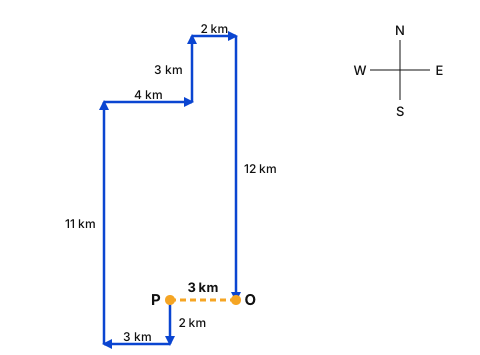
Q starts from Point P and drives 2 km towards the south. He then takes a right turn, drives 3 km, turns right and drives 11 km. He then takes a right turn and drives 4 km, turns left and drives 3 km. He then takes a right turn and drives 2 km. He takes a final right turn, drives 12 km and stops at Point O. How far (shortest distance) and towards which direction should he drive in order to reach Point P again? (All turns are 90 degree turns only unless specified.)
Q बिंदु P से आरंभ करता है और दक्षिण की ओर 2 km गाड़ी चलाता है। फिर वह दाएँ मुड़ता है, 3 km गाड़ी चलाता है, दाएँ मुड़ता है और 11 km गाड़ी चलाता है। फिर वह दाएँ मुड़ता है और 4 km गाड़ी चलाता है, बाएँ मुड़ता है और 3 km गाड़ी चलाता है। फिर वह दाएँ मुड़ता है और 2 km गाड़ी चलाता है। वह अंतिम बार दाएँ मुड़ता है, 12 km गाड़ी चलाता है और बिंदु O पर रुकता है। पुनः बिंदु P तक पहुँचने के लिए उसे कितनी दूरी (न्यूनतम दूरी) तक और किस दिशा में गाड़ी चलानी चाहिए? (जब तक निर्दिष्ट न किया जाए, सभी मोड़ केवल 90 डिग्री के मोड़ हैं।)
  1. A7 km towards the northउत्तर की ओर 7 km
  2. B5 km towards the southदक्षिण की ओर 5 km
  3. C3 km towards the eastपूर्व की ओर 3 km
  4. D3 km towards the westपश्चिम की ओर 3 km
Show answer

Concept: Track net East-West and North-South movement.

  1. South 2 → right (West) 3 → right (North) 11 → right (East) 4 → left (North) 3 → right (East) 2 → right (South) 12.
  2. North-South: −2+11+3−12=0.
  3. East-West: −3+4+2=+3 → O is 3 km East of P.
  4. So from O he must drive 3 km towards the West.

Trick: Net vertical = 0 means P and O are on the same horizontal line; just add east-west moves.

Answer: (D) 3 km towards the west

अवधारणा: कुल पूर्व-पश्चिम और उत्तर-दक्षिण दूरी निकालें।

  1. दक्षिण 2 → दाएँ (पश्चिम) 3 → दाएँ (उत्तर) 11 → दाएँ (पूर्व) 4 → बाएँ (उत्तर) 3 → दाएँ (पूर्व) 2 → दाएँ (दक्षिण) 12।
  2. उत्तर-दक्षिण: −2+11+3−12=0।
  3. पूर्व-पश्चिम: −3+4+2=+3 → O, P से 3 km पूर्व में है।
  4. अतः O से 3 km पश्चिम की ओर जाना होगा।

ट्रिक: ऊर्ध्व कुल = 0 हो तो P और O एक ही क्षैतिज रेखा पर हैं; केवल पूर्व-पश्चिम जोड़ें।

उत्तर: (D) 3 km पश्चिम की ओर

RRB NTPC Graduate CBT 1General Intelligence and ReasoningDirection and DistanceRRB NTPC Graduate CBT 1 2024 · 11 Jun Shift 1 →
Q3474.
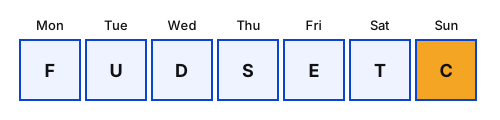
Each of C, D, E, F, S, T and U has an exam on a different day of a week starting from Monday and ending on Sunday of the same week. S has the exam on Thursday and T has the exam on Saturday. F has the exam immediately before U. C has the exam on one of the days after E. D has the exam immediately after U. Who has the exam on the last day of the week?
C, D, E, F, S, T और U में से प्रत्येक की परीक्षा एक ही सप्ताह के सोमवार से आरंभ होकर रविवार को समाप्त होने वाले सप्ताह के एक अलग-अलग दिन है। S की परीक्षा गुरुवार को है और T की परीक्षा शनिवार को है। F की परीक्षा U से ठीक पहले है। C की परीक्षा E के बाद के दिनों में से किसी एक दिन है। D की परीक्षा U के ठीक बाद है। सप्ताह के अंतिम दिन किसकी परीक्षा है?
  1. AE
  2. BD
  3. CC
  4. DT
Show answer

Concept: Fix the given days, then place the consecutive block F–U–D.

  1. S = Thursday, T = Saturday.
  2. F, U, D are on three consecutive days. Only Mon–Tue–Wed is free in a row (Fri–Sat and Wed–Thu are blocked).
  3. So F = Mon, U = Tue, D = Wed.
  4. Left: Friday and Sunday for E and C; C is after E → E = Friday, C = Sunday.

Trick: Place the longest consecutive block first – it usually has only one fit.

Answer: (C) C

अवधारणा: दिए गए दिन तय करें, फिर लगातार F–U–D का ब्लॉक रखें।

  1. S = गुरुवार, T = शनिवार।
  2. F, U, D लगातार तीन दिन हैं। केवल सोम–मंगल–बुध लगातार खाली हैं।
  3. अतः F = सोमवार, U = मंगलवार, D = बुधवार।
  4. शेष शुक्रवार और रविवार E व C के लिए; C, E के बाद → E = शुक्रवार, C = रविवार।

ट्रिक: सबसे लंबा लगातार ब्लॉक पहले रखें – प्रायः एक ही स्थान बचता है।

उत्तर: (C) C

RRB NTPC Graduate CBT 1General Intelligence and ReasoningScheduling puzzleRRB NTPC Graduate CBT 1 2024 · 11 Jun Shift 1 →
Q3475.
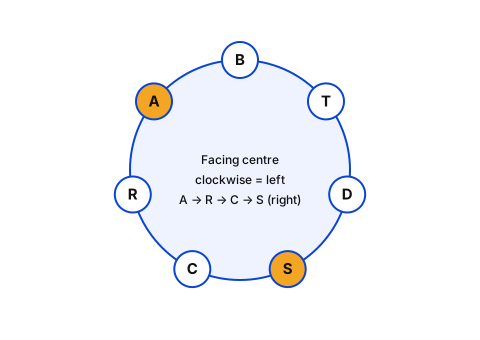
A, B, C, D, R, S and T are sitting around a circular table facing the centre of the table. Only four people sit between B and D when counted from the right of B. B sits third to the left of C. T sits third to the left of R. S is an immediate neighbour of both D and C. How many people sit between A and S when counted from the right of A?
A, B, C, D, R, S और T एक वृत्ताकार मेज़ के चारों ओर मेज़ के केंद्र की ओर मुख करके बैठे हैं। B के दाएँ से गिनने पर B और D के बीच केवल चार लोग बैठे हैं। B, C के बाएँ से तीसरे स्थान पर बैठा है। T, R के बाएँ से तीसरे स्थान पर बैठा है। S, D और C दोनों का निकटतम पड़ोसी है। A के दाएँ से गिनने पर A और S के बीच कितने लोग बैठे हैं?
  1. AThreeतीन
  2. BOneएक
  3. CFourचार
  4. DTwoदो
Show answer

Concept: Facing the centre, a person's left is clockwise and right is anticlockwise.

  1. Four between B and D from B's right → D is 2 places to B's left. B is third to the left of C → C is 4 places to B's left.
  2. S neighbours both D and C → S sits between them. Clockwise from B: B, _, D, S, C, _, _.
  3. T third to the left of R fits only with R and T at the two remaining sides: clockwise B, T, D, S, C, R, A.
  4. From A's right (anticlockwise): R, C, then S → 2 people between.

Trick: In a 7-seat circle, '4 between on one side' = '1 between on the other side'.

Answer: (D) Two

अवधारणा: केंद्र की ओर मुख होने पर व्यक्ति का बायाँ = दक्षिणावर्त (clockwise), दायाँ = वामावर्त।

  1. B के दाएँ से B और D के बीच चार → D, B के बाएँ 2 स्थान पर। B, C के बाएँ तीसरा → C, B के बाएँ 4 स्थान पर।
  2. S, D और C दोनों का पड़ोसी → S उनके बीच। B से दक्षिणावर्त: B, _, D, S, C, _, _।
  3. T, R के बाएँ तीसरा – केवल यह क्रम बनता है: B, T, D, S, C, R, A (दक्षिणावर्त)।
  4. A के दाएँ (वामावर्त) से: R, C, फिर S → बीच में 2 व्यक्ति।

ट्रिक: 7 सीटों के वृत्त में 'एक ओर 4 बीच में' = 'दूसरी ओर 1 बीच में'।

उत्तर: (D) दो

RRB NTPC Graduate CBT 1General Intelligence and ReasoningCircular seatingRRB NTPC Graduate CBT 1 2024 · 11 Jun Shift 1 →
Q3476.
MBKF is related to OGMK in a certain way based on the English alphabetical order. In the same way, QLOP is related to SQQU. To which of the given options is UVSZ related, following the same logic?
अंग्रेज़ी वर्णमाला क्रम के आधार पर MBKF एक निश्चित प्रकार से OGMK से संबंधित है। उसी प्रकार, QLOP, SQQU से संबंधित है। समान तर्क का अनुसरण करते हुए, UVSZ दिए गए विकल्पों में से किससे संबंधित है?
  1. AVBUD
  2. BWAUE
  3. CXZVF
  4. DWBTD
Show answer

Concept: Find the shift of each letter position.

  1. MBKF → OGMK: M+2, B+5, K+2, F+5.
  2. Check: QLOP → SQQU: Q+2, L+5, O+2, P+5 ✓.
  3. UVSZ: U+2 = W, V+5 = A (wrap: 22+5=27→1), S+2 = U, Z+5 = E.
  4. Answer: WAUE.

Trick: Pattern +2, +5, +2, +5; after Z start again from A.

Answer: (B) WAUE

अवधारणा: प्रत्येक अक्षर के स्थान का अंतर निकालें।

  1. MBKF → OGMK: M+2, B+5, K+2, F+5।
  2. जाँच: QLOP → SQQU: Q+2, L+5, O+2, P+5 ✓।
  3. UVSZ: U+2 = W, V+5 = A (22+5=27→1), S+2 = U, Z+5 = E।
  4. उत्तर: WAUE।

ट्रिक: पैटर्न +2, +5, +2, +5; Z के बाद फिर A से गिनें।

उत्तर: (B) WAUE

RRB NTPC Graduate CBT 1General Intelligence and ReasoningLetter analogyRRB NTPC Graduate CBT 1 2024 · 11 Jun Shift 1 →
Q3477.
If 14 : A :: A : 56, find the positive value of A.
यदि 14 : A :: A : 56 है, तो A का धनात्मक मान ज्ञात कीजिए।
  1. A29
  2. B31
  3. C28
  4. D26
Show answer

Concept: If a:x::x:b, then x2=a×b (mean proportional).

  1. A2=14×56=784.
  2. A=784=28.

Trick: 14×2=28, 28×2=56 – a doubling chain.

Answer: (C) 28

अवधारणा: यदि a:x::x:b तो x2=a×b (मध्यानुपाती)।

  1. A2=14×56=784।
  2. A=784=28।

ट्रिक: 14×2=28, 28×2=56 – दोगुनी शृंखला।

उत्तर: (C) 28

RRB NTPC Graduate CBT 1General Intelligence and ReasoningNumber analogy (mean proportional)RRB NTPC Graduate CBT 1 2024 · 11 Jun Shift 1 →
Q3478.
What should come in place of the question mark (?) in the given series?
51 87 121 153 183 211 ?
दी गई शृंखला में प्रश्नचिह्न (?) के स्थान पर क्या आना चाहिए?
51 87 121 153 183 211 ?
  1. A237
  2. B249
  3. C241
  4. D253
Show answer

Concept: Check the differences between consecutive terms.

  1. Differences: 36, 34, 32, 30, 28 – decreasing by 2.
  2. Next difference =26.
  3. 211+26=237.

Trick: First differences forming an AP → just continue the AP.

Answer: (A) 237

अवधारणा: क्रमागत पदों का अंतर देखें।

  1. अंतर: 36, 34, 32, 30, 28 – हर बार 2 कम।
  2. अगला अंतर =26।
  3. 211+26=237।

ट्रिक: अंतर समांतर श्रेणी में हों तो उसी को आगे बढ़ाएँ।

उत्तर: (A) 237

RRB NTPC Graduate CBT 1General Intelligence and ReasoningNumber seriesRRB NTPC Graduate CBT 1 2024 · 11 Jun Shift 1 →
Q3479.
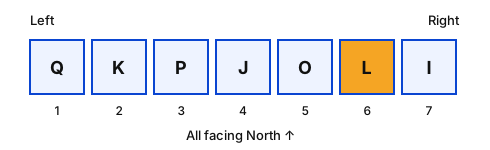
Seven people, I, J, K, L, O, P and Q are sitting in a row, facing north. Only two people sit to the left of P. Only three people sit between P and I. Only one person sits between I and O. Q sits to the immediate left of K. J is not an immediate neighbour of I. How many people sit to the right of L?
सात व्यक्ति, I, J, K, L, O, P और Q उत्तर की ओर मुख करके एक पंक्ति में बैठे हैं। P के बाईं ओर केवल दो व्यक्ति बैठे हैं। P और I के बीच केवल तीन व्यक्ति बैठे हैं। I और O के बीच केवल एक व्यक्ति बैठा है। Q, K के ठीक बाईं ओर बैठा है। J, I का निकटतम पड़ोसी नहीं है। L के दाईं ओर कितने व्यक्ति बैठे हैं?
  1. AThreeतीन
  2. BOneएक
  3. CFourचार
  4. DTwoदो
Show answer

Concept: All face north, so left and right are the viewer's left and right. Number seats 1 to 7 from the left.

  1. Two people to the left of P → P = 3. Three between P and I → I = 7.
  2. One between I and O → O = 5.
  3. Q immediately left of K: free seats 1, 2, 4, 6 → only Q = 1, K = 2.
  4. J not next to I → J = 4, L = 6. Right of L: only I → 1 person.

Trick: Facing north: left = your left; count seats from the left end.

Answer: (B) One

अवधारणा: सभी उत्तर की ओर मुख किए हैं, अतः बायाँ-दायाँ हमारे जैसा। बाएँ से सीट 1 से 7।

  1. P के बाएँ दो व्यक्ति → P = 3। P और I के बीच तीन → I = 7।
  2. I और O के बीच एक → O = 5।
  3. Q, K के ठीक बाएँ: खाली सीटें 1, 2, 4, 6 → केवल Q = 1, K = 2।
  4. J, I का पड़ोसी नहीं → J = 4, L = 6। L के दाएँ केवल I → 1 व्यक्ति।

ट्रिक: उत्तर मुख: बायाँ = आपका बायाँ; बाएँ छोर से गिनें।

उत्तर: (B) एक

RRB NTPC Graduate CBT 1General Intelligence and ReasoningLinear seatingRRB NTPC Graduate CBT 1 2024 · 11 Jun Shift 1 →
Q3480.
What should come in place of the question mark (?) in the given series based on the English alphabetical order?
WOM CVS ICY OJE ?
अंग्रेज़ी वर्णमाला क्रम के आधार पर दी गई शृंखला में प्रश्नचिह्न (?) के स्थान पर क्या आना चाहिए?
WOM CVS ICY OJE ?
  1. AUKQ
  2. BKUQ
  3. CUQK
  4. DKQU
Show answer

Concept: Track each letter position separately (A = 1 … Z = 26, wrap after Z).

  1. 1st letters: W, C, I, O → +6 each → U.
  2. 2nd letters: O, V, C, J → +7 each → Q.
  3. 3rd letters: M, S, Y, E → +6 each → K.
  4. Next term = UQK.

Trick: W(23)+6 = 29 → 29 − 26 = 3 = C: subtract 26 after Z.

Answer: (C) UQK

अवधारणा: हर स्थान के अक्षर अलग-अलग देखें (A = 1 … Z = 26, Z के बाद फिर A)।

  1. पहले अक्षर: W, C, I, O → हर बार +6 → U।
  2. दूसरे अक्षर: O, V, C, J → हर बार +7 → Q।
  3. तीसरे अक्षर: M, S, Y, E → हर बार +6 → K।
  4. अगला पद = UQK।

ट्रिक: W(23)+6 = 29 → 29 − 26 = 3 = C: Z के बाद 26 घटाएँ।

उत्तर: (C) UQK

RRB NTPC Graduate CBT 1General Intelligence and ReasoningLetter seriesRRB NTPC Graduate CBT 1 2024 · 11 Jun Shift 1 →