Question bank

Q&A: practice questions with answers

Search questions on any topic. Filter by exam category, exam, subject and topic, try the question, then open the answer and explanation.

Courses – airGurukul

2,400 questions found.

Q341.
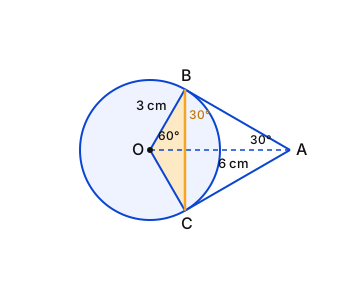
Two tangents, AB and AC, are drawn on a circle from an external point A, which is 6 cm away from its centre O. If the radius of the circle is 3 cm, then what is the measure of angle OBC?
एक वृत्त पर उसके केंद्र O से 6 cm दूर स्थित एक बाह्य बिंदु A से दो स्पर्श रेखाएँ AB और AC खींची गई हैं। यदि वृत्त की त्रिज्या 3 cm है, तो कोण OBC का माप क्या है?
  1. A30∘
  2. B100∘
  3. C60∘
  4. D120∘
Show answer

Concept: A tangent is perpendicular to the radius at the point of contact, so △OBA is right-angled at B. Also OB=OC, so △OBC is isosceles.

  1. In △OBA: sin∠OAB=OBOA=36=12⇒∠OAB=30∘, so ∠AOB=60∘.
  2. By symmetry ∠AOC=60∘, hence ∠BOC=120∘.
  3. In isosceles △OBC: ∠OBC=∠OCB=180∘−120∘2=30∘.

Trick: When the external point is at distance 2r from the centre, the two tangents make 60∘ with each other, the central angle is 120∘ and each base angle of △OBC is 30∘.

Answer: (A) 30∘

अवधारणा: स्पर्श रेखा, स्पर्श बिंदु पर त्रिज्या के लंबवत होती है, अतः △OBA में B पर समकोण है। साथ ही OB=OC, इसलिए △OBC समद्विबाहु है।

  1. △OBA में: sin∠OAB=OBOA=36=12⇒∠OAB=30∘, अतः ∠AOB=60∘।
  2. सममिति से ∠AOC=60∘, इसलिए ∠BOC=120∘।
  3. समद्विबाहु △OBC में: ∠OBC=∠OCB=180∘−120∘2=30∘।

ट्रिक: जब बाहरी बिंदु केंद्र से 2r दूरी पर हो, तो दोनों स्पर्श रेखाओं के बीच 60∘, केंद्रीय कोण 120∘ और △OBC का प्रत्येक आधार कोण 30∘ होता है।

उत्तर: (A) 30∘

RRB NTPC Graduate CBT 1MathematicsCircle – TangentsRRB NTPC Graduate CBT 1 2025 · 25 Mar Shift 3 →
Q342.
If 9 students can prepare 117 charts in 3 hours, how many students are needed to prepare 208 charts in 1 hour?
यदि 9 विद्यार्थी 3 घंटे में 117 चार्ट तैयार कर सकते हैं, तो 1 घंटे में 208 चार्ट तैयार करने के लिए कितने विद्यार्थियों की आवश्यकता होगी?
  1. A42 students42 विद्यार्थी
  2. B48 students48 विद्यार्थी
  3. C46 students46 विद्यार्थी
  4. D45 students45 विद्यार्थी
Show answer

Concept: M1T1W1=M2T2W2 (men × time ∝ work).

  1. 9×3117=M2×1208
  2. M2=27×208117=27×208117; since 117=9×13 and 208=16×13: M2=27×169=48.

Trick: One student makes 11727=133 charts per hour, so 208÷133=16×3=48 students.

Answer: (B) 48 students

अवधारणा: M1T1W1=M2T2W2 (व्यक्ति × समय ∝ कार्य)।

  1. 9×3117=M2×1208
  2. M2=27×208117; चूँकि 117=9×13 और 208=16×13: M2=27×169=48।

ट्रिक: एक छात्र प्रति घंटे 11727=133 चार्ट बनाता है, अतः 208÷133=16×3=48 छात्र।

उत्तर: (B) 48 छात्र

RRB NTPC Graduate CBT 1MathematicsWork and time – chain ruleRRB NTPC Graduate CBT 1 2025 · 25 Mar Shift 3 →
Q343.
If the mean proportional between x and 36 is 18, what is the value of x?
यदि x और 36 के बीच मध्यानुपाती 18 है, तो x का मान क्या है?
  1. A12
  2. B18
  3. C9
  4. D6
Show answer

Concept: The mean proportional between a and b is ab, i.e. m2=ab.

  1. 182=x×36
  2. x=32436=9

Trick: x:18=18:36; the right ratio is 1:2, so x=182=9.

Answer: (C) 9

अवधारणा: a और b के बीच मध्यानुपाती (mean proportional) =ab, अर्थात् m2=ab।

  1. 182=x×36
  2. x=32436=9

ट्रिक: x:18=18:36; दाहिना अनुपात 1:2 है, अतः x=182=9।

उत्तर: (C) 9

RRB NTPC Graduate CBT 1MathematicsRatio – mean proportionalRRB NTPC Graduate CBT 1 2025 · 25 Mar Shift 3 →
Q344.
Sharad is two times as old as his younger brother, and his other brother is 3 years younger than the younger brother. If the sum of the ages of these three brothers 3 years ago was 28 years, find Sharad’s present age, in years.
शरद की आयु अपने छोटे भाई की आयु की दो गुनी है, और उसका दूसरा भाई छोटे भाई से 3 वर्ष छोटा है। यदि 3 वर्ष पहले इन तीनों भाइयों की आयु का योग 28 वर्ष था, तो शरद की वर्तमान आयु (वर्षों में) ज्ञात कीजिए।
  1. A26
  2. B20
  3. C22
  4. D18
Show answer

Concept: Take the younger brother's present age as x and express the others in terms of x; "3 years ago" reduces each age by 3.

  1. Younger brother =x, Sharad =2x, other brother =x−3. Present sum =4x−3.
  2. Three years ago: (4x−3)−9=28⇒4x=40⇒x=10.
  3. Sharad's age =2x=20 years.

Trick: Sum of ages 3 years ago =28 → present sum =28+3×3=37. Then 4x−3=37⇒x=10.

Answer: (B) 20

अवधारणा: छोटे भाई की वर्तमान आयु x मानकर बाकी को x में लिखिए; "3 वर्ष पहले" में प्रत्येक आयु 3 कम हो जाती है।

  1. छोटा भाई =x, शरद =2x, दूसरा भाई =x−3। वर्तमान योग =4x−3।
  2. तीन वर्ष पहले: (4x−3)−9=28⇒4x=40⇒x=10।
  3. शरद की आयु =2x=20 वर्ष।

ट्रिक: 3 वर्ष पहले योग =28 → वर्तमान योग =28+3×3=37। फिर 4x−3=37⇒x=10।

उत्तर: (B) 20

RRB NTPC Graduate CBT 1MathematicsAgesRRB NTPC Graduate CBT 1 2025 · 25 Mar Shift 3 →
Q345.
Find the value of y, satisfying 22×3×816÷2601=y+794.
y का वह मान ज्ञात कीजिए, जो 22×3×816÷2601=y+794 को संतुष्ट करता है।
  1. A258
  2. B262
  3. C270
  4. D256
Show answer

Concept: Apply BODMAS: evaluate the square root first, then multiplication/division from left to right.

  1. 2601=51 (since 512=2601).
  2. 22×3×816÷51=66×81651=66×16=1056.
  3. y=1056−794=262.

Trick: 816=51×16 – spot such factors before multiplying, it keeps numbers small.

Answer: (B) 262

अवधारणा: BODMAS लागू करें: पहले वर्गमूल, फिर गुणा/भाग बाएँ से दाएँ।

  1. 2601=51 (क्योंकि 512=2601)।
  2. 22×3×816÷51=66×81651=66×16=1056।
  3. y=1056−794=262।

ट्रिक: 816=51×16 – गुणा करने से पहले ऐसे गुणनखंड पहचानें, संख्याएँ छोटी रहती हैं।

उत्तर: (B) 262

RRB NTPC Graduate CBT 1MathematicsSimplification – BODMASRRB NTPC Graduate CBT 1 2025 · 25 Mar Shift 3 →
Q346.
Trisha and Riya started a partnership business, investing some amount in the ratio of 8 : 5. Poorva joined then after six months with an amount equal to that of Riya. In what ratio should the profit at the end of one year be distributed among Trisha, Riya and Poorva?
तृषा और रिया ने 8 : 5 के अनुपात में कुछ राशि निवेश करके एक साझेदारी व्यवसाय शुरू किया। छह महीने बाद पूर्वा रिया के बराबर राशि के साथ उनके साथ जुड़ गई। एक वर्ष के अंत में लाभ को तृषा, रिया और पूर्वा के बीच किस अनुपात में वितरित किया जाना चाहिए?
  1. A19 : 15 : 8
  2. B15 : 5 : 2
  3. C16 : 10 : 5
  4. D17 : 7 : 3
Show answer

Concept: Profit is shared in the ratio of (capital × time).

  1. Trisha: 8×12=96; Riya: 5×12=60; Poorva (equal to Riya, for 6 months): 5×6=30.
  2. Ratio =96:60:30=16:10:5.

Trick: Poorva's capital equals Riya's but for half the time, so her share is half of Riya's: 8:5:2.5=16:10:5.

Answer: (C) 16 : 10 : 5

अवधारणा: लाभ (पूँजी × समय) के अनुपात में बँटता है।

  1. तृषा: 8×12=96; रिया: 5×12=60; पूर्वा (रिया के बराबर, 6 माह): 5×6=30।
  2. अनुपात =96:60:30=16:10:5।

ट्रिक: पूर्वा की पूँजी रिया के बराबर पर आधे समय के लिए है, अतः उसका हिस्सा रिया का आधा: 8:5:2.5=16:10:5।

उत्तर: (C) 16 : 10 : 5

RRB NTPC Graduate CBT 1MathematicsPartnershipRRB NTPC Graduate CBT 1 2025 · 25 Mar Shift 3 →
Q347.
A shopkeeper professes to sell his goods at a 45% loss but uses a false balance and gains 50%. The actual weight (rounded off to one decimal place) that he uses instead of 1 kg is:
एक दुकानदार अपना सामान 45% हानि पर बेचने का दावा करता है, परंतु गलत तराज़ू का उपयोग करके 50% लाभ प्राप्त करता है। 1 kg के स्थान पर वह जो वास्तविक भार (एक दशमलव स्थान तक पूर्णांकित) उपयोग करता है, वह है:
  1. A369.3 gm
  2. B368.6 gm
  3. C366.7 gm
  4. D365.2 gm
Show answer

Concept: If the shopkeeper claims a loss of 45%, he charges only 55% of the cost of 1 kg. To still gain 50%, the goods he actually gives must cost 55150 of 1 kg.

  1. Amount charged =0.55×(CP of 1 kg).
  2. Gain 50% ⇒ actual CP of goods given =0.551.5 kg =55150=1130 kg.
  3. 1130×1000=366.67≈366.7 g.

Trick: True weight=100−claimed loss%100+actual gain%×1000=55150×1000=366.7 g.

Answer: (C) 366.7 gm

अवधारणा: दुकानदार 45% हानि का दावा करता है, अर्थात् वह 1 kg की लागत का केवल 55% लेता है। फिर भी 50% लाभ पाने के लिए दिए गए माल की लागत 1 kg की 55150 होनी चाहिए।

  1. वसूली गई राशि =0.55×(1 kg का CP)।
  2. 50% लाभ ⇒ दिए गए माल का वास्तविक CP =0.551.5 kg =55150=1130 kg।
  3. 1130×1000=366.67≈366.7 g।

ट्रिक: वास्तविक भार=100−कथित हानि%100+वास्तविक लाभ%×1000=55150×1000=366.7 g।

उत्तर: (C) 366.7 gm

RRB NTPC Graduate CBT 1MathematicsProfit & loss – false weightRRB NTPC Graduate CBT 1 2025 · 25 Mar Shift 3 →
Q348.
If 3A = 4B = 8C, what is A : B : C?
यदि 3A = 4B = 8C है, तो A : B : C क्या है?
  1. A6 : 3 : 8
  2. B8 : 6 : 3
  3. C8 : 4 : 3
  4. D6 : 8 : 3
Show answer

Concept: If 3A=4B=8C=k, then A=k3, B=k4, C=k8.

  1. Take k=LCM(3,4,8)=24.
  2. A=8, B=6, C=3 → A:B:C=8:6:3.

Trick: A:B:C=13:14:18; multiply by 24 → 8:6:3. The biggest coefficient gives the smallest share.

Answer: (B) 8 : 6 : 3

अवधारणा: यदि 3A=4B=8C=k, तो A=k3, B=k4, C=k8।

  1. k=LCM(3,4,8)=24 लें।
  2. A=8, B=6, C=3 → A:B:C=8:6:3।

ट्रिक: A:B:C=13:14:18; 24 से गुणा → 8:6:3। सबसे बड़ा गुणांक सबसे छोटा हिस्सा देता है।

उत्तर: (B) 8 : 6 : 3

RRB NTPC Graduate CBT 1MathematicsRatio – equal productsRRB NTPC Graduate CBT 1 2025 · 25 Mar Shift 3 →
Q349.
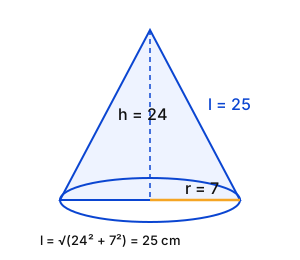
A manufacturer is making conical paper cups of height 24 cm and radius 7 cm. How much paper (in m2 correct up to 2 decimal places) is needed to make 1000 such cups? (Take π=3.14)
एक निर्माता 24 cm ऊँचाई और 7 cm त्रिज्या वाले शंक्वाकार कागज़ के कप बना रहा है। ऐसे 1000 कप बनाने के लिए कितना कागज़ (m2 में, 2 दशमलव स्थानों तक सही) चाहिए? (π=3.14 लीजिए)
  1. A71.34 m2
  2. B70.34 m2
  3. C80.34 m2
  4. D54.95 m2
Show answer

Concept: A paper cup is an open cone, so paper needed = curved surface area =πrl, where slant height l=h2+r2.

  1. l=242+72=576+49=625=25 cm.
  2. CSA of one cup =3.14×7×25=549.5 cm2.
  3. 1000 cups: 549500 cm2=54950010000=54.95 m2.

Trick: 7-24-25 is a Pythagorean triplet – no calculation needed for l. And 1 m2=104 cm2.

Answer: (D) 54.95 m2

अवधारणा: कागज़ का कप खुला शंकु है, अतः आवश्यक कागज़ = वक्र पृष्ठीय क्षेत्रफल =πrl, जहाँ तिर्यक ऊँचाई l=h2+r2।

  1. l=242+72=576+49=625=25 cm।
  2. एक कप का CSA =3.14×7×25=549.5 cm2।
  3. 1000 कप: 549500 cm2=54950010000=54.95 m2।

ट्रिक: 7-24-25 पाइथागोरस त्रिक है – l के लिए गणना नहीं चाहिए। और 1 m2=104 cm2।

उत्तर: (D) 54.95 m2

RRB NTPC Graduate CBT 1MathematicsMensuration – coneRRB NTPC Graduate CBT 1 2025 · 25 Mar Shift 3 →
Q350.
The total surface area of a solid hemisphere is 200 cm2. Its radius (in cm) is:
(Take π=227)
एक ठोस अर्धगोले का कुल पृष्ठीय क्षेत्रफल 200 cm2 है। इसकी त्रिज्या (cm में) है:
(π=227 लीजिए)
  1. A70333
  2. B71033
  3. C69233
  4. D70033
Show answer

Concept: Total surface area of a solid hemisphere =2πr2+πr2=3πr2.

  1. 3×227×r2=200⇒r2=200×766=140066=70033.
  2. r=70033 cm.

Trick: Hemisphere: CSA =2πr2, TSA =3πr2, volume =23πr3. Do not forget the flat circular base in TSA.

Answer: (D) 70033

अवधारणा: ठोस अर्धगोले का कुल पृष्ठीय क्षेत्रफल =2πr2+πr2=3πr2।

  1. 3×227×r2=200⇒r2=200×766=140066=70033।
  2. r=70033 cm।

ट्रिक: अर्धगोला: CSA =2πr2, TSA =3πr2, आयतन =23πr3। TSA में समतल वृत्ताकार आधार मत भूलिए।

उत्तर: (D) 70033

RRB NTPC Graduate CBT 1MathematicsMensuration – hemisphereRRB NTPC Graduate CBT 1 2025 · 25 Mar Shift 3 →
Q351.
There are 69 members in group A, 65 members in group B and 88 members in group C. All the members of these groups went to a restaurant. The average amounts spent on each member of groups A, B and C are ₹468, ₹120 and ₹276, respectively. The overall average amount (in ₹) spent per member is:
समूह A में 69 सदस्य, समूह B में 65 सदस्य और समूह C में 88 सदस्य हैं। इन समूहों के सभी सदस्य एक रेस्तरां में गए। समूह A, B और C के प्रत्येक सदस्य पर खर्च की गई औसत राशि क्रमशः ₹468, ₹120 और ₹276 है। प्रति सदस्य खर्च की गई समग्र औसत राशि (₹ में) है:
  1. A286
  2. B288
  3. C290
  4. D294
Show answer

Concept: Overall average =total amounttotal members.

  1. Total =69×468+65×120+88×276=32292+7800+24288=64380.
  2. Members =69+65+88=222.
  3. Average =64380222=290.

Trick: Take 288 as base: deviations 69×180−65×168−88×12=12420−10920−1056=444; 444222=2 → 288+2=290.

Answer: (C) 290

अवधारणा: समग्र औसत =कुल राशिकुल सदस्य।

  1. कुल =69×468+65×120+88×276=32292+7800+24288=64380।
  2. सदस्य =69+65+88=222।
  3. औसत =64380222=290।

ट्रिक: 288 आधार लें: विचलन 69×180−65×168−88×12=12420−10920−1056=444; 444222=2 → 288+2=290।

उत्तर: (C) 290

RRB NTPC Graduate CBT 1MathematicsAverage – weightedRRB NTPC Graduate CBT 1 2025 · 25 Mar Shift 3 →
Q352.
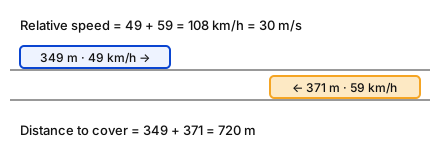
Two trains are running with the speed of 49 km/hr and 59 km/hr towards each other on parallel tracks. Their lengths are 349 m and 371 m, respectively. In how much time (in seconds) will they completely pass each other?
दो रेलगाड़ियाँ समानांतर पटरियों पर 49 km/hr और 59 km/hr की चाल से एक-दूसरे की ओर चल रही हैं। उनकी लंबाइयाँ क्रमशः 349 m और 371 m हैं। वे कितने समय (सेकंड में) में एक-दूसरे को पूरी तरह पार कर लेंगी?
  1. A42
  2. B30
  3. C24
  4. D34
Show answer

Concept: Trains moving towards each other: relative speed = sum of speeds; distance to cross = sum of lengths.

  1. Relative speed =49+59=108 km/h=108×518=30 m/s.
  2. Distance =349+371=720 m.
  3. Time =72030=24 s.

Trick: 108 km/h is exactly 30 m/s (×518); memorise 18 → 5, 36 → 10, 54 → 15, 72 → 20, 90 → 25, 108 → 30.

Answer: (C) 24

अवधारणा: एक-दूसरे की ओर आती रेलगाड़ियाँ: सापेक्ष चाल = चालों का योग; पार करने की दूरी = लंबाइयों का योग।

  1. सापेक्ष चाल =49+59=108 km/h=108×518=30 m/s।
  2. दूरी =349+371=720 m।
  3. समय =72030=24 s।

ट्रिक: 108 km/h ठीक 30 m/s है (×518); याद रखें 18 → 5, 36 → 10, 54 → 15, 72 → 20, 90 → 25, 108 → 30।

उत्तर: (C) 24

RRB NTPC Graduate CBT 1MathematicsTrains – opposite directionRRB NTPC Graduate CBT 1 2025 · 25 Mar Shift 3 →
Q353.
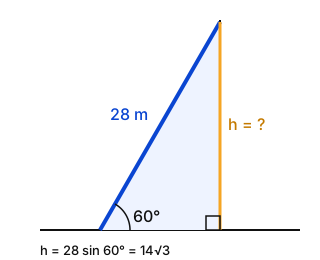
A ladder 28 meters long leans against a wall, making an angle of 60° with the ground. Find the height at which the ladder touches the wall. (Use √3 = 1.74)
28 मीटर लंबी एक सीढ़ी एक दीवार के सहारे टिकी है और ज़मीन के साथ 60° का कोण बनाती है। वह ऊँचाई ज्ञात कीजिए जिस पर सीढ़ी दीवार को स्पर्श करती है। (√3 = 1.74 लीजिए)
  1. A21.5 m
  2. B22.65 m
  3. C24.36 m
  4. D23.8 m
Show answer

Concept: Ladder, wall and ground form a right triangle; height on the wall =ladder×sinθ.

  1. h=28sin60∘=28×32=143.
  2. 14×1.74=24.36 m.

Trick: In a 30°-60°-90° triangle the sides are 1:3:2; opposite 60∘ is 32 of the hypotenuse.

Answer: (C) 24.36 m

अवधारणा: सीढ़ी, दीवार और ज़मीन समकोण त्रिभुज बनाते हैं; दीवार पर ऊँचाई =सीढ़ी×sinθ।

  1. h=28sin60∘=28×32=143।
  2. 14×1.74=24.36 m।

ट्रिक: 30°-60°-90° त्रिभुज में भुजाएँ 1:3:2 होती हैं; 60∘ के सामने की भुजा कर्ण की 32।

उत्तर: (C) 24.36 m

RRB NTPC Graduate CBT 1MathematicsHeights and distancesRRB NTPC Graduate CBT 1 2025 · 25 Mar Shift 3 →
Q354.
At what rate per annum will a sum of money become five times itself in 4 years under simple interest?
साधारण ब्याज पर कोई धनराशि 4 वर्षों में स्वयं की पाँच गुनी किस वार्षिक दर से हो जाएगी?
  1. A200%
  2. B100%
  3. C98%
  4. D102%
Show answer

Concept: If a sum becomes n times under SI, interest =(n−1)P and R=(n−1)×100T.

  1. Five times ⇒ SI =4P.
  2. R=4P×100P×4=100% per annum.

Trick: R×T=(n−1)×100 → R×4=400 → R=100%.

Answer: (B) 100%

अवधारणा: साधारण ब्याज पर यदि राशि n गुना हो जाए, तो ब्याज =(n−1)P और R=(n−1)×100T।

  1. पाँच गुना ⇒ SI =4P।
  2. R=4P×100P×4=100% वार्षिक।

ट्रिक: R×T=(n−1)×100 → R×4=400 → R=100%।

उत्तर: (B) 100%

RRB NTPC Graduate CBT 1MathematicsSimple interestRRB NTPC Graduate CBT 1 2025 · 25 Mar Shift 3 →
Q355.
100 men have provisions for 27 days. If 50 men have left, for how many days the same provisions would last for the remaining men?
100 आदमियों के लिए 27 दिनों की खाद्य सामग्री है। यदि 50 आदमी चले जाएँ, तो वही खाद्य सामग्री शेष आदमियों के लिए कितने दिनों तक चलेगी?
  1. A56
  2. B52
  3. C58
  4. D54
Show answer

Concept: Fixed provisions: men × days = constant (inverse variation).

  1. 100×27=50×D
  2. D=270050=54 days.

Trick: Half the men ⇒ double the days: 27×2=54.

Answer: (D) 54

अवधारणा: निश्चित रसद: व्यक्ति × दिन = स्थिर (व्युत्क्रम अनुपात)।

  1. 100×27=50×D
  2. D=270050=54 दिन।

ट्रिक: आधे आदमी ⇒ दोगुने दिन: 27×2=54।

उत्तर: (D) 54

RRB NTPC Graduate CBT 1MathematicsInverse variation – provisionsRRB NTPC Graduate CBT 1 2025 · 25 Mar Shift 3 →
Q356.
A shopkeeper fixes the marked price of an item 160% above its cost price. What percentage of discount on marked price should be allowed to gain 30%?
एक दुकानदार किसी वस्तु का अंकित मूल्य उसके क्रय मूल्य से 160% अधिक निर्धारित करता है। 30% लाभ प्राप्त करने के लिए अंकित मूल्य पर कितने प्रतिशत छूट दी जानी चाहिए?
  1. A48%
  2. B50%
  3. C47%
  4. D49%
Show answer

Concept: Take CP = 100; MP = CP + 160% = 260; required SP = 130 (30% gain). Discount is measured on MP.

  1. Discount =260−130=130.
  2. Discount% =130260×100=50%.

Trick: SPMP=130260=12, so half the marked price is knocked off → 50% discount.

Answer: (B) 50%

अवधारणा: CP = 100 लें; MP = CP + 160% = 260; आवश्यक SP = 130 (30% लाभ)। छूट MP पर मापी जाती है।

  1. छूट =260−130=130।
  2. छूट% =130260×100=50%।

ट्रिक: SPMP=130260=12, अर्थात् अंकित मूल्य का आधा घटाना है → 50% छूट।

उत्तर: (B) 50%

RRB NTPC Graduate CBT 1MathematicsProfit & loss – discountRRB NTPC Graduate CBT 1 2025 · 25 Mar Shift 3 →
Q357.
If a+1a=3, then find the value of a6+1a6.
यदि a+1a=3 है, तो a6+1a6 का मान ज्ञात कीजिए।
  1. A324
  2. B321
  3. C323
  4. D322
Show answer

Concept: If a+1a=k, then a2+1a2=k2−2 and a3+1a3=k3−3k; also a6+1a6=(a3+1a3)2−2.

  1. a3+1a3=33−3×3=27−9=18.
  2. a6+1a6=182−2=324−2=322.

Trick: For a+1a=3: squares chain 3 → 7 → 47 (for a4), cubes 18, sixth power 182−2=322. Cross-check: 73−3×7=343−21=322 ✓.

Answer: (D) 322

अवधारणा: यदि a+1a=k, तो a2+1a2=k2−2 और a3+1a3=k3−3k; साथ ही a6+1a6=(a3+1a3)2−2।

  1. a3+1a3=33−3×3=27−9=18।
  2. a6+1a6=182−2=324−2=322।

ट्रिक: a+1a=3 के लिए: वर्ग 7, घन 18, छठी घात 182−2=322। जाँच: 73−3×7=343−21=322 ✓।

उत्तर: (D) 322

RRB NTPC Graduate CBT 1MathematicsAlgebra – a + 1/a identitiesRRB NTPC Graduate CBT 1 2025 · 25 Mar Shift 3 →
Q358.
Find the value of m, satisfying the equation:
(289)11×(928)16×(289)17=(928)2m+8
समीकरण को संतुष्ट करने वाले m का मान ज्ञात कीजिए:
(289)11×(928)16×(289)17=(928)2m+8
  1. A−10
  2. B−9
  3. C1
  4. D−26
Show answer

Concept: Same base → add the powers: am×an=am+n, and (928)=(289)−1.

  1. Write everything with base 289: (928)16=(289)−16.
  2. LHS =(289)11−16+17=(289)12.
  3. RHS =(928)2m+8=(289)−(2m+8).
  4. Equate powers: −(2m+8)=12⇒2m=−20⇒m=−10.

Trick: Flip the fraction = change the sign of the power. Bring every term to one base first, then just compare exponents.

Answer: (A) −10

अवधारणा: समान आधार → घात जुड़ते हैं: am×an=am+n, और (928)=(289)−1।

  1. सब कुछ आधार 289 में लिखें: (928)16=(289)−16।
  2. LHS =(289)11−16+17=(289)12।
  3. RHS =(928)2m+8=(289)−(2m+8)।
  4. घात बराबर करें: −(2m+8)=12⇒2m=−20⇒m=−10।

ट्रिक: भिन्न उलटना = घात का चिह्न बदलना। पहले सभी पदों को एक आधार में लाएँ, फिर केवल घातों की तुलना करें।

उत्तर: (A) −10

RRB NTPC Graduate CBT 1MathematicsLaws of ExponentsRRB NTPC Graduate CBT 1 2025 · 25 Mar Shift 3 →
Q359.
Simplify (555+444)2+(555−444)2555×555+444×444.
(555+444)2+(555−444)2555×555+444×444 को सरल कीजिए।
  1. A1000
  2. B2
  3. C111
  4. D999
Show answer

Concept: (a+b)2+(a−b)2=2(a2+b2).

  1. Let a=555, b=444.
  2. Numerator =(a+b)2+(a−b)2=2(a2+b2).
  3. Denominator =a×a+b×b=a2+b2.
  4. Ratio =2(a2+b2)a2+b2=2.

Trick: Big numbers in a "simplify" question are a hint that an identity will cancel everything – never multiply them out.

Answer: (B) 2

अवधारणा: (a+b)2+(a−b)2=2(a2+b2)।

  1. मान लें a=555, b=444।
  2. अंश =(a+b)2+(a−b)2=2(a2+b2)।
  3. हर =a×a+b×b=a2+b2।
  4. अनुपात =2(a2+b2)a2+b2=2।

ट्रिक: "सरल कीजिए" में बड़ी संख्याएँ संकेत हैं कि कोई सर्वसमिका सब कुछ काट देगी – कभी गुणा न करें।

उत्तर: (B) 2

RRB NTPC Graduate CBT 1MathematicsAlgebraic IdentitiesRRB NTPC Graduate CBT 1 2025 · 25 Mar Shift 3 →
Q360.
For equation (2m−3)x2+ (m+1)x + 5 = 0 to represent a quadratic equation, which of the following must be definitely true?
समीकरण (2m−3)x2+ (m+1)x + 5 = 0 के द्विघात समीकरण होने के लिए, निम्नलिखित में से कौन-सा निश्चित रूप से सत्य होना चाहिए?
  1. Am=−1
  2. Bm=−32
  3. Cm≠2
  4. Dm≠32
Show answer

Concept: ax2+bx+c=0 is quadratic only when the coefficient of x2 is non-zero: a≠0.

  1. Here a=2m−3.
  2. Condition: 2m−3≠0⇒m≠32.
  3. The coefficient of x or the constant may be anything, so options with m=−1 or m=−32 are not required.

Trick: "Must be true" for a quadratic = only one check: leading coefficient ≠0.

Answer: (D) m≠32

अवधारणा: ax2+bx+c=0 द्विघात तभी है जब x2 का गुणांक शून्य न हो: a≠0।

  1. यहाँ a=2m−3।
  2. शर्त: 2m−3≠0⇒m≠32।
  3. x का गुणांक या अचर कुछ भी हो सकता है, इसलिए m=−1 या m=−32 वाले विकल्प आवश्यक नहीं।

ट्रिक: द्विघात के लिए "अवश्य सत्य" = केवल एक जाँच: अग्र गुणांक ≠0।

उत्तर: (D) m≠32

RRB NTPC Graduate CBT 1MathematicsQuadratic Equations – DefinitionRRB NTPC Graduate CBT 1 2025 · 25 Mar Shift 3 →