Question bank

Q&A: practice questions with answers

Search questions on any topic. Filter by exam category, exam, subject and topic, try the question, then open the answer and explanation.

Courses – airGurukul

7,077 questions found.

Q3621.
Chandragupta Maurya is said to have converted to:
कहा जाता है कि चंद्रगुप्त मौर्य ने किस धर्म को अपना लिया था?
  1. AChristianityईसाई धर्म
  2. BJainismजैन धर्म
  3. CZoroastrianismपारसी धर्म (Zoroastrianism)
  4. DBuddhismबौद्ध धर्म
Show answer

Concept: Jain tradition records the later life of Chandragupta Maurya.

  1. Chandragupta gave up his throne, became a disciple of the Jain monk Bhadrabahu and went to Shravanabelagola (Karnataka).
  2. He is said to have died there by sallekhana (fasting unto death); Chandragiri hill is named after him.
  3. Buddhism is linked with his grandson Ashoka, not with Chandragupta.

Yaad rakhein: Chandragupta – Jainism (Bhadrabahu); Ashoka – Buddhism (Upagupta); Bindusara – Ajivika.

Answer: (B) Jainism

अवधारणा: जैन परंपरा चंद्रगुप्त मौर्य के अंतिम जीवन का वर्णन करती है।

  1. चंद्रगुप्त ने सिंहासन त्यागकर जैन मुनि भद्रबाहु का शिष्यत्व लिया और श्रवणबेलगोला (कर्नाटक) गए।
  2. कहा जाता है कि वहाँ उन्होंने सल्लेखना (उपवास द्वारा देह-त्याग) की; चंद्रगिरि पहाड़ी उन्हीं के नाम पर है।
  3. बौद्ध धर्म उनके पौत्र अशोक से जुड़ा है, चंद्रगुप्त से नहीं।

याद रखें: चंद्रगुप्त – जैन (भद्रबाहु); अशोक – बौद्ध (उपगुप्त); बिंदुसार – आजीवक।

उत्तर: (B) जैन धर्म
RRB NTPC Graduate CBT 1General AwarenessAncient History – MauryasRRB NTPC Graduate CBT 1 2024 · 10 Jun Shift 2 →
Q3622.
C is the third proportional of 44 and B. If B is the sum of the first three even natural numbers, then find the value of C.
(Round off your answer to two decimal places)
C, 44 और B का तृतीयानुपाती है। यदि B पहली तीन सम प्राकृत संख्याओं का योग है, तो C का मान ज्ञात कीजिए।
(अपना उत्तर दशमलव के दो स्थानों तक पूर्णांकित कीजिए)
  1. A3.27
  2. B0.98
  3. C1.98
  4. D4.58
Show answer

Concept: If a:b=b:c, then c is the third proportional: c=b2a.

  1. First three even natural numbers: 2+4+6=12, so B=12.
  2. C=B244=14444.
  3. 14444=3611=3.2727…≈3.27.

Trick: Third proportional =(middle)2first.

Answer: (A) 3.27

अवधारणा: यदि a:b=b:c हो, तो c तृतीय समानुपाती है: c=b2a।

  1. पहली तीन सम प्राकृत संख्याएँ: 2+4+6=12, अतः B=12।
  2. C=B244=14444।
  3. 14444=3611=3.2727…≈3.27।

ट्रिक: तृतीय समानुपाती =(मध्य)2प्रथम।

उत्तर: (A) 3.27

RRB NTPC Graduate CBT 1MathematicsThird proportionalRRB NTPC Graduate CBT 1 2024 · 10 Jun Shift 2 →
Q3623.
If α and β are the roots of the quadratic equation y2−9y+8=0, then find the value of α+β−αβ.
यदि α और β द्विघात समीकरण y2−9y+8=0 के मूल हैं, तो α+β−αβ का मान ज्ञात कीजिए।
  1. A4
  2. B1
  3. C3
  4. D2
Show answer

Concept: For ay2+by+c=0: sum of roots α+β=−ba and product αβ=ca.

  1. Here a=1, b=−9, c=8.
  2. α+β=9 and αβ=8.
  3. α+β−αβ=9−8=1.

Trick: Roots are actually 1 and 8 (since 1+8=9, 1×8=8): 9−8=1.

Answer: (B) 1

अवधारणा: ay2+by+c=0 के लिए: मूलों का योग α+β=−ba और गुणनफल αβ=ca।

  1. यहाँ a=1, b=−9, c=8।
  2. α+β=9 और αβ=8।
  3. α+β−αβ=9−8=1।

ट्रिक: मूल 1 और 8 हैं (1+8=9, 1×8=8): 9−8=1।

उत्तर: (B) 1

RRB NTPC Graduate CBT 1MathematicsQuadratic equationsRRB NTPC Graduate CBT 1 2024 · 10 Jun Shift 2 →
Q3624.
If the ratio of two numbers is 18 : 5 and the product of their LCM and their HCF is 360, then the sum of the reciprocals of the LCM and the HCF is:
यदि दो संख्याओं का अनुपात 18 : 5 है और उनके LCM और HCF का गुणनफल 360 है, तो LCM और HCF के व्युत्क्रमों का योग है:
  1. A91180
  2. B91185
  3. C91204
  4. D91193
Show answer

Concept: Product of two numbers =LCM×HCF.

  1. Let the numbers be 18k and 5k; product =90k2=360, so k2=4, k=2.
  2. Numbers: 36 and 10; HCF =2, LCM =180 (check: 180×2=360).
  3. 1180+12=1+90180=91180.

Trick: Since 18 and 5 are co-prime, HCF =k and LCM =90k.

Answer: (A) 91180

अवधारणा: दो संख्याओं का गुणनफल =LCM×HCF।

  1. संख्याएँ 18k और 5k; गुणनफल =90k2=360, अतः k2=4, k=2।
  2. संख्याएँ 36 और 10; HCF =2, LCM =180 (जाँच: 180×2=360)।
  3. 1180+12=1+90180=91180।

ट्रिक: 18 और 5 सह-अभाज्य हैं, अतः HCF =k और LCM =90k।

उत्तर: (A) 91180

RRB NTPC Graduate CBT 1MathematicsHCF and LCMRRB NTPC Graduate CBT 1 2024 · 10 Jun Shift 2 →
Q3625.
Gopal gets a 2% increase in his sale amount in the first year and a 20% increase in the second year, and with that his present sale is ₹1,83,600. What was his sale (in ₹) two years ago?
गोपाल की बिक्री राशि में पहले वर्ष 2% और दूसरे वर्ष 20% की वृद्धि होती है, और इसके साथ उसकी वर्तमान बिक्री ₹1,83,600 है। दो वर्ष पहले उसकी बिक्री (₹ में) कितनी थी?
  1. A1,50,000
  2. B1,80,000
  3. C1,53,000
  4. D1,30,000
Show answer

Concept: After increases of a% and b%: present =original×(1+a100)(1+b100).

  1. original×1.02×1.20=183600.
  2. 1.02×1.20=1.224.
  3. Original =1836001.224=150000.

Trick: Check options: 150000×1.02=153000; 153000×1.2=183600 ✓.

Answer: (A) ₹1,50,000

अवधारणा: a% और b% वृद्धि के बाद: वर्तमान =मूल×(1+a100)(1+b100)।

  1. मूल×1.02×1.20=183600।
  2. 1.02×1.20=1.224।
  3. मूल =1836001.224=150000।

ट्रिक: विकल्प जाँचें: 150000×1.02=153000; 153000×1.2=183600 ✓।

उत्तर: (A) ₹1,50,000

RRB NTPC Graduate CBT 1MathematicsSuccessive percentage increaseRRB NTPC Graduate CBT 1 2024 · 10 Jun Shift 2 →
Q3626.
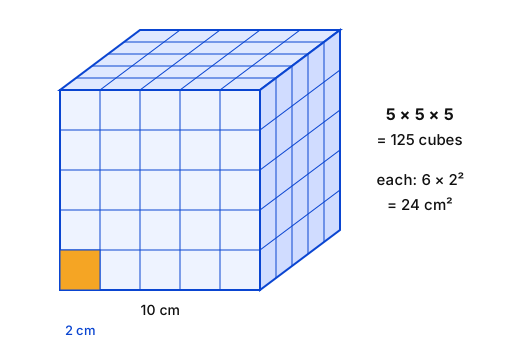
A cube of side 10 cm is cut into cubes of side 2 cm. Calculate the total surface area (in cm2) of all the small cubes:
10 cm भुजा वाले एक घन को 2 cm भुजा वाले घनों में काटा जाता है। सभी छोटे घनों का कुल पृष्ठीय क्षेत्रफल (cm2 में) ज्ञात कीजिए:
  1. A3000
  2. B3008
  3. C3002
  4. D3010
Show answer

Concept: Number of small cubes =(big sidesmall side)3; surface area of one cube =6a2.

  1. Number of cubes =(102)3=125.
  2. TSA of one small cube =6×22=24cm2.
  3. Total =125×24=3000cm2.

Trick: Total TSA =original TSA×102=600×5=3000.

Answer: (A) 3000

अवधारणा: छोटे घनों की संख्या =(बड़ी भुजाछोटी भुजा)3; एक घन का पृष्ठीय क्षेत्रफल =6a2।

  1. घनों की संख्या =(102)3=125।
  2. एक छोटे घन का TSA =6×22=24cm2।
  3. कुल =125×24=3000cm2।

ट्रिक: कुल TSA =मूल TSA×102=600×5=3000।

उत्तर: (A) 3000

RRB NTPC Graduate CBT 1MathematicsMensuration – cubesRRB NTPC Graduate CBT 1 2024 · 10 Jun Shift 2 →
Q3627.
The simplified value of 118 - 5 × (10 + 20) + 55 is:
118 - 5 × (10 + 20) + 55 का सरलीकृत मान है:
  1. A17
  2. B23
  3. C33
  4. D20
Show answer

Concept: BODMAS: Brackets → Of → Division/Multiplication → Addition/Subtraction.

  1. Bracket: 10+20=30.
  2. Multiplication: 5×30=150.
  3. 118−150+55=23.

Trick: Do 118+55=173 first, then 173−150=23.

Answer: (B) 23

अवधारणा: BODMAS: कोष्ठक → का → भाग/गुणा → जोड़/घटाव।

  1. कोष्ठक: 10+20=30।
  2. गुणा: 5×30=150।
  3. 118−150+55=23।

ट्रिक: पहले 118+55=173, फिर 173−150=23।

उत्तर: (B) 23

RRB NTPC Graduate CBT 1MathematicsSimplification (BODMAS)RRB NTPC Graduate CBT 1 2024 · 10 Jun Shift 2 →
Q3628.
Two numbers are respectively 30% and 18% more than a third number. The ratio of the two numbers is:
दो संख्याएँ एक तीसरी संख्या से क्रमशः 30% और 18% अधिक हैं। दोनों संख्याओं का अनुपात है:
  1. A55 : 64
  2. B58 : 63
  3. C65 : 59
  4. D73 : 74
Show answer

Concept: If two numbers are a% and b% more than the same number, their ratio is (100+a):(100+b).

  1. Let the third number =100.
  2. First =130, second =118.
  3. Ratio =130:118=65:59.

Trick: Take the base as 100 and simplify.

Answer: (C) 65:59

अवधारणा: यदि दो संख्याएँ किसी एक संख्या से a% और b% अधिक हैं, तो अनुपात (100+a):(100+b)।

  1. तीसरी संख्या =100 मानें।
  2. पहली =130, दूसरी =118।
  3. अनुपात =130:118=65:59।

ट्रिक: आधार 100 मानकर सरल करें।

उत्तर: (C) 65:59

RRB NTPC Graduate CBT 1MathematicsPercentage and ratioRRB NTPC Graduate CBT 1 2024 · 10 Jun Shift 2 →
Q3629.
The median of the observations 49, 91, 24, 46, 90, 20, 21, 14, 66, 32 and 92 is:
प्रेक्षणों 49, 91, 24, 46, 90, 20, 21, 14, 66, 32 और 92 की माध्यिका है:
  1. A46
  2. B24
  3. C49
  4. D32
Show answer

Concept: Arrange data in ascending order; for odd n, median =(n+12)th term.

  1. Ascending: 14, 20, 21, 24, 32, 46, 49, 66, 90, 91, 92.
  2. n=11, so median =(11+12)th=6th term.
  3. 6th term =46.

Trick: Five values below and five above the median.

Answer: (A) 46

अवधारणा: आँकड़ों को आरोही क्रम में लिखें; विषम n के लिए माध्यिका =(n+12)वाँ पद।

  1. आरोही: 14, 20, 21, 24, 32, 46, 49, 66, 90, 91, 92।
  2. n=11, अतः माध्यिका =(11+12) वाँ =6 वाँ पद।
  3. छठा पद =46।

ट्रिक: माध्यिका के नीचे पाँच और ऊपर पाँच मान।

उत्तर: (A) 46

RRB NTPC Graduate CBT 1MathematicsMedianRRB NTPC Graduate CBT 1 2024 · 10 Jun Shift 2 →
Q3630.
What will the amount after 1 year be, if ₹2,400 is invested at 20% compound interest per annum, compounded half-yearly?
यदि ₹2,400 को 20% वार्षिक चक्रवृद्धि ब्याज पर निवेश किया जाए, जिसमें ब्याज अर्धवार्षिक रूप से संयोजित होता है, तो 1 वर्ष बाद मिश्रधन कितना होगा?
  1. A₹2,460
  2. B₹2,904
  3. C₹3,071
  4. D₹2,950
Show answer

Concept: Half-yearly compounding: rate =R2 per half-year and time =2n half-years; A=P(1+r100)t.

  1. Rate =202=10% per half-year, periods =2.
  2. A=2400×(1.1)2=2400×1.21.
  3. A=2904.

Trick: 10% twice: 2400→2640→2904.

Answer: (B) ₹2,904

अवधारणा: अर्धवार्षिक चक्रवृद्धि: दर =R2 प्रति छमाही और समय =2n छमाही; A=P(1+r100)t।

  1. दर =202=10% प्रति छमाही, अवधियाँ =2।
  2. A=2400×(1.1)2=2400×1.21।
  3. A=2904।

ट्रिक: दो बार 10%: 2400→2640→2904।

उत्तर: (B) ₹2,904

RRB NTPC Graduate CBT 1MathematicsCompound interestRRB NTPC Graduate CBT 1 2024 · 10 Jun Shift 2 →
Q3631.
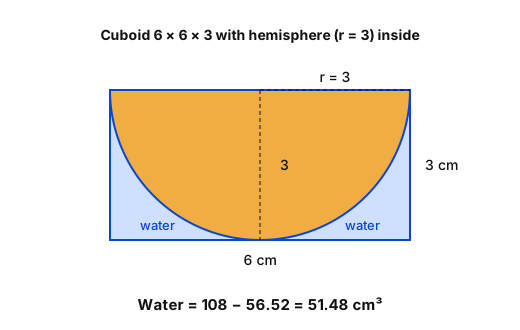
If a hemisphere of radius 3 cm is fitted inside a cuboid and then water is filled inside the cuboid, the amount of water (in cm3) present in the cuboid is:
(Take π = 3.14)
यदि 3 cm त्रिज्या वाले एक अर्धगोले को एक घनाभ के अंदर फिट किया जाए और फिर घनाभ में पानी भरा जाए, तो घनाभ में उपस्थित पानी की मात्रा (cm3 में) है:
(π = 3.14 लीजिए)
  1. A57.64
  2. B49.81
  3. C51.48
  4. D55.28
Show answer

Concept: The smallest cuboid holding a hemisphere of radius r is 2r×2r×r. Water = cuboid volume − hemisphere volume (23πr3).

  1. Cuboid =6×6×3=108cm3.
  2. Hemisphere =23×3.14×27=56.52cm3.
  3. Water =108−56.52=51.48cm3.

Trick: Water =r3(4−2π3)=27×1.9067≈51.48.

Answer: (C) 51.48

अवधारणा: त्रिज्या r के अर्धगोले को रखने वाला सबसे छोटा घनाभ 2r×2r×r है। पानी = घनाभ आयतन − अर्धगोला आयतन (23πr3)।

  1. घनाभ =6×6×3=108cm3।
  2. अर्धगोला =23×3.14×27=56.52cm3।
  3. पानी =108−56.52=51.48cm3।

ट्रिक: पानी =r3(4−2π3)=27×1.9067≈51.48।

उत्तर: (C) 51.48

RRB NTPC Graduate CBT 1MathematicsMensuration – hemisphere in cuboidRRB NTPC Graduate CBT 1 2024 · 10 Jun Shift 2 →
Q3632.
A man covers distances of 100 km, 408 km, and 1460 km at the speeds of 20 km/hr, x km/hr, and 20 km/hr, respectively. If his average speed for the whole journey is 20 km/hr, then what is the value of x?
एक व्यक्ति 100 km, 408 km और 1460 km की दूरियाँ क्रमशः 20 km/hr, x km/hr और 20 km/hr की चाल से तय करता है। यदि पूरी यात्रा के लिए उसकी औसत चाल 20 km/hr है, तो x का मान क्या है?
  1. A22
  2. B25
  3. C20
  4. D15
Show answer

Concept: Average speed =total distancetotal time.

  1. Total distance =100+408+1460=1968km; total time =196820=98.4h.
  2. Time for 1st and 3rd parts =10020+146020=5+73=78h.
  3. Time for 2nd part =98.4−78=20.4h, so x=40820.4=20.

Trick: If the average equals the speed of the other parts (20), the middle speed must also be 20.

Answer: (C) 20

अवधारणा: औसत चाल =कुल दूरीकुल समय।

  1. कुल दूरी =100+408+1460=1968km; कुल समय =196820=98.4h।
  2. पहले और तीसरे भाग का समय =10020+146020=5+73=78h।
  3. दूसरे भाग का समय =98.4−78=20.4h, अतः x=40820.4=20।

ट्रिक: यदि औसत चाल बाकी भागों की चाल (20) के बराबर है, तो बीच वाली चाल भी 20 होगी।

उत्तर: (C) 20

RRB NTPC Graduate CBT 1MathematicsAverage speedRRB NTPC Graduate CBT 1 2024 · 10 Jun Shift 2 →
Q3633.
One pipe can fill the tank in 8 minutes while another pipe can empty the completely filled tank in 11 minutes. If both the pipes are operated together on empty tank, how long (in minutes) will it take to fill three-fourth of the tank?
एक पाइप टंकी को 8 मिनट में भर सकता है जबकि दूसरा पाइप पूरी भरी टंकी को 11 मिनट में खाली कर सकता है। यदि दोनों पाइपों को खाली टंकी पर एक साथ चलाया जाए, तो टंकी का तीन-चौथाई भाग भरने में कितना समय (मिनट में) लगेगा?
  1. A22
  2. B45
  3. C44
  4. D23
Show answer

Concept: Net rate = filling rate − emptying rate; time =worknet rate.

  1. Net rate =18−111=11−888=388 tank per minute.
  2. Time for 34 tank =34÷388=34×883=22 min.

Trick: Full tank needs 883 min; three-fourth of it =22 min.

Answer: (A) 22

अवधारणा: शुद्ध दर = भरने की दर − खाली करने की दर; समय =कार्यशुद्ध दर।

  1. शुद्ध दर =18−111=11−888=388 टंकी प्रति मिनट।
  2. 34 टंकी का समय =34÷388=34×883=22 मिनट।

ट्रिक: पूरी टंकी 883 मिनट; उसका तीन-चौथाई =22 मिनट।

उत्तर: (A) 22

RRB NTPC Graduate CBT 1MathematicsPipes and cisternRRB NTPC Graduate CBT 1 2024 · 10 Jun Shift 2 →
Q3634.
Find the value of 38a2−4a+1+17a, when a=2.
38a2−4a+1+17a का मान ज्ञात कीजिए, जब a=2 है।
  1. A42
  2. B49
  3. C53
  4. D46
Show answer

Concept: Substitute the value of a and simplify inside the root first.

  1. 8a2−4a+1=8×4−8+1=25.
  2. 325=3×5=15.
  3. 17a=34; total =15+34=49.

Trick: A perfect square under the root (25) confirms the substitution is right.

Answer: (B) 49

अवधारणा: a का मान रखें और पहले वर्गमूल के अंदर सरल करें।

  1. 8a2−4a+1=8×4−8+1=25।
  2. 325=3×5=15।
  3. 17a=34; कुल =15+34=49।

ट्रिक: वर्गमूल के अंदर पूर्ण वर्ग (25) आना जाँच की पुष्टि है।

उत्तर: (B) 49

RRB NTPC Graduate CBT 1MathematicsAlgebraic substitutionRRB NTPC Graduate CBT 1 2024 · 10 Jun Shift 2 →
Q3635.
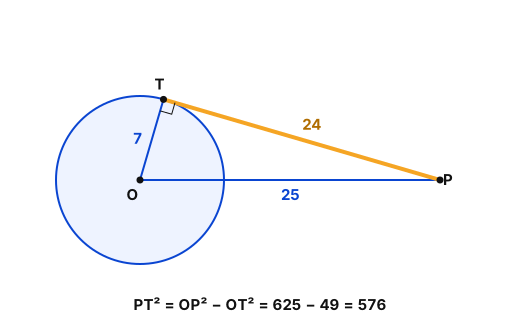
A tangent is drawn from point P to a circle with centre O. The radius of the circle is 7 cm, and the distance from point P to the centre O is 25 cm. What is the length of the tangent from point P to the point of tangency?
केंद्र O वाले एक वृत्त पर बिंदु P से एक स्पर्शरेखा खींची जाती है। वृत्त की त्रिज्या 7 cm है, और बिंदु P से केंद्र O की दूरी 25 cm है। बिंदु P से स्पर्श बिंदु तक स्पर्शरेखा की लंबाई कितनी है?
  1. A24 cm
  2. B27 cm
  3. C31 cm
  4. D21 cm
Show answer

Concept: A tangent is perpendicular to the radius at the point of contact, so OTP is a right triangle with OP as hypotenuse.

  1. PT2=OP2−OT2=252−72.
  2. PT2=625−49=576.
  3. PT=576=24cm.

Trick: Triplet (7,24,25).

Answer: (A) 24 cm

अवधारणा: स्पर्शरेखा, स्पर्श बिंदु पर त्रिज्या के लंबवत होती है, अतः OTP समकोण त्रिभुज है जिसका कर्ण OP है।

  1. PT2=OP2−OT2=252−72।
  2. PT2=625−49=576।
  3. PT=576=24cm।

ट्रिक: त्रिक (7,24,25)।

उत्तर: (A) 24 cm

RRB NTPC Graduate CBT 1MathematicsCircle – tangentRRB NTPC Graduate CBT 1 2024 · 10 Jun Shift 2 →
Q3636.
3 years ago from now, the age of father was 14 years more than twice his son's age. After how many years, from now, will he be twice his son's age?
अब से 3 वर्ष पहले, पिता की आयु उसके पुत्र की आयु के दोगुने से 14 वर्ष अधिक थी। अब से कितने वर्ष बाद, उसकी आयु उसके पुत्र की आयु की दोगुनी होगी?
  1. A12
  2. B14
  3. C8
  4. D11
Show answer

Concept: Form equations from the given conditions; the age difference between father and son never changes.

  1. Let present ages be father F and son S. Three years ago: F−3=2(S−3)+14⇒F=2S+11.
  2. After x years: F+x=2(S+x)⇒x=F−2S.
  3. x=(2S+11)−2S=11 years.

Trick: When F=2S+k today, the father becomes twice the son's age after exactly k years.

Answer: (D) 11

अवधारणा: दी गई शर्तों से समीकरण बनाइए; पिता और पुत्र की आयु का अंतर कभी नहीं बदलता।

  1. माना वर्तमान आयु पिता F, पुत्र S। 3 वर्ष पहले: F−3=2(S−3)+14⇒F=2S+11।
  2. x वर्ष बाद: F+x=2(S+x)⇒x=F−2S।
  3. x=(2S+11)−2S=11 वर्ष।

ट्रिक: यदि आज F=2S+k है, तो ठीक k वर्ष बाद पिता की आयु पुत्र की दोगुनी होगी।

उत्तर: (D) 11

RRB NTPC Graduate CBT 1MathematicsProblems on AgesRRB NTPC Graduate CBT 1 2024 · 10 Jun Shift 2 →
Q3637.
A retailer offers the following discount schemes for buyers on an article.
I. Two successive discounts of 27%.
II. A discount of 36% followed by a discount of 45%.
III. Successive discounts of 19% and 32%.
IV. A discount of 34% followed by a discount of 7%.
Which scheme will fetch the maximum selling price?
एक खुदरा विक्रेता किसी वस्तु पर ख़रीदारों के लिए निम्नलिखित छूट योजनाएँ प्रस्तुत करता है।
I. 27% की दो क्रमिक छूटें।
II. 36% की छूट के बाद 45% की छूट।
III. 19% और 32% की क्रमिक छूटें।
IV. 34% की छूट के बाद 7% की छूट।
किस योजना से अधिकतम विक्रय मूल्य प्राप्त होगा?
  1. AIII
  2. BI
  3. CIV
  4. DII
Show answer

Concept: Maximum selling price comes from the scheme whose net multiplier (product of the remaining percentages) is the largest.

  1. I: 0.73×0.73=0.5329
  2. II: 0.64×0.55=0.352
  3. III: 0.81×0.68=0.5508
  4. IV: 0.66×0.93=0.6138 ← largest, i.e. least net discount =38.62%.

Trick: Net discount =a+b−ab100: IV gives 34+7−2.38=38.62%, the smallest of all.

Answer: (C) IV

अवधारणा: अधिकतम विक्रय मूल्य उस योजना से मिलेगा जिसका शुद्ध गुणक (बचे हुए प्रतिशतों का गुणनफल) सबसे बड़ा हो।

  1. I: 0.73×0.73=0.5329
  2. II: 0.64×0.55=0.352
  3. III: 0.81×0.68=0.5508
  4. IV: 0.66×0.93=0.6138 ← सबसे बड़ा, यानी न्यूनतम शुद्ध छूट =38.62%।

ट्रिक: शुद्ध छूट =a+b−ab100: IV में 34+7−2.38=38.62%, जो सबसे कम है।

उत्तर: (C) IV

RRB NTPC Graduate CBT 1MathematicsSuccessive DiscountsRRB NTPC Graduate CBT 1 2024 · 10 Jun Shift 2 →
Q3638.
The average of three numbers is 23. If two of them are 11 and 26, the third number is:
तीन संख्याओं का औसत 23 है। यदि उनमें से दो संख्याएँ 11 और 26 हैं, तो तीसरी संख्या है:
  1. A31
  2. B33
  3. C32
  4. D34
Show answer

Concept: Sum of numbers = average × count.

  1. Sum of three numbers =23×3=69.
  2. Third number =69−(11+26)=69−37=32.

Trick: Deviations from 23: 11→−12, 26→+3; third must be +9 → 23+9=32.

Answer: (C) 32

अवधारणा: संख्याओं का योग = औसत × संख्याओं की गिनती।

  1. तीनों संख्याओं का योग =23×3=69।
  2. तीसरी संख्या =69−(11+26)=69−37=32।

ट्रिक: 23 से विचलन: 11→−12, 26→+3; तीसरी का विचलन +9 → 23+9=32।

उत्तर: (C) 32

RRB NTPC Graduate CBT 1MathematicsAverageRRB NTPC Graduate CBT 1 2024 · 10 Jun Shift 2 →
Q3639.
Anil bought the first pen for ₹100 and the second pen for ₹160, respectively. He sells the first pen at 15% of the profit but the buyer bargains for the price, and he has to offer a 29% discount and the second pen at 58% of the profit. Find the total profit he had in this transaction (correct to two decimal places).
अनिल ने पहला पेन ₹100 में और दूसरा पेन ₹160 में ख़रीदा। वह पहला पेन 15% लाभ पर बेचता है, लेकिन ख़रीदार मूल्य पर मोल-भाव करता है और उसे 29% की छूट देनी पड़ती है, तथा दूसरा पेन 58% लाभ पर बेचता है। इस लेन-देन में उसे हुआ कुल लाभ ज्ञात कीजिए (दशमलव के दो स्थानों तक सही)।
  1. A₹74.26
  2. B₹74.45
  3. C₹77.75
  4. D₹72.91
Show answer

Concept: Find each pen's actual selling price, then total profit = total SP − total CP.

  1. Pen 1: marked at 15% profit =100×1.15= ₹115; after 29% discount: 115×0.71= ₹81.65 → loss ₹18.35.
  2. Pen 2: sold at 58% profit =160×1.58= ₹252.80 → profit ₹92.80.
  3. Net profit =92.80−18.35= ₹74.45.

Trick: Total SP =81.65+252.80=334.45; total CP =260 → profit =74.45.

Answer: (B) ₹74.45

अवधारणा: हर पेन का वास्तविक विक्रय मूल्य निकालें; कुल लाभ = कुल SP − कुल CP।

  1. पेन 1: 15% लाभ पर मूल्य =100×1.15= ₹115; 29% छूट के बाद: 115×0.71= ₹81.65 → हानि ₹18.35।
  2. पेन 2: 58% लाभ पर =160×1.58= ₹252.80 → लाभ ₹92.80।
  3. शुद्ध लाभ =92.80−18.35= ₹74.45।

ट्रिक: कुल SP =81.65+252.80=334.45; कुल CP =260 → लाभ =74.45।

उत्तर: (B) ₹74.45

RRB NTPC Graduate CBT 1MathematicsProfit, Loss and DiscountRRB NTPC Graduate CBT 1 2024 · 10 Jun Shift 2 →
Q3640.
The equivalent fraction of 2.777... is:
2.777... की तुल्य भिन्न है:
  1. A2811
  2. B293
  3. C212
  4. D259
Show answer

Concept: A pure recurring decimal 0.a―=a9.

  1. 2.777…=2+0.7―=2+79.
  2. =18+79=259.
  3. Check: 25÷9=2.777…

Trick: whole number without bar−non-recurring part9=27−29=259.

Answer: (D) 259

अवधारणा: शुद्ध आवर्ती दशमलव 0.a―=a9 होता है।

  1. 2.777…=2+0.7―=2+79।
  2. =18+79=259।
  3. जाँच: 25÷9=2.777…

ट्रिक: पूरी संख्या−अनावर्ती भाग9=27−29=259।

उत्तर: (D) 259

RRB NTPC Graduate CBT 1MathematicsRecurring DecimalsRRB NTPC Graduate CBT 1 2024 · 10 Jun Shift 2 →