Question bank

Q&A: practice questions with answers

Search questions on any topic. Filter by exam category, exam, subject and topic, try the question, then open the answer and explanation.

Courses – airGurukul

7,077 questions found.

Q3641.
The downstream speed is 22 km/hr and the upstream speed is 5.5 km/hr. It takes a boat a total of 8 hours to go to a place and come back. What is the total distance travelled by the boat?
धारा के अनुकूल चाल 22 km/hr है और धारा के प्रतिकूल चाल 5.5 km/hr है। एक नाव को किसी स्थान तक जाने और वापस आने में कुल 8 घंटे लगते हैं। नाव द्वारा तय की गई कुल दूरी कितनी है?
  1. A3665 km
  2. B3525 km
  3. C1765 km
  4. D1726 km
Show answer

Concept: Time =DistanceSpeed; one-way distance d is covered once downstream and once upstream.
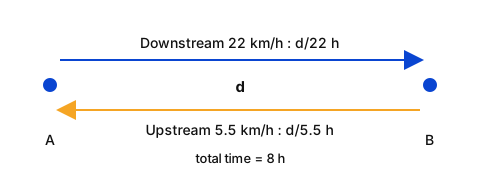
  1. d22+d5.5=8⇒d22+4d22=8.
  2. 5d22=8⇒d=1765km (one way).
  3. Total distance (to and fro) =2d=3525km.

Trick: Speeds ratio 22:5.5=4:1 → times 1:4 → downstream takes 85 h, so d=22×85=1765; double it.

Answer: (B) 3525km

अवधारणा: समय =दूरीचाल; एक ओर की दूरी d एक बार धारा के साथ और एक बार विपरीत तय होती है।

  1. d22+d5.5=8⇒d22+4d22=8।
  2. 5d22=8⇒d=1765km (एक ओर)।
  3. कुल दूरी (जाना + आना) =2d=3525km।

ट्रिक: चाल अनुपात 22:5.5=4:1 → समय 1:4 → downstream समय 85 h, d=22×85=1765; इसे दोगुना करें।

उत्तर: (B) 3525km

RRB NTPC Graduate CBT 1MathematicsBoats and StreamsRRB NTPC Graduate CBT 1 2024 · 10 Jun Shift 2 →
Q3642.
By selling an article for ₹112, a man loses 20%. At what price (in ₹) should he sell it to gain 50%?
एक वस्तु को ₹112 में बेचने पर एक व्यक्ति को 20% की हानि होती है। 50% लाभ प्राप्त करने के लिए उसे वह वस्तु किस मूल्य (₹ में) पर बेचनी चाहिए?
  1. A220
  2. B210
  3. C200
  4. D230
Show answer

Concept: SP=CP×100±gain/loss%100.

  1. At 20% loss: 112=CP×0.8⇒CP= ₹140.
  2. For 50% gain: SP=140×1.5= ₹210.

Trick: 80%→112, so 150%→11280×150=210.

Answer: (B) 210

अवधारणा: SP=CP×100±लाभ/हानि%100।

  1. 20% हानि पर: 112=CP×0.8⇒CP= ₹140।
  2. 50% लाभ के लिए: SP=140×1.5= ₹210।

ट्रिक: 80%→112, अतः 150%→11280×150=210।

उत्तर: (B) 210

RRB NTPC Graduate CBT 1MathematicsProfit and LossRRB NTPC Graduate CBT 1 2024 · 10 Jun Shift 2 →
Q3643.
If sinA=34, then calculate 2cosA7.
यदि sinA=34 है, तो 2cosA7 की गणना कीजिए।
  1. A72
  2. B74
  3. C12
  4. D14
Show answer

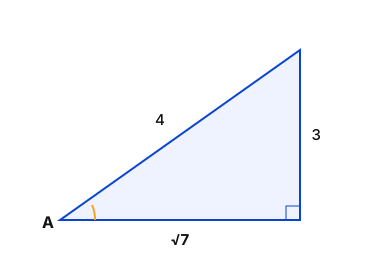
Concept: In a right triangle, sinA=perpendicularhypotenuse and cosA=basehypotenuse.

  1. sinA=34 → perpendicular 3, hypotenuse 4, base =16−9=7.
  2. cosA=74.
  3. 2cosA7=2×747=24=12.

Trick: Use cosA=1−sin2A=1−916=74 – the 7 cancels.

Answer: (C) 12

अवधारणा: समकोण त्रिभुज में sinA=लंबकर्ण और cosA=आधारकर्ण।

  1. sinA=34 → लंब 3, कर्ण 4, आधार =16−9=7।
  2. cosA=74।
  3. 2cosA7=2×747=24=12।

ट्रिक: cosA=1−sin2A=1−916=74 – 7 कट जाता है।

उत्तर: (C) 12

RRB NTPC Graduate CBT 1MathematicsTrigonometryRRB NTPC Graduate CBT 1 2024 · 10 Jun Shift 2 →
Q3644.
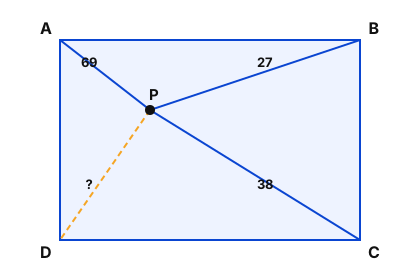
P is any point inside the rectangle ABCD. If PA = 69 cm, PB = 27 cm and PC = 38 cm, then the length of PD (in cm) is:
P आयत ABCD के अंदर स्थित कोई बिंदु है। यदि PA = 69 cm, PB = 27 cm और PC = 38 cm है, तो PD की लंबाई (cm में) है:
  1. A70
  2. B72
  3. C78
  4. D74
Show answer

Concept: British Flag theorem: for any point P inside rectangle ABCD, PA2+PC2=PB2+PD2 (opposite corners pair up).

  1. PA2+PC2=692+382=4761+1444=6205.
  2. PD2=6205−PB2=6205−272=6205−729=5476.
  3. PD=5476=74cm.

Trick: A and C are opposite, B and D are opposite – the sums of squares of distances to opposite corners are equal.

Answer: (D) 74

अवधारणा: British Flag प्रमेय: आयत ABCD के अंदर किसी बिंदु P के लिए PA2+PC2=PB2+PD2 (आमने-सामने के कोने)।

  1. PA2+PC2=692+382=4761+1444=6205।
  2. PD2=6205−PB2=6205−272=6205−729=5476।
  3. PD=5476=74cm।

ट्रिक: A-C और B-D आमने-सामने हैं – सम्मुख कोनों की दूरियों के वर्गों का योग बराबर होता है।

उत्तर: (D) 74

RRB NTPC Graduate CBT 1MathematicsGeometry – RectangleRRB NTPC Graduate CBT 1 2024 · 10 Jun Shift 2 →
Q3645.
Find the simple interest (in ₹) on ₹1,200 at an interest rate of 3% per month in 1 month.
₹1,200 पर 3% प्रति माह की ब्याज दर से 1 माह का साधारण ब्याज (₹ में) ज्ञात कीजिए।
  1. A6
  2. B36
  3. C23
  4. D3
Show answer

Concept: SI=P×R×T100 with R and T in the same time unit.

  1. P=1200, R=3% per month, T=1 month.
  2. SI=1200×3×1100=36.

Trick: 1 month at 3% per month = simply 3% of principal: 12×3=36.

Answer: (B) 36

अवधारणा: SI=P×R×T100, जहाँ R और T एक ही समय-इकाई में हों।

  1. P=1200, R=3% प्रति माह, T=1 माह।
  2. SI=1200×3×1100=36।

ट्रिक: 3% प्रति माह पर 1 माह = मूलधन का 3%: 12×3=36।

उत्तर: (B) 36

RRB NTPC Graduate CBT 1MathematicsSimple InterestRRB NTPC Graduate CBT 1 2024 · 10 Jun Shift 2 →
Q3646.
If x+1x=4, then the value of x3+1x3 is:
यदि x+1x=4 है, तो x3+1x3 का मान है:
  1. A52
  2. B134
  3. C151
  4. D39
Show answer

Concept: x3+1x3=(x+1x)3−3(x+1x).

  1. Put x+1x=4.
  2. x3+1x3=43−3×4=64−12=52.

Trick: If x+1x=a, then x3+1x3=a3−3a.

Answer: (A) 52

अवधारणा: x3+1x3=(x+1x)3−3(x+1x)।

  1. x+1x=4 रखें।
  2. x3+1x3=43−3×4=64−12=52।

ट्रिक: यदि x+1x=a, तो x3+1x3=a3−3a।

उत्तर: (A) 52

RRB NTPC Graduate CBT 1MathematicsAlgebraic IdentitiesRRB NTPC Graduate CBT 1 2024 · 10 Jun Shift 2 →
Q3647.
A person who spends 33% of his monthly income is able to save ₹6,298 per month. His monthly expenses (in ₹) are:
एक व्यक्ति जो अपनी मासिक आय का 33% ख़र्च करता है, प्रति माह ₹6,298 बचा पाता है। उसका मासिक व्यय (₹ में) है:
  1. A3,195
  2. B3,083
  3. C3,102
  4. D3,024
Show answer

Concept: Income = Expenditure + Savings.

  1. Expenditure =33% → savings =67% of income =6298.
  2. 1%=629867=94.
  3. Expenditure =33×94=3102.

Trick: Income =9400; go straight to 33% of it.

Answer: (C) 3,102

अवधारणा: आय = व्यय + बचत।

  1. व्यय =33% → बचत =67% आय =6298।
  2. 1%=629867=94।
  3. व्यय =33×94=3102।

ट्रिक: आय =9400; सीधे इसका 33% निकालें।

उत्तर: (C) 3,102

RRB NTPC Graduate CBT 1MathematicsPercentage – Income and SavingsRRB NTPC Graduate CBT 1 2024 · 10 Jun Shift 2 →
Q3648.
The average height of 15 boys out of a class of 50 is 163 cm. If the average height of the remaining boys is 165 cm, the average height (in cm) of all the boys of the class is:
50 छात्रों की एक कक्षा में से 15 लड़कों की औसत ऊँचाई 163 cm है। यदि शेष लड़कों की औसत ऊँचाई 165 cm है, तो कक्षा के सभी लड़कों की औसत ऊँचाई (cm में) है:
  1. A164.4
  2. B165
  3. C164
  4. D165.4
Show answer

Concept: Overall average =n1a1+n2a2n1+n2.

  1. Remaining boys =50−15=35.
  2. Total height =15×163+35×165=2445+5775=8220.
  3. Average =822050=164.4cm.

Trick: Start at 163: extra =35×250=1.4 → 164.4.

Answer: (A) 164.4

अवधारणा: कुल औसत =n1a1+n2a2n1+n2।

  1. शेष लड़के =50−15=35।
  2. कुल ऊँचाई =15×163+35×165=2445+5775=8220।
  3. औसत =822050=164.4cm।

ट्रिक: 163 से शुरू करें: अतिरिक्त =35×250=1.4 → 164.4।

उत्तर: (A) 164.4

RRB NTPC Graduate CBT 1MathematicsWeighted AverageRRB NTPC Graduate CBT 1 2024 · 10 Jun Shift 2 →
Q3649.
The mean and the mode of a data set are 51.5 and 61.7, respectively. Find the median of the data set, using the empirical formula.
एक आँकड़ा समुच्चय का माध्य और बहुलक क्रमशः 51.5 और 61.7 हैं। आनुभविक सूत्र का उपयोग करके आँकड़ा समुच्चय की माध्यिका ज्ञात कीजिए।
  1. A55.4
  2. B56.1
  3. C54.3
  4. D54.9
Show answer

Concept: Empirical relation: Mode=3Median−2Mean.

  1. 3Median=Mode+2Mean=61.7+2×51.5=61.7+103=164.7.
  2. Median=164.73=54.9.

Trick: Median=Mean+Mode−Mean3=51.5+10.23=54.9.

Answer: (D) 54.9

अवधारणा: आनुभविक संबंध: बहुलक=3माध्यिका−2माध्य।

  1. 3माध्यिका=61.7+2×51.5=61.7+103=164.7।
  2. माध्यिका=164.73=54.9।

ट्रिक: माध्यिका=माध्य+बहुलक−माध्य3=51.5+10.23=54.9।

उत्तर: (D) 54.9

RRB NTPC Graduate CBT 1MathematicsStatistics – Mean, Median, ModeRRB NTPC Graduate CBT 1 2024 · 10 Jun Shift 2 →
Q3650.
Three persons X, Y, and Z started a business with their shares in the ratio 13 : 20 : 15. After 7 months, Y withdrew his 33% share, while Z withdrew his 24% share 5 months prior to the completion of the year. If the total profit at the end of year is ₹16,100, find the share of Z (in ₹) in the profit.
तीन व्यक्तियों X, Y और Z ने 13 : 20 : 15 के अनुपात में अपने अंश लगाकर एक व्यवसाय शुरू किया। 7 महीने बाद, Y ने अपना 33% अंश निकाल लिया, जबकि Z ने वर्ष पूरा होने से 5 महीने पहले अपना 24% अंश निकाल लिया। यदि वर्ष के अंत में कुल लाभ ₹16,100 है, तो लाभ में Z का हिस्सा (₹ में) ज्ञात कीजिए।
  1. A4,888
  2. B5,250
  3. C5,063
  4. D4,968
Show answer

Concept: Profit is shared in the ratio of capital×time.

  1. Take capitals 1300, 2000, 1500. X: 1300×12=15600.
  2. Y keeps 67% after 7 months: 2000×7+1340×5=14000+6700=20700.
  3. Z withdraws 24% with 5 months left: 1500×7+1140×5=10500+5700=16200.
  4. Total =52500; Z's share =1620052500×16100=4968.

Trick: Ratio 15600:20700:16200=52:69:54 (sum 175); Z =54175×16100=54×92=4968.

Answer: (D) 4,968

अवधारणा: लाभ पूँजी×समय के अनुपात में बँटता है।

  1. पूँजी 1300, 2000, 1500 लें। X: 1300×12=15600।
  2. Y 7 माह बाद 33% निकालता है (बचा 67%): 2000×7+1340×5=14000+6700=20700।
  3. Z वर्ष पूरा होने से 5 माह पहले 24% निकालता है: 1500×7+1140×5=10500+5700=16200।
  4. कुल =52500; Z का हिस्सा =1620052500×16100=4968।

ट्रिक: अनुपात 15600:20700:16200=52:69:54 (योग 175); Z =54175×16100=54×92=4968।

उत्तर: (D) 4,968

RRB NTPC Graduate CBT 1MathematicsPartnershipRRB NTPC Graduate CBT 1 2024 · 10 Jun Shift 2 →
Q3651.
Rajesh ranked 17th from the top and 44th from the bottom in his class. How many students are there in his class?
राजेश अपनी कक्षा में ऊपर से 17वें और नीचे से 44वें स्थान पर था। उसकी कक्षा में कितने छात्र हैं?
  1. A61
  2. B60
  3. C59
  4. D62
Show answer

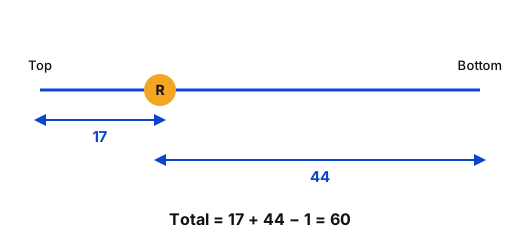
Concept: Total persons =(rank from top)+(rank from bottom)−1, because the person is counted twice.

  1. Rank from top =17, rank from bottom =44.
  2. Total =17+44−1=60.

Trick: Add both ranks and subtract 1.

Answer: (B) 60

अवधारणा: कुल व्यक्ति =(ऊपर से रैंक)+(नीचे से रैंक)−1, क्योंकि वह व्यक्ति दो बार गिना जाता है।

  1. ऊपर से रैंक =17, नीचे से रैंक =44।
  2. कुल =17+44−1=60।

ट्रिक: दोनों रैंक जोड़ें और 1 घटाएँ।

उत्तर: (B) 60

RRB NTPC Graduate CBT 1General Intelligence and ReasoningRankingRRB NTPC Graduate CBT 1 2024 · 10 Jun Shift 2 →
Q3652.
O, P, Q, R, S, T and X are sitting around a circular table facing the centre of the table. Only one person sits between Q and X when counted from the left of X. P sits third to the right of R. O sits third to the left of T. P sits to the immediate right of O. S is not an immediate neighbour of O. How many people sit between S and X when counted from the right of S?
O, P, Q, R, S, T और X एक वृत्ताकार मेज़ के चारों ओर मेज़ के केंद्र की ओर मुख करके बैठे हैं। X के बाएँ से गिनने पर Q और X के बीच केवल एक व्यक्ति बैठा है। P, R के दाएँ से तीसरे स्थान पर बैठा है। O, T के बाएँ से तीसरे स्थान पर बैठा है। P, O के ठीक दाएँ बैठा है। S, O का निकटतम पड़ोसी नहीं है। S के दाएँ से गिनने पर S और X के बीच कितने व्यक्ति बैठे हैं?
  1. ATwoदो
  2. BOneएक
  3. CThreeतीन
  4. DFourचार
Show answer

Concept: Facing the centre: a person's right is anticlockwise and left is clockwise. Fix O first, then place the others.

  1. P is immediately right of O; P is third to the right of R, so R is third to the left of P.
  2. O is third to the left of T, so T is third to the right of O.
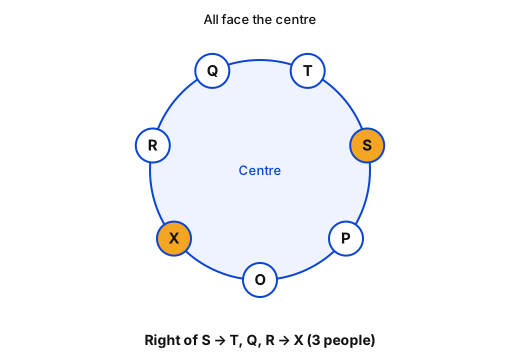
  3. Free seats remain on O's left side and the top. S is not next to O, and Q is second to the left of X, so X sits immediately left of O, Q two seats further and S in the last seat.
  4. Counting from the right of S: T, Q, R, then X → three people in between.

Trick: Draw O at the bottom; right = anticlockwise for centre-facing people.

Answer: (C) Three

अवधारणा: केंद्र की ओर मुख होने पर व्यक्ति का दायाँ = वामावर्त और बायाँ = दक्षिणावर्त। पहले O को स्थिर करें।

  1. P, O के ठीक दाएँ है; P, R के तीसरे दाएँ है, अतः R, P के तीसरे बाएँ।
  2. O, T के तीसरे बाएँ है, अतः T, O के तीसरे दाएँ।
  3. बची सीटें O के बाएँ और ऊपर हैं। S, O का पड़ोसी नहीं और Q, X के दूसरे बाएँ है, अतः X ठीक O के बाएँ, Q दो सीट आगे और S आख़िरी सीट पर।
  4. S के दाएँ से गिनें: T, Q, R, फिर X → बीच में तीन व्यक्ति।

ट्रिक: O को नीचे बनाएँ; केंद्र की ओर मुख = दायाँ वामावर्त।

उत्तर: (C) तीन

RRB NTPC Graduate CBT 1General Intelligence and ReasoningCircular seatingRRB NTPC Graduate CBT 1 2024 · 10 Jun Shift 2 →
Q3653.
What will come in the place of the question mark (?) in the following equation, if ‘+’ and ‘−’ are interchanged and ‘×’ and ‘÷’ are interchanged?
173 ÷ 3 − 135 × 5 + 17 = ?
यदि '+' और '−' को आपस में बदल दिया जाए तथा '×' और '÷' को आपस में बदल दिया जाए, तो निम्नलिखित समीकरण में प्रश्न चिह्न (?) के स्थान पर क्या आएगा?
173 ÷ 3 − 135 × 5 + 17 = ?
  1. A529
  2. B528
  3. C527
  4. D530
Show answer

Concept: Interchange the signs first, then apply BODMAS (÷, × before +, −).

  1. Interchanging '+'↔'−' and '×'↔'÷': 173×3+135÷5−17.
  2. 173×3=519 and 135÷5=27.
  3. 519+27−17=529.

Trick: Rewrite the whole expression with new signs before calculating.

Answer: (A) 529

अवधारणा: पहले चिह्न बदलें, फिर BODMAS लगाएँ (÷, × पहले, फिर +, −)।

  1. '+'↔'−' और '×'↔'÷' बदलने पर: 173×3+135÷5−17।
  2. 173×3=519 और 135÷5=27।
  3. 519+27−17=529।

ट्रिक: गणना से पहले पूरा व्यंजक नए चिह्नों के साथ लिखें।

उत्तर: (A) 529

RRB NTPC Graduate CBT 1General Intelligence and ReasoningSymbol interchangeRRB NTPC Graduate CBT 1 2024 · 10 Jun Shift 2 →
Q3654.
This question is based on the five, three-digit numbers given below.
(Left) 611 733 279 265 370 (Right)
(Example: 697 – First digit = 6, second digit = 9 and third digit = 7)
(NOTE: All operations to be done from left to right.)
What will be the resultant if the second digit of the highest number is added to the first digit of the lowest number?
यह प्रश्न नीचे दी गई तीन अंकों वाली पाँच संख्याओं पर आधारित है।
(बाएँ) 611 733 279 265 370 (दाएँ)
(उदाहरण: 697 – पहला अंक = 6, दूसरा अंक = 9 और तीसरा अंक = 7)
(नोट: सभी संक्रियाएँ बाएँ से दाएँ की जानी हैं।)
यदि सबसे बड़ी संख्या के दूसरे अंक को सबसे छोटी संख्या के पहले अंक में जोड़ा जाए, तो परिणाम क्या होगा?
  1. A4
  2. B5
  3. C6
  4. D8
Show answer

Concept: Identify the highest and lowest numbers, then pick the required digits.

  1. Numbers: 611, 733, 279, 265, 370. Highest =733, lowest =265.
  2. Second digit of 733 =3; first digit of 265 =2.
  3. 3+2=5.

Trick: Comparing only first digits quickly gives highest (7xx) and lowest (2xx; 265 is less than 279).

Answer: (B) 5

अवधारणा: सबसे बड़ी और सबसे छोटी संख्या पहचानें, फिर आवश्यक अंक लें।

  1. संख्याएँ: 611, 733, 279, 265, 370। सबसे बड़ी =733, सबसे छोटी =265।
  2. 733 का दूसरा अंक =3; 265 का पहला अंक =2।
  3. 3+2=5।

ट्रिक: पहले अंक से तुलना करें: सबसे बड़ी 7xx, सबसे छोटी 2xx (265, 279 से छोटी)।

उत्तर: (B) 5

RRB NTPC Graduate CBT 1General Intelligence and ReasoningNumber–digit operationsRRB NTPC Graduate CBT 1 2024 · 10 Jun Shift 2 →
Q3655.
CSVG is related to GOZC in a certain way based on the English alphabetical order. In the same way, KKDY is related to OGHU. To which of the given options is SCLQ related, following the same logic?
अंग्रेज़ी वर्णमाला क्रम के आधार पर CSVG एक निश्चित प्रकार से GOZC से संबंधित है। उसी प्रकार, KKDY, OGHU से संबंधित है। समान तर्क का अनुसरण करते हुए, SCLQ दिए गए विकल्पों में से किससे संबंधित है?
  1. AVZPL
  2. BWYPM
  3. CWZOL
  4. DXYQN
Show answer

Concept: Find the position change of each letter: here the pattern is +4,−4,+4,−4.

  1. CSVG → GOZC: C+4=G, S−4=O, V+4=Z, G−4=C.
  2. KKDY → OGHU: K+4=O, K−4=G, D+4=H, Y−4=U ✓.
  3. SCLQ: S+4=W, C−4=Y (wrapping back from A to Z), L+4=P, Q−4=M → WYPM.

Trick: C −4: C(3) → 3−4+26=25 = Y.

Answer: (B) WYPM

अवधारणा: हर अक्षर का स्थान परिवर्तन देखें: पैटर्न +4,−4,+4,−4 है।

  1. CSVG → GOZC: C+4=G, S−4=O, V+4=Z, G−4=C।
  2. KKDY → OGHU: K+4=O, K−4=G, D+4=H, Y−4=U ✓।
  3. SCLQ: S+4=W, C−4=Y (A के बाद Z पर लौटकर), L+4=P, Q−4=M → WYPM।

ट्रिक: C −4: C(3) → 3−4+26=25 = Y।

उत्तर: (B) WYPM

RRB NTPC Graduate CBT 1General Intelligence and ReasoningLetter analogyRRB NTPC Graduate CBT 1 2024 · 10 Jun Shift 2 →
Q3656.
A group of numbers and symbols is coded using letter codes as per the codes given below and the conditions that follow. Study the given codes and conditions and answer the question that follows.
Note: If none of the conditions apply, then codes for the respective number/symbol are to be followed directly as given in the table.
LetterLMEPAUX
Code7$@92%6
Conditions:
1. If the 1st letter is a vowel and the last letter is a consonant, their codes are to be interchanged.
2. If the 2nd letter is a vowel and the last letter is a consonant, both are to be coded as ‘W’.
3. If the 3rd and 4th letters are consonants, both are to be coded as the code for the 3rd letter.
4. If the 1st and 2nd letters are vowels, then both are to be coded as ‘Q’.
What will be the code for the following group?
APUXR
संख्याओं और प्रतीकों के एक समूह को नीचे दिए गए कूटों और उसके बाद दी गई शर्तों के अनुसार अक्षर कूटों का उपयोग करके कूटबद्ध किया जाता है। दिए गए कूटों और शर्तों का अध्ययन कीजिए और नीचे दिए गए प्रश्न का उत्तर दीजिए।
नोट: यदि कोई भी शर्त लागू नहीं होती है, तो संबंधित संख्या/प्रतीक के लिए तालिका में दिए गए कूटों का सीधे अनुसरण किया जाना है।
अक्षरLMEPAUX
कूट7$@92%6
शर्तें:
1. यदि पहला अक्षर स्वर है और अंतिम अक्षर व्यंजन है, तो उनके कूट आपस में बदल दिए जाने हैं।
2. यदि दूसरा अक्षर स्वर है और अंतिम अक्षर व्यंजन है, तो दोनों को 'W' के रूप में कूटबद्ध किया जाना है।
3. यदि तीसरा और चौथा अक्षर व्यंजन हैं, तो दोनों को तीसरे अक्षर के कूट के रूप में कूटबद्ध किया जाना है।
4. यदि पहला और दूसरा अक्षर स्वर हैं, तो दोनों को 'Q' के रूप में कूटबद्ध किया जाना है।
निम्नलिखित समूह के लिए कूट क्या होगा?
APUXR
  1. A2 9 % 6 4
  2. BQ 9 % 6 Q
  3. C2 9 % 6 2
  4. D4 9 % 6 2
Show answer

Concept: Check each condition on the given group; apply only those that hold, otherwise use the table codes.

  1. A P U X R: 1st letter A is a vowel and last letter R is a consonant → condition 1 applies (interchange codes of A and R).
  2. Condition 2: 2nd letter P is a consonant ✗. Condition 3: U is a vowel ✗. Condition 4: P is a consonant ✗.
  3. Direct codes: A = 2, P = 9, U = %, X = 6, R = 4 (the option pattern 4 9 % 6 2 shows R's code is 4).
  4. After interchanging the 1st and last codes: 4 9 % 6 2.

Trick: Test condition 1 first: vowel at start + consonant at end → just swap the end codes.

Answer: (D) 4 9 % 6 2

अवधारणा: दिए गए समूह पर हर शर्त जाँचें; जो लागू हों वही लगाएँ, अन्यथा तालिका के कूट लें।

  1. A P U X R: पहला अक्षर A स्वर और अंतिम R व्यंजन → शर्त 1 लागू (A और R के कूट आपस में बदलें)।
  2. शर्त 2: दूसरा अक्षर P व्यंजन ✗। शर्त 3: U स्वर ✗। शर्त 4: P व्यंजन ✗।
  3. सीधे कूट: A = 2, P = 9, U = %, X = 6, R = 4 (विकल्प 4 9 % 6 2 से R का कूट 4 स्पष्ट है)।
  4. पहले और अंतिम कूट बदलने पर: 4 9 % 6 2।

ट्रिक: पहले शर्त 1 देखें: शुरू में स्वर + अंत में व्यंजन → केवल सिरों के कूट बदलें।

उत्तर: (D) 4 9 % 6 2

RRB NTPC Graduate CBT 1General Intelligence and ReasoningCoding with conditionsRRB NTPC Graduate CBT 1 2024 · 10 Jun Shift 2 →
Q3657.
5 is related to 35 following a certain logic. Following the same logic, 2 is related to 14. To which of the following is 9 related, following the same logic?
(NOTE: Operations should be performed on the whole numbers, without breaking down the numbers into their constituent digits. E.g. 13 – Operations on 13 such as
adding/subtracting/multiplying to 13 can be performed. Breaking down 13 into 1 and 3 and then performing mathematical operations on 1 and 3 is not allowed.)
एक निश्चित तर्क का अनुसरण करते हुए 5, 35 से संबंधित है। उसी तर्क का अनुसरण करते हुए, 2, 14 से संबंधित है। समान तर्क का अनुसरण करते हुए, 9 निम्नलिखित में से किससे संबंधित है?
(नोट: संख्याओं को उनके घटक अंकों में विभक्त किए बिना, पूर्ण संख्याओं पर संक्रियाएँ की जानी चाहिए। उदाहरण: 13 – 13 पर संक्रियाएँ जैसे 13 में
जोड़ना/घटाना/गुणा करना आदि की जा सकती हैं। 13 को 1 और 3 में विभक्त करना और फिर 1 और 3 पर गणितीय संक्रियाएँ करना वर्जित है।)
  1. A63
  2. B61
  3. C65
  4. D67
Show answer

Concept: Find one operation that works for both given pairs.

  1. 5×7=35.
  2. 2×7=14 ✓ – the rule is 'multiply by 7'.
  3. 9×7=63.

Trick: Both outputs are multiples of 7 – divide and check.

Answer: (A) 63

अवधारणा: दोनों दिए गए युग्मों पर लागू होने वाली एक संक्रिया खोजें।

  1. 5×7=35।
  2. 2×7=14 ✓ – नियम है '7 से गुणा'।
  3. 9×7=63।

ट्रिक: दोनों उत्तर 7 के गुणज हैं – भाग देकर जाँचें।

उत्तर: (A) 63

RRB NTPC Graduate CBT 1General Intelligence and ReasoningNumber analogyRRB NTPC Graduate CBT 1 2024 · 10 Jun Shift 2 →
Q3658.
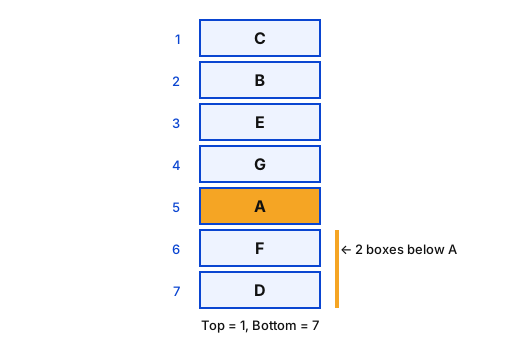
Seven boxes, A, B, C, D, E, F and G, are kept one over the other but not necessarily in the same order. Only three boxes are kept above G. Only one box is kept between F and G. Only three boxes are kept between F and B. B is kept in some place above G. E is kept immediately below B. A is kept in one of the places above D. C is not kept immediately above or below F. How many boxes are kept below A?
सात डिब्बे A, B, C, D, E, F और G एक के ऊपर एक रखे गए हैं, परंतु आवश्यक नहीं कि इसी क्रम में हों। G के ऊपर केवल तीन डिब्बे रखे गए हैं। F और G के बीच केवल एक डिब्बा रखा गया है। F और B के बीच केवल तीन डिब्बे रखे गए हैं। B, G के ऊपर किसी स्थान पर रखा गया है। E, B के ठीक नीचे रखा गया है। A, D के ऊपर के स्थानों में से किसी एक पर रखा गया है। C, F के ठीक ऊपर या ठीक नीचे नहीं रखा गया है। A के नीचे कितने डिब्बे रखे गए हैं?
  1. A2
  2. B4
  3. C1
  4. D3
Show answer

Concept: Number positions 1 (top) to 7 (bottom) and place the boxes with fixed positions first.

  1. Three boxes above G → G is at 4. One box between F and G → F at 2 or 6.
  2. Three boxes between F and B with B above G: F = 6 gives B = 2 ✓ (F = 2 gives B = 6, below G ✗). E just below B → E = 3.
  3. Free places 1, 5, 7. C is not next to F (6) → C = 1. A above D → A = 5, D = 7.
  4. Below A: F and D → 2 boxes.

Trick: Fix G first, then F–B pair; the rest falls in place.

Answer: (A) 2

अवधारणा: स्थान 1 (ऊपर) से 7 (नीचे) तक मानें और पहले निश्चित स्थान वाले डिब्बे रखें।

  1. G के ऊपर तीन डिब्बे → G स्थान 4 पर। F और G के बीच एक → F, 2 या 6 पर।
  2. F और B के बीच तीन तथा B, G के ऊपर: F = 6 से B = 2 ✓ (F = 2 से B = 6, G के नीचे ✗)। E ठीक B के नीचे → E = 3।
  3. खाली स्थान 1, 5, 7। C, F (6) के पास नहीं → C = 1। A, D के ऊपर → A = 5, D = 7।
  4. A के नीचे: F और D → 2 डिब्बे।

ट्रिक: पहले G, फिर F–B जोड़ी तय करें; बाकी अपने-आप बैठ जाते हैं।

उत्तर: (A) 2

RRB NTPC Graduate CBT 1General Intelligence and ReasoningBox arrangementRRB NTPC Graduate CBT 1 2024 · 10 Jun Shift 2 →
Q3659.
This question is based on the five, three-digit numbers given below.
(Left) 388 739 783 483 785 (Right)
(Example: 697 – First digit = 6, second digit = 9 and third digit = 7)
(NOTE: All operations to be done from left to right.)
What will be the resultant if the first digit of the highest number is subtracted from the third digit of the lowest number?
यह प्रश्न नीचे दी गई तीन अंकों वाली पाँच संख्याओं पर आधारित है।
(बाएँ) 388 739 783 483 785 (दाएँ)
(उदाहरण: 697 – पहला अंक = 6, दूसरा अंक = 9 और तीसरा अंक = 7)
(नोट: सभी संक्रियाएँ बाएँ से दाएँ की जानी हैं।)
यदि सबसे बड़ी संख्या के पहले अंक को सबसे छोटी संख्या के तीसरे अंक में से घटाया जाए, तो परिणाम क्या होगा?
  1. A0
  2. B1
  3. C2
  4. D4
Show answer

Concept: Identify the highest and lowest numbers, then pick the required digits.

  1. Numbers: 388, 739, 783, 483, 785. Highest =785, lowest =388.
  2. First digit of 785 =7; third digit of 388 =8.
  3. 8−7=1.

Trick: 783 vs 785: compare the last digit → 785 is highest.

Answer: (B) 1

अवधारणा: सबसे बड़ी और सबसे छोटी संख्या पहचानें, फिर आवश्यक अंक लें।

  1. संख्याएँ: 388, 739, 783, 483, 785। सबसे बड़ी =785, सबसे छोटी =388।
  2. 785 का पहला अंक =7; 388 का तीसरा अंक =8।
  3. 8−7=1।

ट्रिक: 783 और 785: अंतिम अंक से तुलना → 785 सबसे बड़ी।

उत्तर: (B) 1

RRB NTPC Graduate CBT 1General Intelligence and ReasoningNumber–digit operationsRRB NTPC Graduate CBT 1 2024 · 10 Jun Shift 2 →
Q3660.
In a certain code language,
'A + B' means 'A is the mother of B',
'A – B' means 'A is the brother of B',
'A × B' means 'A is the wife of B' and
'A ÷ B' means 'A is the father of B'.
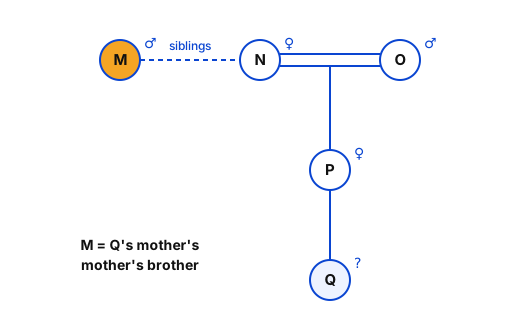
Based on the above, how is M related to Q if 'M – N × O ÷ P + Q'?
एक निश्चित कूट भाषा में,
'A + B' का अर्थ है 'A, B की माता है',
'A – B' का अर्थ है 'A, B का भाई है',
'A × B' का अर्थ है 'A, B की पत्नी है' और
'A ÷ B' का अर्थ है 'A, B का पिता है'।
उपर्युक्त के आधार पर, यदि 'M – N × O ÷ P + Q' है, तो M का Q से क्या संबंध है?
  1. AMother's Mother's Brotherमाता की माता का भाई
  2. BFather's Brotherपिता का भाई
  3. CMother's Fatherमाता का पिता
  4. D​Father's Fatherपिता का पिता
Show answer

Concept: Decode each symbol from left to right and draw the family tree.

  1. M – N: M is the brother of N.
  2. N × O: N is the wife of O (N is female).
  3. O ÷ P: O is the father of P, so N is P's mother.
  4. P + Q: P is the mother of Q. So N is Q's mother's mother and M is her brother.

Trick: Read the chain backwards from Q: mother (P) → her mother (N) → N's brother (M).

Answer: (A) Mother's Mother's Brother

अवधारणा: हर चिह्न को बाएँ से दाएँ डिकोड करें और वंश-वृक्ष बनाएँ।

  1. M – N: M, N का भाई है।
  2. N × O: N, O की पत्नी है (N महिला)।
  3. O ÷ P: O, P का पिता है, अतः N, P की माँ।
  4. P + Q: P, Q की माँ है। अतः N, Q की नानी है और M उसका भाई।

ट्रिक: Q से उल्टा पढ़ें: माँ (P) → उसकी माँ (N) → N का भाई (M)।

उत्तर: (A) माँ की माँ का भाई

RRB NTPC Graduate CBT 1General Intelligence and ReasoningCoded blood relationsRRB NTPC Graduate CBT 1 2024 · 10 Jun Shift 2 →