Question bank

Q&A: practice questions with answers

Search questions on any topic. Filter by exam category, exam, subject and topic, try the question, then open the answer and explanation.

Courses – airGurukul

2,400 questions found.

Q361.
Gopal has ₹1394 with him. He divides this amount between his two sons, Akshay and Arjun, and asks them to invest their respective shares at a compound interest rate of 5% per annum, compounded annually. It is observed that Akshay’s investment amounts to the same value after 16 years as Arjun’s investment does after 17 years. How much (in ₹) did Gopal give to Arjun?
गोपाल के पास ₹1394 हैं। वह इस राशि को अपने दो पुत्रों, अक्षय और अर्जुन, के बीच बाँटता है और उन्हें अपने-अपने हिस्से को 5% वार्षिक चक्रवृद्धि ब्याज की दर पर, वार्षिक रूप से संयोजित, निवेश करने के लिए कहता है। यह देखा गया कि अक्षय का निवेश 16 वर्षों के बाद उतनी ही राशि हो जाता है जितनी अर्जुन का निवेश 17 वर्षों के बाद होता है। गोपाल ने अर्जुन को कितनी राशि (₹ में) दी?
  1. A680
  2. B814
  3. C530
  4. D714
Show answer

Concept: Equal amounts after different periods: P1(1+r)16=P2(1+r)17⇒P1P2=(1+r)17−16.

  1. AkshayArjun=1.05=2120.
  2. Total parts =21+20=41; one part =139441=34.
  3. Arjun =20×34= ₹680 (Akshay =21×34= ₹714).

Trick: Difference of years =1 → shares are in ratio (100+r):100=21:20; the one invested longer (Arjun) gets the smaller share.

Answer: (A) 680

अवधारणा: अलग-अलग अवधि के बाद मिश्रधन बराबर: P1(1+r)16=P2(1+r)17⇒P1P2=(1+r)17−16।

  1. अक्षयअर्जुन=1.05=2120।
  2. कुल भाग =21+20=41; एक भाग =139441=34।
  3. अर्जुन =20×34= ₹680 (अक्षय =21×34= ₹714)।

ट्रिक: वर्षों का अंतर =1 → हिस्से (100+r):100=21:20 में; जो अधिक समय निवेश करता है (अर्जुन) उसे छोटा हिस्सा मिलता है।

उत्तर: (A) 680
RRB NTPC Graduate CBT 1MathematicsCompound Interest – Division of AmountRRB NTPC Graduate CBT 1 2025 · 25 Mar Shift 3 →
Q362.
A shopkeeper purchased 48 dozens of articles at the rate of ₹300 per dozen. He sold each one of them at the rate of ₹90. What percentage profit did he make?
एक दुकानदार ने ₹300 प्रति दर्जन की दर से 48 दर्जन वस्तुएँ खरीदीं। उसने उनमें से प्रत्येक को ₹90 की दर से बेच दिया। उसे कितने प्रतिशत लाभ हुआ?
  1. A260%
  2. B262%
  3. C259%
  4. D257%
Show answer

Concept: Compare cost and selling price of one article; Profit%=SP−CPCP×100.

  1. CP per article =30012= ₹25.
  2. SP per article = ₹90 → profit =90−25= ₹65.
  3. Profit% =6525×100=260%.

Trick: The "48 dozens" is a distraction – percentage profit is the same for one article as for all.

Answer: (A) 260%

अवधारणा: एक वस्तु का क्रय और विक्रय मूल्य तुलना करें; लाभ%=SP−CPCP×100।

  1. प्रति वस्तु CP =30012= ₹25।
  2. प्रति वस्तु SP = ₹90 → लाभ =90−25= ₹65।
  3. लाभ% =6525×100=260%।

ट्रिक: "48 दर्जन" केवल भटकाने के लिए है – प्रतिशत लाभ एक वस्तु और सभी वस्तुओं के लिए समान है।

उत्तर: (A) 260%

RRB NTPC Graduate CBT 1MathematicsProfit and LossRRB NTPC Graduate CBT 1 2025 · 25 Mar Shift 3 →
Q363.
If the mean of the following data is 35, find the value of X.
Class10-2020-3030-4040-5050-60
Frequency15214341X
यदि निम्नलिखित आँकड़ों का माध्य 35 है, तो X का मान ज्ञात कीजिए।
वर्ग10-2020-3030-4040-5050-60
बारंबारता15214341X
  1. A14
  2. B8
  3. C11
  4. D5
Show answer

Concept: Assumed-mean method: x¯=a+∑fidi∑fi with di=xi−a. If x¯=a, then ∑fidi=0.

  1. Mid-points: 15, 25, 35, 45, 55. Take a=35 (= given mean), so di=−20,−10,0,10,20.
  2. ∑fidi=15(−20)+21(−10)+43(0)+41(10)+X(20)=−300−210+410+20X=20X−100.
  3. Mean =35 means 20X−100=0⇒X=5.

Trick: When the given mean equals a mid-point, deviations about it must sum to zero – no division needed.

Answer: (D) 5

अवधारणा: कल्पित माध्य विधि: x¯=a+∑fidi∑fi, di=xi−a। यदि x¯=a हो तो ∑fidi=0।

  1. मध्य-बिंदु: 15, 25, 35, 45, 55। a=35 (= दिया गया माध्य) लें, तो di=−20,−10,0,10,20।
  2. ∑fidi=15(−20)+21(−10)+43(0)+41(10)+X(20)=−300−210+410+20X=20X−100।
  3. माध्य =35 का अर्थ 20X−100=0⇒X=5।

ट्रिक: जब दिया गया माध्य किसी मध्य-बिंदु के बराबर हो, उसके सापेक्ष विचलनों का योग शून्य होना चाहिए – भाग देने की ज़रूरत नहीं।

उत्तर: (D) 5

RRB NTPC Graduate CBT 1MathematicsStatistics – Mean of Grouped DataRRB NTPC Graduate CBT 1 2025 · 25 Mar Shift 3 →
Q364.
Two numbers have an HCF of 12 and an LCM of 840. If one of the numbers is 84, then find the other number.
दो संख्याओं का HCF 12 और LCM 840 है। यदि इनमें से एक संख्या 84 है, तो दूसरी संख्या ज्ञात कीजिए।
  1. A168
  2. B368
  3. C120
  4. D840
Show answer

Concept: For two numbers, HCF×LCM=a×b.

  1. 12×840=84×b.
  2. b=12×84084=12×10=120.
  3. Check: HCF(84, 120) = 12, LCM = 840 ✓.

Trick: 84084=10, so the other number is simply HCF×10=120.

Answer: (C) 120

अवधारणा: दो संख्याओं के लिए म.स.×ल.स.=a×b।

  1. 12×840=84×b।
  2. b=12×84084=12×10=120।
  3. जाँच: म.स.(84, 120) = 12, ल.स. = 840 ✓।

ट्रिक: 84084=10, अतः दूसरी संख्या =म.स.×10=120।

उत्तर: (C) 120

RRB NTPC Graduate CBT 1MathematicsHCF and LCMRRB NTPC Graduate CBT 1 2025 · 25 Mar Shift 3 →
Q365.
If A's salary is 113% more than that of B, then by how much percent is B's salary less than that of A (correct to 2 decimal places)?
यदि A का वेतन B के वेतन से 113% अधिक है, तो B का वेतन A के वेतन से कितने प्रतिशत कम है (2 दशमलव स्थानों तक सही)?
  1. A51.35%
  2. B53.05%
  3. C50.45%
  4. D55.15%
Show answer

Concept: If A is x% more than B, then B is x100+x×100% less than A.

  1. Let B =100, so A =213.
  2. B is less than A by 213−100=113 on a base of 213.
  3. 113213×100=53.05%.

Trick: "More" → base is the smaller; "less" → base is the bigger. Never reuse 113% as the answer.

Answer: (B) 53.05%

अवधारणा: यदि A, B से x% अधिक है, तो B, A से x100+x×100% कम है।

  1. B =100 मानें, तो A =213।
  2. B, A से 213−100=113 कम है, आधार 213।
  3. 113213×100=53.05%।

ट्रिक: "अधिक" → आधार छोटी राशि; "कम" → आधार बड़ी राशि। 113% को ही उत्तर कभी न मानें।

उत्तर: (B) 53.05%

RRB NTPC Graduate CBT 1MathematicsPercentage – ComparisonRRB NTPC Graduate CBT 1 2025 · 25 Mar Shift 3 →
Q366.
Find the average value of the first 350 positive multiples of 7.
7 के प्रथम 350 धनात्मक गुणजों का औसत मान ज्ञात कीजिए।
  1. A1416.5
  2. B1228.5
  3. C1326.5
  4. D1254.5
Show answer

Concept: The first n multiples of k form an AP; average =k×n+12 (middle term).

  1. Multiples: 7, 14, …, 7×350.
  2. Average =7+24502=24572=1228.5.
  3. Or 7×3512=7×175.5=1228.5.

Trick: Average of first n multiples of k = k×n+12; for even n it always ends in .5 × k.

Answer: (B) 1228.5

अवधारणा: k के पहले n गुणज एक AP बनाते हैं; औसत =k×n+12 (मध्य पद)।

  1. गुणज: 7, 14, …, 7×350।
  2. औसत =7+24502=24572=1228.5।
  3. या 7×3512=7×175.5=1228.5।

ट्रिक: k के पहले n गुणजों का औसत =k×n+12; n सम हो तो उत्तर k× (.5 वाली संख्या)।

उत्तर: (B) 1228.5

RRB NTPC Graduate CBT 1MathematicsAverage of MultiplesRRB NTPC Graduate CBT 1 2025 · 25 Mar Shift 3 →
Q367.
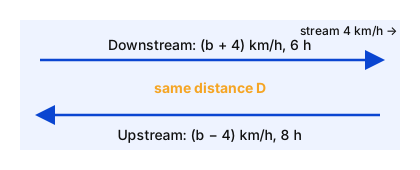
A boat covers a certain distance downstream in 6 hours and takes 8 hours to return upstream to the starting point. If the speed of the stream is 4 km/h, find the speed of the boat in still water.
एक नाव धारा की दिशा में एक निश्चित दूरी 6 घंटे में तय करती है और धारा के विपरीत प्रारंभिक बिंदु तक वापस आने में 8 घंटे लेती है। यदि धारा की चाल 4 km/h है, तो शांत जल में नाव की चाल ज्ञात कीजिए।
  1. A24 km/hr
  2. B28 km/hr
  3. C12 km/hr
  4. D18 km/hr
Show answer

Concept: Same distance both ways: (b+s)×t1=(b−s)×t2.

  1. (b+4)×6=(b−4)×8.
  2. 6b+24=8b−32⇒2b=56⇒b=28.
  3. Check: downstream 32×6=192 km, upstream 24×8=192 km ✓.

Trick: Time ratio 6:8=3:4 → speed ratio down:up =4:3. Difference (1 part) =2s=8 → part =8; boat =4+32×8=28 km/h.

Answer: (B) 28 km/hr

अवधारणा: दोनों ओर समान दूरी: (b+s)×t1=(b−s)×t2।

  1. (b+4)×6=(b−4)×8।
  2. 6b+24=8b−32⇒2b=56⇒b=28।
  3. जाँच: धारा के अनुकूल 32×6=192 km, प्रतिकूल 24×8=192 km ✓।

ट्रिक: समय अनुपात 6:8=3:4 → चाल अनुपात अनुकूल:प्रतिकूल =4:3। अंतर (1 भाग) =2s=8 → भाग =8; नाव =4+32×8=28 km/h।

उत्तर: (B) 28 km/hr

RRB NTPC Graduate CBT 1MathematicsBoats and StreamsRRB NTPC Graduate CBT 1 2025 · 25 Mar Shift 3 →
Q368.
The monthly incomes of two friends Vipul and Vijay, are in the ratio 6 : 7 respectively and each of them saves ₹66,000 every month. If the ratio of their monthly expenditure is 1 : 3, find the monthly income of Vipul (in ₹).
दो मित्रों विपुल और विजय की मासिक आय क्रमशः 6 : 7 के अनुपात में है और उनमें से प्रत्येक हर महीने ₹66,000 की बचत करता है। यदि उनके मासिक व्यय का अनुपात 1 : 3 है, तो विपुल की मासिक आय (₹ में) ज्ञात कीजिए।
  1. A71,000
  2. B72,000
  3. C1,00,800
  4. D73,000
Show answer

Concept: Expenditure = Income − Savings; set up the ratio of expenditures.

  1. Incomes 6x and 7x; savings ₹66,000 each.
  2. 6x−660007x−66000=13⇒18x−198000=7x−66000.
  3. 11x=132000⇒x=12000.
  4. Vipul's income =6x= ₹72,000.

Trick: Check: expenditures 72000−66000=6000 and 84000−66000=18000 → 1:3 ✓.

Answer: (B) 72,000

अवधारणा: व्यय = आय − बचत; व्ययों का अनुपात बनाएँ।

  1. आय 6x और 7x; बचत प्रत्येक की ₹66,000।
  2. 6x−660007x−66000=13⇒18x−198000=7x−66000।
  3. 11x=132000⇒x=12000।
  4. विपुल की आय =6x= ₹72,000।

ट्रिक: जाँच: व्यय 72000−66000=6000 और 84000−66000=18000 → 1:3 ✓।

उत्तर: (B) 72,000

RRB NTPC Graduate CBT 1MathematicsRatio – Income and ExpenditureRRB NTPC Graduate CBT 1 2025 · 25 Mar Shift 3 →
Q369.
The following frequency table gives the marks obtained by 48 students in a class test.
Marks78910
Frequency12131211
With reference to the frequency table, match the following statements: (Values are rounded off to three decimal places.)
Column PColumn Q
i. The mean of the distribution1. 8.485
ii. The standard deviation of the distribution2. 1.207
iii. The variance of the distribution3. 1.099
निम्नलिखित बारंबारता सारणी एक कक्षा परीक्षा में 48 विद्यार्थियों द्वारा प्राप्त अंकों को दर्शाती है।
अंक78910
बारंबारता12131211
बारंबारता सारणी के संदर्भ में, निम्नलिखित कथनों का मिलान कीजिए: (मान तीन दशमलव स्थानों तक पूर्णांकित हैं।)
स्तंभ Pस्तंभ Q
i. बंटन का माध्य1. 8.485
ii. बंटन का मानक विचलन2. 1.207
iii. बंटन का प्रसरण3. 1.099
  1. Ai - 1, ii - 2 and iii - 3i - 1, ii - 2 और iii - 3
  2. Bi - 3, ii - 1 and iii - 2i - 3, ii - 1 और iii - 2
  3. Ci - 1, ii - 3 and iii - 2i - 1, ii - 3 और iii - 2
  4. Di - 2, ii - 3 and iii - 1i - 2, ii - 3 और iii - 1
Show answer

Concept: x¯=∑fx∑f, σ2=∑fx2∑f−x¯2, σ=σ2; SD is always smaller than variance when variance >1.

  1. ∑fx=84+104+108+110=406; mean =40648≈8.46 – the only value near 8.5 is item 1, so i → 1.
  2. ∑fx2=588+832+972+1100=3492; 349248=72.75; variance =72.75−8.4582≈72.75−71.54=1.207 → iii → 2.
  3. SD =1.207≈1.099 → ii → 3.

Trick: Of the two small numbers, variance is the larger (1.207) and SD its square root (1.099) – that alone fixes ii and iii.

Answer: (C) i - 1, ii - 3 and iii - 2

अवधारणा: x¯=∑fx∑f, σ2=∑fx2∑f−x¯2, σ=σ2; प्रसरण >1 हो तो मानक विचलन उससे छोटा होता है।

  1. ∑fx=84+104+108+110=406; माध्य =40648≈8.46 – 8.5 के पास केवल मद 1 है, अतः i → 1।
  2. ∑fx2=588+832+972+1100=3492; 349248=72.75; प्रसरण =72.75−8.4582≈72.75−71.54=1.207 → iii → 2।
  3. SD =1.207≈1.099 → ii → 3।

ट्रिक: दो छोटी संख्याओं में प्रसरण बड़ा (1.207) और SD उसका वर्गमूल (1.099) – इसी से ii और iii तय हो जाते हैं।

उत्तर: (C) i - 1, ii - 3 और iii - 2

RRB NTPC Graduate CBT 1MathematicsStatistics – Mean, Variance, SDRRB NTPC Graduate CBT 1 2025 · 25 Mar Shift 3 →
Q370.
The sum of all interior angles in a trapezium is ___________.
एक समलंब (trapezium) के सभी अंतः कोणों का योग ___________ होता है।
  1. A180∘
  2. B240∘
  3. C360∘
  4. D540∘
Show answer

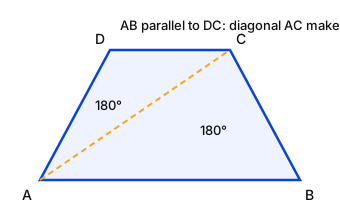
Concept: Angle sum of any polygon =(n−2)×180∘; a trapezium has n=4.

  1. A diagonal splits the trapezium into two triangles.
  2. Each triangle has angle sum 180∘ → total =2×180∘=360∘.
  3. Equivalently (4−2)×180∘=360∘.

Trick: Every quadrilateral – square, kite, trapezium, any shape – has interior angles summing to 360∘.

Answer: (C) 360∘

अवधारणा: किसी भी बहुभुज का कोण योग =(n−2)×180∘; समलंब में n=4।

  1. एक विकर्ण समलंब को दो त्रिभुजों में बाँटता है।
  2. हर त्रिभुज का कोण योग 180∘ → कुल =2×180∘=360∘।
  3. या (4−2)×180∘=360∘।

ट्रिक: हर चतुर्भुज – वर्ग, पतंग, समलंब, कोई भी आकार – के अंतःकोणों का योग 360∘ होता है।

उत्तर: (C) 360∘

RRB NTPC Graduate CBT 1MathematicsQuadrilaterals – Angle SumRRB NTPC Graduate CBT 1 2025 · 25 Mar Shift 3 →
Q371.
In a certain code language,
A + B means ‘A is the mother of B’
A – B means ‘A is the brother of B’
A x B means ‘A is the wife of B’
A % B means ‘A is the father of B’
A # B means ‘A is the daughter of B’
Based on the above, how is D related to E if ‘D x N % P + K # E’?
एक निश्चित कूट भाषा में,
A + B का अर्थ है ‘A, B की माता है’
A – B का अर्थ है ‘A, B का भाई है’
A x B का अर्थ है ‘A, B की पत्नी है’
A % B का अर्थ है ‘A, B का पिता है’
A # B का अर्थ है ‘A, B की पुत्री है’
उपर्युक्त के आधार पर, यदि ‘D x N % P + K # E’ है, तो D का E से क्या संबंध है?
  1. AWife’s fatherपत्नी का पिता
  2. BDaughter’s husbandपुत्री का पति
  3. CWife’s motherपत्नी की माता
  4. DDaughter’s daughterपुत्री की पुत्री
Show answer

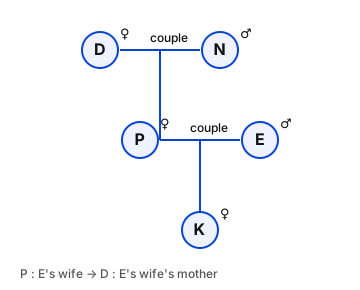
Concept: Decode each symbol step by step and build the family tree, starting from the end (E) to reach D.

  1. D × N → D is the wife of N. N % P → N is the father of P, so D is P's mother.
  2. P + K → P is the mother of K. K # E → K is the daughter of E, so E is K's father and P's husband.
  3. D is the mother of P, and P is E's wife → D is E's wife's mother.

Trick: Whenever one person is "mother of X" and another is "father of X", they are husband and wife – that single link solves most coded-relation questions.

Answer: (C) Wife's mother

अवधारणा: प्रत्येक प्रतीक को एक-एक करके डिकोड कर वंश-वृक्ष बनाइए, अंत (E) से शुरू कर D तक पहुँचिए।

  1. D × N → D, N की पत्नी है। N % P → N, P का पिता है, अतः D, P की माँ है।
  2. P + K → P, K की माँ है। K # E → K, E की पुत्री है, अतः E, K का पिता और P का पति है।
  3. D, P की माँ है और P, E की पत्नी है → D, E की पत्नी की माँ (सास) है।

ट्रिक: जब एक व्यक्ति "X की माँ" और दूसरा "X का पिता" हो, तो वे पति-पत्नी हैं – यही एक कड़ी अधिकांश कोडित-संबंध प्रश्न हल कर देती है।

उत्तर: (C) पत्नी की माँ

RRB NTPC Graduate CBT 1General Intelligence and ReasoningBlood relations – codedRRB NTPC Graduate CBT 1 2025 · 25 Mar Shift 3 →
Q372.
Based on the English alphabetical order, three of the following four are alike in a certain way and thus form a group. Which is the one that does not belong to that group? (Note: The odd one out is not based on the number of consonants/vowels or their position in the letter cluster.)
अंग्रेज़ी वर्णमाला क्रम के आधार पर, निम्नलिखित चार में से तीन एक निश्चित प्रकार से समान हैं और इस प्रकार एक समूह बनाते हैं। वह कौन-सा है जो उस समूह से संबंधित नहीं है? (नोट: विषम अक्षर-समूह व्यंजनों/स्वरों की संख्या या अक्षर-समूह में उनकी स्थिति पर आधारित नहीं है।)
  1. AJNT
  2. BLPU
  3. CWAF
  4. DDHM
Show answer

Concept: Write the place values (A=1 … Z=26) and compare the gaps between consecutive letters.

  1. LPU: 12, 16, 21 → +4, +5. WAF: 23, 1, 6 → +4 (W→A cyclic), +5. DHM: 4, 8, 13 → +4, +5.
  2. JNT: 10, 14, 20 → +4, +6 – the second gap breaks the pattern.

Trick: Check the first gap of all four; if all match, the odd one hides in the second gap. Remember that after Z the alphabet wraps to A.

Answer: (A) JNT

अवधारणा: अक्षरों के स्थानीय मान (A=1 … Z=26) लिखकर क्रमागत अक्षरों के अंतर की तुलना कीजिए।

  1. LPU: 12, 16, 21 → +4, +5। WAF: 23, 1, 6 → +4 (W→A चक्रीय), +5। DHM: 4, 8, 13 → +4, +5।
  2. JNT: 10, 14, 20 → +4, +6 – दूसरा अंतर पैटर्न तोड़ता है।

ट्रिक: चारों का पहला अंतर देखें; सब समान हों तो विषम दूसरे अंतर में छिपा है। Z के बाद वर्णमाला A से फिर शुरू होती है।

उत्तर: (A) JNT

RRB NTPC Graduate CBT 1General Intelligence and ReasoningOdd one out – letter clustersRRB NTPC Graduate CBT 1 2025 · 25 Mar Shift 3 →
Q373.
Refer to the following letter, number, symbol series and answer the question. Counting to be done from left to right only. (All numbers are single digit numbers only)
(Left) G & R E 5 K % 7 @ 2 S & 6 C T # 3 4 Y * D (Right)
How many such symbols are there which are immediately preceded by a letter and also immediately followed by a number?
निम्नलिखित अक्षर, संख्या, प्रतीक श्रृंखला को देखिए और प्रश्न का उत्तर दीजिए। गिनती केवल बाएँ से दाएँ की जानी है। (सभी संख्याएँ केवल एक अंक की संख्याएँ हैं)
(बाएँ) G & R E 5 K % 7 @ 2 S & 6 C T # 3 4 Y * D (दाएँ)
ऐसे कितने प्रतीक हैं जिनके ठीक पहले एक अक्षर है और ठीक बाद एक संख्या है?
  1. ANoneकोई नहीं
  2. BTwoदो
  3. CThreeतीन
  4. DOneएक
Show answer

Concept: Scan each symbol and check the element just before it (must be a letter) and just after it (must be a number).

  1. Symbols in the series: & (G, R), % (K, 7), @ (7, 2), & (S, 6), # (T, 3), * (Y, D).
  2. Letter before and number after: K % 7, S & 6, T # 3 → three.

Trick: Underline only the symbols first (there are just six), then test neighbours – far faster than reading the whole series.

Answer: (C) Three

अवधारणा: प्रत्येक प्रतीक के ठीक पहले वाला तत्व (अक्षर होना चाहिए) और ठीक बाद वाला (संख्या होनी चाहिए) जाँचिए।

  1. श्रृंखला के प्रतीक: & (G, R), % (K, 7), @ (7, 2), & (S, 6), # (T, 3), * (Y, D)।
  2. पहले अक्षर और बाद में संख्या: K % 7, S & 6, T # 3 → तीन।

ट्रिक: पहले केवल प्रतीकों को रेखांकित करें (केवल छह हैं), फिर पड़ोसी जाँचें – पूरी श्रृंखला पढ़ने से कहीं तेज़।

उत्तर: (C) तीन

RRB NTPC Graduate CBT 1General Intelligence and ReasoningAlphanumeric seriesRRB NTPC Graduate CBT 1 2025 · 25 Mar Shift 3 →
Q374.
Which of the following letter-number clusters will replace the question mark (?) in the given series to make it logically complete?
TWU 89 YBZ 81 DGE 73 ILJ 65 ?
दी गई श्रृंखला को तार्किक रूप से पूर्ण करने के लिए निम्नलिखित में से कौन-सा अक्षर-संख्या समूह प्रश्नचिह्न (?) के स्थान पर आएगा?
TWU 89 YBZ 81 DGE 73 ILJ 65 ?
  1. ANPN 56
  2. BNQU 56
  3. CNRN 57
  4. DNQO 57
Show answer

Concept: Treat the letters and the numbers as two separate series.

  1. Letters: each position moves +5. T→Y→D→I→N; W→B→G→L→Q; U→Z→E→J→O.
  2. Numbers: 89, 81, 73, 65 → each −8 → 57.
  3. Next term: NQO 57.

Trick: Decide the number first (57 → options C or D), then check just the first letter: I+5 = N in both, so check the second letter L+5 = Q → NQO.

Answer: (D) NQO 57

अवधारणा: अक्षरों और संख्याओं को दो अलग श्रृंखलाओं की तरह देखें।

  1. अक्षर: प्रत्येक स्थान +5 बढ़ता है। T→Y→D→I→N; W→B→G→L→Q; U→Z→E→J→O।
  2. संख्याएँ: 89, 81, 73, 65 → प्रत्येक −8 → 57।
  3. अगला पद: NQO 57।

ट्रिक: पहले संख्या तय करें (57 → विकल्प C या D), फिर दूसरा अक्षर जाँचें L+5 = Q → NQO।

उत्तर: (D) NQO 57

RRB NTPC Graduate CBT 1General Intelligence and ReasoningLetter-number seriesRRB NTPC Graduate CBT 1 2025 · 25 Mar Shift 3 →
Q375.
In a certain code language, ‘SEMI’ is coded as ‘3615’ and ‘TIME’ is coded as ‘1523’. What is the code for ‘T’ in the given code language?
एक निश्चित कूट भाषा में, ‘SEMI’ को ‘3615’ के रूप में कूटबद्ध किया जाता है और ‘TIME’ को ‘1523’ के रूप में कूटबद्ध किया जाता है। दी गई कूट भाषा में ‘T’ का कूट क्या है?
  1. A3
  2. B1
  3. C5
  4. D2
Show answer

Concept: Compare the two words: letters common to both must share the common digits; the leftover letter gets the leftover digit.

  1. SEMI → 3615, TIME → 1523. Common letters: E, M, I. Common digits: 1, 5, 3.
  2. So in SEMI the uncommon letter S ↔ uncommon digit 6; in TIME the uncommon letter T ↔ uncommon digit 2.

Trick: In such questions the codes are jumbled – never match by position, always by "common vs uncommon" elimination.

Answer: (D) 2

अवधारणा: दोनों शब्दों की तुलना करें: दोनों में समान अक्षरों के कोड समान अंक होंगे; बचा हुआ अक्षर = बचा हुआ अंक।

  1. SEMI → 3615, TIME → 1523। समान अक्षर: E, M, I। समान अंक: 1, 5, 3।
  2. अतः SEMI में असमान अक्षर S ↔ असमान अंक 6; TIME में असमान अक्षर T ↔ असमान अंक 2।

ट्रिक: ऐसे प्रश्नों में कोड उलट-पुलट होते हैं – स्थान से नहीं, "समान बनाम असमान" विलोपन से मिलान करें।

उत्तर: (D) 2

RRB NTPC Graduate CBT 1General Intelligence and ReasoningCoding-decodingRRB NTPC Graduate CBT 1 2025 · 25 Mar Shift 3 →
Q376.
Select the set in which the numbers are related in the same way as are the numbers of the following sets.
(NOTE: Operations should be performed on the whole numbers, without breaking down the numbers into its constituent digits. E.g. 13 – Operations on 13 such as adding / subtracting / multiplying etc. to 13 can be performed. Breaking down 13 into 1 and 3 and then performing mathematical operations on 1 and 3 is not allowed.)
(19, 24, 7)
(12, 14, 5)
उस समुच्चय का चयन कीजिए जिसमें संख्याएँ उसी प्रकार संबंधित हैं जिस प्रकार निम्नलिखित समुच्चयों की संख्याएँ संबंधित हैं।
(नोट: संक्रियाएँ पूर्ण संख्याओं पर की जानी चाहिए, संख्याओं को उनके घटक अंकों में तोड़े बिना। उदाहरण के लिए 13 – 13 पर संक्रियाएँ जैसे 13 में जोड़ना / घटाना / गुणा करना आदि की जा सकती हैं। 13 को 1 और 3 में तोड़कर फिर 1 और 3 पर गणितीय संक्रियाएँ करने की अनुमति नहीं है।)
(19, 24, 7)
(12, 14, 5)
  1. A(7, 5, 3)
  2. B(12, 5, 3)
  3. C(3, 4, 1)
  4. D(12, 5, 4)
Show answer

Concept: Find one rule connecting the three numbers of each given set, then test it on the options.

  1. (19, 24, 7): 2×(19−7)=24 ✓. (12, 14, 5): 2×(12−5)=14 ✓. Rule: second = 2 × (first − third).
  2. (3, 4, 1): 2×(3−1)=4 ✓. Others fail: (7,5,3) → 8; (12,5,3) → 18; (12,5,4) → 16.

Trick: When the middle number is the largest, try "middle = (first ± third) × k" – here 2×(a−c) fits both sets at once.

Answer: (C) (3, 4, 1)

अवधारणा: दिए गए प्रत्येक समुच्चय की तीन संख्याओं को जोड़ने वाला एक नियम खोजें, फिर विकल्पों पर जाँचें।

  1. (19, 24, 7): 2×(19−7)=24 ✓। (12, 14, 5): 2×(12−5)=14 ✓। नियम: दूसरी = 2 × (पहली − तीसरी)।
  2. (3, 4, 1): 2×(3−1)=4 ✓। बाकी असफल: (7,5,3) → 8; (12,5,3) → 18; (12,5,4) → 16।

ट्रिक: जब बीच की संख्या सबसे बड़ी हो, तो "बीच = (पहली ± तीसरी) × k" आज़माएँ – यहाँ 2×(a−c) दोनों समुच्चयों पर सही बैठता है।

उत्तर: (C) (3, 4, 1)

RRB NTPC Graduate CBT 1General Intelligence and ReasoningNumber analogy – setsRRB NTPC Graduate CBT 1 2025 · 25 Mar Shift 3 →
Q377.
DMKZ is related to EKNV in a certain way based on the English alphabetical order. In the same way, LOJT is related to MMMP. To which of the following is SRLQ related, following the same logic?
अंग्रेज़ी वर्णमाला क्रम के आधार पर DMKZ, EKNV से एक निश्चित प्रकार से संबंधित है। उसी प्रकार, LOJT, MMMP से संबंधित है। उसी तर्क का अनुसरण करते हुए, SRLQ निम्नलिखित में से किससे संबंधित है?
  1. ATPIU
  2. BTONL
  3. CTPOM
  4. DTTNP
Show answer

Concept: Find the position-wise shift from the first word to the second and apply the same shift.

  1. DMKZ → EKNV: D+1=E, M−2=K, K+3=N, Z−4=V. Pattern: +1, −2, +3, −4.
  2. Check LOJT → MMMP: L+1=M, O−2=M, J+3=M, T−4=P ✓.
  3. SRLQ: S+1=T, R−2=P, L+3=O, Q−4=M → TPOM.

Trick: Alternating signs with increasing magnitude (+1, −2, +3, −4) is a very common RRB pattern – verify with the second pair, then apply.

Answer: (C) TPOM

अवधारणा: पहले शब्द से दूसरे शब्द तक प्रत्येक स्थान का बदलाव निकालें और वही लागू करें।

  1. DMKZ → EKNV: D+1=E, M−2=K, K+3=N, Z−4=V। पैटर्न: +1, −2, +3, −4।
  2. जाँच LOJT → MMMP: L+1=M, O−2=M, J+3=M, T−4=P ✓।
  3. SRLQ: S+1=T, R−2=P, L+3=O, Q−4=M → TPOM।

ट्रिक: बढ़ते परिमाण के साथ बदलते चिह्न (+1, −2, +3, −4) RRB का बहुत सामान्य पैटर्न है – दूसरे युग्म से पुष्टि करें, फिर लागू करें।

उत्तर: (C) TPOM

RRB NTPC Graduate CBT 1General Intelligence and ReasoningLetter analogyRRB NTPC Graduate CBT 1 2025 · 25 Mar Shift 3 →
Q378.
If 1 is added to each odd digit and 1 is subtracted from each even digit in the number 48572613, what will be the product of the greatest and smallest digit in the new number thus formed?
यदि संख्या 48572613 के प्रत्येक विषम अंक में 1 जोड़ा जाए और प्रत्येक सम अंक से 1 घटाया जाए, तो इस प्रकार बनी नई संख्या के सबसे बड़े और सबसे छोटे अंक का गुणनफल क्या होगा?
  1. A8
  2. B9
  3. C18
  4. D0
Show answer

Concept: Change each digit as instructed, then pick the greatest and smallest digits of the new number.

  1. 48572613 → 4−1=3, 8−1=7, 5+1=6, 7+1=8, 2−1=1, 6−1=5, 1+1=2, 3+1=4 → new number 37681524.
  2. Greatest digit 8, smallest digit 1 → product 8×1=8.

Trick: Odd +1 and even −1 just swaps each digit with its neighbour pair (1↔2, 3↔4, 5↔6, 7↔8); only 9 would become 10 and 0 would become −1 – neither occurs here.

Answer: (A) 8

अवधारणा: निर्देशानुसार प्रत्येक अंक बदलें, फिर नई संख्या के सबसे बड़े व सबसे छोटे अंक चुनें।

  1. 48572613 → 4−1=3, 8−1=7, 5+1=6, 7+1=8, 2−1=1, 6−1=5, 1+1=2, 3+1=4 → नई संख्या 37681524।
  2. सबसे बड़ा अंक 8, सबसे छोटा 1 → गुणनफल 8×1=8।

ट्रिक: विषम +1 और सम −1 हर अंक को उसके जोड़ीदार से बदल देता है (1↔2, 3↔4, 5↔6, 7↔8); केवल 9 → 10 और 0 → −1 की समस्या होती, जो यहाँ नहीं हैं।

उत्तर: (A) 8

RRB NTPC Graduate CBT 1General Intelligence and ReasoningNumber operations – digitsRRB NTPC Graduate CBT 1 2025 · 25 Mar Shift 3 →
Q379.
C, D, N, O, P and Q live on six different floors of the same building. The lowermost floor in the building is numbered 1, the floor above it is numbered 2 and so on, till the topmost floor, which is numbered 6. No one lives above D. Only two people live between D and C. Only two people live between O and Q. Q lives below C but above N. How many people live between P and N?
C, D, N, O, P और Q एक ही भवन की छह अलग-अलग मंज़िलों पर रहते हैं। भवन की सबसे निचली मंज़िल की संख्या 1 है, उसके ऊपर की मंज़िल की संख्या 2 है और इसी प्रकार सबसे ऊपरी मंज़िल तक, जिसकी संख्या 6 है। D के ऊपर कोई नहीं रहता है। D और C के बीच केवल दो व्यक्ति रहते हैं। O और Q के बीच केवल दो व्यक्ति रहते हैं। Q, C के नीचे परंतु N के ऊपर रहता है। P और N के बीच कितने व्यक्ति रहते हैं?
  1. AOneएक
  2. BThreeतीन
  3. CZeroशून्य
  4. DTwoदो
Show answer

Concept: Start with the definite clue (top floor), then fix the rest using "only two between" constraints.

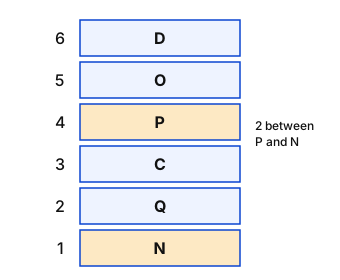
  1. No one above D → D on floor 6. Only two between D and C → C on floor 3.
  2. Q below C but above N → Q = 2, N = 1. Only two between O and Q → O = 5. Remaining P = 4.
  3. Between P (4) and N (1) are floors 3 and 2 → two people (C and Q).

Trick: Draw the 6 boxes first; "only two between X and Y" means X and Y are exactly 3 floors apart.

Answer: (D) Two

अवधारणा: निश्चित सुराग (सबसे ऊपरी मंज़िल) से शुरू करें, फिर "केवल दो के बीच" शर्तों से बाकी तय करें।

  1. D के ऊपर कोई नहीं → D मंज़िल 6 पर। D और C के बीच केवल दो → C मंज़िल 3 पर।
  2. Q, C से नीचे पर N से ऊपर → Q = 2, N = 1। O और Q के बीच केवल दो → O = 5। शेष P = 4।
  3. P (4) और N (1) के बीच मंज़िल 3 और 2 → दो लोग (C और Q)।

ट्रिक: पहले 6 बॉक्स बनाएँ; "X और Y के बीच केवल दो" का अर्थ है X और Y ठीक 3 मंज़िल दूर।

उत्तर: (D) दो

RRB NTPC Graduate CBT 1General Intelligence and ReasoningFloor puzzleRRB NTPC Graduate CBT 1 2025 · 25 Mar Shift 3 →
Q380.
In a certain code language,
A + B means ‘A is the daughter of B’
A – B means ‘A is the brother of B’
A x B means ‘A is the wife of B’
A ÷ B means ‘A is the father of B’
Based on the above, how is D related to J if ‘D – F + G ÷ H x J’?
एक निश्चित कूट भाषा में,
A + B का अर्थ है ‘A, B की पुत्री है’
A – B का अर्थ है ‘A, B का भाई है’
A x B का अर्थ है ‘A, B की पत्नी है’
A ÷ B का अर्थ है ‘A, B का पिता है’
उपर्युक्त के आधार पर, यदि ‘D – F + G ÷ H x J’ है, तो D का J से क्या संबंध है?
  1. AWife's brotherपत्नी का भाई
  2. BWife's fatherपत्नी का पिता
  3. CFatherपिता
  4. DBrotherभाई
Show answer

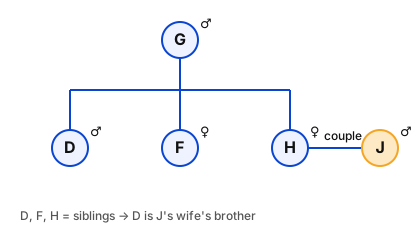
Concept: Decode each symbol and draw the family tree; the gender of D is given by "brother".

  1. D − F → D is the brother of F. F + G → F is the daughter of G, so D is also G's son.
  2. G ÷ H → G is the father of H, so D, F and H are siblings. H × J → H is the wife of J.
  3. D is the brother of J's wife → wife's brother.

Trick: Siblings of a parent's other children are your own siblings – once D and H share father G, D is H's brother, hence J's brother-in-law.

Answer: (A) Wife's brother

अवधारणा: प्रत्येक प्रतीक को डिकोड कर वंश-वृक्ष बनाएँ; "भाई" से D का लिंग पता चलता है।

  1. D − F → D, F का भाई है। F + G → F, G की पुत्री है, अतः D भी G का पुत्र है।
  2. G ÷ H → G, H का पिता है, अतः D, F और H भाई-बहन हैं। H × J → H, J की पत्नी है।
  3. D, J की पत्नी का भाई है → पत्नी का भाई (साला)।

ट्रिक: एक ही पिता की संतानें आपस में भाई-बहन हैं – D और H का पिता G है, अतः D, H का भाई और J का साला।

उत्तर: (A) पत्नी का भाई

RRB NTPC Graduate CBT 1General Intelligence and ReasoningBlood relations – codedRRB NTPC Graduate CBT 1 2025 · 25 Mar Shift 3 →