Question bank

Q&A: practice questions with answers

Search questions on any topic. Filter by exam category, exam, subject and topic, try the question, then open the answer and explanation.

Courses – airGurukul

7,077 questions found.

Q3821.
Find the value of m for which it satisfies (218)12×(821)14×(218)14=(821)9m+20.
m का वह मान ज्ञात कीजिए जो (218)12×(821)14×(218)14=(821)9m+20 को संतुष्ट करता है।
  1. A−259
  2. B−329
  3. C−229
  4. D−379
Show answer

Concept: am×an=am+n and (ba)n=(ab)−n.

  1. Write everything with base 821: (218)12=(821)−12, (218)14=(821)−14.
  2. LHS =(821)−12+14−14=(821)−12.
  3. Equate powers: 9m+20=−12.
  4. 9m=−32⇒m=−329.

Trick: (821)14 and (218)14 cancel, leaving only (218)12.

Answer: (B) −329

अवधारणा: am×an=am+n तथा (ba)n=(ab)−n।

  1. सबको आधार 821 में लिखें: (218)12=(821)−12, (218)14=(821)−14।
  2. LHS =(821)−12+14−14=(821)−12।
  3. घात बराबर करें: 9m+20=−12।
  4. 9m=−32⇒m=−329।

ट्रिक: (821)14 और (218)14 आपस में कट जाते हैं।

उत्तर: (B) −329

RRB NTPC Graduate CBT 1MathematicsLaws of ExponentsRRB NTPC Graduate CBT 1 2024 · 9 Jun Shift 3 →
Q3822.
A person saves 40% of his income. If his expenditure is ₹480, then his income (in ₹) is:
एक व्यक्ति अपनी आय का 40% बचाता है। यदि उसका व्यय ₹480 है, तो उसकी आय (₹ में) है:
  1. A800
  2. B192
  3. C288
  4. D840
Show answer

Concept: If 40% is saved, expenditure is 100%−40%=60% of income.

  1. 60% of income =480 (₹).
  2. Income =480×10060.
  3. Income =800 (₹).

Trick: 60%→480, so 10%→80 and 100%→800.

Answer: (A) 800

अवधारणा: यदि 40% बचत है तो व्यय =100%−40%=60% आय।

  1. आय का 60%=480 (₹)।
  2. आय =480×10060।
  3. आय =800 (₹)।

ट्रिक: 60%→480, अतः 10%→80 और 100%→800।

उत्तर: (A) 800

RRB NTPC Graduate CBT 1MathematicsPercentage – SavingsRRB NTPC Graduate CBT 1 2024 · 9 Jun Shift 3 →
Q3823.
Which of the following numbers is divisible by 38?
निम्नलिखित में से कौन-सी संख्या 38 से विभाज्य है?
  1. A1938
  2. B1495
  3. C2620
  4. D2423
Show answer

Concept: 38=2×19, so the number must be even and divisible by 19.

  1. 1495 and 2423 are odd – rejected.
  2. 2620÷19=137.89… not exact.
  3. 1938=38×51 ✓ (since 38×50=1900, +38=1938).

Trick: Check even first, then divide by 19.

Answer: (A) 1938

अवधारणा: 38=2×19, अतः संख्या सम हो और 19 से विभाज्य हो।

  1. 1495 और 2423 विषम हैं – अस्वीकार।
  2. 2620÷19=137.89… पूर्ण नहीं।
  3. 1938=38×51 ✓ (38×50=1900, +38=1938)।

ट्रिक: पहले सम संख्या जाँचें, फिर 19 से भाग दें।

उत्तर: (A) 1938

RRB NTPC Graduate CBT 1MathematicsDivisibilityRRB NTPC Graduate CBT 1 2024 · 9 Jun Shift 3 →
Q3824.
A can do a piece of work in 57 hours, B and C together can do it in 28 hours, while A and C together can do it in 19 hours. How long (in hours) will B alone take to do it?
A किसी काम को 57 घंटे में कर सकता है, B और C मिलकर उसे 28 घंटे में कर सकते हैं, जबकि A और C मिलकर उसे 19 घंटे में कर सकते हैं। B अकेले उसे करने में कितना समय (घंटों में) लेगा?
  1. A1597
  2. B1595
  3. C1596
  4. D1598
Show answer

Concept: Work rate =1time; rates of people working together add up.

  1. C's rate =119−157=3−157=257.
  2. B's rate =128−257=57−561596=11596.
  3. So B alone takes 1596 hours.

Trick: 28×57=1596 – the LCM is directly the answer since the numerator becomes 1.

Answer: (C) 1596

अवधारणा: कार्य दर =1समय; साथ काम करने पर दरें जुड़ती हैं।

  1. C की दर =119−157=3−157=257।
  2. B की दर =128−257=57−561596=11596।
  3. अतः B अकेले 1596 घंटे लेगा।

ट्रिक: 28×57=1596 – अंश 1 बचता है, इसलिए यही उत्तर है।

उत्तर: (C) 1596

RRB NTPC Graduate CBT 1MathematicsTime and WorkRRB NTPC Graduate CBT 1 2024 · 9 Jun Shift 3 →
Q3825.
Walking at 25 of his normal speed, Abhijeet is 48 minutes late in reaching his office.
The usual time taken by him to cover the distance between his home and his office is:
अपनी सामान्य चाल की 25 चाल से चलने पर, अभिजीत अपने कार्यालय 48 मिनट देर से पहुँचता है।
उसके द्वारा अपने घर और कार्यालय के बीच की दूरी तय करने में लिया जाने वाला सामान्य समय है:
  1. A37 minutes37 मिनट
  2. B32 minutes32 मिनट
  3. C40 minutes40 मिनट
  4. D33 minutes33 मिनट
Show answer

Concept: For fixed distance, time ∝1speed.

  1. At 25 of the speed, time becomes 52T.
  2. Delay =52T−T=32T=48 min.
  3. T=48×23=32 min.

Trick: Speed ab → usual time =delay×ab−a=48×23=32.

Answer: (B) 32 minutes

अवधारणा: निश्चित दूरी पर समय ∝1चाल।

  1. चाल 25 होने पर समय 52T हो जाता है।
  2. देरी =52T−T=32T=48 मिनट।
  3. T=48×23=32 मिनट।

ट्रिक: चाल ab → सामान्य समय =देरी×ab−a=48×23=32।

उत्तर: (B) 32 minutes (32 मिनट)

RRB NTPC Graduate CBT 1MathematicsSpeed, Time and DistanceRRB NTPC Graduate CBT 1 2024 · 9 Jun Shift 3 →
Q3826.
The median of the observations 87, 56, 79, 81, 11, 53, 94, 45, 32, 99 and 98 is:
प्रेक्षणों 87, 56, 79, 81, 11, 53, 94, 45, 32, 99 और 98 की माध्यिका है:
  1. A81
  2. B56
  3. C53
  4. D79
Show answer

Concept: Median of n (odd) observations = the (n+12)th value after arranging in order.

  1. Ascending order: 11, 32, 45, 53, 56, 79, 81, 87, 94, 98, 99.
  2. n=11, so median = the 11+12=6th value.
  3. 6th value =79.

Trick: Count 5 values smaller and 5 larger – the one in the middle is the median.

Answer: (D) 79

अवधारणा: n (विषम) प्रेक्षणों की माध्यिका = क्रम में लगाने पर (n+12)वाँ मान।

  1. आरोही क्रम: 11, 32, 45, 53, 56, 79, 81, 87, 94, 98, 99।
  2. n=11, अतः माध्यिका =11+12=6ठा मान।
  3. 6ठा मान =79।

ट्रिक: 5 मान छोटे और 5 बड़े – बीच वाला माध्यिका है।

उत्तर: (D) 79

RRB NTPC Graduate CBT 1MathematicsStatistics – MedianRRB NTPC Graduate CBT 1 2024 · 9 Jun Shift 3 →
Q3827.
What will come in the place of the question mark (?) in the following equation, if ‘+’ and ‘−’ are interchanged and ‘×’ and ‘÷’ are interchanged?
51 ÷ 12 + 162 × 3 − 104 =?
यदि '+' और '−' को आपस में बदल दिया जाए तथा '×' और '÷' को आपस में बदल दिया जाए, तो निम्नलिखित समीकरण में प्रश्नचिह्न (?) के स्थान पर क्या आएगा?
51 ÷ 12 + 162 × 3 − 104 =?
  1. A662
  2. B642
  3. C672
  4. D652
Show answer

Concept: Swap the signs first, then apply BODMAS.

  1. After swapping: 51×12−162÷3+104.
  2. =612−54+104.
  3. =662.

Trick: Rewrite the full expression with new signs before calculating.

Answer: (A) 662

अवधारणा: पहले चिह्न बदलें, फिर BODMAS लगाएँ।

  1. बदलने के बाद: 51×12−162÷3+104।
  2. =612−54+104।
  3. =662।

ट्रिक: गणना से पहले पूरा व्यंजक नए चिह्नों से लिखें।

उत्तर: (A) 662

RRB NTPC Graduate CBT 1MathematicsMathematical Operations (Interchange)RRB NTPC Graduate CBT 1 2024 · 9 Jun Shift 3 →
Q3828.
If the ratio of two numbers is 3 : 16 and the product of their LCM and their HCF is 432, then the sum of the reciprocals of the LCM and the HCF is:
यदि दो संख्याओं का अनुपात 3 : 16 है और उनके LCM तथा HCF का गुणनफल 432 है, तो LCM और HCF के व्युत्क्रमों का योग है:
  1. A49151
  2. B49145
  3. C49144
  4. D49159
Show answer

Concept: HCF×LCM= product of the two numbers.

  1. Let the numbers be 3x and 16x: 3x×16x=48x2=432⇒x2=9, x=3.
  2. Numbers are 9 and 48; HCF =3, LCM =144.
  3. 1144+13=1+48144=49144.

Trick: With co-prime ratio a:b, HCF =x and LCM =abx.

Answer: (C) 49144

अवधारणा: HCF×LCM= दोनों संख्याओं का गुणनफल।

  1. संख्याएँ 3x, 16x: 3x×16x=48x2=432⇒x2=9, x=3।
  2. संख्याएँ 9 और 48; HCF =3, LCM =144।
  3. 1144+13=1+48144=49144।

ट्रिक: सह-अभाज्य अनुपात a:b में HCF =x, LCM =abx।

उत्तर: (C) 49144

RRB NTPC Graduate CBT 1MathematicsHCF and LCMRRB NTPC Graduate CBT 1 2024 · 9 Jun Shift 3 →
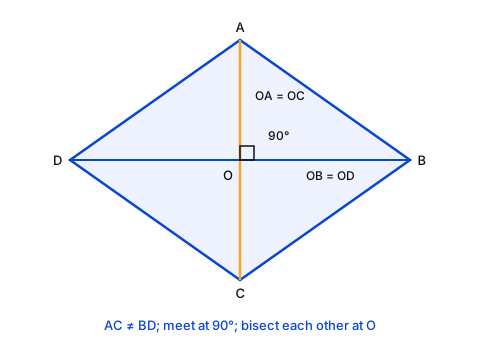
Q3829.
Select the correct statement regarding the properties of diagonals of a rhombus.
समचतुर्भुज के विकर्णों के गुणधर्मों के संबंध में सही कथन का चयन कीजिए।
  1. AThe diagonals of a rhombus are equal, intersect at right angles and bisect each other.समचतुर्भुज के विकर्ण बराबर होते हैं, समकोण पर प्रतिच्छेद करते हैं और एक-दूसरे को समद्विभाजित करते हैं।
  2. BThe diagonals of a rhombus are not equal, intersect at right angles and bisect each other.समचतुर्भुज के विकर्ण बराबर नहीं होते, समकोण पर प्रतिच्छेद करते हैं और एक-दूसरे को समद्विभाजित करते हैं।
  3. CThe diagonals of a rhombus are equal, do not intersect at right angles and bisect each other.समचतुर्भुज के विकर्ण बराबर होते हैं, समकोण पर प्रतिच्छेद नहीं करते और एक-दूसरे को समद्विभाजित करते हैं।
  4. DThe diagonals of a rhombus are equal, intersect at right angles and do not bisect each other.समचतुर्भुज के विकर्ण बराबर होते हैं, समकोण पर प्रतिच्छेद करते हैं और एक-दूसरे को समद्विभाजित नहीं करते।
Show answer

Concept: A rhombus has four equal sides; its diagonals are generally of different lengths.

  1. The diagonals bisect each other (true for every parallelogram).
  2. They cut each other at right angles (90∘).
  3. They are equal only in the special case of a square, so in general they are not equal.

Trick: Equal diagonals → rectangle/square; perpendicular diagonals → rhombus.

Answer: (B) The diagonals of a rhombus are not equal, intersect at right angles and bisect each other.

अवधारणा: समचतुर्भुज की चारों भुजाएँ बराबर होती हैं; सामान्यतः विकर्ण असमान होते हैं।

  1. विकर्ण एक-दूसरे को समद्विभाजित करते हैं (हर समांतर चतुर्भुज में)।
  2. वे एक-दूसरे को समकोण (90∘) पर काटते हैं।
  3. विकर्ण बराबर केवल वर्ग में होते हैं, अतः सामान्यतः बराबर नहीं।

ट्रिक: बराबर विकर्ण → आयत/वर्ग; लंबवत विकर्ण → समचतुर्भुज।

उत्तर: (B) विकर्ण बराबर नहीं, समकोण पर काटते हैं और एक-दूसरे को समद्विभाजित करते हैं।

RRB NTPC Graduate CBT 1MathematicsGeometry – RhombusRRB NTPC Graduate CBT 1 2024 · 9 Jun Shift 3 →
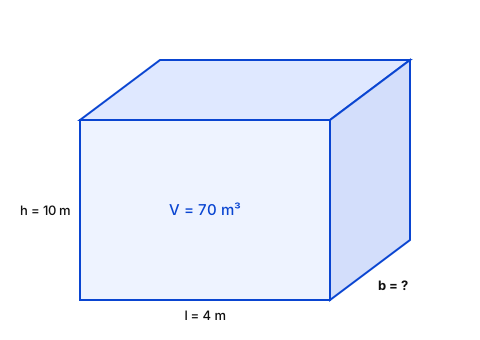
Q3830.
The capacity of a cuboid tank of water is 70,000 litres. Find the breadth of the tank, if its length and depth are 4 m and 10 m, respectively.
पानी की एक घनाभाकार टंकी की धारिता 70,000 लीटर है। यदि इसकी लंबाई और गहराई क्रमशः 4 m और 10 m हैं, तो टंकी की चौड़ाई ज्ञात कीजिए।
  1. A1.75 m
  2. B1.85 m
  3. C1.95 m
  4. D1.65 m
Show answer

Concept: 1m3=1000 litres and V=l×b×h.

  1. Volume =700001000=70m3.
  2. 4×b×10=70.
  3. b=7040=1.75m.

Trick: Divide litres by 1000 to get cubic metres first.

Answer: (A) 1.75m

अवधारणा: 1m3=1000 लीटर और V=l×b×h।

  1. आयतन =700001000=70m3।
  2. 4×b×10=70।
  3. b=7040=1.75m।

ट्रिक: पहले लीटर को 1000 से भाग देकर घन मीटर बनाएँ।

उत्तर: (A) 1.75m

RRB NTPC Graduate CBT 1MathematicsMensuration – CuboidRRB NTPC Graduate CBT 1 2024 · 9 Jun Shift 3 →
Q3831.
y varies directly as (x+3), and y=8 when x=1.
What is the value of y when x=2?
y, (x+3) के अनुक्रमानुपाती है, और y=8 जब x=1 है।
y का मान क्या होगा जब x=2 है?
  1. A10
  2. B5
  3. C8
  4. D2
Show answer

Concept: y∝(x+3)⇒y=k(x+3).

  1. 8=k(1+3)⇒k=2.
  2. At x=2: y=2(2+3).
  3. y=10.

Trick: Ratio method: y28=54⇒y2=10.

Answer: (A) 10

अवधारणा: y∝(x+3)⇒y=k(x+3)।

  1. 8=k(1+3)⇒k=2।
  2. x=2 पर: y=2(2+3)।
  3. y=10।

ट्रिक: अनुपात से: y28=54⇒y2=10।

उत्तर: (A) 10

RRB NTPC Graduate CBT 1MathematicsVariationRRB NTPC Graduate CBT 1 2024 · 9 Jun Shift 3 →
Q3832.
The retail price of a water geyser is ₹11,300. If the manufacturer gains 5%, the wholesale dealer gains 10% and the retailer gains 15%, then find the cost price of the water geyser (rounded off to two decimal places.)
(Note: Manufacturer sells to wholesaler, wholesaler sells to retailer and retailer sells to customer.)
एक वॉटर गीज़र का खुदरा मूल्य ₹11,300 है। यदि निर्माता को 5%, थोक विक्रेता को 10% और खुदरा विक्रेता को 15% लाभ होता है, तो वॉटर गीज़र का लागत मूल्य ज्ञात कीजिए (दो दशमलव स्थानों तक पूर्णांकित)।
(नोट: निर्माता थोक विक्रेता को बेचता है, थोक विक्रेता खुदरा विक्रेता को बेचता है और खुदरा विक्रेता ग्राहक को बेचता है।)
  1. A₹9,500.75
  2. B₹8,507.43
  3. C₹10,110.11
  4. D₹6,050.25
Show answer

Concept: Selling price after successive gains =CP×(1+r1)(1+r2)(1+r3).

  1. CP×1.05×1.10×1.15=11300.
  2. 1.05×1.10×1.15=1.32825.
  3. CP=113001.32825≈8507.43 (₹).

Trick: Rough check: total gain ≈ 33%, and 11300÷1.33≈8500 – only option B is close.

Answer: (B) ₹8,507.43

अवधारणा: क्रमिक लाभ के बाद विक्रय मूल्य =CP×(1+r1)(1+r2)(1+r3)।

  1. CP×1.05×1.10×1.15=11300।
  2. 1.05×1.10×1.15=1.32825।
  3. CP=113001.32825≈8507.43 (₹)।

ट्रिक: अनुमान: कुल लाभ ≈ 33%, 11300÷1.33≈8500 – केवल B पास है।

उत्तर: (B) ₹8,507.43

RRB NTPC Graduate CBT 1MathematicsSuccessive ProfitRRB NTPC Graduate CBT 1 2024 · 9 Jun Shift 3 →
Q3833.
Determine the nature of the roots of the quadratic equation 3x2 + 2x + 5 = 0.
द्विघात समीकरण 3x2 + 2x + 5 = 0 के मूलों की प्रकृति ज्ञात कीजिए।
  1. AComplex Roots (Imaginary Roots)सम्मिश्र मूल (काल्पनिक मूल)
  2. BReal and Equal Rootsवास्तविक और बराबर मूल
  3. CReal and Distinct Rootsवास्तविक और भिन्न मूल
  4. DMore than 2 real roots2 से अधिक वास्तविक मूल
Show answer

Concept: For ax2+bx+c=0, D=b2−4ac: D>0 real distinct, D=0 real equal, D<0 complex.

  1. a=3, b=2, c=5.
  2. D=22−4×3×5=4−60=−56.
  3. D<0 → roots are complex (imaginary).

Trick: If a and c have the same sign and 4ac>b2, the roots are imaginary. A quadratic never has more than 2 roots.

Answer: (A) Complex Roots (Imaginary Roots)

अवधारणा: ax2+bx+c=0 के लिए D=b2−4ac: D>0 वास्तविक भिन्न, D=0 वास्तविक समान, D<0 सम्मिश्र।

  1. a=3, b=2, c=5।
  2. D=22−4×3×5=4−60=−56।
  3. D<0 → मूल सम्मिश्र (काल्पनिक) हैं।

ट्रिक: a, c समान चिह्न और 4ac>b2 हो तो मूल काल्पनिक। द्विघात के 2 से अधिक मूल नहीं होते।

उत्तर: (A) Complex Roots (सम्मिश्र/काल्पनिक मूल)

RRB NTPC Graduate CBT 1MathematicsQuadratic Equations – Nature of RootsRRB NTPC Graduate CBT 1 2024 · 9 Jun Shift 3 →
Q3834.
The original price of a music set is ₹8,000. The price is decreased by 12% and then raised by 20%. What is its new price (in ₹)?
एक म्यूज़िक सेट का मूल मूल्य ₹8,000 है। मूल्य में 12% की कमी की जाती है और फिर 20% की वृद्धि की जाती है। इसका नया मूल्य (₹ में) क्या है?
  1. A7,748
  2. B7,948
  3. C8,948
  4. D8,448
Show answer

Concept: Successive change: multiply by (1−12100) and then (1+20100).

  1. After 12% decrease: 8000×0.88=7040.
  2. After 20% increase: 7040×1.2=8448.

Trick: Net change =−12+20−12×20100=+5.6%; 8000×1.056=8448.

Answer: (D) 8,448

अवधारणा: क्रमिक परिवर्तन: (1−12100) और फिर (1+20100) से गुणा।

  1. 12% कमी के बाद: 8000×0.88=7040।
  2. 20% वृद्धि के बाद: 7040×1.2=8448।

ट्रिक: कुल परिवर्तन =−12+20−12×20100=+5.6%; 8000×1.056=8448।

उत्तर: (D) 8,448

RRB NTPC Graduate CBT 1MathematicsSuccessive Percentage ChangeRRB NTPC Graduate CBT 1 2024 · 9 Jun Shift 3 →
Q3835.
Simplify: 369×(74+12)+99
सरल कीजिए: 369×(74+12)+99
  1. A446
  2. B449
  3. C444
  4. D443
Show answer

Concept: Apply BODMAS: bracket first, then division/multiplication, then addition.

  1. Bracket: 74+12=86.
  2. 369=4, so 4×86=344.
  3. 344+99=443.

Trick: Last digit check: 4×6=24→4, 4+9=13→3 – only 443 ends in 3.

Answer: (D) 443

अवधारणा: BODMAS लगाएँ: पहले कोष्ठक, फिर भाग/गुणा, फिर जोड़।

  1. कोष्ठक: 74+12=86।
  2. 369=4, अतः 4×86=344।
  3. 344+99=443।

ट्रिक: इकाई अंक जाँच: 4×6=24→4, 4+9=13→3 – केवल 443।

उत्तर: (D) 443

RRB NTPC Graduate CBT 1MathematicsSimplification (BODMAS)RRB NTPC Graduate CBT 1 2024 · 9 Jun Shift 3 →
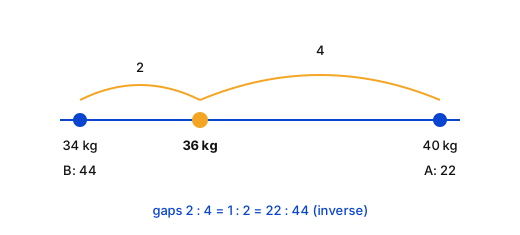
Q3836.
There are two sections A and B of a class, consisting of 22 and 44 students,
respectively. If the average weight of section A is 40 kg and that of section B is 34 kg, find the average weight of the whole class (in kg).
एक कक्षा के दो वर्ग A और B हैं, जिनमें क्रमशः 22 और 44 विद्यार्थी हैं।
यदि वर्ग A का औसत वज़न 40 kg और वर्ग B का औसत वज़न 34 kg है, तो पूरी कक्षा का औसत वज़न (kg में) ज्ञात कीजिए।
  1. A35.5
  2. B36
  3. C37
  4. D36.5
Show answer

Concept: Combined average =n1a1+n2a2n1+n2.

  1. Total weight of A =22×40=880kg.
  2. Total weight of B =44×34=1496kg.
  3. Average =880+149666=237666=36kg.

Trick: Students are in ratio 1:2, so the average divides the gap 6 in ratio 2:1 from 34: 34+2=36.

Answer: (B) 36

अवधारणा: संयुक्त औसत =n1a1+n2a2n1+n2।

  1. A का कुल भार =22×40=880kg।
  2. B का कुल भार =44×34=1496kg।
  3. औसत =880+149666=237666=36kg।

ट्रिक: छात्र अनुपात 1:2, अतः अंतर 6 को उल्टे अनुपात में बाँटें: 34+2=36।

उत्तर: (B) 36

RRB NTPC Graduate CBT 1MathematicsAverage – WeightedRRB NTPC Graduate CBT 1 2024 · 9 Jun Shift 3 →
Q3837.
If a:b=3:4 and b:c=4:7, then a+b+cc is equal to:
यदि a:b=3:4 और b:c=4:7 है, तो a+b+cc किसके बराबर है?
  1. A72
  2. B143
  3. C14
  4. D2
Show answer

Concept: Combine ratios using the common term b.

  1. a:b=3:4 and b:c=4:7; b is already 4 in both, so a:b:c=3:4:7.
  2. Let a=3k, b=4k, c=7k.
  3. a+b+cc=14k7k=2.

Trick: Sum of ratio terms ÷ c's term =147=2.

Answer: (D) 2

अवधारणा: उभयनिष्ठ पद b से अनुपात मिलाएँ।

  1. a:b=3:4 और b:c=4:7; दोनों में b=4, अतः a:b:c=3:4:7।
  2. मान लें a=3k, b=4k, c=7k।
  3. a+b+cc=14k7k=2।

ट्रिक: अनुपात पदों का योग ÷ c का पद =147=2।

उत्तर: (D) 2

RRB NTPC Graduate CBT 1MathematicsRatio and ProportionRRB NTPC Graduate CBT 1 2024 · 9 Jun Shift 3 →
Q3838.
2 men or 9 women can do a job in 14 days. 2 men work for 9 days and leave. The number of women required to complete the remaining work in 9 days is:
2 पुरुष या 9 महिलाएँ किसी काम को 14 दिनों में कर सकते हैं। 2 पुरुष 9 दिनों तक काम करते हैं और छोड़ देते हैं। शेष काम को 9 दिनों में पूरा करने के लिए आवश्यक महिलाओं की संख्या है:
  1. A2
  2. B3
  3. C5
  4. D4
Show answer

Concept: Convert men into women using 2M=9W, then count work in woman-days.

  1. Total work =9×14=126 woman-days.
  2. 2 men for 9 days =9 women×9=81 woman-days.
  3. Remaining =126−81=45 woman-days.
  4. Women needed in 9 days =459=5.

Trick: Replace '2 men' by '9 women' everywhere – the answer is just 9×(14−9)9=5.

Answer: (C) 5

अवधारणा: 2M=9W से पुरुषों को महिलाओं में बदलें और कार्य को महिला-दिवस में गिनें।

  1. कुल कार्य =9×14=126 महिला-दिवस।
  2. 2 पुरुष 9 दिन =9 महिलाएँ×9=81 महिला-दिवस।
  3. शेष =126−81=45 महिला-दिवस।
  4. 9 दिन में आवश्यक महिलाएँ =459=5।

ट्रिक: '2 पुरुष' की जगह '9 महिलाएँ' रखें – उत्तर 9×(14−9)9=5।

उत्तर: (C) 5

RRB NTPC Graduate CBT 1MathematicsTime and WorkRRB NTPC Graduate CBT 1 2024 · 9 Jun Shift 3 →
Q3839.
A shopkeeper marked his goods at X% above their cost price and sold them at a discount of 16%. If he gained 68% profit, then find the value of X.
एक दुकानदार ने अपने सामान पर क्रय मूल्य से X% अधिक मूल्य अंकित किया और उसे 16% की छूट पर बेचा। यदि उसे 68% लाभ हुआ, तो X का मान ज्ञात कीजिए।
  1. A101
  2. B100
  3. C99
  4. D102
Show answer

Concept: SP=MP×(1−discount)=CP×(1+profit).

  1. Let CP =100. SP with 68% profit =168.
  2. MP×84100=168⇒MP=200.
  3. Mark-up X=200−100100×100=100.

Trick: MPCP=100+P%100−D%=16884=2 → 100% above.

Answer: (B) 100

अवधारणा: विक्रय मूल्य=अंकित मूल्य×(1−छूट)=क्रय मूल्य×(1+लाभ)।

  1. माना क्रय मूल्य =100; 68% लाभ पर विक्रय मूल्य =168।
  2. अंकित मूल्य×84100=168⇒अंकित मूल्य=200।
  3. X=200−100100×100=100।

ट्रिक: MPCP=100+P%100−D%=16884=2 → 100% अधिक।

उत्तर: (B) 100

RRB NTPC Graduate CBT 1MathematicsProfit, Loss and DiscountRRB NTPC Graduate CBT 1 2024 · 9 Jun Shift 3 →
Q3840.
Walking at 25 of his normal speed, Abhijeet is 18 minutes late in reaching his office. The usual time taken by him to cover the distance between his home and his office is:
अपनी सामान्य चाल की 25 चाल से चलने पर, अभिजीत अपने कार्यालय 18 मिनट देर से पहुँचता है। उसके द्वारा अपने घर और कार्यालय के बीच की दूरी तय करने में लिया जाने वाला सामान्य समय है:
  1. A12 minutes12 मिनट
  2. B2 minutes2 मिनट
  3. C9 minutes9 मिनट
  4. D11 minutes11 मिनट
Show answer

Concept: For fixed distance, time ∝ 1speed.

  1. Speed becomes 25 ⇒ time becomes 52 of usual time T.
  2. Extra time =52T−T=32T=18 min.
  3. T=18×23=12 min.

Trick: Usual time =late52−1=181.5=12.

Answer: (A) 12 minutes

अवधारणा: निश्चित दूरी पर, समय ∝ 1चाल।

  1. चाल 25 ⇒ समय सामान्य समय T का 52 गुना।
  2. अतिरिक्त समय =52T−T=32T=18 मिनट।
  3. T=18×23=12 मिनट।

ट्रिक: सामान्य समय =देरी52−1=181.5=12।

उत्तर: (A) 12 मिनट

RRB NTPC Graduate CBT 1MathematicsSpeed, Time and DistanceRRB NTPC Graduate CBT 1 2024 · 9 Jun Shift 3 →