Question bank

Q&A: practice questions with answers

Search questions on any topic. Filter by exam category, exam, subject and topic, try the question, then open the answer and explanation.

Courses – airGurukul

7,077 questions found.

Q4161.
Read the given statements and conclusions carefully. Assuming that the information given in the statements is true, even if it appears to be at variance with commonly known facts, decide which of the given conclusion(s) logically follow(s) from the statements.
Statements:
All warriors are politicians.
All leaders are knights.
Some knights are warriors.
Conclusions:
(I) Some warriors are leaders.
(II) Some politicians are knights.
दिए गए कथनों और निष्कर्षों को ध्यानपूर्वक पढ़िए। कथनों में दी गई जानकारी को सत्य मानते हुए, भले ही वह सामान्य रूप से ज्ञात तथ्यों से भिन्न प्रतीत होती हो, निर्णय कीजिए कि दिए गए निष्कर्षों में से कौन-सा/से निष्कर्ष तार्किक रूप से कथनों का अनुसरण करता है/करते हैं।
कथन:
सभी योद्धा, राजनेता हैं।
सभी नेता, सामंत हैं।
कुछ सामंत, योद्धा हैं।
निष्कर्ष:
(I) कुछ योद्धा, नेता हैं।
(II) कुछ राजनेता, सामंत हैं।
  1. AOnly conclusion (II) follows.केवल निष्कर्ष (II) अनुसरण करता है।
  2. BOnly conclusion (I) follows.केवल निष्कर्ष (I) अनुसरण करता है।
  3. CBoth conclusions (I) and (II) follow.निष्कर्ष (I) और (II) दोनों अनुसरण करते हैं।
  4. DNeither conclusion (I) nor (II) follows.न तो निष्कर्ष (I) और न ही (II) अनुसरण करता है।
Show answer

Concept: Draw the least-overlap Venn diagram that satisfies all statements and test each conclusion.
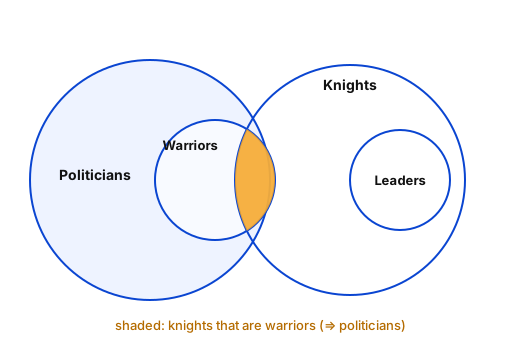
  1. Warriors ⊂ Politicians; Leaders ⊂ Knights; Knights overlap Warriors.
  2. (I) Leaders can lie in the part of Knights away from Warriors → 'Some warriors are leaders' is not certain ✗.
  3. (II) The knights that are warriors are also politicians → 'Some politicians are knights' is certain ✓.

Trick: 'Some A are B' + 'All A are C' ⇒ 'Some B are C' always.

Answer: (A) Only conclusion (II) follows.

अवधारणा: सभी कथनों को संतुष्ट करने वाला न्यूनतम-अतिव्यापन वेन आरेख बनाकर निष्कर्ष जाँचें।

  1. योद्धा ⊂ राजनेता; नेता ⊂ शूरवीर; शूरवीर और योद्धा में कुछ साझा।
  2. (I) नेता, शूरवीरों के उस भाग में हो सकते हैं जो योद्धाओं से अलग है → 'कुछ योद्धा नेता हैं' निश्चित नहीं ✗।
  3. (II) जो शूरवीर योद्धा हैं वे राजनेता भी हैं → 'कुछ राजनेता शूरवीर हैं' निश्चित ✓।

ट्रिक: 'कुछ A, B हैं' + 'सभी A, C हैं' ⇒ 'कुछ B, C हैं' सदैव।

उत्तर: (A) Only conclusion (II) follows.
RRB NTPC Graduate CBT 1General Intelligence and ReasoningSyllogismRRB NTPC Graduate CBT 1 2024 · 6 Jun Shift 3 →
Q4162.
Refer to the following number and symbol series and answer the question that follows. Counting to be done from left to right only. All numbers are single-digit numbers. (Left) @ 5 4 £ 8 & © £ * 2 5 9 $ 6 £ 4 * 8 $ 4 % * (Right)
How many such symbols are there each of which is immediately preceded by a number and also immediately followed by a number?
निम्नलिखित संख्या और प्रतीक शृंखला को देखिए और उसके बाद आने वाले प्रश्न का उत्तर दीजिए। गिनती केवल बाएँ से दाएँ की जानी है। सभी संख्याएँ एक-अंकीय संख्याएँ हैं। (बाएँ) @ 5 4 £ 8 & © £ * 2 5 9 $ 6 £ 4 * 8 $ 4 % * (दाएँ)
ऐसे कितने प्रतीक हैं जिनमें से प्रत्येक के ठीक पहले एक संख्या है और ठीक बाद में भी एक संख्या है?
  1. A4
  2. B7
  3. C5
  4. D6
Show answer

Concept: Look for number–symbol–number triplets.

  1. Series: @ 5 4 £ 8 & © £ * 2 5 9 $ 6 £ 4 * 8 $ 4 % *
  2. Valid: 4 £ 8, 9 $ 6, 6 £ 4, 4 * 8, 8 $ 4
  3. Not valid: & (followed by ©), © £ * (no numbers around), % (followed by *).

Trick: Mark each symbol and just check its two neighbours.

Answer: (C) 5

अवधारणा: संख्या–प्रतीक–संख्या वाले त्रिक खोजें।

  1. शृंखला: @ 5 4 £ 8 & © £ * 2 5 9 $ 6 £ 4 * 8 $ 4 % *
  2. मान्य: 4 £ 8, 9 $ 6, 6 £ 4, 4 * 8, 8 $ 4
  3. अमान्य: & (बाद में ©), © £ * (आसपास संख्या नहीं), % (बाद में *)।

ट्रिक: हर प्रतीक पर निशान लगाएँ और केवल उसके दोनों पड़ोसी देखें।

उत्तर: (C) 5

RRB NTPC Graduate CBT 1General Intelligence and ReasoningNumber–Symbol SeriesRRB NTPC Graduate CBT 1 2024 · 6 Jun Shift 3 →
Q4163.
XC 14 is related to VG 1 in a certain way. In the same way, RD 18 is related to PH 5. To which of the given options is UP 4 related, following the same logic?
XC 14 एक निश्चित प्रकार से VG 1 से संबंधित है। उसी प्रकार, RD 18, PH 5 से संबंधित है। समान तर्क का अनुसरण करते हुए, UP 4 दिए गए विकल्पों में से किससे संबंधित है?
  1. AVR -7
  2. BNR -7
  3. CST -9
  4. DNE -9
Show answer

Concept: Each part of the cluster changes by a fixed rule: first letter, second letter and number are shifted separately.

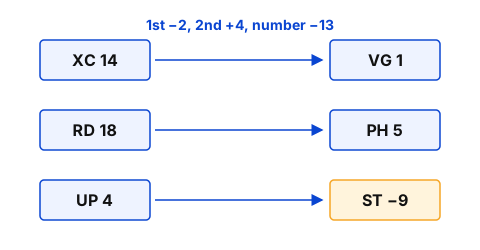
  1. XC 14 → VG 1: X − 2 = V, C + 4 = G, 14−13=1.
  2. RD 18 → PH 5: R − 2 = P, D + 4 = H, 18−13=5.
  3. UP 4: U − 2 = S, P + 4 = T, 4−13=−9 → ST −9.

Trick: Check the number first: −13 in both pairs leaves only the −9 options, then the letters decide.

Answer: (C) ST −9

अवधारणा: क्लस्टर के हर भाग पर अलग नियम लगता है: पहला अक्षर, दूसरा अक्षर और संख्या।

  1. XC 14 → VG 1: X − 2 = V, C + 4 = G, 14−13=1.
  2. RD 18 → PH 5: R − 2 = P, D + 4 = H, 18−13=5.
  3. UP 4: U − 2 = S, P + 4 = T, 4−13=−9 → ST −9.

ट्रिक: पहले संख्या देखें: −13 से केवल −9 वाले विकल्प बचते हैं, फिर अक्षरों से तय करें।

उत्तर: (C) ST −9

RRB NTPC Graduate CBT 1General Intelligence and ReasoningLetter-number analogyRRB NTPC Graduate CBT 1 2024 · 6 Jun Shift 3 →
Q4164.
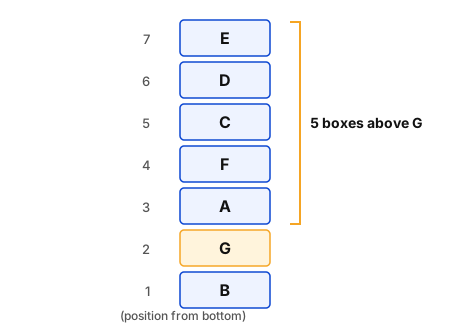
Seven boxes, A, B, C, D, E, F and G, are kept one over the other but not necessarily in the same order. C is kept immediately above F. G is kept immediately above B. Only E is kept above D. Only two boxes are kept above C. G is not kept in third position from the bottom. How many boxes are kept above G?
सात बक्से, A, B, C, D, E, F और G, एक के ऊपर एक रखे गए हैं, लेकिन आवश्यक नहीं कि इसी क्रम में हों। C को F के ठीक ऊपर रखा गया है। G को B के ठीक ऊपर रखा गया है। D के ऊपर केवल E रखा गया है। C के ऊपर केवल दो बक्से रखे गए हैं। G को नीचे से तीसरे स्थान पर नहीं रखा गया है। G के ऊपर कितने बक्से रखे गए हैं?
  1. A4
  2. B5
  3. C3
  4. D2
Show answer

Concept: Place the fixed boxes first (counting from the top), then fit the pair G–B using the last condition.

  1. Only E above D → E 1st, D 2nd from top.
  2. Only two above C → C 3rd, F 4th (C immediately above F).
  3. G–B fits in 5th–6th or 6th–7th; G at 5th from top would be 3rd from bottom, not allowed.
  4. So G 6th, B 7th, A 5th → 5 boxes above G.

Trick: Fix the positions with 'only' and 'immediately' first; the negative clue then decides between the two leftover cases.

Answer: (B) 5

अवधारणा: पहले निश्चित स्थान वाले बॉक्स (ऊपर से गिनकर) रखें, फिर अंतिम शर्त से G–B जोड़ी तय करें।

  1. केवल E, D के ऊपर → E ऊपर से 1st, D 2nd.
  2. C के ऊपर केवल दो → C 3rd, F 4th (C ठीक F के ऊपर)।
  3. G–B 5th–6th या 6th–7th पर; G 5th (ऊपर से) होगा तो नीचे से 3rd होगा, जो मना है।
  4. अतः G 6th, B 7th, A 5th → G के ऊपर 5 बॉक्स।

ट्रिक: पहले 'केवल' और 'ठीक ऊपर' वाली शर्तें लगाएँ; नकारात्मक शर्त बचे दो विकल्पों में से एक चुनती है।

उत्तर: (B) 5

RRB NTPC Graduate CBT 1General Intelligence and ReasoningBox arrangementRRB NTPC Graduate CBT 1 2024 · 6 Jun Shift 3 →
Q4165.
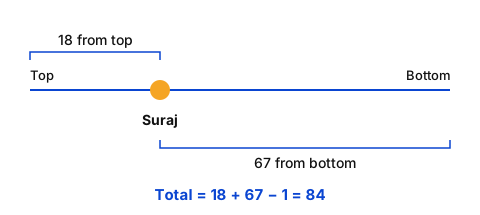
Suraj ranked 18th from the top and 67th from the bottom in his class. How many students are there in his class?
सूरज अपनी कक्षा में ऊपर से 18वें और नीचे से 67वें स्थान पर है। उसकी कक्षा में कितने विद्यार्थी हैं?
  1. A83
  2. B82
  3. C85
  4. D84
Show answer

Concept: Total =rank from top+rank from bottom−1 (the person is counted twice).

  1. Total =18+67−1.
  2. =84 students.

Trick: Always subtract 1 – Suraj is included in both counts.

Answer: (D) 84

अवधारणा: कुल =ऊपर से स्थान+नीचे से स्थान−1 (व्यक्ति दो बार गिना जाता है)।

  1. कुल =18+67−1.
  2. =84 विद्यार्थी।

ट्रिक: हमेशा 1 घटाएँ – सूरज दोनों गिनतियों में शामिल है।

उत्तर: (D) 84

RRB NTPC Graduate CBT 1General Intelligence and ReasoningRankingRRB NTPC Graduate CBT 1 2024 · 6 Jun Shift 3 →
Q4166.
What will come in place of the question mark (?) in the following equation, if ‘+’ and ‘–’ are interchanged, and ‘×’ and ‘÷’ are interchanged?
43 + 15 ÷ 2 – 12 × 4 = ?
यदि '+' और '–' को आपस में बदल दिया जाए तथा '×' और '÷' को आपस में बदल दिया जाए, तो निम्नलिखित समीकरण में प्रश्नवाचक चिह्न (?) के स्थान पर क्या आएगा?
43 + 15 ÷ 2 – 12 × 4 = ?
  1. A16
  2. B18
  3. C22
  4. D24
Show answer

Concept: Interchange the signs, then solve using BODMAS.

  1. 43+15÷2−12×4 becomes 43−15×2+12÷4.
  2. =43−30+3.
  3. =16.

Trick: Rewrite the full expression with new signs before calculating – most errors come from swapping only one pair.

Answer: (A) 16

अवधारणा: चिह्न आपस में बदलें, फिर BODMAS से हल करें।

  1. 43+15÷2−12×4 बन जाता है 43−15×2+12÷4.
  2. =43−30+3.
  3. =16.

ट्रिक: गणना से पहले पूरा व्यंजक नए चिह्नों के साथ लिख लें – अधिकतर गलती एक ही जोड़ी बदलने से होती है।

उत्तर: (A) 16

RRB NTPC Graduate CBT 1General Intelligence and ReasoningMathematical operationsRRB NTPC Graduate CBT 1 2024 · 6 Jun Shift 3 →
Q4167.
In a certain code language, ‘LIPS’ is coded as ‘4628’ and ‘PURE’ is coded as ‘3567’. What is the code for ‘P’ in the given code language?
एक निश्चित कूट भाषा में, 'LIPS' को '4628' के रूप में और 'PURE' को '3567' के रूप में कूटबद्ध किया जाता है। दी गई कूट भाषा में 'P' के लिए कूट क्या है?
  1. A2
  2. B7
  3. C6
  4. D3
Show answer

Concept: A letter common to both words must have the code digit common to both codes.

  1. LIPS → 4628, PURE → 3567.
  2. Common letter: P. Common digit: 6.
  3. So P = 6.

Trick: Match common letter with common digit – order of digits does not matter.

Answer: (C) 6

अवधारणा: दोनों शब्दों में उभयनिष्ठ अक्षर का कोड दोनों कोडों में उभयनिष्ठ अंक होगा।

  1. LIPS → 4628, PURE → 3567.
  2. उभयनिष्ठ अक्षर: P; उभयनिष्ठ अंक: 6.
  3. अतः P = 6.

ट्रिक: उभयनिष्ठ अक्षर को उभयनिष्ठ अंक से मिलाएँ – अंकों का क्रम मायने नहीं रखता।

उत्तर: (C) 6

RRB NTPC Graduate CBT 1General Intelligence and ReasoningCoding-decodingRRB NTPC Graduate CBT 1 2024 · 6 Jun Shift 3 →
Q4168.
Which of the following letter-number clusters will replace the question mark (?) in the given series to make it logically complete?
GIM 8, HJN 11, IKO 14, JLP 17, ?
दी गई शृंखला को तार्किक रूप से पूर्ण करने के लिए निम्नलिखित में से कौन-सा अक्षर-संख्या समूह प्रश्नवाचक चिह्न (?) को प्रतिस्थापित करेगा?
GIM 8, HJN 11, IKO 14, JLP 17, ?
  1. AUVY 20
  2. BKMQ 20
  3. CUYZ 21
  4. DTUY 21
Show answer

Concept: Each letter moves +1 and the number increases by 3 at every step.

  1. G→H→I→J→K, I→J→K→L→M, M→N→O→P→Q.
  2. 8, 11, 14, 17, 20 (+3 each).
  3. Next term: KMQ 20.

Trick: Check the number first: +3 gives 20, leaving only two options; letters K-M-Q confirm.

Answer: (B) KMQ 20

अवधारणा: हर अक्षर +1 आगे बढ़ता है और संख्या हर बार 3 बढ़ती है।

  1. G→H→I→J→K, I→J→K→L→M, M→N→O→P→Q.
  2. 8, 11, 14, 17, 20 (+3)।
  3. अगला पद: KMQ 20.

ट्रिक: पहले संख्या देखें: +3 से 20 आता है, दो विकल्प बचते हैं; अक्षर K-M-Q से पुष्टि।

उत्तर: (B) KMQ 20

RRB NTPC Graduate CBT 1General Intelligence and ReasoningLetter-number seriesRRB NTPC Graduate CBT 1 2024 · 6 Jun Shift 3 →
Q4169.
Based on the English alphabetical order, three of the following four letter-clusters are alike in a certain way and thus form a group. Which letter-cluster DOES NOT belong to that group?
(Note: The odd one out is not based on the number of consonants/vowels or their position in the letter-cluster.)
अंग्रेज़ी वर्णमाला क्रम के आधार पर, निम्नलिखित चार अक्षर-समूहों में से तीन किसी निश्चित प्रकार से एकसमान हैं और इस प्रकार एक समूह बनाते हैं। कौन-सा अक्षर-समूह उस समूह से संबंधित नहीं है?
(ध्यान दें: असंगत अक्षर-समूह, अक्षर-समूह में व्यंजनों/स्वरों की संख्या या उनके स्थान पर आधारित नहीं है।)
  1. AURO
  2. BKIE
  3. CTQN
  4. DWTQ
Show answer

Concept: Write the alphabet positions and check the gaps between letters.

  1. URO: 21, 18, 15 → −3, −3.
  2. TQN: 20, 17, 14 → −3, −3; WTQ: 23, 20, 17 → −3, −3.
  3. KIE: 11, 9, 5 → −2, −4 – different.

Trick: Backward jump of 3 each time in three clusters; the one breaking it is odd.

Answer: (B) KIE

अवधारणा: अक्षरों के स्थानीय मान लिखें और अंतर देखें।

  1. URO: 21, 18, 15 → −3, −3.
  2. TQN: 20, 17, 14 → −3, −3; WTQ: 23, 20, 17 → −3, −3.
  3. KIE: 11, 9, 5 → −2, −4 – अलग।

ट्रिक: तीन समूहों में हर बार 3 पीछे; जो नियम तोड़े वही विषम।

उत्तर: (B) KIE

RRB NTPC Graduate CBT 1General Intelligence and ReasoningOdd one out – lettersRRB NTPC Graduate CBT 1 2024 · 6 Jun Shift 3 →
Q4170.
4 is related to 10 following a certain logic. Following the same logic, 34 is related to 40. To which of the following is 66 related, following the same logic?
(NOTE: Operations should be performed on the whole numbers, without breaking down the numbers into their constituent digits. E.g. 13 – Operations on 13 such as
adding/subtracting/multiplying to 13 can be performed. Breaking down 13 into 1 and 3 and then performing mathematical operations on 1 and 3 is not allowed.)
एक निश्चित तर्क का अनुसरण करते हुए 4, 10 से संबंधित है। उसी तर्क का अनुसरण करते हुए, 34, 40 से संबंधित है। उसी तर्क का अनुसरण करते हुए, 66 निम्नलिखित में से किससे संबंधित है?
(नोट: संख्याओं को उनके घटक अंकों में तोड़े बिना, संक्रियाएँ पूर्ण संख्याओं पर की जानी चाहिए। उदाहरण 13 – 13 पर संक्रियाएँ जैसे 13 में
जोड़ना/घटाना/गुणा करना आदि की जा सकती हैं। 13 को 1 और 3 में तोड़ना और फिर 1 और 3 पर गणितीय संक्रियाएँ करना वर्जित है।)
  1. A70
  2. B68
  3. C72
  4. D74
Show answer

Concept: Find one operation that works for both given pairs.

  1. 4+6=10 and 34+6=40.
  2. So 66+6=72.

Trick: Try the simplest difference first: both pairs differ by 6.

Answer: (C) 72

अवधारणा: दोनों दिए गए जोड़ों पर लागू होने वाली एक संक्रिया खोजें।

  1. 4+6=10 और 34+6=40.
  2. अतः 66+6=72.

ट्रिक: पहले सबसे सरल अंतर देखें: दोनों जोड़ों में अंतर 6 है।

उत्तर: (C) 72

RRB NTPC Graduate CBT 1General Intelligence and ReasoningNumber analogyRRB NTPC Graduate CBT 1 2024 · 6 Jun Shift 3 →
Q4171.
In a certain code language,
A + B means ‘A is the mother of B’,
A − B means ‘A is the brother of B’,
A × B means ‘A is the wife of B’ and
A ÷ B means ‘A is the father of B’.
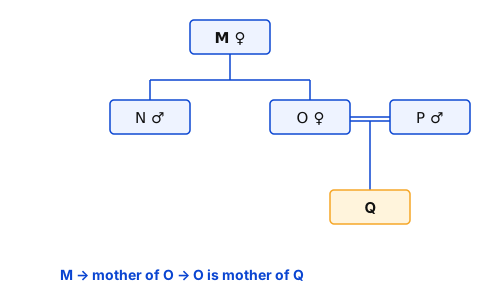
How is M related to Q if ‘M + N − O × P ÷ Q’?
एक निश्चित कूट भाषा में,
A + B का अर्थ है 'A, B की माँ है',
A − B का अर्थ है 'A, B का भाई है',
A × B का अर्थ है 'A, B की पत्नी है' और
A ÷ B का अर्थ है 'A, B का पिता है'।
यदि 'M + N − O × P ÷ Q' है, तो M का Q से क्या संबंध है?
  1. AFather's sisterपिता की बहन
  2. B​Father's motherपिता की माँ
  3. CMother's motherमाँ की माँ
  4. DMother's sisterमाँ की बहन
Show answer

Concept: Decode each symbol from left to right and draw the family tree.

  1. M + N: M is the mother of N.
  2. N − O: N is the brother of O, so M is also O's mother.
  3. O × P: O is the wife of P; P ÷ Q: P is the father of Q, so O is Q's mother.
  4. M is the mother of Q's mother.

Trick: Join links in a chain: mother → (sibling) → mother = maternal grandmother.

Answer: (C) Mother's mother

अवधारणा: हर चिह्न को बाएँ से दाएँ डिकोड करें और वंश-वृक्ष बनाएँ।

  1. M + N: M, N की माँ है।
  2. N − O: N, O का भाई है, अतः M, O की भी माँ है।
  3. O × P: O, P की पत्नी; P ÷ Q: P, Q का पिता, अतः O, Q की माँ है।
  4. M, Q की माँ की माँ (नानी) है।

ट्रिक: कड़ियाँ जोड़ें: माँ → (भाई-बहन) → माँ = नानी।

उत्तर: (C) Mother's mother (नानी)

RRB NTPC Graduate CBT 1General Intelligence and ReasoningCoded blood relationsRRB NTPC Graduate CBT 1 2024 · 6 Jun Shift 3 →
Q4172.
In a certain code language, ‘PICK’ is coded as ‘4628’ and ‘COST’ is coded as ‘3567’. What is the code for ‘C’ in the given code language?
एक निश्चित कूट भाषा में, 'PICK' को '4628' के रूप में और 'COST' को '3567' के रूप में कूटबद्ध किया जाता है। दी गई कूट भाषा में 'C' के लिए कूट क्या है?
  1. A3
  2. B2
  3. C7
  4. D6
Show answer

Concept: A letter common to both words gets the digit common to both codes.

  1. PICK → 4628, COST → 3567.
  2. Common letter: C; common digit: 6.
  3. So C = 6.

Trick: Common letter ↔ common digit, irrespective of position.

Answer: (D) 6

अवधारणा: दोनों शब्दों में उभयनिष्ठ अक्षर का कोड दोनों कोडों का उभयनिष्ठ अंक होता है।

  1. PICK → 4628, COST → 3567.
  2. उभयनिष्ठ अक्षर: C; उभयनिष्ठ अंक: 6.
  3. अतः C = 6.

ट्रिक: उभयनिष्ठ अक्षर ↔ उभयनिष्ठ अंक, स्थान चाहे कुछ भी हो।

उत्तर: (D) 6

RRB NTPC Graduate CBT 1General Intelligence and ReasoningCoding-decodingRRB NTPC Graduate CBT 1 2024 · 6 Jun Shift 3 →
Q4173.
In a certain code language, ‘flag dance best’ is coded as ‘xk tc kz’ and ‘mile flag wine’ is coded as ‘tc di gv’. How is ‘flag’ coded in the given language?
एक निश्चित कूट भाषा में, 'flag dance best' को 'xk tc kz' के रूप में और 'mile flag wine' को 'tc di gv' के रूप में कूटबद्ध किया जाता है। दी गई भाषा में 'flag' को किस प्रकार कूटबद्ध किया जाता है?
  1. Axk
  2. Btc
  3. Ckz
  4. Ddi
Show answer

Concept: The word common to both sentences has the code common to both coded sentences.

  1. 'flag dance best' → xk tc kz; 'mile flag wine' → tc di gv.
  2. Common word: flag; common code: tc.
  3. So flag = tc.

Trick: Common word ↔ common code.

Answer: (B) tc

अवधारणा: दोनों वाक्यों में उभयनिष्ठ शब्द का कोड दोनों कोडित वाक्यों में उभयनिष्ठ होगा।

  1. 'flag dance best' → xk tc kz; 'mile flag wine' → tc di gv.
  2. उभयनिष्ठ शब्द: flag; उभयनिष्ठ कोड: tc.
  3. अतः flag = tc.

ट्रिक: उभयनिष्ठ शब्द ↔ उभयनिष्ठ कोड।

उत्तर: (B) tc

RRB NTPC Graduate CBT 1General Intelligence and ReasoningCoding-decodingRRB NTPC Graduate CBT 1 2024 · 6 Jun Shift 3 →
Q4174.
What will come in place of the question mark (?) in the following equation, if ‘+’ and ‘−’ are interchanged and ‘×’ and ‘÷’ are interchanged?
8 ÷ 7 + 56 × 14 − 2 = ?
यदि '+' और '−' को आपस में बदल दिया जाए तथा '×' और '÷' को आपस में बदल दिया जाए, तो निम्नलिखित समीकरण में प्रश्नवाचक चिह्न (?) के स्थान पर क्या आएगा?
8 ÷ 7 + 56 × 14 − 2 = ?
  1. A56
  2. B52
  3. C58
  4. D54
Show answer

Concept: Interchange the signs, then apply BODMAS.

  1. 8÷7+56×14−2 becomes 8×7−56÷14+2.
  2. =56−4+2.
  3. =54.

Trick: Do the ÷ and × first after swapping: 56 and 4.

Answer: (D) 54

अवधारणा: चिह्न आपस में बदलें, फिर BODMAS लगाएँ।

  1. 8÷7+56×14−2 बन जाता है 8×7−56÷14+2.
  2. =56−4+2.
  3. =54.

ट्रिक: बदलने के बाद पहले ÷ और × करें: 56 और 4.

उत्तर: (D) 54

RRB NTPC Graduate CBT 1General Intelligence and ReasoningMathematical operationsRRB NTPC Graduate CBT 1 2024 · 6 Jun Shift 3 →
Q4175.
If 2 is added to each even digit and 1 is subtracted from each odd digit in the number 415796, what will be the sum of the digits which are fifth from the left and first from the right in the new number thus formed?
यदि संख्या 415796 में प्रत्येक सम अंक में 2 जोड़ा जाए और प्रत्येक विषम अंक में से 1 घटाया जाए, तो इस प्रकार बनी नई संख्या में बाएँ से पाँचवें और दाएँ से पहले अंक का योग क्या होगा?
  1. A14
  2. B10
  3. C16
  4. D12
Show answer

Concept: Change each digit by the rule, then pick the required positions.

  1. 4 1 5 7 9 6 → 4+2, 1−1, 5−1, 7−1, 9−1, 6+2.
  2. New number: 6 0 4 6 8 8.
  3. 5th from left = 8; 1st from right = 8; sum = 16.

Trick: Only digits at the asked positions matter: 9 → 8 and 6 → 8.

Answer: (C) 16

अवधारणा: हर अंक पर नियम लगाएँ, फिर पूछे गए स्थान चुनें।

  1. 4 1 5 7 9 6 → 4+2, 1−1, 5−1, 7−1, 9−1, 6+2.
  2. नई संख्या: 6 0 4 6 8 8.
  3. बाएँ से 5वाँ = 8; दाएँ से पहला = 8; योग = 16.

ट्रिक: केवल पूछे गए स्थानों के अंक बदलें: 9 → 8 और 6 → 8.

उत्तर: (C) 16

RRB NTPC Graduate CBT 1General Intelligence and ReasoningNumber manipulationRRB NTPC Graduate CBT 1 2024 · 6 Jun Shift 3 →
Q4176.
What should come in place of the question mark (?) in the given series?
602 600 696 690 682 ?
दी गई शृंखला में प्रश्नवाचक चिह्न (?) के स्थान पर क्या आना चाहिए?
602 600 696 690 682 ?
  1. A671
  2. B668
  3. C672
  4. D670
Show answer

Concept: Look at the differences between consecutive terms; from 696 onward they fall by 2 each time.

  1. 696−6=690, 690−8=682.
  2. Next difference =−10.
  3. 682−10=672.

Trick: Differences −6, −8, −10 continue the even-number pattern (−2, −4, … in the series).

Answer: (C) 672

अवधारणा: क्रमागत पदों का अंतर देखें; 696 से आगे अंतर हर बार 2 बढ़ता है।

  1. 696−6=690, 690−8=682.
  2. अगला अंतर =−10.
  3. 682−10=672.

ट्रिक: अंतर −6, −8, −10 सम संख्याओं का क्रम (−2, −4, …) आगे बढ़ाते हैं।

उत्तर: (C) 672

RRB NTPC Graduate CBT 1General Intelligence and ReasoningNumber seriesRRB NTPC Graduate CBT 1 2024 · 6 Jun Shift 3 →
Q4177.
This question is based on the five, three-digit numbers given below.
(Left) 412 366 307 241 667 (Right)
(Example: 697 – First digit = 6, second digit = 9 and third digit = 7)
(NOTE: All operations to be done from left to right.)
What will be the resultant if the first digit of the highest number is subtracted from the third digit of the lowest number?
यह प्रश्न नीचे दी गई पाँच, तीन-अंकीय संख्याओं पर आधारित है।
(बाएँ) 412 366 307 241 667 (दाएँ)
(उदाहरण: 697 – पहला अंक = 6, दूसरा अंक = 9 और तीसरा अंक = 7)
(नोट: सभी संक्रियाएँ बाएँ से दाएँ की जानी हैं।)
यदि सबसे बड़ी संख्या के पहले अंक को सबसे छोटी संख्या के तीसरे अंक में से घटाया जाए, तो परिणाम क्या होगा?
  1. A−4
  2. B−2
  3. C−6
  4. D−5
Show answer

Concept: Identify the highest and the lowest numbers, then take the required digits.

  1. Highest = 667 → first digit 6.
  2. Lowest = 241 → third digit 1.
  3. 1−6=−5.

Trick: Mind the order: third digit of lowest MINUS first digit of highest.

Answer: (D) −5

अवधारणा: सबसे बड़ी और सबसे छोटी संख्या पहचानें, फिर आवश्यक अंक लें।

  1. सबसे बड़ी = 667 → पहला अंक 6.
  2. सबसे छोटी = 241 → तीसरा अंक 1.
  3. 1−6=−5.

ट्रिक: क्रम का ध्यान रखें: सबसे छोटी का तीसरा अंक घटा सबसे बड़ी का पहला अंक।

उत्तर: (D) −5

RRB NTPC Graduate CBT 1General Intelligence and ReasoningThree-digit numbersRRB NTPC Graduate CBT 1 2024 · 6 Jun Shift 3 →
Q4178.
Select the number from among the given options that can replace the question mark (?) in the following series.
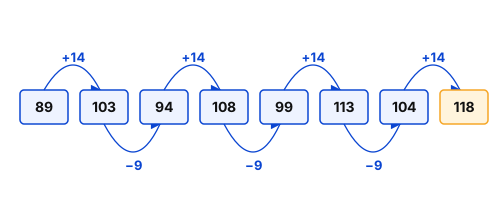
89 103 94 108 99 113 104 ?
दिए गए विकल्पों में से उस संख्या का चयन कीजिए जो निम्नलिखित शृंखला में प्रश्नवाचक चिह्न (?) को प्रतिस्थापित कर सकती है।
89 103 94 108 99 113 104 ?
  1. A123
  2. B95
  3. C118
  4. D98
Show answer

Concept: The series alternately adds 14 and subtracts 9.

  1. 89 +14 = 103, −9 = 94, +14 = 108, −9 = 99.
  2. 99 +14 = 113, −9 = 104.
  3. 104 +14 = 118.

Trick: Net change over two steps is +5: 89, 94, 99, 104 and 103, 108, 113, 118.

Answer: (C) 118

अवधारणा: श्रृंखला में बारी-बारी से 14 जोड़ा और 9 घटाया जाता है।

  1. 89 +14 = 103, −9 = 94, +14 = 108, −9 = 99.
  2. 99 +14 = 113, −9 = 104.
  3. 104 +14 = 118.

ट्रिक: दो चरणों में कुल परिवर्तन +5: 89, 94, 99, 104 और 103, 108, 113, 118.

उत्तर: (C) 118

RRB NTPC Graduate CBT 1General Intelligence and ReasoningNumber seriesRRB NTPC Graduate CBT 1 2024 · 6 Jun Shift 3 →
Q4179.
Who is the current Chief Minister of Delhi as of March 2025, and from which
constituency was he/she elected in the 2025 Delhi Assembly elections?
मार्च 2025 की स्थिति के अनुसार दिल्ली के वर्तमान मुख्यमंत्री कौन हैं, और 2025 के दिल्ली विधानसभा चुनावों में वे किस
निर्वाचन क्षेत्र से निर्वाचित हुए थे?
  1. ARekha Gupta from Rajinder Nagarराजिंदर नगर से रेखा गुप्ता
  2. BRekha Gupta from Shalimar Baghशालीमार बाग से रेखा गुप्ता
  3. CAtishi Marlena from Kalkajiकालकाजी से आतिशी मार्लेना
  4. DArvind Kejriwal from New Delhiनई दिल्ली से अरविंद केजरीवाल
Show answer

Concept: After the BJP won the 2025 Delhi Assembly election, Rekha Gupta became Chief Minister.

  1. Rekha Gupta took oath as the 9th Chief Minister of Delhi on 20 February 2025.
  2. She won from the Shalimar Bagh constituency.
  3. Atishi (Kalkaji) was the previous CM; Arvind Kejriwal lost from New Delhi.

Yaad rakhein: Rekha Gupta – Delhi’s 4th woman CM (after Sushma Swaraj, Sheila Dikshit, Atishi).

Answer: (B) Rekha Gupta from Shalimar Bagh

अवधारणा: 2025 के दिल्ली विधानसभा चुनाव में BJP की जीत के बाद रेखा गुप्ता मुख्यमंत्री बनीं।

  1. रेखा गुप्ता ने 20 फरवरी 2025 को दिल्ली की 9वीं मुख्यमंत्री के रूप में शपथ ली।
  2. वे शालीमार बाग विधानसभा क्षेत्र से जीतीं।
  3. आतिशी (कालकाजी) पिछली CM थीं; अरविंद केजरीवाल नई दिल्ली से हार गए।

याद रखें: रेखा गुप्ता – दिल्ली की चौथी महिला CM (सुषमा स्वराज, शीला दीक्षित, आतिशी के बाद)।

उत्तर: (B) Rekha Gupta from Shalimar Bagh

RRB NTPC Graduate CBT 1General AwarenessCurrent affairs – Delhi CMRRB NTPC Graduate CBT 1 2024 · 6 Jun Shift 2 →
Q4180.
The Swadeshi Movement, launched to oppose the partition of Bengal and promote Indian goods, began in which year?
बंगाल विभाजन का विरोध करने और भारतीय वस्तुओं को बढ़ावा देने के लिए शुरू किया गया स्वदेशी आंदोलन किस वर्ष आरंभ हुआ था?
  1. A1904
  2. B1906
  3. C1907
  4. D1905
Show answer

Concept: The Swadeshi Movement was the response to Lord Curzon’s partition of Bengal.

  1. Partition of Bengal was announced in July 1905.
  2. The Swadeshi Movement was formally proclaimed on 7 August 1905 at the Calcutta Town Hall (boycott resolution).
  3. The partition took effect on 16 October 1905; it was annulled in 1911.

Yaad rakhein: 7 August is celebrated as National Handloom Day in memory of the Swadeshi Movement.

Answer: (D) 1905

अवधारणा: स्वदेशी आंदोलन लॉर्ड कर्ज़न द्वारा बंगाल विभाजन के विरोध में शुरू हुआ।

  1. बंगाल विभाजन की घोषणा जुलाई 1905 में हुई।
  2. 7 अगस्त 1905 को कलकत्ता टाउन हॉल में बहिष्कार प्रस्ताव के साथ स्वदेशी आंदोलन औपचारिक रूप से शुरू हुआ।
  3. विभाजन 16 अक्टूबर 1905 को लागू हुआ और 1911 में रद्द किया गया।

याद रखें: स्वदेशी आंदोलन की याद में 7 अगस्त को राष्ट्रीय हथकरघा दिवस (National Handloom Day) मनाया जाता है।

उत्तर: (D) 1905

RRB NTPC Graduate CBT 1General AwarenessModern Indian History – Swadeshi MovementRRB NTPC Graduate CBT 1 2024 · 6 Jun Shift 2 →