Question bank

Q&A: practice questions with answers

Search questions on any topic. Filter by exam category, exam, subject and topic, try the question, then open the answer and explanation.

Courses – airGurukul

7,077 questions found.

Q4241.
Mr. W travelled 370 km, 390 km and 720 km at speeds of 37 km/hr, 5 km/hr and 8 km/hr, respectively. Find his average speed in km/hr.
श्री W ने 370 km, 390 km और 720 km की दूरी क्रमशः 37 km/hr, 5 km/hr और 8 km/hr की चाल से तय की। km/hr में उसकी औसत चाल ज्ञात कीजिए।
  1. A92189
  2. B93089
  3. C82789
  4. D82889
Show answer

Concept: Average speed=Total distanceTotal time.

  1. Times: 37037=10 h, 3905=78 h, 7208=90 h; total =178 h.
  2. Total distance =370+390+720=1480km.
  3. Average speed =1480178=74089=82889km/h.

Trick: Never average the speeds; always total distance ÷ total time.

Answer: (D) 82889

अवधारणा: औसत चाल=कुल दूरीकुल समय।

  1. समय: 37037=10 घंटे, 3905=78 घंटे, 7208=90 घंटे; कुल =178 घंटे।
  2. कुल दूरी =370+390+720=1480km।
  3. औसत चाल =1480178=74089=82889km/h।

ट्रिक: चालों का सीधा औसत कभी न लें; हमेशा कुल दूरी ÷ कुल समय।

उत्तर: (D) 82889
RRB NTPC Graduate CBT 1MathematicsAverage speedRRB NTPC Graduate CBT 1 2024 · 6 Jun Shift 2 →
Q4242.
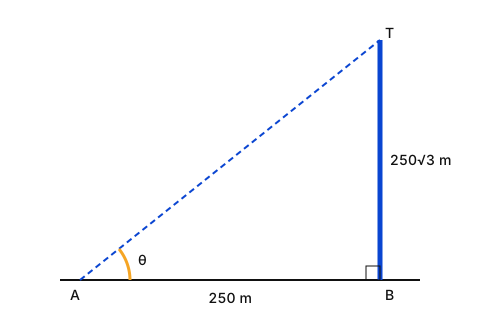
Find the angle of elevation of the top of a 2503 m high tower, from a point which is 250 m away from its foot.
एक 2503 m ऊँची मीनार के शीर्ष का, उसके पाद से 250 m दूर स्थित एक बिंदु से उन्नयन कोण ज्ञात कीजिए।
  1. A75∘
  2. B60∘
  3. C45∘
  4. D30∘
Show answer

Concept: tanθ=HeightBase.

  1. Height =2503m, base =250m.
  2. tanθ=2503250=3.
  3. tan60∘=3⇒θ=60∘.

Trick: Height =3× base → 60∘; base =3× height → 30∘.

Answer: (B) 60∘

अवधारणा: tanθ=ऊँचाईआधार।

  1. ऊँचाई =2503m, आधार =250m।
  2. tanθ=2503250=3।
  3. tan60∘=3⇒θ=60∘।

ट्रिक: ऊँचाई =3× आधार → 60∘; आधार =3× ऊँचाई → 30∘।

उत्तर: (B) 60∘

RRB NTPC Graduate CBT 1MathematicsHeights and distancesRRB NTPC Graduate CBT 1 2024 · 6 Jun Shift 2 →
Q4243.
On selling a wardrobe at ₹3,437, the value of gain is 75% more than the value of loss incurred on selling it at ₹3,338. In order to gain 50%, find the selling price (in ₹).
एक अलमारी को ₹3,437 में बेचने पर प्राप्त लाभ की राशि, उसे ₹3,338 में बेचने पर हुई हानि की राशि से 75% अधिक है। 50% लाभ प्राप्त करने के लिए विक्रय मूल्य (₹ में) ज्ञात कीजिए।
  1. A5,061
  2. B5,058
  3. C5,062
  4. D5,059
Show answer

Concept: Let cost price =C. Gain at ₹3,437 is 75% more than loss at ₹3,338.

  1. 3437−C=175100(C−3338).
  2. 4(3437−C)=7(C−3338)⇒13748+23366=11C⇒C=3711411=3374 (₹).
  3. For 50% gain: SP=3374×150100=5061 (₹).

Trick: 75% more means ratio gain : loss =7:4, so CP divides 3338 and 3437 in 4:7: 3338+411×99=3374.

Answer: (A) 5,061

अवधारणा: माना क्रय मूल्य =C। ₹3,437 पर लाभ, ₹3,338 पर हानि से 75% अधिक है।

  1. 3437−C=175100(C−3338)।
  2. 4(3437−C)=7(C−3338)⇒13748+23366=11C⇒C=3711411=3374 (₹)।
  3. 50% लाभ के लिए: SP=3374×150100=5061 (₹)।

ट्रिक: 75% अधिक = लाभ : हानि =7:4; अतः C=3338+411×99=3374।

उत्तर: (A) 5,061

RRB NTPC Graduate CBT 1MathematicsProfit and lossRRB NTPC Graduate CBT 1 2024 · 6 Jun Shift 2 →
Q4244.
Factorise the polynomial x4− 10x2+ 22 into product of two quadratic polynomials.
बहुपद x4− 10x2+ 22 का दो द्विघात बहुपदों के गुणनफल के रूप में गुणनखंड कीजिए।
  1. A(x2−4+3)(x2−4−3)
  2. B(x2−3+3)(x2−3−3)
  3. C(x2−2+3)(x2−2−3)
  4. D(x2−5+3)(x2−5−3)
Show answer

Concept: Complete the square in x2 and use a2−b2=(a+b)(a−b).

  1. x4−10x2+22=(x2−5)2−25+22=(x2−5)2−3.
  2. =(x2−5)2−(3)2.
  3. =(x2−5+3)(x2−5−3).

Trick: Check: the constants multiply to 25−3=22 and add to −10 ✓.

Answer: (D) (x2−5+3)(x2−5−3)

अवधारणा: x2 में पूर्ण वर्ग बनाएँ और a2−b2=(a+b)(a−b) लगाएँ।

  1. x4−10x2+22=(x2−5)2−25+22=(x2−5)2−3।
  2. =(x2−5)2−(3)2।
  3. =(x2−5+3)(x2−5−3)।

ट्रिक: जाँच: अचरों का गुणनफल 25−3=22 और योग −10 ✓।

उत्तर: (D) (x2−5+3)(x2−5−3)

RRB NTPC Graduate CBT 1MathematicsAlgebra – factorisationRRB NTPC Graduate CBT 1 2024 · 6 Jun Shift 2 →
Q4245.
Pipe A can fill a tank in 18 minutes, while pipe B can empty the completely filled tank in 27 minutes. Initially, pipe A is opened and after 6 minutes pipe B is also opened. In how much time (in minutes) will the remaining tank be filled completely?
पाइप A एक टंकी को 18 मिनट में भर सकता है, जबकि पाइप B पूरी भरी हुई टंकी को 27 मिनट में खाली कर सकता है। प्रारंभ में पाइप A खोला जाता है और 6 मिनट बाद पाइप B भी खोल दिया जाता है। शेष टंकी कितने समय (मिनट में) में पूरी तरह भर जाएगी?
  1. A36
  2. B32
  3. C35
  4. D21
Show answer

Concept: Work done = rate × time; an emptying pipe has negative rate.

  1. In 6 minutes A fills 618=13 of the tank; remaining =23.
  2. Net rate of A and B =118−127=3−254=154 per minute.
  3. Time =23÷154=36 minutes.

Trick: LCM method: tank =54 units; A =+3, B =−2, net +1/min; after 6 min, 54−18=36 units → 36 min.

Answer: (A) 36

अवधारणा: कार्य = दर × समय; खाली करने वाले पाइप की दर ऋणात्मक होती है।

  1. 6 मिनट में A टंकी का 618=13 भाग भरता है; शेष =23।
  2. A और B की शुद्ध दर =118−127=3−254=154 प्रति मिनट।
  3. समय =23÷154=36 मिनट।

ट्रिक: LCM विधि: टंकी =54 इकाई; A =+3, B =−2, शुद्ध +1/मिनट; 6 मिनट बाद 54−18=36 इकाई → 36 मिनट।

उत्तर: (A) 36

RRB NTPC Graduate CBT 1MathematicsPipes and cisternsRRB NTPC Graduate CBT 1 2024 · 6 Jun Shift 2 →
Q4246.
2% of 50% of a number is what percentage of that number?
किसी संख्या के 50% का 2%, उस संख्या का कितना प्रतिशत है?
  1. A100%
  2. B0.1%
  3. C1%
  4. D52%
Show answer

Concept: Successive percentages multiply.

  1. 2% of 50% of N=2100×50100×N=N100.
  2. N100 is 1% of N.

Trick: 2×50=100, and 100100=1%.

Answer: (C) 1%

अवधारणा: क्रमागत प्रतिशत आपस में गुणा होते हैं।

  1. N का 50% का 2%=2100×50100×N=N100।
  2. N100, N का 1% है।

ट्रिक: 2×50=100, और 100100=1%।

उत्तर: (C) 1%

RRB NTPC Graduate CBT 1MathematicsPercentageRRB NTPC Graduate CBT 1 2024 · 6 Jun Shift 2 →
Q4247.
The mode of the observations 4, 3, 8, 7, 3, 7, 3, 1, 1, 3, 8, 3, 3, 5 and 3 is:
प्रेक्षणों 4, 3, 8, 7, 3, 7, 3, 1, 1, 3, 8, 3, 3, 5 और 3 का बहुलक है:
  1. A4
  2. B7
  3. C3
  4. D8
Show answer

Concept: Mode = the observation that occurs most often.

  1. Frequencies: 1 → 2, 3 → 7, 4 → 1, 5 → 1, 7 → 2, 8 → 2.
  2. 3 occurs most often (7 times).

Trick: Tally just the repeated values; no calculation needed.

Answer: (C) 3

अवधारणा: बहुलक (Mode) = सबसे अधिक बार आने वाला प्रेक्षण।

  1. बारंबारता: 1 → 2, 3 → 7, 4 → 1, 5 → 1, 7 → 2, 8 → 2।
  2. 3 सबसे अधिक (7 बार) आता है।

ट्रिक: केवल दोहराए गए मान गिनें; कोई गणना नहीं।

उत्तर: (C) 3

RRB NTPC Graduate CBT 1MathematicsStatistics – modeRRB NTPC Graduate CBT 1 2024 · 6 Jun Shift 2 →
Q4248.
The mode and median of a data set is 89.7 and 32, respectively. What is the mean of the data set? (Use empirical formula.)
एक आँकड़ा समुच्चय का बहुलक और माध्यिका क्रमशः 89.7 और 32 है। आँकड़ा समुच्चय का माध्य क्या है? (आनुभविक सूत्र का प्रयोग कीजिए।)
  1. A2.6
  2. B11.26
  3. C5.9
  4. D3.15
Show answer

Concept: Empirical formula: Mode=3Median−2Mean.

  1. 89.7=3(32)−2Mean=96−2Mean.
  2. 2Mean=96−89.7=6.3.
  3. Mean=3.15.

Trick: Remember “3 Median − 2 Mean” – the coefficients 3 and 2 go with median and mean.

Answer: (D) 3.15

अवधारणा: आनुभविक सूत्र: बहुलक=3माध्यिका−2माध्य।

  1. 89.7=3(32)−2माध्य=96−2माध्य।
  2. 2माध्य=96−89.7=6.3।
  3. माध्य=3.15।

ट्रिक: “3 माध्यिका − 2 माध्य” याद रखें।

उत्तर: (D) 3.15

RRB NTPC Graduate CBT 1MathematicsStatistics – empirical relationRRB NTPC Graduate CBT 1 2024 · 6 Jun Shift 2 →
Q4249.
Based on the English alphabetical order, three of the following four letter-cluster pairs are alike in a certain way and thus form a group. Which letter-cluster pair DOES NOT belong to that group? (Note: The odd one out is not based on the number of
consonants/vowels or their position in the letter cluster)
अंग्रेज़ी वर्णमाला क्रम के आधार पर, निम्नलिखित चार अक्षर-समूह युग्मों में से तीन किसी निश्चित प्रकार से एकसमान हैं और इस प्रकार एक समूह बनाते हैं। कौन-सा अक्षर-समूह युग्म उस समूह से संबंधित नहीं है? (ध्यान दें: असंगत अक्षर-समूह, उस अक्षर-समूह में
व्यंजनों/स्वरों की संख्या या उनके स्थान पर आधारित नहीं है)
  1. APK - MJ
  2. BNO - IJ
  3. CFG - AB
  4. DJK - EF
Show answer

Concept: Compare each letter of the first cluster with the corresponding letter of the second using alphabet positions.

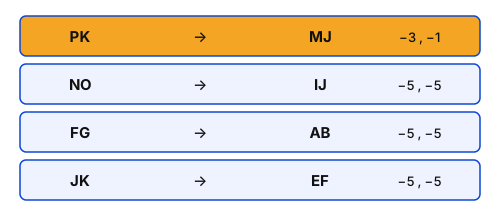
  1. NO → IJ: N(14)−5=I(9), O(15)−5=J(10) → −5,−5.
  2. FG → AB and JK → EF also follow −5,−5.
  3. PK → MJ: P(16)−3=M(13), K(11)−1=J(10) → −3,−1, a different pattern.

Trick: Consecutive letters (NO, FG, JK) going back 5 give consecutive letters again; PK is not even a consecutive pair.

Answer: (A) PK - MJ

अवधारणा: पहले समूह के प्रत्येक अक्षर की तुलना दूसरे समूह के संगत अक्षर से वर्णमाला स्थान द्वारा करें।

  1. NO → IJ: N(14)−5=I(9), O(15)−5=J(10) → −5,−5।
  2. FG → AB और JK → EF भी −5,−5 नियम मानते हैं।
  3. PK → MJ: P(16)−3=M(13), K(11)−1=J(10) → −3,−1, नियम अलग है।

ट्रिक: NO, FG, JK लगातार अक्षर हैं और 5 पीछे जाने पर फिर लगातार अक्षर मिलते हैं; PK लगातार युग्म ही नहीं है।

उत्तर: (A) PK - MJ

RRB NTPC Graduate CBT 1General Intelligence and ReasoningLetter-cluster pairs (odd one out)RRB NTPC Graduate CBT 1 2024 · 6 Jun Shift 2 →
Q4250.
What should come in place of the question mark (?) in the given series based on the English alphabetical order?
LJQ NLS PNU RPW ?
अंग्रेज़ी वर्णमाला क्रम के आधार पर दी गई शृंखला में प्रश्न चिह्न (?) के स्थान पर क्या आना चाहिए?
LJQ NLS PNU RPW ?
  1. ATRZ
  2. BTRY
  3. CTSZ
  4. DTSY
Show answer

Concept: Check each letter position of the clusters separately.

  1. 1st letters: L, N, P, R → +2 each → T
  2. 2nd letters: J, L, N, P → +2 each → R
  3. 3rd letters: Q, S, U, W → +2 each → Y

Trick: All three positions move +2: RPW → TRY.

Answer: (B) TRY

अवधारणा: प्रत्येक समूह के अक्षरों की स्थिति अलग-अलग जाँचें।

  1. पहले अक्षर: L, N, P, R → हर बार +2 → T
  2. दूसरे अक्षर: J, L, N, P → +2 → R
  3. तीसरे अक्षर: Q, S, U, W → +2 → Y

ट्रिक: तीनों स्थान +2 बढ़ते हैं: RPW → TRY।

उत्तर: (B) TRY

RRB NTPC Graduate CBT 1General Intelligence and ReasoningLetter seriesRRB NTPC Graduate CBT 1 2024 · 6 Jun Shift 2 →
Q4251.
A, B, C, D, E and F live on six different floors of the same building. The lowermost floor in the building is numbered 1, the floor above it, number 2 and so on till the topmost floor is numbered 6. The product of floors on which D and F live is 10. C lives
immediately above E. The sum of floors on which B and D live is 11. How many people live between A and E?
A, B, C, D, E और F एक ही इमारत की छह अलग-अलग मंज़िलों पर रहते हैं। इमारत की सबसे निचली मंज़िल की संख्या 1 है, उसके ऊपर वाली मंज़िल की संख्या 2 है और इसी प्रकार सबसे ऊपरी मंज़िल की संख्या 6 है। D और F जिन मंज़िलों पर रहते हैं, उनकी संख्याओं का गुणनफल 10 है। C,
E के ठीक ऊपर रहता है। B और D जिन मंज़िलों पर रहते हैं, उनकी संख्याओं का योग 11 है। A और E के बीच कितने व्यक्ति रहते हैं?
  1. A3
  2. B1
  3. C2
  4. D4
Show answer

Concept: Fix the definite clues (product and sum) first, then place the remaining people.

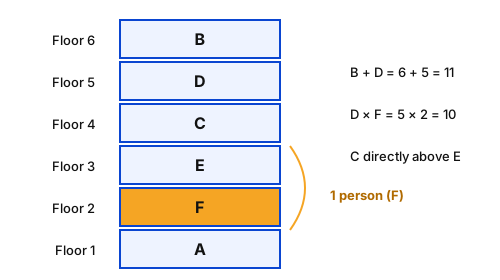
  1. D × F = 10 → floors {2, 5}.
  2. B + D = 11 with D ∈ {2, 5} → D = 5, B = 6 (D = 2 would need B = 9). So F = 2.
  3. Floors left: 1, 3, 4. C immediately above E → E = 3, C = 4; A = 1.
  4. Between A (1) and E (3): only F → 1 person.

Trick: Sum 11 on a 6-floor building forces the pair (5, 6) at once.

Answer: (B) 1

अवधारणा: पहले निश्चित संकेत (गुणनफल और योग) लगाएँ, फिर बाकी लोगों को रखें।

  1. D × F = 10 → मंज़िल {2, 5}।
  2. B + D = 11, D ∈ {2, 5} → D = 5, B = 6 (D = 2 पर B = 9 संभव नहीं)। अतः F = 2।
  3. बची मंज़िलें: 1, 3, 4। C ठीक E के ऊपर → E = 3, C = 4; A = 1।
  4. A (1) और E (3) के बीच केवल F → 1 व्यक्ति।

ट्रिक: 6 मंज़िलों में योग 11 केवल (5, 6) से बनता है।

उत्तर: (B) 1

RRB NTPC Graduate CBT 1General Intelligence and ReasoningFloor puzzleRRB NTPC Graduate CBT 1 2024 · 6 Jun Shift 2 →
Q4252.
Refer to the following number and symbol series and answer the question that follows. Counting to be done from left to right only. All numbers are single-digit numbers. (Left) 5 $ 5 % 8 7 * 5 % & 8 @ 2 6 2 £ 3 8 1 & 5 6 (Right)
How many such numbers are there each of which is immediately preceded by a number and also immediately followed by a number?
निम्नलिखित संख्या और प्रतीक शृंखला का संदर्भ लीजिए और नीचे दिए गए प्रश्न का उत्तर दीजिए। गिनती केवल बाएँ से दाएँ की जानी है। सभी संख्याएँ एक-अंकीय संख्याएँ हैं। (बाएँ) 5 $ 5 % 8 7 * 5 % & 8 @ 2 6 2 £ 3 8 1 & 5 6 (दाएँ)
ऐसी कितनी संख्याएँ हैं जिनमें से प्रत्येक के ठीक पहले एक संख्या है और ठीक बाद भी एक संख्या है?
  1. A2
  2. B3
  3. C4
  4. D7
Show answer

Concept: Look for the pattern Number–Number–Number and count the middle numbers.

  1. Series: 5 $ 5 % 8 7 * 5 % & 8 @ 2 6 2 £ 3 8 1 & 5 6
  2. ‘2 6 2’ → 6 qualifies.
  3. ‘3 8 1’ → 8 qualifies.
  4. No other number has numbers on both sides (e.g. 8 7 * fails, 5 6 is at the end).

Trick: Scan only runs of three or more consecutive digits: ‘262’ and ‘381’ – each gives one middle number.

Answer: (A) 2

अवधारणा: संख्या–संख्या–संख्या पैटर्न खोजें और बीच वाली संख्याएँ गिनें।

  1. श्रृंखला: 5 $ 5 % 8 7 * 5 % & 8 @ 2 6 2 £ 3 8 1 & 5 6
  2. ‘2 6 2’ → 6 मान्य।
  3. ‘3 8 1’ → 8 मान्य।
  4. किसी अन्य संख्या के दोनों ओर संख्या नहीं है (जैसे 8 7 * नहीं, 5 6 अंत में है)।

ट्रिक: केवल लगातार तीन या अधिक अंकों के समूह देखें: ‘262’ और ‘381’ – प्रत्येक से एक बीच वाली संख्या।

उत्तर: (A) 2

RRB NTPC Graduate CBT 1General Intelligence and ReasoningNumber-symbol seriesRRB NTPC Graduate CBT 1 2024 · 6 Jun Shift 2 →
Q4253.
In a certain code language, ‘GATE’ is coded as ‘4628’ and ‘TURN’ is coded as ‘3567’. What is the code for ‘T’ in the given code language?
एक निश्चित कूट भाषा में, ‘GATE’ को ‘4628’ और ‘TURN’ को ‘3567’ के रूप में कूटबद्ध किया जाता है। दी गई कूट भाषा में ‘T’ का कूट क्या है?
  1. A4
  2. B6
  3. C3
  4. D2
Show answer

Concept: A letter common to both words must take the digit common to both codes.

  1. GATE and TURN share only the letter T.
  2. Codes 4628 and 3567 share only the digit 6.
  3. So T = 6.

Trick: Common letter ↔ common digit.

Answer: (B) 6

अवधारणा: दोनों शब्दों में उभयनिष्ठ अक्षर का कोड दोनों कोडों में उभयनिष्ठ अंक होगा।

  1. GATE और TURN में केवल T उभयनिष्ठ है।
  2. 4628 और 3567 में केवल 6 उभयनिष्ठ है।
  3. अतः T = 6।

ट्रिक: उभयनिष्ठ अक्षर ↔ उभयनिष्ठ अंक।

उत्तर: (B) 6

RRB NTPC Graduate CBT 1General Intelligence and ReasoningCoding-decoding (common letter)RRB NTPC Graduate CBT 1 2024 · 6 Jun Shift 2 →
Q4254.
Select the number from among the given options that can replace the question mark (?) in the following series.
139 136 131 124 115 ? 91
दिए गए विकल्पों में से वह संख्या चुनिए जो निम्नलिखित शृंखला में प्रश्न चिह्न (?) को प्रतिस्थापित कर सके।
139 136 131 124 115 ? 91
  1. A106
  2. B109
  3. C104
  4. D101
Show answer

Concept: Find the differences between consecutive terms.

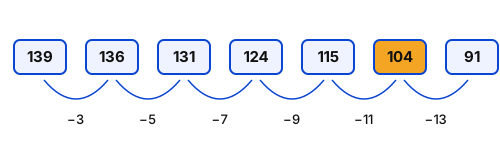
  1. 139−3=136, 136−5=131, 131−7=124, 124−9=115
  2. Next: 115−11=104
  3. Check: 104−13=91 ✔

Trick: Subtract consecutive odd numbers 3, 5, 7, 9, 11, 13.

Answer: (C) 104

अवधारणा: क्रमागत पदों का अंतर निकालें।

  1. 139−3=136, 136−5=131, 131−7=124, 124−9=115
  2. अगला: 115−11=104
  3. जाँच: 104−13=91 ✔

ट्रिक: क्रमागत विषम संख्याएँ 3, 5, 7, 9, 11, 13 घटाई जा रही हैं।

उत्तर: (C) 104

RRB NTPC Graduate CBT 1General Intelligence and ReasoningNumber seriesRRB NTPC Graduate CBT 1 2024 · 6 Jun Shift 2 →
Q4255.
A, B, C, D, G, H, and I are sitting around a circular table facing the centre.
B sits third to the left of I. G sits second to the left of H. Only I sits between A and G. C is not an immediate neighbor of B. How many people sit between D and G when counted from the right of D?
A, B, C, D, G, H और I एक वृत्ताकार मेज़ के चारों ओर केंद्र की ओर मुख करके बैठे हैं।
B, I के बाएँ से तीसरे स्थान पर बैठा है। G, H के बाएँ से दूसरे स्थान पर बैठा है। A और G के बीच केवल I बैठा है। C, B का निकटतम पड़ोसी नहीं है। D के दाएँ से गिनने पर D और G के बीच कितने व्यक्ति बैठे हैं?
  1. AFourचार
  2. BOneएक
  3. CTwoदो
  4. DThreeतीन
Show answer

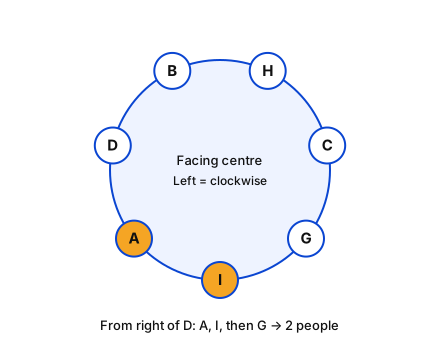
Concept: Facing the centre: left = clockwise, right = anticlockwise. 7 people → 7 seats.

  1. Fix I. B is third to the left of I.
  2. Only I between A and G → A and G are the two neighbours of I.
  3. G second to the left of H: if G were on I’s left, H would sit on I’s right, clashing with A. So A is on I’s left, G on I’s right, H two seats to G’s right.
  4. Two seats remain next to B; C is not B’s neighbour, so C sits beside H and G, and D sits between A and B.
  5. From D going right (anticlockwise): A, I, then G → 2 people.

Trick: Place the ‘only X between’ pair around X first; it fixes most seats.

Answer: (C) Two

अवधारणा: केंद्र की ओर मुख: बायाँ = दक्षिणावर्त (clockwise), दायाँ = वामावर्त। 7 लोग → 7 सीटें।

  1. I को स्थिर करें। B, I के बाएँ तीसरे स्थान पर।
  2. A और G के बीच केवल I → A और G, I के दोनों पड़ोसी हैं।
  3. G, H के बाएँ दूसरे स्थान पर: यदि G, I के बाएँ हो तो H, I के दाएँ आएगा और A से टकराएगा। अतः A, I के बाएँ, G, I के दाएँ, और H, G से दो स्थान दाएँ।
  4. B के पास दो सीटें बचीं; C, B का पड़ोसी नहीं, अतः C, H और G के बीच, D, A और B के बीच।
  5. D से दाएँ गिनें: A, I, फिर G → 2 व्यक्ति।

ट्रिक: ‘केवल X बीच में’ वाले युग्म को पहले X के दोनों ओर रखें; अधिकांश सीटें तय हो जाती हैं।

उत्तर: (C) Two

RRB NTPC Graduate CBT 1General Intelligence and ReasoningCircular seating arrangementRRB NTPC Graduate CBT 1 2024 · 6 Jun Shift 2 →
Q4256.
Below are given two sets of numbers. In each set of numbers, a certain mathematical operation on the first number results in the second number. Similarly, a certain mathematical operation on the second number results in the third number and so on. Which of the given options follows the same set of operations as in the question? (NOTE – A two/three-digit number cannot be broken into individual digits for operations, e.g. if 37 is followed by 10, the operation cannot be 3+7 as a two-digit number cannot be broken into individual digits.)
14 - 15 - 20 - 40 ; 19 - 20 - 25 - 50
नीचे संख्याओं के दो समुच्चय दिए गए हैं। संख्याओं के प्रत्येक समुच्चय में, पहली संख्या पर एक निश्चित गणितीय संक्रिया करने से दूसरी संख्या प्राप्त होती है। इसी प्रकार, दूसरी संख्या पर एक निश्चित गणितीय संक्रिया करने से तीसरी संख्या प्राप्त होती है और इसी प्रकार आगे भी। दिए गए विकल्पों में से कौन-सा विकल्प प्रश्न में दिए गए संक्रियाओं के समान समुच्चय का अनुसरण करता है? (ध्यान दें – संक्रियाओं के लिए किसी दो/तीन-अंकीय संख्या को अलग-अलग अंकों में विभाजित नहीं किया जा सकता, उदाहरणार्थ, यदि 37 के बाद 10 आता है, तो संक्रिया 3+7 नहीं हो सकती क्योंकि दो-अंकीय संख्या को अलग-अलग अंकों में विभाजित नहीं किया जा सकता।)
14 - 15 - 20 - 40 ; 19 - 20 - 25 - 50
  1. A8 - 10 - 15 - 30
  2. B3 - 4 - 9 - 14
  3. C7 - 9 - 18 - 20
  4. D5 - 6 - 11 - 22
Show answer

Concept: Find the chain of operations in the given sets and test each option.

  1. 14→15(+1)→20(+5)→40(×2)
  2. 19→20(+1)→25(+5)→50(×2)
  3. Option (D): 5→6(+1)→11(+5)→22(×2) ✔
  4. (A) starts with +2, (B) ends with +5, (C) starts with +2 – all fail.

Trick: Last term = double the third term; only 11 → 22 satisfies this.

Answer: (D) 5 - 6 - 11 - 22

अवधारणा: दिए गए समूहों में संक्रियाओं की श्रृंखला खोजें और विकल्प जाँचें।

  1. 14→15(+1)→20(+5)→40(×2)
  2. 19→20(+1)→25(+5)→50(×2)
  3. विकल्प (D): 5→6(+1)→11(+5)→22(×2) ✔
  4. (A) +2 से शुरू, (B) +5 पर खत्म, (C) +2 से शुरू – सब असफल।

ट्रिक: अंतिम पद = तीसरे पद का दुगुना; केवल 11 → 22 यह पूरा करता है।

उत्तर: (D) 5 - 6 - 11 - 22

RRB NTPC Graduate CBT 1General Intelligence and ReasoningNumber set operationsRRB NTPC Graduate CBT 1 2024 · 6 Jun Shift 2 →
Q4257.
In a certain code language, ‘BLUE’ is coded as ‘4628’ and ‘LOAD’ is coded as ‘3567’. What is the code for ‘L’ in the given code language?
एक निश्चित कूट भाषा में, ‘BLUE’ को ‘4628’ और ‘LOAD’ को ‘3567’ के रूप में कूटबद्ध किया जाता है। दी गई कूट भाषा में ‘L’ का कूट क्या है?
  1. A3
  2. B6
  3. C7
  4. D8
Show answer

Concept: A letter common to both words takes the digit common to both codes.

  1. BLUE and LOAD share only L.
  2. 4628 and 3567 share only 6.
  3. So L = 6.

Trick: Common letter ↔ common digit.

Answer: (B) 6

अवधारणा: दोनों शब्दों के उभयनिष्ठ अक्षर का कोड दोनों कोडों का उभयनिष्ठ अंक होता है।

  1. BLUE और LOAD में केवल L उभयनिष्ठ है।
  2. 4628 और 3567 में केवल 6 उभयनिष्ठ है।
  3. अतः L = 6।

ट्रिक: उभयनिष्ठ अक्षर ↔ उभयनिष्ठ अंक।

उत्तर: (B) 6

RRB NTPC Graduate CBT 1General Intelligence and ReasoningCoding-decoding (common letter)RRB NTPC Graduate CBT 1 2024 · 6 Jun Shift 2 →
Q4258.
Refer to the following number and symbol series and answer the question that follows. Counting to be done from left to right only. All numbers are single-digit numbers. (Left) @ $ & 7 7 @ 5 7 & & 4 1 9 3 $ 7 8 & 7 € € 1 (Right)
How many such symbols are there each of which is immediately preceded by a number and also immediately followed by a symbol?
निम्नलिखित संख्या और प्रतीक शृंखला का संदर्भ लीजिए और नीचे दिए गए प्रश्न का उत्तर दीजिए। गिनती केवल बाएँ से दाएँ की जानी है। सभी संख्याएँ एक-अंकीय संख्याएँ हैं। (बाएँ) @ $ & 7 7 @ 5 7 & & 4 1 9 3 $ 7 8 & 7 € € 1 (दाएँ)
ऐसे कितने प्रतीक हैं जिनमें से प्रत्येक के ठीक पहले एक संख्या है और ठीक बाद एक प्रतीक है?
  1. A5
  2. B4
  3. C2
  4. D3
Show answer

Concept: Look for the pattern Number–Symbol–Symbol.

  1. Series: @ $ & 7 7 @ 5 7 & & 4 1 9 3 $ 7 8 & 7 € € 1
  2. ‘7 & &’ → qualifies.
  3. ‘7 € €’ → qualifies.
  4. Others fail: ‘7 @ 5’, ‘3 $ 7’, ‘8 & 7’ are followed by numbers.

Trick: Locate pairs of adjacent symbols (& &, € €) and check the element just before the first one.

Answer: (C) 2

अवधारणा: संख्या–प्रतीक–प्रतीक पैटर्न खोजें।

  1. श्रृंखला: @ $ & 7 7 @ 5 7 & & 4 1 9 3 $ 7 8 & 7 € € 1
  2. ‘7 & &’ → मान्य।
  3. ‘7 € €’ → मान्य।
  4. बाकी नहीं: ‘7 @ 5’, ‘3 $ 7’, ‘8 & 7’ के बाद संख्या है।

ट्रिक: लगातार दो प्रतीक (& &, € €) खोजें और पहले प्रतीक से ठीक पहले वाला तत्व देखें।

उत्तर: (C) 2

RRB NTPC Graduate CBT 1General Intelligence and ReasoningNumber-symbol seriesRRB NTPC Graduate CBT 1 2024 · 6 Jun Shift 2 →
Q4259.
Which of the following letter-number clusters will replace the question mark (?) in the given series to make it logically complete?
GKO 11, IMQ 13, KOS 15, MQU 17, ?
निम्नलिखित में से कौन-सा अक्षर-संख्या समूह दी गई शृंखला में प्रश्न चिह्न (?) को प्रतिस्थापित करके उसे तार्किक रूप से पूर्ण करेगा?
GKO 11, IMQ 13, KOS 15, MQU 17, ?
  1. AOSW 19
  2. BNQS 21
  3. CORT 21
  4. DNTZ 19
Show answer

Concept: Track the letter cluster and the number separately.

  1. Each letter moves +2: G→I→K→M→O, K→M→O→Q→S, O→Q→S→U→W
  2. Numbers: 11, 13, 15, 17 → +2 → 19
  3. Next term: OSW 19

Trick: Inside each cluster letters also differ by 4 (G, K, O); O, S, W fits.

Answer: (A) OSW 19

अवधारणा: अक्षर समूह और संख्या को अलग-अलग देखें।

  1. हर अक्षर +2: G→I→K→M→O, K→M→O→Q→S, O→Q→S→U→W
  2. संख्याएँ: 11, 13, 15, 17 → +2 → 19
  3. अगला पद: OSW 19

ट्रिक: हर समूह के अंदर भी अक्षरों में 4 का अंतर है (G, K, O); O, S, W सही बैठता है।

उत्तर: (A) OSW 19

RRB NTPC Graduate CBT 1General Intelligence and ReasoningLetter-number seriesRRB NTPC Graduate CBT 1 2024 · 6 Jun Shift 2 →
Q4260.
If ‘A’ stands for ‘×’, ‘B’ stands for ‘−’, ‘C’ stands for ‘+’, and ‘D’ stands for ‘÷’, then the resultant of which of the following will be 9?
यदि ‘A’ का अर्थ ‘×’ है, ‘B’ का अर्थ ‘−’ है, ‘C’ का अर्थ ‘+’ है और ‘D’ का अर्थ ‘÷’ है, तो निम्नलिखित में से किसका परिणाम 9 होगा?
  1. A8 B 3 A 10 C 2 D 5
  2. B8 B 3 C 10 A 2 D 5
  3. C8 A 3 C 10 B 2 D 5
  4. D8 C 3 B 10 A 2 D 5
Show answer

Concept: Replace letters (A = ×, B = −, C = +, D = ÷) and apply BODMAS.

  1. (B): 8−3+10×2÷5=8−3+4=9 ✔
  2. (A): 8−3×10+2÷5=−21.6
  3. (C): 8×3+10−2÷5=33.6; (D): 8+3−10×2÷5=7

Trick: Look for the option where the ‘×2÷5’ part acts on 10 (gives 4) and the rest gives 5: 8−3=5.

Answer: (B) 8 B 3 C 10 A 2 D 5

अवधारणा: अक्षर बदलें (A = ×, B = −, C = +, D = ÷) और BODMAS लगाएँ।

  1. (B): 8−3+10×2÷5=8−3+4=9 ✔
  2. (A): 8−3×10+2÷5=−21.6
  3. (C): 8×3+10−2÷5=33.6; (D): 8+3−10×2÷5=7

ट्रिक: वह विकल्प खोजें जहाँ ‘×2÷5’ 10 पर लगे (4 मिले) और शेष 5 दे: 8−3=5।

उत्तर: (B) 8 B 3 C 10 A 2 D 5

RRB NTPC Graduate CBT 1General Intelligence and ReasoningMathematical operationsRRB NTPC Graduate CBT 1 2024 · 6 Jun Shift 2 →