Question bank

Q&A: practice questions with answers

Search questions on any topic. Filter by exam category, exam, subject and topic, try the question, then open the answer and explanation.

Courses – airGurukul

7,077 questions found.

Q4341.
The arithmetic mean of the observations 28, 31, 40, 63, 57, 37, 34, 70 and 99 is:
प्रेक्षणों 28, 31, 40, 63, 57, 37, 34, 70 और 99 का समांतर माध्य कितना है?
  1. A55
  2. B50
  3. C41
  4. D51
Show answer

Concept: Mean=Sum of observationsNumber of observations.

  1. Sum =28+31+40+63+57+37+34+70+99=459.
  2. Number of observations = 9.
  3. Mean =4599=51.

Trick: Pair to round numbers: (31 + 99) + (63 + 37) + (70 + 40) + (28 + 57 + 34) = 130 + 100 + 110 + 119 = 459.

Answer: (D) 51

अवधारणा: माध्य=प्रेक्षणों का योगप्रेक्षणों की संख्या।

  1. योग =28+31+40+63+57+37+34+70+99=459।
  2. प्रेक्षणों की संख्या = 9।
  3. माध्य =4599=51।

ट्रिक: जोड़ियाँ बनाएँ: (31 + 99) + (63 + 37) + (70 + 40) + (28 + 57 + 34) = 130 + 100 + 110 + 119 = 459।

उत्तर: (D) 51
RRB NTPC Graduate CBT 1MathematicsStatistics – MeanRRB NTPC Graduate CBT 1 2024 · 6 Jun Shift 1 →
Q4342.
When x is added to each of 22, 26, 19 and 21, then the numbers so obtained, in this order, are in proportion. Then, if 2x : y :: y : (4x-8), and y > 0, what is the value of y?
जब 22, 26, 19 और 21 में से प्रत्येक में x जोड़ा जाता है, तो इस प्रकार प्राप्त संख्याएँ, इसी क्रम में, समानुपात में होती हैं। तब, यदि 2x : y :: y : (4x-8) और y > 0 है, तो y का मान क्या है?
  1. A48
  2. B37
  3. C46
  4. D54
Show answer

Concept: If a:b::c:d then ad=bc; mean proportional y of p and q satisfies y2=pq.

  1. 22+x26+x=19+x21+x⇒(22+x)(21+x)=(19+x)(26+x).
  2. 462+43x=494+45x⇒2x=−32⇒x=−16 (check: 6, 10, 3, 5 are in proportion).
  3. 2x=−32, 4x−8=−72; y2=(−32)(−72)=2304.
  4. y>0⇒y=48.

Trick: y=32×72=2304=48.

Answer: (A) 48

अवधारणा: यदि a:b::c:d तो ad=bc; p और q का मध्यानुपाती y हो तो y2=pq।

  1. 22+x26+x=19+x21+x⇒(22+x)(21+x)=(19+x)(26+x)।
  2. 462+43x=494+45x⇒2x=−32⇒x=−16 (जाँच: 6, 10, 3, 5 समानुपात में हैं)।
  3. 2x=−32, 4x−8=−72; y2=(−32)(−72)=2304।
  4. y>0⇒y=48।

ट्रिक: y=32×72=2304=48।

उत्तर: (A) 48

RRB NTPC Graduate CBT 1MathematicsRatio and ProportionRRB NTPC Graduate CBT 1 2024 · 6 Jun Shift 1 →
Q4343.
If x−1x=4, then the value of x3−1x3 is:
यदि x−1x=4 है, तो x3−1x3 का मान कितना है?
  1. A76
  2. B414
  3. C420
  4. D259
Show answer

Concept: x3−1x3=(x−1x)3+3(x−1x).

  1. Here x−1x=4.
  2. x3−1x3=43+3×4=64+12.
  3. =76.

Trick: If x−1x=k, then x3−1x3=k3+3k.

Answer: (A) 76

अवधारणा: x3−1x3=(x−1x)3+3(x−1x)।

  1. यहाँ x−1x=4।
  2. x3−1x3=43+3×4=64+12।
  3. =76।

ट्रिक: यदि x−1x=k, तो x3−1x3=k3+3k।

उत्तर: (A) 76

RRB NTPC Graduate CBT 1MathematicsAlgebra – IdentitiesRRB NTPC Graduate CBT 1 2024 · 6 Jun Shift 1 →
Q4344.
Manoj has 200 litres of Oil A and 274 litres of Oil B. He fills a number of identical containers with the two types of oil in a manner that each container has only one type of oil, and all containers are completely filled. What can be the maximum volume (in litres) of each container that Manoj uses, so that all the oil that Manoj has, of both the types, can be poured into these containers?
मनोज के पास 200 लीटर तेल A और 274 लीटर तेल B है। वह दोनों प्रकार के तेल से कई एक समान बर्तन इस प्रकार भरता है कि प्रत्येक बर्तन में केवल एक ही प्रकार का तेल हो, और सभी बर्तन पूरी तरह भरे हों। मनोज द्वारा प्रयुक्त प्रत्येक बर्तन का अधिकतम आयतन (लीटर में) कितना हो सकता है, ताकि मनोज के पास उपलब्ध दोनों प्रकार का सारा तेल इन बर्तनों में डाला जा सके?
  1. A2
  2. B10
  3. C8
  4. D3
Show answer

Concept: The largest container that exactly measures both quantities = HCF of the quantities.

  1. 200=23×52.
  2. 274=2×137 (137 is prime).
  3. HCF =2 → maximum volume of each container = 2 litres.

Trick: 274−200=74=2×37; HCF must divide 74 and 200 → only 2 works.

Answer: (A) 2

अवधारणा: दोनों मात्राओं को पूरा-पूरा मापने वाला सबसे बड़ा बर्तन = मात्राओं का HCF।

  1. 200=23×52।
  2. 274=2×137 (137 अभाज्य है)।
  3. HCF =2 → प्रत्येक बर्तन का अधिकतम आयतन = 2 लीटर।

ट्रिक: 274−200=74=2×37; HCF को 74 और 200 दोनों को विभाजित करना होगा → केवल 2।

उत्तर: (A) 2

RRB NTPC Graduate CBT 1MathematicsHCF ApplicationsRRB NTPC Graduate CBT 1 2024 · 6 Jun Shift 1 →
Q4345.
Find roots of 4m2+6m+2=0
4m2+6m+2=0 के मूल ज्ञात कीजिए।
  1. A−12 and −4−12 और −4
  2. B12 and 112 और 1
  3. C−12 and −1−12 और −1
  4. D−12 and 4−12 और 4
Show answer

Concept: Simplify, then factorise by splitting the middle term.

  1. 4m2+6m+2=0⇒2m2+3m+1=0.
  2. 2m2+2m+m+1=0⇒(2m+1)(m+1)=0.
  3. m=−12 or m=−1.

Trick: All coefficients positive → both roots negative; sum =−64=−32 and product =24=12 fit −12,−1.

Answer: (C) −12 and −1

अवधारणा: पहले सरल करें, फिर मध्य पद को विभाजित कर गुणनखंड करें।

  1. 4m2+6m+2=0⇒2m2+3m+1=0।
  2. 2m2+2m+m+1=0⇒(2m+1)(m+1)=0।
  3. m=−12 या m=−1।

ट्रिक: सभी गुणांक धनात्मक → दोनों मूल ऋणात्मक; योग =−64=−32 और गुणनफल =24=12, जो −12,−1 से मेल खाते हैं।

उत्तर: (C) −12 और −1

RRB NTPC Graduate CBT 1MathematicsQuadratic EquationsRRB NTPC Graduate CBT 1 2024 · 6 Jun Shift 1 →
Q4346.
Akshay spends 40% of his income. If he saves ₹24,000, then his income (in ₹) is:
अक्षय अपनी आय का 40% खर्च करता है। यदि वह ₹24,000 की बचत करता है, तो उसकी आय (₹ में) कितनी है?
  1. A9,600
  2. B40,000
  3. C41,000
  4. D39,000
Show answer

Concept: Savings%=100%−Expenditure%.

  1. Spends 40% → saves 60% of income.
  2. 60% of income = ₹24,000.
  3. Income =24000×10060 = ₹40,000.

Trick: 60% = 24,000 → 10% = 4,000 → 100% = 40,000.

Answer: (B) 40,000

अवधारणा: बचत%=100%−व्यय%।

  1. 40% खर्च → आय का 60% बचत।
  2. आय का 60% = ₹24,000।
  3. आय =24000×10060 = ₹40,000।

ट्रिक: 60% = 24,000 → 10% = 4,000 → 100% = 40,000।

उत्तर: (B) 40,000

RRB NTPC Graduate CBT 1MathematicsPercentage – Income & SavingsRRB NTPC Graduate CBT 1 2024 · 6 Jun Shift 1 →
Q4347.
If the selling price of a bed is 2-times of initial, then the profit is 11-times of initial. Find the initial profit percentage.
यदि एक पलंग का विक्रय मूल्य प्रारंभिक मूल्य का 2 गुना हो, तो लाभ प्रारंभिक लाभ का 11 गुना हो जाता है। प्रारंभिक लाभ प्रतिशत ज्ञात कीजिए।
  1. A9211%
  2. B11%
  3. C1119%
  4. D9%
Show answer

Concept: Cost price stays the same; Profit=SP−CP.

  1. Let CP =C, initial profit =p, so SP =C+p.
  2. New SP =2(C+p), new profit =11p: 2(C+p)−C=11p.
  3. C+2p=11p⇒C=9p.
  4. Initial profit %=p9p×100=1009=1119%.

Trick: Doubling SP adds one more SP =(C+p) to profit: C+p=10p⇒C=9p.

Answer: (C) 1119%

अवधारणा: क्रय मूल्य वही रहता है; लाभ=विक्रय मूल्य−क्रय मूल्य।

  1. माना क्रय मूल्य =C, प्रारंभिक लाभ =p, अतः विक्रय मूल्य =C+p।
  2. नया विक्रय मूल्य =2(C+p), नया लाभ =11p: 2(C+p)−C=11p।
  3. C+2p=11p⇒C=9p।
  4. प्रारंभिक लाभ %=p9p×100=1009=1119%।

ट्रिक: विक्रय मूल्य दोगुना करने से लाभ में एक और (C+p) जुड़ता है: C+p=10p⇒C=9p।

उत्तर: (C) 1119%

RRB NTPC Graduate CBT 1MathematicsProfit and LossRRB NTPC Graduate CBT 1 2024 · 6 Jun Shift 1 →
Q4348.
The marked price of a bookshelf is ₹3,100, which is 25% above the cost price. It is sold at a discount of 12% on the marked price. Find the profit percentage.
एक बुकशेल्फ़ का अंकित मूल्य ₹3,100 है, जो क्रय मूल्य से 25% अधिक है। इसे अंकित मूल्य पर 12% की छूट पर बेचा जाता है। लाभ प्रतिशत ज्ञात कीजिए।
  1. A11%
  2. B8%
  3. C9%
  4. D10%
Show answer

Concept: CP=MP1+markup, SP=MP×(1−discount).

  1. CP =3100×100125 = ₹2480.
  2. SP =3100×88100 = ₹2728.
  3. Profit =2728−2480 = ₹248; Profit %=2482480×100=10%.

Trick: Net effect =25−12−25×12100=10% – no need for actual prices.

Answer: (D) 10%

अवधारणा: क्रय मूल्य=अंकित मूल्य1+markup, विक्रय मूल्य=अंकित मूल्य×(1−छूट)।

  1. क्रय मूल्य =3100×100125 = ₹2480।
  2. विक्रय मूल्य =3100×88100 = ₹2728।
  3. लाभ =2728−2480 = ₹248; लाभ %=2482480×100=10%।

ट्रिक: शुद्ध प्रभाव =25−12−25×12100=10% – वास्तविक मूल्यों की ज़रूरत नहीं।

उत्तर: (D) 10%

RRB NTPC Graduate CBT 1MathematicsProfit, Loss and DiscountRRB NTPC Graduate CBT 1 2024 · 6 Jun Shift 1 →
Q4349.
Based on the English alphabetical order, three of the following four letter-clusters are alike in a certain way and thus form a group. Which letter-cluster DOES NOT belong to that group? (Note: The odd one out is not based on the number of consonants/vowels or their position in the letter-cluster.)
अंग्रेज़ी वर्णमाला क्रम के आधार पर, निम्नलिखित चार अक्षर-समूहों में से तीन किसी निश्चित प्रकार से एकसमान हैं और इस प्रकार एक समूह बनाते हैं। कौन-सा अक्षर-समूह उस समूह से संबंधित नहीं है? (ध्यान दें: असंगत अक्षर-समूह, उस अक्षर-समूह में व्यंजनों/स्वरों की संख्या या उनके स्थान पर आधारित नहीं है।)
  1. ASUP
  2. BNPK
  3. CPRV
  4. DGID
Show answer

Concept: Check the alphabet gaps between consecutive letters.

  1. SUP: S +2 U, U −5 P
  2. NPK: N +2 P, P −5 K
  3. GID: G +2 I, I −5 D
  4. PRV: P +2 R, R +4 V — breaks the pattern

Trick: Write position numbers: S19 U21 P16 → +2, −5.

Answer: (C) PRV

अवधारणा: क्रमागत अक्षरों के बीच वर्णमाला अंतर देखें।

  1. SUP: S +2 U, U −5 P
  2. NPK: N +2 P, P −5 K
  3. GID: G +2 I, I −5 D
  4. PRV: P +2 R, R +4 V — पैटर्न टूटता है

ट्रिक: स्थान संख्या लिखें: S19 U21 P16 → +2, −5।

उत्तर: (C) PRV

RRB NTPC Graduate CBT 1General Intelligence and ReasoningLetter cluster odd one outRRB NTPC Graduate CBT 1 2024 · 6 Jun Shift 1 →
Q4350.
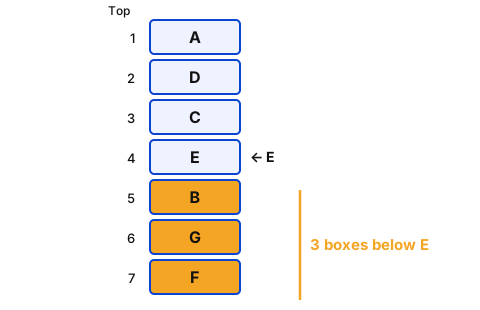
Seven boxes, A, B, C, D, E, F and G, are kept one over the other but not necessarily in the same order. Only four boxes are kept between D and F. Only A is kept above D. Only two boxes are kept between C and G. E is kept immediately above B. G is not kept immediately above E. How many boxes are kept below E?
सात बक्से, A, B, C, D, E, F और G, एक के ऊपर एक रखे गए हैं, परंतु आवश्यक नहीं कि इसी क्रम में हों। D और F के बीच केवल चार बक्से रखे गए हैं। D के ऊपर केवल A रखा गया है। C और G के बीच केवल दो बक्से रखे गए हैं। E, B के ठीक ऊपर रखा गया है। G, E के ठीक ऊपर नहीं रखा गया है। E के नीचे कितने बक्से रखे गए हैं?
  1. A1
  2. B2
  3. C4
  4. D3
Show answer

Concept: Fix the certain positions first (top = 1, bottom = 7).

  1. Only A above D → A = 1, D = 2; four between D and F → F = 7.
  2. C and G (two between) fill 3 & 6; E–B pair takes 4–5.
  3. If G = 3, G is immediately above E ✘ → C = 3, E = 4, B = 5, G = 6.
  4. Below E: B, G, F = 3 boxes.

Trick: Always place the "only X above" clue first — it fixes the top.

Answer: (D) 3

अवधारणा: पहले निश्चित स्थान तय करें (ऊपर = 1, नीचे = 7)।

  1. केवल A, D के ऊपर → A = 1, D = 2; D और F के बीच चार → F = 7।
  2. C और G (बीच में दो) 3 व 6 पर; E–B जोड़ी 4–5 पर।
  3. G = 3 हो तो G, E के ठीक ऊपर ✘ → C = 3, E = 4, B = 5, G = 6।
  4. E के नीचे: B, G, F = 3 बॉक्स।

ट्रिक: "केवल X ऊपर" वाला संकेत पहले लगाएँ — इससे शीर्ष तय होता है।

उत्तर: (D) 3

RRB NTPC Graduate CBT 1General Intelligence and ReasoningBox arrangementRRB NTPC Graduate CBT 1 2024 · 6 Jun Shift 1 →
Q4351.
WJ 15 is related to UN 11 in a certain way. In the same way, QH 8 is related to OL 4. To which of the given options is RI 3 related, following the same logic?
WJ 15 एक निश्चित प्रकार से UN 11 से संबंधित है। उसी प्रकार, QH 8, OL 4 से संबंधित है। समान तर्क का अनुसरण करते हुए, RI 3 दिए गए विकल्पों में से किससे संबंधित है?
  1. AIN −9
  2. BPL −7
  3. CTR −5
  4. DPM −1
Show answer

Concept: Apply the same change to each part.

  1. WJ15 → UN11: W −2 = U, J +4 = N, 15 −4 = 11
  2. QH8 → OL4: Q −2 = O, H +4 = L, 8 −4 = 4
  3. RI3 → R −2 = P, I +4 = M, 3 −4 = −1 → PM −1

Trick: Rule: (−2, +4, −4).

Answer: (D) PM −1

अवधारणा: हर भाग पर वही परिवर्तन लगाएँ।

  1. WJ15 → UN11: W −2 = U, J +4 = N, 15 −4 = 11
  2. QH8 → OL4: Q −2 = O, H +4 = L, 8 −4 = 4
  3. RI3 → R −2 = P, I +4 = M, 3 −4 = −1 → PM −1

ट्रिक: नियम: (−2, +4, −4)।

उत्तर: (D) PM −1

RRB NTPC Graduate CBT 1General Intelligence and ReasoningAnalogy (letters and numbers)RRB NTPC Graduate CBT 1 2024 · 6 Jun Shift 1 →
Q4352.
In a certain code language, ‘joy lab poet’ is coded as ‘to dl dh’ and ‘poet win union’ is coded as ‘dl fo kb’. How is ‘poet’ coded in the given language?
एक निश्चित कूट भाषा में, ‘joy lab poet’ को ‘to dl dh’ के रूप में कूटबद्ध किया जाता है और ‘poet win union’ को ‘dl fo kb’ के रूप में कूटबद्ध किया जाता है। दी गई भाषा में ‘poet’ को किस प्रकार कूटबद्ध किया जाता है?
  1. Adl
  2. Bdh
  3. Cfo
  4. Dto
Show answer

Concept: A word common to two sentences gets the code common to both.

  1. ‘poet’ appears in both: joy lab poet / poet win union.
  2. Common code in ‘to dl dh’ and ‘dl fo kb’ is dl.

Trick: Common word ↔ common code.

Answer: (A) dl

अवधारणा: दोनों वाक्यों में सामान्य शब्द का कोड भी दोनों में सामान्य होगा।

  1. ‘poet’ दोनों में है: joy lab poet / poet win union।
  2. ‘to dl dh’ और ‘dl fo kb’ में सामान्य कोड dl है।

ट्रिक: सामान्य शब्द ↔ सामान्य कोड।

उत्तर: (A) dl

RRB NTPC Graduate CBT 1General Intelligence and ReasoningCoding-decodingRRB NTPC Graduate CBT 1 2024 · 6 Jun Shift 1 →
Q4353.
Each of the digits in the number 8142769 is arranged in the ascending order from left to right. Which of the following digits will be fourth from the left in the new number thus formed?
संख्या 8142769 के प्रत्येक अंक को बाएँ से दाएँ आरोही क्रम में व्यवस्थित किया जाता है। इस प्रकार बनी नई संख्या में बाएँ से चौथा अंक निम्नलिखित में से कौन-सा होगा?
  1. A6
  2. B4
  3. C8
  4. D2
Show answer

Concept: Arrange the digits in ascending order and count from the left.

  1. Digits of 8142769: 8, 1, 4, 2, 7, 6, 9
  2. Ascending: 1 2 4 6 7 8 9
  3. Fourth from left = 6

Trick: With 7 digits, 4th from left is the middle (median) digit.

Answer: (A) 6

अवधारणा: अंकों को आरोही क्रम में रखकर बाएँ से गिनें।

  1. 8142769 के अंक: 8, 1, 4, 2, 7, 6, 9
  2. आरोही: 1 2 4 6 7 8 9
  3. बाएँ से चौथा = 6

ट्रिक: 7 अंकों में बाएँ से चौथा = बीच वाला अंक।

उत्तर: (A) 6

RRB NTPC Graduate CBT 1General Intelligence and ReasoningDigit arrangementRRB NTPC Graduate CBT 1 2024 · 6 Jun Shift 1 →
Q4354.
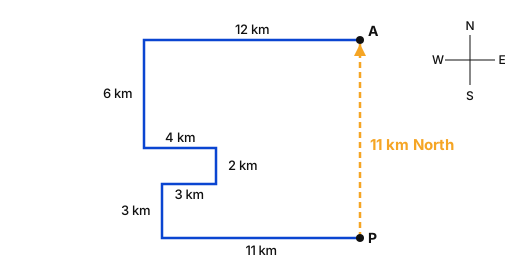
Evan starts from point A and drives 12 km towards west. He then takes a left turn, drives 6 km, turns left and drives 4 km. He then takes a right turn and drives 2 km. He then takes a right turn and drive 3 km. He then takes a left turn and drives 3 km. He takes a final left turn, drives 11 km and stops at point P. How far (shortest distance) and towards which direction should he drive in order to reach point A again (all turns are 90° turns only unless specified)?
इवान बिंदु A से चलना शुरू करता है और पश्चिम की ओर 12 km गाड़ी चलाता है। फिर वह बाएँ मुड़ता है, 6 km गाड़ी चलाता है, बाएँ मुड़ता है और 4 km गाड़ी चलाता है। फिर वह दाएँ मुड़ता है और 2 km गाड़ी चलाता है। फिर वह दाएँ मुड़ता है और 3 km गाड़ी चलाता है। फिर वह बाएँ मुड़ता है और 3 km गाड़ी चलाता है। वह अंतिम बार बाएँ मुड़ता है, 11 km गाड़ी चलाता है और बिंदु P पर रुक जाता है। पुनः बिंदु A तक पहुँचने के लिए उसे कितनी दूरी (न्यूनतम दूरी) तक और किस दिशा में गाड़ी चलानी चाहिए (जब तक निर्दिष्ट न हो, सभी मोड़ केवल 90° के हैं)?
  1. A9 km south9 km दक्षिण
  2. B11 km south11 km दक्षिण
  3. C11 km north11 km उत्तर
  4. D12 km north12 km उत्तर
Show answer

Concept: Track net east–west and north–south movement (left/right turns change facing).

  1. West 12 → left (S) 6 → left (E) 4 → right (S) 2 → right (W) 3 → left (S) 3 → left (E) 11.
  2. East–West: −12+4−3+11=0
  3. North–South: −6−2−3=−11 (11 km south of A)
  4. So P is 11 km south of A → drive 11 km north.

Trick: Horizontal moves cancel exactly, so the answer is just the total southward distance.

Answer: (C) 11 km north

अवधारणा: कुल पूर्व–पश्चिम और उत्तर–दक्षिण विस्थापन निकालें।

  1. पश्चिम 12 → बाएँ (दक्षिण) 6 → बाएँ (पूर्व) 4 → दाएँ (दक्षिण) 2 → दाएँ (पश्चिम) 3 → बाएँ (दक्षिण) 3 → बाएँ (पूर्व) 11।
  2. पूर्व–पश्चिम: −12+4−3+11=0
  3. उत्तर–दक्षिण: −6−2−3=−11 (A से 11 km दक्षिण)
  4. अतः A पहुँचने के लिए 11 km उत्तर।

ट्रिक: क्षैतिज दूरी शून्य, इसलिए केवल दक्षिण की कुल दूरी ही उत्तर है।

उत्तर: (C) 11 km north

RRB NTPC Graduate CBT 1General Intelligence and ReasoningDirection and distanceRRB NTPC Graduate CBT 1 2024 · 6 Jun Shift 1 →
Q4355.
Based on the English alphabetical order, three of the following four letter-cluster pairs are alike in a certain way and thus form a group. Which letter-cluster pair DOES NOT belong to that group?
(Note: The odd one out is not based on the number of consonants/vowels or their position in the letter-cluster.)
अंग्रेज़ी वर्णमाला क्रम के आधार पर, निम्नलिखित चार अक्षर-समूह युग्मों में से तीन किसी निश्चित प्रकार से एकसमान हैं और इस प्रकार एक समूह बनाते हैं। कौन-सा अक्षर-समूह युग्म उस समूह से संबंधित नहीं है?
(ध्यान दें: असंगत अक्षर-समूह, उस अक्षर-समूह में व्यंजनों/स्वरों की संख्या या उनके स्थान पर आधारित नहीं है।)
  1. ALD - KH
  2. BOP - KL
  3. CIJ - EF
  4. DMN - IJ
Show answer

Concept: Compare each letter of the first cluster with the matching letter of the second.

  1. OP → KL: −4, −4
  2. IJ → EF: −4, −4
  3. MN → IJ: −4, −4
  4. LD → KH: −1, +4 — different

Trick: In the group, the first pair is also consecutive letters; LD is not.

Answer: (A) LD - KH

अवधारणा: पहले समूह के हर अक्षर की तुलना दूसरे समूह के संगत अक्षर से करें।

  1. OP → KL: −4, −4
  2. IJ → EF: −4, −4
  3. MN → IJ: −4, −4
  4. LD → KH: −1, +4 — भिन्न

ट्रिक: समूह के जोड़ों में अक्षर क्रमागत हैं; LD नहीं।

उत्तर: (A) LD - KH

RRB NTPC Graduate CBT 1General Intelligence and ReasoningLetter pair odd one outRRB NTPC Graduate CBT 1 2024 · 6 Jun Shift 1 →
Q4356.
DREAM is related to ZNAWI in a certain way based on the English alphabetical order. In the same way, DANCE is related to ZWJYA. To which of the given options is DOUBT related, following the same logic?
अंग्रेज़ी वर्णमाला क्रम के आधार पर DREAM एक निश्चित प्रकार से ZNAWI से संबंधित है। उसी प्रकार, DANCE, ZWJYA से संबंधित है। समान तर्क का अनुसरण करते हुए, DOUBT दिए गए विकल्पों में से किससे संबंधित है?
  1. AZKKXP
  2. BZKVXP
  3. CZKPXP
  4. DZKQXP
Show answer

Concept: Find the shift for each letter (cyclic alphabet).

  1. DREAM → ZNAWI: every letter −4 (D→Z, A→W wraps around).
  2. DANCE → ZWJYA: again −4 each.
  3. DOUBT: D→Z, O→K, U→Q, B→X, T→P = ZKQXP

Trick: −4 = move 4 steps back; after A comes Z.

Answer: (D) ZKQXP

अवधारणा: हर अक्षर का खिसकाव निकालें (चक्रीय वर्णमाला)।

  1. DREAM → ZNAWI: हर अक्षर −4 (D→Z, A→W घूमकर)।
  2. DANCE → ZWJYA: फिर हर अक्षर −4।
  3. DOUBT: D→Z, O→K, U→Q, B→X, T→P = ZKQXP

ट्रिक: −4 = 4 कदम पीछे; A के बाद Z आता है।

उत्तर: (D) ZKQXP

RRB NTPC Graduate CBT 1General Intelligence and ReasoningCoding-decoding (letter shift)RRB NTPC Graduate CBT 1 2024 · 6 Jun Shift 1 →
Q4357.
What will come in place of the question mark (?) in the following equation, if ‘+’ and ‘–’ are interchanged, and ‘×’ and ‘÷’ are interchanged?
56 – 12 × 4 ÷ 9 + 5 = ?
यदि ‘+’ और ‘–’ को आपस में बदल दिया जाए तथा ‘×’ और ‘÷’ को आपस में बदल दिया जाए, तो निम्नलिखित समीकरण में प्रश्नवाचक चिह्न (?) के स्थान पर क्या आएगा?
56 – 12 × 4 ÷ 9 + 5 = ?
  1. A55
  2. B54
  3. C78
  4. D90
Show answer

Concept: Interchange the signs, then use BODMAS.

  1. 56−12×4÷9+5 becomes 56+12÷4×9−5
  2. 12÷4=3, 3×9=27
  3. 56+27−5=78

Trick: Rewrite the whole expression first, then solve — never swap mentally.

Answer: (C) 78

अवधारणा: चिह्न बदलें, फिर BODMAS लगाएँ।

  1. 56−12×4÷9+5 बनता है 56+12÷4×9−5
  2. 12÷4=3, 3×9=27
  3. 56+27−5=78

ट्रिक: पहले पूरा व्यंजक दोबारा लिखें, फिर हल करें।

उत्तर: (C) 78

RRB NTPC Graduate CBT 1General Intelligence and ReasoningMathematical operationsRRB NTPC Graduate CBT 1 2024 · 6 Jun Shift 1 →
Q4358.
What should come in place of the question mark (?) in the given series based on the English alphabetical order?
VQL TOJ RMH PKF ?
अंग्रेज़ी वर्णमाला क्रम के आधार पर दी गई शृंखला में प्रश्नवाचक चिह्न (?) के स्थान पर क्या आना चाहिए?
VQL TOJ RMH PKF ?
  1. ANID
  2. BNDI
  3. CDNI
  4. DDIN
Show answer

Concept: Track each letter position separately.

  1. 1st letters: V T R P N (−2)
  2. 2nd letters: Q O M K I (−2)
  3. 3rd letters: L J H F D (−2)

Trick: All three positions move −2 → NID.

Answer: (A) NID

अवधारणा: हर स्थान के अक्षर अलग-अलग देखें।

  1. पहले अक्षर: V T R P N (−2)
  2. दूसरे अक्षर: Q O M K I (−2)
  3. तीसरे अक्षर: L J H F D (−2)

ट्रिक: तीनों स्थान −2 खिसकते हैं → NID।

उत्तर: (A) NID

RRB NTPC Graduate CBT 1General Intelligence and ReasoningLetter seriesRRB NTPC Graduate CBT 1 2024 · 6 Jun Shift 1 →
Q4359.
If 1 is added to each odd digit and 2 is subtracted from each even digit in the number 1437586, what will be difference between the highest and lowest digits in the number thus formed?
यदि संख्या 1437586 में प्रत्येक विषम अंक में 1 जोड़ा जाए और प्रत्येक सम अंक में से 2 घटाया जाए, तो इस प्रकार बनी संख्या में सबसे बड़े और सबसे छोटे अंकों के बीच का अंतर क्या होगा?
  1. A6
  2. B1
  3. C4
  4. D7
Show answer

Concept: Apply the rule to each digit of 1437586.

  1. Odd +1: 1→2, 3→4, 7→8, 5→6
  2. Even −2: 4→2, 8→6, 6→4
  3. New number: 2 2 4 8 6 6 4
  4. Highest − lowest =8−2=6

Trick: Only the extreme digits matter: 7 becomes 8 (max), 1 and 4 become 2 (min).

Answer: (A) 6

अवधारणा: 1437586 के हर अंक पर नियम लगाएँ।

  1. विषम +1: 1→2, 3→4, 7→8, 5→6
  2. सम −2: 4→2, 8→6, 6→4
  3. नई संख्या: 2 2 4 8 6 6 4
  4. सबसे बड़ा − सबसे छोटा =8−2=6

ट्रिक: केवल सबसे बड़ा (7→8) और सबसे छोटा (1, 4→2) देखें।

उत्तर: (A) 6

RRB NTPC Graduate CBT 1General Intelligence and ReasoningDigit operationsRRB NTPC Graduate CBT 1 2024 · 6 Jun Shift 1 →
Q4360.
What should come in place of the question mark (?) in the given series?
901 900 897 892 885 ?
दी गई शृंखला में प्रश्नवाचक चिह्न (?) के स्थान पर क्या आना चाहिए?
901 900 897 892 885 ?
  1. A877
  2. B876
  3. C875
  4. D873
Show answer

Concept: Look at the differences.

  1. 901 → 900 → 897 → 892 → 885: differences −1, −3, −5, −7
  2. Next difference −9
  3. 885−9=876

Trick: Subtracting consecutive odd numbers: 901−n2 pattern (901−25=876).

Answer: (B) 876

अवधारणा: अंतर देखें।

  1. 901 → 900 → 897 → 892 → 885: अंतर −1, −3, −5, −7
  2. अगला अंतर −9
  3. 885−9=876

ट्रिक: क्रमागत विषम संख्याएँ घट रही हैं: 901−n2 (901−25=876)।

उत्तर: (B) 876

RRB NTPC Graduate CBT 1General Intelligence and ReasoningNumber seriesRRB NTPC Graduate CBT 1 2024 · 6 Jun Shift 1 →