Question bank

Q&A: practice questions with answers

Search questions on any topic. Filter by exam category, exam, subject and topic, try the question, then open the answer and explanation.

Courses – airGurukul

7,077 questions found.

Q4441.
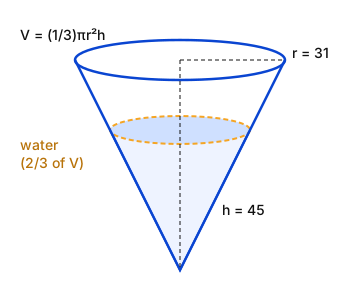
A conical vessel has base radius 31 cm and height 45 cm. Water is poured into the vessel until it is 23 full. Find the volume (in cm3) of water in the vessel.
एक शंक्वाकार बर्तन की आधार त्रिज्या 31 cm और ऊँचाई 45 cm है। बर्तन में तब तक पानी डाला जाता है जब तक कि वह 23 भर न जाए। बर्तन में पानी का आयतन (cm3 में) ज्ञात कीजिए।
  1. A9614π
  2. B9611π
  3. C9610π
  4. D9606π
Show answer

Concept: Volume of cone V=13πr2h; water =23 of V.

  1. V=13π×312×45=15×961π=14415πcm3.
  2. Water =23×14415π=9610πcm3.

Trick: Combine fractions: 23×13×45=10, so answer =10×961π.

Answer: (C) 9610π

अवधारणा: शंकु का आयतन V=13πr2h; पानी =V का 23।

  1. V=13π×312×45=15×961π=14415πcm3।
  2. पानी =23×14415π=9610πcm3।

ट्रिक: भिन्न मिलाएँ: 23×13×45=10, अतः उत्तर =10×961π।

उत्तर: (C) 9610π

RRB NTPC Graduate CBT 1MathematicsMensuration – coneRRB NTPC Graduate CBT 1 2024 · 5 Jun Shift 3 →
Q4442.
A vendor sold 4 chocolates for ₹1, thereby gaining 100%. How many chocolates did he buy for ₹1?
एक विक्रेता ने ₹1 में 4 चॉकलेट बेचकर 100% लाभ प्राप्त किया। उसने ₹1 में कितनी चॉकलेट खरीदी थीं?
  1. A12
  2. B14
  3. C8
  4. D10
Show answer

Concept: CP=SP1+gain.

  1. SP of 1 chocolate =14 rupee.
  2. Gain 100% → CP =12×14=18 rupee per chocolate.
  3. So for ₹1 he bought 8 chocolates.

Trick: 100% gain means CP is half of SP → he bought twice as many per rupee: 2×4=8.

Answer: (C) 8

अवधारणा: CP=SP1+लाभ।

  1. 1 चॉकलेट का विक्रय मूल्य =14 रुपया।
  2. 100% लाभ → क्रय मूल्य =12×14=18 रुपया प्रति चॉकलेट।
  3. अतः ₹1 में 8 चॉकलेट खरीदीं।

ट्रिक: 100% लाभ = क्रय मूल्य, विक्रय मूल्य का आधा → प्रति रुपया दोगुनी वस्तुएँ: 2×4=8।

उत्तर: (C) 8

RRB NTPC Graduate CBT 1MathematicsProfit and loss – articles per rupeeRRB NTPC Graduate CBT 1 2024 · 5 Jun Shift 3 →
Q4443.
Arvind is now 40 years old and Asha is 25 years old. How many years ago from now was Arvind four times as old as Asha?
अरविंद की वर्तमान आयु 40 वर्ष है और आशा की आयु 25 वर्ष है। अब से कितने वर्ष पहले अरविंद की आयु आशा की आयु की चार गुनी थी?
  1. A10 years10 वर्ष
  2. B20 years20 वर्ष
  3. C15 years15 वर्ष
  4. D25 years25 वर्ष
Show answer

Concept: Subtract the same x years from both ages.

  1. x years ago: Arvind =40−x, Asha =25−x.
  2. 40−x=4(25−x)⇒40−x=100−4x.
  3. 3x=60⇒x=20.

Trick: Check: 20 years ago ages were 20 and 5; 20=4×5. ✓

Answer: (B) 20 years

अवधारणा: दोनों आयु से समान x वर्ष घटाएँ।

  1. x वर्ष पहले: अरविंद =40−x, आशा =25−x।
  2. 40−x=4(25−x)⇒40−x=100−4x।
  3. 3x=60⇒x=20।

ट्रिक: जाँच: 20 वर्ष पहले आयु 20 और 5; 20=4×5 ✓

उत्तर: (B) 20 वर्ष

RRB NTPC Graduate CBT 1MathematicsProblems on agesRRB NTPC Graduate CBT 1 2024 · 5 Jun Shift 3 →
Q4444.
Given are the ages (in years) of five people: 20, 30, 35, 40 and 45. Calculate the average age in years.
पाँच व्यक्तियों की आयु (वर्षों में) दी गई है: 20, 30, 35, 40 और 45। औसत आयु वर्षों में ज्ञात कीजिए।
  1. A34
  2. B30
  3. C32.5
  4. D35
Show answer

Concept: Average = sum ÷ number of values.

  1. Sum =20+30+35+40+45=170.
  2. Average =1705=34 years.

Trick: Deviation from 35: −15,−5,0,+5,+10 → total −5 → 35−1=34.

Answer: (A) 34

अवधारणा: औसत = योग ÷ संख्या।

  1. योग =20+30+35+40+45=170।
  2. औसत =1705=34 वर्ष।

ट्रिक: 35 से विचलन: −15,−5,0,+5,+10 → कुल −5 → 35−1=34।

उत्तर: (A) 34

RRB NTPC Graduate CBT 1MathematicsAverageRRB NTPC Graduate CBT 1 2024 · 5 Jun Shift 3 →
Q4445.
In an election, there were two candidates. One of the candidates secured 48% of the votes and was defeated by the other candidate by 756 votes. Find the total number of votes polled.
एक चुनाव में दो उम्मीदवार थे। एक उम्मीदवार को 48% मत प्राप्त हुए और वह दूसरे उम्मीदवार से 756 मतों से हार गया। डाले गए मतों की कुल संख्या ज्ञात कीजिए।
  1. A17,800
  2. B19,500
  3. C15,600
  4. D18900
Show answer

Concept: Winning margin as a percentage of total votes.

  1. Loser =48%, winner =52% (only two candidates).
  2. Margin =52%−48%=4% of total =756.
  3. Total =756×1004=18900.

Trick: Margin % =100−2×48=4%; then 756×25.

Answer: (D) 18900

अवधारणा: जीत का अंतर कुल मतों के प्रतिशत के रूप में।

  1. हारने वाला =48%, जीतने वाला =52% (केवल दो प्रत्याशी)।
  2. अंतर =52%−48%=4% = 756।
  3. कुल =756×1004=18900।

ट्रिक: अंतर % =100−2×48=4%; फिर 756×25।

उत्तर: (D) 18900

RRB NTPC Graduate CBT 1MathematicsPercentage – electionsRRB NTPC Graduate CBT 1 2024 · 5 Jun Shift 3 →
Q4446.
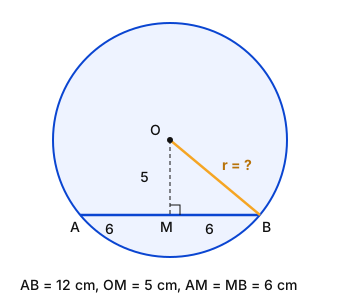
In a circle, the length of a chord is 12 cm and the perpendicular distance from the centre of the circle to the chord is 5 cm. What is the radius of the circle? (Rounded up to two decimal places.)
एक वृत्त में, एक जीवा की लंबाई 12 cm है और वृत्त के केंद्र से जीवा की लंबवत दूरी 5 cm है। वृत्त की त्रिज्या क्या है? (दशमलव के दो स्थानों तक पूर्णांकित)
  1. A7.81 cm
  2. B6.97 cm
  3. C9.87 cm
  4. D10.25 cm
Show answer

Concept: The perpendicular from the centre bisects the chord; use Pythagoras.

  1. Half chord AM=122=6cm, OM=5cm.
  2. r2=62+52=36+25=61.
  3. r=61≈7.81cm.

Trick: 61 lies between 7.82=60.84 and 7.92=62.41 → only 7.81 fits.

Answer: (A) 7.81cm

अवधारणा: केंद्र से जीवा पर लंब, जीवा को समद्विभाजित करता है; पाइथागोरस लगाएँ।

  1. आधी जीवा AM=122=6cm, OM=5cm।
  2. r2=62+52=36+25=61।
  3. r=61≈7.81cm।

ट्रिक: 61, 7.82=60.84 और 7.92=62.41 के बीच → केवल 7.81 सही।

उत्तर: (A) 7.81cm

RRB NTPC Graduate CBT 1MathematicsCircle – chord and radiusRRB NTPC Graduate CBT 1 2024 · 5 Jun Shift 3 →
Q4447.
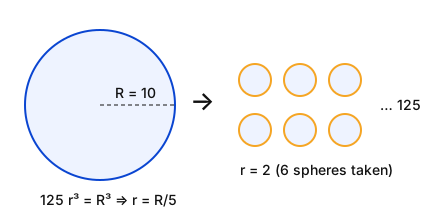
A solid metallic sphere of radius 10 cm is melted and recast into 125 identical spheres. What is the ratio of the surface area of the original sphere to the total surface area of 6 smaller spheres so formed?
10 cm त्रिज्या वाले एक ठोस धात्विक गोले को पिघलाकर 125 सर्वसम गोलों में ढाला जाता है। मूल गोले के पृष्ठीय क्षेत्रफल और इस प्रकार बने 6 छोटे गोलों के कुल पृष्ठीय क्षेत्रफल का अनुपात क्या है?
  1. A49 : 108
  2. B25 : 6
  3. C109 : 84
  4. D25 : 96
Show answer

Concept: Volume is conserved; surface area =4πr2.

  1. 43π(10)3=125×43πr3⇒r3=8⇒r=2cm.
  2. Big sphere SA =4π(10)2=400π.
  3. 6 small spheres SA =6×4π(2)2=96π.
  4. Ratio =400:96=25:6.

Trick: n equal spheres → r=Rn3; here 105=2.

Answer: (B) 25:6

अवधारणा: आयतन संरक्षित रहता है; पृष्ठीय क्षेत्रफल =4πr2।

  1. 43π(10)3=125×43πr3⇒r3=8⇒r=2cm।
  2. बड़े गोले का पृष्ठ =4π(10)2=400π।
  3. 6 छोटे गोलों का पृष्ठ =6×4π(2)2=96π।
  4. अनुपात =400:96=25:6।

ट्रिक: n बराबर गोले → r=Rn3; यहाँ 105=2।

उत्तर: (B) 25:6

RRB NTPC Graduate CBT 1MathematicsMensuration – recasting spheresRRB NTPC Graduate CBT 1 2024 · 5 Jun Shift 3 →
Q4448.
If sum and product of the roots of a quadratic equation are (4−32) and −28, respectively, then find the quadratic equation.
यदि किसी द्विघात समीकरण के मूलों का योग और गुणनफल क्रमशः (4−32) और −28 हैं, तो द्विघात समीकरण ज्ञात कीजिए।
  1. Ax2−(4+32)x+28=0
  2. Bx2+(4+32)x+28=0
  3. Cx2+(4−32)x−28=0
  4. Dx2−(4−32)x−28=0
Show answer

Concept: Equation with sum S and product P of roots: x2−Sx+P=0.

  1. S=4−32, P=−28.
  2. x2−(4−32)x+(−28)=0.
  3. x2−(4−32)x−28=0.

Trick: Sign rule: minus sum, plus product — so a negative product appears as −28.

Answer: (D) x2−(4−32)x−28=0

अवधारणा: मूलों का योग S और गुणनफल P हो तो समीकरण: x2−Sx+P=0।

  1. S=4−32, P=−28।
  2. x2−(4−32)x+(−28)=0।
  3. x2−(4−32)x−28=0।

ट्रिक: चिह्न नियम: योग घटाएँ, गुणनफल जोड़ें — ऋणात्मक गुणनफल −28 बनकर आता है।

उत्तर: (D) x2−(4−32)x−28=0

RRB NTPC Graduate CBT 1MathematicsQuadratic equations – forming from rootsRRB NTPC Graduate CBT 1 2024 · 5 Jun Shift 3 →
Q4449.
A group of numbers and symbols is coded using letter codes as per the codes given below and the conditions that follow. Study the given codes and conditions and answer the question that follows.
Note: If none of the conditions apply, then codes for the respective number/symbol are to be followed directly as given in the table.
Number/Symbol39@&275%18∆46
CodeLCZMDWAPRTFBK
Conditions:
(i) If the first element is a symbol and the last a number, the codes for these two (the first and the last elements) are to be interchanged.
(ii) If the first element is an odd number and the last an even number, the first and last elements are to be coded as ©.
(iii) If both second and third elements are perfect squares, the third element is to be coded as the code for the second element.
What will be the code for the following group?
@ 9 3 8 5
संख्याओं और प्रतीकों के एक समूह को नीचे दिए गए कूटों और उसके बाद दी गई शर्तों के अनुसार अक्षर कूटों का उपयोग करके कूटबद्ध किया जाता है। दिए गए कूटों और शर्तों का अध्ययन कीजिए और इसके बाद दिए गए प्रश्न का उत्तर दीजिए।
नोट: यदि कोई भी शर्त लागू नहीं होती है, तो संबंधित संख्या/प्रतीक के कूटों का सीधे तालिका में दिए गए अनुसार ही पालन करना है।
संख्या/प्रतीक39@&275%18∆46
कूटLCZMDWAPRTFBK
शर्तें:
(i) यदि पहला तत्व एक प्रतीक है और अंतिम तत्व एक संख्या है, तो इन दोनों (पहले और अंतिम तत्वों) के कूटों को आपस में बदल दिया जाना है।
(ii) यदि पहला तत्व एक विषम संख्या है और अंतिम तत्व एक सम संख्या है, तो पहले और अंतिम तत्वों को © के रूप में कूटबद्ध किया जाना है।
(iii) यदि दूसरा और तीसरा दोनों तत्व पूर्ण वर्ग हैं, तो तीसरे तत्व को दूसरे तत्व के कूट के रूप में कूटबद्ध किया जाना है।
निम्नलिखित समूह के लिए कूट क्या होगा?
@ 9 3 8 5
  1. AZ C B T A
  2. BA C B T Z
  3. CZ B C T A
  4. DA C L T Z
Show answer

Concept: Check each condition on the given group, then write the codes from the table.

  1. Codes: @ = Z, 9 = C, 3 = L, 8 = T, 5 = A.
  2. First element @ is a symbol and last element 5 is a number → condition (i) applies: swap the codes of first and last.
  3. Condition (iii) fails (3 is not a perfect square); (ii) fails (first is not a number).
  4. So @ → A, 9 → C, 3 → L, 8 → T, 5 → Z.

Trick: Test only the first, second, third and last elements – the middle ones are always coded directly.

Answer: (D) A C L T Z

अवधारणा: दिए गए समूह पर हर शर्त जाँचें, फिर तालिका से कोड लिखें।

  1. कोड: @ = Z, 9 = C, 3 = L, 8 = T, 5 = A।
  2. पहला तत्व @ प्रतीक है और अंतिम 5 संख्या है → शर्त (i) लागू: पहले और अंतिम के कोड आपस में बदलें।
  3. शर्त (iii) लागू नहीं (3 पूर्ण वर्ग नहीं), (ii) भी नहीं।
  4. अतः @ → A, 9 → C, 3 → L, 8 → T, 5 → Z।

ट्रिक: केवल पहला, दूसरा, तीसरा और अंतिम तत्व जाँचें – बीच वाले हमेशा सीधे कोड होते हैं।

उत्तर: (D) A C L T Z

RRB NTPC Graduate CBT 1General Intelligence and ReasoningCoding with conditionsRRB NTPC Graduate CBT 1 2024 · 5 Jun Shift 3 →
Q4450.
Refer to the following number and symbol series and answer the question that follows. Counting to be done from left to right only. All numbers are single-digit numbers. (Left) 2 * 3 & @ @ 6 4 $ @ 3 * % 6 2 1 3 9 7 8 2 € (Right)
How many such numbers are there each of which is immediately preceded by a number and also immediately followed by a symbol?
निम्नलिखित संख्या और प्रतीक श्रृंखला को देखिए और इसके बाद दिए गए प्रश्न का उत्तर दीजिए। गिनती केवल बाएँ से दाएँ की जानी है। सभी संख्याएँ एक-अंकीय संख्याएँ हैं। (बाएँ) 2 * 3 & @ @ 6 4 $ @ 3 * % 6 2 1 3 9 7 8 2 € (दाएँ)
ऐसी कितनी संख्याएँ हैं जिनमें से प्रत्येक के ठीक पहले एक संख्या है और ठीक बाद एक प्रतीक भी है?
  1. A4
  2. B5
  3. C3
  4. D2
Show answer

Concept: Look for the pattern Number – Number – Symbol.

  1. Series: 2 * 3 & @ @ 6 4 $ @ 3 * % 6 2 1 3 9 7 8 2 €
  2. 6 4 $ → 4 qualifies.
  3. 8 2 € → 2 qualifies. No other number has a number before and a symbol after.

Trick: Scan only the symbols: check whether the two elements just before each symbol are both numbers.

Answer: (D) 2

अवधारणा: पैटर्न खोजें: संख्या – संख्या – प्रतीक।

  1. श्रृंखला: 2 * 3 & @ @ 6 4 $ @ 3 * % 6 2 1 3 9 7 8 2 €
  2. 6 4 $ → 4 सही।
  3. 8 2 € → 2 सही। अन्य कोई संख्या शर्त पूरी नहीं करती।

ट्रिक: केवल प्रतीकों को देखें: उनसे ठीक पहले के दोनों तत्व संख्या हैं या नहीं।

उत्तर: (D) 2

RRB NTPC Graduate CBT 1General Intelligence and ReasoningNumber–symbol seriesRRB NTPC Graduate CBT 1 2024 · 5 Jun Shift 3 →
Q4451.
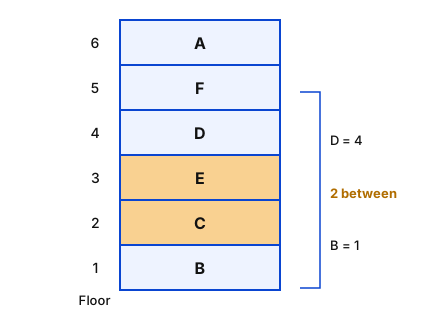
A, B, C, D, E and F live on six different floors of the same building. The lowermost floor in the building is numbered 1, the floor above it, number 2 and so on till the topmost floor is numbered 6. The product of floors on which F and E live is 15. C lives
immediately above B. The sum of floors on which D and E live is 7. How many people live between B and D?
A, B, C, D, E और F एक ही इमारत की छह अलग-अलग मंजिलों पर रहते हैं। इमारत की सबसे निचली मंजिल की संख्या 1 है, उसके ऊपर वाली मंजिल की संख्या 2 है और इसी प्रकार सबसे ऊपरी मंजिल की संख्या 6 है। F और E जिन मंजिलों पर रहते हैं, उनका गुणनफल 15 है। C
B के ठीक ऊपर रहता है। D और E जिन मंजिलों पर रहते हैं, उनका योग 7 है। B और D के बीच कितने व्यक्ति रहते हैं?
  1. A3
  2. B2
  3. C1
  4. D4
Show answer

Concept: Use the product and sum clues to fix E first.

  1. F × E = 15 → {3, 5}. D + E = 7 → if E = 3, D = 4; if E = 5, D = 2.
  2. Case E = 5, F = 3, D = 2: free floors 1, 4, 6 – no two consecutive for B, C. Rejected.
  3. Case E = 3, F = 5, D = 4: free floors 1, 2, 6 → B = 1, C = 2, A = 6.
  4. Between B (1) and D (4): C and E → 2 people.

Trick: Clue with only two possible values (E) → test both cases and reject the one that breaks 'immediately above'.

Answer: (B) 2

अवधारणा: गुणनफल और योग वाले संकेतों से पहले E तय करें।

  1. F × E = 15 → {3, 5}। D + E = 7 → E = 3 तो D = 4; E = 5 तो D = 2।
  2. स्थिति E = 5, F = 3, D = 2: बची मंजिलें 1, 4, 6 – B, C के लिए लगातार मंजिल नहीं। अस्वीकार।
  3. स्थिति E = 3, F = 5, D = 4: बची 1, 2, 6 → B = 1, C = 2, A = 6।
  4. B (1) और D (4) के बीच: C और E → 2 व्यक्ति।

ट्रिक: दो संभावित मान वाले संकेत से दोनों स्थितियाँ जाँचें।

उत्तर: (B) 2

RRB NTPC Graduate CBT 1General Intelligence and ReasoningFloor arrangementRRB NTPC Graduate CBT 1 2024 · 5 Jun Shift 3 →
Q4452.
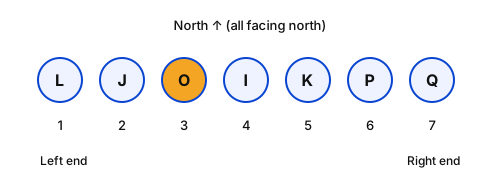
Seven people, I, J, K, L, O, P and Q are sitting in a row, facing north. Only five people sit between L and Q. P sits to the immediate left of Q. Only one person sits between P and I. O sits at some place to the left of K but at some place to the right of J. Who sits third from the left end of the line?
सात व्यक्ति I, J, K, L, O, P और Q एक पंक्ति में उत्तर की ओर मुख करके बैठे हैं। L और Q के बीच केवल पाँच व्यक्ति बैठे हैं। P, Q के ठीक बाईं ओर बैठा है। P और I के बीच केवल एक व्यक्ति बैठा है। O, K के बाईं ओर किसी स्थान पर, किंतु J के दाईं ओर किसी स्थान पर बैठा है। पंक्ति के बाएँ छोर से तीसरे स्थान पर कौन बैठा है?
  1. AP
  2. BQ
  3. CO
  4. DJ
Show answer

Concept: Five people between L and Q in a row of 7 → they sit at the two ends.

  1. P is immediately left of Q, so Q cannot be at the left end → Q = 7, P = 6, L = 1.
  2. One person between P and I → I = 4.
  3. Positions 2, 3, 5 left for J, O, K with J – O – K order → J = 2, O = 3, K = 5.
  4. Third from left = O.

Trick: '5 between' in a row of 7 always means extreme ends.

Answer: (C) O

अवधारणा: 7 की पंक्ति में L और Q के बीच 5 व्यक्ति → दोनों छोरों पर।

  1. P, Q के ठीक बाएँ है, अतः Q बाएँ छोर पर नहीं → Q = 7, P = 6, L = 1।
  2. P और I के बीच एक व्यक्ति → I = 4।
  3. शेष 2, 3, 5 पर J, O, K (J – O – K क्रम) → J = 2, O = 3, K = 5।
  4. बाएँ से तीसरा = O।

ट्रिक: 7 की पंक्ति में '5 बीच में' = दोनों छोर।

उत्तर: (C) O

RRB NTPC Graduate CBT 1General Intelligence and ReasoningLinear seating arrangementRRB NTPC Graduate CBT 1 2024 · 5 Jun Shift 3 →
Q4453.
Based on the English alphabetical order, three of the following four letter-cluster pairs are alike in a certain way and thus form a group. Which letter-cluster pair DOES NOT belong to that group?
(Note: The odd one out is not based on the number of consonants/vowels or their position in the letter-cluster.)
अंग्रेज़ी वर्णमाला क्रम के आधार पर, निम्नलिखित चार अक्षर-समूह युग्मों में से तीन किसी निश्चित प्रकार से एकसमान हैं और इस प्रकार एक समूह बनाते हैं। कौन-सा अक्षर-समूह युग्म उस समूह से संबंधित नहीं है?
(नोट: असंगत अक्षर-समूह, उस अक्षर-समूह में व्यंजनों/स्वरों की संख्या या उनके स्थान पर आधारित नहीं है।)
  1. ANQ - RM
  2. BNM - PO
  3. CSR - UT
  4. DUT - WV
Show answer

Concept: Compare each letter of the first cluster with the corresponding letter of the second.

  1. NM – PO: N + 2 = P, M + 2 = O.
  2. SR – UT: +2, +2; UT – WV: +2, +2.
  3. NQ – RM: N + 4 = R, Q − 4 = M → different.

Trick: Also inside each cluster: NM, SR, UT are reverse consecutive letters; NQ is not.

Answer: (A) NQ - RM

अवधारणा: पहले समूह के प्रत्येक अक्षर की तुलना दूसरे समूह के संगत अक्षर से करें।

  1. NM – PO: N + 2 = P, M + 2 = O।
  2. SR – UT: +2, +2; UT – WV: +2, +2।
  3. NQ – RM: N + 4 = R, Q − 4 = M → भिन्न।

ट्रिक: NM, SR, UT उल्टे क्रमागत अक्षर हैं; NQ नहीं।

उत्तर: (A) NQ - RM

RRB NTPC Graduate CBT 1General Intelligence and ReasoningLetter-cluster odd one outRRB NTPC Graduate CBT 1 2024 · 5 Jun Shift 3 →
Q4454.
Based on the English alphabetical order, three of the following four letter-cluster pairs are alike in a certain way and thus form a group. Which letter-cluster pair DOES NOT belong to that group? (Note: The odd one out is NOT based on the number of
consonants/vowels or their position in the letter cluster)
अंग्रेज़ी वर्णमाला क्रम के आधार पर, निम्नलिखित चार अक्षर-समूह युग्मों में से तीन किसी निश्चित प्रकार से एकसमान हैं और इस प्रकार एक समूह बनाते हैं। कौन-सा अक्षर-समूह युग्म उस समूह से संबंधित नहीं है? (नोट: असंगत अक्षर-समूह, उस अक्षर-समूह में व्यंजनों/स्वरों की संख्या या
उनके स्थान पर आधारित नहीं है।)
  1. APS - QT
  2. BKN - LO
  3. CGJ - HK
  4. DDH - FP
Show answer

Concept: Compare the first cluster with the second, letter by letter.

  1. PS – QT: P + 1 = Q, S + 1 = T.
  2. KN – LO: +1, +1; GJ – HK: +1, +1.
  3. DH – FP: D + 2 = F, H + 8 = P → different.

Trick: Inside the first cluster also: PS, KN, GJ have gap +3; DH has gap +4.

Answer: (D) DH - FP

अवधारणा: पहले समूह की तुलना दूसरे से अक्षर-दर-अक्षर करें।

  1. PS – QT: P + 1 = Q, S + 1 = T।
  2. KN – LO: +1, +1; GJ – HK: +1, +1।
  3. DH – FP: D + 2 = F, H + 8 = P → भिन्न।

ट्रिक: पहले समूह में भी PS, KN, GJ में अंतर +3; DH में +4।

उत्तर: (D) DH - FP

RRB NTPC Graduate CBT 1General Intelligence and ReasoningLetter-cluster odd one outRRB NTPC Graduate CBT 1 2024 · 5 Jun Shift 3 →
Q4455.
What should come in place of the question mark (?) in the given series?
1001 1000 997 992 985 ?
दी गई श्रृंखला में प्रश्न चिह्न (?) के स्थान पर क्या आना चाहिए?
1001 1000 997 992 985 ?
  1. A975
  2. B976
  3. C978
  4. D977
Show answer

Concept: Find the differences between consecutive terms.

  1. 1001−1=1000, 1000−3=997, 997−5=992, 992−7=985
  2. Differences are consecutive odd numbers 1, 3, 5, 7, 9.
  3. Next =985−9=976

Trick: Odd-number differences → also 1001−n2 for n=0,1,2,…: 1001−25=976.

Answer: (B) 976

अवधारणा: क्रमागत पदों का अंतर निकालें।

  1. 1001−1=1000, 1000−3=997, 997−5=992, 992−7=985
  2. अंतर क्रमागत विषम संख्याएँ 1, 3, 5, 7, 9 हैं।
  3. अगला =985−9=976

ट्रिक: पद =1001−n2: 1001−25=976।

उत्तर: (B) 976

RRB NTPC Graduate CBT 1General Intelligence and ReasoningNumber seriesRRB NTPC Graduate CBT 1 2024 · 5 Jun Shift 3 →
Q4456.
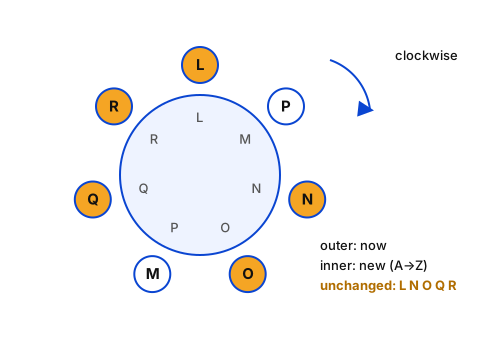
L, M, N, O, P, Q, and R are sitting around a circular table facing the centre. M is sitting to the immediate right of Q and immediate left of O. N is sitting to the immediate right of O. P is sitting to the immediate left of L. R is sitting to the immediate right of L and immediate left of Q. The position of how many persons will remain unchanged if all the persons are arranged in alphabetical order in clockwise direction starting from L (including L)?
L, M, N, O, P, Q और R एक वृत्ताकार मेज़ के चारों ओर केंद्र की ओर मुख करके बैठे हैं। M, Q के ठीक दाईं ओर और O के ठीक बाईं ओर बैठा है। N, O के ठीक दाईं ओर बैठा है। P, L के ठीक बाईं ओर बैठा है। R, L के ठीक दाईं ओर और Q के ठीक बाईं ओर बैठा है। यदि सभी व्यक्तियों को L से शुरू करते हुए (L सहित) दक्षिणावर्त दिशा में वर्णानुक्रम में व्यवस्थित किया जाए, तो कितने व्यक्तियों का स्थान अपरिवर्तित रहेगा?
  1. A4
  2. B3
  3. C1
  4. D5
Show answer

Concept: Facing the centre: a person's left neighbour is clockwise and right neighbour is anticlockwise.

  1. From the clues, the anticlockwise chain is P – L – R – Q – M – O – N, so clockwise from L: L, P, N, O, M, Q, R.
  2. New clockwise order from L: L, M, N, O, P, Q, R.
  3. Compare seat by seat: L, N, O, Q, R stay; P and M swap seats.
  4. Unchanged = 5.

Trick: Write the present clockwise order starting at L under the alphabet and count matches.

Answer: (D) 5

अवधारणा: केंद्र की ओर मुख: बायाँ पड़ोसी दक्षिणावर्त और दायाँ पड़ोसी वामावर्त होता है।

  1. संकेतों से वामावर्त क्रम P – L – R – Q – M – O – N; अतः L से दक्षिणावर्त: L, P, N, O, M, Q, R।
  2. नया दक्षिणावर्त क्रम (L से): L, M, N, O, P, Q, R।
  3. सीट-दर-सीट मिलान: L, N, O, Q, R अपरिवर्तित; P और M बदलते हैं।
  4. अपरिवर्तित = 5।

ट्रिक: वर्तमान दक्षिणावर्त क्रम को वर्णमाला के नीचे लिखकर मिलान गिनें।

उत्तर: (D) 5

RRB NTPC Graduate CBT 1General Intelligence and ReasoningCircular seating arrangementRRB NTPC Graduate CBT 1 2024 · 5 Jun Shift 3 →
Q4457.
If ‘A’ stands for ‘÷’, ‘B’ stands for ‘×’, ‘C’ stands for ‘+’, and ‘D’ stands for ‘−’, what will come in place of the question mark (?) in the following equation?
45 B 14 A 21 D 17 C 25 = ?
यदि ‘A’ का अर्थ ‘÷’, ‘B’ का अर्थ ‘×’, ‘C’ का अर्थ ‘+’ और ‘D’ का अर्थ ‘−’ है, तो निम्नलिखित समीकरण में प्रश्न चिह्न (?) के स्थान पर क्या आएगा?
45 B 14 A 21 D 17 C 25 = ?
  1. A54
  2. B42
  3. C36
  4. D38
Show answer

Concept: Replace letters by signs, then apply BODMAS.

  1. 45×14÷21−17+25
  2. 45×14=630, 630÷21=30
  3. 30−17+25=38

Trick: 1421=23 → 45×23=30 quickly.

Answer: (D) 38

अवधारणा: अक्षरों के स्थान पर चिह्न रखें, फिर BODMAS लगाएँ।

  1. 45×14÷21−17+25
  2. 45×14=630, 630÷21=30
  3. 30−17+25=38

ट्रिक: 45×23=30 सीधे।

उत्तर: (D) 38

RRB NTPC Graduate CBT 1General Intelligence and ReasoningMathematical operationsRRB NTPC Graduate CBT 1 2024 · 5 Jun Shift 3 →
Q4458.
What should come in place of the question mark (?) in the given series based on the English alphabetical order?
SKC WOG ASK EWO ?
अंग्रेज़ी वर्णमाला क्रम के आधार पर दी गई श्रृंखला में प्रश्न चिह्न (?) के स्थान पर क्या आना चाहिए?
SKC WOG ASK EWO ?
  1. AIAS
  2. BAIS
  3. CASI
  4. DISA
Show answer

Concept: Each letter moves +4 in the alphabet (Z wraps to A).

  1. 1st letters: S → W → A → E → I
  2. 2nd letters: K → O → S → W → A
  3. 3rd letters: C → G → K → O → S
  4. Next term: IAS

Trick: Positions +4: S(19) W(23) A(27 = 1) E(5) I(9).

Answer: (A) IAS

अवधारणा: प्रत्येक अक्षर वर्णमाला में +4 आगे बढ़ता है (Z के बाद A)।

  1. पहले अक्षर: S → W → A → E → I
  2. दूसरे अक्षर: K → O → S → W → A
  3. तीसरे अक्षर: C → G → K → O → S
  4. अगला पद: IAS

ट्रिक: स्थान +4: S(19) W(23) A(1) E(5) I(9)।

उत्तर: (A) IAS

RRB NTPC Graduate CBT 1General Intelligence and ReasoningLetter seriesRRB NTPC Graduate CBT 1 2024 · 5 Jun Shift 3 →
Q4459.
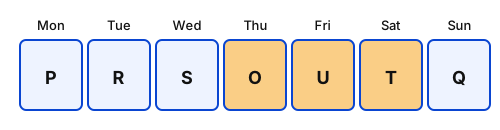
Each of O, P, Q, R, S, T and U has an exam on a different day of a week starting from Monday and ending on Sunday of the same week. S has an exam on Wednesday. R has an exam on one of the days after P and T has an exam on one of the days before Q. U has an exam immediately after O and S has an exam immediately before O. T has an exam on one of the days after U. How many people have an exam between S and Q?
O, P, Q, R, S, T और U में से प्रत्येक की परीक्षा एक ही सप्ताह के सोमवार से शुरू होकर रविवार को समाप्त होने वाले सप्ताह के एक अलग दिन है। S की परीक्षा बुधवार को है। R की परीक्षा P के बाद के किसी एक दिन है और T की परीक्षा Q से पहले के किसी एक दिन है। U की परीक्षा O के ठीक बाद है और S की परीक्षा O के ठीक पहले है। T की परीक्षा U के बाद के किसी एक दिन है। S और Q के बीच कितने व्यक्तियों की परीक्षा है?
  1. ATwoदो
  2. BFourचार
  3. CFiveपाँच
  4. DThreeतीन
Show answer

Concept: Start with the fixed day (S = Wednesday) and chain the 'immediately' clues.

  1. S Wed → O Thu → U Fri.
  2. T after U and before Q → T Sat, Q Sun.
  3. P and R take Mon, Tue with R after P → P Mon, R Tue.
  4. Between S (Wed) and Q (Sun): O, U, T → three.

Trick: Chain 'immediately after' clues first – they fix several days at once.

Answer: (D) Three

अवधारणा: निश्चित दिन (S = बुधवार) से शुरू कर 'ठीक बाद' वाले संकेत जोड़ें।

  1. S बुध → O गुरु → U शुक्र।
  2. T, U के बाद और Q से पहले → T शनि, Q रवि।
  3. P, R के लिए सोम, मंगल; R, P के बाद → P सोम, R मंगल।
  4. S (बुध) और Q (रवि) के बीच: O, U, T → तीन।

ट्रिक: 'ठीक बाद' वाले संकेत पहले जोड़ें।

उत्तर: (D) तीन

RRB NTPC Graduate CBT 1General Intelligence and ReasoningScheduling – daysRRB NTPC Graduate CBT 1 2024 · 5 Jun Shift 3 →
Q4460.
This question is based on the words given below.
(Left) BAD FIG ICE NOT (Right)
In each of the words, each vowel is changed to the letter immediately following it in the English alphabetical order and each consonant is changed to the letter immediately preceding in the English alphabetical order. In how many letter clusters thus formed, will no vowel appear?
यह प्रश्न नीचे दिए गए शब्दों पर आधारित है।
(बाएँ) BAD FIG ICE NOT (दाएँ)
प्रत्येक शब्द में, प्रत्येक स्वर को अंग्रेज़ी वर्णमाला क्रम में उसके ठीक बाद वाले अक्षर में बदल दिया जाता है और प्रत्येक व्यंजन को अंग्रेज़ी वर्णमाला क्रम में उसके ठीक पहले वाले अक्षर में बदल दिया जाता है। इस प्रकार बने कितने अक्षर-समूहों में कोई स्वर नहीं आएगा?
  1. ATwoदो
  2. BNoneकोई नहीं
  3. CThreeतीन
  4. DOneएक
Show answer

Concept: Vowel → next letter; consonant → previous letter.

  1. BAD → A B C (has A); FIG → E J F (has E)
  2. ICE → J B F (no vowel)
  3. NOT → M P S (no vowel)
  4. Clusters without a vowel: 2

Trick: A new vowel can come only from a consonant just after a vowel (B→A, F→E, J→I, P→O, V→U).

Answer: (A) Two

अवधारणा: स्वर → अगला अक्षर; व्यंजन → पिछला अक्षर।

  1. BAD → A B C (A है); FIG → E J F (E है)
  2. ICE → J B F (कोई स्वर नहीं)
  3. NOT → M P S (कोई स्वर नहीं)
  4. स्वर-रहित समूह: 2

ट्रिक: नया स्वर केवल B, F, J, P, V से बनता है (पिछला अक्षर स्वर)।

उत्तर: (A) दो

RRB NTPC Graduate CBT 1General Intelligence and ReasoningLetter coding – vowelsRRB NTPC Graduate CBT 1 2024 · 5 Jun Shift 3 →