Question bank

Q&A: practice questions with answers

Search questions on any topic. Filter by exam category, exam, subject and topic, try the question, then open the answer and explanation.

Courses – airGurukul

7,077 questions found.

Q4461.
This question is based on the five, three-digit numbers given below.
(Left) 662 268 547 409 909 (Right)
(Example: 697 – First digit = 6, second digit = 9 and third digit = 7)
(NOTE: All operations to be done from left to right.)
What will be the resultant if the third digit of the highest number is subtracted from the first digit of the lowest number?
यह प्रश्न नीचे दी गई पाँच, तीन-अंकीय संख्याओं पर आधारित है।
(बाएँ) 662 268 547 409 909 (दाएँ)
(उदाहरण: 697 – पहला अंक = 6, दूसरा अंक = 9 और तीसरा अंक = 7)
(नोट: सभी संक्रियाएँ बाएँ से दाएँ की जानी हैं।)
यदि सबसे बड़ी संख्या के तीसरे अंक को सबसे छोटी संख्या के पहले अंक में से घटाया जाए, तो परिणाम क्या होगा?
  1. A−8
  2. B−6
  3. C−4
  4. D−7
Show answer

Concept: Pick the highest and lowest numbers, then the required digits.

  1. Highest = 909 → third digit 9.
  2. Lowest = 268 → first digit 2.
  3. 2−9=−7

Trick: 'A subtracted from B' means B−A.

Answer: (D) −7

अवधारणा: सबसे बड़ी और सबसे छोटी संख्या चुनें, फिर अंक लें।

  1. सबसे बड़ी = 909 → तीसरा अंक 9।
  2. सबसे छोटी = 268 → पहला अंक 2।
  3. 2−9=−7

ट्रिक: 'A को B से घटाएँ' = B−A।

उत्तर: (D) −7

RRB NTPC Graduate CBT 1General Intelligence and ReasoningThree-digit number operationsRRB NTPC Graduate CBT 1 2024 · 5 Jun Shift 3 →
Q4462.
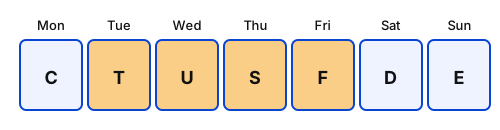
Each of C, D, E, F, S, T and U has an exam on a different day of a week starting from Monday and ending on Sunday of the same week. F has the exam on Friday. Only two people have their exams between T and F. Only four people have their exams between E and T. S has the exam immediately after U. D does not have the exam on Monday. How many people have their exams before D and after C?
C, D, E, F, S, T और U में से प्रत्येक की परीक्षा एक ही सप्ताह के सोमवार से शुरू होकर रविवार को समाप्त होने वाले सप्ताह के एक अलग दिन है। F की परीक्षा शुक्रवार को है। T और F के बीच केवल दो व्यक्तियों की परीक्षा है। E और T के बीच केवल चार व्यक्तियों की परीक्षा है। S की परीक्षा U के ठीक बाद है। D की परीक्षा सोमवार को नहीं है। D से पहले और C के बाद कितने व्यक्तियों की परीक्षा है?
  1. AFourचार
  2. BOneएक
  3. CTwoदो
  4. DThreeतीन
Show answer

Concept: Fix F, then T and E from the 'between' clues.

  1. F = Fri (5). Two between T and F → T = Tue (2).
  2. Four between E and T → E = Sun (7).
  3. Free: Mon, Wed, Thu, Sat. U–S consecutive → U Wed, S Thu.
  4. D not Monday → D Sat, C Mon. Between C (Mon) and D (Sat): T, U, S, F → four.

Trick: Count positions: 'n people between' means a gap of n+1 days.

Answer: (A) Four

अवधारणा: F तय करें, फिर 'बीच में' वाले संकेतों से T और E।

  1. F = शुक्र (5)। T और F के बीच दो → T = मंगल (2)।
  2. E और T के बीच चार → E = रवि (7)।
  3. खाली: सोम, बुध, गुरु, शनि। U–S लगातार → U बुध, S गुरु।
  4. D सोमवार नहीं → D शनि, C सोम। C और D के बीच: T, U, S, F → चार।

ट्रिक: 'n व्यक्ति बीच में' = दिनों में n+1 का अंतर।

उत्तर: (A) चार

RRB NTPC Graduate CBT 1General Intelligence and ReasoningScheduling – daysRRB NTPC Graduate CBT 1 2024 · 5 Jun Shift 3 →
Q4463.
Select the pair that follows the same pattern as that followed by the two sets of pairs given below. Both pairs follow the same pattern.
PIL : TMP
NAP : RET
उस युग्म का चयन कीजिए जो उसी पैटर्न का अनुसरण करता है जिसका अनुसरण नीचे दिए गए दो युग्मों के समुच्चय करते हैं। दोनों युग्म एक ही पैटर्न का अनुसरण करते हैं।
PIL : TMP
NAP : RET
  1. ANLI : JPM
  2. BSWT : WAX
  3. CSPL : WLH
  4. DBGM : GKQ
Show answer

Concept: Find the shift for each letter.

  1. PIL → TMP: +4, +4, +4; NAP → RET: +4, +4, +4.
  2. SWT → WAX: S + 4 = W, W + 4 = A, T + 4 = X ✓
  3. NLI → JPM (−4, +4, +4), SPL → WLH (+4, −4, −4), BGM → GKQ (+5, +4, +4) ✗

Trick: Same +4 to every letter; remember W + 4 wraps to A.

Answer: (B) SWT : WAX

अवधारणा: प्रत्येक अक्षर का खिसकाव ज्ञात करें।

  1. PIL → TMP: +4, +4, +4; NAP → RET: +4, +4, +4।
  2. SWT → WAX: S + 4 = W, W + 4 = A, T + 4 = X ✓
  3. NLI → JPM, SPL → WLH, BGM → GKQ में नियम टूटता है ✗

ट्रिक: हर अक्षर में +4; W + 4 = A (चक्र)।

उत्तर: (B) SWT : WAX

RRB NTPC Graduate CBT 1General Intelligence and ReasoningLetter analogyRRB NTPC Graduate CBT 1 2024 · 5 Jun Shift 3 →
Q4464.
KF 17 is related to HB 6 in a certain way. In the same way, KH 12 is related to HD 1. To which of the following is LP −6 related following the same logic?
KF 17 एक निश्चित प्रकार से HB 6 से संबंधित है। उसी प्रकार, KH 12, HD 1 से संबंधित है। समान तर्क का अनुसरण करते हुए, LP −6 निम्नलिखित में से किससे संबंधित है?
  1. AHI −18
  2. BPL −19
  3. CIL −17
  4. DMP −13
Show answer

Concept: Apply the same change to each letter and to the number.

  1. KF 17 → HB 6: K − 3 = H, F − 4 = B, 17 − 11 = 6.
  2. KH 12 → HD 1: K − 3 = H, H − 4 = D, 12 − 11 = 1.
  3. LP −6 → L − 3 = I, P − 4 = L, −6−11=−17 → IL −17.

Trick: Check the number first: only one option gives −6−11=−17.

Answer: (C) IL −17

अवधारणा: प्रत्येक अक्षर और संख्या पर समान परिवर्तन लगाएँ।

  1. KF 17 → HB 6: K − 3 = H, F − 4 = B, 17 − 11 = 6।
  2. KH 12 → HD 1: K − 3 = H, H − 4 = D, 12 − 11 = 1।
  3. LP −6 → L − 3 = I, P − 4 = L, −6−11=−17 → IL −17।

ट्रिक: पहले संख्या जाँचें: केवल एक विकल्प में −17 है।

उत्तर: (C) IL −17

RRB NTPC Graduate CBT 1General Intelligence and ReasoningAlphanumeric analogyRRB NTPC Graduate CBT 1 2024 · 5 Jun Shift 3 →
Q4465.
Which of the following letter-clusters should replace # and % so that the pattern and relationship followed between the letter-cluster pair on the left side of :: is the same as that on the right side of ::?
# : LQT :: AJM : %
निम्नलिखित में से कौन-से अक्षर-समूह # और % को प्रतिस्थापित करने चाहिए ताकि :: के बाईं ओर के अक्षर-समूह युग्म के बीच का पैटर्न और संबंध वही हो जो :: के दाईं ओर के अक्षर-समूह युग्म के बीच है?
# : LQT :: AJM : %
  1. A# = JQM, % = CPK
  2. B# = JPT, % = CKR
  3. C# = JRM, % = COP
  4. D# = JPR, % = CKO
Show answer

Concept: Both sides of :: must follow the same letter shifts.

  1. Try # = JPR: J + 2 = L, P + 1 = Q, R + 2 = T → pattern +2, +1, +2.
  2. Apply to AJM: A + 2 = C, J + 1 = K, M + 2 = O → % = CKO ✓
  3. Other options give different shifts on the two sides.

Trick: Find the rule from one option, then verify it on the other side.

Answer: (D) # = JPR, % = CKO

अवधारणा: :: के दोनों ओर समान अक्षर-खिसकाव होना चाहिए।

  1. # = JPR लें: J + 2 = L, P + 1 = Q, R + 2 = T → नियम +2, +1, +2।
  2. AJM पर लगाएँ: A + 2 = C, J + 1 = K, M + 2 = O → % = CKO ✓
  3. अन्य विकल्पों में दोनों ओर नियम भिन्न है।

ट्रिक: एक विकल्प से नियम निकालें, फिर दूसरी ओर जाँचें।

उत्तर: (D) # = JPR, % = CKO

RRB NTPC Graduate CBT 1General Intelligence and ReasoningLetter-cluster analogyRRB NTPC Graduate CBT 1 2024 · 5 Jun Shift 3 →
Q4466.
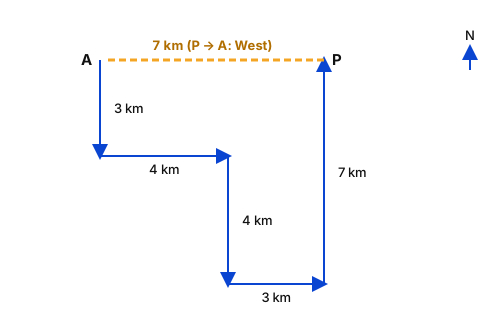
Sudeep starts from Point A and drives 3 km towards south. He then takes a left turn, drives 4 km, turns right and drives 4 km. He then takes a left turn and drives 3 km. He takes a final left turn, drives 7 km and stops at Point P. How far (shortest distance) and towards which direction should he drive in order to reach Point A again (all turns are 90° turns only unless specified)?
सुदीप बिंदु A से शुरू करता है और दक्षिण की ओर 3 km ड्राइव करता है। फिर वह बाएँ मुड़ता है, 4 km ड्राइव करता है, दाएँ मुड़ता है और 4 km ड्राइव करता है। फिर वह बाएँ मुड़ता है और 3 km ड्राइव करता है। वह अंतिम बार बाएँ मुड़ता है, 7 km ड्राइव करता है और बिंदु P पर रुक जाता है। बिंदु A पर पुनः पहुँचने के लिए उसे कितनी दूर (न्यूनतम दूरी) और किस दिशा में ड्राइव करना चाहिए (जब तक निर्दिष्ट न किया जाए, सभी मोड़ केवल 90° के मोड़ हैं)?
  1. A7 km; East7 km; पूर्व
  2. B6 km; East6 km; पूर्व
  3. C7 km; West7 km; पश्चिम
  4. D6 km; West6 km; पश्चिम
Show answer

Concept: Track the net east–west and north–south movement.

  1. South 3, left (east) 4, right (south) 4, left (east) 3, left (north) 7.
  2. North–south: −3−4+7=0 → P is level with A.
  3. East: 4+3=7 km → P is 7 km east of A.
  4. To return: 7 km towards West.

Trick: Net south and north cancel → distance is just the total east movement.

Answer: (C) 7 km; West

अवधारणा: कुल पूर्व–पश्चिम और उत्तर–दक्षिण विस्थापन निकालें।

  1. दक्षिण 3, बाएँ (पूर्व) 4, दाएँ (दक्षिण) 4, बाएँ (पूर्व) 3, बाएँ (उत्तर) 7।
  2. उत्तर–दक्षिण: −3−4+7=0 → P, A की सीध में।
  3. पूर्व: 4+3=7 km → P, A से 7 km पूर्व।
  4. वापस जाने के लिए: 7 km पश्चिम।

ट्रिक: दक्षिण–उत्तर कट जाते हैं → दूरी = कुल पूर्व गति।

उत्तर: (C) 7 km; पश्चिम

RRB NTPC Graduate CBT 1General Intelligence and ReasoningDirection and distanceRRB NTPC Graduate CBT 1 2024 · 5 Jun Shift 3 →
Q4467.
A group of numbers and symbols is coded using letter codes as per the codes given below and the conditions that follow. Study the given codes and conditions and answer the question that follows.
Note: If none of the conditions apply, then codes for the respective number/symbol are to be followed directly as given in the table.
Number/Symbol2@95$&3%#7+486
CodeTFAJLEWQDPRBUS
Conditions:
(i) If the first element is a symbol and the last a number, the codes for these two (the first and the last elements) are to be interchanged.
(ii) If the first element is an odd number and the last an even number, the first and last elements are to be coded as ©.
(iii) If both second and third elements are perfect squares, the third element is to be coded as the code for the second element.
If none of the above conditions are met, then the elements are to be simply coded as per the codes given in the question.
What will be the code for the following group?
@ 2 4 7 +
संख्याओं और प्रतीकों के एक समूह को नीचे दिए गए कूटों और उसके बाद दी गई शर्तों के अनुसार अक्षर कूटों का उपयोग करके कूटबद्ध किया जाता है। दिए गए कूटों और शर्तों का अध्ययन कीजिए और इसके बाद दिए गए प्रश्न का उत्तर दीजिए।
नोट: यदि कोई भी शर्त लागू नहीं होती है, तो संबंधित संख्या/प्रतीक के कूटों का सीधे तालिका में दिए गए अनुसार ही पालन करना है।
संख्या/प्रतीक2@95$&3%#7+486
कूटTFAJLEWQDPRBUS
शर्तें:
(i) यदि पहला तत्व एक प्रतीक है और अंतिम तत्व एक संख्या है, तो इन दोनों (पहले और अंतिम तत्वों) के कूटों को आपस में बदल दिया जाना है।
(ii) यदि पहला तत्व एक विषम संख्या है और अंतिम तत्व एक सम संख्या है, तो पहले और अंतिम तत्वों को © के रूप में कूटबद्ध किया जाना है।
(iii) यदि दूसरा और तीसरा दोनों तत्व पूर्ण वर्ग हैं, तो तीसरे तत्व को दूसरे तत्व के कूट के रूप में कूटबद्ध किया जाना है।
यदि उपरोक्त में से कोई भी शर्त पूरी नहीं होती है, तो तत्वों को केवल प्रश्न में दिए गए कूटों के अनुसार कूटबद्ध किया जाना है।
निम्नलिखित समूह के लिए कूट क्या होगा?
@ 2 4 7 +
  1. ARTBPF
  2. BRBBPF
  3. CFBBPR
  4. DFTBPR
Show answer

Concept: Check each condition, then code directly if none applies.

  1. (i): first @ is a symbol but last + is also a symbol → not applied.
  2. (ii): first is not a number → not applied. (iii): 2 is not a perfect square → not applied.
  3. Direct codes: @ = F, 2 = T, 4 = B, 7 = P, + = R.

Trick: Both ends symbols → (i) and (ii) fail at once; only check (iii).

Answer: (D) FTBPR

अवधारणा: प्रत्येक शर्त जाँचें; कोई लागू न हो तो सीधे कोड लिखें।

  1. (i): पहला @ प्रतीक है पर अंतिम + भी प्रतीक है → लागू नहीं।
  2. (ii): पहला तत्व संख्या नहीं → लागू नहीं। (iii): 2 पूर्ण वर्ग नहीं → लागू नहीं।
  3. सीधे कोड: @ = F, 2 = T, 4 = B, 7 = P, + = R।

ट्रिक: दोनों छोर प्रतीक → (i), (ii) तुरंत खारिज; केवल (iii) जाँचें।

उत्तर: (D) FTBPR

RRB NTPC Graduate CBT 1General Intelligence and ReasoningCoding with conditionsRRB NTPC Graduate CBT 1 2024 · 5 Jun Shift 3 →
Q4468.
MILK is related to TPSR in a certain way based on the English alphabetical order. In the same way, POT is related to WVA. To which of the given options is NATION related, following the same logic?
अंग्रेज़ी वर्णमाला क्रम के आधार पर MILK एक निश्चित प्रकार से TPSR से संबंधित है। उसी प्रकार, POT, WVA से संबंधित है। समान तर्क का अनुसरण करते हुए, NATION दिए गए विकल्पों में से किससे संबंधित है?
  1. AUHAPVU
  2. BUHAPUV
  3. CUHAPUU
  4. DUHAAUV
Show answer

Concept: Each letter is moved a fixed number of places forward in the alphabet.

  1. MILK → TPSR: M(13)→T(20), I(9)→P(16), L(12)→S(19), K(11)→R(18): each +7.
  2. Check POT → WVA: P→W, O→V, T(20)+7=27−26=1→A. ✓
  3. NATION: N→U, A→H, T→A, I→P, O→V, N→U = UHAPVU.

Trick: After Z wrap around: subtract 26 when the position crosses 26.

Answer: (A) UHAPVU

अवधारणा: प्रत्येक अक्षर को वर्णमाला में निश्चित स्थान आगे खिसकाया गया है।

  1. MILK → TPSR: M(13)→T(20), I(9)→P(16), L(12)→S(19), K(11)→R(18): प्रत्येक +7।
  2. जाँच POT → WVA: P→W, O→V, T(20)+7=27−26=1→A ✓
  3. NATION: N→U, A→H, T→A, I→P, O→V, N→U = UHAPVU।

ट्रिक: Z के बाद फिर A से गिनें: 26 से अधिक होने पर 26 घटाएँ।

उत्तर: (A) UHAPVU

RRB NTPC Graduate CBT 1General Intelligence and ReasoningCoding–decoding (letter shift)RRB NTPC Graduate CBT 1 2024 · 5 Jun Shift 3 →
Q4469.
Select the number from among the given options that can replace the question mark (?) in the following series.
62 61.1 60.2 59.3 58.4 57.5 ?
दिए गए विकल्पों में से उस संख्या का चयन कीजिए जो निम्नलिखित श्रृंखला में प्रश्न चिह्न (?) को प्रतिस्थापित कर सकती है।
62 61.1 60.2 59.3 58.4 57.5 ?
  1. A56.6
  2. B56.2
  3. C56.8
  4. D56.4
Show answer

Concept: Constant difference series.

  1. 62−61.1=0.9, 61.1−60.2=0.9, … each term decreases by 0.9.
  2. Next term =57.5−0.9=56.6.

Trick: Same decimal steps → simple subtraction series.

Answer: (A) 56.6

अवधारणा: स्थिर अंतर वाली श्रृंखला।

  1. 62−61.1=0.9, 61.1−60.2=0.9, … प्रत्येक पद 0.9 घटता है।
  2. अगला पद =57.5−0.9=56.6।

ट्रिक: दशमलव में एक समान अंतर → सीधी घटाव श्रृंखला।

उत्तर: (A) 56.6

RRB NTPC Graduate CBT 1General Intelligence and ReasoningNumber seriesRRB NTPC Graduate CBT 1 2024 · 5 Jun Shift 3 →
Q4470.
54 is related to 59 following a certain logic. Following the same logic, 30 is related to 35. To which of the following is 11 related, following the same logic?
(NOTE: Operations should be performed on the whole numbers, without breaking down the numbers into their constituent digits. E.g. 13 – Operations on 13 such as
adding/subtracting/multiplying to 13 can be performed. Breaking down 13 into 1 and 3 and then performing mathematical operations on 1 and 3 is not allowed.)
54 एक निश्चित तर्क का अनुसरण करते हुए 59 से संबंधित है। उसी तर्क का अनुसरण करते हुए, 30, 35 से संबंधित है। समान तर्क का अनुसरण करते हुए, 11 निम्नलिखित में से किससे संबंधित है?
(नोट: संख्याओं को उनके घटक अंकों में विभाजित किए बिना, पूर्ण संख्याओं पर संक्रियाएँ की जानी चाहिए। उदाहरण के लिए, 13 – 13 पर संक्रियाएँ जैसे 13 में
जोड़ना/घटाना/गुणा करना आदि किया जा सकता है। 13 को 1 और 3 में विभाजित करना और फिर 1 और 3 पर गणितीय संक्रियाएँ करना वर्जित है।)
  1. A18
  2. B16
  3. C15
  4. D17
Show answer

Concept: Find the operation that links each pair.

  1. 54→59: 54+5=59.
  2. 30→35: 30+5=35. ✓
  3. So 11→11+5=16.

Trick: Check the simplest difference first; here both pairs differ by 5.

Answer: (B) 16

अवधारणा: प्रत्येक जोड़ी को जोड़ने वाली संक्रिया ज्ञात करें।

  1. 54→59: 54+5=59।
  2. 30→35: 30+5=35 ✓
  3. अतः 11→11+5=16।

ट्रिक: पहले सबसे सरल अंतर देखें; यहाँ दोनों जोड़ियों में अंतर 5 है।

उत्तर: (B) 16

RRB NTPC Graduate CBT 1General Intelligence and ReasoningNumber analogyRRB NTPC Graduate CBT 1 2024 · 5 Jun Shift 3 →
Q4471.
If '+' means '−', '−' means '×', '×' means '÷' and '÷' means '+', then what will come in place of the question mark (?) in the following equation?
13 − 780 × 12 ÷ 16 + 32 = ?
यदि '+' का अर्थ '−', '−' का अर्थ '×', '×' का अर्थ '÷' और '÷' का अर्थ '+' है, तो निम्नलिखित समीकरण में प्रश्न चिह्न (?) के स्थान पर क्या आएगा?
13 − 780 × 12 ÷ 16 + 32 = ?
  1. A829
  2. B929
  3. C815
  4. D1232
Show answer

Concept: Replace symbols, then apply BODMAS.

  1. Given: 13−780×12÷16+32.
  2. Replace (−→×, ×→÷, ÷→+, +→−): 13×780÷12+16−32.
  3. 780÷12=65; 13×65=845.
  4. 845+16−32=829.

Trick: Do the division first: 780÷12=65, then the rest is quick.

Answer: (A) 829

अवधारणा: चिह्न बदलें, फिर BODMAS लगाएँ।

  1. दिया है: 13−780×12÷16+32।
  2. बदलने पर (−→×, ×→÷, ÷→+, +→−): 13×780÷12+16−32।
  3. 780÷12=65; 13×65=845।
  4. 845+16−32=829।

ट्रिक: पहले भाग करें: 780÷12=65, बाकी तुरंत।

उत्तर: (A) 829

RRB NTPC Graduate CBT 1General Intelligence and ReasoningMathematical operations (symbol substitution)RRB NTPC Graduate CBT 1 2024 · 5 Jun Shift 3 →
Q4472.
A group of numbers and symbols is coded using letter codes as per the codes given below and the conditions that follow. Study the given codes and conditions and answer the question that follows.
Note: If none of the conditions apply, then codes for the respective number/symbol are to be followed directly as given in the table.
Number/Symbol4@7#3&8*2^9$6+
CodeHAJBKCLDMENFPG
Conditions:
(i) If the first element is a number and the last a symbol, the codes for these two (the first and the last elements) are to be interchanged.
(ii) If the first element is an even number and the last an odd number, the first and last elements are to be coded as '('.
(iii) If both second and third elements are perfect squares, the code of the third element will be the code for the second element.
What will be the code for the following group?
4739
संख्याओं और प्रतीकों के एक समूह को नीचे दिए गए कूटों और उसके बाद दी गई शर्तों के अनुसार अक्षर कूटों का उपयोग करके कूटबद्ध किया जाता है। दिए गए कूटों और शर्तों का अध्ययन कीजिए और इसके बाद दिए गए प्रश्न का उत्तर दीजिए।
नोट: यदि कोई भी शर्त लागू नहीं होती है, तो संबंधित संख्या/प्रतीक के कूटों का सीधे तालिका में दिए गए अनुसार ही पालन करना है।
संख्या/प्रतीक4@7#3&8*2^9$6+
कूटHAJBKCLDMENFPG
शर्तें:
(i) यदि पहला तत्व एक संख्या है और अंतिम तत्व एक प्रतीक है, तो इन दोनों (पहले और अंतिम तत्वों) के कूटों को आपस में बदल दिया जाना है।
(ii) यदि पहला तत्व एक सम संख्या है और अंतिम तत्व एक विषम संख्या है, तो पहले और अंतिम तत्वों को '(' के रूप में कूटबद्ध किया जाना है।
(iii) यदि दूसरा और तीसरा दोनों तत्व पूर्ण वर्ग हैं, तो तीसरे तत्व का कूट ही दूसरे तत्व का कूट होगा।
निम्नलिखित समूह के लिए कूट क्या होगा?
4739
  1. A(JK(
  2. B(KJ(
  3. CHKJN
  4. DHJKN
Show answer

Concept: Check each condition on the group 4 7 3 9, then code the rest from the table.

  1. Codes: 4 = H, 7 = J, 3 = K, 9 = N.
  2. Condition (i): last element 9 is a number, not a symbol → not applicable.
  3. Condition (ii): first 4 is even, last 9 is odd → first and last become '('.
  4. Condition (iii): 7 and 3 are not perfect squares → not applicable. Middle stays J, K.
  5. Code = ( J K (.

Trick: Test conditions on the first/last elements first — they usually decide the answer quickly.

Answer: (A) (JK(

अवधारणा: समूह 4 7 3 9 पर हर शर्त जाँचें, फिर बाकी तालिका से कोड करें।

  1. कोड: 4 = H, 7 = J, 3 = K, 9 = N।
  2. शर्त (i): अंतिम 9 संख्या है, चिह्न नहीं → लागू नहीं।
  3. शर्त (ii): पहला 4 सम, अंतिम 9 विषम → पहला और अंतिम '(' बनेंगे।
  4. शर्त (iii): 7 और 3 पूर्ण वर्ग नहीं → लागू नहीं; बीच के J, K ही रहेंगे।
  5. कोड = ( J K (।

ट्रिक: पहले/अंतिम तत्व वाली शर्तें पहले जाँचें — उत्तर जल्दी मिलता है।

उत्तर: (A) (JK(

RRB NTPC Graduate CBT 1General Intelligence and ReasoningCoding with conditionsRRB NTPC Graduate CBT 1 2024 · 5 Jun Shift 3 →
Q4473.
What will come in place of the question mark (?) in the following equation, if ‘+’ and ‘−’ are interchanged and ‘×’ and ‘÷’ are interchanged?
54 ÷ 11 + 272 × 8 − 114 = ?
यदि ‘+’ और ‘−’ को आपस में बदल दिया जाए तथा ‘×’ और ‘÷’ को आपस में बदल दिया जाए, तो निम्नलिखित समीकरण में प्रश्न चिह्न (?) के स्थान पर क्या आएगा?
54 ÷ 11 + 272 × 8 − 114 = ?
  1. A674
  2. B672
  3. C675
  4. D673
Show answer

Concept: Interchange the signs, then apply BODMAS.

  1. Given: 54÷11+272×8−114.
  2. After swapping (+↔−, ×↔÷): 54×11−272÷8+114.
  3. 54×11=594; 272÷8=34.
  4. 594−34+114=674.

Trick: Rewrite the whole expression first, then calculate — avoids sign mistakes.

Answer: (A) 674

अवधारणा: चिह्न बदलें, फिर BODMAS लगाएँ।

  1. दिया है: 54÷11+272×8−114।
  2. अदला-बदली के बाद (+↔−, ×↔÷): 54×11−272÷8+114।
  3. 54×11=594; 272÷8=34।
  4. 594−34+114=674।

ट्रिक: पहले पूरा व्यंजक दोबारा लिखें, फिर गणना करें — चिह्न की गलती नहीं होगी।

उत्तर: (A) 674

RRB NTPC Graduate CBT 1General Intelligence and ReasoningMathematical operations (interchange)RRB NTPC Graduate CBT 1 2024 · 5 Jun Shift 3 →
Q4474.
What should come in place of the question mark (?) in the given series based on the English alphabetical order?
JGM KHN LIO MJP ?
अंग्रेज़ी वर्णमाला क्रम के आधार पर दी गई श्रृंखला में प्रश्न चिह्न (?) के स्थान पर क्या आना चाहिए?
JGM KHN LIO MJP ?
  1. ANKR
  2. BNLR
  3. CNLQ
  4. DNKQ
Show answer

Concept: Each letter of the cluster moves +1.

  1. 1st letters: J, K, L, M → N.
  2. 2nd letters: G, H, I, J → K.
  3. 3rd letters: M, N, O, P → Q.
  4. Next term = NKQ.

Trick: Read the series column-wise: three separate +1 sequences.

Answer: (D) NKQ

अवधारणा: समूह का प्रत्येक अक्षर +1 बढ़ता है।

  1. पहले अक्षर: J, K, L, M → N।
  2. दूसरे अक्षर: G, H, I, J → K।
  3. तीसरे अक्षर: M, N, O, P → Q।
  4. अगला पद = NKQ।

ट्रिक: श्रृंखला को स्तंभ-वार पढ़ें: तीन अलग +1 क्रम।

उत्तर: (D) NKQ

RRB NTPC Graduate CBT 1General Intelligence and ReasoningLetter seriesRRB NTPC Graduate CBT 1 2024 · 5 Jun Shift 3 →
Q4475.
If 2 is added to each even digit and 1 is subtracted from each odd digit in the number 6435127, what will be the sum of the second digit from the left and the third digit from the right in the new number thus formed?
यदि संख्या 6435127 में प्रत्येक सम अंक में 2 जोड़ा जाए और प्रत्येक विषम अंक में से 1 घटाया जाए, तो इस प्रकार बनी नई संख्या में बाएँ से दूसरे अंक और दाएँ से तीसरे अंक का योग क्या होगा?
  1. A4
  2. B10
  3. C8
  4. D6
Show answer

Concept: Change each digit, then pick positions.

  1. Number: 6 4 3 5 1 2 7. Even digits +2, odd digits −1.
  2. New number: 8 6 2 4 0 4 6.
  3. 2nd from left =6; 3rd from right =0 (from right: 6, 4, 0).
  4. Sum =6+0=6.

Trick: Write the new number fully before counting positions from the right.

Answer: (D) 6

अवधारणा: हर अंक बदलें, फिर स्थान चुनें।

  1. संख्या: 6 4 3 5 1 2 7। सम अंक +2, विषम अंक −1।
  2. नई संख्या: 8 6 2 4 0 4 6।
  3. बाएँ से दूसरा =6; दाएँ से तीसरा =0 (दाएँ से: 6, 4, 0)।
  4. योग =6+0=6।

ट्रिक: दाएँ से गिनने से पहले पूरी नई संख्या लिख लें।

उत्तर: (D) 6

RRB NTPC Graduate CBT 1General Intelligence and ReasoningDigit operationsRRB NTPC Graduate CBT 1 2024 · 5 Jun Shift 3 →
Q4476.
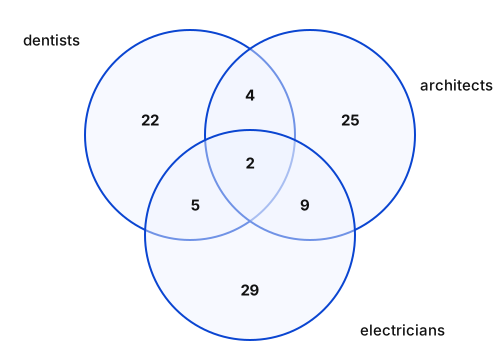
Study the given Venn diagram carefully and answer the questions.

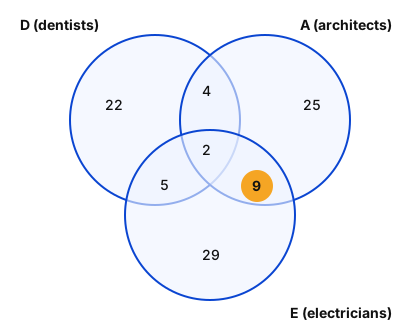
The numbers in different sections indicate the number of persons. How many electricians are there who are also architects but not dentists?
दिए गए वेन आरेख का ध्यानपूर्वक अध्ययन कीजिए और प्रश्नों के उत्तर दीजिए।

विभिन्न खंडों में दी गई संख्याएँ व्यक्तियों की संख्या दर्शाती हैं। ऐसे कितने इलेक्ट्रीशियन हैं जो आर्किटेक्ट भी हैं लेकिन डेंटिस्ट नहीं हैं?
  1. A5
  2. B2
  3. C9
  4. D4
Show answer

Concept: 'Electricians who are architects but not dentists' = region in E and A only, outside D.

  1. E ∩ A (both) contains 9+2=11 persons.
  2. The 2 in the centre are also dentists, so exclude them.
  3. Required =9.

Trick: 'Both but not the third' → the two-circle overlap region only, never the centre.

Answer: (C) 9

अवधारणा: 'वे इलेक्ट्रीशियन जो आर्किटेक्ट भी हैं पर डेंटिस्ट नहीं' = केवल E और A का साझा क्षेत्र, D से बाहर।

  1. E ∩ A में 9+2=11 व्यक्ति हैं।
  2. बीच के 2 डेंटिस्ट भी हैं, अतः उन्हें हटाएँ।
  3. अभीष्ट =9।

ट्रिक: 'दोनों पर तीसरा नहीं' → केवल दो वृत्तों का साझा भाग, केंद्र नहीं।

उत्तर: (C) 9

RRB NTPC Graduate CBT 1General Intelligence and ReasoningVenn diagram – reading regionsRRB NTPC Graduate CBT 1 2024 · 5 Jun Shift 3 →
Q4477.
In a certain code language,
A + B means ‘A is the mother of B’,
A − B means ‘A is the brother of B’,
A × B means ‘A is the wife of B’ and
A ÷ B means ‘A is the father of B’.
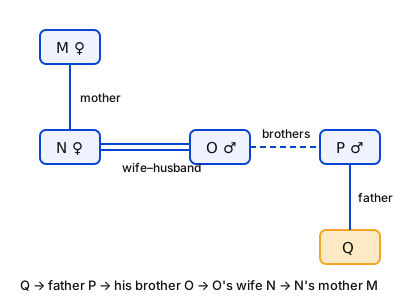
How is M related to Q if ‘M + N × O − P ÷ Q’?
एक निश्चित कूट भाषा में,
A + B का अर्थ है ‘A, B की माँ है’,
A − B का अर्थ है ‘A, B का भाई है’,
A × B का अर्थ है ‘A, B की पत्नी है’ और
A ÷ B का अर्थ है ‘A, B का पिता है’।
यदि ‘M + N × O − P ÷ Q’ है, तो M, Q से किस प्रकार संबंधित है?
  1. AMother's brother's wife's sisterमाँ के भाई की पत्नी की बहन
  2. BFather's brother's wife's sisterपिता के भाई की पत्नी की बहन
  3. CFather's brother's wife's motherपिता के भाई की पत्नी की माँ
  4. D​Mother's brother's wife's motherमाँ के भाई की पत्नी की माँ
Show answer

Concept: Decode each symbol and build the family tree.

  1. M + N: M is the mother of N. N × O: N is the wife of O.
  2. O − P: O is the brother of P. P ÷ Q: P is the father of Q.
  3. From Q: father = P → father's brother = O → his wife = N → her mother = M.
  4. M is Q's father's brother's wife's mother.

Trick: Start from the person asked about (Q) and walk back along the chain.

Answer: (C) Father's brother's wife's mother

अवधारणा: प्रत्येक चिह्न को खोलकर वंश-वृक्ष बनाएँ।

  1. M + N: M, N की माँ है। N × O: N, O की पत्नी है।
  2. O − P: O, P का भाई है। P ÷ Q: P, Q का पिता है।
  3. Q से: पिता = P → पिता का भाई = O → उसकी पत्नी = N → उसकी माँ = M।
  4. M, Q के पिता के भाई की पत्नी की माँ है।

ट्रिक: जिसके बारे में पूछा है (Q) वहीं से शुरू कर श्रृंखला में पीछे चलें।

उत्तर: (C) Father's brother's wife's mother (पिता के भाई की पत्नी की माँ)

RRB NTPC Graduate CBT 1General Intelligence and ReasoningBlood relations – codedRRB NTPC Graduate CBT 1 2024 · 5 Jun Shift 3 →
Q4478.
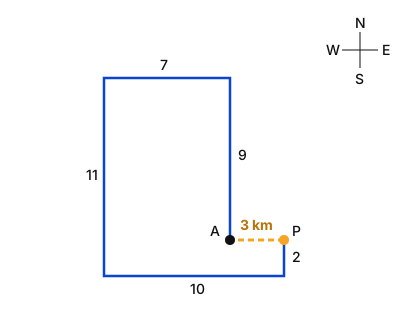
Rajendra starts from point A and drives 9 km towards the north. He then takes a left turn, drives 7 km, turns left and drives 11 km. He then takes a left turn and drives 10 km. He takes a final left turn, drives 2 km and stops at point P. How far (shortest distance) and towards which direction should he drive in order to reach point A again? (All turns are 90 degree turns only unless specified.)
राजेंद्र बिंदु A से शुरू करता है और उत्तर की ओर 9 km ड्राइव करता है। फिर वह बाएँ मुड़ता है, 7 km ड्राइव करता है, बाएँ मुड़ता है और 11 km ड्राइव करता है। फिर वह बाएँ मुड़ता है और 10 km ड्राइव करता है। वह अंतिम बार बाएँ मुड़ता है, 2 km ड्राइव करता है और बिंदु P पर रुक जाता है। बिंदु A पर पुनः पहुँचने के लिए उसे कितनी दूर (न्यूनतम दूरी) और किस दिशा में ड्राइव करना चाहिए? (जब तक निर्दिष्ट न किया जाए, सभी मोड़ केवल 90 डिग्री के मोड़ हैं।)
  1. A3 km to the westपश्चिम की ओर 3 km
  2. B1 km to the westपश्चिम की ओर 1 km
  3. C2 km to the westपश्चिम की ओर 2 km
  4. D3 km to the eastपूर्व की ओर 3 km
Show answer

Concept: Track net north–south and east–west displacement (every left turn here is a 90° turn).

  1. North 9 → left (west) 7 → left (south) 11 → left (east) 10 → left (north) 2.
  2. North–south: 9−11+2=0.
  3. East–west: 10−7=3km east of A.
  4. So P is 3 km east of A; to return he drives 3 km to the west.

Trick: Four left turns bring you back to the start direction — only the leftover east–west gap matters.

Answer: (A) 3 km to the west

अवधारणा: उत्तर–दक्षिण व पूर्व–पश्चिम कुल विस्थापन ज्ञात करें (हर बायाँ मोड़ 90°)।

  1. उत्तर 9 → बाएँ (पश्चिम) 7 → बाएँ (दक्षिण) 11 → बाएँ (पूर्व) 10 → बाएँ (उत्तर) 2।
  2. उत्तर–दक्षिण: 9−11+2=0।
  3. पूर्व–पश्चिम: 10−7=3km A के पूर्व।
  4. अतः P, A से 3 km पूर्व; लौटने के लिए 3 km पश्चिम जाना होगा।

ट्रिक: चार बाएँ मोड़ों के बाद दिशा वही — केवल बचा पूर्व–पश्चिम अंतर देखें।

उत्तर: (A) 3 km पश्चिम

RRB NTPC Graduate CBT 1General Intelligence and ReasoningDirection and distanceRRB NTPC Graduate CBT 1 2024 · 5 Jun Shift 3 →
Q4479.
How many medals did India win in total at the World Para Athletics Grand Prix 2025?
वर्ल्ड पैरा एथलेटिक्स ग्रैंड प्रिक्स 2025 में भारत ने कुल कितने पदक जीते?
  1. A120
  2. B150
  3. C134
  4. D180
Show answer

Concept: The World Para Athletics Grand Prix 2025 was held in New Delhi (March 2025) – India's first time hosting this event.

  1. India topped the medal table with 134 medals: 45 gold, 40 silver and 49 bronze.
  2. 45+40+49=134.

Yaad rakhein: New Delhi GP 2025 → India 134 medals (45 gold).

Answer: (C) 134

अवधारणा: वर्ल्ड पैरा एथलेटिक्स ग्रां प्री 2025 नई दिल्ली (मार्च 2025) में हुई – भारत ने पहली बार इसकी मेज़बानी की।

  1. भारत ने कुल 134 पदक जीते: 45 स्वर्ण, 40 रजत और 49 कांस्य।
  2. 45+40+49=134.

याद रखें: नई दिल्ली GP 2025 → भारत 134 पदक (45 स्वर्ण)।

उत्तर: (C) 134

RRB NTPC Graduate CBT 1General AwarenessSports – Para AthleticsRRB NTPC Graduate CBT 1 2024 · 5 Jun Shift 2 →
Q4480.
What is the primary function of the CPU in a computer system?
कंप्यूटर प्रणाली में CPU का प्राथमिक कार्य क्या है?
  1. AConnect input and output devicesइनपुट और आउटपुट डिवाइसों को जोड़ना
  2. BExecute instructions and process dataनिर्देशों को निष्पादित करना और डेटा को संसाधित करना
  3. CManage the power supplyविद्युत आपूर्ति का प्रबंधन करना
  4. DStore data permanentlyडेटा को स्थायी रूप से संग्रहीत करना
Show answer

Concept: The CPU (Central Processing Unit) is the "brain" of the computer.

  1. It fetches, decodes and executes instructions and processes data (ALU + Control Unit).
  2. Permanent storage is done by hard disk/SSD; power is managed by the SMPS – not the CPU.

Yaad rakhein: CPU = ALU + CU + registers → execute & process.

Answer: (B) Execute instructions and process data

अवधारणा: CPU (सेंट्रल प्रोसेसिंग यूनिट) कंप्यूटर का "मस्तिष्क" है।

  1. यह निर्देश (instructions) प्राप्त कर, डिकोड कर निष्पादित (execute) करता है और डेटा प्रोसेस करता है (ALU + Control Unit)।
  2. स्थायी भंडारण हार्ड डिस्क/SSD करता है; बिजली SMPS संभालता है – CPU नहीं।

याद रखें: CPU = ALU + CU + रजिस्टर → निष्पादन व प्रोसेसिंग।

उत्तर: (B) Execute instructions and process data

RRB NTPC Graduate CBT 1General AwarenessComputer – CPURRB NTPC Graduate CBT 1 2024 · 5 Jun Shift 2 →