Question bank

Q&A: practice questions with answers

Search questions on any topic. Filter by exam category, exam, subject and topic, try the question, then open the answer and explanation.

Courses – airGurukul

7,077 questions found.

Q4541.
Find the value of m which satisfies (294)3×(429)2×(294)11=(429)9m+7.
m का वह मान ज्ञात कीजिए जो (294)3×(429)2×(294)11=(429)9m+7 को संतुष्ट करता है।
  1. A−199
  2. B−239
  3. C−189
  4. D−109
Show answer

Concept: With the same base, multiply by adding powers; and (ab)n=(ba)−n.

  1. Write (429)2=(294)−2.
  2. LHS =(294)3−2+11=(294)12=(429)−12.
  3. So 9m+7=−12⇒9m=−19⇒m=−199.

Trick: Flipping the base flips the sign of the power – convert everything to one base first.

Answer: (A) −199

अवधारणा: समान आधार पर गुणा करने पर घातें जुड़ती हैं; तथा (ab)n=(ba)−n।

  1. (429)2=(294)−2 लिखें।
  2. बायाँ पक्ष =(294)3−2+11=(294)12=(429)−12।
  3. अतः 9m+7=−12⇒9m=−19⇒m=−199।

ट्रिक: आधार उलटते ही घात का चिह्न उलट जाता है – पहले सबको एक ही आधार में बदलें।

उत्तर: (A) −199
RRB NTPC Graduate CBT 1MathematicsLaws of ExponentsRRB NTPC Graduate CBT 1 2024 · 5 Jun Shift 2 →
Q4542.
What is the discriminant of the equation x2 − 2x + 13 = 0? Also, determine how many real solutions this equation has.
समीकरण x2 − 2x + 13 = 0 का विविक्तकर (discriminant) क्या है? साथ ही, यह भी ज्ञात कीजिए कि इस समीकरण के कितने वास्तविक हल हैं।
  1. A44, Two real roots44, दो वास्तविक मूल
  2. B−48, No real roots−48, कोई वास्तविक मूल नहीं
  3. C40, Two equal roots40, दो समान मूल
  4. D46, One real root46, एक वास्तविक मूल
Show answer

Concept: For ax2+bx+c=0, discriminant D=b2−4ac. D>0: two real roots; D=0: equal roots; D<0: no real roots.

  1. Here a=1, b=−2, c=13.
  2. D=(−2)2−4×1×13=4−52=−48.
  3. D<0, so there are no real roots.

Trick: If c is positive and b2<4ac (here 4<52), the roots are imaginary at once.

Answer: (B) −48, No real roots

अवधारणा: ax2+bx+c=0 के लिए विविक्तकर D=b2−4ac। D>0: दो वास्तविक मूल; D=0: समान मूल; D<0: कोई वास्तविक मूल नहीं।

  1. यहाँ a=1, b=−2, c=13।
  2. D=(−2)2−4×1×13=4−52=−48।
  3. D<0, अतः कोई वास्तविक मूल नहीं।

ट्रिक: यदि b2<4ac (यहाँ 4<52) तो मूल तुरंत काल्पनिक।

उत्तर: (B) −48, No real roots

RRB NTPC Graduate CBT 1MathematicsQuadratic Equations – DiscriminantRRB NTPC Graduate CBT 1 2024 · 5 Jun Shift 2 →
Q4543.
A group of people consists of men, women and children. Among them, 20% are men, 50% are women and the rest are children, and their average weights are 45 kg, 60 kg and 20 kg, respectively. The average weight (in kg) of the group is:
लोगों के एक समूह में पुरुष, महिलाएँ और बच्चे हैं। उनमें से 20% पुरुष, 50% महिलाएँ और शेष बच्चे हैं, और उनके औसत भार क्रमशः 45 kg, 60 kg और 20 kg हैं। समूह का औसत भार (kg में) है:
  1. A44
  2. B45
  3. C43
  4. D42
Show answer

Concept: Weighted average =∑(share×average)∑share.

  1. Children =100%−20%−50%=30%.
  2. Average =0.2×45+0.5×60+0.3×20.
  3. =9+30+6=45kg.

Trick: Take 10 people: 2 men, 5 women, 3 children → total 90+300+60=450, average =45.

Answer: (B) 45

अवधारणा: भारित औसत =∑(हिस्सा×औसत)∑हिस्सा।

  1. बच्चे =100%−20%−50%=30%।
  2. औसत =0.2×45+0.5×60+0.3×20।
  3. =9+30+6=45kg।

ट्रिक: 10 लोग मानें: 2 पुरुष, 5 महिलाएँ, 3 बच्चे → कुल 90+300+60=450, औसत =45।

उत्तर: (B) 45

RRB NTPC Graduate CBT 1MathematicsAverage – WeightedRRB NTPC Graduate CBT 1 2024 · 5 Jun Shift 2 →
Q4544.
When x is added to each of 26, 40, 22 and 34, then the numbers so obtained, in this order, are in proportion. Then, if 4x : y :: y : (7x-6), and y > 0, what is the value of y?
जब 26, 40, 22 और 34 में से प्रत्येक में x जोड़ा जाता है, तो इस प्रकार प्राप्त संख्याएँ, इसी क्रम में, समानुपात में होती हैं। तब, यदि 4x : y :: y : (7x-6) है, और y > 0 है, तो y का मान क्या है?
  1. A2
  2. B8
  3. C3
  4. D9
Show answer

Concept: a:b::c:d⇒ad=bc; and if p:y::y:q then y2=pq.

  1. (26+x)(34+x)=(40+x)(22+x).
  2. 884+60x+x2=880+62x+x2⇒2x=4⇒x=2.
  3. 4x=8, 7x−6=8; so y2=8×8=64.
  4. y>0⇒y=8.

Trick: Check options: x=2 gives 28:42=24:36, both =2:3 ✓.

Answer: (B) 8

अवधारणा: a:b::c:d⇒ad=bc; तथा यदि p:y::y:q तो y2=pq।

  1. (26+x)(34+x)=(40+x)(22+x)।
  2. 884+60x+x2=880+62x+x2⇒2x=4⇒x=2।
  3. 4x=8, 7x−6=8; अतः y2=8×8=64।
  4. y>0⇒y=8।

ट्रिक: जाँच: x=2 पर 28:42=24:36, दोनों =2:3 ✓।

उत्तर: (B) 8

RRB NTPC Graduate CBT 1MathematicsRatio & Proportion – Mean ProportionalRRB NTPC Graduate CBT 1 2024 · 5 Jun Shift 2 →
Q4545.
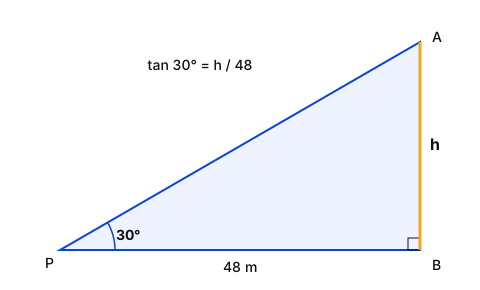
The angle of elevation of the top of a tower from a point on the ground, which is 48 m away from the foot of the tower is 30∘. Find the height of the tower.
मीनार के पाद से 48 m दूर भूमि पर स्थित एक बिंदु से मीनार के शिखर का उन्नयन कोण 30∘ है। मीनार की ऊँचाई ज्ञात कीजिए।
  1. A153 m
  2. B183 m
  3. C123 m
  4. D163 m
Show answer

Concept: In the right triangle formed by the tower and the ground, tanθ=heightbase.

  1. tan30∘=h48.
  2. 13=h48⇒h=483.
  3. h=4833=163m.

Trick: For 30∘: height =base3; dividing by 3 is the same as base3×3, i.e. 163.

Answer: (D) 163m

अवधारणा: मीनार और ज़मीन से बने समकोण त्रिभुज में tanθ=ऊँचाईआधार।

  1. tan30∘=h48।
  2. 13=h48⇒h=483।
  3. h=4833=163m।

ट्रिक: 30∘ पर: ऊँचाई =आधार3×3, अर्थात् 163।

उत्तर: (D) 163m

RRB NTPC Graduate CBT 1MathematicsHeights and DistancesRRB NTPC Graduate CBT 1 2024 · 5 Jun Shift 2 →
Q4546.
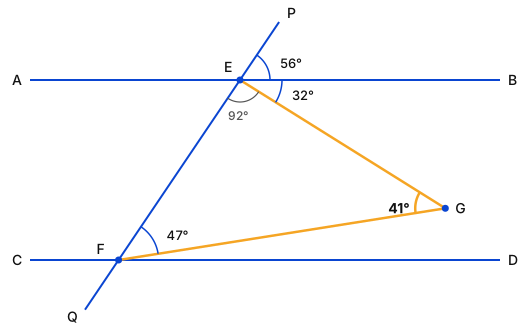
AB is parallel to CD. A transversal PQ intersects AB and CD at E and F, respectively, and ∠PEB = 56°. G is a point between AB and CD such that ∠BEG = 32° and ∠GFE = 47°. What is the measure of ∠EGF?
AB, CD के समांतर है। एक तिर्यक रेखा PQ, AB और CD को क्रमशः E और F पर प्रतिच्छेद करती है, और ∠PEB = 56° है। G, AB और CD के बीच एक बिंदु इस प्रकार है कि ∠BEG = 32° और ∠GFE = 47° है। ∠EGF का माप क्या है?
  1. A29°
  2. B46°
  3. C37°
  4. D41°
Show answer

Concept: Angles on a straight line add to 180∘, and the angles of a triangle add to 180∘.

  1. ∠PEB and ∠BEF are a linear pair: ∠BEF=180∘−56∘=124∘.
  2. G lies inside ∠BEF: ∠GEF=124∘−32∘=92∘.
  3. In △EGF: ∠EGF=180∘−92∘−47∘=41∘.

Trick: Shortcut: ∠EGF=180∘−(180∘−56∘−32∘)−47∘=56∘+32∘−47∘=41∘.

Answer: (D) 41∘

अवधारणा: सरल रेखा पर कोणों का योग 180∘ और त्रिभुज के कोणों का योग 180∘ होता है।

  1. ∠PEB और ∠BEF रैखिक युग्म हैं: ∠BEF=180∘−56∘=124∘।
  2. G, ∠BEF के अंदर है: ∠GEF=124∘−32∘=92∘।
  3. △EGF में: ∠EGF=180∘−92∘−47∘=41∘।

ट्रिक: शॉर्टकट: ∠EGF=56∘+32∘−47∘=41∘।

उत्तर: (D) 41∘

RRB NTPC Graduate CBT 1MathematicsGeometry – Parallel Lines & TransversalRRB NTPC Graduate CBT 1 2024 · 5 Jun Shift 2 →
Q4547.
A vendor sold 5 chocolates for ₹1, thereby gaining 40%. How many chocolates did he buy for ₹1?
एक विक्रेता ने ₹1 में 5 चॉकलेट बेचीं, जिससे उसे 40% का लाभ हुआ। उसने ₹1 में कितनी चॉकलेट खरीदी थीं?
  1. A9
  2. B11
  3. C13
  4. D7
Show answer

Concept: CP=SP1+gain%; number bought for ₹1 =1CP of one.

  1. SP of 1 chocolate =₹15.
  2. CP of 1 chocolate =15÷1.4=17 rupee.
  3. So for ₹1 he bought 7 chocolates.

Trick: With gain, he buys fewer per rupee than he sells: 5×1.4=7.

Answer: (D) 7

अवधारणा: क्रय मूल्य=विक्रय मूल्य1+लाभ%; ₹1 में खरीदी गई संख्या =1एक का क्रय मूल्य।

  1. 1 चॉकलेट का विक्रय मूल्य =15 रुपया।
  2. 1 चॉकलेट का क्रय मूल्य =15÷1.4=17 रुपया।
  3. अतः ₹1 में 7 चॉकलेट खरीदीं।

ट्रिक: लाभ होने पर ₹1 में बेची गई संख्या × 1.4 = खरीदी गई संख्या: 5×1.4=7।

उत्तर: (D) 7

RRB NTPC Graduate CBT 1MathematicsProfit & Loss – Articles per RupeeRRB NTPC Graduate CBT 1 2024 · 5 Jun Shift 2 →
Q4548.
At what rate of interest (rounded off to two decimal places) per year will a sum of money double itself in 12 years on simple interest?
साधारण ब्याज पर कोई धनराशि कितनी वार्षिक ब्याज दर (दो दशमलव स्थानों तक पूर्णांकित) पर 12 वर्षों में स्वयं की दोगुनी हो जाएगी?
  1. A6.33%
  2. B8.33%
  3. C16.67%
  4. D10.33%
Show answer

Concept: A sum doubles when SI=P, so R×T=100.

  1. SI=P×R×T100=P⇒R×12=100.
  2. R=10012=8.33% (approx.).

Trick: To become n times in SI: R=(n−1)×100T; here 10012=813%.

Answer: (B) 8.33%

अवधारणा: मूलधन दोगुना होने पर साधारण ब्याज=P, अतः R×T=100।

  1. P×R×T100=P⇒R×12=100।
  2. R=10012=8.33% (लगभग)।

ट्रिक: SI में n गुना होने के लिए: R=(n−1)×100T; यहाँ 10012=813%।

उत्तर: (B) 8.33%

RRB NTPC Graduate CBT 1MathematicsSimple Interest – DoublingRRB NTPC Graduate CBT 1 2024 · 5 Jun Shift 2 →
Q4549.
Select the number from among the given options that can replace the question mark (?) in the following series.
37 55 66 84 95 113 ?
दिए गए विकल्पों में से उस संख्या का चयन कीजिए जो निम्नलिखित श्रृंखला में प्रश्न चिह्न (?) के स्थान पर आ सकती है।
37 55 66 84 95 113 ?
  1. A166
  2. B145
  3. C131
  4. D124
Show answer

Concept: Look at the differences between consecutive terms.

  1. Differences: +18, +11, +18, +11, +18, …
  2. Next difference = +11: 113+11=124.

Trick: Alternating add pattern (+18, +11) – check differences first.

Answer: (D) 124

अवधारणा: क्रमागत पदों का अंतर देखें।

  1. अंतर: +18, +11, +18, +11, +18, …
  2. अगला अंतर +11: 113+11=124.

ट्रिक: वैकल्पिक जोड़ (+18, +11) – पहले अंतर जाँचें।

उत्तर: (D) 124

RRB NTPC Graduate CBT 1General Intelligence and ReasoningNumber SeriesRRB NTPC Graduate CBT 1 2024 · 5 Jun Shift 2 →
Q4550.
In a certain code language, ‘GIVE’ is coded as ‘4628’ and ‘VOLT’ is coded as ‘3567’. What is the code for ‘V’ in the given code language?
एक निश्चित कूट भाषा में, ‘GIVE’ को ‘4628’ और ‘VOLT’ को ‘3567’ के रूप में कूटबद्ध किया जाता है। दी गई कूट भाषा में ‘V’ का कूट क्या है?
  1. A2
  2. B5
  3. C6
  4. D3
Show answer

Concept: A letter common to two words gets the digit common to their codes.

  1. GIVE = {G,I,V,E} → {4,6,2,8}; VOLT = {V,O,L,T} → {3,5,6,7}.
  2. Common letter: V; common digit: 6.
  3. So V = 6.

Trick: Common letter ↔ common digit.

Answer: (C) 6

अवधारणा: दो शब्दों में उभयनिष्ठ अक्षर का कोड उनके कोड में उभयनिष्ठ अंक होता है।

  1. GIVE = {G,I,V,E} → {4,6,2,8}; VOLT = {V,O,L,T} → {3,5,6,7}.
  2. उभयनिष्ठ अक्षर: V; उभयनिष्ठ अंक: 6.
  3. अतः V = 6.

ट्रिक: उभयनिष्ठ अक्षर ↔ उभयनिष्ठ अंक।

उत्तर: (C) 6

RRB NTPC Graduate CBT 1General Intelligence and ReasoningCoding-DecodingRRB NTPC Graduate CBT 1 2024 · 5 Jun Shift 2 →
Q4551.
Which of the following letter-clusters should replace # and % so that the pattern and relationship followed between the letter-cluster pair on the left side of :: is the same as that on the right side of ::?
# : FLN :: TXB : %
निम्नलिखित में से कौन-से अक्षर-समूह # और % को प्रतिस्थापित करने चाहिए, ताकि :: के बाईं ओर के अक्षर-समूह युग्म के बीच का पैटर्न और संबंध वही हो जो :: के दाईं ओर है?
# : FLN :: TXB : %
  1. A# = BPJ, % = XTF
  2. B# = LFT, % = BPJ
  3. C# = XTF, % = PBX
  4. D# = PBX, % = XTF
Show answer

Concept: Find the letter shifts from first cluster to second on one side and apply them on the other side.

  1. Try (A): BPJ → FLN: B+4=F, P−4=L, J+4=N → pattern (+4, −4, +4).
  2. TXB → T+4=X, X−4=T, B+4=F = XTF ✓.

Trick: Test each option on the left pair first; reuse the same shifts on the right.

Answer: (A) # = BPJ, % = XTF

अवधारणा: बाएँ जोड़े में अक्षरों का खिसकाव (shift) निकालें और दाएँ जोड़े पर लगाएँ।

  1. विकल्प (A): BPJ → FLN: B+4=F, P−4=L, J+4=N → पैटर्न (+4, −4, +4)।
  2. TXB → T+4=X, X−4=T, B+4=F = XTF ✓.

ट्रिक: पहले बाएँ जोड़े पर विकल्प जाँचें, वही shift दाईं ओर लगाएँ।

उत्तर: (A) # = BPJ, % = XTF

RRB NTPC Graduate CBT 1General Intelligence and ReasoningLetter AnalogyRRB NTPC Graduate CBT 1 2024 · 5 Jun Shift 2 →
Q4552.
Based on the English alphabetical order, three of the following four letter-cluster pairs are alike in a certain way and thus form a group. Which letter-cluster pair DOES NOT belong to that group? (Note: The odd one out is not based on the number of
consonants/vowels or their position in the letter cluster)
अंग्रेज़ी वर्णमाला क्रम के आधार पर, निम्नलिखित चार अक्षर-समूह युग्मों में से तीन किसी निश्चित प्रकार से एकसमान हैं और इस प्रकार एक समूह बनाते हैं। कौन-सा अक्षर-समूह युग्म उस समूह से संबंधित नहीं है? (ध्यान दें: असंगत अक्षर-समूह, उस अक्षर-समूह में
व्यंजनों/स्वरों की संख्या या उनके स्थान पर आधारित नहीं है।)
  1. AHK - LP
  2. BKL - FG
  3. CXY - ST
  4. DOP - JK
Show answer

Concept: Compare letters at the same position in the two clusters.

  1. KL − FG: K−5=F, L−5=G; XY − ST: −5, −5; OP − JK: −5, −5.
  2. HK − LP: H+4=L, K+5=P – different rule (also H, K are not consecutive).

Trick: Three pairs = "consecutive letters, each moved back 5".

Answer: (A) HK - LP

अवधारणा: दोनों समूहों में समान स्थान के अक्षरों की तुलना करें।

  1. KL − FG: K−5=F, L−5=G; XY − ST: −5, −5; OP − JK: −5, −5.
  2. HK − LP: H+4=L, K+5=P – अलग नियम (H, K क्रमागत भी नहीं)।

ट्रिक: तीन जोड़े = "क्रमागत अक्षर, प्रत्येक 5 पीछे"।

उत्तर: (A) HK - LP

RRB NTPC Graduate CBT 1General Intelligence and ReasoningOdd One Out – Letter PairsRRB NTPC Graduate CBT 1 2024 · 5 Jun Shift 2 →
Q4553.
If ‘S’ stands for ‘−’, ‘Q’ stands for ‘×’, ‘R’ stands for ‘÷’, and ‘P’ stands for ‘+’, what will come in place of the question mark (?) in the following equation?
1 P 4 5 R 2 Q 2 S 4 = ?
यदि ‘S’ का अर्थ ‘−’, ‘Q’ का अर्थ ‘×’, ‘R’ का अर्थ ‘÷’ और ‘P’ का अर्थ ‘+’ है, तो निम्नलिखित समीकरण में प्रश्न चिह्न (?) के स्थान पर क्या आएगा?
1 P 4 5 R 2 Q 2 S 4 = ?
  1. A40
  2. B42
  3. C46
  4. D36
Show answer

Concept: Replace letters by signs, then apply BODMAS.

  1. 1+45÷2×2−4
  2. 45÷2×2=45
  3. 1+45−4=42

Trick: ÷ and × are done left to right before + and −.

Answer: (B) 42

अवधारणा: अक्षरों को चिह्नों से बदलें, फिर BODMAS लगाएँ।

  1. 1+45÷2×2−4
  2. 45÷2×2=45
  3. 1+45−4=42

ट्रिक: ÷ और × बाएँ से दाएँ, फिर + और −।

उत्तर: (B) 42

RRB NTPC Graduate CBT 1General Intelligence and ReasoningMathematical OperationsRRB NTPC Graduate CBT 1 2024 · 5 Jun Shift 2 →
Q4554.
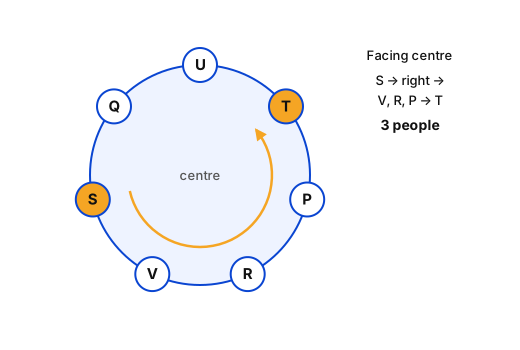
P, Q, R, S, T, U and V are sitting around a circular table facing the centre. Only one person sits between R and T when counted from the left of T. Q sits third to the right of P. U sits third to the left of V. Q sits to the immediate right of U. S is not an immediate neighbour of U. How many people sit between S and T when counted from the right of S?
P, Q, R, S, T, U और V एक वृत्ताकार मेज़ के चारों ओर केंद्र की ओर मुख करके बैठे हैं। T के बाएँ से गिनने पर R और T के बीच केवल एक व्यक्ति बैठा है। Q, P के दाएँ से तीसरे स्थान पर बैठा है। U, V के बाएँ से तीसरे स्थान पर बैठा है। Q, U के ठीक दाएँ बैठा है। S, U का निकटतम पड़ोसी नहीं है। S के दाएँ से गिनने पर S और T के बीच कितने व्यक्ति बैठे हैं?
  1. A4
  2. B2
  3. C3
  4. D1
Show answer

Concept: Facing the centre: right = anticlockwise, left = clockwise.

  1. U fixed; Q is immediate right of U; P is 3rd to the left of Q (Q 3rd right of P); V is 3rd to the right of U.
  2. Remaining 3 seats for R, S, T. R is 2nd to the left of T; S not next to U → T next to U, then R, then S.
  3. Order (clockwise): U, T, P, R, V, S, Q.
  4. From S going right: V, R, P, then T → 3 people.

Trick: Fix the person with most links (U) first.

Answer: (C) 3

अवधारणा: केंद्र की ओर मुख: दायाँ = वामावर्त (anticlockwise), बायाँ = दक्षिणावर्त (clockwise)।

  1. U निश्चित; Q, U के तुरंत दाएँ; P, Q के बाएँ तीसरा; V, U के दाएँ तीसरा।
  2. बची 3 सीटें R, S, T की। R, T के बाएँ दूसरा; S, U का पड़ोसी नहीं → T, U के पास, फिर R, फिर S।
  3. क्रम (clockwise): U, T, P, R, V, S, Q.
  4. S के दाएँ से: V, R, P, फिर T → 3 व्यक्ति।

ट्रिक: सबसे अधिक संबंध वाले व्यक्ति (U) को पहले रखें।

उत्तर: (C) 3

RRB NTPC Graduate CBT 1General Intelligence and ReasoningCircular Seating ArrangementRRB NTPC Graduate CBT 1 2024 · 5 Jun Shift 2 →
Q4555.
If 2 is added to each even digit and 1 is subtracted from each odd digit in the number 6154932, how many digits will appear more than once in the new number thus formed?
यदि संख्या 6154932 में प्रत्येक सम अंक में 2 जोड़ा जाए और प्रत्येक विषम अंक में से 1 घटाया जाए, तो इस प्रकार बनी नई संख्या में कितने अंक एक से अधिक बार आएँगे?
  1. AThreeतीन
  2. BFourचार
  3. CTwoदो
  4. DOneएक
Show answer

Concept: Change each digit separately: even + 2, odd − 1.

  1. 6→8, 1→0, 5→4, 4→6, 9→8, 3→2, 2→4
  2. New number: 8046824
  3. 8 appears twice, 4 appears twice; 0, 6, 2 once → two digits.

Trick: Write the new number fully, then tally.

Answer: (C) Two

अवधारणा: हर अंक अलग से बदलें: सम + 2, विषम − 1।

  1. 6→8, 1→0, 5→4, 4→6, 9→8, 3→2, 2→4
  2. नई संख्या: 8046824
  3. 8 दो बार, 4 दो बार; 0, 6, 2 एक बार → दो अंक।

ट्रिक: नई संख्या पूरी लिखें, फिर गिनें।

उत्तर: (C) Two

RRB NTPC Graduate CBT 1General Intelligence and ReasoningDigit OperationsRRB NTPC Graduate CBT 1 2024 · 5 Jun Shift 2 →
Q4556.
Which of the following letter-clusters should replace # and % so that the pattern and relationship followed between the letter-cluster pair on the left side of :: is the same as that on the right side of :: ?
# : LPR :: PSV : %
निम्नलिखित में से कौन-से अक्षर-समूह # और % को प्रतिस्थापित करने चाहिए, ताकि :: के बाईं ओर के अक्षर-समूह युग्म के बीच का पैटर्न और संबंध वही हो जो :: के दाईं ओर है?
# : LPR :: PSV : %
  1. A# = HNT, % = TUT
  2. B# = HMR, % = TVW
  3. C# = FNR, % = RVM
  4. D# = FMP, % = RUY
Show answer

Concept: Find the shift from # to LPR and apply the same shift to PSV.

  1. (A) HNT → LPR: H+4=L, N+2=P, T−2=R → (+4, +2, −2).
  2. PSV → P+4=T, S+2=U, V−2=T = TUT ✓.

Trick: Check the left pair for each option; keep the one whose shifts also give a listed %.

Answer: (A) # = HNT, % = TUT

अवधारणा: # से LPR तक का खिसकाव निकालकर PSV पर लगाएँ।

  1. (A) HNT → LPR: H+4=L, N+2=P, T−2=R → (+4, +2, −2)।
  2. PSV → P+4=T, S+2=U, V−2=T = TUT ✓.

ट्रिक: हर विकल्प का बायाँ जोड़ा जाँचें; जिसका % भी मिले वही सही।

उत्तर: (A) # = HNT, % = TUT

RRB NTPC Graduate CBT 1General Intelligence and ReasoningLetter AnalogyRRB NTPC Graduate CBT 1 2024 · 5 Jun Shift 2 →
Q4557.
Which of the following letter-clusters should replace # and % so that the pattern and relationship followed between the letter-cluster pair on the left side of :: is the same as that on the right side of ::?
# : AND :: RWX : %
निम्नलिखित में से कौन-से अक्षर-समूह # और % को प्रतिस्थापित करने चाहिए, ताकि :: के बाईं ओर के अक्षर-समूह युग्म के बीच का पैटर्न और संबंध वही हो जो :: के दाईं ओर है?
# : AND :: RWX : %
  1. A# = UTZ, % = OZV
  2. B# = OZV, % = LCT
  3. C# = XQB, % = UTZ
  4. D# = LCT, % = XQB
Show answer

Concept: Find the shift from # to AND and apply it to RWX.

  1. (C) XQB → AND: X+3=A (wrap-around), Q−3=N, B+2=D → (+3, −3, +2).
  2. RWX → R+3=U, W−3=T, X+2=Z = UTZ ✓.

Trick: Remember wrap-around: X → Y → Z → A.

Answer: (C) # = XQB, % = UTZ

अवधारणा: # से AND तक का खिसकाव निकालकर RWX पर लगाएँ।

  1. (C) XQB → AND: X+3=A (Z के बाद फिर A), Q−3=N, B+2=D → (+3, −3, +2)।
  2. RWX → R+3=U, W−3=T, X+2=Z = UTZ ✓.

ट्रिक: चक्रीय क्रम याद रखें: X → Y → Z → A।

उत्तर: (C) # = XQB, % = UTZ

RRB NTPC Graduate CBT 1General Intelligence and ReasoningLetter AnalogyRRB NTPC Graduate CBT 1 2024 · 5 Jun Shift 2 →
Q4558.
Select the triad that follows the same pattern as that followed by the two triads given below. Both triads follow the same pattern.
EL-GN-IK
GN-IP-KM
उस त्रयी का चयन कीजिए जो नीचे दी गई दो त्रयियों के समान पैटर्न का अनुसरण करती है। दोनों त्रयी एक ही पैटर्न का अनुसरण करती हैं।
EL-GN-IK
GN-IP-KM
  1. AJP-KR-MQ
  2. BIP-KR-MQ
  3. CIP-KR-MO
  4. DJP-KS-MQ
Show answer

Concept: Check each letter position separately.

  1. EL-GN-IK: E→G→I (+2, +2); L→N (+2), N→K (−3).
  2. GN-IP-KM: same rule.
  3. IP-KR-MO: I→K→M; P→R (+2), R→O (−3) ✓.

Trick: Option (B) gives MQ – the second letter must be R−3 = O, not Q.

Answer: (C) IP-KR-MO

अवधारणा: हर स्थान के अक्षर अलग जाँचें।

  1. EL-GN-IK: E→G→I (+2, +2); L→N (+2), N→K (−3)।
  2. GN-IP-KM: वही नियम।
  3. IP-KR-MO: I→K→M; P→R (+2), R→O (−3) ✓.

ट्रिक: (B) में MQ है – दूसरा अक्षर R−3 = O होना चाहिए, Q नहीं।

उत्तर: (C) IP-KR-MO

RRB NTPC Graduate CBT 1General Intelligence and ReasoningLetter TriadsRRB NTPC Graduate CBT 1 2024 · 5 Jun Shift 2 →
Q4559.
This question is based on the words given below.
(Left) ACT BUS CAR DAD (Right)
In each of the words, each vowel is changed to the letter immediately following it in the English alphabetical order and each consonant is changed to the letter immediately preceding in the English alphabetical order. In how many letter clusters thus formed, will no vowel appear?
यह प्रश्न नीचे दिए गए शब्दों पर आधारित है।
(बाएँ) ACT BUS CAR DAD (दाएँ)
प्रत्येक शब्द में, प्रत्येक स्वर को अंग्रेज़ी वर्णमाला क्रम में उसके ठीक बाद वाले अक्षर से बदल दिया जाता है और प्रत्येक व्यंजन को अंग्रेज़ी वर्णमाला क्रम में उसके ठीक पहले वाले अक्षर से बदल दिया जाता है। इस प्रकार बने कितने अक्षर-समूहों में कोई स्वर नहीं आएगा?
  1. AOneएक
  2. BTwoदो
  3. CNoneएक भी नहीं
  4. DThreeतीन
Show answer

Concept: Vowel → next letter; consonant → previous letter.

  1. ACT → B B S (no vowel)
  2. BUS → A V R (A is a vowel)
  3. CAR → B B Q (no vowel); DAD → C B C (no vowel)
  4. So 3 clusters have no vowel.

Trick: A consonant B becomes vowel A – watch for B → A.

Answer: (D) Three

अवधारणा: स्वर → अगला अक्षर; व्यंजन → पिछला अक्षर।

  1. ACT → B B S (कोई स्वर नहीं)
  2. BUS → A V R (A स्वर है)
  3. CAR → B B Q (कोई स्वर नहीं); DAD → C B C (कोई स्वर नहीं)
  4. अतः 3 समूहों में स्वर नहीं।

ट्रिक: व्यंजन B बदलकर स्वर A बनता है – B → A पर ध्यान दें।

उत्तर: (D) Three

RRB NTPC Graduate CBT 1General Intelligence and ReasoningLetter Coding – VowelsRRB NTPC Graduate CBT 1 2024 · 5 Jun Shift 2 →
Q4560.
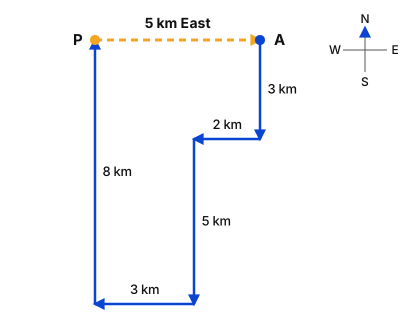
Uday starts from Point A and drives 3 km towards south. He then takes a right turn, drives 2 km, turns left and drives 5 km. He then takes a right turn and drives 3 km. He takes a final right turn, drives 8 km and stops at Point P. How far (shortest distance) and towards which direction should he drive in order to reach Point A again (all turns are 90° turns only unless specified)?
उदय बिंदु A से चलना शुरू करता है और दक्षिण की ओर 3 km गाड़ी चलाता है। फिर वह दाएँ मुड़ता है, 2 km गाड़ी चलाता है, बाएँ मुड़ता है और 5 km गाड़ी चलाता है। फिर वह दाएँ मुड़ता है और 3 km गाड़ी चलाता है। वह अंतिम बार दाएँ मुड़ता है, 8 km गाड़ी चलाता है और बिंदु P पर रुक जाता है। बिंदु A पर फिर से पहुँचने के लिए उसे कितनी दूर (न्यूनतम दूरी) और किस दिशा में गाड़ी चलानी चाहिए (जब तक निर्दिष्ट न हो, सभी मोड़ केवल 90° के हैं)?
  1. A3 km; East3 km; पूर्व
  2. B5 km; West5 km; पश्चिम
  3. C4 km; East4 km; पूर्व
  4. D5 km; East5 km; पूर्व
Show answer

Concept: Track every turn on a sketch (A at origin).

  1. 3 km S; right → West 2 km; left → South 5 km; right → West 3 km; right → North 8 km.
  2. Vertical: −3−5+8=0 → P is level with A.
  3. Horizontal: 2+3=5 km West of A → go 5 km East.

Trick: Net N–S = 0 means the answer is purely East/West.

Answer: (D) 5 km; East

अवधारणा: हर मोड़ को चित्र पर अंकित करें (A मूल बिंदु)।

  1. 3 km दक्षिण; दाएँ → पश्चिम 2 km; बाएँ → दक्षिण 5 km; दाएँ → पश्चिम 3 km; दाएँ → उत्तर 8 km।
  2. ऊर्ध्वाधर: −3−5+8=0 → P, A की सीध में।
  3. क्षैतिज: 2+3=5 km पश्चिम → A तक 5 km पूर्व जाना होगा।

ट्रिक: उत्तर–दक्षिण का शुद्ध योग 0 हो तो उत्तर केवल पूर्व/पश्चिम।

उत्तर: (D) 5 km; East

RRB NTPC Graduate CBT 1General Intelligence and ReasoningDirection and DistanceRRB NTPC Graduate CBT 1 2024 · 5 Jun Shift 2 →