Question bank

Q&A: practice questions with answers

Search questions on any topic. Filter by exam category, exam, subject and topic, try the question, then open the answer and explanation.

Courses – airGurukul

7,077 questions found.

Q461.
The profit made on a product is 79%. What is the loss percentage (correct to two decimal places) incurred on the sale if the figures of both the cost price and the selling price are interchanged?
किसी उत्पाद पर 79% लाभ होता है। यदि क्रय मूल्य और विक्रय मूल्य दोनों के आँकड़े आपस में बदल दिए जाएँ, तो बिक्री पर कितने प्रतिशत हानि (दो दशमलव स्थानों तक सही) होगी?
  1. A45.77%
  2. B46.79%
  3. C45.18%
  4. D44.13%
Show answer

Concept: Take CP = 100; after swapping, the old SP becomes the new CP.

  1. Profit 79% → SP = 179
  2. Swapped: CP = 179, SP = 100, loss = 79
  3. Loss%=79179×100=44.13%

Trick: Swap rule: Loss%=P100+P×100.

Answer: (D) 44.13%

अवधारणा: CP = 100 लें; अदला-बदली के बाद पुराना SP नया CP बनता है।

  1. लाभ 79% → SP = 179
  2. बदलने पर: CP = 179, SP = 100, हानि = 79
  3. हानि%=79179×100=44.13%

ट्रिक: सूत्र: हानि%=P100+P×100।

उत्तर: (D) 44.13%

RRB NTPC Graduate CBT 1MathematicsProfit and lossRRB NTPC Graduate CBT 1 2024 · 23 Jun Shift 2 →
Q462.
Find the roots of the quadratic equation 5x2−12x−17=0.
द्विघात समीकरण 5x2−12x−17=0 के मूल ज्ञात कीजिए।
  1. A1, −175
  2. B−1, 175
  3. C−1, −175
  4. D1, 175
Show answer

Concept: Split the middle term: find two numbers with product 5×(−17)=−85 and sum −12.

  1. The numbers are −17 and 5.
  2. 5x2−17x+5x−17=x(5x−17)+1(5x−17)=(x+1)(5x−17)
  3. x=−1 or x=175

Trick: If a−b+c=0 (here 5+12−17=0), one root is −1 and the other is −ca=175.

Answer: (B) −1, 175

अवधारणा: मध्य पद विभाजित करें: ऐसी दो संख्याएँ जिनका गुणनफल 5×(−17)=−85 और योग −12 हो।

  1. संख्याएँ −17 और 5 हैं।
  2. 5x2−17x+5x−17=x(5x−17)+1(5x−17)=(x+1)(5x−17)
  3. x=−1 या x=175

ट्रिक: यदि a−b+c=0 (यहाँ 5+12−17=0), तो एक मूल −1 और दूसरा −ca=175।

उत्तर: (B) −1, 175

RRB NTPC Graduate CBT 1MathematicsQuadratic equationsRRB NTPC Graduate CBT 1 2024 · 23 Jun Shift 2 →
Q463.
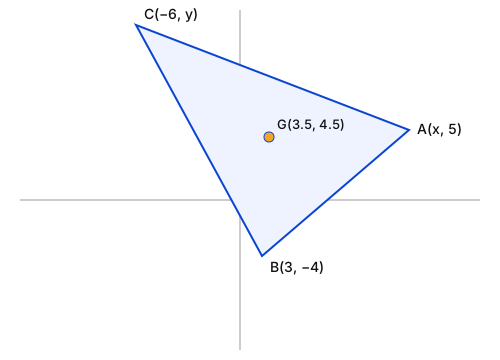
A (x, 5), B (3, – 4) and C (– 6, y) are the three vertices of a triangle ABC. If (3.5, 4.5) is the centroid of the triangle, find the point (x + 3, y – 4).
A (x, 5), B (3, – 4) और C (– 6, y) त्रिभुज ABC के तीन शीर्ष हैं। यदि (3.5, 4.5) त्रिभुज का केंद्रक है, तो बिंदु (x + 3, y – 4) ज्ञात कीजिए।
  1. A(16.5, 8.5)
  2. B(13.5, 12.5)
  3. C(8.5, 16.5)
  4. D(15.5, 9.5)
Show answer

Concept: Centroid G=(x1+x2+x33,y1+y2+y33).

  1. x+3−63=3.5⇒x−3=10.5⇒x=13.5
  2. 5−4+y3=4.5⇒1+y=13.5⇒y=12.5
  3. (x+3, y−4)=(16.5, 8.5)

Trick: Sum of x-coordinates =3×3.5=10.5; sum of y-coordinates =3×4.5=13.5.

Answer: (A) (16.5, 8.5)

अवधारणा: केन्द्रक G=(x1+x2+x33,y1+y2+y33)।

  1. x+3−63=3.5⇒x−3=10.5⇒x=13.5
  2. 5−4+y3=4.5⇒1+y=13.5⇒y=12.5
  3. (x+3, y−4)=(16.5, 8.5)

ट्रिक: x-निर्देशांकों का योग =3×3.5=10.5; y का योग =3×4.5=13.5।

उत्तर: (A) (16.5, 8.5)

RRB NTPC Graduate CBT 1MathematicsCoordinate geometry – centroidRRB NTPC Graduate CBT 1 2024 · 23 Jun Shift 2 →
Q464.
Mukesh sold a car for ₹1,20,000 at 40% loss. For what price (in ₹) should he sell the car to gain 55% profit?
मुकेश ने एक कार ₹1,20,000 में 40% हानि पर बेची। 55% लाभ प्राप्त करने के लिए उसे कार किस मूल्य (₹ में) पर बेचनी चाहिए?
  1. A3,09,999
  2. B3,10,002
  3. C3,10,000
  4. D3,09,998
Show answer

Concept: CP=SP×100100−Loss%; new SP=CP×100+Gain%100.

  1. CP=120000×10060=200000
  2. Required SP=200000×155100=310000

Trick: Direct: 120000×15560=310000.

Answer: (C) ₹3,10,000

अवधारणा: CP=SP×100100−हानि%; नया SP=CP×100+लाभ%100।

  1. CP=120000×10060=200000
  2. अभीष्ट SP=200000×155100=310000

ट्रिक: सीधे: 120000×15560=310000।

उत्तर: (C) ₹3,10,000

RRB NTPC Graduate CBT 1MathematicsProfit and lossRRB NTPC Graduate CBT 1 2024 · 23 Jun Shift 2 →
Q465.
A sum of ₹x amounts to ₹83,853 in 212 years at 12% p.a., interest compounded 10-monthly. What is the value of x?
₹x की राशि 12% वार्षिक दर पर, ब्याज 10-मासिक चक्रवृद्धि होने पर, 212 वर्षों में ₹83,853 हो जाती है। x का मान क्या है?
  1. A62,000
  2. B64,000
  3. C61,000
  4. D63,000
Show answer

Concept: When interest is compounded every 10 months, convert both rate and time to 10-month periods.

  1. Rate per period =12×1012=10%
  2. Time =212 years =30 months =3 periods
  3. x×(1.1)3=83853⇒x×1.331=83853
  4. x=838531.331=63000

Trick: (1.1)3=1.331=13311000; 83853÷1331=63.

Answer: (D) 63,000

अवधारणा: जब ब्याज हर 10 महीने पर चक्रवृद्धि हो, तो दर और समय दोनों 10-मासिक अवधि में बदलें।

  1. प्रति अवधि दर =12×1012=10%
  2. समय =212 वर्ष =30 माह =3 अवधियाँ
  3. x×(1.1)3=83853⇒x×1.331=83853
  4. x=838531.331=63000

ट्रिक: (1.1)3=1.331; 83853÷1331=63।

उत्तर: (D) 63,000

RRB NTPC Graduate CBT 1MathematicsCompound interestRRB NTPC Graduate CBT 1 2024 · 23 Jun Shift 2 →
Q466.
In what time (in years) will ₹2,500 fetch an interest of ₹1,000 at 10% per year simple interest?
₹2,500 पर 10% वार्षिक साधारण ब्याज की दर से कितने समय (वर्षों में) में ₹1,000 ब्याज प्राप्त होगा?
  1. A6
  2. B7
  3. C4
  4. D5
Show answer

Concept: SI=P×R×T100

  1. 1000=2500×10×T100
  2. 1000=250T⇒T=4

Trick: Interest per year =10% of 2500 =250; 1000÷250=4.

Answer: (C) 4 years

अवधारणा: SI=P×R×T100

  1. 1000=2500×10×T100
  2. 1000=250T⇒T=4

ट्रिक: प्रति वर्ष ब्याज =2500 का 10%=250; 1000÷250=4।

उत्तर: (C) 4 वर्ष

RRB NTPC Graduate CBT 1MathematicsSimple interestRRB NTPC Graduate CBT 1 2024 · 23 Jun Shift 2 →
Q467.
If a2+b2=90 and ab=27, then find the possible value of a+ba−b.
यदि a2+b2=90 और ab=27 है, तो a+ba−b का संभावित मान ज्ञात कीजिए।
  1. A2
  2. B4
  3. C3
  4. D1
Show answer

Concept: (a±b)2=a2+b2±2ab

  1. (a+b)2=90+54=144⇒a+b=±12
  2. (a−b)2=90−54=36⇒a−b=±6
  3. a+ba−b=126=2 (or −2); the possible value in the options is 2

Trick: Also: a=9, b=3 fits (81+9=90, ab=27) → 126=2.

Answer: (A) 2

अवधारणा: (a±b)2=a2+b2±2ab

  1. (a+b)2=90+54=144⇒a+b=±12
  2. (a−b)2=90−54=36⇒a−b=±6
  3. a+ba−b=126=2 (या −2); विकल्पों में संभव मान 2 है

ट्रिक: a=9, b=3 रखें (81+9=90, ab=27) → 126=2।

उत्तर: (A) 2

RRB NTPC Graduate CBT 1MathematicsAlgebraic identitiesRRB NTPC Graduate CBT 1 2024 · 23 Jun Shift 2 →
Q468.
The LCM of 48, 88 and another number, x, is 4752. Which of the following can be the value of x?
48, 88 और एक अन्य संख्या x का LCM 4752 है। निम्नलिखित में से कौन-सा x का मान हो सकता है?
  1. A202
  2. B307
  3. C216
  4. D123
Show answer

Concept: x must divide the LCM and must supply every prime power of the LCM that 48 and 88 lack.

  1. 48=24×3, 88=23×11, 4752=24×33×11
  2. x must contain 33=27 and have no prime other than 2, 3, 11.
  3. 216=23×33 ✓; 202 has 101, 307 is prime, 123 has 41 – none divide 4752.

Trick: First test: does the option divide the LCM? 4752÷216=22 ✓.

Answer: (C) 216

अवधारणा: x को LCM का गुणनखंड होना चाहिए और वह अभाज्य घात देनी चाहिए जो 48 और 88 में नहीं है।

  1. 48=24×3, 88=23×11, 4752=24×33×11
  2. x में 33=27 होना चाहिए और 2, 3, 11 के अलावा कोई अभाज्य नहीं।
  3. 216=23×33 ✓; 202 में 101, 307 अभाज्य, 123 में 41 – कोई भी 4752 को नहीं बाँटता।

ट्रिक: पहले देखें: क्या विकल्प LCM को विभाजित करता है? 4752÷216=22 ✓।

उत्तर: (C) 216

RRB NTPC Graduate CBT 1MathematicsLCMRRB NTPC Graduate CBT 1 2024 · 23 Jun Shift 2 →
Q469.
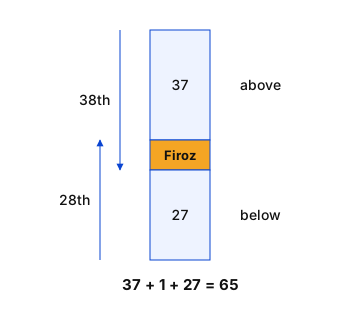
Firoz ranked 38th from the top and 28th from the bottom in his class. How many students are there in his class?
फ़िरोज़ अपनी कक्षा में ऊपर से 38वें और नीचे से 28वें स्थान पर है। उसकी कक्षा में कितने विद्यार्थी हैं?
  1. A65
  2. B66
  3. C63
  4. D64
Show answer

Concept: Total students = rank from top + rank from bottom − 1.

  1. Students above Firoz = 38−1=37; below him = 28−1=27.
  2. Total = 37+1+27=65.

Trick: Total =T+B−1=38+28−1=65.

Answer: (A) 65

अवधारणा: कुल छात्र = ऊपर से रैंक + नीचे से रैंक − 1।

  1. फिरोज़ से ऊपर =38−1=37; नीचे =28−1=27।
  2. कुल =37+1+27=65।

ट्रिक: कुल =T+B−1=38+28−1=65।

उत्तर: (A) 65

RRB NTPC Graduate CBT 1General Intelligence and ReasoningRankingRRB NTPC Graduate CBT 1 2024 · 23 Jun Shift 2 →
Q470.
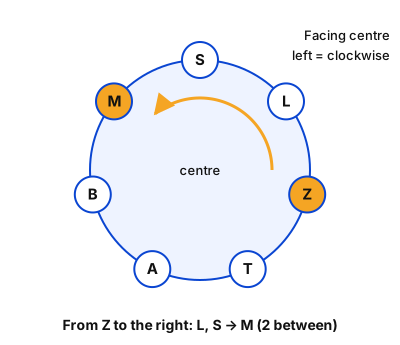
A, B, L, M, S, T and Z are sitting around a circular table facing the centre. T sits third to the left of S. M sits second to the left of A. Only S sits between L and M. B is not an immediate neighbour of T. How many people sit between Z and M when counted from the right of Z?
A, B, L, M, S, T और Z एक वृत्ताकार मेज़ के चारों ओर केंद्र की ओर मुख करके बैठे हैं। T, S के बाएँ से तीसरे स्थान पर बैठा है। M, A के बाएँ से दूसरे स्थान पर बैठा है। L और M के बीच केवल S बैठा है। B, T का निकटतम पड़ोसी नहीं है। Z के दाएँ से गिनने पर Z और M के बीच कितने व्यक्ति बैठे हैं?
  1. A1
  2. B2
  3. C3
  4. D4
Show answer

Concept: Facing the centre, 'left' means clockwise and 'right' means anticlockwise.

  1. Fix S. T is third to the left of S. Only S sits between L and M, so L and M are the two neighbours of S.
  2. M is second to the left of A. If M were on S's left, A would land on L's seat, so M is on S's right (anticlockwise) side, L on S's left, and A is two places to the right of M.
  3. The two seats left go to B and Z. B cannot sit next to T, so B takes the seat beside A on M's side, and Z sits next to T.
  4. Going right from Z: L, S, then M, so 2 people sit between them.

Trick: Draw the circle first, place S and T, then the pair L–S–M; the rest fall in place.

Answer: (B) 2

अवधारणा: केंद्र की ओर मुख होने पर 'बाएँ' = दक्षिणावर्त (clockwise), 'दाएँ' = वामावर्त।

  1. S को स्थिर करें। T, S के बाएँ तीसरे स्थान पर है। L और M के बीच केवल S है, अतः L और M, S के दोनों पड़ोसी हैं।
  2. M, A के बाएँ दूसरे स्थान पर है। M को S के बाईं ओर रखने पर A की जगह L से टकराती है, इसलिए M, S के दाईं ओर (वामावर्त) और L बाईं ओर है; A, M से दो स्थान दाईं ओर है।
  3. बचे दो स्थान B और Z के हैं। B, T का पड़ोसी नहीं, इसलिए B, A के पास M वाली ओर बैठता है और Z, T के पास।
  4. Z के दाएँ चलें: L, S, फिर M → बीच में 2 व्यक्ति।

ट्रिक: पहले वृत्त बनाएँ, S और T रखें, फिर L–S–M जोड़ी; बाकी अपने-आप बैठ जाते हैं।

उत्तर: (B) 2

RRB NTPC Graduate CBT 1General Intelligence and ReasoningCircular Seating ArrangementRRB NTPC Graduate CBT 1 2024 · 23 Jun Shift 2 →
Q471.
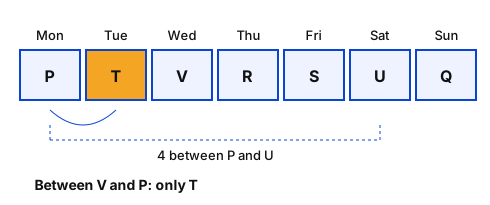
Each of P, Q, R, S, T, U and V has an exam on a different day of a week starting from Monday and ending on Sunday of the same week. T has the exam immediately after P. R has the exam before S but after V. Q has the exam on Sunday. Only four people have exams between P and U. How many people have exams between V and P?
P, Q, R, S, T, U और V में से प्रत्येक की परीक्षा एक ही सप्ताह के सोमवार से शुरू होकर रविवार को समाप्त होने वाले सप्ताह के अलग-अलग दिन है। T की परीक्षा P के ठीक बाद है। R की परीक्षा S से पहले लेकिन V के बाद है। Q की परीक्षा रविवार को है। P और U के बीच केवल चार व्यक्तियों की परीक्षाएँ हैं। V और P के बीच कितने व्यक्तियों की परीक्षाएँ हैं?
  1. AOneएक
  2. BTwoदो
  3. CFourचार
  4. DThreeतीन
Show answer

Concept: Fix the definite clues first (Q on Sunday), then the pair clues.

  1. Four between P and U ⇒ positions (Mon, Sat) or (Tue, Sun). Sunday is Q, so P and U are Mon and Sat.
  2. T is right after P; if P were Sat, T would be Sun (Q's day). So P = Mon, T = Tue, U = Sat.
  3. V, R, S fill Wed, Thu, Fri in order V < R < S.
  4. Between V (Wed) and P (Mon): only T → one person.

Trick: Clue with 'only four between' in a 7-slot row has just two placements – test both.

Answer: (A) One

अवधारणा: पहले निश्चित संकेत (Q रविवार) रखें, फिर जोड़ी वाले संकेत।

  1. P और U के बीच चार ⇒ (सोम, शनि) या (मंगल, रवि)। रविवार Q का है, अतः P, U सोम और शनि पर।
  2. T, P के ठीक बाद; P शनि हो तो T रवि पर (Q का दिन)। अतः P = सोम, T = मंगल, U = शनि।
  3. V, R, S क्रम V < R < S में बुध, गुरु, शुक्र पर।
  4. V (बुध) और P (सोम) के बीच केवल T → एक व्यक्ति।

ट्रिक: 7 स्थानों में 'बीच में चार' के केवल दो विकल्प होते हैं – दोनों जाँचें।

उत्तर: (A) One

RRB NTPC Graduate CBT 1General Intelligence and ReasoningScheduling PuzzleRRB NTPC Graduate CBT 1 2024 · 23 Jun Shift 2 →
Q472.
Refer to the following number and symbol series and answer the question that follows. Counting to be done from left to right only.
(Left) 5 @ 6 # 8 $ % 1 9 ^ 7 ≺ 2 3 ⋟ 4 (Right)
How many such symbols are there, each of which is immediately preceded by a number and also immediately followed by another number?
निम्नलिखित संख्या और प्रतीक शृंखला को देखिए और उसके बाद आने वाले प्रश्न का उत्तर दीजिए। गिनती केवल बाएँ से दाएँ की जानी है।
(बाएँ) 5 @ 6 # 8 $ % 1 9 ^ 7 ≺ 2 3 ⋟ 4 (दाएँ)
ऐसे कितने प्रतीक हैं, जिनमें से प्रत्येक के ठीक पहले एक संख्या है और ठीक बाद भी एक अन्य संख्या है?
  1. AOneएक
  2. BThreeतीन
  3. CTwoदो
  4. DMore than threeतीन से अधिक
Show answer

Concept: Check every symbol: the element just before and just after it must both be numbers.

  1. Series: 5 @ 6 # 8 $ % 1 9 ^ 7 ≺ 2 3 ⋟ 4
  2. @ (5, 6) ✓, # (6, 8) ✓, $ (8, %) ✗, % ($, 1) ✗
  3. ^ (9, 7) ✓, ≺ (7, 2) ✓, ⋟ (3, 4) ✓
  4. Total = 5, i.e. more than three.

Trick: Two symbols together ($ %) can never qualify – skip them quickly.

Answer: (D) More than three

अवधारणा: हर प्रतीक के ठीक पहले और ठीक बाद संख्या होनी चाहिए।

  1. श्रृंखला: 5 @ 6 # 8 $ % 1 9 ^ 7 ≺ 2 3 ⋟ 4
  2. @ (5, 6) ✓, # (6, 8) ✓, $ (8, %) ✗, % ($, 1) ✗
  3. ^ (9, 7) ✓, ≺ (7, 2) ✓, ⋟ (3, 4) ✓
  4. कुल = 5, अर्थात तीन से अधिक।

ट्रिक: लगातार दो प्रतीक ($ %) कभी शर्त पूरी नहीं करते – उन्हें छोड़ दें।

उत्तर: (D) More than three

RRB NTPC Graduate CBT 1General Intelligence and ReasoningSymbol-Number SeriesRRB NTPC Graduate CBT 1 2024 · 23 Jun Shift 2 →
Q473.
Refer to the following number and symbol series and answer the question that follows. Counting to be done from left to right only.
(Note: All numbers are single digit numbers only.)
(Left) € & % & 5 6 3 1 © 1 4 6 @ £ @ $ 8 8 £ 8 % 1 (Right)
How many such numbers are there, each of which is immediately preceded by a symbol and also immediately followed by a symbol?
निम्नलिखित संख्या और प्रतीक शृंखला को देखिए और उसके बाद आने वाले प्रश्न का उत्तर दीजिए। गिनती केवल बाएँ से दाएँ की जानी है।
(नोट: सभी संख्याएँ केवल एक-अंकीय संख्याएँ हैं।)
(बाएँ) € & % & 5 6 3 1 © 1 4 6 @ £ @ $ 8 8 £ 8 % 1 (दाएँ)
ऐसी कितनी संख्याएँ हैं, जिनमें से प्रत्येक के ठीक पहले एक प्रतीक है और ठीक बाद भी एक प्रतीक है?
  1. A2
  2. B3
  3. C0
  4. D1
Show answer

Concept: Look for the pattern symbol – number – symbol.

  1. Series: € & % & 5 6 3 1 © 1 4 6 @ £ @ $ 8 8 £ 8 % 1
  2. 5 (after &) is followed by 6 ✗; 1 after © is followed by 4 ✗; 8 after $ is followed by 8 ✗.
  3. £ 8 % ✓ – the only one; the last 1 has nothing after it.
  4. Count = 1.

Trick: Scan only numbers that stand alone between two symbols.

Answer: (D) 1

अवधारणा: प्रतीक – संख्या – प्रतीक का क्रम खोजें।

  1. श्रृंखला: € & % & 5 6 3 1 © 1 4 6 @ £ @ $ 8 8 £ 8 % 1
  2. & के बाद 5 के बाद 6 है ✗; © के बाद 1 के बाद 4 ✗; $ के बाद 8 के बाद 8 ✗।
  3. £ 8 % ✓ – केवल यही; अंतिम 1 के बाद कुछ नहीं।
  4. संख्या = 1।

ट्रिक: केवल वे संख्याएँ देखें जो दो प्रतीकों के बीच अकेली हों।

उत्तर: (D) 1

RRB NTPC Graduate CBT 1General Intelligence and ReasoningSymbol-Number SeriesRRB NTPC Graduate CBT 1 2024 · 23 Jun Shift 2 →
Q474.
A group of numbers and symbols is coded using letter codes as per the codes given below and the conditions that follow. Study the given codes and conditions and answer the question that follows.
Note: If none of the conditions apply, then codes for the respective number/symbol are to be followed directly as given in the table.
Number/symbol6÷7%@+84-2#39&
CodePESHWQGTIMZAVR
Conditions:
(i) If the first element is a prime number and the last element is an even number, then the codes for these two (first and last elements) are to be interchanged.
(ii) If the third element is a symbol, then it is to be coded as α.
(iii) If both the second and the fourth elements are perfect numbers, then the fourth number is to be coded as the code for the second element.
What will be the code for the following group?
3 ÷ 7 @ 4
संख्याओं और प्रतीकों के एक समूह को नीचे दिए गए कूटों और उसके बाद दी गई शर्तों के अनुसार अक्षर कूटों का प्रयोग करके कूटबद्ध किया गया है। दिए गए कूटों और शर्तों का अध्ययन कीजिए और उसके बाद आने वाले प्रश्न का उत्तर दीजिए।
नोट: यदि कोई भी शर्त लागू नहीं होती है, तो संबंधित संख्या/प्रतीक के कूट का सीधे तालिका में दिए गए अनुसार पालन किया जाना है।
संख्या/प्रतीक6÷7%@+84-2#39&
कूटPESHWQGTIMZAVR
शर्तें:
(i) यदि पहला अवयव एक अभाज्य संख्या है और अंतिम अवयव एक सम संख्या है, तो इन दोनों (पहले और अंतिम अवयवों) के कूट आपस में बदल दिए जाएँगे।
(ii) यदि तीसरा अवयव एक प्रतीक है, तो उसे α के रूप में कूटबद्ध किया जाएगा।
(iii) यदि दूसरा और चौथा दोनों अवयव पूर्ण संख्याएँ (perfect numbers) हैं, तो चौथी संख्या को दूसरे अवयव के कूट के रूप में कूटबद्ध किया जाएगा।
निम्नलिखित समूह का कूट क्या होगा?
3 ÷ 7 @ 4
  1. AAESWT
  2. BAESWA
  3. CTEAWA
  4. DTESWA
Show answer

Concept: Write the direct codes, then apply only the conditions that are satisfied.

  1. Direct codes: 3 → A, ÷ → E, 7 → S, @ → W, 4 → T.
  2. Condition (i): first 3 is prime and last 4 is even → swap codes: first = T, last = A.
  3. Condition (ii): third element 7 is not a symbol – no change. Condition (iii): second element ÷ is not a number – no change.
  4. Code = T E S W A.

Trick: Check conditions one by one; most groups satisfy only one.

Answer: (D) TESWA

अवधारणा: पहले सीधे कोड लिखें, फिर केवल लागू शर्तें लगाएँ।

  1. सीधे कोड: 3 → A, ÷ → E, 7 → S, @ → W, 4 → T।
  2. शर्त (i): पहला 3 अभाज्य और अंतिम 4 सम → कोड अदला-बदली: पहला = T, अंतिम = A।
  3. शर्त (ii): तीसरा 7 प्रतीक नहीं; शर्त (iii): दूसरा ÷ संख्या नहीं – कोई बदलाव नहीं।
  4. कोड = T E S W A।

ट्रिक: शर्तें एक-एक कर जाँचें; प्रायः एक ही लागू होती है।

उत्तर: (D) TESWA

RRB NTPC Graduate CBT 1General Intelligence and ReasoningCoding with ConditionsRRB NTPC Graduate CBT 1 2024 · 23 Jun Shift 2 →
Q475.
Which of the following letter-clusters should replace # and % so that the pattern and relationship followed between the letter-cluster pair on the left side of :: is the same as that on the right side of :: ?
# : MTZ :: KRX : %
निम्नलिखित में से कौन-से अक्षर-समूह # और % को प्रतिस्थापित करें, ताकि :: के बाईं ओर के अक्षर-समूह युग्म के बीच का पैटर्न और संबंध वही हो, जो :: के दाईं ओर है?
# : MTZ :: KRX : %
  1. A# = HOU, % = PWP
  2. B# = YOU, % = PWC
  3. C# = HYU, % = PWC
  4. D# = HOU, % = PWC
Show answer

Concept: Find how KRX changes; apply the same change to get MTZ from #.

  1. Positions: H(8) O(15) U(21) → +5 each → M(13) T(20) Z(26).
  2. Same rule on KRX: K+5 = P, R+5 = W, X+5 = C (wrap after Z).
  3. So # = HOU and % = PWC.

Trick: Check one letter first: X + 5 = C eliminates PWP straight away.

Answer: (D) # = HOU, % = PWC

अवधारणा: KRX में होने वाला बदलाव ही # से MTZ में होना चाहिए।

  1. स्थान: H(8) O(15) U(21) → प्रत्येक +5 → M(13) T(20) Z(26)।
  2. KRX पर वही नियम: K+5 = P, R+5 = W, X+5 = C (Z के बाद फिर A से)।
  3. अतः # = HOU, % = PWC।

ट्रिक: पहले एक अक्षर जाँचें: X + 5 = C, इससे PWP तुरंत हट जाता है।

उत्तर: (D) # = HOU, % = PWC

RRB NTPC Graduate CBT 1General Intelligence and ReasoningLetter AnalogyRRB NTPC Graduate CBT 1 2024 · 23 Jun Shift 2 →
Q476.
What should come in place of the question mark (?) in the given series?
1312 1320 1330 1342 1356 ?
दी गई शृंखला में प्रश्न चिह्न (?) के स्थान पर क्या आना चाहिए?
1312 1320 1330 1342 1356 ?
  1. A1372
  2. B1370
  3. C1374
  4. D1368
Show answer

Concept: Look at the differences between consecutive terms.

  1. 1320−1312=8, 1330−1320=10, 1342−1330=12, 1356−1342=14
  2. Differences rise by 2 → next difference =16.
  3. 1356+16=1372

Trick: Differences 8, 10, 12, 14, 16 – an even-number ladder.

Answer: (A) 1372

अवधारणा: क्रमागत पदों का अंतर देखें।

  1. अंतर: 8,10,12,14
  2. अंतर 2-2 से बढ़ रहा है → अगला अंतर =16।
  3. 1356+16=1372

ट्रिक: अंतर 8, 10, 12, 14, 16 – सम संख्याओं की सीढ़ी।

उत्तर: (A) 1372

RRB NTPC Graduate CBT 1General Intelligence and ReasoningNumber SeriesRRB NTPC Graduate CBT 1 2024 · 23 Jun Shift 2 →
Q477.
In a certain code language, ‘YOUR’ is coded as ‘5683’ and ‘UNIT’ is coded as ‘2519’. What is the code for ‘U’ in the given code language?
एक निश्चित कूट भाषा में, ‘YOUR’ को ‘5683’ के रूप में और ‘UNIT’ को ‘2519’ के रूप में कूटबद्ध किया जाता है। दी गई कूट भाषा में ‘U’ का कूट क्या है?
  1. A5
  2. B8
  3. C9
  4. D2
Show answer

Concept: A letter common to two words must take the digit common to both codes.

  1. YOUR → 5683 and UNIT → 2519.
  2. Common letter: U. Common digit: 5.
  3. So U = 5.

Trick: Match common letters with common digits.

Answer: (A) 5

अवधारणा: दोनों शब्दों में उभयनिष्ठ अक्षर का कोड दोनों कोडों में उभयनिष्ठ अंक होगा।

  1. YOUR → 5683 और UNIT → 2519।
  2. उभयनिष्ठ अक्षर: U; उभयनिष्ठ अंक: 5।
  3. अतः U = 5।

ट्रिक: उभयनिष्ठ अक्षर ↔ उभयनिष्ठ अंक।

उत्तर: (A) 5

RRB NTPC Graduate CBT 1General Intelligence and ReasoningCoding-DecodingRRB NTPC Graduate CBT 1 2024 · 23 Jun Shift 2 →
Q478.
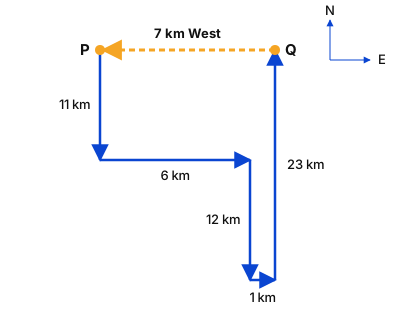
Mr. D starts from Point P and drives 11 km towards the South. He then takes a left turn, drives 6 km, turns right and drives 12 km. He then takes a left turn and drives 1 km. He takes a final left turn derives 23 km and stops at Point Q. How far (shortest distance) and towards which direction should he drive in order to reach Point P again? (All turns are 90 degrees turns only unless specified.)
श्री D बिंदु P से शुरू करते हैं और दक्षिण की ओर 11 km गाड़ी चलाते हैं। फिर वे बाएँ मुड़ते हैं, 6 km गाड़ी चलाते हैं, दाएँ मुड़ते हैं और 12 km गाड़ी चलाते हैं। फिर वे बाएँ मुड़ते हैं और 1 km गाड़ी चलाते हैं। वे अंतिम बार बाएँ मुड़ते हैं, 23 km गाड़ी चलाते हैं और बिंदु Q पर रुक जाते हैं। पुनः बिंदु P पर पहुँचने के लिए उन्हें कितनी दूर (न्यूनतम दूरी) और किस दिशा में गाड़ी चलानी चाहिए? (जब तक निर्दिष्ट न किया जाए, सभी मोड़ केवल 90 डिग्री के मोड़ हैं।)
  1. A3 km towards the Northउत्तर की ओर 3 km
  2. B4 km towards the Southदक्षिण की ओर 4 km
  3. C7 km towards the Westपश्चिम की ओर 7 km
  4. D7 km towards the Eastपूर्व की ओर 7 km
Show answer

Concept: Track each move on a grid (East +x, North +y).

  1. P(0, 0) → 11 km South → (0, −11).
  2. Left (now East) 6 km → (6, −11); right (South) 12 km → (6, −23).
  3. Left (East) 1 km → (7, −23); left (North) 23 km → Q(7, 0).
  4. Q is 7 km East of P, so he must drive 7 km towards the West.

Trick: Net N–S: −11 −12 +23 = 0; net E–W: 6 + 1 = 7 East → return 7 km West.

Answer: (C) 7 km towards the West

अवधारणा: हर कदम को ग्रिड पर लिखें (पूर्व +x, उत्तर +y)।

  1. P(0, 0) → 11 किमी दक्षिण → (0, −11)।
  2. बाएँ (पूर्व) 6 किमी → (6, −11); दाएँ (दक्षिण) 12 किमी → (6, −23)।
  3. बाएँ (पूर्व) 1 किमी → (7, −23); बाएँ (उत्तर) 23 किमी → Q(7, 0)।
  4. Q, P से 7 किमी पूर्व में है, अतः 7 किमी पश्चिम जाना होगा।

ट्रिक: उत्तर–दक्षिण: −11 −12 +23 = 0; पूर्व–पश्चिम: 6 + 1 = 7 पूर्व → वापसी 7 किमी पश्चिम।

उत्तर: (C) 7 km towards the West

RRB NTPC Graduate CBT 1General Intelligence and ReasoningDirection and DistanceRRB NTPC Graduate CBT 1 2024 · 23 Jun Shift 2 →
Q479.
In a certain code language,
A + B means ‘A is the son of B’,
A – B means ‘A is the sister of B’,
A x B means ‘A is the wife of B’ and
A ÷ B means ‘A is the father of B’.
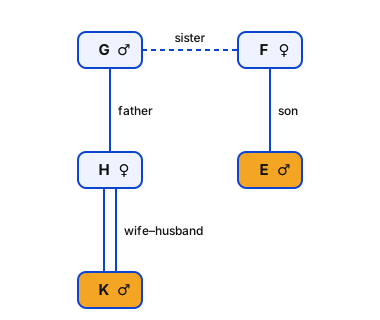
Based on the above, how is E related to K if ‘E + F – G ÷ H x K’?
एक निश्चित कूट भाषा में,
A + B का अर्थ है ‘A, B का पुत्र है’,
A – B का अर्थ है ‘A, B की बहन है’,
A x B का अर्थ है ‘A, B की पत्नी है’ और
A ÷ B का अर्थ है ‘A, B का पिता है’।
उपर्युक्त के आधार पर, यदि ‘E + F – G ÷ H x K’ है, तो E, K से किस प्रकार संबंधित है?
  1. AWife's father's sister's sonपत्नी के पिता की बहन का पुत्र
  2. BWife's father's brother's sonपत्नी के पिता के भाई का पुत्र
  3. CWife's mother's sister's sonपत्नी की माता की बहन का पुत्र
  4. DWife's mother's brother's sonपत्नी की माता के भाई का पुत्र
Show answer

Concept: Decode each symbol and build the family tree from K's side.

  1. E + F: E is the son of F. F – G: F is the sister of G.
  2. G ÷ H: G is the father of H. H × K: H is the wife of K.
  3. From K: wife (H) → her father (G) → his sister (F) → her son (E).

Trick: Read the chain backwards from K to E.

Answer: (A) Wife's father's sister's son

अवधारणा: हर प्रतीक का अर्थ लिखें और K की ओर से वंश-वृक्ष बनाएँ।

  1. E + F: E, F का पुत्र है। F – G: F, G की बहन है।
  2. G ÷ H: G, H का पिता है। H × K: H, K की पत्नी है।
  3. K से: पत्नी (H) → उसके पिता (G) → उनकी बहन (F) → उनका पुत्र (E)।

ट्रिक: श्रृंखला को K से E की ओर उल्टा पढ़ें।

उत्तर: (A) Wife's father's sister's son

RRB NTPC Graduate CBT 1General Intelligence and ReasoningCoded Blood RelationsRRB NTPC Graduate CBT 1 2024 · 23 Jun Shift 2 →
Q480.
Based on the English alphabetical order, three of the following four letter-cluster pairs are alike in a certain way and thus form a group. Which letter-cluster pair DOES NOT belong to that group?
(Note: The odd one out is not based on the number of consonants/vowels or their position in the letter-cluster.)
अंग्रेज़ी वर्णमाला क्रम के आधार पर, निम्नलिखित चार अक्षर-समूह युग्मों में से तीन किसी निश्चित प्रकार से एकसमान हैं और इस प्रकार एक समूह बनाते हैं। कौन-सा अक्षर-समूह युग्म उस समूह से संबंधित नहीं है?
(नोट: असंगत अक्षर-समूह, उस अक्षर-समूह में व्यंजनों/स्वरों की संख्या या उनके स्थान पर आधारित नहीं है।)
  1. AGE – ZU
  2. BPN – JD
  3. CLJ – EZ
  4. DQO – JE
Show answer

Concept: Find the letter gap inside each cluster.

  1. GE – ZU: G−2 = E, Z−5 = U.
  2. LJ – EZ: L−2 = J, E−5 = Z (wrap). QO – JE: Q−2 = O, J−5 = E.
  3. PN – JD: P−2 = N but J−6 = D → breaks the −2, −5 pattern.

Trick: First clusters all are −2; the second cluster decides – check −5.

Answer: (B) PN – JD

अवधारणा: हर क्लस्टर के अंदर अक्षरों का अंतर देखें।

  1. GE – ZU: G−2 = E, Z−5 = U।
  2. LJ – EZ: L−2 = J, E−5 = Z (घूमकर)। QO – JE: Q−2 = O, J−5 = E।
  3. PN – JD: P−2 = N पर J−6 = D → −2, −5 का नियम टूटता है।

ट्रिक: पहला क्लस्टर सबमें −2 है; दूसरे क्लस्टर में −5 जाँचें।

उत्तर: (B) PN – JD

RRB NTPC Graduate CBT 1General Intelligence and ReasoningOdd One Out – Letter PairsRRB NTPC Graduate CBT 1 2024 · 23 Jun Shift 2 →