Question bank

Q&A: practice questions with answers

Search questions on any topic. Filter by exam category, exam, subject and topic, try the question, then open the answer and explanation.

Courses – airGurukul

7,077 questions found.

Q481.
Read the given statements and conclusions carefully. Assuming that the information given in the statements is true, even if it appears to be at variance with commonly known facts, decide which of the given conclusion(s) logically follow(s) from the statements.
Statements:
All bottles are glasses.
No glasses are plates.
Some plates are spoons.
Conclusion (I) No bottles are plates.
Conclusion (II) No spoons are glasses.
दिए गए कथनों और निष्कर्षों को ध्यानपूर्वक पढ़िए। यह मानते हुए कि कथनों में दी गई जानकारी सत्य है, भले ही वह सामान्यतः ज्ञात तथ्यों से भिन्न प्रतीत होती हो, निर्णय लीजिए कि दिए गए निष्कर्षों में से कौन-सा/से निष्कर्ष तार्किक रूप से कथनों का अनुसरण करता है/करते हैं।
कथन:
सभी बोतलें, गिलास हैं।
कोई गिलास, प्लेट नहीं है।
कुछ प्लेटें, चम्मच हैं।
निष्कर्ष (I) कोई बोतल, प्लेट नहीं है।
निष्कर्ष (II) कोई चम्मच, गिलास नहीं है।
  1. AOnly Conclusion (II) is trueकेवल निष्कर्ष (II) सत्य है
  2. BBoth Conclusion (I) and (II) are trueनिष्कर्ष (I) और (II) दोनों सत्य हैं
  3. CNeither Conclusion (I) nor (II) is trueन तो निष्कर्ष (I) और न ही (II) सत्य है
  4. DOnly Conclusion (I) is trueकेवल निष्कर्ष (I) सत्य है
Show answer

Concept: Draw the least-overlap Venn diagram that satisfies all statements.
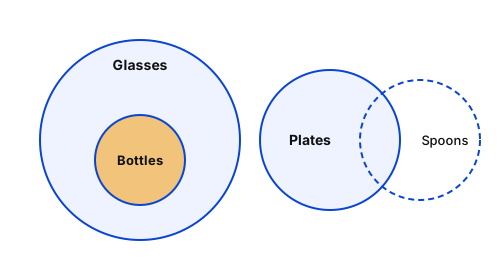
  1. All bottles are inside glasses, and glasses are completely separate from plates ⇒ no bottle can be a plate. Conclusion I ✓.
  2. Spoons only touch plates; some spoons may still be glasses (possible case), so 'No spoons are glasses' is not certain. Conclusion II ✗.

Trick: All A are B + No B are C ⇒ No A are C (always).

Answer: (D) Only Conclusion (I) is true

अवधारणा: सभी कथनों को मानते हुए न्यूनतम ओवरलैप वाला वेन आरेख बनाएँ।

  1. सभी bottles, glasses के अंदर हैं और glasses, plates से पूरी तरह अलग ⇒ कोई bottle, plate नहीं। निष्कर्ष I ✓।
  2. Spoons केवल plates से जुड़े हैं; कुछ spoons glasses हो भी सकते हैं, अतः 'No spoons are glasses' निश्चित नहीं। निष्कर्ष II ✗।

ट्रिक: सभी A, B हैं + कोई B, C नहीं ⇒ कोई A, C नहीं (हमेशा)।

उत्तर: (D) Only Conclusion (I) is true
RRB NTPC Graduate CBT 1General Intelligence and ReasoningSyllogismRRB NTPC Graduate CBT 1 2024 · 23 Jun Shift 2 →
Q482.
In the following triads, each group of letters is related to the subsequent one following a certain logic. Select from the given options, the one that follows the same logic. WORK - OWRK - KOWR
FERN - EFRN - NEFR
निम्नलिखित त्रिकों में, अक्षरों का प्रत्येक समूह एक निश्चित तर्क का अनुसरण करते हुए अगले समूह से संबंधित है। दिए गए विकल्पों में से उस विकल्प का चयन कीजिए, जो समान तर्क का अनुसरण करता है। WORK - OWRK - KOWR
FERN - EFRN - NEFR
  1. ARATE - ARTE - ATER
  2. BWIND - IWND - DIWN
  3. CQUIT - UQIT - TUIQ
  4. DDRUM - DURM - MURD
Show answer

Concept: Step 1: swap the first two letters. Step 2: move the last letter to the front.

  1. WORK → OWRK → KOWR; FERN → EFRN → NEFR.
  2. WIND → IWND (swap W, I) → DIWN (D to front) ✓.
  3. RATE → ARTE → EART (not ATER); QUIT → UQIT → TUQI (not TUIQ); DRUM → RDUM (not DURM).

Trick: Test only the last step on each option – the moved letter must be the old last one.

Answer: (B) WIND - IWND - DIWN

अवधारणा: चरण 1: पहले दो अक्षर अदला-बदली। चरण 2: अंतिम अक्षर सबसे आगे।

  1. WORK → OWRK → KOWR; FERN → EFRN → NEFR।
  2. WIND → IWND (W, I बदले) → DIWN (D आगे) ✓।
  3. RATE → ARTE → EART (ATER नहीं); QUIT → UQIT → TUQI (TUIQ नहीं); DRUM → RDUM (DURM नहीं)।

ट्रिक: हर विकल्प में अंतिम चरण जाँचें – आगे आया अक्षर पहले का अंतिम अक्षर होना चाहिए।

उत्तर: (B) WIND - IWND - DIWN

RRB NTPC Graduate CBT 1General Intelligence and ReasoningLetter Pattern TriadsRRB NTPC Graduate CBT 1 2024 · 23 Jun Shift 2 →
Q483.
If ‘P’ stands for ‘×’, ‘Q’ stands for ‘÷’, ‘R’ stands for ‘−’ and ‘S’ stands for ‘+’, then what will come in place of the question mark (?) in the following equation?
(11 S 7) P 3 R 41 S 8 P 12 R 54 = ?
यदि ‘P’ का अर्थ ‘×’, ‘Q’ का अर्थ ‘÷’, ‘R’ का अर्थ ‘−’ और ‘S’ का अर्थ ‘+’ है, तो निम्नलिखित समीकरण में प्रश्न चिह्न (?) के स्थान पर क्या आएगा?
(11 S 7) P 3 R 41 S 8 P 12 R 54 = ?
  1. A70
  2. B55
  3. C32
  4. D40
Show answer

Concept: Replace letters with signs, then apply BODMAS.

  1. (11+7)×3−41+8×12−54
  2. =18×3−41+96−54
  3. =54−41+96−54=55

Trick: +54 and −54 cancel: answer =96−41=55.

Answer: (B) 55

अवधारणा: अक्षरों को चिह्नों से बदलें, फिर BODMAS लगाएँ।

  1. (11+7)×3−41+8×12−54
  2. =54−41+96−54
  3. =55

ट्रिक: +54 और −54 कट जाते हैं: 96−41=55।

उत्तर: (B) 55

RRB NTPC Graduate CBT 1General Intelligence and ReasoningMathematical OperationsRRB NTPC Graduate CBT 1 2024 · 23 Jun Shift 2 →
Q484.
Select the set in which the numbers are related in the same way as are the numbers of the following sets.
(NOTE: Operations should be performed on the whole numbers, without breaking down the numbers into their constituent digits. E.g. 13 – Operations on 13 such as
adding/subtracting/multiplying to 13 can be performed. Breaking down 13 into 1 and 3 and then performing mathematical operations on 1 and 3 is not allowed.)
(23, 253, 11)
(46, 1104, 24)
उस समुच्चय का चयन कीजिए जिसमें संख्याएँ उसी प्रकार संबंधित हैं, जिस प्रकार निम्नलिखित समुच्चयों की संख्याएँ संबंधित हैं।
(नोट: संक्रियाएँ संख्याओं को उनके घटक अंकों में विभाजित किए बिना, पूर्ण संख्याओं पर की जानी चाहिए। उदाहरण के लिए 13 – 13 पर संक्रियाएँ जैसे
13 में जोड़ना/घटाना/गुणा करना आदि किया जा सकता है। 13 को 1 और 3 में विभाजित करना और फिर 1 और 3 पर गणितीय संक्रियाएँ करना वर्जित है।)
(23, 253, 11)
(46, 1104, 24)
  1. A(4, 11, 2)
  2. B(1, 12, 9)
  3. C(25, 253, 10)
  4. D(25, 525, 21)
Show answer

Concept: Find the rule linking the three numbers.

  1. 23×11=253; 46×24=1104 → first × third = second.
  2. (D): 25×21=525 ✓
  3. (A) 4×2=8; (B) 1×9=9; (C) 25×10=250 – none match.

Trick: Middle number largest → try product of the outer two.

Answer: (D) (25, 525, 21)

अवधारणा: तीनों संख्याओं का संबंध खोजें।

  1. 23×11=253; 46×24=1104 → पहली × तीसरी = दूसरी।
  2. (D): 25×21=525 ✓
  3. (A) 4×2=8; (B) 1×9=9; (C) 25×10=250 – कोई मेल नहीं।

ट्रिक: बीच वाली संख्या सबसे बड़ी → बाहरी दोनों का गुणनफल आज़माएँ।

उत्तर: (D) (25, 525, 21)

RRB NTPC Graduate CBT 1General Intelligence and ReasoningNumber TriadsRRB NTPC Graduate CBT 1 2024 · 23 Jun Shift 2 →
Q485.
What should come in place of the question mark (?) in the given series based on the English alphabetical order?
TWY RUW PSU NQS ?
अंग्रेज़ी वर्णमाला क्रम के आधार पर दी गई शृंखला में प्रश्न चिह्न (?) के स्थान पर क्या आना चाहिए?
TWY RUW PSU NQS ?
  1. ALOR
  2. BLPR
  3. CLOQ
  4. DLPQ
Show answer

Concept: Each letter moves back by 2 in every term.

  1. T → R → P → N → L; W → U → S → Q → O; Y → W → U → S → Q.
  2. Next term = LOQ.

Trick: All three positions −2: just shift NQS back by 2.

Answer: (C) LOQ

अवधारणा: हर पद में प्रत्येक अक्षर 2 पीछे जाता है।

  1. T → R → P → N → L; W → U → S → Q → O; Y → W → U → S → Q।
  2. अगला पद = LOQ।

ट्रिक: तीनों स्थान −2: NQS को 2 पीछे खिसकाएँ।

उत्तर: (C) LOQ

RRB NTPC Graduate CBT 1General Intelligence and ReasoningLetter SeriesRRB NTPC Graduate CBT 1 2024 · 23 Jun Shift 2 →
Q486.
Which of the following letter-number clusters will replace the question mark (?) in the given series to make it logically complete?
LOH 1, JMG 8, HKF 27, FIE 64, ?
निम्नलिखित में से कौन-सा अक्षर-संख्या समूह दी गई शृंखला में प्रश्न चिह्न (?) को प्रतिस्थापित करके उसे तार्किक रूप से पूर्ण करेगा?
LOH 1, JMG 8, HKF 27, FIE 64, ?
  1. ADAD 144
  2. BDFD 125
  3. CDCD 144
  4. D​DGD 125
Show answer

Concept: Treat each position separately.

  1. 1st letters: L, J, H, F, D (−2). 2nd letters: O, M, K, I, G (−2). 3rd letters: H, G, F, E, D (−1).
  2. Numbers: 13,23,33,43 → next 53=125.
  3. Next term = DGD 125.

Trick: Numbers 1, 8, 27, 64 are cubes → 125 removes the 144 options.

Answer: (D) DGD 125

अवधारणा: हर स्थान को अलग देखें।

  1. पहला अक्षर: L, J, H, F, D (−2)। दूसरा: O, M, K, I, G (−2)। तीसरा: H, G, F, E, D (−1)।
  2. संख्याएँ: 13,23,33,43 → अगली 53=125।
  3. अगला पद = DGD 125।

ट्रिक: 1, 8, 27, 64 घन हैं → 125, जिससे 144 वाले विकल्प हट जाते हैं।

उत्तर: (D) DGD 125

RRB NTPC Graduate CBT 1General Intelligence and ReasoningAlpha-Numeric SeriesRRB NTPC Graduate CBT 1 2024 · 23 Jun Shift 2 →
Q487.
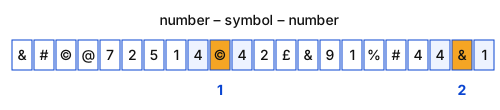
Refer to the following number and symbol series and answer the question that follows. Counting to be done from left to right only.
(Note: All numbers are single digit numbers only.)
(Left) & # © @ 7 2 5 1 4 © 4 2 £ & 9 1 % # 4 4 & 1 (Right)
How many such symbols are there, each of which is immediately preceded by a number and also immediately followed by a number?
निम्नलिखित संख्या और प्रतीक शृंखला को देखिए और उसके बाद आने वाले प्रश्न का उत्तर दीजिए। गिनती केवल बाएँ से दाएँ की जानी है।
(नोट: सभी संख्याएँ केवल एक-अंकीय संख्याएँ हैं।)
(बाएँ) & # © @ 7 2 5 1 4 © 4 2 £ & 9 1 % # 4 4 & 1 (दाएँ)
ऐसे कितने प्रतीक हैं, जिनमें से प्रत्येक के ठीक पहले एक संख्या है और ठीक बाद भी एक संख्या है?
  1. A3
  2. B1
  3. C0
  4. D2
Show answer

Concept: Check each symbol: its left neighbour and right neighbour must both be numbers.

  1. Pattern needed: number – symbol – number.
  2. '4 © 4' (10th element) fits.
  3. '4 & 1' (last symbol) fits.
  4. £, the second &, %, # all touch another symbol on one side – rejected.

Trick: Scan only the symbols, then peek left and right.

Answer: (D) 2

अवधारणा: हर प्रतीक के बाएँ और दाएँ, दोनों ओर संख्या होनी चाहिए।

  1. आवश्यक क्रम: संख्या – प्रतीक – संख्या।
  2. '4 © 4' (10वाँ पद) सही है।
  3. '4 & 1' (अंतिम प्रतीक) सही है।
  4. £, दूसरा &, %, # – किसी एक ओर प्रतीक है, अतः अस्वीकार।

ट्रिक: केवल प्रतीकों पर रुकें और उनके दोनों पड़ोसी देखें।

उत्तर: (D) 2

RRB NTPC Graduate CBT 1General Intelligence and ReasoningNumber-symbol seriesRRB NTPC Graduate CBT 1 2024 · 23 Jun Shift 2 →
Q488.
If 1 is added to each odd digit and 1 is subtracted from each even digit in the number 8146752, what will be the difference between the last and first digits from the left in the new number thus formed?
यदि संख्या 8146752 में प्रत्येक विषम अंक में 1 जोड़ दिया जाए और प्रत्येक सम अंक में से 1 घटा दिया जाए, तो इस प्रकार बनी नई संख्या में बाएँ से अंतिम और पहले अंक के बीच का अंतर क्या होगा?
  1. A3
  2. B4
  3. C6
  4. D5
Show answer

Concept: Change each digit by the rule, then compare the first and last digits.

  1. 8146752: odd digits 1, 7, 5 → +1 = 2, 8, 6; even digits 8, 4, 6, 2 → −1 = 7, 3, 5, 1.
  2. New number: 7235861
  3. First digit 7, last digit 1 → 7−1=6

Trick: Only the first and last digits matter: 8→7, 2→1.

Answer: (C) 6

अवधारणा: नियम से हर अंक बदलें, फिर पहला और अंतिम अंक देखें।

  1. 8146752: विषम अंक 1, 7, 5 → +1 = 2, 8, 6; सम अंक 8, 4, 6, 2 → −1 = 7, 3, 5, 1।
  2. नई संख्या: 7235861
  3. पहला अंक 7, अंतिम अंक 1 → 7−1=6

ट्रिक: केवल पहला और अंतिम अंक बदलें: 8→7, 2→1।

उत्तर: (C) 6

RRB NTPC Graduate CBT 1General Intelligence and ReasoningDigit operationsRRB NTPC Graduate CBT 1 2024 · 23 Jun Shift 2 →
Q489.
If 1 is added to each even digit and 2 is subtracted from each odd digit in the number 2756493, then which of the following digits will be second from the left in the new number thus formed?
यदि संख्या 2756493 में प्रत्येक सम अंक में 1 जोड़ दिया जाए और प्रत्येक विषम अंक में से 2 घटा दिया जाए, तो इस प्रकार बनी नई संख्या में निम्नलिखित में से कौन-सा अंक बाएँ से दूसरा होगा?
  1. A1
  2. B5
  3. C3
  4. D6
Show answer

Concept: Apply the rule digit by digit: even +1, odd −2.

  1. 2756493 → 2+1=3, 7−2=5, 5−2=3, 6+1=7, 4+1=5, 9−2=7, 3−2=1
  2. New number: 3537571
  3. Second digit from left = 5

Trick: Only the 2nd original digit (7, odd) is needed: 7−2=5.

Answer: (B) 5

अवधारणा: नियम लागू करें: सम अंक +1, विषम अंक −2।

  1. 2756493 → 2+1=3, 7−2=5, 5−2=3, 6+1=7, 4+1=5, 9−2=7, 3−2=1
  2. नई संख्या: 3537571
  3. बाएँ से दूसरा अंक = 5

ट्रिक: केवल मूल दूसरा अंक (7, विषम) बदलें: 7−2=5।

उत्तर: (B) 5

RRB NTPC Graduate CBT 1General Intelligence and ReasoningDigit operationsRRB NTPC Graduate CBT 1 2024 · 23 Jun Shift 2 →
Q490.
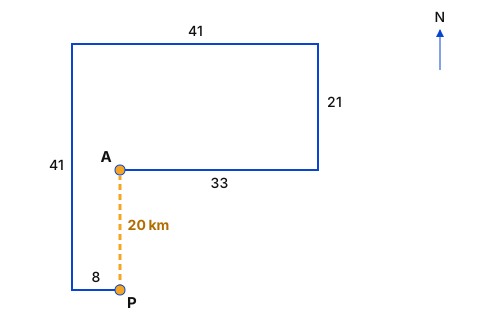
Mr. STU starts from Point A and drives 33 km towards the east. He then takes a left turn, drives 21 km, turns left and drives 41 km. He then takes a left turn and drives 41 km. He takes a final left turn, drives 8 km and stops at Point P. How far (shortest distance) and in which direction should he drive in order to reach Point A again? (All turns are 90- degree turns only unless specified)
श्री STU बिंदु A से शुरू करते हैं और पूर्व की ओर 33 km गाड़ी चलाते हैं। फिर वे बाएँ मुड़ते हैं, 21 km गाड़ी चलाते हैं, बाएँ मुड़ते हैं और 41 km गाड़ी चलाते हैं। फिर वे बाएँ मुड़ते हैं और 41 km गाड़ी चलाते हैं। वे अंतिम बार बाएँ मुड़ते हैं, 8 km गाड़ी चलाते हैं और बिंदु P पर रुक जाते हैं। पुनः बिंदु A पर पहुँचने के लिए उन्हें कितनी दूर (न्यूनतम दूरी) और किस दिशा में गाड़ी चलानी चाहिए? (जब तक निर्दिष्ट न किया जाए, सभी मोड़ केवल 90 डिग्री के मोड़ हैं)
  1. A20 km to the northउत्तर की ओर 20 km
  2. B17 km to the northउत्तर की ओर 17 km
  3. C12 km to the southदक्षिण की ओर 12 km
  4. D13 km to the eastपूर्व की ओर 13 km
Show answer

Concept: Track the position with coordinates (east = +x, north = +y).

  1. East 33 → (33, 0); left = north 21 → (33, 21)
  2. Left = west 41 → (−8, 21); left = south 41 → (−8, −20)
  3. Left = east 8 → P(0, −20)
  4. P is 20 km directly south of A, so he must drive 20 km to the north.

Trick: Net east-west: 33−41+8=0; net north-south: 21−41=−20.

Answer: (A) 20 km to the north

अवधारणा: निर्देशांक लें (पूर्व = +x, उत्तर = +y) और स्थिति ट्रैक करें।

  1. पूर्व 33 → (33, 0); बाएँ = उत्तर 21 → (33, 21)
  2. बाएँ = पश्चिम 41 → (−8, 21); बाएँ = दक्षिण 41 → (−8, −20)
  3. बाएँ = पूर्व 8 → P(0, −20)
  4. P, A से ठीक 20 km दक्षिण में है, अतः उसे 20 km उत्तर जाना होगा।

ट्रिक: पूर्व-पश्चिम: 33−41+8=0; उत्तर-दक्षिण: 21−41=−20।

उत्तर: (A) 20 km उत्तर की ओर

RRB NTPC Graduate CBT 1General Intelligence and ReasoningDirection and distanceRRB NTPC Graduate CBT 1 2024 · 23 Jun Shift 2 →
Q491.
What should come in place of the question mark (?) in the given series?
21, 52, 87, 126, 169, ?
दी गई शृंखला में प्रश्न चिह्न (?) के स्थान पर क्या आना चाहिए?
21, 52, 87, 126, 169, ?
  1. A227
  2. B221
  3. C232
  4. D216
Show answer

Concept: Check the differences between consecutive terms.

  1. Differences: 31, 35, 39, 43 – increasing by 4.
  2. Next differences: 47
  3. 169+47=216

Trick: Second difference constant (4) → add the next term of the AP of differences.

Answer: (D) 216

अवधारणा: क्रमागत पदों के अंतर देखें।

  1. अंतर: 31, 35, 39, 43 – हर बार 4 बढ़ता है।
  2. अगला अंतर: 47
  3. 169+47=216

ट्रिक: दूसरा अंतर स्थिर (4) है।

उत्तर: (D) 216

RRB NTPC Graduate CBT 1General Intelligence and ReasoningNumber seriesRRB NTPC Graduate CBT 1 2024 · 23 Jun Shift 2 →
Q492.
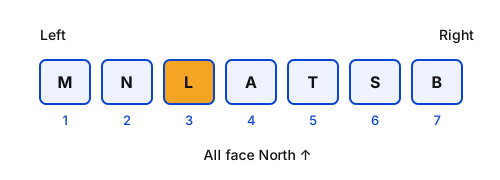
Seven people, A, B, L, M, N, S, and T are sitting in a row, facing north. Only two people sit to the right of T. Only two people sit between T and N. Only two people sit between M and A. A sits to the immediate left of T. B sits to the immediate right of S.
Who sits at third position from the left end of the line?
सात व्यक्ति, A, B, L, M, N, S और T, उत्तर की ओर मुख करके एक पंक्ति में बैठे हैं। T के दाईं ओर केवल दो व्यक्ति बैठे हैं। T और N के बीच केवल दो व्यक्ति बैठे हैं। M और A के बीच केवल दो व्यक्ति बैठे हैं। A, T के ठीक बाईं ओर बैठा है। B, S के ठीक दाईं ओर बैठा है।
पंक्ति के बाएँ छोर से तीसरे स्थान पर कौन बैठा है?
  1. AL
  2. BD
  3. CT
  4. DA
Show answer

Concept: All face north, so their right = our right. Place the fixed clues first.

  1. Two people to the right of T → T is 5th from left; A is immediately left → A = 4th.
  2. Two between T and N → N = 2nd.
  3. Two between M and A → M = 1st or 7th. S and B need two adjacent seats (S left of B).
  4. If M = 7th, seats 1, 3, 6 are left – no adjacent pair. So M = 1st, S = 6th, B = 7th, L = 3rd.

Trick: Fix T from 'only two to the right' – the rest follows.

Answer: (A) L

अवधारणा: सभी उत्तर की ओर मुख किए हैं, अतः उनका दायाँ = हमारा दायाँ। पहले निश्चित सूचनाएँ रखें।

  1. T के दाएँ केवल दो → T बाएँ से 5वाँ; A ठीक बाएँ → A = 4वाँ।
  2. T और N के बीच दो → N = 2रा।
  3. M और A के बीच दो → M = 1ला या 7वाँ। S और B को दो सटी सीटें चाहिए (S बाएँ, B दाएँ)।
  4. यदि M = 7वाँ, तो सीटें 1, 3, 6 बचती हैं – कोई सटा जोड़ा नहीं। अतः M = 1ला, S = 6वाँ, B = 7वाँ, L = 3रा।

ट्रिक: 'केवल दो दाएँ' से T तय करें – बाकी अपने-आप बैठ जाते हैं।

उत्तर: (A) L

RRB NTPC Graduate CBT 1General Intelligence and ReasoningLinear seating arrangementRRB NTPC Graduate CBT 1 2024 · 23 Jun Shift 2 →
Q493.
In a certain code language, ‘NEST’ is coded as ‘4683’ and ‘SOUP’ is coded as ‘2319’. What is the code for ‘S’ in the given code language?
एक निश्चित कूट भाषा में, ‘NEST’ को ‘4683’ के रूप में और ‘SOUP’ को ‘2319’ के रूप में कूटबद्ध किया जाता है। दी गई कूट भाषा में ‘S’ का कूट क्या है?
  1. A3
  2. B1
  3. C9
  4. D2
Show answer

Concept: A letter common to both words gets the digit common to both codes.

  1. NEST and SOUP have only S in common.
  2. 4683 and 2319 have only 3 in common.
  3. So S = 3.

Trick: Common letter ↔ common digit.

Answer: (A) 3

अवधारणा: दोनों शब्दों में उभयनिष्ठ अक्षर का कोड दोनों कोडों में उभयनिष्ठ अंक होता है।

  1. NEST और SOUP में केवल S उभयनिष्ठ है।
  2. 4683 और 2319 में केवल 3 उभयनिष्ठ है।
  3. अतः S = 3

ट्रिक: उभयनिष्ठ अक्षर ↔ उभयनिष्ठ अंक।

उत्तर: (A) 3

RRB NTPC Graduate CBT 1General Intelligence and ReasoningCoding-decodingRRB NTPC Graduate CBT 1 2024 · 23 Jun Shift 2 →
Q494.
If 2 is added to each even digit and 1 is subtracted from each odd digit in the number 74135296, how many digits will appear more than once in the new number thus formed?
यदि संख्या 74135296 में प्रत्येक सम अंक में 2 जोड़ दिया जाए और प्रत्येक विषम अंक में से 1 घटा दिया जाए, तो इस प्रकार बनी नई संख्या में कितने अंक एक से अधिक बार आएँगे?
  1. AOneएक
  2. BTwoदो
  3. CThreeतीन
  4. DFourचार
Show answer

Concept: Change each digit (even +2, odd −1) and count repeated digits.

  1. 74135296 → 7−1=6, 4+2=6, 1−1=0, 3−1=2, 5−1=4, 2+2=4, 9−1=8, 6+2=8
  2. New number: 66024488
  3. Repeated digits: 6, 4 and 8 → three digits

Trick: Count digits, not occurrences: 6, 4, 8 each appear twice.

Answer: (C) Three

अवधारणा: हर अंक बदलें (सम +2, विषम −1) और दोहराए गए अंक गिनें।

  1. 74135296 → 7−1=6, 4+2=6, 1−1=0, 3−1=2, 5−1=4, 2+2=4, 9−1=8, 6+2=8
  2. नई संख्या: 66024488
  3. दोहराए गए अंक: 6, 4 और 8 → तीन

ट्रिक: अंक गिनें, बार नहीं: 6, 4, 8 प्रत्येक दो बार आए।

उत्तर: (C) तीन

RRB NTPC Graduate CBT 1General Intelligence and ReasoningDigit operationsRRB NTPC Graduate CBT 1 2024 · 23 Jun Shift 2 →
Q495.
Select the pair which follows the same pattern as that followed by the two set of pairs given below. Both pairs follow the same pattern.
JOL : FRO
MKH : INK
उस युग्म का चयन कीजिए जो उसी पैटर्न का अनुसरण करता है, जिसका अनुसरण नीचे दिए गए दो युग्म करते हैं। दोनों युग्म एक ही पैटर्न का अनुसरण करते हैं।
JOL : FRO
MKH : INK
  1. ALOA : HSD
  2. BNRF : JUH
  3. CRME : NPG
  4. DHPD : DSG
Show answer

Concept: Find the position shift of each letter: J(10) O(15) L(12) → F(6) R(18) O(15).

  1. Pattern: 1st letter −4, 2nd +3, 3rd +3.
  2. Check MKH: M−4=I, K+3=N, H+3=K ✓
  3. HPD: H−4=D, P+3=S, D+3=G → DSG ✓

Trick: Remember positions: E=5, J=10, O=15, T=20, Y=25.

Answer: (D) HPD : DSG

अवधारणा: प्रत्येक अक्षर का स्थान-अंतर देखें: J(10) O(15) L(12) → F(6) R(18) O(15)।

  1. पैटर्न: पहला अक्षर −4, दूसरा +3, तीसरा +3।
  2. जाँच MKH: M−4=I, K+3=N, H+3=K ✓
  3. HPD: H−4=D, P+3=S, D+3=G → DSG ✓

ट्रिक: EJOTY = 5, 10, 15, 20, 25 याद रखें।

उत्तर: (D) HPD : DSG

RRB NTPC Graduate CBT 1General Intelligence and ReasoningLetter analogyRRB NTPC Graduate CBT 1 2024 · 23 Jun Shift 2 →
Q496.
Based on the English alphabetical order, three of the following four letter-clusters are alike in a certain way and thus form a group. Which letter-cluster DOES NOT belong to that group?
(Note: The odd one out is not based on the number of consonants/vowels or their position in the letter-cluster.)
अंग्रेज़ी वर्णमाला क्रम के आधार पर, निम्नलिखित चार अक्षर-समूहों में से तीन किसी निश्चित प्रकार से एकसमान हैं और इस प्रकार एक समूह बनाते हैं। कौन-सा अक्षर-समूह उस समूह से संबंधित नहीं है?
(नोट: असंगत अक्षर-समूह, उस अक्षर-समूह में व्यंजनों/स्वरों की संख्या या उनके स्थान पर आधारित नहीं है।)
  1. ANRUA
  2. BGKNT
  3. CDGKQ
  4. DQUXD
Show answer

Concept: Check the gaps between consecutive letters (wrap Z → A).

  1. NRUA: N→R +4, R→U +3, U→A +6
  2. GKNT: +4, +3, +6; QUXD: +4, +3, +6
  3. DGKQ: D→G +3, G→K +4, K→Q +6 – order of gaps differs

Trick: Write the gap triplet for every option; the odd triplet wins.

Answer: (C) DGKQ

अवधारणा: क्रमागत अक्षरों के बीच अंतर देखें (Z के बाद A)।

  1. NRUA: N→R +4, R→U +3, U→A +6
  2. GKNT: +4, +3, +6; QUXD: +4, +3, +6
  3. DGKQ: D→G +3, G→K +4, K→Q +6 – क्रम अलग है

ट्रिक: हर विकल्प के अंतर-त्रिक लिखें; अलग त्रिक वाला उत्तर।

उत्तर: (C) DGKQ

RRB NTPC Graduate CBT 1General Intelligence and ReasoningLetter-cluster odd one outRRB NTPC Graduate CBT 1 2024 · 23 Jun Shift 2 →
Q497.
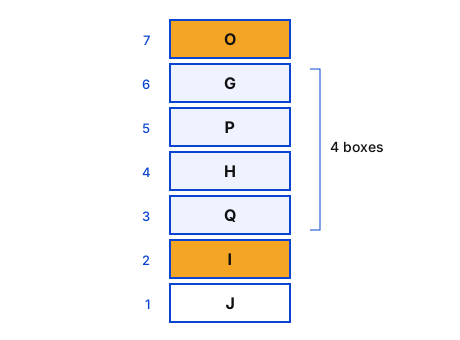
Seven boxes, G, H, I, J, O,P and Q, are kept one over the other but not necessarily in the same order. Only two boxes are kept below Q. Only one box is kept above G. Only one box is kept between G and H. I is kept immediately above J. P is kept at some place below O. How many boxes are kept between O and I?
सात बक्से, G, H, I, J, O, P और Q, एक के ऊपर एक रखे गए हैं, लेकिन आवश्यक नहीं कि इसी क्रम में हों। Q के नीचे केवल दो बक्से रखे गए हैं। G के ऊपर केवल एक बक्सा रखा गया है। G और H के बीच केवल एक बक्सा रखा गया है। I को J के ठीक ऊपर रखा गया है। P को O के नीचे किसी स्थान पर रखा गया है। O और I के बीच कितने बक्से रखे गए हैं?
  1. AFourचार
  2. BThreeतीन
  3. CTwoदो
  4. DOneएक
Show answer

Concept: Number positions 1 (bottom) to 7 (top) and place the fixed boxes first.

  1. Two below Q → Q = 3; one above G → G = 6.
  2. One box between G and H → H = 4.
  3. I immediately above J: only free adjacent pair is 1, 2 → J = 1, I = 2.
  4. P below O in the remaining 5 and 7 → P = 5, O = 7.
  5. Between O (7) and I (2): G, P, H, Q → four boxes.

Trick: 'Only n below/above' fixes a box exactly – start there.

Answer: (A) Four

अवधारणा: स्थान 1 (नीचे) से 7 (ऊपर) तक लें और पहले निश्चित बॉक्स रखें।

  1. Q के नीचे दो → Q = 3; G के ऊपर एक → G = 6।
  2. G और H के बीच एक → H = 4।
  3. I, J के ठीक ऊपर: खाली सटा जोड़ा केवल 1, 2 → J = 1, I = 2।
  4. शेष 5 और 7 में P, O के नीचे → P = 5, O = 7।
  5. O (7) और I (2) के बीच: G, P, H, Q → चार बॉक्स।

ट्रिक: 'केवल n नीचे/ऊपर' से बॉक्स का स्थान तय होता है – वहीं से शुरू करें।

उत्तर: (A) चार

RRB NTPC Graduate CBT 1General Intelligence and ReasoningBox arrangementRRB NTPC Graduate CBT 1 2024 · 23 Jun Shift 2 →
Q498.
YAGK is related to PRXB in a certain way based on the English alphabetical order. In the same way, OQWA is related to FHNR. To which of the following options is NPVZ related, following the same logic?
अंग्रेज़ी वर्णमाला क्रम के आधार पर YAGK एक निश्चित प्रकार से PRXB से संबंधित है। उसी प्रकार, OQWA, FHNR से संबंधित है। समान तर्क का अनुसरण करते हुए, NPVZ निम्नलिखित में से किस विकल्प से संबंधित है?
  1. AEQMG
  2. BEGMQ
  3. CEGQM
  4. DEQGM
Show answer

Concept: Find the shift of each letter (with wrap-around).

  1. YAGK → PRXB: Y−9=P, A−9=R, G−9=X, K−9=B (each −9).
  2. OQWA → FHNR: also −9 for each letter ✓
  3. NPVZ −9: N→E, P→G, V→M, Z→Q = EGMQ

Trick: −9 is the same as +17; with wrap: A(1)−9 → 18 = R.

Answer: (B) EGMQ

अवधारणा: प्रत्येक अक्षर का स्थान-अंतर देखें (Z के बाद A)।

  1. YAGK → PRXB: Y−9=P, A−9=R, G−9=X, K−9=B (हर अक्षर −9)।
  2. OQWA → FHNR: भी हर अक्षर −9 ✓
  3. NPVZ −9: N→E, P→G, V→M, Z→Q = EGMQ

ट्रिक: −9 = +17; चक्र में A(1)−9 → 18 = R।

उत्तर: (B) EGMQ

RRB NTPC Graduate CBT 1General Intelligence and ReasoningLetter analogyRRB NTPC Graduate CBT 1 2024 · 23 Jun Shift 2 →
Q499.
Which Edition of the European Political Community Summit was held in November 2024?
नवंबर 2024 में यूरोपीय राजनीतिक समुदाय (European Political Community) शिखर सम्मेलन का कौन-सा संस्करण आयोजित किया गया था?
  1. A4thचौथा
  2. B6thछठा
  3. C7thसातवाँ
  4. D5thपाँचवाँ
Show answer

Concept: The European Political Community (EPC) is a forum of European leaders launched in 2022, meeting about twice a year.

  1. 1st Prague (Oct 2022), 2nd Moldova (Jun 2023), 3rd Granada, Spain (Oct 2023), 4th Blenheim Palace, UK (Jul 2024).
  2. The 5th EPC summit was held in Budapest, Hungary on 7 November 2024.

Yaad rakhein: EPC count: Prague → Moldova → Granada → UK → Budapest (5th).

Answer: (D) 5th

अवधारणा: यूरोपीय राजनीतिक समुदाय (EPC) यूरोपीय नेताओं का मंच है, जो 2022 में शुरू हुआ और साल में लगभग दो बार मिलता है।

  1. पहला प्राग (अक्टूबर 2022), दूसरा मोल्दोवा (2023), तीसरा ग्रेनाडा, स्पेन (2023), चौथा ब्लेनहेम पैलेस, UK (जुलाई 2024)।
  2. 5वाँ EPC शिखर सम्मेलन 7 नवंबर 2024 को बुडापेस्ट, हंगरी में हुआ।

याद रखें: क्रम: प्राग → मोल्दोवा → ग्रेनाडा → UK → बुडापेस्ट (5वाँ)।

उत्तर: (D) 5th

RRB NTPC Graduate CBT 1General AwarenessInternational SummitsRRB NTPC Graduate CBT 1 2024 · 23 Jun Shift 1 →
Q500.
British land revenue policies were deeply exploitative. Under which system were landlords required to pay a fixed revenue regardless of crop yield?
ब्रिटिश भू-राजस्व नीतियाँ अत्यंत शोषणकारी थीं। किस व्यवस्था के अंतर्गत ज़मींदारों को फसल की उपज की परवाह किए बिना एक निश्चित राजस्व का भुगतान करना पड़ता था?
  1. ARyotwariरैयतवाड़ी
  2. BZamindariज़मींदारी
  3. CMahalwariमहालवाड़ी
  4. DIndian revenue systemभारतीय राजस्व व्यवस्था
Show answer

Concept: Under the Permanent Settlement (1793, Lord Cornwallis) the revenue demand on zamindars was fixed permanently.

  1. In the Zamindari system, zamindars had to pay a fixed amount to the Company on time, whether the harvest was good or bad (Sunset Law).
  2. Ryotwari (Madras, Bombay) dealt directly with peasants and was revised periodically; Mahalwari was settled with the village community and also revised.

Yaad rakhein: Fixed for ever = Zamindari (Bengal, Bihar, Odisha).

Answer: (B) Zamindari

अवधारणा: स्थायी बंदोबस्त (1793, लॉर्ड कॉर्नवालिस) में ज़मींदारों पर राजस्व की राशि हमेशा के लिए तय कर दी गई।

  1. ज़मींदारी व्यवस्था में ज़मींदार को फसल अच्छी हो या ख़राब, तय राशि समय पर चुकानी पड़ती थी (सूर्यास्त कानून)।
  2. रैयतवाड़ी (मद्रास, बॉम्बे) में सीधे किसान से राजस्व लिया जाता था और समय-समय पर बदला जाता था; महालवाड़ी गाँव-समुदाय के साथ था।

याद रखें: हमेशा के लिए तय = ज़मींदारी (बंगाल, बिहार, ओडिशा)।

उत्तर: (B) Zamindari

RRB NTPC Graduate CBT 1General AwarenessBritish Land Revenue SystemsRRB NTPC Graduate CBT 1 2024 · 23 Jun Shift 1 →