Question bank

Q&A: practice questions with answers

Search questions on any topic. Filter by exam category, exam, subject and topic, try the question, then open the answer and explanation.

Courses – airGurukul

7,077 questions found.

Q5221.
Harishika bought an article for ₹200 and sold it to Ritu at a loss of 30%. With this amount, Harishika bought another article and sold it at a gain of 75%. What is Harishika's overall gain percentage?
हरिशिका ने एक वस्तु ₹200 में खरीदी और उसे 30% की हानि पर रितु को बेच दिया। इस राशि से हरिशिका ने एक अन्य वस्तु खरीदी और उसे 75% के लाभ पर बेच दिया। हरिशिका का कुल लाभ प्रतिशत क्या है?
  1. A17.5%
  2. B19.4%
  3. C22.5%
  4. D24.5%
Show answer

Concept: Track the actual money: total investment is ₹200 (the second purchase is made from the first sale's money).

  1. Sale 1: 200×70100=140 (loss 30%).
  2. Second article bought for ₹140, sold at 75% gain: 140×175100=245.
  3. Overall gain =245−200=45 on ₹200 ⇒45200×100=22.5%.

Trick: Successive % formula: −30+75+(−30)(75)100=45−22.5=22.5%.

Answer: (C) 22.5%

अवधारणा: वास्तविक धन पर नज़र रखें: कुल निवेश ₹200 है (दूसरी खरीद पहली बिक्री के पैसे से होती है)।

  1. बिक्री 1: 200×70100=140 (30% हानि)।
  2. दूसरी वस्तु ₹140 में खरीदी, 75% लाभ पर बेची: 140×175100=245।
  3. कुल लाभ =245−200=45, ₹200 पर ⇒45200×100=22.5%।

ट्रिक: क्रमिक % सूत्र: −30+75+(−30)(75)100=45−22.5=22.5%।

उत्तर: (C) 22.5%

RRB NTPC Graduate CBT 1MathematicsSuccessive profit and lossRRB NTPC Graduate CBT 1 2025 · 25 Mar Shift 1 →
Q5222.
The population of a village was 2,90,000. It increased by 10% in the first year and increased by 30% in the second year. Its population after two years is _______.
एक गाँव की जनसंख्या 2,90,000 थी। पहले वर्ष में इसमें 10% की वृद्धि हुई और दूसरे वर्ष में 30% की वृद्धि हुई। दो वर्षों के बाद इसकी जनसंख्या _______ है।
  1. A3,19,000
  2. B3,77,000
  3. C4,14,700
  4. D4,06,000
Show answer

Concept: Successive increases multiply: P(1+r1100)(1+r2100).

  1. After year 1: 2,90,000×1.1=3,19,000.
  2. After year 2: 3,19,000×1.3=4,14,700.

Trick: Net % =10+30+10×30100=43%; 2,90,000×1.43=4,14,700.

Answer: (C) 4,14,700

अवधारणा: क्रमिक वृद्धियाँ गुणा होती हैं: P(1+r1100)(1+r2100)।

  1. पहले वर्ष बाद: 2,90,000×1.1=3,19,000।
  2. दूसरे वर्ष बाद: 3,19,000×1.3=4,14,700।

ट्रिक: शुद्ध % =10+30+10×30100=43%; 2,90,000×1.43=4,14,700।

उत्तर: (C) 4,14,700

RRB NTPC Graduate CBT 1MathematicsSuccessive percentage increaseRRB NTPC Graduate CBT 1 2025 · 25 Mar Shift 1 →
Q5223.
The average of 7 numbers is 47. If each number is decreased by 7, what will the new average be?
7 संख्याओं का औसत 47 है। यदि प्रत्येक संख्या में 7 की कमी कर दी जाए, तो नया औसत क्या होगा?
  1. A33
  2. B40
  3. C7
  4. D47
Show answer

Concept: If every observation changes by the same amount k, the average changes by exactly k.

  1. Each of the 7 numbers decreases by 7, so the total decreases by 7×7=49.
  2. New average =47×7−497=47−7=40.

Trick: Add/subtract to all → average shifts by the same; multiply all → average multiplies by the same.

Answer: (B) 40

अवधारणा: यदि हर प्रेक्षण में समान राशि k का परिवर्तन हो, तो औसत में ठीक k का परिवर्तन होता है।

  1. 7 संख्याओं में प्रत्येक 7 घटती है, अतः योग 7×7=49 घटता है।
  2. नया औसत =47×7−497=47−7=40।

ट्रिक: सबमें जोड़ें/घटाएँ → औसत उतना ही खिसकता है; सबको गुणा करें → औसत उतने ही गुना।

उत्तर: (B) 40

RRB NTPC Graduate CBT 1MathematicsAverage – shifting all valuesRRB NTPC Graduate CBT 1 2025 · 25 Mar Shift 1 →
Q5224.
Evaluate: 16 + 18 ÷ 6 - 3 × 4
मान ज्ञात कीजिए: 16 + 18 ÷ 6 - 3 × 4
  1. A6
  2. B9
  3. C10
  4. D7
Show answer

Concept: Order of operations: Division and Multiplication first (left to right), then Addition and Subtraction.

  1. 18÷6=3 and 3×4=12.
  2. 16+3−12=7.

Trick: Never add 16+18 first – that is the common trap.

Answer: (D) 7

अवधारणा: संक्रियाओं का क्रम: पहले भाग और गुणा (बाएँ से दाएँ), फिर जोड़ और घटाव।

  1. 18÷6=3 और 3×4=12।
  2. 16+3−12=7।

ट्रिक: कभी पहले 16+18 न जोड़ें – यही आम जाल है।

उत्तर: (D) 7

RRB NTPC Graduate CBT 1MathematicsBODMASRRB NTPC Graduate CBT 1 2025 · 25 Mar Shift 1 →
Q5225.
Find the value of 2tan30∘1+tan230∘.
2tan30∘1+tan230∘ का मान ज्ञात कीजिए।
  1. Acos 45°
  2. Bcos 30°
  3. Ccos 60°
  4. Dcos 90°
Show answer

Concept: 2tanθ1+tan2θ=sin2θ.

  1. With θ=30∘: value =sin60∘=32.
  2. Direct check: tan30∘=13, so 2/31+13=23×34=32.
  3. 32=cos30∘.

Trick: sin60∘=cos30∘ (complementary angles) – the options are in cos, so convert.

Answer: (B) cos30∘

अवधारणा: 2tanθ1+tan2θ=sin2θ।

  1. θ=30∘ पर: मान =sin60∘=32।
  2. सीधी जाँच: tan30∘=13, अतः 2/31+13=23×34=32।
  3. 32=cos30∘।

ट्रिक: sin60∘=cos30∘ (पूरक कोण) – विकल्प cos में हैं, इसलिए बदलें।

उत्तर: (B) cos30∘

RRB NTPC Graduate CBT 1MathematicsTrigonometric identitiesRRB NTPC Graduate CBT 1 2025 · 25 Mar Shift 1 →
Q5226.
Find the value of m, satisfying equation:
(129)19×(912)5×(129)8=(912)6m+11
समीकरण को संतुष्ट करने वाले m का मान ज्ञात कीजिए:
(129)19×(912)5×(129)8=(912)6m+11
  1. A−356
  2. B−336
  3. C−376
  4. D−346
Show answer

Concept: 912=(129)−1; make all bases equal, then equate powers.

  1. LHS =(129)19(129)−5(129)8=(129)22.
  2. RHS =(912)6m+11=(129)−(6m+11).
  3. 22=−(6m+11)⇒6m=−33⇒m=−336.

Trick: Flipping a fraction flips the sign of its exponent – convert everything to one base before adding powers.

Answer: (B) −336

अवधारणा: 912=(129)−1; सभी आधार समान करें, फिर घातों की तुलना करें।

  1. LHS =(129)19(129)−5(129)8=(129)22।
  2. RHS =(912)6m+11=(129)−(6m+11)।
  3. 22=−(6m+11)⇒6m=−33⇒m=−336।

ट्रिक: भिन्न को उलटने से घात का चिह्न उलट जाता है – घात जोड़ने से पहले सबको एक आधार में लाएँ।

उत्तर: (B) −336

RRB NTPC Graduate CBT 1MathematicsLaws of indicesRRB NTPC Graduate CBT 1 2025 · 25 Mar Shift 1 →
Q5227.
There are 42 members in group A, 31 members in group B and 32 members in group C. All the members of these groups went to a restaurant. The average amounts spent on each member of groups A, B and C are ₹335, ₹103 and ₹271, respectively. The overall average amount (in ₹) spent per member is:
समूह A में 42 सदस्य, समूह B में 31 सदस्य और समूह C में 32 सदस्य हैं। इन समूहों के सभी सदस्य एक रेस्तरां में गए। समूह A, B और C के प्रत्येक सदस्य पर खर्च की गई औसत राशि क्रमशः ₹335, ₹103 और ₹271 है। प्रति सदस्य खर्च की गई समग्र औसत राशि (₹ में) है:
  1. A248
  2. B247
  3. C242
  4. D249
Show answer

Concept: Overall average=∑(members×average)total members.

  1. Totals: 42×335=14070, 31×103=3193, 32×271=8672.
  2. Sum =14070+3193+8672=25935; members =42+31+32=105.
  3. Average =25935105=247.

Trick: 105×247=105×250−105×3=26250−315=25935 – verify by multiplying back.

Answer: (B) 247

अवधारणा: कुल औसत=∑(सदस्य×औसत)कुल सदस्य।

  1. योग: 42×335=14070, 31×103=3193, 32×271=8672।
  2. कुल =14070+3193+8672=25935; सदस्य =42+31+32=105।
  3. औसत =25935105=247।

ट्रिक: 105×247=105×250−105×3=26250−315=25935 – वापस गुणा करके जाँचें।

उत्तर: (B) 247

RRB NTPC Graduate CBT 1MathematicsWeighted averageRRB NTPC Graduate CBT 1 2025 · 25 Mar Shift 1 →
Q5228.
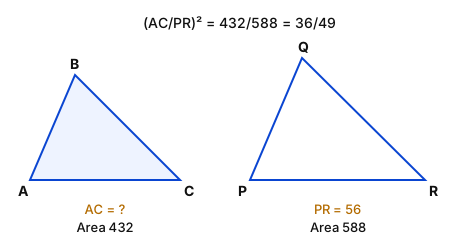
The areas of similar triangles ΔABC and ΔPQR are 432 cm2 and 588 cm2, respectively. If the longest side PR of ΔPQR is 56 cm, then find the longest side AC of ΔABC.
समरूप त्रिभुजों ΔABC और ΔPQR के क्षेत्रफल क्रमशः 432 cm2 और 588 cm2 हैं। यदि ΔPQR की सबसे लंबी भुजा PR 56 cm है, तो ΔABC की सबसे लंबी भुजा AC ज्ञात कीजिए।
  1. A48 cm
  2. B24 cm
  3. C52 cm
  4. D35 cm
Show answer

Concept: For similar triangles, Area1Area2=(side1side2)2, and corresponding (longest) sides pair up.

  1. (ACPR)2=432588=3649.
  2. ACPR=67⇒AC=56×67=48cm.

Trick: Divide both areas by 12 to see the perfect squares 36 and 49 at once.

Answer: (A) 48 cm

अवधारणा: समरूप त्रिभुजों में क्षेत्रफल1क्षेत्रफल2=(भुजा1भुजा2)2, और संगत (सबसे लंबी) भुजाएँ जोड़े में आती हैं।

  1. (ACPR)2=432588=3649।
  2. ACPR=67⇒AC=56×67=48cm।

ट्रिक: दोनों क्षेत्रफलों को 12 से भाग दें – पूर्ण वर्ग 36 और 49 तुरंत दिखेंगे।

उत्तर: (A) 48 cm

RRB NTPC Graduate CBT 1MathematicsSimilar triangles – area ratioRRB NTPC Graduate CBT 1 2025 · 25 Mar Shift 1 →
Q5229.
Find the sum of all the interior angles of a regular polygon of 6 sides.
6 भुजाओं वाले एक सम बहुभुज के सभी अंतः कोणों का योग ज्ञात कीजिए।
  1. A760°
  2. B720°
  3. C600°
  4. D680°
Show answer

Concept: Sum of interior angles of an n-sided polygon =(n−2)×180∘.

  1. n=6: (6−2)×180∘=4×180∘=720∘.
  2. Each angle of a regular hexagon =720∘6=120∘.

Yaad rakhein: Triangle 180°, quadrilateral 360°, pentagon 540°, hexagon 720° – add 180° per extra side.

Answer: (B) 720∘

अवधारणा: n भुजाओं वाले बहुभुज के अंतःकोणों का योग =(n−2)×180∘।

  1. n=6: (6−2)×180∘=4×180∘=720∘।
  2. सम षट्भुज का प्रत्येक कोण =720∘6=120∘।

याद रखें: त्रिभुज 180°, चतुर्भुज 360°, पंचभुज 540°, षट्भुज 720° – हर अतिरिक्त भुजा पर 180° जोड़ें।

उत्तर: (B) 720∘

RRB NTPC Graduate CBT 1MathematicsInterior angles of a polygonRRB NTPC Graduate CBT 1 2025 · 25 Mar Shift 1 →
Q5230.
A shopkeeper fixes the marked price of an item at 150% above its cost price. What percentage of discount on the marked price should be allowed to gain 20%?
एक दुकानदार किसी वस्तु का अंकित मूल्य उसके क्रय मूल्य से 150% अधिक निर्धारित करता है। 20% लाभ प्राप्त करने के लिए अंकित मूल्य पर कितने प्रतिशत की छूट दी जानी चाहिए?
  1. A54%
  2. B52%
  3. C49%
  4. D55%
Show answer

Concept: Take CP = 100; "150% above CP" means MP = 250; required SP = 120.

  1. Discount =250−120=130.
  2. Discount% =130250×100=52%.

Trick: "150% above" = 2.5 times (not 1.5 times) – read "above" carefully.

Answer: (B) 52%

अवधारणा: CP = 100 लें; "CP से 150% ऊपर" का अर्थ MP = 250; आवश्यक SP = 120।

  1. छूट =250−120=130।
  2. छूट% =130250×100=52%।

ट्रिक: "150% ऊपर" = 2.5 गुना (1.5 गुना नहीं) – "ऊपर" ध्यान से पढ़ें।

उत्तर: (B) 52%

RRB NTPC Graduate CBT 1MathematicsMarked price and discountRRB NTPC Graduate CBT 1 2025 · 25 Mar Shift 1 →
Q5231.
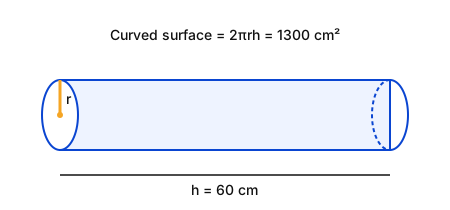
A cylindrical rod has an outer curved surface area of 1300 cm2. If the length of the rod is 60 cm, then the outer radius (in cm) of the rod, correct to two places of decimal, is: (Take π=227)
एक बेलनाकार छड़ का बाहरी वक्र पृष्ठीय क्षेत्रफल 1300 cm2 है। यदि छड़ की लंबाई 60 cm है, तो दशमलव के दो स्थानों तक सही, छड़ की बाहरी त्रिज्या (cm में) है: (π=227 लीजिए)
  1. A3.45
  2. B1.88
  3. C1.02
  4. D3.48
Show answer

Concept: Curved surface area of a cylinder =2πrh.

  1. 2×227×r×60=1300.
  2. r=1300×72×22×60=91002640≈3.447.
  3. Correct to two decimals: r≈3.45cm.

Trick: 91002640=455132; 132×3.45=455.4, so the answer is just under 3.45 → rounds to 3.45 (not 3.48).

Answer: (A) 3.45

अवधारणा: बेलन का वक्र पृष्ठ क्षेत्रफल =2πrh।

  1. 2×227×r×60=1300।
  2. r=1300×72×22×60=91002640≈3.447।
  3. दो दशमलव तक: r≈3.45cm।

ट्रिक: 91002640=455132; 132×3.45=455.4, अतः उत्तर 3.45 से ज़रा कम → 3.45 (3.48 नहीं)।

उत्तर: (A) 3.45

RRB NTPC Graduate CBT 1MathematicsCylinder – curved surface areaRRB NTPC Graduate CBT 1 2025 · 25 Mar Shift 1 →
Q5232.
Simplify
25−5.6÷7+1.6×0.5
सरल कीजिए
25−5.6÷7+1.6×0.5
  1. A5.6
  2. B23.4
  3. C0
  4. D25
Show answer

Concept: Do ÷ and × before + and −.

  1. 5.6÷7=0.8 and 1.6×0.5=0.8.
  2. 25−0.8+0.8=25.

Trick: The two middle terms are equal and opposite – they cancel, leaving 25.

Answer: (D) 25

अवधारणा: + और − से पहले ÷ और × करें।

  1. 5.6÷7=0.8 और 1.6×0.5=0.8।
  2. 25−0.8+0.8=25।

ट्रिक: बीच के दोनों पद बराबर और विपरीत हैं – कट जाते हैं, 25 बचता है।

उत्तर: (D) 25

RRB NTPC Graduate CBT 1MathematicsSimplification (BODMAS)RRB NTPC Graduate CBT 1 2025 · 25 Mar Shift 1 →
Q5233.
A shopkeeper purchased 60 dozens of articles at the rate of ₹474 per dozen. He sold each one of them at the rate of ₹79. What percentage profit did he make?
एक दुकानदार ने ₹474 प्रति दर्जन की दर से 60 दर्जन वस्तुएँ खरीदीं। उसने उनमें से प्रत्येक को ₹79 की दर से बेच दिया। उसने कितने प्रतिशत लाभ अर्जित किया?
  1. A99%
  2. B100%
  3. C102%
  4. D101%
Show answer

Concept: Compare cost price and selling price of one article; the number of articles does not affect the percentage.

  1. CP of one article =47412=39.5 rupees.
  2. SP of one article = ₹79, so profit =79−39.5=39.5 rupees.
  3. Profit%=39.539.5×100=100%.

Trick: 79×12=948=2×474 – SP per dozen is exactly double the CP per dozen, so profit is 100%.

Answer: (B) 100%

अवधारणा: एक वस्तु का क्रय मूल्य और विक्रय मूल्य तुलना करें; वस्तुओं की संख्या प्रतिशत पर असर नहीं डालती।

  1. एक वस्तु का CP =47412=39.5 रुपये।
  2. एक वस्तु का SP = ₹79, अतः लाभ =79−39.5=39.5 रुपये।
  3. लाभ%=39.539.5×100=100%।

ट्रिक: 79×12=948=2×474 – प्रति दर्जन SP, CP का ठीक दोगुना है, इसलिए लाभ 100%।

उत्तर: (B) 100%

RRB NTPC Graduate CBT 1MathematicsProfit and LossRRB NTPC Graduate CBT 1 2025 · 25 Mar Shift 1 →
Q5234.
Kiran’s salary is ₹18000 per month. He spends ₹5000 on house rent, ₹3000 on bills and the rest of the amount is his monthly savings. Find his savings (in ₹) in a year, if in the month of his birthday, he spent his complete monthly saving for birthday celebration.
किरण का वेतन ₹18000 प्रति माह है। वह ₹5000 घर के किराए पर, ₹3000 बिलों पर खर्च करता है और शेष राशि उसकी मासिक बचत है। एक वर्ष में उसकी बचत (₹ में) ज्ञात कीजिए, यदि अपने जन्मदिन के महीने में उसने अपनी पूरी मासिक बचत जन्मदिन समारोह पर खर्च कर दी।
  1. A100000
  2. B110000
  3. C90000
  4. D120000
Show answer

Concept: Monthly saving = salary − expenses; count only the months in which the saving is actually kept.

  1. Monthly saving =18000−5000−3000=10000 rupees.
  2. In the birthday month the whole saving is spent, so savings are kept for only 11 months.
  3. Yearly savings =11×10000=110000 rupees.

Trick: Read the 'birthday' condition carefully – it removes exactly one month; 12 × 10000 = 120000 is the trap.

Answer: (B) 110000

अवधारणा: मासिक बचत = वेतन − खर्च; केवल उन्हीं महीनों को गिनें जिनमें बचत सचमुच बची।

  1. मासिक बचत =18000−5000−3000=10000 रुपये।
  2. जन्मदिन के महीने में पूरी बचत खर्च हो गई, अतः बचत केवल 11 महीनों की रही।
  3. वार्षिक बचत =11×10000=110000 रुपये।

ट्रिक: 'जन्मदिन' वाली शर्त ध्यान से पढ़ें – वह ठीक एक महीना हटाती है; 12 × 10000 = 120000 जाल है।

उत्तर: (B) 110000

RRB NTPC Graduate CBT 1MathematicsSimple ArithmeticRRB NTPC Graduate CBT 1 2025 · 25 Mar Shift 1 →
Q5235.
The least common multiple of two numbers is 21 times the first number, and the highest common factor of the two numbers is a two-digit prime number. What is the least possible value of the second number?
दो संख्याओं का लघुत्तम समापवर्त्य (LCM) पहली संख्या का 21 गुना है, और दोनों संख्याओं का महत्तम समापवर्तक (HCF) एक दो-अंकीय अभाज्य संख्या है। दूसरी संख्या का न्यूनतम संभव मान क्या है?
  1. A357
  2. B273
  3. C231
  4. D147
Show answer

Concept: If HCF = h, write the numbers as ha and hb with a,b co-prime; then LCM =hab.

  1. Given LCM =21× (first number) ⇒hab=21ha⇒b=21.
  2. So the second number =21h, where h is a two-digit prime.
  3. Smallest two-digit prime h=11, so least second number =21×11=231.

Trick: LCM ÷ first number = the co-prime factor of the second number; multiply it by the HCF.

Answer: (C) 231

अवधारणा: यदि HCF = h हो तो संख्याएँ ha और hb लिखें (a,b सह-अभाज्य); तब LCM =hab।

  1. दिया है LCM =21× (पहली संख्या) ⇒hab=21ha⇒b=21।
  2. अतः दूसरी संख्या =21h, जहाँ h दो अंकों की अभाज्य संख्या है।
  3. सबसे छोटी दो-अंकीय अभाज्य h=11, अतः न्यूनतम दूसरी संख्या =21×11=231।

ट्रिक: LCM ÷ पहली संख्या = दूसरी संख्या का सह-अभाज्य गुणक; इसे HCF से गुणा करें।

उत्तर: (C) 231

RRB NTPC Graduate CBT 1MathematicsLCM and HCFRRB NTPC Graduate CBT 1 2025 · 25 Mar Shift 1 →
Q5236.
What should come in place of ‘?’ in the given series?
15 19 27 39 55 ?
दी गई श्रेणी में ‘?’ के स्थान पर क्या आना चाहिए?
15 19 27 39 55 ?
  1. A75
  2. B76
  3. C72
  4. D74
Show answer

Concept: Take successive differences; if they form a simple pattern, extend it.

  1. 19−15=4, 27−19=8, 39−27=12, 55−39=16.
  2. Differences are 4,8,12,16 – multiples of 4 – so the next difference is 20.
  3. 55+20=75.

Trick: Differences increasing by a constant = second-level AP; just add the next multiple.

Answer: (A) 75

अवधारणा: क्रमागत अंतर निकालें; यदि वे सरल पैटर्न बनाएँ तो उसे आगे बढ़ाएँ।

  1. 19−15=4, 27−19=8, 39−27=12, 55−39=16।
  2. अंतर 4,8,12,16 – 4 के गुणज – अतः अगला अंतर 20।
  3. 55+20=75।

ट्रिक: अंतर स्थिर मात्रा से बढ़ें = द्वितीय-स्तर AP; बस अगला गुणज जोड़ें।

उत्तर: (A) 75

RRB NTPC Graduate CBT 1MathematicsNumber SeriesRRB NTPC Graduate CBT 1 2025 · 25 Mar Shift 1 →
Q5237.
What should come in place of ‘?’ in the given series?
33 40 54 75 103 ?
दी गई श्रेणी में ‘?’ के स्थान पर क्या आना चाहिए?
33 40 54 75 103 ?
  1. A134
  2. B136
  3. C135
  4. D138
Show answer

Concept: Successive differences often form multiples of a fixed number.

  1. 40−33=7, 54−40=14, 75−54=21, 103−75=28.
  2. Differences 7,14,21,28 are multiples of 7, so the next is 35.
  3. 103+35=138.

Trick: First difference 7 and it keeps adding 7 – table of 7.

Answer: (D) 138

अवधारणा: क्रमागत अंतर प्रायः किसी स्थिर संख्या के गुणज बनाते हैं।

  1. 40−33=7, 54−40=14, 75−54=21, 103−75=28।
  2. अंतर 7,14,21,28 – 7 के गुणज, अतः अगला 35।
  3. 103+35=138।

ट्रिक: पहला अंतर 7 और हर बार 7 जुड़ता है – 7 का पहाड़ा।

उत्तर: (D) 138

RRB NTPC Graduate CBT 1MathematicsNumber SeriesRRB NTPC Graduate CBT 1 2025 · 25 Mar Shift 1 →
Q5238.
The product of two consecutive natural numbers is 380. The greater of the two numbers is:
दो क्रमागत प्राकृत संख्याओं का गुणनफल 380 है। दोनों संख्याओं में बड़ी संख्या है:
  1. A20
  2. B24
  3. C12
  4. D14
Show answer

Concept: The product of two consecutive numbers lies just below the square of the larger one.

  1. Let the numbers be n and n+1: n(n+1)=380.
  2. 192=361 and 202=400, so try 19×20=380 ✓.
  3. Greater number =20.

Trick: 380≈19.5 – the two consecutive numbers sit on either side of it: 19 and 20.

Answer: (A) 20

अवधारणा: दो क्रमागत संख्याओं का गुणनफल बड़ी संख्या के वर्ग से ठीक नीचे होता है।

  1. संख्याएँ n और n+1 लें: n(n+1)=380।
  2. 192=361 और 202=400, अतः 19×20=380 ✓।
  3. बड़ी संख्या =20।

ट्रिक: 380≈19.5 – दोनों क्रमागत संख्याएँ इसके दोनों ओर: 19 और 20।

उत्तर: (A) 20

RRB NTPC Graduate CBT 1MathematicsConsecutive NumbersRRB NTPC Graduate CBT 1 2025 · 25 Mar Shift 1 →
Q5239.
If a=3+53−5 and b=3−53+5, find the value of a2+b2+3ab.
यदि a=3+53−5 और b=3−53+5 है, तो a2+b2+3ab का मान ज्ञात कीजिए।
  1. A42
  2. B50
  3. C98
  4. D78
Show answer

Concept: When a and b are reciprocals of each other, work with a+b and ab instead of the individual values.

  1. a=3+53−5 and b=3−53+5, so ab=1.
  2. a+b=(3+5)2+(3−5)2(3−5)(3+5)=2(9+5)9−5=284=7.
  3. a2+b2+3ab=(a+b)2+ab=49+1=50.

Trick: a2+b2+3ab=(a+b)2+ab – never rationalise separately when ab=1.

Answer: (B) 50

अवधारणा: जब a और b एक-दूसरे के व्युत्क्रम हों, तो अलग-अलग मान के बजाय a+b और ab से काम लें।

  1. a=3+53−5 और b=3−53+5, अतः ab=1।
  2. a+b=(3+5)2+(3−5)2(3−5)(3+5)=2(9+5)9−5=284=7।
  3. a2+b2+3ab=(a+b)2+ab=49+1=50।

ट्रिक: a2+b2+3ab=(a+b)2+ab – जब ab=1 हो तो अलग-अलग परिमेयकरण कभी न करें।

उत्तर: (B) 50

RRB NTPC Graduate CBT 1MathematicsSurds – Algebraic IdentitiesRRB NTPC Graduate CBT 1 2025 · 25 Mar Shift 1 →
Q5240.
Arun has ₹1407 with him. He divides this amount between his two sons, Mahesh and Vijay, and asks them to invest their respective shares at a compound interest rate of 10% per annum, compounded annually. It is observed that Mahesh’s investment amounts to the same value after 12 years as Vijay’s investment does after 13 years. How much (in ₹) did Arun give to Vijay?
अरुण के पास ₹1407 हैं। वह इस राशि को अपने दो पुत्रों, महेश और विजय, के बीच बाँटता है और उन्हें अपने-अपने हिस्से को 10% वार्षिक चक्रवृद्धि ब्याज की दर पर, वार्षिक रूप से संयोजित, निवेश करने के लिए कहता है। यह देखा गया कि महेश के निवेश की राशि 12 वर्षों के बाद उतनी ही हो जाती है जितनी विजय के निवेश की राशि 13 वर्षों के बाद होती है। अरुण ने विजय को कितनी राशि (₹ में) दी?
  1. A737
  2. B837
  3. C670
  4. D520
Show answer

Concept: If two sums become equal after n and n+1 years at the same CI rate, the sums are in the ratio (1+r):1.

  1. Let Mahesh get M, Vijay V. M(1.1)12=V(1.1)13⇒M=1.1V.
  2. M:V=11:10, total 21 parts =1407⇒ 1 part =67.
  3. Vijay's share =10×67=670 rupees.

Trick: One year's difference at 10% → ratio 11:10; just divide the total in that ratio.

Answer: (C) 670

अवधारणा: यदि दो राशियाँ समान CI दर पर n और n+1 वर्षों में बराबर हो जाएँ, तो राशियाँ (1+r):1 के अनुपात में होती हैं।

  1. महेश को M, विजय को V मिले। M(1.1)12=V(1.1)13⇒M=1.1V।
  2. M:V=11:10, कुल 21 भाग =1407⇒ 1 भाग =67।
  3. विजय का हिस्सा =10×67=670 रुपये।

ट्रिक: 10% पर एक वर्ष का अंतर → अनुपात 11:10; कुल को इसी अनुपात में बाँटें।

उत्तर: (C) 670

RRB NTPC Graduate CBT 1MathematicsCompound InterestRRB NTPC Graduate CBT 1 2025 · 25 Mar Shift 1 →