Question bank

Q&A: practice questions with answers

Search questions on any topic. Filter by exam category, exam, subject and topic, try the question, then open the answer and explanation.

Courses – airGurukul

7,077 questions found.

Q5421.
Evaluate: 16 + 20 ÷ 4 - 2 × 4
मान ज्ञात कीजिए: 16 + 20 ÷ 4 - 2 × 4
  1. A13
  2. B16
  3. C15
  4. D12
Show answer

Concept: Follow BODMAS: division and multiplication first (left to right), then addition and subtraction.

  1. 20÷4=5 and 2×4=8.
  2. 16+5−8=13.

Trick: Never add first – '16 + 20' before dividing gives a wrong answer.

Answer: (A) 13

अवधारणा: BODMAS का पालन करें: पहले भाग और गुणा (बाएँ से दाएँ), फिर जोड़ और घटाव।

  1. 20÷4=5 और 2×4=8।
  2. 16+5−8=13।

ट्रिक: पहले कभी न जोड़ें – भाग से पहले '16 + 20' करने पर गलत उत्तर आता है।

उत्तर: (A) 13
RRB NTPC Graduate CBT 1MathematicsBODMASRRB NTPC Graduate CBT 1 2025 · 24 Mar Shift 2 →
Q5422.
Which of the given ratios is the greatest?
3 : 17, 13 : 67, 10 : 37 and 5 : 9
दिए गए अनुपातों में से कौन-सा सबसे बड़ा है?
3 : 17, 13 : 67, 10 : 37 और 5 : 9
  1. A13 : 67
  2. B5 : 9
  3. C10 : 37
  4. D3 : 17
Show answer

Concept: Convert each ratio to a decimal (or compare with a benchmark such as 12).

  1. 3:17=317≈0.176; 13:67=1367≈0.194.
  2. 10:37=1037≈0.270; 5:9=59≈0.556.
  3. Greatest is 5:9.

Trick: Only 59 is more than 12 (numerator more than half the denominator) – spot it without any division.

Answer: (B) 5 : 9

अवधारणा: हर अनुपात को दशमलव में बदलें (या 12 जैसे मानक से तुलना करें)।

  1. 3:17=317≈0.176; 13:67=1367≈0.194।
  2. 10:37=1037≈0.270; 5:9=59≈0.556।
  3. सबसे बड़ा 5:9 है।

ट्रिक: केवल 59 ही 12 से बड़ा है (अंश, हर के आधे से अधिक) – बिना भाग किए पहचानें।

उत्तर: (B) 5 : 9

RRB NTPC Graduate CBT 1MathematicsComparison of RatiosRRB NTPC Graduate CBT 1 2025 · 24 Mar Shift 2 →
Q5423.
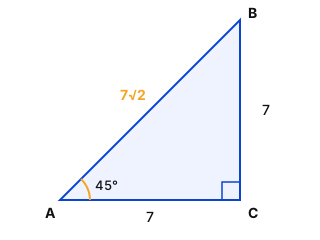
In a right-angled triangle ABC, ∠C=90°, ∠A=45°, and the length of the adjacent side to ∠A (side AC) is 7 units.
Determine the length of the side AB (the hypotenuse).
एक समकोण त्रिभुज ABC में, ∠C=90°, ∠A=45°, और ∠A की आसन्न भुजा (भुजा AC) की लंबाई 7 इकाई है।
भुजा AB (कर्ण) की लंबाई ज्ञात कीजिए।
  1. A14 units14 इकाई
  2. B7 units7 इकाई
  3. C72 units72 इकाई
  4. D142 units142 इकाई
Show answer

Concept: In a right triangle with one acute angle 45∘, the other is also 45∘, so the two legs are equal and hypotenuse =leg×2.

  1. ∠C=90∘, ∠A=45∘⇒∠B=45∘, so BC=AC=7.
  2. AB=72+72=98=72 units.
  3. Check with trigonometry: cos45∘=ACAB⇒AB=71/2=72.

Trick: 45-45-90 triangle sides are in the ratio 1:1:2; 30-60-90 are 1:3:2.

Answer: (C) 72 units

अवधारणा: समकोण त्रिभुज में एक न्यून कोण 45∘ हो तो दूसरा भी 45∘ होता है, अतः दोनों भुजाएँ बराबर और कर्ण =भुजा×2।

  1. ∠C=90∘, ∠A=45∘⇒∠B=45∘, अतः BC=AC=7।
  2. AB=72+72=98=72 इकाई।
  3. त्रिकोणमिति से जाँच: cos45∘=ACAB⇒AB=71/2=72।

ट्रिक: 45-45-90 त्रिभुज की भुजाएँ 1:1:2 में; 30-60-90 की 1:3:2 में।

उत्तर: (C) 72 इकाई

RRB NTPC Graduate CBT 1MathematicsRight Triangle – 45°-45°-90°RRB NTPC Graduate CBT 1 2025 · 24 Mar Shift 2 →
Q5424.
Three positive integers, a, b, c, satisfy: gcd (a, b) = 8, gcd (b, c) = 12, gcd (c, a) = 4 and LCM (a, b, c) = 240. Then, the minimum value of a + b + c is:
तीन धनात्मक पूर्णांक a, b, c निम्न को संतुष्ट करते हैं: gcd (a, b) = 8, gcd (b, c) = 12, gcd (c, a) = 4 और LCM (a, b, c) = 240। तब a + b + c का न्यूनतम मान है:
  1. A100
  2. B84
  3. C96
  4. D80
Show answer

Concept: Work with prime powers: 240=24×3×5. Each HCF fixes the minimum power common to two numbers.

  1. gcd(a,b)=8 and gcd(b,c)=12 → b is a multiple of 24; gcd(c,a)=4 → c=22×3×… and a has no factor 3.
  2. LCM needs 24 (in a or b) and a factor 5 (in any one). Smallest bases: a=8,b=24,c=12.
  3. Options: a=16,b=24,c=60 → 100; a=40,b=48,c=12 → 100; a=8,b=48,c=60 → 116; a=80,b=24,c=12 → 116.
  4. Check (16,24,60): gcds 8,12,4 and LCM 240 ✓. Minimum sum =100.

Trick: Put the 'expensive' extra factors (24 and 5) on different numbers and compare – 16+24+60 and 40+48+12 both give 100.

Answer: (A) 100

अवधारणा: अभाज्य घातों से काम करें: 240=24×3×5। हर HCF दो संख्याओं में न्यूनतम उभयनिष्ठ घात तय करता है।

  1. gcd(a,b)=8 और gcd(b,c)=12 → b, 24 का गुणज; gcd(c,a)=4 → c=22×3×… और a में गुणनखंड 3 नहीं।
  2. LCM के लिए 24 (a या b में) और गुणनखंड 5 (किसी एक में) चाहिए। सबसे छोटे आधार: a=8,b=24,c=12।
  3. विकल्प: a=16,b=24,c=60 → 100; a=40,b=48,c=12 → 100; a=8,b=48,c=60 → 116; a=80,b=24,c=12 → 116।
  4. जाँच (16,24,60): gcd 8,12,4 और LCM 240 ✓। न्यूनतम योग =100।

ट्रिक: 'महँगे' अतिरिक्त गुणनखंड (24 और 5) अलग-अलग संख्याओं पर रखकर तुलना करें – 16+24+60 और 40+48+12 दोनों 100 देते हैं।

उत्तर: (A) 100

RRB NTPC Graduate CBT 1MathematicsHCF and LCMRRB NTPC Graduate CBT 1 2025 · 24 Mar Shift 2 →
Q5425.
Solve the given equations for (x, y, z):
x + y + z = 2
6x − 4y + 5z = 31
5x + 2y + 2z = 13
दिए गए समीकरणों को (x, y, z) के लिए हल कीजिए:
x + y + z = 2
6x − 4y + 5z = 31
5x + 2y + 2z = 13
  1. A(3, −2, −1)
  2. B(−3, −2, 1)
  3. C(3, −2, 1)
  4. D(3, 2, 1)
Show answer

Concept: With options given, substitute the triple that satisfies all three equations; otherwise eliminate one variable at a time.

  1. Try (3,−2,1): 3−2+1=2 ✓.
  2. 6(3)−4(−2)+5(1)=18+8+5=31 ✓.
  3. 5(3)+2(−2)+2(1)=15−4+2=13 ✓ – all three satisfied.
  4. Option (A) fails the first equation (3−2−1=0), (D) fails (3+2+1=6), (B) fails (−3−2+1=−4).

Trick: The first equation x+y+z=2 alone rejects A, B and D – check the simplest equation first.

Answer: (C) (3, −2, 1)

अवधारणा: विकल्प दिए हों तो वह त्रिक रखें जो तीनों समीकरण संतुष्ट करे; अन्यथा एक-एक चर हटाएँ।

  1. (3,−2,1) रखें: 3−2+1=2 ✓।
  2. 6(3)−4(−2)+5(1)=18+8+5=31 ✓।
  3. 5(3)+2(−2)+2(1)=15−4+2=13 ✓ – तीनों संतुष्ट।
  4. विकल्प (A) पहले समीकरण में विफल (3−2−1=0), (D) विफल (3+2+1=6), (B) विफल (−3−2+1=−4)।

ट्रिक: अकेला पहला समीकरण x+y+z=2 ही A, B और D को खारिज कर देता है – सबसे सरल समीकरण पहले जाँचें।

उत्तर: (C) (3, −2, 1)

RRB NTPC Graduate CBT 1MathematicsLinear Equations in Three VariablesRRB NTPC Graduate CBT 1 2025 · 24 Mar Shift 2 →
Q5426.
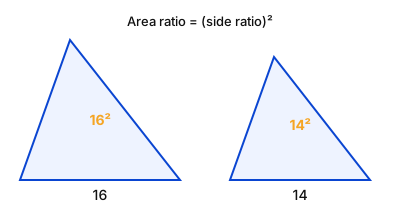
The ratio of the lengths of two corresponding sides of two similar triangles is 16 : 14. The ratio of the areas of these two triangles, in the order mentioned, is:
दो समरूप त्रिभुजों की दो संगत भुजाओं की लंबाइयों का अनुपात 16 : 14 है। इन दो त्रिभुजों के क्षेत्रफलों का अनुपात, उल्लिखित क्रम में, है:
  1. A256 : 196
  2. B1616:14
  3. C257 : 197
  4. D16 : 14
Show answer

Concept: For similar triangles, ratio of areas = square of the ratio of corresponding sides.

  1. Side ratio =16:14.
  2. Area ratio =162:142=256:196 (which simplifies to 64:49).

Trick: Sides → square for area, cube for volume; never take the same ratio for area.

Answer: (A) 256 : 196

अवधारणा: समरूप त्रिभुजों में क्षेत्रफलों का अनुपात = संगत भुजाओं के अनुपात का वर्ग।

  1. भुजा अनुपात =16:14।
  2. क्षेत्रफल अनुपात =162:142=256:196 (सरल रूप 64:49)।

ट्रिक: भुजा → क्षेत्रफल के लिए वर्ग, आयतन के लिए घन; क्षेत्रफल के लिए वही अनुपात कभी न लें।

उत्तर: (A) 256 : 196

RRB NTPC Graduate CBT 1MathematicsSimilar Triangles – Area RatioRRB NTPC Graduate CBT 1 2025 · 24 Mar Shift 2 →
Q5427.
There are 12 members in group A, 55 members in group B and 89 members in group C. All the members of these groups went to a restaurant. The average amounts spent on each member of groups A, B and C are ₹160, ₹109 and ₹181, respectively. The overall average amount (in ₹) spent per member is:
समूह A में 12 सदस्य, समूह B में 55 सदस्य और समूह C में 89 सदस्य हैं। इन समूहों के सभी सदस्य एक रेस्तरां में गए। समूह A, B और C के प्रत्येक सदस्य पर खर्च की गई औसत राशि क्रमशः ₹160, ₹109 और ₹181 है। प्रति सदस्य खर्च की गई कुल औसत राशि (₹ में) है:
  1. A157
  2. B153
  3. C151
  4. D154
Show answer

Concept: Overall average =total amounttotal members – weight each group average by its size.

  1. Totals: 12×160=1920, 55×109=5995, 89×181=16109.
  2. Sum =1920+5995+16109=24024; members =12+55+89=156.
  3. Average =24024156=154.

Trick: Never average the averages (160+109+1813=150) – group sizes differ.

Answer: (D) 154

अवधारणा: कुल औसत =कुल राशिकुल सदस्य – हर समूह के औसत को उसके आकार से भारित करें।

  1. कुल: 12×160=1920, 55×109=5995, 89×181=16109।
  2. योग =1920+5995+16109=24024; सदस्य =12+55+89=156।
  3. औसत =24024156=154।

ट्रिक: औसतों का औसत (160+109+1813=150) कभी न लें – समूहों के आकार अलग हैं।

उत्तर: (D) 154

RRB NTPC Graduate CBT 1MathematicsWeighted AverageRRB NTPC Graduate CBT 1 2025 · 24 Mar Shift 2 →
Q5428.
The selling price of 48 pieces of an item is same as the cost price of its x pieces. If the profit is 25%, then find the value of x.
किसी वस्तु के 48 नगों का विक्रय मूल्य उसके x नगों के क्रय मूल्य के समान है। यदि लाभ 25% है, तो x का मान ज्ञात कीजिए।
  1. A60
  2. B40
  3. C50
  4. D70
Show answer

Concept: If SP of m articles = CP of n articles, then Profit%=n−mm×100.

  1. Let CP of each piece = ₹1. Then SP of 48 pieces = ₹x (the CP of x pieces).
  2. Profit 25% → SP of 48 pieces =48×125100=60.
  3. So x=60.

Trick: x−4848=14⇒x−48=12⇒x=60; with profit, x>48 – reject 40 instantly.

Answer: (A) 60

अवधारणा: यदि m वस्तुओं का SP = n वस्तुओं का CP, तो लाभ%=n−mm×100।

  1. माना प्रत्येक का CP = ₹1। तब 48 वस्तुओं का SP = ₹x (x वस्तुओं का CP)।
  2. लाभ 25% → 48 वस्तुओं का SP =48×125100=60।
  3. अतः x=60।

ट्रिक: x−4848=14⇒x−48=12⇒x=60; लाभ में x>48 – 40 तुरंत खारिज।

उत्तर: (A) 60

RRB NTPC Graduate CBT 1MathematicsProfit and LossRRB NTPC Graduate CBT 1 2025 · 24 Mar Shift 2 →
Q5429.
If (x+y):(y+z):(z+x)=6:7:8 and x+y+z=14, then find the value of z.
यदि (x+y):(y+z):(z+x)=6:7:8 और x+y+z=14 है, तो z का मान ज्ञात कीजिए।
  1. A8
  2. B6
  3. C5
  4. D7
Show answer

Concept: Adding the three pair-sums gives twice the total x+y+z.

  1. Let x+y=6k,y+z=7k,z+x=8k.
  2. Adding: 2(x+y+z)=21k⇒28=21k⇒k=43.
  3. z=(x+y+z)−(x+y)=14−6k=14−8=6.

Trick: Simpler: the pair-sum that leaves out z is x+y=621×28=8, so z=14−8=6.

Answer: (B) 6

अवधारणा: तीनों युग्म-योगों को जोड़ने पर कुल x+y+z का दोगुना मिलता है।

  1. माना x+y=6k,y+z=7k,z+x=8k।
  2. जोड़ने पर: 2(x+y+z)=21k⇒28=21k⇒k=43।
  3. z=(x+y+z)−(x+y)=14−6k=14−8=6।

ट्रिक: सरल तरीका: जिस भाग में z नहीं है वह x+y=621×28=8, अतः z=14−8=6।

उत्तर: (B) 6

RRB NTPC Graduate CBT 1MathematicsRatio and ProportionRRB NTPC Graduate CBT 1 2025 · 24 Mar Shift 2 →
Q5430.
How many coins, each 5.5 cm in circumference and 2 mm thick, must be melted to form a cuboid of dimensions 14 cm × 11 cm × 8 cm? (Use π = 22/7)
5.5 cm परिधि और 2 mm मोटाई वाले कितने सिक्कों को पिघलाकर 14 cm × 11 cm × 8 cm विमाओं वाला एक घनाभ बनाया जा सकता है? (π = 22/7 का प्रयोग कीजिए)
  1. A2560
  2. B2370
  3. C2480
  4. D2240
Show answer

Concept: Number of coins =Volume of cuboidVolume of one coin (volume is conserved on melting).

  1. Circumference 2πr=5.5⇒r=5.5×72×22=78 cm; thickness h=2 mm =15 cm.
  2. Coin volume =πr2h=227×4964×15=77160 cm³.
  3. Cuboid volume =14×11×8=1232 cm³.
  4. Coins =1232÷77160=1232×16077=16×160=2560.

Trick: Convert mm to cm before anything else; 123277=16 because 77×16=1232.

Answer: (A) 2560

अवधारणा: सिक्कों की संख्या =घनाभ का आयतनएक सिक्के का आयतन (पिघलाने पर आयतन संरक्षित)।

  1. परिधि 2πr=5.5⇒r=5.5×72×22=78 cm; मोटाई h=2 mm =15 cm।
  2. सिक्के का आयतन =πr2h=227×4964×15=77160 cm³।
  3. घनाभ का आयतन =14×11×8=1232 cm³।
  4. सिक्के =1232÷77160=1232×16077=16×160=2560।

ट्रिक: सबसे पहले mm को cm में बदलें; 123277=16 क्योंकि 77×16=1232।

उत्तर: (A) 2560

RRB NTPC Graduate CBT 1MathematicsMensuration – Cylinder to CuboidRRB NTPC Graduate CBT 1 2025 · 24 Mar Shift 2 →
Q5431.
The sum of the cubes of the numbers 55, –30 and –25 is equal to:
संख्याओं 55, –30 और –25 के घनों का योग किसके बराबर है?
  1. A132570
  2. B132750
  3. C123570
  4. D123750
Show answer

Concept: If a+b+c=0, then a3+b3+c3=3abc.

  1. 55+(−30)+(−25)=0, so the identity applies.
  2. 3abc=3×55×(−30)×(−25)=3×55×750=123750.
  3. Direct check: 166375−27000−15625=123750.

Trick: Whenever three numbers add to zero, skip the cubes – just compute 3abc.

Answer: (D) 123750

अवधारणा: यदि a+b+c=0, तो a3+b3+c3=3abc।

  1. 55+(−30)+(−25)=0, अतः सर्वसमिका लागू।
  2. 3abc=3×55×(−30)×(−25)=3×55×750=123750।
  3. सीधी जाँच: 166375−27000−15625=123750।

ट्रिक: जब तीन संख्याओं का योग शून्य हो, घन निकालना छोड़ें – सीधे 3abc निकालें।

उत्तर: (D) 123750

RRB NTPC Graduate CBT 1MathematicsAlgebraic Identities – Sum of CubesRRB NTPC Graduate CBT 1 2025 · 24 Mar Shift 2 →
Q5432.
Govind gets double the amount in 7 years when invested at compound
interest,compounded annually. In how many years will the amount become eight times itself?
गोविंद को वार्षिक रूप से संयोजित चक्रवृद्धि ब्याज पर निवेश करने पर 7 वर्षों में
दोगुनी राशि प्राप्त होती है। कितने वर्षों में राशि स्वयं की आठ गुनी हो जाएगी?
  1. A28
  2. B14
  3. C21
  4. D56
Show answer

Concept: Under compound interest, if money doubles in n years, it becomes 2k times in k×n years.

  1. Doubles in 7 years: (1+r)7=2.
  2. Eight times =23=[(1+r)7]3=(1+r)21.
  3. So the time is 21 years.

Trick: CI: double in n → 4× in 2n, 8× in 3n. (In SI it would be 7×7=49 years – a different rule.)

Answer: (C) 21

अवधारणा: चक्रवृद्धि ब्याज में धन n वर्षों में दोगुना हो तो k×n वर्षों में 2k गुना होता है।

  1. 7 वर्ष में दोगुना: (1+r)7=2।
  2. आठ गुना =23=[(1+r)7]3=(1+r)21।
  3. अतः समय =21 वर्ष।

ट्रिक: CI: n में दोगुना → 2n में 4 गुना, 3n में 8 गुना। (SI में 7×7=49 वर्ष होता – नियम अलग है।)

उत्तर: (C) 21

RRB NTPC Graduate CBT 1MathematicsCompound Interest – DoublingRRB NTPC Graduate CBT 1 2025 · 24 Mar Shift 2 →
Q5433.
At what rate per annum will a sum of money become four times itself in 25 years under simple interest?
साधारण ब्याज पर कोई धनराशि 25 वर्षों में स्वयं की चार गुनी किस वार्षिक दर पर हो जाएगी?
  1. A10%
  2. B14%
  3. C12%
  4. D24%
Show answer

Concept: Under simple interest, if a sum becomes n times itself, the interest earned is (n−1) times the principal, so R=(n−1)×100T.

  1. Sum becomes 4 times, so SI=3P.
  2. SI=P×R×T100⇒3P=P×R×25100.
  3. R=30025=12% per annum.

Trick: "n times in T years" ⇒R=100(n−1)T. Here 100×325=12.

Answer: (C) 12%

अवधारणा: साधारण ब्याज में यदि धन n गुना हो जाए तो ब्याज मूलधन का (n−1) गुना होता है, अतः R=(n−1)×100T।

  1. धन 4 गुना हुआ, अतः SI=3P।
  2. SI=P×R×T100⇒3P=P×R×25100।
  3. R=30025=12% वार्षिक।

ट्रिक: "T वर्ष में n गुना" ⇒R=100(n−1)T। यहाँ 100×325=12।

उत्तर: (C) 12%

RRB NTPC Graduate CBT 1MathematicsSimple InterestRRB NTPC Graduate CBT 1 2025 · 24 Mar Shift 2 →
Q5434.
Three friends X, Y and Z started a business by investing a sum of money in the ratio of 9 : 4 : 8. After 6 months, X withdraws half of his capital. If the sum invested by Z is ₹23,000, then out of a total annual profit of ₹33,000, what is the difference between X's and Y's profit?
तीन मित्रों X, Y और Z ने 9 : 4 : 8 के अनुपात में धनराशि निवेश करके एक व्यापार शुरू किया। 6 महीने बाद, X अपनी पूँजी का आधा भाग निकाल लेता है। यदि Z द्वारा निवेश की गई राशि ₹23,000 है, तो ₹33,000 के कुल वार्षिक लाभ में से X और Y के लाभ के बीच का अंतर क्या है?
  1. A₹5845
  2. B₹3880
  3. C₹4840
  4. D₹4660
Show answer

Concept: Profit is shared in the ratio of (capital × time). When capital changes mid-year, add the products for each period.

  1. X: 9×6+92×6=54+27=81; Y: 4×12=48; Z: 8×12=96. Ratio 81:48:96, total 225 parts.
  2. Difference of X and Y =81−48=33 parts.
  3. 33×33000225=33×146.67= ₹4840.

Trick: Z's ₹23,000 is only a distractor; the profit split needs only the ratio. 33000225=14623, times 33 gives 4840.

Answer: (C) ₹4840

अवधारणा: लाभ (पूँजी × समय) के अनुपात में बँटता है। बीच में पूँजी बदले तो हर अवधि के गुणनफल जोड़ें।

  1. X: 9×6+92×6=54+27=81; Y: 4×12=48; Z: 8×12=96। अनुपात 81:48:96, कुल 225 भाग।
  2. X और Y का अंतर =81−48=33 भाग।
  3. 33×33000225=33×146.67= ₹4840।

ट्रिक: Z के ₹23,000 केवल भटकाने के लिए हैं; लाभ बाँटने में सिर्फ अनुपात चाहिए। 33000225=14623, इसे 33 से गुणा करने पर 4840।

उत्तर: (C) ₹4840

RRB NTPC Graduate CBT 1MathematicsPartnershipRRB NTPC Graduate CBT 1 2025 · 24 Mar Shift 2 →
Q5435.
The sum of the interior angles of a regular polygon is 1620°. What is the difference (in degrees) between the measures of an interior angle and an exterior angle of the polygon?
एक सम बहुभुज के अंतः कोणों का योग 1620° है। बहुभुज के एक अंतः कोण और एक बहिष्कोण के मापों के बीच का अंतर (डिग्री में) क्या है?
  1. A114611
  2. B182511
  3. C213211
  4. D151311
Show answer

Concept: Sum of interior angles =(n−2)×180∘; each exterior angle of a regular polygon =360∘n; interior + exterior =180∘.

  1. (n−2)×180=1620⇒n−2=9⇒n=11.
  2. Interior angle =162011, exterior angle =36011.
  3. Difference =1620−36011=126011=114611 degrees.

Trick: Difference =180∘−2×exterior=180−72011=126011.

Answer: (A) 114611

अवधारणा: अंतः कोणों का योग =(n−2)×180∘; सम बहुभुज का प्रत्येक बाह्य कोण =360∘n; अंतः + बाह्य =180∘।

  1. (n−2)×180=1620⇒n−2=9⇒n=11।
  2. अंतः कोण =162011, बाह्य कोण =36011।
  3. अंतर =1620−36011=126011=114611 डिग्री।

ट्रिक: अंतर =180∘−2×बाह्य कोण=180−72011=126011।

उत्तर: (A) 114611

RRB NTPC Graduate CBT 1MathematicsPolygons – Interior & Exterior AnglesRRB NTPC Graduate CBT 1 2025 · 24 Mar Shift 2 →
Q5436.
By selling an article at 311 of its marked price, Hitesh incurs a loss of 15%. If he sells it at 54% of its marked price, then the profit percentage is
किसी वस्तु को उसके अंकित मूल्य के 311 पर बेचने से हितेश को 15% की हानि होती है। यदि वह इसे इसके अंकित मूल्य के 54% पर बेचता है, तो लाभ प्रतिशत है
  1. A67.4%
  2. B68.3%
  3. C67.2%
  4. D69.5%
Show answer

Concept: Express MP in terms of CP from the loss condition, then compute the new SP.

  1. 311MP=0.85CP⇒MP=0.85×113CP=9.353CP.
  2. New SP =0.54×MP=0.54×9.353CP=1.683CP.
  3. Profit =68.3%.

Trick: Let MP =1100. Then 311×1100=300=0.85CP⇒CP=352.94; SP =594; profit =594−352.94352.94×100≈68.3%.

Answer: (B) 68.3%

अवधारणा: हानि की शर्त से MP को CP के रूप में लिखें, फिर नया SP निकालें।

  1. 311MP=0.85CP⇒MP=0.85×113CP=9.353CP।
  2. नया SP =0.54×MP=0.54×9.353CP=1.683CP।
  3. लाभ =68.3%।

ट्रिक: MP =1100 मानें। 311×1100=300=0.85CP⇒CP=352.94; SP =594; लाभ =594−352.94352.94×100≈68.3%।

उत्तर: (B) 68.3%

RRB NTPC Graduate CBT 1MathematicsProfit, Loss & Marked PriceRRB NTPC Graduate CBT 1 2025 · 24 Mar Shift 2 →
Q5437.
What is the mode of the data given below? [Give your answer correct to 2 decimal places.]
Age in years20-3030-4040-5050-6060-7070-8080-90
No. of patients31293328391018
नीचे दिए गए आँकड़ों का बहुलक (mode) क्या है? [अपना उत्तर 2 दशमलव स्थानों तक सही दीजिए।]
आयु (वर्षों में)20-3030-4040-5050-6060-7070-8080-90
रोगियों की संख्या31293328391018
  1. A61.75
  2. B62.75
  3. C64.75
  4. D65.75
Show answer

Concept: Mode =l+f1−f02f1−f0−f2×h, where l = lower limit of the modal class, f1 its frequency, f0, f2 the frequencies before and after, h class width.

  1. Highest frequency 39 → modal class 60–70; l=60, h=10, f1=39, f0=28, f2=10.
  2. Mode =60+39−2878−28−10×10=60+1140×10.
  3. =60+2.75=62.75.

Trick: The mode always lies inside the modal class (60–70); only options A and B qualify, and 11040=2.75 settles it.

Answer: (B) 62.75

अवधारणा: बहुलक =l+f1−f02f1−f0−f2×h, जहाँ l = बहुलक वर्ग की निचली सीमा, f1 उसकी बारंबारता, f0, f2 पहले और बाद वाले वर्गों की बारंबारता, h वर्ग-अंतराल।

  1. अधिकतम बारंबारता 39 → बहुलक वर्ग 60–70; l=60, h=10, f1=39, f0=28, f2=10।
  2. बहुलक =60+39−2878−28−10×10=60+1140×10।
  3. =60+2.75=62.75।

ट्रिक: बहुलक हमेशा बहुलक वर्ग (60–70) के अंदर होता है; केवल A और B बचते हैं, और 11040=2.75 से उत्तर तय।

उत्तर: (B) 62.75

RRB NTPC Graduate CBT 1MathematicsStatistics – Mode of Grouped DataRRB NTPC Graduate CBT 1 2025 · 24 Mar Shift 2 →
Q5438.
If x=723−7−23, then the value of x3+3x is:
यदि x=723−7−23 है, तो x3+3x का मान है:
  1. A790343
  2. B240049
  3. C250042
  4. D80049
Show answer

Concept: If x=a−b with ab=1, then x3=a3−b3−3ab(a−b)=a3−b3−3x, so x3+3x=a3−b3.

  1. Here a=72/3, b=7−2/3, and ab=70=1.
  2. a3=72=49, b3=7−2=149.
  3. x3+3x=49−149=2401−149=240049.

Trick: Whenever x=t−1t, remember x3+3x=t3−1t3 (and for x=t+1t, x3−3x=t3+1t3).

Answer: (B) 240049

अवधारणा: यदि x=a−b और ab=1, तो x3=a3−b3−3ab(a−b)=a3−b3−3x, अतः x3+3x=a3−b3।

  1. यहाँ a=72/3, b=7−2/3, और ab=70=1।
  2. a3=72=49, b3=7−2=149।
  3. x3+3x=49−149=2401−149=240049।

ट्रिक: जब x=t−1t हो, याद रखें x3+3x=t3−1t3 (और x=t+1t के लिए x3−3x=t3+1t3)।

उत्तर: (B) 240049

RRB NTPC Graduate CBT 1MathematicsAlgebra – Cubic IdentitiesRRB NTPC Graduate CBT 1 2025 · 24 Mar Shift 2 →
Q5439.
What is the maximum value that must be assigned to A so that the 8-digit number 230A7807 is divisible by 3?
A को अधिकतम कौन-सा मान दिया जाना चाहिए ताकि 8-अंकीय संख्या 230A7807, 3 से विभाज्य हो?
  1. A5
  2. B4
  3. C9
  4. D7
Show answer

Concept: A number is divisible by 3 when the sum of its digits is divisible by 3.

  1. Digit sum of 230A7807 =2+3+0+A+7+8+0+7=27+A.
  2. 27 is already a multiple of 3, so A must be a multiple of 3: A=0,3,6,9.
  3. Maximum single digit value =9.

Trick: Drop digits that already sum to a multiple of 3 (2+7, 3, 8+7) → only A remains, so A∈{0,3,6,9}.

Answer: (C) 9

अवधारणा: कोई संख्या 3 से विभाज्य होती है जब उसके अंकों का योग 3 से विभाज्य हो।

  1. 230A7807 का अंक-योग =2+3+0+A+7+8+0+7=27+A।
  2. 27 पहले से 3 का गुणज है, अतः A भी 3 का गुणज होना चाहिए: A=0,3,6,9।
  3. अधिकतम एक-अंकीय मान =9।

ट्रिक: जिन अंकों का योग पहले से 3 का गुणज है (2+7, 3, 8+7) उन्हें हटा दें → केवल A बचता है, अतः A∈{0,3,6,9}।

उत्तर: (C) 9

RRB NTPC Graduate CBT 1MathematicsDivisibility RulesRRB NTPC Graduate CBT 1 2025 · 24 Mar Shift 2 →
Q5440.
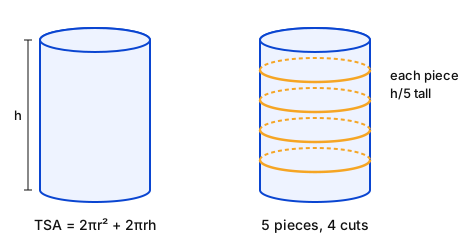
A solid cylinder is cut into 5 identical pieces by making cuts parallel to its flat surfaces. The curved surface area of all pieces is equal to the flat surface area of all pieces. If the total surface area of a piece is S square units, then the total surface area of the cylinder was ____ square units initially.
एक ठोस बेलन को उसके सपाट पृष्ठों के समांतर कटाव करके 5 समरूप टुकड़ों में काटा जाता है। सभी टुकड़ों का वक्र पृष्ठीय क्षेत्रफल, सभी टुकड़ों के सपाट पृष्ठीय क्षेत्रफल के बराबर है। यदि एक टुकड़े का कुल पृष्ठीय क्षेत्रफल S वर्ग इकाई है, तो बेलन का कुल पृष्ठीय क्षेत्रफल प्रारंभ में ____ वर्ग इकाई था।
  1. A5S
  2. B2S
  3. C4S
  4. D3S
Show answer

Concept: Cutting a cylinder parallel to its bases does not change the curved surface; it only adds new circular faces. TSA of cylinder =2πr2+2πrh.

  1. 5 pieces have 10 flat faces of area πr2 each, total 10πr2; their total curved surface is still 2πrh.
  2. Given 2πrh=10πr2, so the original TSA =2πr2+10πr2=12πr2.
  3. One piece: S=2πr2+2πrh5=2πr2+2πr2=4πr2. Hence TSA =12πr24πr2S=3S.

Trick: Per piece, flat = curved = 2πr2, so S=4πr2; original TSA =2πr2 (ends) +10πr2 (curved) =12πr2=3S.

Answer: (D) 3S

अवधारणा: बेलन को आधारों के समांतर काटने से वक्र पृष्ठ नहीं बदलता; केवल नए वृत्ताकार फलक जुड़ते हैं। बेलन का TSA =2πr2+2πrh।

  1. 5 टुकड़ों में πr2 क्षेत्रफल वाले 10 समतल फलक हैं, कुल 10πr2; कुल वक्र पृष्ठ अब भी 2πrh।
  2. दिया है 2πrh=10πr2, अतः मूल TSA =2πr2+10πr2=12πr2।
  3. एक टुकड़ा: S=2πr2+2πrh5=2πr2+2πr2=4πr2। अतः TSA =12πr24πr2S=3S।

ट्रिक: प्रति टुकड़ा समतल = वक्र = 2πr2, अतः S=4πr2; मूल TSA =2πr2 (सिरे) +10πr2 (वक्र) =12πr2=3S।

उत्तर: (D) 3S

RRB NTPC Graduate CBT 1MathematicsMensuration – CylinderRRB NTPC Graduate CBT 1 2025 · 24 Mar Shift 2 →