Question bank

Q&A: practice questions with answers

Search questions on any topic. Filter by exam category, exam, subject and topic, try the question, then open the answer and explanation.

Courses – airGurukul

7,077 questions found.

Q5441.
A shopkeeper fixes the marked price of an item 136% above its cost price. What percentage of discount on marked price should be allowed to gain 18%?
एक दुकानदार किसी वस्तु का अंकित मूल्य उसके क्रय मूल्य से 136% अधिक निर्धारित करता है। 18% लाभ प्राप्त करने के लिए अंकित मूल्य पर कितने प्रतिशत छूट दी जानी चाहिए?
  1. A47%
  2. B51%
  3. C48%
  4. D50%
Show answer

Concept: Take CP =100; then MP and the required SP are easy to compare.

  1. CP =100, MP =100+136=236.
  2. Required SP for 18% gain =118.
  3. Discount =236−118=118; discount% =118236×100=50%.

Trick: 236=2×118, so the SP is exactly half of MP → 50% discount.

Answer: (D) 50%

अवधारणा: CP =100 मानें; फिर MP और वांछित SP की तुलना आसान है।

  1. CP =100, MP =100+136=236।
  2. 18% लाभ के लिए SP =118।
  3. छूट =236−118=118; छूट% =118236×100=50%।

ट्रिक: 236=2×118, अतः SP ठीक MP का आधा है → 50% छूट।

उत्तर: (D) 50%
RRB NTPC Graduate CBT 1MathematicsDiscount & Marked PriceRRB NTPC Graduate CBT 1 2025 · 24 Mar Shift 2 →
Q5442.
What should come in place of ‘?’ in the given series?
73 71 68 63 56 ?
दी गई श्रेणी में '?' के स्थान पर क्या आना चाहिए?
73 71 68 63 56 ?
  1. A45
  2. B44
  3. C46
  4. D43
Show answer

Concept: Look at the differences between consecutive terms.

  1. 73−71=2, 71−68=3, 68−63=5, 63−56=7: the differences are consecutive primes.
  2. Next prime is 11, so ?=56−11=45.

Trick: Differences 2, 3, 5, 7, 11, 13 … (primes) is a very common NTPC pattern.

Answer: (A) 45

अवधारणा: क्रमागत पदों के अंतर देखें।

  1. 73−71=2, 71−68=3, 68−63=5, 63−56=7: अंतर क्रमागत अभाज्य संख्याएँ हैं।
  2. अगली अभाज्य 11, अतः ?=56−11=45।

ट्रिक: अंतर 2, 3, 5, 7, 11, 13 … (अभाज्य) NTPC का बहुत आम पैटर्न है।

उत्तर: (A) 45

RRB NTPC Graduate CBT 1MathematicsNumber SeriesRRB NTPC Graduate CBT 1 2025 · 24 Mar Shift 2 →
Q5443.
What should come in place of ‘?’ in the given series?
122 120 117 112 105 ?
दी गई श्रेणी में '?' के स्थान पर क्या आना चाहिए?
122 120 117 112 105 ?
  1. A93
  2. B94
  3. C95
  4. D92
Show answer

Concept: Find the pattern in the differences.

  1. 122−120=2, 120−117=3, 117−112=5, 112−105=7: consecutive primes.
  2. Next difference =11, so ?=105−11=94.

Trick: Same prime-difference pattern as the series 73, 71, 68, 63, 56 → 45.

Answer: (B) 94

अवधारणा: अंतरों में पैटर्न खोजें।

  1. 122−120=2, 120−117=3, 117−112=5, 112−105=7: क्रमागत अभाज्य।
  2. अगला अंतर =11, अतः ?=105−11=94।

ट्रिक: वही अभाज्य-अंतर पैटर्न जैसा 73, 71, 68, 63, 56 → 45 में था।

उत्तर: (B) 94

RRB NTPC Graduate CBT 1MathematicsNumber SeriesRRB NTPC Graduate CBT 1 2025 · 24 Mar Shift 2 →
Q5444.
The ratio of the angles of a triangle is 2:3:4. What percentage of the total angle measure is the largest angle? (Round to the nearest integer)
एक त्रिभुज के कोणों का अनुपात 2:3:4 है। सबसे बड़ा कोण कुल कोण माप का कितना प्रतिशत है? (निकटतम पूर्णांक तक पूर्णांकित कीजिए)
  1. A44%
  2. B40%
  3. C42%
  4. D46%
Show answer

Concept: The angles of a triangle add to 180∘; a ratio share as a percentage of the total is partsum of parts×100.

  1. Ratio 2:3:4, sum of parts =9; largest angle =49×180=80∘.
  2. Percentage =80180×100=49×100=44.44%≈44%.

Trick: You don't even need 180∘: the largest share is 49 of the total =44.4%.

Answer: (A) 44%

अवधारणा: त्रिभुज के कोणों का योग 180∘ होता है; कुल का प्रतिशत =भागभागों का योग×100।

  1. अनुपात 2:3:4, भागों का योग =9; सबसे बड़ा कोण =49×180=80∘।
  2. प्रतिशत =80180×100=49×100=44.44%≈44%।

ट्रिक: 180∘ की ज़रूरत ही नहीं: सबसे बड़ा हिस्सा कुल का 49=44.4% है।

उत्तर: (A) 44%

RRB NTPC Graduate CBT 1MathematicsTriangles – Angle Sum & PercentageRRB NTPC Graduate CBT 1 2025 · 24 Mar Shift 2 →
Q5445.
Two taps can fill a cistern in 4 hours and 30 hours respectively. A third tap can empty it in 30 hours. How long (in hours) will it take to fill one-fourth of the empty cistern, if all of them are opened together?
दो नल एक टंकी को क्रमशः 4 घंटे और 30 घंटे में भर सकते हैं। एक तीसरा नल इसे 30 घंटे में खाली कर सकता है। यदि सभी को एक साथ खोल दिया जाए, तो खाली टंकी का एक-चौथाई भाग भरने में कितना समय (घंटों में) लगेगा?
  1. A3
  2. B1
  3. C2
  4. D4
Show answer

Concept: Add the per-hour work of filling taps and subtract that of the emptying tap.

  1. Net part filled per hour =14+130−130=14.
  2. Full cistern takes 4 hours, so one-fourth takes 4×14=1 hour.

Trick: The 30-hour filler and 30-hour emptier cancel exactly; only the 4-hour tap matters.

Answer: (B) 1

अवधारणा: भरने वाले नलों का प्रति घंटा कार्य जोड़ें और खाली करने वाले का घटाएँ।

  1. प्रति घंटा शुद्ध भराव =14+130−130=14।
  2. पूरी टंकी 4 घंटे में, अतः एक-चौथाई 4×14=1 घंटे में।

ट्रिक: 30 घंटे वाला भरने वाला और 30 घंटे वाला खाली करने वाला नल एक-दूसरे को काट देते हैं; केवल 4 घंटे वाला नल मायने रखता है।

उत्तर: (B) 1

RRB NTPC Graduate CBT 1MathematicsPipes & CisternsRRB NTPC Graduate CBT 1 2025 · 24 Mar Shift 2 →
Q5446.
The marks obtained by a student in five subjects are: 72, 68, 74, 70, and 76. What is the average marks of the student per subject?
एक छात्र द्वारा पाँच विषयों में प्राप्त अंक हैं: 72, 68, 74, 70 और 76। छात्र के प्रति विषय औसत अंक क्या हैं?
  1. A74
  2. B70
  3. C75
  4. D72
Show answer

Concept: Average =sum of observationsnumber of observations.

  1. Sum =72+68+74+70+76=360.
  2. Average =3605=72.

Trick: Take 72 as base: deviations 0,−4,+2,−2,+4 add to 0, so the average is exactly 72.

Answer: (D) 72

अवधारणा: औसत =प्रेक्षणों का योगप्रेक्षणों की संख्या।

  1. योग =72+68+74+70+76=360।
  2. औसत =3605=72।

ट्रिक: 72 को आधार मानें: विचलन 0,−4,+2,−2,+4 का योग 0 है, अतः औसत ठीक 72।

उत्तर: (D) 72

RRB NTPC Graduate CBT 1MathematicsAverageRRB NTPC Graduate CBT 1 2025 · 24 Mar Shift 2 →
Q5447.
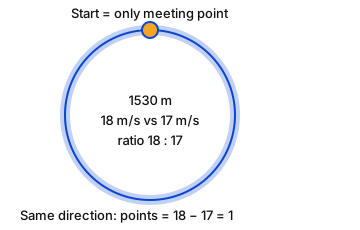
In a circular race of length 1530 m, Shahrukh and Amir start simultaneously from the same point and run in the same direction. Shahrukh completes one round in 85 seconds, while Amir completes one round in 90 seconds. How many different meeting points are there on the circumference of the track?
1530 m लंबाई की एक वृत्ताकार दौड़ में, शाहरुख और आमिर एक ही बिंदु से एक साथ शुरू करते हैं और एक ही दिशा में दौड़ते हैं। शाहरुख एक चक्कर 85 सेकंड में पूरा करता है, जबकि आमिर एक चक्कर 90 सेकंड में पूरा करता है। ट्रैक की परिधि पर कितने भिन्न मिलन बिंदु हैं?
  1. A1
  2. B35
  3. C11
  4. D2
Show answer

Concept: If two runners run in the same direction with speeds in the simplest ratio a:b, the number of distinct meeting points on the track is |a−b| (for opposite directions it is a+b).

  1. Speeds: Shahrukh =153085=18m/s, Amir =153090=17m/s.
  2. Ratio 18:17 is already in lowest terms.
  3. Same direction → meeting points =18−17=1 (only at the starting point).

Trick: Ratio of speeds = inverse ratio of lap times =90:85=18:17; difference 1 → one meeting point.

Answer: (A) 1

अवधारणा: यदि दो धावक एक ही दिशा में दौड़ें और उनकी चालों का सरलतम अनुपात a:b हो, तो ट्रैक पर अलग-अलग मिलन बिंदुओं की संख्या |a−b| होती है (विपरीत दिशा में a+b)।

  1. चाल: Shahrukh =153085=18m/s, Amir =153090=17m/s।
  2. अनुपात 18:17 पहले से सरलतम रूप में है।
  3. एक ही दिशा → मिलन बिंदु =18−17=1 (केवल प्रारंभ बिंदु पर)।

ट्रिक: चालों का अनुपात = चक्कर-समय का व्युत्क्रम अनुपात =90:85=18:17; अंतर 1 → एक मिलन बिंदु।

उत्तर: (A) 1

RRB NTPC Graduate CBT 1MathematicsCircular Races – Meeting PointsRRB NTPC Graduate CBT 1 2025 · 24 Mar Shift 2 →
Q5448.
The following table shows the heights of plants (in cm) and the corresponding number of plants. Find the mode of the data.
Height (in cm)142723211917
Number of Plants1361275
निम्न तालिका पौधों की ऊँचाई (cm में) और पौधों की संगत संख्या दर्शाती है। आँकड़ों का बहुलक (mode) ज्ञात कीजिए।
ऊँचाई (cm में)142723211917
पौधों की संख्या1361275
  1. A21 cm
  2. B27 cm
  3. C24 cm
  4. D23 cm
Show answer

Concept: For ungrouped frequency data, the mode is the observation with the highest frequency.

  1. Number of plants: 14 cm → 1, 27 cm → 3, 23 cm → 6, 21 cm → 12, 19 cm → 7, 17 cm → 5.
  2. Highest frequency is 12, for height 21 cm.

Trick: Mode = "most repeated"; do not average or pick the largest height (27 cm is a distractor).

Answer: (A) 21 cm

अवधारणा: अवर्गीकृत बारंबारता आँकड़ों में बहुलक वह प्रेक्षण है जिसकी बारंबारता सबसे अधिक हो।

  1. पौधों की संख्या: 14 cm → 1, 27 cm → 3, 23 cm → 6, 21 cm → 12, 19 cm → 7, 17 cm → 5।
  2. सबसे अधिक बारंबारता 12 है, ऊँचाई 21 cm के लिए।

ट्रिक: बहुलक = "सबसे अधिक बार"; औसत न निकालें और न ही सबसे बड़ी ऊँचाई चुनें (27 cm भटकाने के लिए है)।

उत्तर: (A) 21 cm

RRB NTPC Graduate CBT 1MathematicsStatistics – ModeRRB NTPC Graduate CBT 1 2025 · 24 Mar Shift 2 →
Q5449.
Ansh walks to his school at a certain speed from his home in the morning and returns in the afternoon at a speed, which is 2 km/h slower than his speed in the morning. If the average speed of Ansh of going to and coming back from the school is 4.8 km/h, find the sum of the speeds (in km/h) of Ansh in the morning and afternoon.
अंश सुबह अपने घर से एक निश्चित चाल से अपने विद्यालय जाता है और दोपहर में ऐसी चाल से वापस आता है, जो उसकी सुबह की चाल से 2 km/h कम है। यदि विद्यालय जाने और वापस आने में अंश की औसत चाल 4.8 km/h है, तो सुबह और दोपहर में अंश की चालों का योग (km/h में) ज्ञात कीजिए।
  1. A9
  2. B10
  3. C8
  4. D11
Show answer

Concept: For equal distances at speeds a and b, average speed =2aba+b.

  1. Let morning speed =v, afternoon =v−2. Then 2v(v−2)2v−2=4.8⇒v(v−2)v−1=4.8.
  2. v2−2v=4.8v−4.8⇒v2−6.8v+4.8=0⇒(v−6)(v−0.8)=0.
  3. v=6 (since v>2); speeds 6 and 4 km/h, sum =10 km/h.

Trick: Test options: sum 10 → speeds 6 and 4 → 2×6×410=4.8 ✓ in one line.

Answer: (B) 10

अवधारणा: समान दूरी के लिए चाल a और b हों तो औसत चाल =2aba+b।

  1. सुबह की चाल =v, दोपहर =v−2। तो 2v(v−2)2v−2=4.8⇒v(v−2)v−1=4.8।
  2. v2−2v=4.8v−4.8⇒v2−6.8v+4.8=0⇒(v−6)(v−0.8)=0।
  3. v=6 (क्योंकि v>2); चालें 6 और 4 km/h, योग =10 km/h।

ट्रिक: विकल्प जाँचें: योग 10 → चालें 6 और 4 → 2×6×410=4.8 ✓ एक पंक्ति में।

उत्तर: (B) 10

RRB NTPC Graduate CBT 1MathematicsAverage SpeedRRB NTPC Graduate CBT 1 2025 · 24 Mar Shift 2 →
Q5450.
In a certain code language, ‘COOK’ is coded as ‘8245’ and ‘HOOK’ is coded as ‘5429’. What is the code for ‘H’ in that language?
एक निश्चित कूट भाषा में, 'COOK' को '8245' के रूप में कूटबद्ध किया जाता है और 'HOOK' को '5429' के रूप में कूटबद्ध किया जाता है। उस भाषा में 'H' का कूट क्या है?
  1. A8
  2. B9
  3. C4
  4. D5
Show answer

Concept: Compare two coded words: common letters get the common digits; the leftover letter gets the leftover digit.

  1. COOK → 8245 and HOOK → 5429 share the letters O, O, K.
  2. Common digits of 8245 and 5429 are 2, 4, 5 → these belong to O, O, K.
  3. Leftover: C → 8 (from COOK) and H → 9 (from HOOK).

Trick: In such codes the digits are usually jumbled, so match by elimination, not by position.

Answer: (B) 9

अवधारणा: दो कूट शब्दों की तुलना करें: समान अक्षरों को समान अंक मिलते हैं; बचे अक्षर को बचा अंक।

  1. COOK → 8245 और HOOK → 5429 में O, O, K अक्षर समान हैं।
  2. 8245 और 5429 में समान अंक 2, 4, 5 हैं → ये O, O, K के हैं।
  3. शेष: C → 8 (COOK से) और H → 9 (HOOK से)।

ट्रिक: ऐसे कूट में अंक प्रायः उलट-पुलट होते हैं, इसलिए स्थिति से नहीं, निराकरण (elimination) से मिलान करें।

उत्तर: (B) 9

RRB NTPC Graduate CBT 1General Intelligence and ReasoningCoding-DecodingRRB NTPC Graduate CBT 1 2025 · 24 Mar Shift 2 →
Q5451.
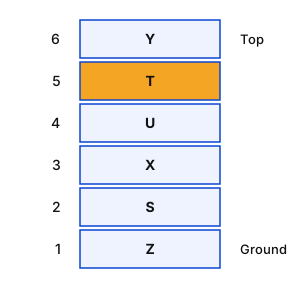
X, Y, Z, S, T and U live on six different floors of the same building. The lowermost floor in the building is numbered 1, the floor above it is numbered 2, and so on till the topmost floor is numbered 6. U lives on floor number 4. Only two people live between U and Z. Only T lives between U and Y. X lives immediately below U. Who lives on floor number 5?
X, Y, Z, S, T और U एक ही भवन की छह अलग-अलग मंज़िलों पर रहते हैं। भवन की सबसे निचली मंज़िल की संख्या 1 है, उसके ऊपर की मंज़िल की संख्या 2 है, और इसी प्रकार सबसे ऊपरी मंज़िल तक, जिसकी संख्या 6 है। U मंज़िल संख्या 4 पर रहता है। U और Z के बीच केवल दो व्यक्ति रहते हैं। U और Y के बीच केवल T रहता है। X, U के ठीक नीचे रहता है। मंज़िल संख्या 5 पर कौन रहता है?
  1. AS
  2. BY
  3. CX
  4. DT
Show answer

Concept: Fix the given floor first, then place people using the 'between' and 'immediately' clues.

  1. U = floor 4. Two people between U and Z → Z = 1 (floor 7 does not exist).
  2. X lives immediately below U → X = 3.
  3. Only T between U and Y → T = 5, Y = 6 (T = 3 is taken by X). Remaining S = 2.
  4. Floor 5 is occupied by T.

Trick: Always begin with the definite clue (U = 4); 'immediately below' kills the other branch at once.

Answer: (D) T

अवधारणा: पहले दी गई मंज़िल तय करें, फिर 'बीच में' और 'ठीक नीचे' वाले संकेतों से लोगों को रखें।

  1. U = मंज़िल 4। U और Z के बीच दो लोग → Z = 1 (मंज़िल 7 नहीं है)।
  2. X, U के ठीक नीचे रहता है → X = 3।
  3. U और Y के बीच केवल T → T = 5, Y = 6 (T = 3 पर X है)। शेष S = 2।
  4. मंज़िल 5 पर T रहता है।

ट्रिक: हमेशा निश्चित संकेत (U = 4) से शुरू करें; 'ठीक नीचे' दूसरी शाखा को तुरंत खत्म कर देता है।

उत्तर: (D) T

RRB NTPC Graduate CBT 1General Intelligence and ReasoningFloor PuzzleRRB NTPC Graduate CBT 1 2025 · 24 Mar Shift 2 →
Q5452.
Based on the English alphabetical order, three of the following four letter-cluster pairs are alike in a certain way and thus form a group. Which letter-cluster pair DOES NOT belong to that group?
(Note: The odd one out is not based on the number of consonants/vowels or their position in the letter-cluster.)
अंग्रेज़ी वर्णमाला क्रम के आधार पर, निम्नलिखित चार अक्षर-समूह युग्मों में से तीन एक निश्चित प्रकार से समान हैं और इस प्रकार एक समूह बनाते हैं। कौन-सा अक्षर-समूह युग्म उस समूह से संबंधित नहीं है?
(नोट: विषम वाला व्यंजनों/स्वरों की संख्या या अक्षर-समूह में उनकी स्थिति पर आधारित नहीं है।)
  1. ARQ−PO
  2. BZY−XW
  3. CYX−WV
  4. DLK−IK
Show answer

Concept: Write the alphabet positions and look at the pattern inside each pair.

  1. RQ−PO: R(18) Q(17) P(16) O(15) – four consecutive letters in reverse order.
  2. ZY−XW: 26, 25, 24, 23 and YX−WV: 25, 24, 23, 22 – also four consecutive letters backwards.
  3. LK−IK: L(12) K(11) I(9) K(11) – the chain breaks (gap of 2, then K repeats).

Trick: Three options following 'consecutive descending' leave the odd one out immediately – look for the repeated letter.

Answer: (D) LK−IK

अवधारणा: अक्षरों के स्थान लिखें और हर जोड़े के भीतर पैटर्न देखें।

  1. RQ−PO: R(18) Q(17) P(16) O(15) – उल्टे क्रम में चार क्रमागत अक्षर।
  2. ZY−XW: 26, 25, 24, 23 और YX−WV: 25, 24, 23, 22 – ये भी उल्टे क्रम में चार क्रमागत अक्षर।
  3. LK−IK: L(12) K(11) I(9) K(11) – शृंखला टूटती है (2 का अंतर, फिर K दोहराया)।

ट्रिक: तीन विकल्प 'क्रमागत अवरोही' हैं, इससे विषम तुरंत दिखता है – दोहराया हुआ अक्षर पहचानें।

उत्तर: (D) LK−IK

RRB NTPC Graduate CBT 1General Intelligence and ReasoningLetter Cluster ClassificationRRB NTPC Graduate CBT 1 2025 · 24 Mar Shift 2 →
Q5453.
Each of the digits in the number 7814329 is arranged in ascending order from left to right. The position of how many digits will remain unchanged as compared to that in the original number?
संख्या 7814329 के प्रत्येक अंक को बाएँ से दाएँ आरोही क्रम में व्यवस्थित किया जाता है। मूल संख्या की तुलना में कितने अंकों की स्थिति अपरिवर्तित रहेगी?
  1. AFourचार
  2. BThreeतीन
  3. COneएक
  4. DTwoदो
Show answer

Concept: Write the original and the rearranged number one below the other and compare position by position.

  1. Original: 7 8 1 4 3 2 9.
  2. Ascending order: 1 2 3 4 7 8 9.
  3. Position 4 has 4 in both and position 7 has 9 in both; all other positions change.
  4. So the position of two digits remains unchanged.

Trick: Only the digit that is already the k-th smallest and sits at the k-th place stays – check each quickly.

Answer: (D) Two

अवधारणा: मूल और पुनर्व्यवस्थित संख्या को एक के नीचे एक लिखकर स्थान-दर-स्थान तुलना करें।

  1. मूल: 7 8 1 4 3 2 9।
  2. आरोही क्रम: 1 2 3 4 7 8 9।
  3. चौथे स्थान पर दोनों में 4 और सातवें स्थान पर दोनों में 9 है; बाकी सभी स्थान बदलते हैं।
  4. अतः दो अंकों का स्थान अपरिवर्तित रहता है।

ट्रिक: केवल वही अंक रुकता है जो पहले से k-वाँ सबसे छोटा है और k-वें स्थान पर बैठा है – हर स्थान तेज़ी से जाँचें।

उत्तर: (D) दो

RRB NTPC Graduate CBT 1General Intelligence and ReasoningNumber ArrangementRRB NTPC Graduate CBT 1 2025 · 24 Mar Shift 2 →
Q5454.
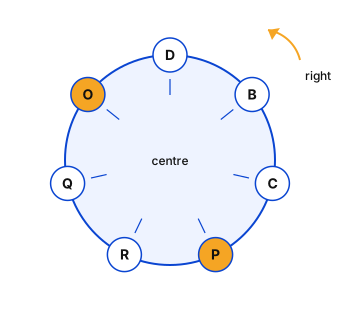
Seven people B, C, D, O, P, Q and R are sitting around a circular table facing the center of the table. Only four people sit between D and C when counted from the right of D. R sits third to the right of D. B sits third to the left of Q. P is an immediate neighbor of both C and R. How many people sit between O and P when counted from the left of O?
सात व्यक्ति B, C, D, O, P, Q और R एक वृत्ताकार मेज़ के चारों ओर मेज़ के केंद्र की ओर मुख करके बैठे हैं। D के दाएँ से गिनने पर D और C के बीच केवल चार व्यक्ति बैठे हैं। R, D के दाएँ तीसरे स्थान पर बैठा है। B, Q के बाएँ तीसरे स्थान पर बैठा है। P, C और R दोनों का निकटतम पड़ोसी है। O के बाएँ से गिनने पर O और P के बीच कितने व्यक्ति बैठे हैं?
  1. AOneएक
  2. BTwoदो
  3. CFourचार
  4. DThreeतीन
Show answer

Concept: Facing the centre, 'right' means anticlockwise. In 7 seats, 'four between D and C from D's right' = C is 5th to the right of D.

  1. Place D. Going right: R is 3rd to the right of D; C is 5th to the right of D.
  2. P is a neighbour of both C and R → P sits in the 4th seat (between R and C).
  3. Seats left: 1st, 2nd and 6th to the right of D. B is 3rd to the left of Q → Q at 2nd right, B at 6th right; O takes the 1st seat right of D.
  4. From O's left (clockwise): D, B, C, then P → three people between O and P.

Trick: Number the seats 0–6 anticlockwise from D; 'n-th to the right' = +n, 'n-th to the left' = −n (mod 7).

Answer: (D) Three

अवधारणा: केंद्र की ओर मुख होने पर 'दाएँ' = वामावर्त (anticlockwise)। 7 सीटों में 'D के दाएँ से D और C के बीच चार' = C, D के दाएँ 5वाँ।

  1. D रखें। दाएँ चलते हुए: R, D के दाएँ तीसरा; C, D के दाएँ पाँचवाँ।
  2. P, C और R दोनों का पड़ोसी → P चौथी सीट (R और C के बीच) पर।
  3. बची सीटें: D के दाएँ पहली, दूसरी और छठी। B, Q के बाएँ तीसरा → Q दूसरी दाएँ, B छठी दाएँ; O, D के दाएँ पहली सीट पर।
  4. O के बाएँ (दक्षिणावर्त) से: D, B, C, फिर P → O और P के बीच तीन लोग।

ट्रिक: D से वामावर्त सीटें 0–6 नंबर करें; 'दाएँ n-वाँ' = +n, 'बाएँ n-वाँ' = −n (mod 7)।

उत्तर: (D) तीन

RRB NTPC Graduate CBT 1General Intelligence and ReasoningCircular Seating ArrangementRRB NTPC Graduate CBT 1 2025 · 24 Mar Shift 2 →
Q5455.
Based on the alphabetical order, three of the following four are alike in a certain way and thus form a group. Which is the one that does not belong to that group?
(Note: The odd man out is not based on the number of consonants/vowels or their position in the letter cluster.)
वर्णमाला क्रम के आधार पर, निम्नलिखित चार में से तीन एक निश्चित प्रकार से समान हैं और इस प्रकार एक समूह बनाते हैं। वह कौन-सा है जो उस समूह से संबंधित नहीं है?
(नोट: विषम वाला व्यंजनों/स्वरों की संख्या या अक्षर-समूह में उनकी स्थिति पर आधारित नहीं है।)
  1. APLO
  2. BNJM
  3. CJFH
  4. DLHK
Show answer

Concept: Convert letters to positions and find the gap pattern between 1st→2nd and 2nd→3rd letters.

  1. PLO: 16, 12, 15 → −4,+3.
  2. NJM: 14, 10, 13 → −4,+3; LHK: 12, 8, 11 → −4,+3.
  3. JFH: 10, 6, 8 → −4,+2 – the second gap differs.

Trick: When three options share a pattern like (−4,+3), the one with a single different step is the answer.

Answer: (C) JFH

अवधारणा: अक्षरों को स्थान में बदलें और पहले→दूसरे तथा दूसरे→तीसरे अक्षर के अंतर का पैटर्न देखें।

  1. PLO: 16, 12, 15 → −4,+3।
  2. NJM: 14, 10, 13 → −4,+3; LHK: 12, 8, 11 → −4,+3।
  3. JFH: 10, 6, 8 → −4,+2 – दूसरा अंतर अलग है।

ट्रिक: जब तीन विकल्पों में (−4,+3) जैसा समान पैटर्न हो, तो एक अलग कदम वाला विकल्प उत्तर है।

उत्तर: (C) JFH

RRB NTPC Graduate CBT 1General Intelligence and ReasoningLetter Cluster ClassificationRRB NTPC Graduate CBT 1 2025 · 24 Mar Shift 2 →
Q5456.
In a certain code language,
A + B means ‘A is the mother of B’
A – B means ‘A is the brother of B’
A × B means ‘A is the wife of B’
A % B means ‘A is the father of B’
A # B means ‘A is the daughter of B’
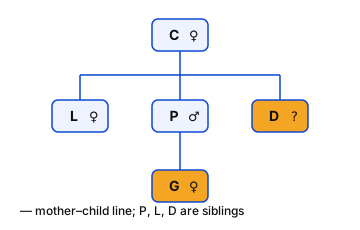
Based on the above, how is G related to D if ‘G # P – L # C + D’?
एक निश्चित कूट भाषा में,
A + B का अर्थ है 'A, B की माता है'
A – B का अर्थ है 'A, B का भाई है'
A × B का अर्थ है 'A, B की पत्नी है'
A % B का अर्थ है 'A, B का पिता है'
A # B का अर्थ है 'A, B की पुत्री है'
उपर्युक्त के आधार पर, यदि 'G # P – L # C + D' है, तो G, D से किस प्रकार संबंधित है?
  1. ABrother’s daughterभाई की पुत्री
  2. BFather’s sisterपिता की बहन
  3. CFather’s motherपिता की माता
  4. DSon’s daughterपुत्र की पुत्री
Show answer

Concept: Decode symbol by symbol and build the family tree from the top (oldest) generation.

  1. C + D: C is the mother of D. L # C: L is the daughter of C → L and D are siblings.
  2. P − L: P is the brother of L → P is also a child of C, i.e. P is D's brother.
  3. G # P: G is the daughter of P.
  4. So G is the daughter of D's brother → brother's daughter (niece).

Trick: Start from the end of the chain (the mother C) – children of the same mother are siblings; then attach the first person.

Answer: (A) Brother's daughter

अवधारणा: प्रतीकों को एक-एक करके डिकोड करें और ऊपर (सबसे पुरानी) पीढ़ी से वंश-वृक्ष बनाएँ।

  1. C + D: C, D की माता है। L # C: L, C की पुत्री → L और D भाई-बहन हैं।
  2. P − L: P, L का भाई → P भी C की संतान, अर्थात P, D का भाई है।
  3. G # P: G, P की पुत्री है।
  4. अतः G, D के भाई की पुत्री → भाई की बेटी (भतीजी)।

ट्रिक: शृंखला के अंत (माता C) से शुरू करें – एक ही माता की संतानें भाई-बहन हैं; फिर पहले व्यक्ति को जोड़ें।

उत्तर: (A) भाई की बेटी

RRB NTPC Graduate CBT 1General Intelligence and ReasoningBlood RelationsRRB NTPC Graduate CBT 1 2025 · 24 Mar Shift 2 →
Q5457.
What will come in the place of ‘?’ in the following equation, if ‘+’ and ‘−’ are
interchanged and ‘×’ and ‘÷’ are interchanged?
25 ÷ 2 + 12 × 4 − 7 = ? + 13
यदि '+' और '−' को परस्पर बदल दिया जाए तथा '×' और '÷' को परस्पर बदल दिया जाए, तो निम्नलिखित समीकरण में '?' के स्थान पर क्या आएगा?
25 ÷ 2 + 12 × 4 − 7 = ? + 13
  1. A66
  2. B64
  3. C65
  4. D67
Show answer

Concept: Interchange the signs on both sides of the equation, then apply BODMAS.

  1. After interchange: 25×2−12÷4+7=?−13.
  2. LHS: 12÷4=3; 25×2=50; 50−3+7=54.
  3. ?−13=54⇒?=67.

Trick: The '+' on the right side also becomes '−' – forgetting this gives 41, which is not an option.

Answer: (D) 67

अवधारणा: समीकरण के दोनों पक्षों में चिह्न बदलें, फिर BODMAS लगाएँ।

  1. बदलने पर: 25×2−12÷4+7=?−13।
  2. LHS: 12÷4=3; 25×2=50; 50−3+7=54।
  3. ?−13=54⇒?=67।

ट्रिक: दाएँ पक्ष का '+' भी '−' बनता है – इसे भूलने पर 41 आता है, जो विकल्प में नहीं है।

उत्तर: (D) 67

RRB NTPC Graduate CBT 1General Intelligence and ReasoningMathematical OperationsRRB NTPC Graduate CBT 1 2025 · 24 Mar Shift 2 →
Q5458.
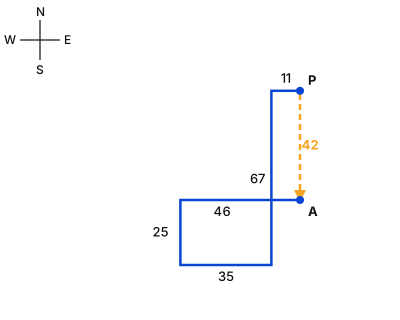
Dinesh starts from Point A and drives 46 km towards West. He then takes a left turn, drives 25 km, turns left and drives 35 km. He then takes a left turn and drives 67 km. He takes a final right turn, drives 11 km and stops at Point P. How far (shortest distance) and towards which direction should he drive in order to reach Point A again? (All turns are 90 degrees turns only unless specified)
दिनेश बिंदु A से शुरू करता है और पश्चिम की ओर 46 km गाड़ी चलाता है। फिर वह बाएँ मुड़ता है, 25 km चलता है, बाएँ मुड़ता है और 35 km चलता है। फिर वह बाएँ मुड़ता है और 67 km चलता है। वह अंत में दाएँ मुड़ता है, 11 km चलता है और बिंदु P पर रुक जाता है। बिंदु A पर पुनः पहुँचने के लिए उसे कितनी दूर (न्यूनतम दूरी) और किस दिशा में गाड़ी चलानी चाहिए? (जब तक अन्यथा निर्दिष्ट न हो, सभी मोड़ केवल 90 डिग्री के मोड़ हैं)
  1. A40 km to the South40 km दक्षिण की ओर
  2. B40 km to the North40 km उत्तर की ओर
  3. C42 km to the South42 km दक्षिण की ओर
  4. D42 km to the North42 km उत्तर की ओर
Show answer

Concept: Track the facing direction after each turn: facing West, left = South; facing South, left = East; facing East, left = North; facing North, right = East.

  1. Take A as origin. West 46 → (−46,0); left (South) 25 → (−46,−25); left (East) 35 → (−11,−25).
  2. Left (North) 67 → (−11,42); right (East) 11 → (0,42)=P.
  3. P is directly 42 km north of A, so he must drive 42 km towards the South.

Trick: Net East–West: −46+35+11=0; net North–South: −25+67=42 north – when one component is zero no Pythagoras is needed.

Answer: (C) 42 km to the South

अवधारणा: हर मोड़ के बाद मुख की दिशा नोट करें: पश्चिम मुख पर बायाँ = दक्षिण; दक्षिण मुख पर बायाँ = पूर्व; पूर्व मुख पर बायाँ = उत्तर; उत्तर मुख पर दायाँ = पूर्व।

  1. A को मूल बिंदु लें। पश्चिम 46 → (−46,0); बायाँ (दक्षिण) 25 → (−46,−25); बायाँ (पूर्व) 35 → (−11,−25)।
  2. बायाँ (उत्तर) 67 → (−11,42); दायाँ (पूर्व) 11 → (0,42)=P।
  3. P, A के ठीक 42 km उत्तर में है, अतः उसे 42 km दक्षिण की ओर चलना होगा।

ट्रिक: शुद्ध पूर्व–पश्चिम: −46+35+11=0; शुद्ध उत्तर–दक्षिण: −25+67=42 उत्तर – एक घटक शून्य हो तो पाइथागोरस की ज़रूरत नहीं।

उत्तर: (C) 42 km दक्षिण की ओर

RRB NTPC Graduate CBT 1General Intelligence and ReasoningDirection and DistanceRRB NTPC Graduate CBT 1 2025 · 24 Mar Shift 2 →
Q5459.
Refer to the given letter, number, symbol series and answer the question that follows. Counting to be done from left to right. All numbers are single-digit numbers.
(Left) W 5 $ D % 9 R Q 2 8 @ F # 6 P 3 V & L 4 K ^ U (Right)
How many such symbols are there, each of which is immediately preceded by a letter and also immediately followed by a number?
दी गई अक्षर, संख्या, प्रतीक श्रेणी को देखिए और उसके बाद आने वाले प्रश्न का उत्तर दीजिए। गिनती बाएँ से दाएँ की जानी है। सभी संख्याएँ एक-अंकीय संख्याएँ हैं।
(बाएँ) W 5 $ D % 9 R Q 2 8 @ F # 6 P 3 V & L 4 K ^ U (दाएँ)
ऐसे कितने प्रतीक हैं, जिनमें से प्रत्येक के ठीक पहले एक अक्षर है और ठीक बाद एक संख्या है?
  1. ANoneकोई नहीं
  2. BThreeतीन
  3. COneएक
  4. DTwoदो
Show answer

Concept: Scan only the symbols and check the character just before (must be a letter) and just after (must be a number).

  1. Symbols in order: $ (W before, D after – fails), % (D before, 9 after – ✓), @ (8 before – fails).
  2. # (F before, 6 after – ✓), & (V before, L after – fails), ^ (K before, U after – fails).
  3. Required pattern Letter–Symbol–Number occurs twice.

Trick: Mark each symbol and look one step left and one step right only – do not scan the whole series repeatedly.

Answer: (D) Two

अवधारणा: केवल प्रतीकों को देखें और ठीक पहले वाला (अक्षर होना चाहिए) व ठीक बाद वाला (संख्या होनी चाहिए) जाँचें।

  1. क्रम में प्रतीक: $ (पहले W, बाद D – नहीं), % (पहले D, बाद 9 – ✓), @ (पहले 8 – नहीं)।
  2. # (पहले F, बाद 6 – ✓), & (पहले V, बाद L – नहीं), ^ (पहले K, बाद U – नहीं)।
  3. अक्षर–प्रतीक–संख्या पैटर्न दो बार आता है।

ट्रिक: हर प्रतीक पर निशान लगाकर केवल एक कदम बाएँ और एक कदम दाएँ देखें – पूरी शृंखला बार-बार न पढ़ें।

उत्तर: (D) दो

RRB NTPC Graduate CBT 1General Intelligence and ReasoningLetter-Number-Symbol SeriesRRB NTPC Graduate CBT 1 2025 · 24 Mar Shift 2 →
Q5460.
Select the pair which follows the same pattern as that followed by the two set of pairs given below. Both pairs follow the same pattern.
RUB : WSG
BQL : GOQ
उस युग्म का चयन कीजिए जो नीचे दिए गए दो युग्मों के समान पैटर्न का अनुसरण करता है। दोनों युग्म समान पैटर्न का अनुसरण करते हैं।
RUB : WSG
BQL : GOQ
  1. ALMV : QKA
  2. BBCG : GYL
  3. CKDH : NZK
  4. DMHV : OCX
Show answer

Concept: Find the shift applied to each letter position in the given pairs and apply the same to the options.

  1. RUB → WSG: R+5=W, U−2=S, B+5=G. BQL → GOQ: B+5=G, Q−2=O, L+5=Q. Pattern (+5,−2,+5).
  2. LMV → QKA: L+5=Q, M−2=K, V+5=A (V=22, 22+5=27→1=A) ✓.
  3. BCG→GYL (C−4), KDH→NZK (+3,−4,+3), MHV→OCX (+2,−5,+2) do not match.

Trick: Write the three shifts once; check options letter by letter and stop at the first mismatch.

Answer: (A) LMV : QKA

अवधारणा: दिए गए जोड़ों में हर अक्षर-स्थान पर लगा अंतर निकालें और वही विकल्पों पर लगाएँ।

  1. RUB → WSG: R+5=W, U−2=S, B+5=G। BQL → GOQ: B+5=G, Q−2=O, L+5=Q। पैटर्न (+5,−2,+5)।
  2. LMV → QKA: L+5=Q, M−2=K, V+5=A (V=22, 22+5=27→1=A) ✓।
  3. BCG→GYL (C−4), KDH→NZK (+3,−4,+3), MHV→OCX (+2,−5,+2) मेल नहीं खाते।

ट्रिक: तीनों अंतर एक बार लिखें; विकल्पों को अक्षर-दर-अक्षर जाँचें और पहली असंगति पर रुक जाएँ।

उत्तर: (A) LMV : QKA

RRB NTPC Graduate CBT 1General Intelligence and ReasoningLetter AnalogyRRB NTPC Graduate CBT 1 2025 · 24 Mar Shift 2 →