Question bank

Q&A: practice questions with answers

Search questions on any topic. Filter by exam category, exam, subject and topic, try the question, then open the answer and explanation.

Courses – airGurukul

7,077 questions found.

Q5641.
Line PQ is parallel to line RS and a transversal AB intersects PQ at C and RS at D. If ∠ACQ=(6x)∘, ∠QCD=(5x+y)∘ and ∠BDS=(2x+3y)∘, find the measure of ∠QCD.
रेखा PQ रेखा RS के समांतर है और एक तिर्यक रेखा AB, PQ को C पर तथा RS को D पर प्रतिच्छेद करती है। यदि ∠ACQ=(6x)∘, ∠QCD=(5x+y)∘ और ∠BDS=(2x+3y)∘ है, तो ∠QCD का माप ज्ञात कीजिए।
  1. A93.6∘
  2. B84.5∘
  3. C102∘
  4. D110∘
Show answer

Concept: On a straight line, adjacent angles sum to 180∘; with parallel lines, corresponding angles are equal.
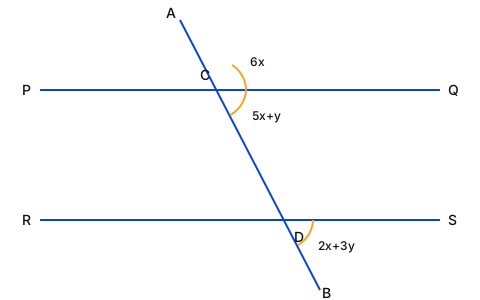
  1. ∠ACQ+∠QCD=180∘ (linear pair on AB): 6x+5x+y=180⇒11x+y=180.
  2. ∠QCD=∠BDS (corresponding angles, PQ ∥ RS): 5x+y=2x+3y⇒3x=2y⇒y=1.5x.
  3. 11x+1.5x=180⇒x=14.4, y=21.6.
  4. ∠QCD=5(14.4)+21.6=93.6∘.

Trick: Two equations, two unknowns: linear pair gives one, corresponding angles give the other – solve for x, then add 5x+y.

Answer: (A) 93.6∘

अवधारणा: सरल रेखा पर आसन्न कोणों का योग 180∘; समांतर रेखाओं में संगत कोण (corresponding angles) बराबर।

  1. ∠ACQ+∠QCD=180∘ (AB पर रैखिक युग्म): 6x+5x+y=180⇒11x+y=180।
  2. ∠QCD=∠BDS (संगत कोण, PQ ∥ RS): 5x+y=2x+3y⇒y=1.5x।
  3. 11x+1.5x=180⇒x=14.4, y=21.6।
  4. ∠QCD=5(14.4)+21.6=93.6∘।

ट्रिक: दो समीकरण, दो अज्ञात: रैखिक युग्म से एक, संगत कोण से दूसरा – x निकालें, फिर 5x+y जोड़ें।

उत्तर: (A) 93.6∘

RRB NTPC Graduate CBT 1MathematicsLines and Angles – Parallel LinesRRB NTPC Graduate CBT 1 2025 · 22 Mar Shift 3 →
Q5642.
If a=x+2x and b=x−2x, then find the value of a4+b4−2a2b2.
यदि a=x+2x और b=x−2x है, तो a4+b4−2a2b2 का मान ज्ञात कीजिए।
  1. A36
  2. B64
  3. C16
  4. D49
Show answer

Concept: a4+b4−2a2b2=(a2−b2)2=[(a+b)(a−b)]2.

  1. a+b=2x, a−b=4x.
  2. (a+b)(a−b)=2x×4x=8.
  3. Required value =82=64.

Trick: Whenever you see a4+b4−2a2b2, read it as (a2−b2)2 – the x cancels and no expansion is needed.

Answer: (B) 64

अवधारणा: a4+b4−2a2b2=(a2−b2)2=[(a+b)(a−b)]2।

  1. a+b=2x, a−b=4x।
  2. (a+b)(a−b)=2x×4x=8।
  3. अभीष्ट मान =82=64।

ट्रिक: a4+b4−2a2b2 दिखे तो उसे (a2−b2)2 पढ़ें – x कट जाता है, विस्तार की ज़रूरत नहीं।

उत्तर: (B) 64

RRB NTPC Graduate CBT 1MathematicsAlgebra – IdentitiesRRB NTPC Graduate CBT 1 2025 · 22 Mar Shift 3 →
Q5643.
What is the mean of the following distribution?
Marks1621478099
No. of Students2438263213
निम्नलिखित बंटन का माध्य क्या है?
अंक1621478099
छात्रों की संख्या2438263213
  1. A67
  2. B47
  3. C74
  4. D71
Show answer

Concept: x¯=∑fixi∑fi.

  1. ∑fixi=16×24+21×38+47×26+80×32+99×13=384+798+1222+2560+1287=6251.
  2. ∑fi=24+38+26+32+13=133.
  3. x¯=6251133=47.

Trick: Take assumed mean 47: deviations −31,−26,0,33,52 give ∑fidi=−744−988+0+1056+676=0 → mean is exactly 47.

Answer: (B) 47

अवधारणा: x¯=∑fixi∑fi।

  1. ∑fixi=16×24+21×38+47×26+80×32+99×13=384+798+1222+2560+1287=6251।
  2. ∑fi=24+38+26+32+13=133।
  3. x¯=6251133=47।

ट्रिक: कल्पित माध्य 47 लें: विचलन −31,−26,0,33,52 से ∑fidi=−744−988+0+1056+676=0 → माध्य ठीक 47।

उत्तर: (B) 47

RRB NTPC Graduate CBT 1MathematicsStatistics – MeanRRB NTPC Graduate CBT 1 2025 · 22 Mar Shift 3 →
Q5644.
A and B start a business by investing capitals in the ratio 5:7. After 4 months, C joins the business with a capital equal to half of B’s capital. After 8 months from the start, A withdraws 40% of his capital, while B continues with the same investment. At the end of one year, the total profit is ₹27,675. The share of profit of B (in ₹) is:
A और B 5:7 के अनुपात में पूँजी निवेश करके एक व्यापार शुरू करते हैं। 4 महीने बाद, C, B की पूँजी के आधे के बराबर पूँजी के साथ व्यापार में शामिल होता है। शुरुआत से 8 महीने बाद, A अपनी पूँजी का 40% निकाल लेता है, जबकि B उसी निवेश के साथ बना रहता है। एक वर्ष के अंत में कुल लाभ ₹27,675 है। B के लाभ का हिस्सा (₹ में) है:
  1. A17,175
  2. B14,175
  3. C16,175
  4. D15,175
Show answer

Concept: Profit is shared in the ratio of (capital × time).

  1. Let A = 5, B = 7, C = 3.5 units.
  2. A: 5×8+3×4=52 (after withdrawing 40%, 3 units remain); B: 7×12=84; C: 3.5×8=28.
  3. Ratio 52 : 84 : 28 = 13 : 21 : 7 (total 41).
  4. B's share =2141×27675=21×675=14175.

Trick: 27675÷41=675 exactly – a clean division confirms the ratio is right.

Answer: (B) 14,175

अवधारणा: लाभ (पूँजी × समय) के अनुपात में बँटता है।

  1. A = 5, B = 7, C = 3.5 इकाई मानें।
  2. A: 5×8+3×4=52 (40% निकालने पर 3 इकाई शेष); B: 7×12=84; C: 3.5×8=28।
  3. अनुपात 52 : 84 : 28 = 13 : 21 : 7 (योग 41)।
  4. B का हिस्सा =2141×27675=21×675=14175।

ट्रिक: 27675÷41=675 पूरा-पूरा – साफ़ भाग अनुपात सही होने की पुष्टि है।

उत्तर: (B) 14,175

RRB NTPC Graduate CBT 1MathematicsPartnershipRRB NTPC Graduate CBT 1 2025 · 22 Mar Shift 3 →
Q5645.
Evaluate: (-9) - (-56) ÷ (-14) + (-3) × 7
मान ज्ञात कीजिए: (-9) - (-56) ÷ (-14) + (-3) × 7
  1. A-37
  2. B-36
  3. C-34
  4. D-33
Show answer

Concept: Division and multiplication before addition and subtraction; watch the signs.

  1. (−56)÷(−14)=4; (−3)×7=−21.
  2. (−9)−4+(−21)=−13−21=−34.

Trick: Negative ÷ negative = positive; then "minus a positive" makes the total more negative.

Answer: (C) −34

अवधारणा: जोड़-घटाव से पहले भाग और गुणा; चिह्नों पर ध्यान।

  1. (−56)÷(−14)=4; (−3)×7=−21।
  2. (−9)−4+(−21)=−13−21=−34।

ट्रिक: ऋण ÷ ऋण = धन; फिर "ऋण में धन घटाना" योग को और ऋणात्मक करता है।

उत्तर: (C) −34

RRB NTPC Graduate CBT 1MathematicsSimplification – BODMASRRB NTPC Graduate CBT 1 2025 · 22 Mar Shift 3 →
Q5646.
What should come in place of ‘?’ in the given series?
55 56 60 69 85 ?
दी गई श्रेणी में '?' के स्थान पर क्या आना चाहिए?
55 56 60 69 85 ?
  1. A108
  2. B110
  3. C104
  4. D112
Show answer

Concept: Look at the differences between consecutive terms.

  1. 56 − 55 = 1, 60 − 56 = 4, 69 − 60 = 9, 85 − 69 = 16 → perfect squares 12,22,32,42.
  2. Next difference =52=25 → 85+25=110.

Trick: Differences 1, 4, 9, 16 – squares; next is always 25.

Answer: (B) 110

अवधारणा: क्रमागत पदों के अंतर देखें।

  1. 56 − 55 = 1, 60 − 56 = 4, 69 − 60 = 9, 85 − 69 = 16 → पूर्ण वर्ग 12,22,32,42।
  2. अगला अंतर =52=25 → 85+25=110।

ट्रिक: अंतर 1, 4, 9, 16 – वर्ग; अगला हमेशा 25।

उत्तर: (B) 110

RRB NTPC Graduate CBT 1MathematicsNumber SeriesRRB NTPC Graduate CBT 1 2025 · 22 Mar Shift 3 →
Q5647.
The total surface area of a cube having side 91 cm is:
91 cm भुजा वाले एक घन का कुल पृष्ठीय क्षेत्रफल है:
  1. A49668 cm2
  2. B49716 cm2
  3. C49666 cm2
  4. D49686 cm2
Show answer

Concept: Total surface area of a cube =6a2.

  1. 912=(90+1)2=8100+180+1=8281.
  2. TSA =6×8281=49686 cm2.

Trick: Unit digit 6×1=6 keeps only B and D; then 6×8300=49800 minus 6×19=114 gives 49686.

Answer: (D) 49686 cm2

अवधारणा: घन का कुल पृष्ठीय क्षेत्रफल =6a2।

  1. 912=(90+1)2=8100+180+1=8281।
  2. TSA =6×8281=49686 cm2।

ट्रिक: इकाई अंक 6×1=6 – विकल्प B और D में 6; 6×8300=49800 में से 6×19=114 घटाएँ → 49686।

उत्तर: (D) 49686 cm2

RRB NTPC Graduate CBT 1MathematicsMensuration – CubeRRB NTPC Graduate CBT 1 2025 · 22 Mar Shift 3 →
Q5648.
The HCF and LCM of two numbers are 5 and 180 respectively. If one number is 45, what is the other number?
दो संख्याओं का HCF और LCM क्रमशः 5 और 180 है। यदि एक संख्या 45 है, तो दूसरी संख्या क्या है?
  1. A36
  2. B40
  3. C20
  4. D25
Show answer

Concept: Product of two numbers =HCF×LCM.

  1. 45×n=5×180=900.
  2. n=90045=20.
  3. Check: HCF(45, 20) = 5, LCM = 180 ✓.

Trick: Other number =HCF×LCMgiven number – one line, no factorisation.

Answer: (C) 20

अवधारणा: दो संख्याओं का गुणनफल =HCF×LCM।

  1. 45×n=5×180=900।
  2. n=90045=20।
  3. जाँच: HCF(45, 20) = 5, LCM = 180 ✓।

ट्रिक: दूसरी संख्या =HCF×LCMदी गई संख्या – एक पंक्ति, गुणनखंड की ज़रूरत नहीं।

उत्तर: (C) 20

RRB NTPC Graduate CBT 1MathematicsHCF and LCMRRB NTPC Graduate CBT 1 2025 · 22 Mar Shift 3 →
Q5649.
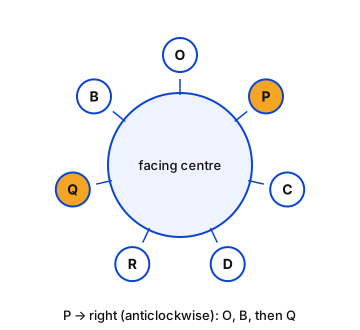
Seven people B, C, D, O, P, Q and R are sitting around a circular table facing the center of the table.
D sits fourth to the right of O. Only two people sit between D and B when counted from the left of D. B sits third to the right of C. Q is an immediate neighbor of B and R. How many people sit between P and Q when counted from the right of P?
सात व्यक्ति B, C, D, O, P, Q और R एक वृत्ताकार मेज़ के चारों ओर मेज़ के केंद्र की ओर मुख करके बैठे हैं।
D, O के दायें चौथे स्थान पर बैठा है। D के बायें से गिनने पर D और B के बीच केवल दो व्यक्ति बैठे हैं। B, C के दायें तीसरे स्थान पर बैठा है। Q, B और R का निकटतम पड़ोसी है। P के दायें से गिनने पर P और Q के बीच कितने व्यक्ति बैठे हैं?
  1. AOneएक
  2. BFourचार
  3. CThreeतीन
  4. DTwoदो
Show answer

Concept: Facing the centre, “right” means anticlockwise and “left” means clockwise. Number the seats 1–7 clockwise and place people step by step.

  1. O at seat 1. D is 4th to the right (anticlockwise) of O → D at seat 4.
  2. Two people between D and B counting from D's left (clockwise): seats 5, 6 in between → B at seat 7.
  3. B is 3rd to the right of C → C is 3 clockwise from B → seat 3. Q is a neighbour of B (seats 6 or 1); seat 1 is O, so Q at 6 and R at 5. P gets seat 2.
  4. From P (seat 2) to the right (anticlockwise): O (1), B (7), then Q (6) → two people between P and Q.

Trick: Facing centre: right = anticlockwise, left = clockwise. Fix the first person at the top and count seats, not names.

Answer: (D) Two

अवधारणा: केंद्र की ओर मुख होने पर “दाएँ” = वामावर्त (anticlockwise) और “बाएँ” = दक्षिणावर्त (clockwise)। सीटों को 1–7 दक्षिणावर्त नंबर दें और क्रम से बैठाएँ।

  1. O सीट 1 पर। D, O के दाएँ (वामावर्त) चौथा → D सीट 4 पर।
  2. D के बाएँ (दक्षिणावर्त) से गिनने पर D और B के बीच दो लोग: सीट 5, 6 बीच में → B सीट 7 पर।
  3. B, C के दाएँ तीसरा → C, B से 3 दक्षिणावर्त → सीट 3। Q, B का पड़ोसी (सीट 6 या 1); सीट 1 पर O है, अतः Q सीट 6 और R सीट 5 पर। P को सीट 2।
  4. P (सीट 2) से दाएँ (वामावर्त): O (1), B (7), फिर Q (6) → P और Q के बीच दो लोग।

ट्रिक: केंद्र की ओर मुख: दाएँ = वामावर्त, बाएँ = दक्षिणावर्त। पहले व्यक्ति को ऊपर रखें और नाम नहीं, सीटें गिनें।

उत्तर: (D) दो

RRB NTPC Graduate CBT 1General Intelligence and ReasoningCircular SeatingRRB NTPC Graduate CBT 1 2025 · 22 Mar Shift 3 →
Q5650.
Select the set in which the numbers are related in the same way as are the numbers of the following sets.
(NOTE: Operations should be performed on the whole numbers, without breaking down the numbers into their constituent digits. E.g. 13 – Operations on 13 such as
adding/subtracting/multiplying to 13 can be performed. Breaking down 13 into 1 and 3 and then performing mathematical operations on 1 and 3 is not allowed.)
(252, 80, 172)
(170, 55, 115)
उस समुच्चय का चयन कीजिए जिसमें संख्याएँ उसी प्रकार संबंधित हैं जिस प्रकार निम्नलिखित समुच्चयों की संख्याएँ संबंधित हैं।
(नोट: संक्रियाएँ पूर्ण संख्याओं पर की जानी चाहिए, संख्याओं को उनके घटक अंकों में तोड़े बिना। उदाहरण के लिए 13 – 13 पर संक्रियाएँ जैसे
13 में जोड़ना/घटाना/गुणा करना की जा सकती हैं। 13 को 1 और 3 में तोड़कर फिर 1 और 3 पर गणितीय संक्रियाएँ करने की अनुमति नहीं है।)
(252, 80, 172)
(170, 55, 115)
  1. A(212, 72, 130)
  2. B(195, 95, 100)
  3. C(180, 53, 137)
  4. D(236, 105, 141)
Show answer

Concept: Find one rule linking the three numbers of each given set and apply it to the options.

  1. (252,80,172): 252−80=172.
  2. (170,55,115): 170−55=115. Rule: first − second = third.
  3. Check: 195−95=100 ✓; 212−72=140≠130; 180−53=127≠137; 236−105=131≠141.

Trick: In three-number sets, test a−b=c and a+b or a×b relations first.

Answer: (B) (195, 95, 100)

अवधारणा: दिए गए समुच्चयों की तीनों संख्याओं को जोड़ने वाला नियम खोजें और विकल्पों पर लगाएँ।

  1. (252,80,172): 252−80=172।
  2. (170,55,115): 170−55=115। नियम: पहली − दूसरी = तीसरी।
  3. जाँच: 195−95=100 ✓; 212−72=140≠130; 180−53=127≠137; 236−105=131≠141।

ट्रिक: तीन संख्याओं के समुच्चय में पहले a−b=c, फिर a+b या a×b संबंध जाँचें।

उत्तर: (B) (195, 95, 100)

RRB NTPC Graduate CBT 1General Intelligence and ReasoningNumber AnalogyRRB NTPC Graduate CBT 1 2025 · 22 Mar Shift 3 →
Q5651.
Read the given statements and conclusions carefully. Assuming that the information given in the statements is true, even if it appears to be at variance with commonly known facts, decide which of the given conclusion(s) logically follow(s) from the statements.
Statements:
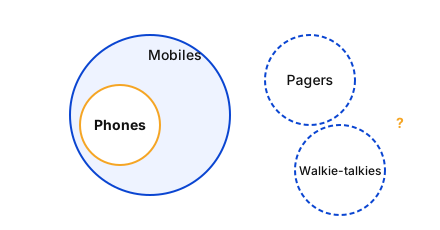
All phones are mobiles. No mobile is a pager. No mobile is a walkie-talkie.
Conclusions:
(I) No phone is a pager.
(II) Some walkie-talkies are pagers.
दिए गए कथनों और निष्कर्षों को ध्यानपूर्वक पढ़िए। यह मानते हुए कि कथनों में दी गई जानकारी सत्य है, भले ही वह सामान्यतः ज्ञात तथ्यों से भिन्न प्रतीत होती हो, निर्णय कीजिए कि दिए गए निष्कर्षों में से कौन-सा/से निष्कर्ष कथनों का तार्किक रूप से अनुसरण करता/करते है/हैं।
कथन:
सभी फ़ोन मोबाइल हैं। कोई मोबाइल पेजर नहीं है। कोई मोबाइल वॉकी-टॉकी नहीं है।
निष्कर्ष:
(I) कोई फ़ोन पेजर नहीं है।
(II) कुछ वॉकी-टॉकी पेजर हैं।
  1. AOnly conclusion (II) follows.केवल निष्कर्ष (II) अनुसरण करता है।
  2. BNeither conclusion (I) nor (II) follows.न तो निष्कर्ष (I) और न ही (II) अनुसरण करता है।
  3. COnly conclusion (I) follows.केवल निष्कर्ष (I) अनुसरण करता है।
  4. DBoth conclusions (I) and (II) follow.निष्कर्ष (I) और (II) दोनों अनुसरण करते हैं।
Show answer

Concept: Draw the Venn diagram. “All A are B” + “No B is C” ⇒ “No A is C” is a definite conclusion; two “No” statements about different classes tell nothing about each other.

  1. Phones lie wholly inside Mobiles; Mobiles and Pagers are disjoint → no phone can be a pager. Conclusion I follows.
  2. Pagers and Walkie-talkies are each separated from Mobiles only; their mutual relation is unknown → “Some walkie-talkies are pagers” is not definite. Conclusion II does not follow.

Trick: All + No (shared middle term) = No. Two negative premises never give a positive conclusion.

Answer: (C) Only conclusion (I) follows.

अवधारणा: वेन आरेख बनाएँ। “सभी A, B हैं” + “कोई B, C नहीं” ⇒ “कोई A, C नहीं” निश्चित निष्कर्ष है; अलग-अलग वर्गों के दो “कोई नहीं” कथन आपस में कुछ नहीं बताते।

  1. Phones पूरी तरह Mobiles के अंदर; Mobiles और Pagers अलग → कोई phone, pager नहीं हो सकता। निष्कर्ष I अनुसरण करता है।
  2. Pagers और Walkie-talkies केवल Mobiles से अलग हैं; आपसी संबंध अज्ञात → “कुछ walkie-talkies, pagers हैं” निश्चित नहीं। निष्कर्ष II अनुसरण नहीं करता।

ट्रिक: सभी + कोई नहीं (साझा मध्य पद) = कोई नहीं। दो नकारात्मक कथन कभी सकारात्मक निष्कर्ष नहीं देते।

उत्तर: (C) केवल निष्कर्ष (I) अनुसरण करता है।

RRB NTPC Graduate CBT 1General Intelligence and ReasoningSyllogismRRB NTPC Graduate CBT 1 2025 · 22 Mar Shift 3 →
Q5652.
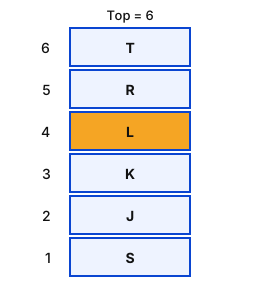
J, K, L, R, S and T live on six different floors of the same building. The lowermost floor in the building is numbered 1, the floor above it is numbered 2 and so on till the topmost floor is numbered 6. Only two people live between R and J. Only two people live between T and K. No one lives above T. J lives below K but above S. How many people live below L?
J, K, L, R, S और T एक ही भवन की छह अलग-अलग मंज़िलों पर रहते हैं। भवन की सबसे निचली मंज़िल की संख्या 1 है, उसके ऊपर की मंज़िल की संख्या 2 है और इसी प्रकार सबसे ऊपरी मंज़िल की संख्या 6 है। R और J के बीच केवल दो व्यक्ति रहते हैं। T और K के बीच केवल दो व्यक्ति रहते हैं। T के ऊपर कोई नहीं रहता। J, K के नीचे लेकिन S के ऊपर रहता है। L के नीचे कितने व्यक्ति रहते हैं?
  1. AOneएक
  2. BThreeतीन
  3. CTwoदो
  4. DFourचार
Show answer

Concept: Start with the definite clue (“no one above T”) and fill the floors one by one.

  1. No one above T → T on floor 6. Two people between T and K → K on floor 3.
  2. J below K but above S → J on 2 and S on 1 (only floors left below 3).
  3. Two people between R and J (floor 2) → R on floor 5. L takes the remaining floor 4.
  4. Below L (floor 4): K, J, S → three people.

Trick: Always lock the top/bottom floor first; “only two between X and Y” means a gap of 3 floors.

Answer: (B) Three

अवधारणा: निश्चित सुराग (“T के ऊपर कोई नहीं”) से शुरू करके मंज़िलें एक-एक कर भरें।

  1. T के ऊपर कोई नहीं → T मंज़िल 6 पर। T और K के बीच दो लोग → K मंज़िल 3 पर।
  2. J, K से नीचे पर S से ऊपर → J मंज़िल 2, S मंज़िल 1 पर।
  3. R और J (मंज़िल 2) के बीच दो लोग → R मंज़िल 5 पर। बची मंज़िल 4 पर L।
  4. L (मंज़िल 4) के नीचे: K, J, S → तीन लोग।

ट्रिक: सबसे ऊपर/नीचे की मंज़िल पहले तय करें; “X और Y के बीच केवल दो” = 3 मंज़िल का अंतर।

उत्तर: (B) तीन

RRB NTPC Graduate CBT 1General Intelligence and ReasoningFloor PuzzleRRB NTPC Graduate CBT 1 2025 · 22 Mar Shift 3 →
Q5653.
DUMB is related to FXOE in a certain way based on the English alphabetical order. In the same way, LGUN is related to NJWQ. To which of the following options is RPAW related, following the same logic?
अंग्रेज़ी वर्णमाला क्रम के आधार पर DUMB, FXOE से एक निश्चित प्रकार से संबंधित है। उसी प्रकार, LGUN, NJWQ से संबंधित है। समान तर्क का अनुसरण करते हुए, RPAW निम्नलिखित में से किस विकल्प से संबंधित है?
  1. ATCXS
  2. BTZCS
  3. CTCDS
  4. DTSCZ
Show answer

Concept: Compare each letter's position in the word with the code to find the shift pattern.

  1. DUMB → FXOE: D+2=F, U+3=X, M+2=O, B+3=E. Pattern +2,+3,+2,+3.
  2. LGUN → NJWQ: L+2=N, G+3=J, U+2=W, N+3=Q ✓.
  3. RPAW: R+2=T, P+3=S, A+2=C, W+3=Z → TSCZ.

Trick: Options TCXS, TZCS, TCDS all have C in the 2nd place; only the 2nd letter test (P+3=S) picks D instantly.

Answer: (D) TSCZ

अवधारणा: शब्द के हर अक्षर की स्थिति की कूट से तुलना कर शिफ्ट पैटर्न निकालें।

  1. DUMB → FXOE: D+2=F, U+3=X, M+2=O, B+3=E। पैटर्न +2,+3,+2,+3।
  2. LGUN → NJWQ: L+2=N, G+3=J, U+2=W, N+3=Q ✓।
  3. RPAW: R+2=T, P+3=S, A+2=C, W+3=Z → TSCZ।

ट्रिक: TCXS, TZCS, TCDS में दूसरा अक्षर C है; केवल दूसरे अक्षर की जाँच (P+3=S) से D तुरंत मिल जाता है।

उत्तर: (D) TSCZ

RRB NTPC Graduate CBT 1General Intelligence and ReasoningLetter CodingRRB NTPC Graduate CBT 1 2025 · 22 Mar Shift 3 →
Q5654.
In a certain code language,
A + B means ‘A is the daughter of B’
A – B means ‘A is the brother of B’
A x B means ‘A is the wife of B’
A ÷ B means ‘A is the father of B’
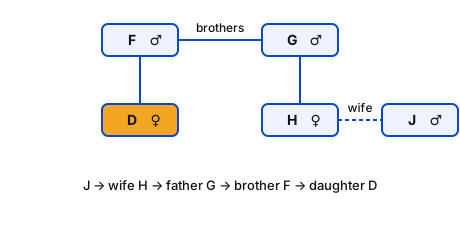
Based on the above, how is D related to J if ‘D + F – G ÷ H x J’?
एक निश्चित कूट भाषा में,
A + B का अर्थ है ‘A, B की पुत्री है’
A – B का अर्थ है ‘A, B का भाई है’
A x B का अर्थ है ‘A, B की पत्नी है’
A ÷ B का अर्थ है ‘A, B का पिता है’
उपर्युक्त के आधार पर, यदि ‘D + F – G ÷ H x J’ है, तो D, J से किस प्रकार संबंधित है?
  1. AWife's father's brother's daughterपत्नी के पिता के भाई की पुत्री
  2. BWife's mother's brother's wifeपत्नी की माता के भाई की पत्नी
  3. CWife's father's brother's wifeपत्नी के पिता के भाई की पत्नी
  4. DWife's mother's brother's daughterपत्नी की माता के भाई की पुत्री
Show answer

Concept: Decode from the end (the person asked about is J) and build the family tree.

  1. H × J → H is the wife of J. G ÷ H → G is the father of H, i.e. J's wife's father.
  2. F − G → F is the brother of G (J's wife's father's brother).
  3. D + F → D is the daughter of F.
  4. So D is J's wife's father's brother's daughter.

Trick: Read the chain from J backwards: wife → father → brother → daughter – the option must follow this exact order.

Answer: (A) Wife's father's brother's daughter

अवधारणा: अंत (J) से कूट खोलें और वंश-वृक्ष बनाएँ।

  1. H × J → H, J की पत्नी। G ÷ H → G, H का पिता, अर्थात J की पत्नी का पिता।
  2. F − G → F, G का भाई (J की पत्नी के पिता का भाई)।
  3. D + F → D, F की बेटी।
  4. अतः D, J की पत्नी के पिता के भाई की बेटी है।

ट्रिक: J से उल्टा पढ़ें: पत्नी → पिता → भाई → बेटी – विकल्प इसी क्रम में होना चाहिए।

उत्तर: (A) पत्नी के पिता के भाई की बेटी

RRB NTPC Graduate CBT 1General Intelligence and ReasoningBlood Relations – CodedRRB NTPC Graduate CBT 1 2025 · 22 Mar Shift 3 →
Q5655.
If 1 is added to each odd digit and 2 is subtracted from each even digit in the number 8634157, which of the following digits will be second from the left?
यदि संख्या 8634157 में प्रत्येक विषम अंक में 1 जोड़ा जाए और प्रत्येक सम अंक से 2 घटाया जाए, तो निम्नलिखित में से कौन-सा अंक बायें से दूसरे स्थान पर होगा?
  1. A1
  2. B3
  3. C4
  4. D2
Show answer

Concept: Apply the rule digit by digit: odd digit +1, even digit −2.

  1. 8634157: 8→6, 6→4, 3→4, 4→2, 1→2, 5→6, 7→8.
  2. New number =6442268.
  3. Second digit from the left =4.

Trick: Only the asked position matters – the 2nd digit is 6 (even) → 6−2=4.

Answer: (C) 4

अवधारणा: नियम हर अंक पर लगाएँ: विषम अंक +1, सम अंक −2।

  1. 8634157: 8→6, 6→4, 3→4, 4→2, 1→2, 5→6, 7→8।
  2. नई संख्या =6442268।
  3. बाएँ से दूसरा अंक =4।

ट्रिक: केवल पूछी गई स्थिति देखें – दूसरा अंक 6 (सम) → 6−2=4।

उत्तर: (C) 4

RRB NTPC Graduate CBT 1General Intelligence and ReasoningNumber OperationsRRB NTPC Graduate CBT 1 2025 · 22 Mar Shift 3 →
Q5656.
Based on the alphabetical order, three of the following four are alike in a certain way and thus form a group. Which is the one that does not belong to that group?
(Note: The odd man out is not based on the number of consonants/vowels or their position in the letter cluster.)
वर्णमाला क्रम के आधार पर, निम्नलिखित चार में से तीन एक निश्चित प्रकार से समान हैं और इस प्रकार एक समूह बनाते हैं। वह कौन-सा है जो उस समूह से संबंधित नहीं है?
(नोट: असंगत (odd man out) व्यंजनों/स्वरों की संख्या या अक्षर-समूह में उनकी स्थिति पर आधारित नहीं है।)
  1. ARNU
  2. BEAG
  3. CHDK
  4. DTPW
Show answer

Concept: Convert letters to positions and compare the gaps between consecutive letters.

  1. RNU: 18,14,21 → −4,+7.
  2. HDK: 8,4,11 → −4,+7. TPW: 20,16,23 → −4,+7.
  3. EAG: 5,1,7 → −4,+6 – different second gap.

Trick: First gap is −4 in all four; check only the last gap: +7 thrice, +6 once.

Answer: (B) EAG

अवधारणा: अक्षरों को स्थान-संख्या में बदलें और क्रमागत अंतर तुलना करें।

  1. RNU: 18,14,21 → −4,+7।
  2. HDK: 8,4,11 → −4,+7। TPW: 20,16,23 → −4,+7।
  3. EAG: 5,1,7 → −4,+6 – दूसरा अंतर अलग।

ट्रिक: पहला अंतर चारों में −4; केवल अंतिम अंतर देखें: तीन बार +7, एक बार +6।

उत्तर: (B) EAG

RRB NTPC Graduate CBT 1General Intelligence and ReasoningLetter Cluster – Odd One OutRRB NTPC Graduate CBT 1 2025 · 22 Mar Shift 3 →
Q5657.
What should come in place of the question mark (?) in the given series?
23 24 32 59 123 ?
दी गई श्रेणी में प्रश्नचिह्न (?) के स्थान पर क्या आना चाहिए?
23 24 32 59 123 ?
  1. A218
  2. B248
  3. C168
  4. D198
Show answer

Concept: Look at the differences between consecutive terms – here they are perfect cubes.

  1. 24−23=1=13, 32−24=8=23, 59−32=27=33, 123−59=64=43.
  2. Next difference =53=125.
  3. ?=123+125=248.

Trick: Differences 1,8,27,64 shout “cubes” – add 125.

Answer: (B) 248

अवधारणा: क्रमागत पदों के अंतर देखें – यहाँ वे पूर्ण घन हैं।

  1. 24−23=1=13, 32−24=8=23, 59−32=27=33, 123−59=64=43।
  2. अगला अंतर =53=125।
  3. ?=123+125=248।

ट्रिक: अंतर 1,8,27,64 = घन – 125 जोड़ें।

उत्तर: (B) 248

RRB NTPC Graduate CBT 1General Intelligence and ReasoningNumber SeriesRRB NTPC Graduate CBT 1 2025 · 22 Mar Shift 3 →
Q5658.
In a certain code language, ‘food is delicious’ is coded as ‘ga dc vr’ and ‘harry loves food’ is coded as ‘dc hu bw’. How is ‘food’ coded in that language?
एक निश्चित कूट भाषा में, ‘food is delicious’ को ‘ga dc vr’ के रूप में कूटबद्ध किया जाता है और ‘harry loves food’ को ‘dc hu bw’ के रूप में कूटबद्ध किया जाता है। उस भाषा में ‘food’ को किस रूप में कूटबद्ध किया जाएगा?
  1. Abw
  2. Bga
  3. Cvr
  4. Ddc
Show answer

Concept: A word common to two sentences has the code common to both coded sentences.

  1. ‘food is delicious’ → ga dc vr; ‘harry loves food’ → dc hu bw.
  2. Common word: food; common code: dc.
  3. So food = dc.

Trick: Match the repeated word with the repeated code – no need to decode anything else.

Answer: (D) dc

अवधारणा: दो वाक्यों में साझा शब्द का कूट दोनों कूट-वाक्यों में साझा होता है।

  1. ‘food is delicious’ → ga dc vr; ‘harry loves food’ → dc hu bw।
  2. साझा शब्द: food; साझा कूट: dc।
  3. अतः food = dc।

ट्रिक: दोहराए शब्द को दोहराए कूट से मिलाएँ – बाकी कुछ खोलने की ज़रूरत नहीं।

उत्तर: (D) dc

RRB NTPC Graduate CBT 1General Intelligence and ReasoningCoding-Decoding – SentencesRRB NTPC Graduate CBT 1 2025 · 22 Mar Shift 3 →
Q5659.
Read the given statements and conclusions carefully. Assuming that the information given in the statements is true, even if it appears to be at variance with commonly known facts, decide which of the given conclusions logically follow(s) from the statements.
Statements:
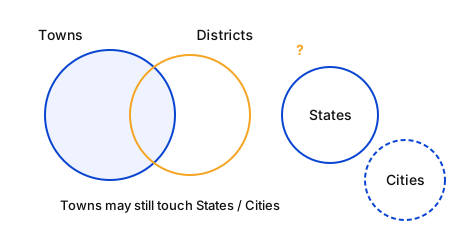
Some towns are districts. No district is a state. No state is a city.
Conclusions:
(I) No town is a state.
(II) No district is a city.
दिए गए कथनों और निष्कर्षों को ध्यानपूर्वक पढ़िए। यह मानते हुए कि कथनों में दी गई जानकारी सत्य है, भले ही वह सामान्यतः ज्ञात तथ्यों से भिन्न प्रतीत होती हो, निर्णय कीजिए कि दिए गए निष्कर्षों में से कौन-सा/से निष्कर्ष कथनों का तार्किक रूप से अनुसरण करता/करते है/हैं।
कथन:
कुछ कस्बे ज़िले हैं। कोई ज़िला राज्य नहीं है। कोई राज्य शहर नहीं है।
निष्कर्ष:
(I) कोई कस्बा राज्य नहीं है।
(II) कोई ज़िला शहर नहीं है।
  1. AOnly conclusion (I) followsकेवल निष्कर्ष (I) अनुसरण करता है
  2. BBoth conclusions (I) and (II) followनिष्कर्ष (I) और (II) दोनों अनुसरण करते हैं
  3. CNeither conclusion (I) nor (II) followsन तो निष्कर्ष (I) और न ही (II) अनुसरण करता है
  4. DOnly conclusion (II) followsकेवल निष्कर्ष (II) अनुसरण करता है
Show answer

Concept: “Some A are B” + “No B is C” gives only “Some A are not C”, never “No A is C”. Two negative statements give no conclusion about the outer terms.

  1. Only some towns are districts; the other towns may well be states → “No town is a state” is not definite. Conclusion I fails.
  2. Districts are separated from states, and states from cities, but districts and cities have no stated link → “No district is a city” is not definite. Conclusion II fails.

Trick: Some + No = Some-not (never a full No). No + No = nothing.

Answer: (C) Neither conclusion (I) nor (II) follows

अवधारणा: “कुछ A, B हैं” + “कोई B, C नहीं” से केवल “कुछ A, C नहीं” मिलता है, “कोई A, C नहीं” कभी नहीं। दो नकारात्मक कथनों से बाहरी पदों पर कोई निष्कर्ष नहीं।

  1. केवल कुछ towns, districts हैं; बाकी towns, states हो सकते हैं → “कोई town, state नहीं” निश्चित नहीं। निष्कर्ष I असफल।
  2. Districts, states से अलग और states, cities से अलग हैं, पर districts और cities का कोई संबंध नहीं बताया → “कोई district, city नहीं” निश्चित नहीं। निष्कर्ष II असफल।

ट्रिक: कुछ + कोई नहीं = कुछ-नहीं (पूरा “कोई नहीं” कभी नहीं)। कोई नहीं + कोई नहीं = कुछ नहीं।

उत्तर: (C) न निष्कर्ष (I) न (II) अनुसरण करता है

RRB NTPC Graduate CBT 1General Intelligence and ReasoningSyllogismRRB NTPC Graduate CBT 1 2025 · 22 Mar Shift 3 →
Q5660.
In a certain code language, ‘ALIT’ is coded as ‘2159’ and ‘HILT’ is coded as ‘6912’. What is the code for ‘H’ in the given code language?
एक निश्चित कूट भाषा में, ‘ALIT’ को ‘2159’ के रूप में और ‘HILT’ को ‘6912’ के रूप में कूटबद्ध किया जाता है। दी गई कूट भाषा में ‘H’ का कूट क्या है?
  1. A6
  2. B2
  3. C9
  4. D1
Show answer

Concept: Letters common to both words carry the digits common to both codes; the leftover letter gets the leftover digit.

  1. ALIT → 2159 and HILT → 6912. Common letters: I, L, T.
  2. Common digits: {2,1,5,9}∩{6,9,1,2}={1,2,9}.
  3. The extra letter in HILT is H and the extra digit is 6 → H = 6 (and A = 5).

Trick: Don't look for letter order – just subtract the common digits from the code of the word containing the asked letter.

Answer: (A) 6

अवधारणा: दोनों शब्दों के साझा अक्षरों के पास दोनों कूटों के साझा अंक होते हैं; बचा अक्षर = बचा अंक।

  1. ALIT → 2159 और HILT → 6912। साझा अक्षर: I, L, T।
  2. साझा अंक: {2,1,5,9}∩{6,9,1,2}={1,2,9}।
  3. HILT में अतिरिक्त अक्षर H और अतिरिक्त अंक 6 → H = 6 (और A = 5)।

ट्रिक: अक्षरों का क्रम न खोजें – पूछे गए अक्षर वाले शब्द के कूट से साझा अंक घटा दें।

उत्तर: (A) 6

RRB NTPC Graduate CBT 1General Intelligence and ReasoningCoding-Decoding – Letters to DigitsRRB NTPC Graduate CBT 1 2025 · 22 Mar Shift 3 →