Question bank

Q&A: practice questions with answers

Search questions on any topic. Filter by exam category, exam, subject and topic, try the question, then open the answer and explanation.

Courses – airGurukul

7,077 questions found.

Q5661.
If 1 is added to each odd digit and 2 is subtracted from each even digit in the number 8263451, how many digits will appear more than once in the new number thus formed?
यदि संख्या 8263451 में प्रत्येक विषम अंक में 1 जोड़ा जाए और प्रत्येक सम अंक से 2 घटाया जाए, तो इस प्रकार बनी नई संख्या में कितने अंक एक से अधिक बार आएँगे?
  1. A3
  2. B4
  3. C1
  4. D2
Show answer

Concept: Apply the rule digit by digit, then count repeats in the new number.

  1. 8263451 → odd digits +1, even digits −2.
  2. 8→6, 2→0, 6→4, 3→4, 4→2, 5→6, 1→2 → new number 6044262.
  3. Repeated digits: 6 (twice), 4 (twice), 2 (twice) → 3 digits.

Trick: Write the new number under the old one digit-by-digit; mistakes happen only when you skip the 0 (2 − 2 = 0 is a valid digit).

Answer: (A) 3

अवधारणा: नियम हर अंक पर लगाएँ, फिर नई संख्या में दोहराए गए अंक गिनें।

  1. 8263451 → विषम अंक +1, सम अंक −2।
  2. 8→6, 2→0, 6→4, 3→4, 4→2, 5→6, 1→2 → नई संख्या 6044262।
  3. दोहराए गए अंक: 6 (दो बार), 4 (दो बार), 2 (दो बार) → 3 अंक।

ट्रिक: पुरानी संख्या के नीचे नई संख्या अंक-दर-अंक लिखें; गलती तभी होती है जब 0 छूट जाए (2 − 2 = 0 भी एक अंक है)।

उत्तर: (A) 3
RRB NTPC Graduate CBT 1General Intelligence and ReasoningNumber OperationsRRB NTPC Graduate CBT 1 2025 · 22 Mar Shift 3 →
Q5662.
In this question, a question is followed by two statements numbered (I) and (II). You have to decide whether the data provided in the statements are sufficient to answer the question. Read both the statements and decide the appropriate answer.
Q. Anuj, Bhavesh, Chirag, Darshan, and Eklavya - each have different height. Who is the tallest?
(I) Chirag is taller than Anuj and Bhavesh but shorter than Darshan.
(II) Eklavya is taller than Chirag but shorter than Darshan.
इस प्रश्न में, एक प्रश्न के बाद (I) और (II) क्रमांकित दो कथन दिए गए हैं। आपको यह निर्णय करना है कि कथनों में दिए गए आँकड़े प्रश्न का उत्तर देने के लिए पर्याप्त हैं या नहीं। दोनों कथनों को पढ़िए और उचित उत्तर का चयन कीजिए।
प्रश्न. अनुज, भावेश, चिराग, दर्शन और एकलव्य - प्रत्येक की ऊँचाई अलग-अलग है। सबसे लंबा कौन है?
(I) चिराग, अनुज और भावेश से लंबा है लेकिन दर्शन से छोटा है।
(II) एकलव्य, चिराग से लंबा है लेकिन दर्शन से छोटा है।
  1. AData in Statement II alone is sufficient to answer the question while data in Statement I is notप्रश्न का उत्तर देने के लिए केवल कथन II के आँकड़े पर्याप्त हैं, जबकि कथन I के आँकड़े पर्याप्त नहीं हैं
  2. BBoth statements I and II together are NOT sufficient to answer the questionकथन I और II दोनों एक साथ भी पर्याप्त नहीं हैं
  3. CData in Statement I alone is sufficient to answer the question while data in Statement II is notप्रश्न का उत्तर देने के लिए केवल कथन I के आँकड़े पर्याप्त हैं, जबकि कथन II के आँकड़े पर्याप्त नहीं हैं
  4. DBoth statements I and II together (and not statement I alone or statement II alone) are sufficient to answer the questionकथन I और II दोनों एक साथ (और न कि केवल कथन I या केवल कथन II) पर्याप्त हैं
Show answer

Concept: Check each statement alone, then together, for whether the tallest is fixed.

  1. Statement I: D > C > A, B. Eklavya is not placed – he could be above D. Not sufficient.
  2. Statement II: D > E > C. A and B are not placed. Not sufficient.
  3. Together: D is above C, A, B and above E → Darshan is the tallest. Both needed.

Trick: For "who is tallest", one statement is sufficient only if it places every person below someone.

Answer: (D) Both statements together are sufficient

अवधारणा: हर कथन को अकेले, फिर साथ में जाँचें कि सबसे लंबा तय होता है या नहीं।

  1. कथन I: D > C > A, B. एकलव्य का स्थान नहीं – वह D से ऊपर हो सकता है। अपर्याप्त।
  2. कथन II: D > E > C. A और B का स्थान नहीं। अपर्याप्त।
  3. दोनों साथ: D, C, A, B और E सबसे ऊपर → दर्शन सबसे लंबा। दोनों आवश्यक।

ट्रिक: "सबसे लंबा कौन" में एक कथन तभी पर्याप्त है जब वह हर व्यक्ति को किसी से नीचे रखे।

उत्तर: (D) दोनों कथन साथ में पर्याप्त हैं

RRB NTPC Graduate CBT 1General Intelligence and ReasoningData Sufficiency – OrderingRRB NTPC Graduate CBT 1 2025 · 22 Mar Shift 3 →
Q5663.
Which of the given letter-number clusters will replace the question mark (?) in the following series to make it logically complete?
SWD 9 HLS 12 WAH 16 LPW 21 ?
निम्नलिखित श्रेणी को तार्किक रूप से पूर्ण करने के लिए दिए गए अक्षर-संख्या समूहों में से कौन-सा प्रश्नचिह्न (?) के स्थान पर आएगा?
SWD 9 HLS 12 WAH 16 LPW 21 ?
  1. ACIK 30
  2. BKDT 27
  3. CAKM 32
  4. DAEL 27
Show answer

Concept: Treat letters and numbers as separate patterns.

  1. Numbers: 9, 12, 16, 21 → +3, +4, +5 → next +6 = 27.
  2. Letters: each letter moves +15 every term: S→H→W→L→A, W→L→A→P→E, D→S→H→W→L.
  3. Next cluster = AEL 27.

Trick: Check the number first – only options B and D have 27; then one letter (A) settles it.

Answer: (D) AEL 27

अवधारणा: अक्षरों और संख्याओं के पैटर्न अलग-अलग देखें।

  1. संख्याएँ: 9, 12, 16, 21 → +3, +4, +5 → अगला +6 = 27।
  2. अक्षर: हर अक्षर हर पद में +15: S→H→W→L→A, W→L→A→P→E, D→S→H→W→L।
  3. अगला समूह = AEL 27।

ट्रिक: पहले संख्या देखें – केवल B और D में 27 है; फिर एक अक्षर (A) से उत्तर तय।

उत्तर: (D) AEL 27

RRB NTPC Graduate CBT 1General Intelligence and ReasoningLetter-Number SeriesRRB NTPC Graduate CBT 1 2025 · 22 Mar Shift 3 →
Q5664.
LEKO is related to OIPU in a certain way based on the English alphabetical order. In the same way, CANQ is related to FESW. To which of the following is EIJS related, following the same logic?
अंग्रेज़ी वर्णमाला क्रम के आधार पर LEKO, OIPU से एक निश्चित प्रकार से संबंधित है। उसी प्रकार, CANQ, FESW से संबंधित है। समान तर्क का अनुसरण करते हुए, EIJS निम्नलिखित में से किससे संबंधित है?
  1. ALLPP
  2. BNOPA
  3. CHMOY
  4. DMNPZ
Show answer

Concept: Find the shift of each position from the first pair and apply it.

  1. LEKO → OIPU: L+3=O, E+4=I, K+5=P, O+6=U. Check CANQ → FESW: +3, +4, +5, +6 ✓.
  2. EIJS: E+3=H, I+4=M, J+5=O, S+6=Y → HMOY.

Trick: Shifts +3, +4, +5, +6 – once the first letter gives H, only option C starts with H.

Answer: (C) HMOY

अवधारणा: पहली जोड़ी से हर स्थान का shift निकालें और वही लगाएँ।

  1. LEKO → OIPU: L+3=O, E+4=I, K+5=P, O+6=U। जाँच CANQ → FESW: +3, +4, +5, +6 ✓।
  2. EIJS: E+3=H, I+4=M, J+5=O, S+6=Y → HMOY।

ट्रिक: shift +3, +4, +5, +6 – पहला अक्षर H आते ही केवल विकल्प C बचता है।

उत्तर: (C) HMOY

RRB NTPC Graduate CBT 1General Intelligence and ReasoningLetter AnalogyRRB NTPC Graduate CBT 1 2025 · 22 Mar Shift 3 →
Q5665.
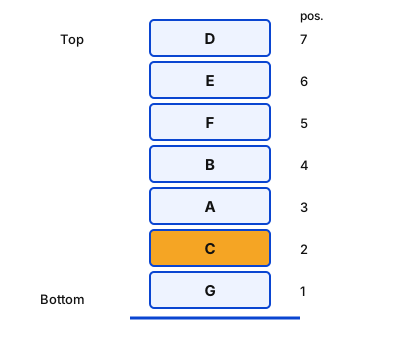
Seven boxes, A, B, C, D, E, F and G, are kept one over the other but not necessarily in the same order. Only two boxes are kept between B and G. Only D is kept above E. No box is kept below G. A is kept at some place below F but at some place above C. How many boxes are kept above C?
सात बक्से A, B, C, D, E, F और G एक के ऊपर एक रखे गए हैं, लेकिन आवश्यक नहीं कि इसी क्रम में हों। B और G के बीच केवल दो बक्से रखे हैं। E के ऊपर केवल D रखा है। G के नीचे कोई बक्सा नहीं रखा है। A, F के नीचे किसी स्थान पर लेकिन C के ऊपर किसी स्थान पर रखा है। C के ऊपर कितने बक्से रखे हैं?
  1. A4
  2. B5
  3. C2
  4. D3
Show answer

Concept: Number positions 1 (bottom) to 7 (top) and place the fixed boxes first.

  1. No box below G → G = 1. Two boxes between B and G → B = 4.
  2. Only D above E → E = 6, D = 7.
  3. F above A above C in the remaining 2, 3, 5 → F = 5, A = 3, C = 2.
  4. Boxes above C: A, B, F, E, D = 5.

Trick: "Only X is above Y" fixes two boxes at the very top in one go.

Answer: (B) 5

अवधारणा: स्थान 1 (नीचे) से 7 (ऊपर) तक संख्यांकित करें और पहले निश्चित बॉक्स रखें।

  1. G के नीचे कोई नहीं → G = 1। B और G के बीच दो → B = 4।
  2. E के ऊपर केवल D → E = 6, D = 7।
  3. शेष 2, 3, 5 में F, A से ऊपर और A, C से ऊपर → F = 5, A = 3, C = 2।
  4. C के ऊपर: A, B, F, E, D = 5।

ट्रिक: "Y के ऊपर केवल X" एक साथ सबसे ऊपर के दो बॉक्स तय कर देता है।

उत्तर: (B) 5

RRB NTPC Graduate CBT 1General Intelligence and ReasoningBox ArrangementRRB NTPC Graduate CBT 1 2025 · 22 Mar Shift 3 →
Q5666.
Refer to the given letter, symbol series and answer the question that follows. Counting to be done from left to right only.
(Left) K Y C K & A A C P N P Y M R B # + J $ & ^ (Right)
How many such symbols are there, each of which is immediately preceded by a symbol and also immediately followed by a letter?
दी गई अक्षर, प्रतीक श्रेणी को देखिए और उसके बाद दिए गए प्रश्न का उत्तर दीजिए। गिनती केवल बायें से दायें की ओर की जानी है।
(बायाँ) K Y C K & A A C P N P Y M R B # + J $ & ^ (दायाँ)
ऐसे कितने प्रतीक हैं, जिनमें से प्रत्येक के ठीक पहले एक प्रतीक है और ठीक बाद एक अक्षर है?
  1. AOneएक
  2. BFourचार
  3. CThreeतीन
  4. DTwoदो
Show answer

Concept: Scan each symbol and check its left neighbour (symbol?) and right neighbour (letter?).

  1. Symbols in the series: & (after K, before A), # (after B), + (after #, before J), $ (after J), & (after $, before the caret), caret (last).
  2. Only "+" has a symbol (#) before it and a letter (J) after it; the second & is followed by the caret, a symbol.
  3. Count = one.

Trick: Underline every symbol first, then test only those – it avoids re-reading the whole line.

Answer: (A) One

अवधारणा: हर प्रतीक के बाएँ पड़ोसी (प्रतीक?) और दाएँ पड़ोसी (अक्षर?) जाँचें।

  1. श्रृंखला के प्रतीक: & (K के बाद, A से पहले), # (B के बाद), + (# के बाद, J से पहले), $ (J के बाद), & ($ के बाद, caret से पहले), caret (अंतिम)।
  2. केवल "+" के पहले प्रतीक (#) और बाद में अक्षर (J) है; दूसरे & के बाद caret (प्रतीक) है।
  3. संख्या = एक।

ट्रिक: पहले हर प्रतीक रेखांकित करें, फिर केवल उन्हीं को जाँचें – पूरी पंक्ति बार-बार नहीं पढ़नी पड़ती।

उत्तर: (A) एक

RRB NTPC Graduate CBT 1General Intelligence and ReasoningSymbol Series CountingRRB NTPC Graduate CBT 1 2025 · 22 Mar Shift 3 →
Q5667.
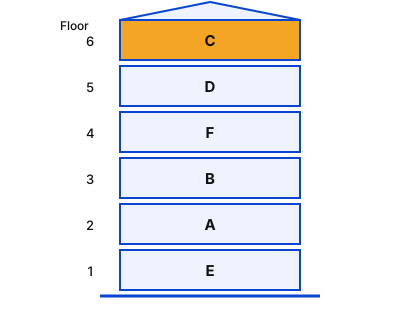
A, B, C, D, E and F live on six different floors of the same building. The lowermost floor in the building is numbered 1, the floor above it is numbered 2 and so on till the topmost floor, which is numbered 6.
Only one person lives above D. Only two people live between A and D. F lives
immediately above B. E does not live above D.
How many people live below C?
A, B, C, D, E और F एक ही भवन की छह अलग-अलग मंज़िलों पर रहते हैं। भवन की सबसे निचली मंज़िल की संख्या 1 है, उसके ऊपर की मंज़िल की संख्या 2 है और इसी प्रकार सबसे ऊपरी मंज़िल की संख्या 6 है।
D के ऊपर केवल एक व्यक्ति रहता है। A और D के बीच केवल दो व्यक्ति रहते हैं। F, B के ठीक ऊपर रहता है। E, D के ऊपर नहीं रहता।
C के नीचे कितने व्यक्ति रहते हैं?
  1. AFiveपाँच
  2. BThreeतीन
  3. CFourचार
  4. DTwoदो
Show answer

Concept: Fix the most restricted person first, then fill the rest.

  1. Only one above D → D = 5. Two between A and D → A = 2.
  2. F immediately above B: free floors 1, 3, 4, 6 → only B = 3, F = 4 works.
  3. E not above D → E = 1, so C = 6 (top).
  4. People below C: five.

Trick: Draw six boxes and fill from the clue with a fixed number ("only one above") – never start from a relative clue.

Answer: (A) Five

अवधारणा: सबसे बंधे व्यक्ति को पहले रखें, फिर बाकी भरें।

  1. D के ऊपर केवल एक → D = 5। A और D के बीच दो → A = 2।
  2. F, B के ठीक ऊपर: खाली मंज़िलें 1, 3, 4, 6 → केवल B = 3, F = 4 संभव।
  3. E, D से ऊपर नहीं → E = 1, अतः C = 6 (सबसे ऊपर)।
  4. C के नीचे: पाँच।

ट्रिक: छह बॉक्स बनाएँ और निश्चित संख्या वाले सुराग ("ऊपर केवल एक") से शुरू करें – सापेक्ष सुराग से कभी नहीं।

उत्तर: (A) पाँच

RRB NTPC Graduate CBT 1General Intelligence and ReasoningFloor PuzzleRRB NTPC Graduate CBT 1 2025 · 22 Mar Shift 3 →
Q5668.
In the following number-pairs, the second number is obtained by applying certain mathematical operations to the first number. Select the set in which the numbers are related in the same way as are the numbers of the following sets.
(NOTE: Operations should be performed on the whole numbers, without breaking down the numbers into their constituent digits. E.g. 13 – Operations on 13 such as
adding/subtracting/multiplying to 13 can be performed. Breaking down 13 into 1 and 3 and then performing mathematical operations on 1 and 3 is not allowed.)
16, 62
21, 82
निम्नलिखित संख्या-युग्मों में, पहली संख्या पर कुछ निश्चित गणितीय संक्रियाएँ करके दूसरी संख्या प्राप्त की जाती है। उस समुच्चय का चयन कीजिए जिसमें संख्याएँ उसी प्रकार संबंधित हैं जिस प्रकार निम्नलिखित समुच्चयों की संख्याएँ संबंधित हैं।
(नोट: संक्रियाएँ पूर्ण संख्याओं पर की जानी चाहिए, संख्याओं को उनके घटक अंकों में तोड़े बिना। उदाहरण के लिए 13 – 13 पर संक्रियाएँ जैसे
13 में जोड़ना/घटाना/गुणा करना की जा सकती हैं। 13 को 1 और 3 में तोड़कर फिर 1 और 3 पर गणितीय संक्रियाएँ करने की अनुमति नहीं है।)
16, 62
21, 82
  1. A23, 94
  2. B24, 95
  3. C24, 94
  4. D23, 95
Show answer

Concept: Find one operation that converts both given first numbers to the second.

  1. 16×4−2=62; 21×4−2=82 ✓.
  2. 24×4−2=94 → (24, 94) fits.
  3. Others: 23 → 90, neither 94 nor 95; 24 → 94, not 95.

Trick: Second ≈ 4 × first – check 6216≈3.9 and 8221≈3.9 to spot "×4 then −2".

Answer: (C) 24, 94

अवधारणा: ऐसी एक संक्रिया खोजें जो दोनों दी गई पहली संख्याओं को दूसरी में बदले।

  1. 16×4−2=62; 21×4−2=82 ✓।
  2. 24×4−2=94 → (24, 94) सही।
  3. अन्य: 23 → 90, न 94 न 95; 24 → 94, 95 नहीं।

ट्रिक: दूसरी ≈ 4 × पहली – 6216≈3.9 और 8221≈3.9 देखकर "×4 फिर −2" पकड़ें।

उत्तर: (C) 24, 94

RRB NTPC Graduate CBT 1General Intelligence and ReasoningNumber AnalogyRRB NTPC Graduate CBT 1 2025 · 22 Mar Shift 3 →
Q5669.
Below are given two sets of numbers. In each set of numbers, a certain mathematical operation on the first number results in the second number. Similarly, certain
mathematical operation on the second number results in the third number and so on. Which of the given options follows the same set of operations as in question? (NOTE – A two/three-digit number cannot be broken into individual digits for operations, e.g., if 37 is followed by 10, the operation cannot be 3+7 as a two-digit number cannot be broken into individual digits.)
15 - 75 - 80 - 160; 16 - 80 - 85 - 170
नीचे संख्याओं के दो समुच्चय दिए गए हैं। संख्याओं के प्रत्येक समुच्चय में, पहली संख्या पर एक निश्चित गणितीय संक्रिया करने से दूसरी संख्या प्राप्त होती है। इसी प्रकार, दूसरी संख्या पर एक निश्चित
गणितीय संक्रिया करने से तीसरी संख्या प्राप्त होती है, और इसी प्रकार आगे भी। दिए गए विकल्पों में से कौन-सा प्रश्न में दी गई संक्रियाओं के समान समुच्चय का अनुसरण करता है? (नोट – संक्रियाओं के लिए दो/तीन अंकों की संख्या को अलग-अलग अंकों में नहीं तोड़ा जा सकता, उदाहरण के लिए, यदि 37 के बाद 10 आता है, तो संक्रिया 3+7 नहीं हो सकती क्योंकि दो अंकों की संख्या को अलग-अलग अंकों में नहीं तोड़ा जा सकता।)
15 - 75 - 80 - 160; 16 - 80 - 85 - 170
  1. A20-100-105-220
  2. B18-80-85-170
  3. C17-85-90-180
  4. D13-75-80-160
Show answer

Concept: Find the chain of operations and test each option fully.

  1. 15 → 75 → 80 → 160: ×5, +5, ×2. Check 16 → 80 → 85 → 170 ✓.
  2. 17: 17×5=85, 85+5=90, 90×2=180 ✓.
  3. A fails at the last step (105 × 2 = 210 ≠ 220); B fails at 18 × 5 = 90 ≠ 80; D fails at 13 × 5 = 65 ≠ 75.

Trick: Check the first step (×5) – it alone eliminates B and D; then the last step removes A.

Answer: (C) 17-85-90-180

अवधारणा: संक्रियाओं की श्रृंखला खोजें और हर विकल्प पूरा जाँचें।

  1. 15 → 75 → 80 → 160: ×5, +5, ×2। जाँच 16 → 80 → 85 → 170 ✓।
  2. 17: 17×5=85, 85+5=90, 90×2=180 ✓।
  3. A अंतिम चरण में गलत (105 × 2 = 210 ≠ 220); B में 18 × 5 = 90 ≠ 80; D में 13 × 5 = 65 ≠ 75।

ट्रिक: पहला चरण (×5) देखें – उसी से B और D कटते हैं; फिर अंतिम चरण A हटाता है।

उत्तर: (C) 17-85-90-180

RRB NTPC Graduate CBT 1General Intelligence and ReasoningNumber Series – OperationsRRB NTPC Graduate CBT 1 2025 · 22 Mar Shift 3 →
Q5670.
In a certain code language,
A + B means ‘A is the daughter of B’
A - B means ‘A is the mother of B’
A x B means ‘A is the wife of B’
A ÷ B means ‘A is the father of B’
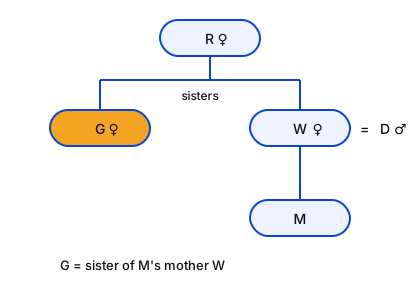
Based on the above, how is G related to M if 'G + R - W x D ÷ M’?
एक निश्चित कूट भाषा में,
A + B का अर्थ है ‘A, B की पुत्री है’
A - B का अर्थ है ‘A, B की माता है’
A x B का अर्थ है ‘A, B की पत्नी है’
A ÷ B का अर्थ है ‘A, B का पिता है’
उपर्युक्त के आधार पर, यदि 'G + R - W x D ÷ M’ है, तो G, M से किस प्रकार संबंधित है?
  1. AMotherमाता
  2. BMother's sisterमाता की बहन
  3. CMother's motherमाता की माता
  4. DSisterबहन
Show answer

Concept: Decode left to right and build the family tree.

  1. G + R: G is the daughter of R. R − W: R is the mother of W → G and W are sisters.
  2. W × D: W is the wife of D. D ÷ M: D is the father of M → W is the mother of M.
  3. G is the sister of M's mother → mother's sister (maasi).

Trick: Mark genders as you go: + gives female (daughter), − female (mother), × female (wife), ÷ male (father).

Answer: (B) Mother's sister

अवधारणा: बाएँ से दाएँ कोड खोलें और वंश-वृक्ष बनाएँ।

  1. G + R: G, R की पुत्री। R − W: R, W की माता → G और W बहनें।
  2. W × D: W, D की पत्नी। D ÷ M: D, M का पिता → W, M की माता।
  3. G, M की माता की बहन → मौसी (mother's sister)।

ट्रिक: साथ-साथ लिंग लिखते चलें: + स्त्री (पुत्री), − स्त्री (माता), × स्त्री (पत्नी), ÷ पुरुष (पिता)।

उत्तर: (B) माता की बहन (मौसी)

RRB NTPC Graduate CBT 1General Intelligence and ReasoningBlood Relations – CodedRRB NTPC Graduate CBT 1 2025 · 22 Mar Shift 3 →
Q5671.
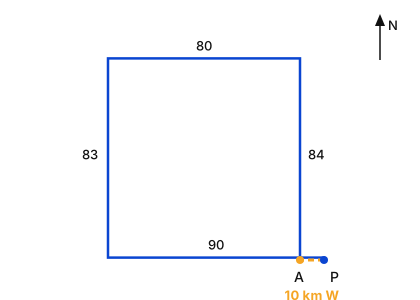
Nikhil starts from Point A and drives 84 km towards North. He then takes a left turn, drives 80 km, turns left and drives 83 km. He then takes a left turn and drives 90 km. He takes a final right turn, drives 1 km and stops at Point P. How far (shortest distance) and towards which direction should he drive in order to reach Point A again? (All turns are 90-degree turns only, unless specified.)
निखिल बिंदु A से शुरू करता है और उत्तर की ओर 84 km गाड़ी चलाता है। फिर वह बायें मुड़ता है, 80 km गाड़ी चलाता है, बायें मुड़ता है और 83 km गाड़ी चलाता है। फिर वह बायें मुड़ता है और 90 km गाड़ी चलाता है। अंत में वह दायें मुड़ता है, 1 km गाड़ी चलाता है और बिंदु P पर रुक जाता है। पुनः बिंदु A पर पहुँचने के लिए उसे कितनी दूर (न्यूनतम दूरी) और किस दिशा में गाड़ी चलानी चाहिए? (जब तक अन्यथा निर्दिष्ट न हो, सभी मोड़ केवल 90 डिग्री के हैं।)
  1. A12 km to the east12 km पूर्व की ओर
  2. B11 km to the west11 km पश्चिम की ओर
  3. C13 km to the east13 km पूर्व की ओर
  4. D10 km to the west10 km पश्चिम की ओर
Show answer

Concept: Track coordinates: North = +y, East = +x, starting at A (0, 0).

  1. 84 km North → (0, 84); left (West) 80 → (−80, 84); left (South) 83 → (−80, 1).
  2. Left (East) 90 → (10, 1); right (South) 1 → P = (10, 0).
  3. P is 10 km east of A, so he must drive 10 km to the west.

Trick: Net East–West = 90 − 80 = 10 km east; net North–South = 84 − 83 − 1 = 0 → same latitude as A.

Answer: (D) 10 km to the west

अवधारणा: निर्देशांक रखें: उत्तर = +y, पूर्व = +x, प्रारंभ A (0, 0)।

  1. 84 km उत्तर → (0, 84); बाएँ (पश्चिम) 80 → (−80, 84); बाएँ (दक्षिण) 83 → (−80, 1)।
  2. बाएँ (पूर्व) 90 → (10, 1); दाएँ (दक्षिण) 1 → P = (10, 0)।
  3. P, A से 10 km पूर्व में है, अतः 10 km पश्चिम चलना होगा।

ट्रिक: शुद्ध पूर्व–पश्चिम = 90 − 80 = 10 km पूर्व; शुद्ध उत्तर–दक्षिण = 84 − 83 − 1 = 0 → A की सीध में।

उत्तर: (D) 10 km पश्चिम

RRB NTPC Graduate CBT 1General Intelligence and ReasoningDirection and DistanceRRB NTPC Graduate CBT 1 2025 · 22 Mar Shift 3 →
Q5672.
Which of the following letter-clusters should replace # and % so that the pattern and relationship followed between the letter-cluster pair on the left side of :: is the same as that on the right side of :: ?
# : MIN :: RNS : %
निम्नलिखित में से किन अक्षर-समूहों को # और % के स्थान पर रखा जाना चाहिए ताकि :: के बायीं ओर के अक्षर-समूह युग्म के बीच का पैटर्न और संबंध वही हो जो :: के दायीं ओर के युग्म का है?
# : MIN :: RNS : %
  1. A# = OKP , % = PLQ
  2. B# = OKP , % = PLR
  3. C# = OKP , % = PMQ
  4. D# = OKO , % = PLQ
Show answer

Concept: All options give # = OKP (or OKO), so first find the rule from OKP → MIN, then apply it to RNS.

  1. OKP → MIN: O−2 = M, K−2 = I, P−2 = N (each letter −2).
  2. RNS → R−2 = P, N−2 = L, S−2 = Q → PLQ.
  3. Only option A has both OKP and PLQ.

Trick: When the options share a value for #, use it as the given pair – the question is really only about %.

Answer: (A) # = OKP, % = PLQ

अवधारणा: सभी विकल्पों में # = OKP (या OKO) है, अतः पहले OKP → MIN का नियम निकालें, फिर RNS पर लगाएँ।

  1. OKP → MIN: O−2 = M, K−2 = I, P−2 = N (हर अक्षर −2)।
  2. RNS → R−2 = P, N−2 = L, S−2 = Q → PLQ।
  3. केवल विकल्प A में OKP और PLQ दोनों हैं।

ट्रिक: जब विकल्पों में # का मान एक-सा हो, उसे दी हुई जोड़ी मानें – प्रश्न असल में केवल % का है।

उत्तर: (A) # = OKP, % = PLQ

RRB NTPC Graduate CBT 1General Intelligence and ReasoningLetter Cluster AnalogyRRB NTPC Graduate CBT 1 2025 · 22 Mar Shift 3 →
Q5673.
Based on the English alphabetical order, three of the following four are alike in a certain way and thus form a group. Which is the one that does not belong to that group? (Note: The odd man out is not based on the number of consonants/vowels or their position in the letter cluster)
अंग्रेज़ी वर्णमाला क्रम के आधार पर, निम्नलिखित चार में से तीन एक निश्चित प्रकार से समान हैं और इस प्रकार एक समूह बनाते हैं। वह कौन-सा है जो उस समूह से संबंधित नहीं है? (नोट: असंगत (odd man out) व्यंजनों/स्वरों की संख्या या अक्षर-समूह में उनकी स्थिति पर आधारित नहीं है)
  1. ASUR
  2. BNPL
  3. CDFB
  4. DQSO
Show answer

Concept: Compare the letter gaps inside each cluster.

  1. NPL: N+2 = P, P−4 = L. DFB: +2, −4. QSO: +2, −4.
  2. SUR: S+2 = U, U−3 = R – the second gap is −3, not −4.

Trick: Write the alphabet positions (S19 U21 R18) – differences show the odd cluster in seconds.

Answer: (A) SUR

अवधारणा: हर समूह के भीतर अक्षरों के अंतर तुलना करें।

  1. NPL: N+2 = P, P−4 = L। DFB: +2, −4। QSO: +2, −4।
  2. SUR: S+2 = U, U−3 = R – दूसरा अंतर −3 है, −4 नहीं।

ट्रिक: अक्षरों की स्थिति लिखें (S19 U21 R18) – अंतर से विषम समूह सेकंडों में दिखता है।

उत्तर: (A) SUR

RRB NTPC Graduate CBT 1General Intelligence and ReasoningOdd One Out – LettersRRB NTPC Graduate CBT 1 2025 · 22 Mar Shift 3 →
Q5674.
Which of the following letter-number clusters will replace the question mark (?) in the given series to make it logically complete?
IJM 77 PQT 69 WXA 61 DEH 53 ?
दी गई श्रेणी को तार्किक रूप से पूर्ण करने के लिए निम्नलिखित में से कौन-सा अक्षर-संख्या समूह प्रश्नचिह्न (?) के स्थान पर आएगा?
IJM 77 PQT 69 WXA 61 DEH 53 ?
  1. AKMN 45
  2. BKKN 44
  3. CKLO 45
  4. DKSB 44
Show answer

Concept: Separate the letter pattern from the number pattern.

  1. Numbers: 77, 69, 61, 53 → −8 each → 45.
  2. Letters: each position +7: I→P→W→D→K, J→Q→X→E→L, M→T→A→H→O.
  3. Next cluster = KLO 45.

Trick: Inside each cluster the letters are consecutive-consecutive-skip (IJ M, PQ T) – so the answer must be KL + O.

Answer: (C) KLO 45

अवधारणा: अक्षर पैटर्न और संख्या पैटर्न अलग करें।

  1. संख्याएँ: 77, 69, 61, 53 → हर बार −8 → 45।
  2. अक्षर: हर स्थान +7: I→P→W→D→K, J→Q→X→E→L, M→T→A→H→O।
  3. अगला समूह = KLO 45।

ट्रिक: हर समूह में अक्षर क्रमागत-क्रमागत-छलाँग हैं (IJ M, PQ T) – अतः उत्तर KL + O ही होगा।

उत्तर: (C) KLO 45

RRB NTPC Graduate CBT 1General Intelligence and ReasoningLetter-Number SeriesRRB NTPC Graduate CBT 1 2025 · 22 Mar Shift 3 →
Q5675.
Refer to the following letter, symbol series and answer the question. Counting to be done from left to right only
(Left) € A © D R & I % B B V @ A J $ £ * S B £ N L (Right)
How many such symbols are there each of which is immediately preceded by a letter and also immediately followed by a symbol?
निम्नलिखित अक्षर, प्रतीक श्रेणी को देखिए और प्रश्न का उत्तर दीजिए। गिनती केवल बायें से दायें की ओर की जानी है
(बायाँ) € A © D R & I % B B V @ A J $ £ * S B £ N L (दायाँ)
ऐसे कितने प्रतीक हैं, जिनमें से प्रत्येक के ठीक पहले एक अक्षर है और ठीक बाद एक प्रतीक है?
  1. A1
  2. B0
  3. C3
  4. D2
Show answer

Concept: For each symbol, check: left neighbour a letter AND right neighbour a symbol.

  1. Symbols with their neighbours: €(start, A), ©(A, D), &(R, I), %(I, B), @(V, A), $(J, £), £($, *), *(£, S), £(B, N).
  2. Only $ has a letter (J) before and a symbol (£) after.
  3. Count = 1.

Trick: Letter–Symbol–Symbol patterns can only occur where two symbols sit together – here only at "$ £ *".

Answer: (A) 1

अवधारणा: हर प्रतीक के लिए जाँचें: बायाँ पड़ोसी अक्षर और दायाँ पड़ोसी प्रतीक।

  1. प्रतीक व पड़ोसी: €(प्रारंभ, A), ©(A, D), &(R, I), %(I, B), @(V, A), $(J, £), £($, *), *(£, S), £(B, N)।
  2. केवल $ के पहले अक्षर (J) और बाद में प्रतीक (£) है।
  3. संख्या = 1।

ट्रिक: अक्षर–प्रतीक–प्रतीक पैटर्न वहीं हो सकता है जहाँ दो प्रतीक साथ हों – यहाँ केवल "$ £ *" पर।

उत्तर: (A) 1

RRB NTPC Graduate CBT 1General Intelligence and ReasoningSymbol Series CountingRRB NTPC Graduate CBT 1 2025 · 22 Mar Shift 3 →
Q5676.
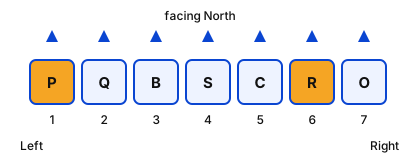
Seven people, B, C, O, P, Q, R and S, are sitting in a straight line, facing north. Only three people sit to the left of S. Only three people sit between B and O. Only four people sit between Q and O, none of whom sit at the left end. C sits immediately to the left of R. How many people sit between P and R?
सात व्यक्ति B, C, O, P, Q, R और S एक सीधी पंक्ति में उत्तर की ओर मुख करके बैठे हैं। S के बायें केवल तीन व्यक्ति बैठे हैं। B और O के बीच केवल तीन व्यक्ति बैठे हैं। Q और O के बीच केवल चार व्यक्ति बैठे हैं, जिनमें से कोई भी बायें छोर पर नहीं बैठा है। C, R के ठीक बायें बैठा है। P और R के बीच कितने व्यक्ति बैठे हैं?
  1. AOneएक
  2. BTwoदो
  3. CFourचार
  4. DThreeतीन
Show answer

Concept: Number seats 1–7 from the left (all face north) and place the definite clues first.

  1. Three people left of S → S = 4.
  2. Four between Q and O, neither at the left end → they take seats 2 and 7.
  3. Three between B and O: O = 7 gives B = 3 (O = 2 would give B = 6, leaving 1, 3, 5 – C and R could not be adjacent). So O = 7, Q = 2, B = 3.
  4. C immediately left of R in the free seats 1, 5, 6 → C = 5, R = 6, P = 1.
  5. Between P (1) and R (6): Q, B, S, C = four.

Trick: "None at the left end" is the hidden clue that fixes Q/O at 2 and 7 instead of 1 and 6.

Answer: (C) Four

अवधारणा: बाएँ से सीटें 1–7 संख्यांकित करें (सब उत्तर की ओर) और निश्चित सुराग पहले रखें।

  1. S के बाएँ तीन → S = 4।
  2. Q और O के बीच चार, कोई बाएँ छोर पर नहीं → सीटें 2 और 7।
  3. B और O के बीच तीन: O = 7 से B = 3 (O = 2 से B = 6, तब 1, 3, 5 बचतीं – C, R सटे नहीं बैठ पाते)। अतः O = 7, Q = 2, B = 3।
  4. खाली 1, 5, 6 में C, R के ठीक बाएँ → C = 5, R = 6, P = 1।
  5. P (1) और R (6) के बीच: Q, B, S, C = चार।

ट्रिक: "कोई बाएँ छोर पर नहीं" ही वह छिपा सुराग है जो Q/O को 1-6 के बजाय 2-7 पर रखता है।

उत्तर: (C) चार

RRB NTPC Graduate CBT 1General Intelligence and ReasoningLinear Seating ArrangementRRB NTPC Graduate CBT 1 2025 · 22 Mar Shift 3 →
Q5677.
Refer to the following letter, symbol series and answer the question. Counting to be done from left to right only.
(Left) R # L ? V ! M S + N - $ O T * P / < Q U (Right)
How many such symbols are there, each of which is immediately preceded by a letter and also immediately followed by another symbol?
निम्नलिखित अक्षर, प्रतीक श्रेणी को देखिए और प्रश्न का उत्तर दीजिए। गिनती केवल बायें से दायें की ओर की जानी है।
(बायाँ) R # L ? V ! M S + N - $ O T * P / < Q U (दायाँ)
ऐसे कितने प्रतीक हैं, जिनमें से प्रत्येक के ठीक पहले एक अक्षर है और ठीक बाद एक अन्य प्रतीक है?
  1. ATHREEतीन
  2. BONEएक
  3. CTWOदो
  4. DFOURचार
Show answer

Concept: For each symbol, check: letter on the left AND symbol on the right.

  1. Symbols with neighbours: #(R, L), ?(L, V), !(V, M), +(S, N), −(N, $), $(−, O), *(T, P), /(P, <), <(/, Q).
  2. Qualifying: "−" (N before, $ after) and "/" (P before, < after).
  3. Count = two.

Trick: Only look where two symbols are adjacent ("− $" and "/ <") – the first symbol of each such pair is a candidate.

Answer: (C) TWO

अवधारणा: हर प्रतीक के लिए जाँचें: बाएँ अक्षर और दाएँ प्रतीक।

  1. प्रतीक व पड़ोसी: #(R, L), ?(L, V), !(V, M), +(S, N), −(N, $), $(−, O), *(T, P), /(P, <), <(/, Q)।
  2. योग्य: "−" (पहले N, बाद $) और "/" (पहले P, बाद <)।
  3. संख्या = दो।

ट्रिक: केवल वहाँ देखें जहाँ दो प्रतीक सटे हों ("− $" और "/ <") – हर ऐसी जोड़ी का पहला प्रतीक उम्मीदवार है।

उत्तर: (C) दो (TWO)

RRB NTPC Graduate CBT 1General Intelligence and ReasoningSymbol Series CountingRRB NTPC Graduate CBT 1 2025 · 22 Mar Shift 3 →
Q5678.
In 2025, the Global AI Conclave, reinforcing India’s role as a thought leader in
responsible artificial intelligence, was hosted in which city?
2025 में, उत्तरदायी कृत्रिम बुद्धिमत्ता (artificial intelligence) में भारत की विचार-नेता (thought leader) की भूमिका को सुदृढ़ करने वाले ग्लोबल AI कॉन्क्लेव की मेज़बानी किस शहर में की गई?
  1. AChennaiचेन्नई
  2. BHyderabadहैदराबाद
  3. CBengaluruबेंगलुरु
  4. DNew Delhiनई दिल्ली
Show answer

Concept: Major AI events of 2025 are a favourite current-affairs area.

  1. The Global AI Conclave 2025 was held in Chennai in December 2025, organised by IIT Madras with the IndiaAI Mission.
  2. Its focus was safe, trusted and responsible AI governance, projecting India as a thought leader before the AI Impact Summit 2026 in New Delhi.
  3. Bengaluru and Hyderabad host many tech summits, but this particular conclave was in Chennai.

Yaad rakhein: Global AI Conclave 2025 → Chennai (IIT Madras); AI Impact Summit 2026 → New Delhi.

Answer: (A) Chennai

अवधारणा: 2025 के प्रमुख AI आयोजन समसामयिकी का महत्वपूर्ण विषय हैं।

  1. ग्लोबल AI कॉन्क्लेव 2025 दिसंबर 2025 में चेन्नई में हुआ, जिसे IIT मद्रास ने IndiaAI मिशन के साथ आयोजित किया।
  2. इसका विषय सुरक्षित, भरोसेमंद और जिम्मेदार AI गवर्नेंस था – AI इम्पैक्ट समिट 2026 (नई दिल्ली) से पहले भारत की विचार-नेतृत्व भूमिका।
  3. बेंगलुरु और हैदराबाद में कई टेक समिट होते हैं, पर यह कॉन्क्लेव चेन्नई में था।

याद रखें: ग्लोबल AI कॉन्क्लेव 2025 → चेन्नई (IIT मद्रास); AI इम्पैक्ट समिट 2026 → नई दिल्ली।

उत्तर: (A) चेन्नई

RRB NTPC Graduate CBT 1General AwarenessCurrent Affairs – Global AI Conclave 2025RRB NTPC Graduate CBT 1 2025 · 22 Mar Shift 2 →
Q5679.
The period of southwest monsoon season in India is:
भारत में दक्षिण-पश्चिम मानसून ऋतु की अवधि है:
  1. AJuly to Decemberजुलाई से दिसंबर
  2. BJune to Septemberजून से सितंबर
  3. CMay to Septemberमई से सितंबर
  4. DJune to Novemberजून से नवंबर
Show answer

Concept: India's year is divided into four seasons; the south-west monsoon is the main rainy season.

  1. South-west monsoon (advancing monsoon): June to September – onset over Kerala around 1 June, covers the country by mid-July.
  2. October–November is the retreating (north-east) monsoon, so options extending to November/December are wrong.

Yaad rakhein: Winter (Dec–Feb) → Summer (Mar–May) → SW Monsoon (Jun–Sep) → Retreating (Oct–Nov).

Answer: (B) June to September

अवधारणा: भारत का वर्ष चार ऋतुओं में बँटा है; दक्षिण-पश्चिम मानसून मुख्य वर्षा ऋतु है।

  1. दक्षिण-पश्चिम मानसून (अग्रसर मानसून): जून से सितंबर – केरल में लगभग 1 जून को आगमन, जुलाई मध्य तक पूरे देश में।
  2. अक्टूबर–नवंबर लौटता (उत्तर-पूर्वी) मानसून है, इसलिए नवंबर/दिसंबर तक वाले विकल्प गलत हैं।

याद रखें: शीत (दिस–फर) → ग्रीष्म (मार–मई) → SW मानसून (जून–सित) → लौटता मानसून (अक्टू–नव)।

उत्तर: (B) जून से सितंबर

RRB NTPC Graduate CBT 1General AwarenessIndian Climate – MonsoonRRB NTPC Graduate CBT 1 2025 · 22 Mar Shift 2 →
Q5680.
Which is the latest version of Windows?
Windows का नवीनतम संस्करण (version) कौन-सा है?
  1. AWindows 18
  2. BWindows 11
  3. CWindows 7
  4. DWindows 10
Show answer

Concept: Microsoft's desktop OS versions in order: Windows 7 → 8 → 8.1 → 10 → 11.

  1. Windows 11 (released October 2021) is the latest version; Windows 10 support ended in October 2025.
  2. "Windows 18" does not exist.

Yaad rakhein: Microsoft skipped Windows 9 – after 8.1 came 10, then 11.

Answer: (B) Windows 11

अवधारणा: Microsoft के डेस्कटॉप OS क्रम में: Windows 7 → 8 → 8.1 → 10 → 11।

  1. Windows 11 (अक्टूबर 2021) नवीनतम संस्करण है; Windows 10 का सपोर्ट अक्टूबर 2025 में समाप्त हुआ।
  2. "Windows 18" नाम का कोई संस्करण नहीं है।

याद रखें: Microsoft ने Windows 9 छोड़ दिया – 8.1 के बाद 10, फिर 11।

उत्तर: (B) Windows 11

RRB NTPC Graduate CBT 1General AwarenessComputer Awareness – Operating SystemsRRB NTPC Graduate CBT 1 2025 · 22 Mar Shift 2 →