Question bank

Q&A: practice questions with answers

Search questions on any topic. Filter by exam category, exam, subject and topic, try the question, then open the answer and explanation.

Courses – airGurukul

7,077 questions found.

Q5721.
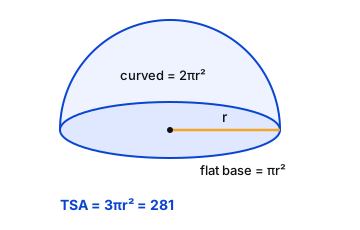
The total surface area of a solid hemisphere is 281 cm2. What is its radius (in cm)? (Take π=227)
एक ठोस अर्धगोले का कुल पृष्ठीय क्षेत्रफल 281 cm2 है। इसकी त्रिज्या (cm में) क्या है? (π=227 लीजिए)
  1. A196666
  2. B196766
  3. C196566
  4. D1957132
Show answer

Concept: TSA of a solid hemisphere =2πr2+πr2=3πr2.

  1. 3×227×r2=281.
  2. r2=281×766=196766.
  3. r=196766cm.

Trick: Solid hemisphere → 3πr2 (with base); hollow bowl surface → 2πr2. Here numerator must be 281×7=1967.

Answer: (B) 196766

अवधारणा: ठोस अर्धगोले का TSA =2πr2+πr2=3πr2।

  1. 3×227×r2=281।
  2. r2=281×766=196766।
  3. r=196766cm।

ट्रिक: ठोस अर्धगोला → 3πr2 (आधार सहित); खोखला कटोरा → 2πr2। यहाँ अंश 281×7=1967 होना चाहिए।

उत्तर: (B) 196766

RRB NTPC Graduate CBT 1MathematicsMensuration – HemisphereRRB NTPC Graduate CBT 1 2025 · 22 Mar Shift 2 →
Q5722.
Pipe P can fill 59 part of a tank in 15 hours and pipe Q can fill 79 part of the same tank in 21 hours. Both P and Q were kept open for 3 hours, then both were closed. Pipe R alone was then opened and it emptied the water in the tank in 4 hours. Pipes P, Q and R together can fill the empty tank in:
पाइप P एक टंकी के 59 भाग को 15 घंटे में भर सकता है और पाइप Q उसी टंकी के 79 भाग को 21 घंटे में भर सकता है। P और Q दोनों को 3 घंटे तक खुला रखा गया, फिर दोनों को बंद कर दिया गया। इसके बाद केवल पाइप R को खोला गया और उसने टंकी के पानी को 4 घंटे में खाली कर दिया। पाइप P, Q और R मिलकर खाली टंकी को कितने समय में भर सकते हैं:
  1. A57 hours57 घंटे
  2. B58 hours58 घंटे
  3. C42 hours42 घंटे
  4. D54 hours54 घंटे
Show answer

Concept: Convert each pipe to "full tank per hour", then add fillers and subtract the emptier.

  1. P fills 59 in 15 h → full tank in 15×95=27 h. Q fills 79 in 21 h → 21×97=27 h.
  2. P + Q in 3 h =3×227=29 of tank. R empties 29 in 4 h → R empties full tank in 18 h.
  3. Together: 127+127−118=4−354=154 → 54 hours.

Trick: Take LCM 54 units: P =2, Q =2, R =−3 per hour → net 1 unit/h → 54 h.

Answer: (D) 54 hours

अवधारणा: हर पाइप को "पूरी टंकी प्रति घंटा" में बदलें, भरने वाले जोड़ें और खाली करने वाला घटाएँ।

  1. P, 15 घंटे में 59 भरता है → पूरी टंकी 15×95=27 घंटे। Q, 21 घंटे में 79 → 21×97=27 घंटे।
  2. P + Q 3 घंटे में =3×227=29 टंकी। R इसे 4 घंटे में खाली करता है → पूरी टंकी 18 घंटे में।
  3. तीनों साथ: 127+127−118=4−354=154 → 54 घंटे।

ट्रिक: LCM 54 इकाई लें: P =2, Q =2, R =−3 प्रति घंटा → शुद्ध 1 इकाई/घंटा → 54 घंटे।

उत्तर: (D) 54 घंटे

RRB NTPC Graduate CBT 1MathematicsPipes & CisternsRRB NTPC Graduate CBT 1 2025 · 22 Mar Shift 2 →
Q5723.
A and B complete a work in 20 days. If A alone can do it in 45 days, then B alone can do three-fourth of the same work in ______________days.
A और B एक कार्य को 20 दिनों में पूरा करते हैं। यदि A अकेले इसे 45 दिनों में कर सकता है, तो B अकेले उसी कार्य का तीन-चौथाई भाग ______________ दिनों में कर सकता है।
  1. A81
  2. B54
  3. C108
  4. D27
Show answer

Concept: B's one-day work = (A+B)'s − A's.

  1. 120−145=9−4180=5180=136 → B alone takes 36 days.
  2. Three-fourth of the work: 34×36=27 days.

Trick: LCM 180 units: A+B =9/day, A =4/day, B =5/day → 1355=27 days.

Answer: (D) 27

अवधारणा: B का एक दिन का कार्य = (A+B) का − A का।

  1. 120−145=9−4180=5180=136 → B अकेला 36 दिन।
  2. तीन-चौथाई कार्य: 34×36=27 दिन।

ट्रिक: LCM 180 इकाई: A+B =9/दिन, A =4/दिन, B =5/दिन → 1355=27 दिन।

उत्तर: (D) 27

RRB NTPC Graduate CBT 1MathematicsTime & WorkRRB NTPC Graduate CBT 1 2025 · 22 Mar Shift 2 →
Q5724.
The population of a village was 2,90,000. It increased by 15% in the first year and increased by 20% in the second year. Its population after two years is _______.
एक गाँव की जनसंख्या 2,90,000 थी। पहले वर्ष में इसमें 15% की वृद्धि हुई और दूसरे वर्ष में 20% की वृद्धि हुई। दो वर्ष बाद इसकी जनसंख्या _______ है।
  1. A3,33,500
  2. B4,00,200
  3. C3,48,000
  4. D3,91,500
Show answer

Concept: Successive increases multiply: P×(1+r1)(1+r2).

  1. Net factor =1.15×1.20=1.38 (same as 15+20+15×20100=38%).
  2. Population =2,90,000×1.38=4,00,200.

Trick: a+b+ab100 for two successive changes – here 38% of 2,90,000=1,10,200; add it.

Answer: (B) 4,00,200

अवधारणा: क्रमिक वृद्धियाँ गुणा होती हैं: P×(1+r1)(1+r2)।

  1. कुल गुणक =1.15×1.20=1.38 (यानी 15+20+15×20100=38%)।
  2. जनसंख्या =2,90,000×1.38=4,00,200।

ट्रिक: दो क्रमिक परिवर्तनों के लिए a+b+ab100 – यहाँ 2,90,000 का 38%=1,10,200 जोड़ें।

उत्तर: (B) 4,00,200

RRB NTPC Graduate CBT 1MathematicsSuccessive Percentage ChangeRRB NTPC Graduate CBT 1 2025 · 22 Mar Shift 2 →
Q5725.
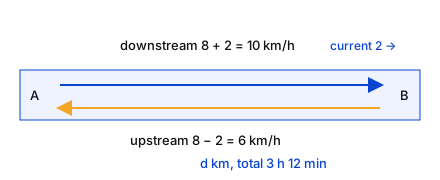
A man can row at 8 km/hr in still water. When the river flows at 2 km/hr, he takes 3 hours 12 minutes to row to a destination and back. Find the distance to the destination.
एक व्यक्ति शांत जल में 8 km/hr की चाल से नाव चला सकता है। जब नदी 2 km/hr की चाल से बहती है, तो उसे एक गंतव्य तक जाकर वापस आने में 3 घंटे 12 मिनट लगते हैं। गंतव्य की दूरी ज्ञात कीजिए।
  1. A10 km
  2. B8 km
  3. C15 km
  4. D12 km
Show answer

Concept: Downstream speed =u+v, upstream speed =u−v; total time =du+v+du−v.

  1. Downstream =8+2=10km/h, upstream =8−2=6km/h; time =3h12min=165 h.
  2. d10+d6=165 → 8d30=165.
  3. d=165×308=12 km.

Trick: d=T(u2−v2)2u=3.2×6016=12.

Answer: (D) 12 km

अवधारणा: अनुप्रवाह चाल =u+v, प्रतिप्रवाह =u−v; कुल समय =du+v+du−v।

  1. अनुप्रवाह =8+2=10km/h, प्रतिप्रवाह =8−2=6km/h; समय =3h12min=165 घंटे।
  2. d10+d6=165 → 8d30=165।
  3. d=165×308=12 km।

ट्रिक: d=T(u2−v2)2u=3.2×6016=12।

उत्तर: (D) 12 km

RRB NTPC Graduate CBT 1MathematicsBoats & StreamsRRB NTPC Graduate CBT 1 2025 · 22 Mar Shift 2 →
Q5726.
Simplify: cosθ1+sinθ+1+sinθcosθ.
सरल कीजिए: cosθ1+sinθ+1+sinθcosθ।
  1. A2cosecθ
  2. B2sinθ
  3. C2secθ
  4. D2cosθ
Show answer

Concept: Take LCM and use sin2θ+cos2θ=1.

  1. cosθ1+sinθ+1+sinθcosθ=cos2θ+(1+sinθ)2(1+sinθ)cosθ.
  2. Numerator =cos2θ+1+2sinθ+sin2θ=2+2sinθ=2(1+sinθ).
  3. Cancel (1+sinθ): result =2cosθ=2secθ.

Trick: Put θ=0∘: 11+11=2; only 2sec0∘=2 matches.

Answer: (C) 2secθ

अवधारणा: LCM लें और sin2θ+cos2θ=1 लगाएँ।

  1. cosθ1+sinθ+1+sinθcosθ=cos2θ+(1+sinθ)2(1+sinθ)cosθ।
  2. अंश =cos2θ+1+2sinθ+sin2θ=2+2sinθ=2(1+sinθ)।
  3. (1+sinθ) काटने पर =2cosθ=2secθ।

ट्रिक: θ=0∘ रखें: 11+11=2; केवल 2sec0∘=2 मिलता है।

उत्तर: (C) 2secθ

RRB NTPC Graduate CBT 1MathematicsTrigonometric IdentitiesRRB NTPC Graduate CBT 1 2025 · 22 Mar Shift 2 →
Q5727.
At what rate (in percentage) per year will a sum of money double itself in 20 years on simple interest?
साधारण ब्याज पर प्रति वर्ष कितनी दर (प्रतिशत में) से कोई धनराशि 20 वर्षों में स्वयं की दोगुनी हो जाएगी?
  1. A10
  2. B5
  3. C7
  4. D3
Show answer

Concept: To double, SI must equal the principal: P×R×T100=P → R×T=100.

  1. T=20 years → R=10020=5% per annum.

Trick: Double → RT=100; triple → RT=200; n times → RT=100(n−1).

Answer: (B) 5

अवधारणा: दोगुना होने के लिए SI = मूलधन: P×R×T100=P → R×T=100।

  1. T=20 वर्ष → R=10020=5% वार्षिक।

ट्रिक: दोगुना → RT=100; तिगुना → RT=200; n गुना → RT=100(n−1)।

उत्तर: (B) 5

RRB NTPC Graduate CBT 1MathematicsSimple InterestRRB NTPC Graduate CBT 1 2025 · 22 Mar Shift 2 →
Q5728.
If 2820 is divided into two parts such that one-fifth of the first part and one-eighth of the second part are in the ratio 3 : 4, what is the ratio of the first part to the second part?
यदि 2820 को दो भागों में इस प्रकार विभाजित किया जाता है कि पहले भाग का पाँचवाँ भाग और दूसरे भाग का आठवाँ भाग 3 : 4 के अनुपात में हैं, तो पहले भाग का दूसरे भाग से अनुपात क्या है?
  1. A18 : 19
  2. B15 : 32
  3. C15 : 37
  4. D17 : 36
Show answer

Concept: Set up the ratio of the fractional parts and simplify.

  1. a/5b/8=34 → 8a5b=34 → 32a=15b.
  2. a:b=15:32.

Trick: a:b=(3×5):(4×8)=15:32 – multiply each ratio term by its own denominator. The total 2820 is not needed.

Answer: (B) 15 : 32

अवधारणा: भिन्नात्मक भागों का अनुपात लिखकर सरल करें।

  1. a/5b/8=34 → 8a5b=34 → 32a=15b।
  2. a:b=15:32।

ट्रिक: a:b=(3×5):(4×8)=15:32 – हर अनुपात-पद को उसके हर से गुणा करें। कुल 2820 की ज़रूरत नहीं।

उत्तर: (B) 15 : 32

RRB NTPC Graduate CBT 1MathematicsRatio & ProportionRRB NTPC Graduate CBT 1 2025 · 22 Mar Shift 2 →
Q5729.
In a 150-meter race, R beats S by 6 meters. In a 250-meter race, R beats S by 2 seconds. As per this, in a race, if R runs for 30 seconds, then he beats S by ___ meters.
150 मीटर की दौड़ में, R, S को 6 मीटर से हराता है। 250 मीटर की दौड़ में, R, S को 2 सेकंड से हराता है। इसके अनुसार, एक दौड़ में यदि R 30 सेकंड तक दौड़ता है, तो वह S को ___ मीटर से हराता है।
  1. A5.75
  2. B7.25
  3. C6.75
  4. D6.25
Show answer

Concept: Find the speed ratio from the first race and S's actual speed from the second.

  1. 150 m race: R runs 150 while S runs 144 → speeds R : S =25:24.
  2. 250 m race: when R finishes 250, S has run 240 and needs 2 s for the last 10 m → S's speed =5m/s; R's speed =5×2524=12524m/s.
  3. In 30 s: R =156.25 m, S =150 m → R beats S by 6.25 m.

Trick: Lead in 30 s =30×(R−S speed)=30×524=6.25.

Answer: (D) 6.25

अवधारणा: पहली दौड़ से चाल का अनुपात और दूसरी से S की वास्तविक चाल निकालें।

  1. 150 m दौड़: R 150 दौड़ता है तो S 144 → चाल R : S =25:24।
  2. 250 m दौड़: R के 250 पूरे करने पर S 240 पर; बचे 10 m में 2 s → S की चाल =5m/s; R की चाल =5×2524=12524m/s।
  3. 30 s में: R =156.25 m, S =150 m → R, S को 6.25 m से हराता है।

ट्रिक: 30 s की बढ़त =30×(R−S चाल)=30×524=6.25।

उत्तर: (D) 6.25

RRB NTPC Graduate CBT 1MathematicsRacesRRB NTPC Graduate CBT 1 2025 · 22 Mar Shift 2 →
Q5730.
What will be the positive difference in the population of a town 3 years ago and 2 years ago, if its current population is 450000 and the population has been increasing at a rate of 25% every year?
किसी नगर की 3 वर्ष पहले और 2 वर्ष पहले की जनसंख्या में धनात्मक अंतर क्या होगा, यदि इसकी वर्तमान जनसंख्या 450000 है और जनसंख्या प्रति वर्ष 25% की दर से बढ़ रही है?
  1. A57050
  2. B56850
  3. C57950
  4. D57600
Show answer

Concept: Past population =present(1+r)n; 25% growth means factor 54 per year.

  1. 2 years ago: 450000×45×45=288000.
  2. 3 years ago: 288000×45=230400.
  3. Difference =288000−230400=57600.

Trick: Difference = (population 3 yrs ago) ×25% =230400×14=57600.

Answer: (D) 57600

अवधारणा: पिछली जनसंख्या =वर्तमान(1+r)n; 25% वृद्धि = प्रति वर्ष गुणक 54।

  1. 2 वर्ष पहले: 450000×45×45=288000।
  2. 3 वर्ष पहले: 288000×45=230400।
  3. अंतर =288000−230400=57600।

ट्रिक: अंतर = (3 वर्ष पहले की जनसंख्या) ×25% =230400×14=57600।

उत्तर: (D) 57600

RRB NTPC Graduate CBT 1MathematicsCompound Growth – PopulationRRB NTPC Graduate CBT 1 2025 · 22 Mar Shift 2 →
Q5731.
Girish scored 768 marks in an examination and was 60 marks short of 92% of maximum marks. In the same examination, his friend scored 738 marks. What is the percentage of marks scored by his friend?
गिरीश ने एक परीक्षा में 768 अंक प्राप्त किए और वह अधिकतम अंकों के 92% से 60 अंक कम रहा। उसी परीक्षा में उसके मित्र ने 738 अंक प्राप्त किए। उसके मित्र द्वारा प्राप्त अंकों का प्रतिशत क्या है?
  1. A82%
  2. B80%
  3. C79%
  4. D81%
Show answer

Concept: First find the maximum marks from Girish's score.

  1. 92% of max =768+60=828 → max =828×10092=900.
  2. Friend's percentage =738900×100=82%.

Trick: 828=92×9 → max =900; then 738÷9=82.

Answer: (A) 82%

अवधारणा: पहले गिरीश के अंकों से अधिकतम अंक निकालें।

  1. अधिकतम का 92%=768+60=828 → अधिकतम =828×10092=900।
  2. मित्र का प्रतिशत =738900×100=82%।

ट्रिक: 828=92×9 → अधिकतम =900; फिर 738÷9=82।

उत्तर: (A) 82%

RRB NTPC Graduate CBT 1MathematicsPercentage – MarksRRB NTPC Graduate CBT 1 2025 · 22 Mar Shift 2 →
Q5732.
What is the nature of the roots of the following quadratic equation?
x−1x=17
निम्नलिखित द्विघात समीकरण के मूलों की प्रकृति क्या है?
x−1x=17
  1. AReal and equalवास्तविक और समान
  2. BNo real rootsकोई वास्तविक मूल नहीं
  3. CReal and distinct (irrational)वास्तविक और भिन्न (अपरिमेय)
  4. DReal and distinct (rational)वास्तविक और भिन्न (परिमेय)
Show answer

Concept: For ax2+bx+c=0, the discriminant D=b2−4ac decides the roots: D>0 real and distinct (rational if D is a perfect square, else irrational), D=0 equal, D<0 no real roots.

  1. Multiply x−1x=17 by x: x2−17x−1=0.
  2. D=(−17)2−4(1)(−1)=289+4=293>0.
  3. 293 is not a perfect square (172=289, 182=324), so the roots are real, distinct and irrational.

Trick: Whenever c is negative with a positive, D=b2−4ac is surely positive – roots are always real and distinct; just check perfect square for rational/irrational.

Answer: (C) Real and distinct (irrational)

अवधारणा: ax2+bx+c=0 के लिए विविक्तकर (discriminant) D=b2−4ac मूलों की प्रकृति बताता है: D>0 वास्तविक व भिन्न (यदि D पूर्ण वर्ग हो तो परिमेय, अन्यथा अपरिमेय), D=0 समान, D<0 कोई वास्तविक मूल नहीं।

  1. x−1x=17 को x से गुणा करें: x2−17x−1=0।
  2. D=(−17)2−4(1)(−1)=289+4=293>0।
  3. 293 पूर्ण वर्ग नहीं है (172=289, 182=324), अतः मूल वास्तविक, भिन्न और अपरिमेय (irrational) हैं।

ट्रिक: जब a धनात्मक और c ऋणात्मक हो, तो D निश्चित ही धनात्मक होता है – मूल हमेशा वास्तविक व भिन्न; बस पूर्ण वर्ग जाँचकर परिमेय/अपरिमेय तय करें।

उत्तर: (C) Real and distinct (irrational)

RRB NTPC Graduate CBT 1MathematicsQuadratic Equations – Nature of RootsRRB NTPC Graduate CBT 1 2025 · 22 Mar Shift 2 →
Q5733.
The larger of two supplementary angles is 32° more than the smaller. The smaller angle (in degree) is:
दो संपूरक कोणों में से बड़ा कोण छोटे कोण से 32° अधिक है। छोटा कोण (डिग्री में) है:
  1. A75
  2. B81
  3. C74
  4. D76
Show answer

Concept: Two angles are supplementary when their sum is 180∘.

  1. Let the smaller angle be x; the larger is x+32.
  2. x+(x+32)=180⇒2x=148⇒x=74.
  3. Check: 74∘+106∘=180∘ ✓

Trick: Smaller =180−difference2=180−322=74; larger =180+322=106.

Answer: (C) 74

अवधारणा: दो कोण संपूरक (supplementary) होते हैं जब उनका योग 180∘ हो।

  1. छोटा कोण x मानें; बड़ा x+32।
  2. x+(x+32)=180⇒2x=148⇒x=74।
  3. जाँच: 74∘+106∘=180∘ ✓

ट्रिक: छोटा =180−अंतर2=180−322=74; बड़ा =180+322=106।

उत्तर: (C) 74

RRB NTPC Graduate CBT 1MathematicsSupplementary AnglesRRB NTPC Graduate CBT 1 2025 · 22 Mar Shift 2 →
Q5734.
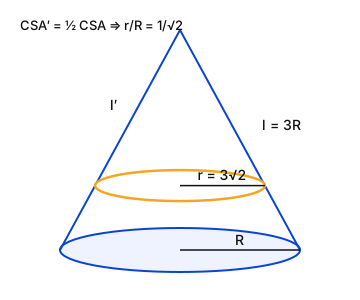
A right circular cone has a slant height that is 3 times its radius. A plane cuts the cone parallel to the base at a height such that the smaller, upper cone has half the curved surface area of the original cone. If the diameter of the smaller cone is 62 cm, then what is the radius (in cm) of the original cone?
एक लंब वृत्तीय शंकु की तिर्यक ऊँचाई उसकी त्रिज्या की 3 गुनी है। एक समतल शंकु को आधार के समांतर इतनी ऊँचाई पर काटता है कि छोटे, ऊपरी शंकु का वक्र पृष्ठीय क्षेत्रफल मूल शंकु के वक्र पृष्ठीय क्षेत्रफल का आधा है। यदि छोटे शंकु का व्यास 62 cm है, तो मूल शंकु की त्रिज्या (cm में) क्या है?
  1. A3
  2. B6
  3. C9
  4. D12
Show answer

Concept: A plane parallel to the base cuts off a smaller cone similar to the original. If the linear ratio is k, areas scale by k2 and volumes by k3.

  1. CSA of the small cone =12 CSA of the original ⇒k2=12⇒k=12.
  2. Radius of the small cone =622=32cm.
  3. Original radius R=32k=32×2=6cm.
  4. Check with l=3R: CSA =πR·3R=3πR2; small cone 3π(32)2=54π, original 3π·36=108π – exactly half ✓

Trick: For similar solids: length ratio k, area ratio k2, volume ratio k3. The "slant height = 3 × radius" data is only a distraction here.

Answer: (B) 6

अवधारणा: आधार के समांतर काटने से बना छोटा शंकु मूल शंकु के समरूप होता है। यदि रैखिक अनुपात k हो तो क्षेत्रफल k2 और आयतन k3 के अनुपात में होते हैं।

  1. छोटे शंकु का वक्र पृष्ठ =12 मूल का ⇒k2=12⇒k=12।
  2. छोटे शंकु की त्रिज्या =622=32cm।
  3. मूल त्रिज्या R=32k=32×2=6cm।
  4. l=3R से जाँच: CSA =πR·3R=3πR2; छोटा 3π(32)2=54π, मूल 3π·36=108π – ठीक आधा ✓

ट्रिक: समरूप ठोसों में: लंबाई अनुपात k, क्षेत्रफल k2, आयतन k3। "तिर्यक ऊँचाई = 3 × त्रिज्या" यहाँ केवल ध्यान भटकाने के लिए है।

उत्तर: (B) 6

RRB NTPC Graduate CBT 1MathematicsMensuration – Frustum/Similar ConesRRB NTPC Graduate CBT 1 2025 · 22 Mar Shift 2 →
Q5735.
A trader gives 5% discount on the marked price of an article and gives 2 articles free for buying 14 articles and gains 33% in the entire transaction. Assuming a customer pays for 14 articles, the marked price of an article is what percent more than its cost price?
एक व्यापारी एक वस्तु के अंकित मूल्य पर 5% की छूट देता है और 14 वस्तुएँ खरीदने पर 2 वस्तुएँ मुफ़्त देता है तथा पूरे लेन-देन में 33% का लाभ प्राप्त करता है। यह मानते हुए कि ग्राहक 14 वस्तुओं का भुगतान करता है, एक वस्तु का अंकित मूल्य उसके क्रय मूल्य से कितने प्रतिशत अधिक है?
  1. A52%
  2. B60%
  3. C68%
  4. D58%
Show answer

Concept: Take CP of one article as ₹100. The customer pays for 14 articles but the trader gives away 16, so the cost is on 16 articles while the sale is on 14 at the discounted price.

  1. CP of 16 articles =16×100=1600. Gain 33% ⇒ SP =1600×1.33=2128.
  2. SP per paid article =212814=152.
  3. SP =95% of MP ⇒ MP =1520.95=160.
  4. MP is 160−100=60% above CP.

Trick: Chain formula: MP=CP×1614×133100×10095=100×16×13314×95=160.

Answer: (B) 60%

अवधारणा: एक वस्तु का CP ₹100 मानें। ग्राहक 14 का भुगतान करता है पर 16 पाता है, अतः लागत 16 वस्तुओं की और बिक्री 14 वस्तुओं की छूट-सहित कीमत पर।

  1. 16 वस्तुओं का CP =16×100=1600। 33% लाभ ⇒ SP =1600×1.33=2128।
  2. प्रति भुगतान-वस्तु SP =212814=152।
  3. SP = MP का 95% ⇒ MP =1520.95=160।
  4. MP, CP से 160−100=60% अधिक।

ट्रिक: श्रृंखला सूत्र: MP=CP×1614×133100×10095=100×16×13314×95=160।

उत्तर: (B) 60%

RRB NTPC Graduate CBT 1MathematicsProfit & Loss – Discount with Free ArticlesRRB NTPC Graduate CBT 1 2025 · 22 Mar Shift 2 →
Q5736.
A shopkeeper purchased 32 dozens of articles at the rate of ₹102 per dozen. He sold each one of them at the rate of ₹68. What percentage profit did he make?
एक दुकानदार ने ₹102 प्रति दर्जन की दर से 32 दर्जन वस्तुएँ खरीदीं। उसने उनमें से प्रत्येक को ₹68 की दर से बेच दिया। उसे कितने प्रतिशत लाभ हुआ?
  1. A697%
  2. B702%
  3. C700%
  4. D701%
Show answer

Concept: Profit% is calculated on the cost price of the same unit: Profit%=SP−CPCP×100.

  1. CP of one article =10212=8.5 rupees.
  2. SP of one article =68 rupees. Profit =68−8.5=59.5.
  3. Profit% =59.58.5×100=7×100=700%.

Trick: Note 68=8×8.5, i.e. SP is 8 times CP → profit is 7 times CP → 700%. The "32 dozens" is irrelevant.

Answer: (C) 700%

अवधारणा: लाभ% समान इकाई के क्रय मूल्य पर निकाला जाता है: लाभ%=SP−CPCP×100।

  1. एक वस्तु का CP =10212=8.5 रुपये।
  2. एक वस्तु का SP =68 रुपये। लाभ =68−8.5=59.5।
  3. लाभ% =59.58.5×100=7×100=700%।

ट्रिक: ध्यान दें 68=8×8.5, यानी SP, CP का 8 गुना → लाभ CP का 7 गुना → 700%। "32 दर्जन" अनावश्यक है।

उत्तर: (C) 700%

RRB NTPC Graduate CBT 1MathematicsProfit PercentageRRB NTPC Graduate CBT 1 2025 · 22 Mar Shift 2 →
Q5737.
The marks obtained by 11 students in a mathematics test are as follows: 45, 62, 58, 71, 66, 54, 60, 49, 68, 57, 63.What is the median marks?
गणित की एक परीक्षा में 11 विद्यार्थियों द्वारा प्राप्त अंक निम्नलिखित हैं: 45, 62, 58, 71, 66, 54, 60, 49, 68, 57, 63। माध्यिका अंक क्या है?
  1. A60
  2. B66
  3. C58
  4. D54
Show answer

Concept: For n observations arranged in order, the median is the (n+12)th value when n is odd.

  1. Arrange: 45, 49, 54, 57, 58, 60, 62, 63, 66, 68, 71.
  2. n=11⇒ median =11+12=6th value =60.

Trick: Odd count → middle value directly; even count → average of the two middle values. Always sort first!

Answer: (A) 60

अवधारणा: n प्रेक्षणों को क्रम में रखने पर, n विषम हो तो माध्यिका (n+12)वाँ मान होती है।

  1. क्रम में: 45, 49, 54, 57, 58, 60, 62, 63, 66, 68, 71।
  2. n=11⇒ माध्यिका =11+12=6वाँ मान =60।

ट्रिक: विषम संख्या → सीधे बीच वाला मान; सम संख्या → बीच के दो मानों का औसत। पहले क्रम में लगाना न भूलें!

उत्तर: (A) 60

RRB NTPC Graduate CBT 1MathematicsStatistics – MedianRRB NTPC Graduate CBT 1 2025 · 22 Mar Shift 2 →
Q5738.
The least common multiple and the highest common factor of x2.5y0.5×xy and y1.5x×xy are ____ and ______, respectively, where x and y are co-prime integers greater than 1.
x2.5y0.5×xy और y1.5x×xy का लघुत्तम समापवर्त्य और महत्तम समापवर्तक क्रमशः ____ और ______ हैं, जहाँ x और y 1 से बड़े सह-अभाज्य पूर्णांक हैं।
  1. Ax(xy)2, x
  2. By(xy)2, 1
  3. Cy(xy)2, y
  4. Dx(xy)2, 1
Show answer

Concept: First simplify each expression using the laws of indices (am·an=am+n, a=a0.5), then find LCM and HCF.

  1. First: x2.5y0.5×xy=x2.5y−0.5·x0.5y0.5=x3.
  2. Second: y1.5x×xy=y1.5x−0.5·x0.5y0.5=y2.
  3. x and y are co-prime, so x3 and y2 share no factor: HCF =1, LCM =x3y2=x(xy)2.

Trick: For co-prime bases the HCF of pure powers is always 1 and the LCM is just their product.

Answer: (D) x(xy)2, 1

अवधारणा: पहले घातांक नियमों (am·an=am+n, a=a0.5) से हर व्यंजक सरल करें, फिर LCM और HCF निकालें।

  1. पहला: x2.5y0.5×xy=x2.5y−0.5·x0.5y0.5=x3।
  2. दूसरा: y1.5x×xy=y1.5x−0.5·x0.5y0.5=y2।
  3. x और y सह-अभाज्य हैं, अतः x3 और y2 में कोई उभयनिष्ठ गुणनखंड नहीं: HCF =1, LCM =x3y2=x(xy)2।

ट्रिक: सह-अभाज्य आधारों की शुद्ध घातों का HCF हमेशा 1 और LCM उनका गुणनफल होता है।

उत्तर: (D) x(xy)2, 1

RRB NTPC Graduate CBT 1MathematicsIndices – LCM & HCF of ExpressionsRRB NTPC Graduate CBT 1 2025 · 22 Mar Shift 2 →
Q5739.
Solve the following system of linear equations:
u+v+w=2
6u+4v+5w=31
5u+2v+2w=13
रैखिक समीकरणों के निम्नलिखित निकाय को हल कीजिए:
u+v+w=2
6u+4v+5w=31
5u+2v+2w=13
  1. Au = 1, v = 15, w = −14
  2. Bu = 3, v = −15, w = 14
  3. Cu = 1, v = 18, w = −17
  4. Du = 3, v = −18, w = 17
Show answer

Concept: Eliminate one variable using the simplest equation, reduce to two equations in two unknowns, then back-substitute. Options can also be verified directly.

  1. From (1): w=2−u−v. Put in (2): 6u+4v+5(2−u−v)=31⇒u−v=21.
  2. Put in (3): 5u+2v+2(2−u−v)=13⇒3u=9⇒u=3.
  3. Then v=u−21=−18 and w=2−3+18=17.
  4. Check (2): 18−72+85=31 ✓

Trick: Equation (3) collapses fast because 2v+2w=2(v+w)=2(2−u). Look for such shortcuts before heavy elimination – or simply test options in equation (1) first (only B and D give 2).

Answer: (D) u = 3, v = −18, w = 17

अवधारणा: सबसे सरल समीकरण से एक चर हटाएँ, दो चरों के दो समीकरण बनाएँ, फिर पीछे प्रतिस्थापन करें। विकल्प सीधे जाँचे भी जा सकते हैं।

  1. (1) से: w=2−u−v। (2) में रखें: 6u+4v+5(2−u−v)=31⇒u−v=21।
  2. (3) में रखें: 5u+2v+2(2−u−v)=13⇒3u=9⇒u=3।
  3. तब v=u−21=−18 और w=2−3+18=17।
  4. जाँच (2): 18−72+85=31 ✓

ट्रिक: समीकरण (3) जल्दी सुलझता है क्योंकि 2v+2w=2(v+w)=2(2−u)। भारी विलोपन से पहले ऐसे शॉर्टकट देखें – या पहले विकल्पों को समीकरण (1) में जाँचें (केवल B और D से 2 आता है)।

उत्तर: (D) u = 3, v = −18, w = 17

RRB NTPC Graduate CBT 1MathematicsLinear Equations in Three VariablesRRB NTPC Graduate CBT 1 2025 · 22 Mar Shift 2 →
Q5740.
There are 16 members in group A, 86 members in group B and 21 members in group C. All the members of these groups went to a restaurant. The average amounts spent on each member of groups A, B and C are ₹447, ₹396 and ₹158, respectively. The overall average amount (in ₹) spent per member is:
समूह A में 16 सदस्य, समूह B में 86 सदस्य और समूह C में 21 सदस्य हैं। इन समूहों के सभी सदस्य एक रेस्तरां में गए। समूह A, B और C के प्रत्येक सदस्य पर खर्च की गई औसत राशि क्रमशः ₹447, ₹396 और ₹158 है। प्रति सदस्य खर्च की गई समग्र औसत राशि (₹ में) है:
  1. A362
  2. B366
  3. C367
  4. D360
Show answer

Concept: Overall average =total amounttotal members=∑nix¯i∑ni.

  1. Totals: 16×447=7152, 86×396=34056, 21×158=3318.
  2. Sum =7152+34056+3318=44526; members =16+86+21=123.
  3. Average =44526123=362.

Trick: Use deviations from 400: 16(+47)+86(−4)+21(−242)=752−344−5082=−4674; −4674123=−38 → 400−38=362.

Answer: (A) 362

अवधारणा: समग्र औसत =कुल राशिकुल सदस्य=∑nix¯i∑ni।

  1. योग: 16×447=7152, 86×396=34056, 21×158=3318।
  2. कुल =7152+34056+3318=44526; सदस्य =16+86+21=123।
  3. औसत =44526123=362।

ट्रिक: 400 से विचलन लें: 16(+47)+86(−4)+21(−242)=752−344−5082=−4674; −4674123=−38 → 400−38=362।

उत्तर: (A) 362

RRB NTPC Graduate CBT 1MathematicsWeighted AverageRRB NTPC Graduate CBT 1 2025 · 22 Mar Shift 2 →