Question bank

Q&A: practice questions with answers

Search questions on any topic. Filter by exam category, exam, subject and topic, try the question, then open the answer and explanation.

Courses – airGurukul

2,400 questions found.

Q41.
The ratio of boys to girls in two sections A and B of a class is the same. Section A comprises of 36 boys and 24 girls. If there are 28 girls in section B, how many boys are there in that section?
एक कक्षा के दो वर्गों A और B में लड़कों और लड़कियों का अनुपात समान है। वर्ग A में 36 लड़के और 24 लड़कियाँ हैं। यदि वर्ग B में 28 लड़कियाँ हैं, तो उस वर्ग में कितने लड़के हैं?
  1. A48
  2. B40
  3. C45
  4. D42
Show answer

Concept: Same ratio → boysgirls is equal in both sections.

  1. Section A: 36:24=3:2.
  2. Section B: boys28=32 → boys =3×282=42.

Trick: 2 parts = 28 → 1 part = 14 → 3 parts = 42.

Answer: (D) 42

अवधारणा: समान अनुपात → दोनों सेक्शनों में लड़केलड़कियाँ बराबर।

  1. सेक्शन A: 36:24=3:2।
  2. सेक्शन B: लड़के28=32 → लड़के =3×282=42।

ट्रिक: 2 भाग = 28 → 1 भाग = 14 → 3 भाग = 42।

उत्तर: (D) 42
RRB NTPC Graduate CBT 1MathematicsRatio and ProportionRRB NTPC Graduate CBT 1 2025 · 27 Mar Shift 3 →
Q42.
Evaluate: (-9) - (-56) ÷ (-14) + (-4) × 9
मान ज्ञात कीजिए: (-9) - (-56) ÷ (-14) + (-4) × 9
  1. A-49
  2. B-51
  3. C-52
  4. D-48
Show answer

Concept: BODMAS – division and multiplication first, then addition/subtraction from left to right.

  1. (−56)÷(−14)=4 and (−4)×9=−36.
  2. Expression =(−9)−4+(−36)=−13−36=−49.

Trick: Negative ÷ negative = positive; keep the signs of each piece before combining.

Answer: (A) −49

अवधारणा: BODMAS – पहले भाग व गुणा, फिर बाएँ से दाएँ जोड़/घटाव।

  1. (−56)÷(−14)=4 तथा (−4)×9=−36।
  2. व्यंजक =(−9)−4+(−36)=−13−36=−49।

ट्रिक: ऋण ÷ ऋण = धन; हर भाग का चिह्न तय करके ही जोड़ें।

उत्तर: (A) −49

RRB NTPC Graduate CBT 1MathematicsSimplification (BODMAS)RRB NTPC Graduate CBT 1 2025 · 27 Mar Shift 3 →
Q43.
What value must be assigned to A so that the 8-digit number 493A9132 is divisible by 9?
A का क्या मान होना चाहिए ताकि 8 अंकों की संख्या 493A9132, 9 से विभाज्य हो?
  1. A5
  2. B9
  3. C7
  4. D2
Show answer

Concept: A number is divisible by 9 if its digit sum is a multiple of 9.

  1. Digit sum =4+9+3+A+9+1+3+2=31+A.
  2. Nearest multiple of 9 above 31 is 36 → A=5.

Trick: 31→36 needs 5; A=9 would give 40 (not a multiple of 9).

Answer: (A) 5

अवधारणा: संख्या 9 से विभाज्य है यदि अंकों का योग 9 का गुणज हो।

  1. अंक योग =4+9+3+A+9+1+3+2=31+A।
  2. 31 से ऊपर 9 का निकटतम गुणज 36 → A=5।

ट्रिक: 31→36 के लिए 5 चाहिए; A=9 से 40 आता (9 का गुणज नहीं)।

उत्तर: (A) 5

RRB NTPC Graduate CBT 1MathematicsDivisibility Rule of 9RRB NTPC Graduate CBT 1 2025 · 27 Mar Shift 3 →
Q44.
Form the quadratic equation whose roots are 3 and –2.
वह द्विघात समीकरण बनाइए जिसके मूल 3 और –2 हैं।
  1. Ax² + x + 6 = 0
  2. Bx² – x – 6 = 0
  3. Cx² – x + 6 = 0
  4. Dx² + x – 6 = 0
Show answer

Concept: Equation with roots α,β: x2−(α+β)x+αβ=0.

  1. Sum =3+(−2)=1, product =3×(−2)=−6.
  2. Equation: x2−x−6=0.

Trick: Check: (x−3)(x+2)=x2−x−6.

Answer: (B) x2−x−6=0

अवधारणा: मूल α,β वाला समीकरण: x2−(α+β)x+αβ=0।

  1. योग =3+(−2)=1, गुणनफल =3×(−2)=−6।
  2. समीकरण: x2−x−6=0।

ट्रिक: जाँच: (x−3)(x+2)=x2−x−6।

उत्तर: (B) x2−x−6=0

RRB NTPC Graduate CBT 1MathematicsQuadratic EquationsRRB NTPC Graduate CBT 1 2025 · 27 Mar Shift 3 →
Q45.
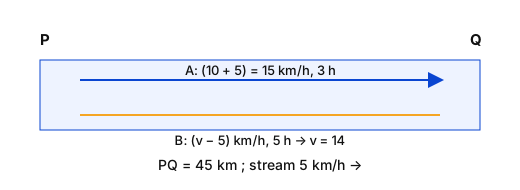
Boat A, whose speed in still water is 10 km/h, goes downstream from city P to city Q in 3 hours. Boat B goes from city Q to city P in 5 hours. What will be the time taken (in hours) by boat B to travel from city P to city Q, if the speed of the stream is 5 km/h?
नाव A, जिसकी शांत जल में चाल 10 km/h है, धारा के अनुकूल शहर P से शहर Q तक 3 घंटे में जाती है। नाव B शहर Q से शहर P तक 5 घंटे में जाती है। यदि धारा की चाल 5 km/h है, तो नाव B द्वारा शहर P से शहर Q तक जाने में लिया गया समय (घंटों में) क्या होगा?
  1. A3415
  2. B3
  3. C2719
  4. D4
Show answer

Concept: Downstream speed =u+v, upstream speed =u−v (u = still-water speed, v = stream speed).

  1. Boat A downstream: (10+5)×3=45km = distance PQ.
  2. Boat B upstream (Q→P): 455=9km/h=u−5 → u=14km/h.
  3. Boat B downstream (P→Q): 14+5=19km/h → time =4519=2719 h.

Trick: Downstream − upstream =2v=10 → B's downstream speed = 9+10=19 directly.

Answer: (C) 2719

अवधारणा: अनुप्रवाह चाल =u+v, ऊर्ध्वप्रवाह चाल =u−v (u = शांत जल में चाल, v = धारा की चाल)।

  1. नाव A अनुप्रवाह: (10+5)×3=45km = दूरी PQ।
  2. नाव B ऊर्ध्वप्रवाह (Q→P): 455=9km/h=u−5 → u=14km/h।
  3. नाव B अनुप्रवाह (P→Q): 14+5=19km/h → समय =4519=2719 घंटे।

ट्रिक: अनुप्रवाह − ऊर्ध्वप्रवाह =2v=10 → B की अनुप्रवाह चाल सीधे 9+10=19।

उत्तर: (C) 2719

RRB NTPC Graduate CBT 1MathematicsBoats and StreamsRRB NTPC Graduate CBT 1 2025 · 27 Mar Shift 3 →
Q46.
The area of a square is 5184 cm2. Its perimeter is equal to the perimeter of a regular hexagon. What is the area (in cm2) of the hexagon?
एक वर्ग का क्षेत्रफल 5184 cm2 है। इसका परिमाप एक सम षट्भुज के परिमाप के बराबर है। षट्भुज का क्षेत्रफल (cm2 में) क्या है?
  1. A3434
  2. B34323
  3. C3472
  4. D34563
Show answer

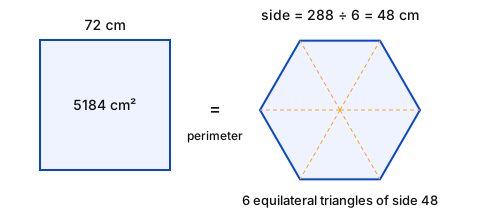
Concept: Area of regular hexagon =332a2 (six equilateral triangles).

  1. Square side =5184=72cm; perimeter =288cm.
  2. Hexagon side a=2886=48cm.
  3. Area =332×482=332×2304=34563cm2.

Trick: 722=5184 is worth memorising; hexagon side = 23 of square side.

Answer: (D) 34563

अवधारणा: सम षट्भुज का क्षेत्रफल =332a2 (छह समबाहु त्रिभुज)।

  1. वर्ग की भुजा =5184=72cm; परिमाप =288cm।
  2. षट्भुज की भुजा a=2886=48cm।
  3. क्षेत्रफल =332×482=332×2304=34563cm2।

ट्रिक: 722=5184 याद रखें; षट्भुज की भुजा = वर्ग की भुजा का 23।

उत्तर: (D) 34563

RRB NTPC Graduate CBT 1MathematicsMensuration – HexagonRRB NTPC Graduate CBT 1 2025 · 27 Mar Shift 3 →
Q47.
Select the correct option.
सही विकल्प चुनिए।
  1. AThe diagonals of a square are equal and bisect each other.एक वर्ग के विकर्ण बराबर होते हैं और एक-दूसरे को समद्विभाजित करते हैं।
  2. BThe diagonals of a square are not equal and bisect each other.एक वर्ग के विकर्ण बराबर नहीं होते हैं और एक-दूसरे को समद्विभाजित करते हैं।
  3. CThe diagonals of a square are not equal and do not bisect each other.एक वर्ग के विकर्ण बराबर नहीं होते हैं और एक-दूसरे को समद्विभाजित नहीं करते हैं।
  4. DThe diagonals of a square are equal and do not bisect each other.एक वर्ग के विकर्ण बराबर होते हैं और एक-दूसरे को समद्विभाजित नहीं करते हैं।
Show answer

Concept: A square is both a rectangle and a rhombus, so it inherits the diagonal properties of both.

  1. Rectangle property: diagonals are equal.
  2. Parallelogram/rhombus property: diagonals bisect each other (and in a square also at 90∘).

Yaad rakhein: Square diagonals – equal, bisect each other, perpendicular, and bisect the vertex angles.

Answer: (A) The diagonals of a square are equal and bisect each other.

अवधारणा: वर्ग आयत भी है और समचतुर्भुज भी, अतः दोनों के विकर्ण-गुण इसमें होते हैं।

  1. आयत का गुण: विकर्ण बराबर होते हैं।
  2. समांतर चतुर्भुज/समचतुर्भुज का गुण: विकर्ण एक-दूसरे को समद्विभाजित करते हैं (वर्ग में 90∘ पर भी)।

याद रखें: वर्ग के विकर्ण – बराबर, समद्विभाजक, लंबवत, और शीर्ष कोणों को भी समद्विभाजित करते हैं।

उत्तर: (A) The diagonals of a square are equal and bisect each other.

RRB NTPC Graduate CBT 1MathematicsProperties of QuadrilateralsRRB NTPC Graduate CBT 1 2025 · 27 Mar Shift 3 →
Q48.
The marks obtained by 12 students out of 50 are 24, 25, 32, 23, 40, 27, 30, 25, 20, 15, 16, 45. Find the median marks.
12 विद्यार्थियों द्वारा 50 में से प्राप्त अंक 24, 25, 32, 23, 40, 27, 30, 25, 20, 15, 16, 45 हैं। माध्यिका अंक ज्ञात कीजिए।
  1. A23
  2. B25
  3. C27
  4. D24
Show answer

Concept: For even n, median = average of the n2th and (n2+1)th values after sorting.

  1. Sorted: 15, 16, 20, 23, 24, 25, 25, 27, 30, 32, 40, 45.
  2. n=12 → 6th and 7th values are 25 and 25 → median =25+252=25.

Trick: Always sort first – the raw order is a trap.

Answer: (B) 25

अवधारणा: सम n के लिए माध्यिका = क्रमबद्ध करने के बाद n2वें और (n2+1)वें मानों का औसत।

  1. क्रमबद्ध: 15, 16, 20, 23, 24, 25, 25, 27, 30, 32, 40, 45।
  2. n=12 → 6वाँ और 7वाँ मान 25 और 25 → माध्यिका =25+252=25।

ट्रिक: पहले हमेशा क्रमबद्ध करें – मूल क्रम एक जाल है।

उत्तर: (B) 25

RRB NTPC Graduate CBT 1MathematicsStatistics – MedianRRB NTPC Graduate CBT 1 2025 · 27 Mar Shift 3 →
Q49.
A shopkeeper purchased 67 dozens of articles at the rate of ₹300 per dozen. He sold each one of them at the rate of ₹34. What percentage profit did he make?
एक दुकानदार ने ₹300 प्रति दर्जन की दर से 67 दर्जन वस्तुएँ खरीदीं। उसने उनमें से प्रत्येक को ₹34 की दर से बेच दिया। उसे कितने प्रतिशत लाभ हुआ?
  1. A37%
  2. B38%
  3. C34%
  4. D36%
Show answer

Concept: Profit % =SP−CPCP×100; compare per article.

  1. CP per article =30012=25 rupees; SP per article = ₹34.
  2. Profit =34−25=9 → 925×100=36%.

Trick: The "67 dozens" is irrelevant – percentage profit is the same per article.

Answer: (D) 36%

अवधारणा: लाभ % =SP−CPCP×100; प्रति वस्तु तुलना करें।

  1. प्रति वस्तु CP =30012=25 रुपये; प्रति वस्तु SP = ₹34।
  2. लाभ =34−25=9 → 925×100=36%।

ट्रिक: "67 दर्जन" अनावश्यक है – प्रतिशत लाभ प्रति वस्तु समान रहता है।

उत्तर: (D) 36%

RRB NTPC Graduate CBT 1MathematicsProfit and LossRRB NTPC Graduate CBT 1 2025 · 27 Mar Shift 3 →
Q50.
If the mean of the following data is 45, find the value of X.
Class20-3030-4040-5050-6060-70
Frequency49192521X
यदि निम्नलिखित आँकड़ों का माध्य 45 है, तो X का मान ज्ञात कीजिए।
वर्ग20-3030-4040-5050-6060-70
बारंबारता49192521X
  1. A42
  2. B48
  3. C26
  4. D32
Show answer

Concept: Mean =∑fixi∑fi, with xi = class mid-point.

  1. Mid-points 25, 35, 45, 55, 65; frequencies 49, 19, 25, 21, X.
  2. ∑fixi=1225+665+1125+1155+65X=4170+65X; ∑fi=114+X.
  3. 4170+65X114+X=45 → 4170+65X=5130+45X → 20X=960 → X=48.

Trick: Use deviations from assumed mean 45: 49(−20)+19(−10)+0+21(10)+20X=0 → −980−190+210+20X=0 → X=48.

Answer: (B) 48

अवधारणा: माध्य =∑fixi∑fi, जहाँ xi = वर्ग मध्य-बिंदु।

  1. मध्य-बिंदु 25, 35, 45, 55, 65; बारंबारताएँ 49, 19, 25, 21, X।
  2. ∑fixi=1225+665+1125+1155+65X=4170+65X; ∑fi=114+X।
  3. 4170+65X114+X=45 → 4170+65X=5130+45X → 20X=960 → X=48।

ट्रिक: कल्पित माध्य 45 से विचलन लें: 49(−20)+19(−10)+0+21(10)+20X=0 → X=48।

उत्तर: (B) 48

RRB NTPC Graduate CBT 1MathematicsStatistics – Mean of Grouped DataRRB NTPC Graduate CBT 1 2025 · 27 Mar Shift 3 →
Q51.
What is the value of csc263∘+3sec256∘−3cot234∘−tan227∘?
csc263∘+3sec256∘−3cot234∘−tan227∘ का मान क्या है?
  1. A4
  2. B3
  3. C2
  4. D1
Show answer

Concept: tan(90∘−θ)=cotθ, cot(90∘−θ)=tanθ; identities csc2θ−cot2θ=1, sec2θ−tan2θ=1.

  1. tan227∘=cot263∘ → csc263∘−tan227∘=csc263∘−cot263∘=1.
  2. cot234∘=tan256∘ → 3sec256∘−3cot234∘=3(sec256∘−tan256∘)=3.
  3. Total =1+3=4.

Trick: Pair angles adding to 90∘ (63+27, 56+34) and convert to one angle.

Answer: (A) 4

अवधारणा: tan(90∘−θ)=cotθ, cot(90∘−θ)=tanθ; सर्वसमिकाएँ csc2θ−cot2θ=1, sec2θ−tan2θ=1।

  1. tan227∘=cot263∘ → csc263∘−tan227∘=csc263∘−cot263∘=1।
  2. cot234∘=tan256∘ → 3sec256∘−3cot234∘=3(sec256∘−tan256∘)=3।
  3. कुल =1+3=4।

ट्रिक: 90∘ बनाने वाले कोण जोड़ें (63+27, 56+34) और एक कोण में बदलें।

उत्तर: (A) 4

RRB NTPC Graduate CBT 1MathematicsTrigonometry – Complementary AnglesRRB NTPC Graduate CBT 1 2025 · 27 Mar Shift 3 →
Q52.
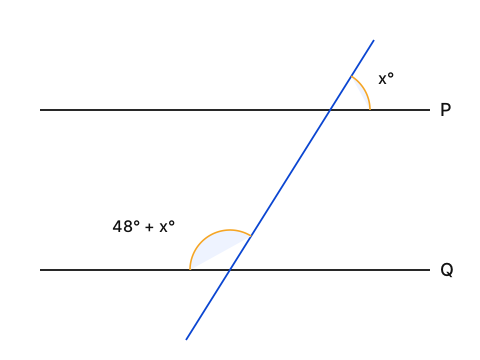
In the given figure, find the value of x if P ∥ Q is given.
दी गई आकृति में, यदि P ∥ Q दिया गया है, तो x का मान ज्ञात कीजिए।
  1. A66
  2. B68
  3. C72
  4. D70
Show answer

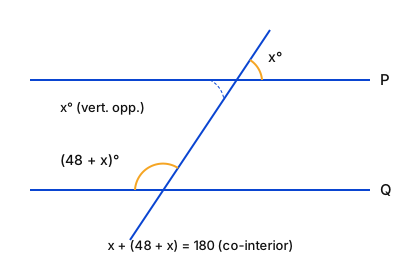
Concept: When a transversal cuts parallel lines, co-interior (same-side interior) angles are supplementary.

  1. The angle x∘ marked above P equals its vertically opposite angle below P (on the opposite side of the transversal).
  2. That angle and (48+x)∘ at Q lie between the parallels on the same side → co-interior: x+48+x=180.
  3. 2x=132 → x=66.

Trick: One acute + one obtuse angle at parallel lines always add to 180∘.

Answer: (A) 66

अवधारणा: तिर्यक रेखा समांतर रेखाओं को काटे तो सह-अंतःकोण (same-side interior) संपूरक होते हैं।

  1. P के ऊपर अंकित कोण x∘ अपने शीर्षाभिमुख कोण (P के नीचे, तिर्यक रेखा के दूसरी ओर) के बराबर है।
  2. वह कोण और Q पर (48+x)∘ समांतर रेखाओं के बीच एक ही ओर हैं → सह-अंतःकोण: x+48+x=180।
  3. 2x=132 → x=66।

ट्रिक: समांतर रेखाओं पर एक न्यूनकोण + एक अधिककोण का योग सदैव 180∘।

उत्तर: (A) 66

RRB NTPC Graduate CBT 1MathematicsLines and Angles – Parallel LinesRRB NTPC Graduate CBT 1 2025 · 27 Mar Shift 3 →
Q53.
In what duration (in years) will ₹9,000 fetch a simple interest of ₹720 at 4% per annum rate of interest?
4% वार्षिक ब्याज दर पर ₹9,000 पर ₹720 का साधारण ब्याज कितनी अवधि (वर्षों में) में प्राप्त होगा?
  1. A1
  2. B3
  3. C4
  4. D2
Show answer

Concept: SI=P×R×T100.

  1. 720=9000×4×T100=360T.
  2. T=720360=2 years.

Trick: 4% of 9000 = 360 per year → 720 needs 2 years.

Answer: (D) 2

अवधारणा: SI=P×R×T100।

  1. 720=9000×4×T100=360T।
  2. T=720360=2 वर्ष।

ट्रिक: 9000 का 4% = 360 प्रति वर्ष → 720 के लिए 2 वर्ष।

उत्तर: (D) 2

RRB NTPC Graduate CBT 1MathematicsSimple InterestRRB NTPC Graduate CBT 1 2025 · 27 Mar Shift 3 →
Q54.
Two taps can fill a cistern in 4 hours and 29 hours respectively. A third tap can empty it in 29 hours. How long (in hours) will it take to fill one-fourth of the empty cistern, if all of them are opened together?
दो नल एक टंकी को क्रमशः 4 घंटे और 29 घंटे में भर सकते हैं। एक तीसरा नल इसे 29 घंटे में खाली कर सकता है। यदि इन सभी को एक साथ खोल दिया जाए, तो खाली टंकी का एक-चौथाई भाग भरने में कितना समय (घंटों में) लगेगा?
  1. A3
  2. B1
  3. C2
  4. D4
Show answer

Concept: Net work per hour = sum of filling rates − emptying rate.

  1. Rates: 14+129−129=14 of the cistern per hour.
  2. The second filling tap and the emptying tap cancel each other exactly.
  3. One-fourth of the cistern at 14 per hour ⇒ 1 hour.

Trick: Whenever a filling and an emptying pipe have the same time, strike both out – only the remaining pipe matters.

Answer: (B) 1

अवधारणा: प्रति घंटा नेट कार्य = भरने की दरों का योग − खाली करने की दर।

  1. दरें: 14+129−129=14 टंकी प्रति घंटा।
  2. दूसरा भरने वाला नल और खाली करने वाला नल एक-दूसरे को पूरी तरह काट देते हैं।
  3. टंकी का एक-चौथाई, 14 प्रति घंटा की दर से ⇒ 1 घंटा।

ट्रिक: जब भरने और खाली करने वाले पाइप का समय समान हो, दोनों को काट दें – केवल बचा हुआ पाइप गिनें।

उत्तर: (B) 1

RRB NTPC Graduate CBT 1MathematicsPipes and CisternsRRB NTPC Graduate CBT 1 2025 · 27 Mar Shift 3 →
Q55.
A dealer buys two articles X and Y for ₹3,500 each. He marks each of them at the same price. He sells X by giving two successive discounts of 45% and 60% and still earns ₹889 as profit. If he sells Y at a single discount of 69%, then what is the profit
percentage on Y?
एक व्यापारी दो वस्तुएँ X और Y प्रत्येक ₹3,500 में खरीदता है। वह दोनों पर समान मूल्य अंकित करता है। वह X को 45% और 60% की दो क्रमिक छूट देकर बेचता है और फिर भी ₹889 का लाभ कमाता है। यदि वह Y को 69% की एकल छूट पर बेचता है, तो Y पर लाभ
प्रतिशत क्या है?
  1. A76.7%
  2. B75.7%
  3. C76%
  4. D75%
Show answer

Concept: Successive discounts multiply: SP=MP×(1−d1)(1−d2). Same marked price for both articles.

  1. SP of X =3500+889=4389.
  2. MP×0.55×0.40=0.22MP=4389⇒MP=19950.
  3. SP of Y =19950×0.31=6184.5; profit =6184.5−3500=2684.5.
  4. Profit% =2684.53500×100=76.7%.

Trick: 45% and 60% off together leave 0.55×0.40=22% of MP – never add discounts.

Answer: (A) 76.7%

अवधारणा: क्रमिक छूट गुणा होती हैं: SP=MP×(1−d1)(1−d2)। दोनों वस्तुओं का अंकित मूल्य समान है।

  1. X का SP =3500+889=4389।
  2. MP×0.55×0.40=0.22MP=4389⇒MP=19950।
  3. Y का SP =19950×0.31=6184.5; लाभ =6184.5−3500=2684.5।
  4. लाभ% =2684.53500×100=76.7%।

ट्रिक: 45% और 60% की छूट मिलकर MP का 0.55×0.40=22% छोड़ती हैं – छूटें कभी जोड़ें नहीं।

उत्तर: (A) 76.7%

RRB NTPC Graduate CBT 1MathematicsSuccessive DiscountsRRB NTPC Graduate CBT 1 2025 · 27 Mar Shift 3 →
Q56.
A teacher needs to split 300 students into three groups so that the second and third groups have a ratio of 3 : 7, and the first and third groups have a ratio of 2 : 7. Which of the following is the correct number of students in the second group?
एक शिक्षक को 300 विद्यार्थियों को तीन समूहों में इस प्रकार बाँटना है कि दूसरे और तीसरे समूह का अनुपात 3 : 7 हो, तथा पहले और तीसरे समूह का अनुपात 2 : 7 हो। निम्नलिखित में से दूसरे समूह में विद्यार्थियों की सही संख्या कौन-सी है?
  1. A88
  2. B72
  3. C75
  4. D64
Show answer

Concept: Make the common term (third group) equal in both ratios, then combine.

  1. Second : Third =3:7 and First : Third =2:7 – third is already 7 in both.
  2. First : Second : Third =2:3:7, total 12 parts.
  3. 1 part =30012=25; second group =3×25=75.

Trick: When the shared quantity already has the same number in both ratios, just write the three numbers side by side.

Answer: (C) 75

अवधारणा: दोनों अनुपातों में उभयनिष्ठ पद (तीसरा समूह) बराबर करके जोड़ें।

  1. दूसरा : तीसरा =3:7 और पहला : तीसरा =2:7 – तीसरा दोनों में पहले से 7 है।
  2. पहला : दूसरा : तीसरा =2:3:7, कुल 12 भाग।
  3. 1 भाग =30012=25; दूसरा समूह =3×25=75।

ट्रिक: जब साझा राशि दोनों अनुपातों में पहले से समान संख्या हो, तीनों संख्याएँ सीधे साथ लिख दें।

उत्तर: (C) 75

RRB NTPC Graduate CBT 1MathematicsRatio – Combining RatiosRRB NTPC Graduate CBT 1 2025 · 27 Mar Shift 3 →
Q57.
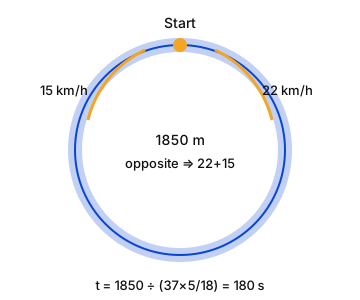
In a circular race of 1850 m, Aman and Suman start from the same point and at the same time with speeds of 22 km/h and 15 km/h, respectively. After how long will they meet again for the first time on the track when they are running in the opposite direction?
1850 m की एक वृत्ताकार दौड़ में, अमन और सुमन एक ही बिंदु से एक ही समय पर क्रमशः 22 km/h और 15 km/h की चाल से दौड़ना शुरू करते हैं। विपरीत दिशा में दौड़ते हुए वे ट्रैक पर पहली बार पुनः कितने समय बाद मिलेंगे?
  1. A189 seconds189 सेकंड
  2. B170 seconds170 सेकंड
  3. C180 seconds180 सेकंड
  4. D172 seconds172 सेकंड
Show answer

Concept: Running in opposite directions, first meeting time =track lengthsum of speeds.

  1. Relative speed =22+15=37km/h=37×518=18518m/s.
  2. Time =1850185/18=1850×18185=10×18=180 seconds.

Trick: 1850=185×10 – spot the 185 and the 518 conversion cancels neatly.

Answer: (C) 180 seconds

अवधारणा: विपरीत दिशा में दौड़ने पर पहली मुलाकात का समय =ट्रैक की लंबाईचालों का योग।

  1. सापेक्ष चाल =22+15=37km/h=37×518=18518m/s।
  2. समय =1850185/18=1850×18185=10×18=180 सेकंड।

ट्रिक: 1850=185×10 – 185 को पहचानें, 518 का रूपांतरण साफ कट जाता है।

उत्तर: (C) 180 seconds

RRB NTPC Graduate CBT 1MathematicsCircular Track – Relative SpeedRRB NTPC Graduate CBT 1 2025 · 27 Mar Shift 3 →
Q58.
A shopkeeper professes to sell his goods at a 35% loss but uses a false balance and gains 75%. The actual weight (rounded off to one decimal place) he uses for 1 kg is:
एक दुकानदार अपना माल 35% हानि पर बेचने का दावा करता है, लेकिन गलत तराजू का उपयोग करता है और 75% लाभ कमाता है। वह 1 kg के लिए जिस वास्तविक भार का उपयोग करता है, वह (एक दशमलव स्थान तक पूर्णांकित) है:
  1. A371.4 gm
  2. B374.5 gm
  3. C372.9 gm
  4. D376.5 gm
Show answer

Concept: Let cost price be ₹1 per gram (₹1000 per kg). He sells a "kg" at a 35% loss on the claimed cost but actually gives only w grams.

  1. SP of the "kg" =0.65×1000=650.
  2. Actual cost =w; gain 75% ⇒1.75w=650.
  3. w=6501.75=371.43≈371.4 g.

Trick: weight used=100−loss%100+gain%×1000=65175×1000.

Answer: (A) 371.4 gm

अवधारणा: मान लें लागत ₹1 प्रति ग्राम (₹1000 प्रति kg)। वह "1 kg" घोषित लागत पर 35% हानि पर बेचता है पर वास्तव में केवल w ग्राम देता है।

  1. "1 kg" का SP =0.65×1000=650।
  2. वास्तविक लागत =w; 75% लाभ ⇒1.75w=650।
  3. w=6501.75=371.43≈371.4 g।

ट्रिक: प्रयुक्त भार=100−हानि%100+लाभ%×1000=65175×1000।

उत्तर: (A) 371.4 gm

RRB NTPC Graduate CBT 1MathematicsFalse Weight – Profit and LossRRB NTPC Graduate CBT 1 2025 · 27 Mar Shift 3 →
Q59.
If p2+3p=3, then the value of (p+4)3+1(p+4)3 is:
यदि p2+3p=3 है, तो (p+4)3+1(p+4)3 का मान है:
  1. A110
  2. B104
  3. C52
  4. D55
Show answer

Concept: Put t=p+4 and reduce the condition to t+1t=k; then t3+1t3=k3−3k.

  1. p=t−4: (t−4)2+3(t−4)=3⇒t2−5t+1=0.
  2. Divide by t: t+1t=5.
  3. t3+1t3=53−3×5=125−15=110.

Trick: x+1x=a⇒x3+1x3=a3−3a – memorise; the whole question is just finding a.

Answer: (A) 110

अवधारणा: t=p+4 रखें और शर्त को t+1t=k में बदलें; तब t3+1t3=k3−3k।

  1. p=t−4: (t−4)2+3(t−4)=3⇒t2−5t+1=0।
  2. t से भाग दें: t+1t=5।
  3. t3+1t3=53−3×5=125−15=110।

ट्रिक: x+1x=a⇒x3+1x3=a3−3a – याद रखें; पूरा प्रश्न बस a निकालना है।

उत्तर: (A) 110

RRB NTPC Graduate CBT 1MathematicsAlgebra – Cube IdentityRRB NTPC Graduate CBT 1 2025 · 27 Mar Shift 3 →
Q60.
The average of the marks of 16 students in a class is 56. If the marks of each student are doubled, find the new average.
एक कक्षा के 16 विद्यार्थियों के अंकों का औसत 56 है। यदि प्रत्येक विद्यार्थी के अंक दोगुने कर दिए जाएँ, तो नया औसत ज्ञात कीजिए।
  1. A32
  2. B56
  3. C112
  4. D16
Show answer

Concept: If every observation is multiplied by k, the average is also multiplied by k.

  1. Old average =56, each mark doubled ⇒k=2.
  2. New average =2×56=112 (the number of students, 16, does not matter).

Trick: Add x to all ⇒ average +x; multiply all by k ⇒ average ×k.

Answer: (C) 112

अवधारणा: यदि हर प्रेक्षण को k से गुणा करें तो औसत भी k गुना हो जाता है।

  1. पुराना औसत =56, हर अंक दोगुना ⇒k=2।
  2. नया औसत =2×56=112 (छात्रों की संख्या 16 का कोई असर नहीं)।

ट्रिक: सबमें x जोड़ें ⇒ औसत +x; सबको k से गुणा करें ⇒ औसत ×k।

उत्तर: (C) 112

RRB NTPC Graduate CBT 1MathematicsAverageRRB NTPC Graduate CBT 1 2025 · 27 Mar Shift 3 →