Question bank

Q&A: practice questions with answers

Search questions on any topic. Filter by exam category, exam, subject and topic, try the question, then open the answer and explanation.

Courses – airGurukul

7,077 questions found.

Q581.
Mr. C starts from Point D and drives 3 km towards the west. He then takes a left turn, drives 11 km, turns left and drives 9 km. He then takes a right turn and drives 5 km, turns left drives 7 km. He then takes left turn, drives 16 km. He takes a final left turn drives 9 km and stops at Point E. How far (shortest distance) and towards which direction should he drive in order to reach Point D again? (All turns are 90 degrees turns only unless specified.)
श्री C बिंदु D से प्रारंभ करते हैं और पश्चिम की ओर 3 km गाड़ी चलाते हैं। फिर वे बाएँ मुड़ते हैं, 11 km गाड़ी चलाते हैं, बाएँ मुड़ते हैं और 9 km गाड़ी चलाते हैं। फिर वे दाएँ मुड़ते हैं और 5 km गाड़ी चलाते हैं, बाएँ मुड़ते हैं और 7 km गाड़ी चलाते हैं। फिर वे बाएँ मुड़ते हैं, 16 km गाड़ी चलाते हैं। वे अंतिम बार बाएँ मुड़ते हैं, 9 km गाड़ी चलाते हैं और बिंदु E पर रुक जाते हैं। पुनः बिंदु D पर पहुँचने के लिए उन्हें कितनी दूर (न्यूनतम दूरी) और किस दिशा की ओर गाड़ी चलानी चाहिए? (जब तक निर्दिष्ट न हो, सभी मोड़ केवल 90 डिग्री के हैं।)
  1. A2 km towards the Eastपूर्व की ओर 2 km
  2. B4 km towards the Westपश्चिम की ओर 4 km
  3. C2 km towards the Westपश्चिम की ओर 2 km
  4. D4 km towards the Southदक्षिण की ओर 4 km
Show answer

Concept: Take D as origin, east +x, north +y; track the facing direction after each turn.
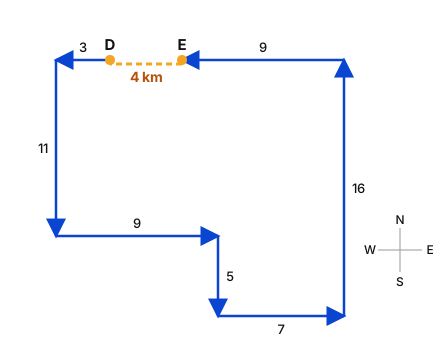
  1. West 3: (−3,0). Left → south 11: (−3,−11). Left → east 9: (6,−11).
  2. Right → south 5: (6,−16). Left → east 7: (13,−16).
  3. Left → north 16: (13,0). Left → west 9: E =(4,0). D is 4km to the west of E.

Trick: Net N–S: −11−5+16=0; net E–W: −3+9+7−9=4 east ⇒ go 4 west.

Answer: (B) 4km towards the West

अवधारणा: D को मूल बिंदु लें, पूर्व +x, उत्तर +y; हर मोड़ पर दिशा देखें।

  1. पश्चिम 3: (−3,0)। बाएँ → दक्षिण 11: (−3,−11)। बाएँ → पूर्व 9: (6,−11)।
  2. दाएँ → दक्षिण 5: (6,−16)। बाएँ → पूर्व 7: (13,−16)।
  3. बाएँ → उत्तर 16: (13,0)। बाएँ → पश्चिम 9: E =(4,0)। D, E से 4km पश्चिम में है।

ट्रिक: उत्तर–दक्षिण: −11−5+16=0; पूर्व–पश्चिम: −3+9+7−9=4 पूर्व ⇒ 4 पश्चिम जाएँ।

उत्तर: (B) 4km towards the West

RRB NTPC Graduate CBT 1General Intelligence and ReasoningDirection and DistanceRRB NTPC Graduate CBT 1 2024 · 23 Jun Shift 1 →
Q582.
This question is based on the five, three-digit numbers given below.
(Left) 441 317 999 155 444 (Right)
(Example- 697 – First digit = 6, second digit = 9 and third digit = 7)
(NOTE: All operations to be done from left to right.)
What will be the resultant if the third digit of the highest number is subtracted from the first digit of the lowest number?
यह प्रश्न नीचे दी गई तीन अंकों वाली पाँच संख्याओं पर आधारित है।
(बाएँ) 441 317 999 155 444 (दाएँ)
(उदाहरण- 697 – पहला अंक = 6, दूसरा अंक = 9 और तीसरा अंक = 7)
(नोट: सभी संक्रियाएँ बाएँ से दाएँ की जानी हैं।)
यदि सबसे बड़ी संख्या के तीसरे अंक को सबसे छोटी संख्या के पहले अंक में से घटाया जाए, तो परिणाम क्या होगा?
  1. A−6
  2. B−7
  3. C−5
  4. D−8
Show answer

Concept: Identify the highest and lowest numbers, then subtract as asked.

  1. Highest =999 → third digit =9.
  2. Lowest =155 → first digit =1.
  3. 1−9=−8.

Trick: 'A subtracted from B' means B−A.

Answer: (D) −8

अवधारणा: सबसे बड़ी और सबसे छोटी संख्या पहचानें, फिर घटाएँ।

  1. सबसे बड़ी =999 → तीसरा अंक =9।
  2. सबसे छोटी =155 → पहला अंक =1।
  3. 1−9=−8।

ट्रिक: 'A को B से घटाएँ' = B−A।

उत्तर: (D) −8

RRB NTPC Graduate CBT 1General Intelligence and ReasoningNumber OperationsRRB NTPC Graduate CBT 1 2024 · 23 Jun Shift 1 →
Q583.
This question is based on the five, three-digit numbers given below.
(Left) 107 788 634 346 488 (Right)
(Example- 697 – First digit = 6, second digit = 9 and third digit = 7)
(NOTE: All operations to be done from left to right.)
What will be the resultant if the first digit of the highest number is added to the third digit of the lowest number?
यह प्रश्न नीचे दी गई तीन अंकों वाली पाँच संख्याओं पर आधारित है।
(बाएँ) 107 788 634 346 488 (दाएँ)
(उदाहरण- 697 – पहला अंक = 6, दूसरा अंक = 9 और तीसरा अंक = 7)
(नोट: सभी संक्रियाएँ बाएँ से दाएँ की जानी हैं।)
यदि सबसे बड़ी संख्या के पहले अंक को सबसे छोटी संख्या के तीसरे अंक में जोड़ा जाए, तो परिणाम क्या होगा?
  1. A7
  2. B9
  3. C12
  4. D14
Show answer

Concept: Find the highest and lowest of the five numbers, then pick the asked digits.

  1. Numbers: 107, 788, 634, 346, 488.
  2. Highest = 788 → first digit = 7.
  3. Lowest = 107 → third digit = 7.
  4. Sum: 7+7=14.

Trick: Compare only the hundreds digit first: 7 (in 788) is the largest, 1 (in 107) the smallest.

Answer: (D) 14

अवधारणा: पाँचों संख्याओं में सबसे बड़ी और सबसे छोटी संख्या ढूँढकर पूछे गए अंक लें।

  1. संख्याएँ: 107, 788, 634, 346, 488।
  2. सबसे बड़ी = 788 → पहला अंक = 7।
  3. सबसे छोटी = 107 → तीसरा अंक = 7।
  4. योग: 7+7=14।

ट्रिक: पहले सैकड़े का अंक देखें: 788 का 7 सबसे बड़ा, 107 का 1 सबसे छोटा।

उत्तर: (D) 14

RRB NTPC Graduate CBT 1General Intelligence and ReasoningNumber arrangement (digits)RRB NTPC Graduate CBT 1 2024 · 23 Jun Shift 1 →
Q584.
Which of the following letter-number clusters will replace the question mark (?) in the given series to make it logically complete?
LOK 4, JMI 9, HKG 25, FIE 49, ?
दी गई श्रृंखला को तार्किक रूप से पूर्ण करने के लिए निम्नलिखित में से कौन-सा अक्षर-संख्या समूह प्रश्न चिह्न (?) को प्रतिस्थापित करेगा?
LOK 4, JMI 9, HKG 25, FIE 49, ?
  1. ADGC 169
  2. BDGC 121
  3. CDFC 121
  4. DDGC 81
Show answer

Concept: Letters and numbers follow separate patterns.

  1. Each letter moves back by 2: L→J→H→F→D, O→M→K→I→G, K→I→G→E→C → DGC.
  2. Numbers are squares of primes: 22=4, 32=9, 52=25, 72=49, next 112=121.
  3. Required term: DGC 121.

Trick: 4, 9, 25, 49 skip 16 and 36 – a hint that the bases are primes 2, 3, 5, 7, 11.

Answer: (B) DGC 121

अवधारणा: अक्षर और संख्याएँ अलग-अलग पैटर्न पर चलते हैं।

  1. हर अक्षर 2 पीछे जाता है: L→J→H→F→D, O→M→K→I→G, K→I→G→E→C → DGC।
  2. संख्याएँ अभाज्य संख्याओं के वर्ग हैं: 22=4, 32=9, 52=25, 72=49, अगला 112=121।
  3. अभीष्ट पद: DGC 121।

ट्रिक: 4, 9, 25, 49 में 16 और 36 नहीं हैं – यानी आधार अभाज्य 2, 3, 5, 7, 11 हैं।

उत्तर: (B) DGC 121

RRB NTPC Graduate CBT 1General Intelligence and ReasoningLetter-number seriesRRB NTPC Graduate CBT 1 2024 · 23 Jun Shift 1 →
Q585.
PSKO is related to ILDH in a certain way based on the English alphabetical order. In the same way, RUMQ is related to KNFJ. To which of the given options is TWOS related, following the same logic?
अंग्रेज़ी वर्णमाला क्रम के आधार पर PSKO एक निश्चित प्रकार से ILDH से संबंधित है। उसी प्रकार, RUMQ, KNFJ से संबंधित है। समान तर्क का अनुसरण करते हुए, TWOS दिए गए विकल्पों में से किससे संबंधित है?
  1. APMLH
  2. BMPLH
  3. CMPHL
  4. DPMHL
Show answer

Concept: Find the shift from each letter of the first word to the second.

  1. PSKO → ILDH: P(16)→I(9), S(19)→L(12), K(11)→D(4), O(15)→H(8); each −7.
  2. Check RUMQ → KNFJ: each −7 ✓.
  3. TWOS: T(20)→M(13), W(23)→P(16), O(15)→H(8), S(19)→L(12) → MPHL.

Trick: −7 is the same as +19; use EJOTY (5, 10, 15, 20, 25) to locate letters fast.

Answer: (C) MPHL

अवधारणा: पहले शब्द के हर अक्षर से दूसरे शब्द के अक्षर तक का अंतर ज्ञात करें।

  1. PSKO → ILDH: P(16)→I(9), S(19)→L(12), K(11)→D(4), O(15)→H(8); हर अक्षर −7।
  2. जाँच RUMQ → KNFJ: हर अक्षर −7 ✓।
  3. TWOS: T(20)→M(13), W(23)→P(16), O(15)→H(8), S(19)→L(12) → MPHL।

ट्रिक: EJOTY (5, 10, 15, 20, 25) से अक्षरों की स्थिति जल्दी निकालें।

उत्तर: (C) MPHL

RRB NTPC Graduate CBT 1General Intelligence and ReasoningLetter analogyRRB NTPC Graduate CBT 1 2024 · 23 Jun Shift 1 →
Q586.
Which of the following letter-number clusters will replace the question mark (?) in the given series to make it logically complete?
HL27 GK38 FJ49 EI60 ?
दी गई श्रृंखला को तार्किक रूप से पूर्ण करने के लिए निम्नलिखित में से कौन-सा अक्षर-संख्या समूह प्रश्न चिह्न (?) को प्रतिस्थापित करेगा?
HL27 GK38 FJ49 EI60 ?
  1. ADG71
  2. BDH71
  3. CDH72
  4. DDG72
Show answer

Concept: Each part of the cluster changes by a fixed step.

  1. First letter: H, G, F, E → D (back 1).
  2. Second letter: L, K, J, I → H (back 1).
  3. Number: 27, 38, 49, 60 → 60+11=71.
  4. Next term: DH71.

Trick: Only the options with H and 71 survive – DH71 is the only one.

Answer: (B) DH71

अवधारणा: समूह का हर भाग एक निश्चित अंतर से बदलता है।

  1. पहला अक्षर: H, G, F, E → D (1 पीछे)।
  2. दूसरा अक्षर: L, K, J, I → H (1 पीछे)।
  3. संख्या: 27, 38, 49, 60 → 60+11=71।
  4. अगला पद: DH71।

ट्रिक: H और 71 दोनों वाला विकल्प केवल DH71 है।

उत्तर: (B) DH71

RRB NTPC Graduate CBT 1General Intelligence and ReasoningLetter-number seriesRRB NTPC Graduate CBT 1 2024 · 23 Jun Shift 1 →
Q587.
In this question, a group of numbers/symbols are coded using letter codes as per the codes given below, and the conditions that follow. The correct combination of codes (following only the condition/s that apply) is your answer.
Note: If none of the conditions apply, then codes for the respective number/symbol are to be followed directly as given in the table.
Number/symbol7@62#%&89=$34+
CodeEJAHFRBYLHQTKZ

Conditions:
(i) If the first element is an odd number and the last element is also an odd number then the codes for these two (the first and the last elements) are to be interchanged.
(ii) If the first and last elements are perfect squares then the code of the 1st and last element is to be that of the preceding number or symbol.
(iii) If the first and last element is a symbol then the first and last element is to be coded as >.
What is the code for the following?
9%+27
इस प्रश्न में, नीचे दिए गए कूटों और उसके बाद दी गई शर्तों के अनुसार संख्याओं/प्रतीकों के एक समूह को अक्षर कूटों का उपयोग करके कूटबद्ध किया गया है। कूटों का सही संयोजन (केवल लागू होने वाली शर्त/शर्तों का अनुसरण करते हुए) आपका उत्तर है।
नोट: यदि कोई भी शर्त लागू नहीं होती है, तो संबंधित संख्या/प्रतीक के लिए तालिका में दिए गए कूटों का सीधे अनुसरण किया जाना है।
संख्या/प्रतीक7@62#%&89=$34+
कूटEJAHFRBYLHQTKZ

शर्तें:
(i) यदि पहला अवयव एक विषम संख्या है और अंतिम अवयव भी एक विषम संख्या है, तो इन दोनों (पहले और अंतिम अवयवों) के कूट आपस में बदल दिए जाने हैं।
(ii) यदि पहला और अंतिम अवयव पूर्ण वर्ग हैं, तो पहले और अंतिम अवयव का कूट उसके पूर्ववर्ती संख्या या प्रतीक का कूट होगा।
(iii) यदि पहला और अंतिम अवयव प्रतीक है, तो पहले और अंतिम अवयव को > के रूप में कूटबद्ध किया जाना है।
निम्नलिखित के लिए कूट क्या है?
9%+27
  1. ALRZHE
  2. BERZHE
  3. CLRZHL
  4. DERZHL
Show answer

Concept: Write the plain codes first, then test each condition on the first and last elements.

  1. 9 % + 2 7 → L R Z H E.
  2. First 9 is odd and last 7 is odd → condition (i): interchange their codes.
  3. Condition (ii) fails (7 is not a perfect square); (iii) fails (both are numbers).
  4. Code: E R Z H L.

Trick: Check the first and last elements only – odd/odd here, so just swap the end letters: LRZHE → ERZHL.

Answer: (D) ERZHL

अवधारणा: पहले सीधे कोड लिखें, फिर पहले और अंतिम तत्व पर शर्तें जाँचें।

  1. 9 % + 2 7 → L R Z H E।
  2. पहला 9 विषम और अंतिम 7 विषम → शर्त (i): दोनों के कोड आपस में बदलें।
  3. शर्त (ii) लागू नहीं (7 पूर्ण वर्ग नहीं); (iii) लागू नहीं (दोनों संख्याएँ हैं)।
  4. कोड: E R Z H L।

ट्रिक: केवल पहला और अंतिम तत्व देखें – विषम/विषम, अतः छोर के अक्षर बदलें: LRZHE → ERZHL।

उत्तर: (D) ERZHL

RRB NTPC Graduate CBT 1General Intelligence and ReasoningCoding with conditionsRRB NTPC Graduate CBT 1 2024 · 23 Jun Shift 1 →
Q588.
If ‘P’ stands for ‘×’, ‘Q’ stands for ‘÷’, ‘R’ stands for ‘−’ and ‘S’ stands for ‘+’, then what will come in place of the question mark (?) in the following equation?
29 S 9 P 3 R 13 P 4 S 55 = ?
यदि 'P' का अर्थ '×', 'Q' का अर्थ '÷', 'R' का अर्थ '−' और 'S' का अर्थ '+' है, तो निम्नलिखित समीकरण में प्रश्न चिह्न (?) के स्थान पर क्या आएगा?
29 S 9 P 3 R 13 P 4 S 55 = ?
  1. A59
  2. B27
  3. C83
  4. D41
Show answer

Concept: Replace letters by signs, then apply BODMAS.

  1. 29+9×3−13×4+55.
  2. =29+27−52+55.
  3. =111−52=59.

Trick: Do both multiplications first (27 and 52), then add/subtract left to right.

Answer: (A) 59

अवधारणा: अक्षरों के स्थान पर चिह्न रखकर BODMAS लगाएँ।

  1. 29+9×3−13×4+55।
  2. =29+27−52+55।
  3. =111−52=59।

ट्रिक: पहले दोनों गुणा (27 और 52), फिर जोड़-घटाव।

उत्तर: (A) 59

RRB NTPC Graduate CBT 1General Intelligence and ReasoningMathematical operationsRRB NTPC Graduate CBT 1 2024 · 23 Jun Shift 1 →
Q589.
In a certain code language,
‘A + B’ means ‘A is the son of B’,
‘A – B’ means ‘A is the brother of B’,
‘A × B’ means ‘A is the wife of B’ and
‘A ÷ B’ means ‘A is the father of B’.
How is S related to H if ‘S + D – F × G ÷ H’?
एक निश्चित कूट भाषा में,
'A + B' का अर्थ है 'A, B का पुत्र है',
'A – B' का अर्थ है 'A, B का भाई है',
'A × B' का अर्थ है 'A, B की पत्नी है' और
'A ÷ B' का अर्थ है 'A, B का पिता है'।
यदि 'S + D – F × G ÷ H' है, तो S, H से किस प्रकार संबंधित है?
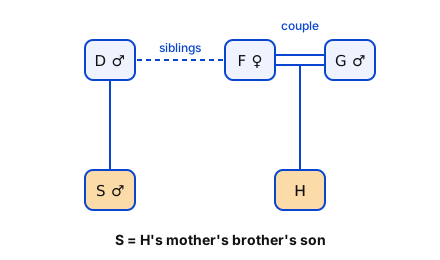
  1. AFather's sister's sonपिता की बहन का पुत्र
  2. BFather's brother's sonपिता के भाई का पुत्र
  3. CMother's sister's sonमाता की बहन का पुत्र
  4. DMother's brother's sonमाता के भाई का पुत्र
Show answer

Concept: Decode each symbol and draw the family tree.

  1. S + D: S is the son of D.
  2. D – F: D is the brother of F.
  3. F × G: F is the wife of G; G ÷ H: G is the father of H.
  4. So F is H's mother, D is H's mother's brother, and S is his son.

Trick: Read the chain from H backwards: father G → his wife F (mother) → her brother D → his son S.

Answer: (D) Mother's brother's son

अवधारणा: हर चिह्न को डिकोड करके वंश-वृक्ष बनाएँ।

  1. S + D: S, D का पुत्र है।
  2. D – F: D, F का भाई है।
  3. F × G: F, G की पत्नी है; G ÷ H: G, H का पिता है।
  4. अतः F, H की माँ है, D मामा है और S मामा का पुत्र है।

ट्रिक: H से पीछे पढ़ें: पिता G → पत्नी F (माँ) → उसका भाई D (मामा) → पुत्र S।

उत्तर: (D) माँ के भाई का पुत्र (Mother's brother's son)

RRB NTPC Graduate CBT 1General Intelligence and ReasoningCoded blood relationsRRB NTPC Graduate CBT 1 2024 · 23 Jun Shift 1 →
Q590.
What should come in place of the question mark (?) in the given series?
216, 182, 152, 126, 104, ?
दी गई श्रृंखला में प्रश्न चिह्न (?) के स्थान पर क्या आना चाहिए?
216, 182, 152, 126, 104, ?
  1. A78
  2. B72
  3. C81
  4. D86
Show answer

Concept: Check the differences between consecutive terms.

  1. Differences: 216−182=34, 182−152=30, 152−126=26, 126−104=22.
  2. Differences decrease by 4 → next difference =18.
  3. 104−18=86.

Trick: Differences 34, 30, 26, 22, 18 – an arithmetic pattern.

Answer: (D) 86

अवधारणा: लगातार पदों का अंतर देखें।

  1. अंतर: 216−182=34, 182−152=30, 152−126=26, 126−104=22।
  2. अंतर हर बार 4 कम → अगला अंतर =18।
  3. 104−18=86।

ट्रिक: अंतर 34, 30, 26, 22, 18 – समांतर पैटर्न।

उत्तर: (D) 86

RRB NTPC Graduate CBT 1General Intelligence and ReasoningNumber seriesRRB NTPC Graduate CBT 1 2024 · 23 Jun Shift 1 →
Q591.
In a certain code language, ‘SOUP’ is coded as ‘5173’ and ‘PINT’ is coded as ‘4216’. What is the code for ‘P’ in the given code language?
एक निश्चित कूट भाषा में, 'SOUP' को '5173' के रूप में कूटबद्ध किया जाता है और 'PINT' को '4216' के रूप में कूटबद्ध किया जाता है। दी गई कूट भाषा में 'P' के लिए कूट क्या है?
  1. A1
  2. B4
  3. C6
  4. D3
Show answer

Concept: A letter common to two words gets the digit common to both codes.

  1. SOUP → 5173 and PINT → 4216.
  2. Common letter: P only.
  3. Common digit: 1 only.
  4. So P = 1.

Trick: Match the common letter with the common digit – no need to fix the order.

Answer: (A) 1

अवधारणा: दो शब्दों में उभयनिष्ठ अक्षर का कोड दोनों कोडों में उभयनिष्ठ अंक होता है।

  1. SOUP → 5173 और PINT → 4216।
  2. उभयनिष्ठ अक्षर: केवल P।
  3. उभयनिष्ठ अंक: केवल 1।
  4. अतः P = 1।

ट्रिक: उभयनिष्ठ अक्षर = उभयनिष्ठ अंक – क्रम देखने की ज़रूरत नहीं।

उत्तर: (A) 1

RRB NTPC Graduate CBT 1General Intelligence and ReasoningCoding-decodingRRB NTPC Graduate CBT 1 2024 · 23 Jun Shift 1 →
Q592.
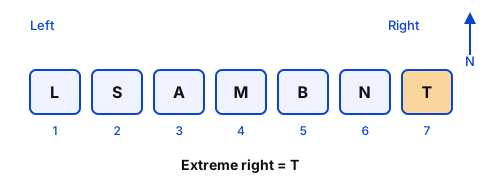
Seven people, A, B, L, M, N, S, and T are sitting in a row, facing north. Only L sits to the left of S. Only four people sit between L and N. Only M sits between A and B, and A is not an immediate neighbour of N.
Who sits at the extreme right of the line?
सात व्यक्ति, A, B, L, M, N, S और T एक पंक्ति में उत्तर की ओर मुख करके बैठे हैं। केवल L, S के बाईं ओर बैठा है। L और N के बीच केवल चार व्यक्ति बैठे हैं। A और B के बीच केवल M बैठा है, और A, N का निकटतम पड़ोसी नहीं है।
पंक्ति के दाएँ छोर पर कौन बैठा है?
  1. AA
  2. BN
  3. CD
  4. DT
Show answer

Concept: All face north, so left = left end. Fix the sure positions first.

  1. Only L is left of S → L at 1, S at 2.
  2. Four people between L and N → N at 6.
  3. A, M, B must sit together (A_M_B) in 3, 4, 5 (no other three consecutive seats are free).
  4. A is not next to N → A at 3, M at 4, B at 5; T at 7.

Trick: Order: L S A M B N T – the last seat left over goes to T.

Answer: (D) T

अवधारणा: सभी उत्तर की ओर मुख किए हैं, अतः बायाँ = बायाँ सिरा। पहले निश्चित स्थान तय करें।

  1. केवल L, S के बाएँ → L स्थान 1, S स्थान 2।
  2. L और N के बीच चार लोग → N स्थान 6।
  3. A, M, B साथ-साथ (A_M_B) केवल 3, 4, 5 पर बैठ सकते हैं।
  4. A, N का पड़ोसी नहीं → A 3, M 4, B 5; T स्थान 7।

ट्रिक: क्रम: L S A M B N T – बचा हुआ अंतिम स्थान T का।

उत्तर: (D) T

RRB NTPC Graduate CBT 1General Intelligence and ReasoningLinear seating arrangementRRB NTPC Graduate CBT 1 2024 · 23 Jun Shift 1 →
Q593.
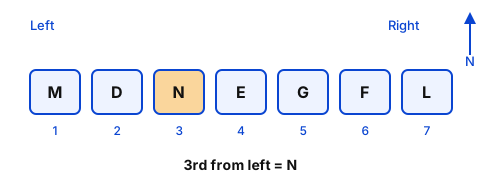
Seven people D, E, F, G, L, M and N are sitting in a row, facing north. Only five people sit between M and L. F sits to the immediate left of L. Only one person sits between F and E. N sits at some place to the left of G but at some place to the right of D. Who sits third from the left end of the row?
सात व्यक्ति D, E, F, G, L, M और N एक पंक्ति में उत्तर की ओर मुख करके बैठे हैं। M और L के बीच केवल पाँच व्यक्ति बैठे हैं। F, L के ठीक बाईं ओर बैठा है। F और E के बीच केवल एक व्यक्ति बैठा है। N, G के बाईं ओर किसी स्थान पर, परंतु D के दाईं ओर किसी स्थान पर बैठा है। पंक्ति के बाएँ छोर से तीसरे स्थान पर कौन बैठा है?
  1. AN
  2. BD
  3. CG
  4. DF
Show answer

Concept: Seven seats, all facing north; place the fixed gaps first.

  1. Five people between M and L → they occupy the two ends.
  2. F is immediately left of L, so L cannot be at the left end → M at 1, L at 7, F at 6.
  3. One person between F and E → E at 4.
  4. Seats 2, 3, 5 are left; D … N … G from left to right → D 2, N 3, G 5.

Trick: Order: M D N E G F L – third from left is N.

Answer: (A) N

अवधारणा: सात स्थान, सभी उत्तरमुखी; पहले निश्चित अंतर वाले लोग बैठाएँ।

  1. M और L के बीच पाँच लोग → दोनों सिरों पर।
  2. F, L के ठीक बाएँ है, अतः L बाएँ सिरे पर नहीं → M 1, L 7, F 6।
  3. F और E के बीच एक व्यक्ति → E 4।
  4. बचे स्थान 2, 3, 5; बाएँ से D … N … G → D 2, N 3, G 5।

ट्रिक: क्रम: M D N E G F L – बाएँ से तीसरा N।

उत्तर: (A) N

RRB NTPC Graduate CBT 1General Intelligence and ReasoningLinear seating arrangementRRB NTPC Graduate CBT 1 2024 · 23 Jun Shift 1 →
Q594.
Select the set in which the numbers are related in the same way as are the numbers of the following sets.
(NOTE: Operations should be performed on the whole numbers, without breaking down the numbers into their constituent digits. E.g. 13 – Operations on 13 such as
adding/subtracting/multiplying to 13 can be performed. Breaking down 13 into 1 and 3 and then performing mathematical operations on 1 and 3 is not allowed.)
(29, 53, 24)
(12, 32, 20)
उस समुच्चय का चयन कीजिए जिसमें संख्याएँ उसी प्रकार संबंधित हैं जिस प्रकार निम्नलिखित समुच्चयों की संख्याएँ संबंधित हैं।
(नोट: संख्याओं को उनके घटक अंकों में तोड़े बिना, पूर्ण संख्याओं पर संक्रियाएँ की जानी चाहिए। उदाहरण के लिए 13 – 13 पर संक्रियाएँ जैसे 13 में
जोड़ना/घटाना/गुणा करना आदि किया जा सकता है। 13 को 1 और 3 में तोड़कर फिर 1 और 3 पर गणितीय संक्रियाएँ करने की अनुमति नहीं है।)
(29, 53, 24)
(12, 32, 20)
  1. A(47, 75, 25)
  2. B(24, 40, 13)
  3. C(49, 71, 19)
  4. D(46, 60, 14)
Show answer

Concept: Find how the middle number is formed from the other two.

  1. (29, 53, 24): 29+24=53.
  2. (12, 32, 20): 12+20=32.
  3. Check (46, 60, 14): 46+14=60 ✓.
  4. Others: 47+25=72, 24+13=37, 49+19=68 – all fail.

Trick: Rule: first + third = middle.

Answer: (D) (46, 60, 14)

अवधारणा: बीच की संख्या बाकी दो से कैसे बनी, यह खोजें।

  1. (29, 53, 24): 29+24=53।
  2. (12, 32, 20): 12+20=32।
  3. जाँच (46, 60, 14): 46+14=60 ✓।
  4. अन्य: 47+25=72, 24+13=37, 49+19=68 – सब गलत।

ट्रिक: नियम: पहली + तीसरी = बीच वाली।

उत्तर: (D) (46, 60, 14)

RRB NTPC Graduate CBT 1General Intelligence and ReasoningNumber set analogyRRB NTPC Graduate CBT 1 2024 · 23 Jun Shift 1 →
Q595.
Each of the digits in the number 257461398 is arranged in ascending order from left to right. What will be the sum of the digits that are second from the left and third from the right in the new number thus formed?
संख्या 257461398 के प्रत्येक अंक को बाएँ से दाएँ आरोही क्रम में व्यवस्थित किया जाता है। इस प्रकार बनी नई संख्या में बाएँ से दूसरे और दाएँ से तीसरे अंकों का योग क्या होगा?
  1. A10
  2. B11
  3. C8
  4. D9
Show answer

Concept: Sort the digits, then locate positions from each end.

  1. Digits of 257461398 in ascending order: 1 2 3 4 5 6 7 8 9.
  2. Second from left = 2.
  3. Third from right = 7.
  4. Sum =2+7=9.

Trick: All digits 1–9 appear once, so the sorted number is simply 123456789.

Answer: (D) 9

अवधारणा: अंकों को क्रम में लगाकर दोनों सिरों से स्थान देखें।

  1. 257461398 के अंक आरोही क्रम में: 1 2 3 4 5 6 7 8 9।
  2. बाएँ से दूसरा = 2।
  3. दाएँ से तीसरा = 7।
  4. योग =2+7=9।

ट्रिक: 1 से 9 तक सभी अंक एक बार हैं, अतः नई संख्या 123456789।

उत्तर: (D) 9

RRB NTPC Graduate CBT 1General Intelligence and ReasoningDigit arrangementRRB NTPC Graduate CBT 1 2024 · 23 Jun Shift 1 →
Q596.
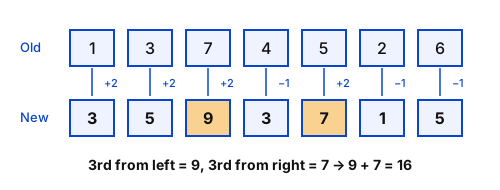
If 2 is added to each odd digit and 1 is subtracted from each even digit in the number 1374526, then what will the sum of the digits which are third from the left and third from the right in the new number thus formed be?
यदि संख्या 1374526 में प्रत्येक विषम अंक में 2 जोड़ा जाए और प्रत्येक सम अंक में से 1 घटाया जाए, तो इस प्रकार बनी नई संख्या में बाएँ से तीसरे और दाएँ से तीसरे अंकों का योग क्या होगा?
  1. A8
  2. B14
  3. C11
  4. D16
Show answer

Concept: Change every digit by its rule, then read positions from both ends.

  1. Odd digits +2: 1→3, 3→5, 7→9, 5→7.
  2. Even digits −1: 4→3, 2→1, 6→5.
  3. 1374526 → 3593715.
  4. Third from left = 9, third from right = 7; sum =16.

Trick: Only the two required positions (7 and 5 in the old number) need converting: 9+7=16.

Answer: (D) 16

अवधारणा: हर अंक को नियम से बदलें, फिर दोनों सिरों से स्थान पढ़ें।

  1. विषम अंक +2: 1→3, 3→5, 7→9, 5→7।
  2. सम अंक −1: 4→3, 2→1, 6→5।
  3. 1374526 → 3593715।
  4. बाएँ से तीसरा = 9, दाएँ से तीसरा = 7; योग =16।

ट्रिक: केवल दोनों आवश्यक स्थानों (पुरानी संख्या में 7 और 5) को बदलें: 9+7=16।

उत्तर: (D) 16

RRB NTPC Graduate CBT 1General Intelligence and ReasoningDigit operationsRRB NTPC Graduate CBT 1 2024 · 23 Jun Shift 1 →
Q597.
In this question, a group of numbers/symbols are coded using letter codes as per the codes given below, and the conditions that follow. The correct combination of codes (following only the condition/s that apply) is your answer.
Note: If none of the conditions apply, then codes for the respective number/symbol are to be followed directly as given in the table.
Number/symbol7@62#%&89=$34+
CodeEJAHFRBYLHQTKZ

Conditions:
(i) If the first element is an odd number and the last element is also an odd number, then the codes for these two (the first and the last elements) are to be interchanged.
(ii) If the first and last elements are perfect squares, then the code of the 1st and last element are to be interchanged.
(iii) If the first and last element is a symbol, then the first and last element is to be coded as >.
What is the code for the following?
98#@4
इस प्रश्न में, नीचे दिए गए कूटों और उसके बाद दी गई शर्तों के अनुसार संख्याओं/प्रतीकों के एक समूह को अक्षर कूटों का उपयोग करके कूटबद्ध किया गया है। कूटों का सही संयोजन (केवल लागू होने वाली शर्त/शर्तों का अनुसरण करते हुए) आपका उत्तर है।
नोट: यदि कोई भी शर्त लागू नहीं होती है, तो संबंधित संख्या/प्रतीक के लिए तालिका में दिए गए कूटों का सीधे अनुसरण किया जाना है।
संख्या/प्रतीक7@62#%&89=$34+
कूटEJAHFRBYLHQTKZ

शर्तें:
(i) यदि पहला अवयव एक विषम संख्या है और अंतिम अवयव भी एक विषम संख्या है, तो इन दोनों (पहले और अंतिम अवयवों) के कूट आपस में बदल दिए जाने हैं।
(ii) यदि पहला और अंतिम अवयव पूर्ण वर्ग हैं, तो पहले और अंतिम अवयव के कूट आपस में बदल दिए जाने हैं।
(iii) यदि पहला और अंतिम अवयव प्रतीक है, तो पहले और अंतिम अवयव को > के रूप में कूटबद्ध किया जाना है।
निम्नलिखित के लिए कूट क्या है?
98#@4
  1. AKYFJL
  2. BLYFJK
  3. CTYFJY
  4. DKYFEL
Show answer

Concept: Write the plain codes, then test the conditions on the first and last elements.

  1. 9 8 # @ 4 → L Y F J K.
  2. Condition (i) fails: last element 4 is even.
  3. Condition (ii): 9 and 4 are both perfect squares → interchange their codes.
  4. Code: K Y F J L.

Trick: Squares at both ends → swap end letters: LYFJK → KYFJL.

Answer: (A) KYFJL

अवधारणा: पहले सीधे कोड लिखें, फिर पहले और अंतिम तत्व पर शर्तें जाँचें।

  1. 9 8 # @ 4 → L Y F J K।
  2. शर्त (i) लागू नहीं: अंतिम 4 सम है।
  3. शर्त (ii): 9 और 4 दोनों पूर्ण वर्ग → कोड आपस में बदलें।
  4. कोड: K Y F J L।

ट्रिक: दोनों सिरों पर पूर्ण वर्ग → छोर के अक्षर बदलें: LYFJK → KYFJL।

उत्तर: (A) KYFJL

RRB NTPC Graduate CBT 1General Intelligence and ReasoningCoding with conditionsRRB NTPC Graduate CBT 1 2024 · 23 Jun Shift 1 →
Q598.
Which river is associated with the Mohenjo-daro site?
मोहनजोदड़ो स्थल किस नदी से संबंधित है?
  1. ASaraswatiसरस्वती
  2. BGangaगंगा
  3. CYamunaयमुना
  4. DIndusसिंधु
Show answer

Concept: Mohenjo-daro is one of the largest cities of the Harappan (Indus Valley) Civilisation.

  1. Mohenjo-daro lies in Larkana district of Sindh (Pakistan), on the right bank of the Indus.
  2. It was excavated by R.D. Banerji in 1922; the Great Bath and the Dancing Girl bronze come from here.
  3. Harappa lies on the Ravi; Ganga and Yamuna are far east of the Harappan core.

Yaad rakhein: Mohenjo-daro = Sindh = Indus; Harappa = Ravi; Lothal = Bhogava; Kalibangan = Ghaggar.

Answer: (D) Indus

अवधारणा: मोहनजोदड़ो हड़प्पा (सिंधु घाटी) सभ्यता के सबसे बड़े नगरों में से एक है।

  1. मोहनजोदड़ो सिंध (पाकिस्तान) के लरकाना ज़िले में सिंधु नदी के दाहिने तट पर है।
  2. 1922 में आर.डी. बनर्जी ने इसकी खुदाई की; विशाल स्नानागार और नर्तकी की कांस्य मूर्ति यहीं से मिली।
  3. हड़प्पा रावी पर है; गंगा-यमुना हड़प्पा क्षेत्र से बहुत पूर्व में हैं।

याद रखें: मोहनजोदड़ो = सिंध = सिंधु; हड़प्पा = रावी; लोथल = भोगवा; कालीबंगा = घग्गर।

उत्तर: (D) सिंधु

RRB NTPC Graduate CBT 1General AwarenessIndus Valley CivilisationRRB NTPC Graduate CBT 1 2024 · 21 Jun Shift 3 →
Q599.
Under which provision can the Governor extend judicial service rules to certain magistrates?
किस प्रावधान के अंतर्गत राज्यपाल न्यायिक सेवा के नियमों को कुछ मजिस्ट्रेटों पर लागू कर सकता है?
  1. AArticle 234अनुच्छेद 234
  2. BArticle 142अनुच्छेद 142
  3. CArticle 233अनुच्छेद 233
  4. DArticle 237अनुच्छेद 237
Show answer

Concept: Articles 233–237 (Part VI, Chapter VI) deal with subordinate courts.

  1. Article 237: the Governor may by public notification direct that Articles 233–236 (judicial service rules) apply to any class of magistrates in the State.
  2. Article 233 = appointment of district judges; Article 234 = recruitment of other judicial officers; Article 142 = Supreme Court's power to do complete justice.

Yaad rakhein: 233 district judge → 234 recruitment → 235 HC control → 236 definitions → 237 extension to magistrates.

Answer: (D) Article 237

अवधारणा: अनुच्छेद 233–237 (भाग VI, अध्याय VI) अधीनस्थ न्यायालयों से संबंधित हैं।

  1. अनुच्छेद 237: राज्यपाल सार्वजनिक अधिसूचना द्वारा अनुच्छेद 233–236 के प्रावधान (न्यायिक सेवा नियम) राज्य के किसी भी वर्ग के मजिस्ट्रेटों पर लागू कर सकता है।
  2. अनुच्छेद 233 = ज़िला न्यायाधीश की नियुक्ति; 234 = अन्य न्यायिक अधिकारियों की भर्ती; 142 = सुप्रीम कोर्ट का 'पूर्ण न्याय' अधिकार।

याद रखें: 233 ज़िला जज → 234 भर्ती → 235 HC का नियंत्रण → 236 परिभाषाएँ → 237 मजिस्ट्रेटों पर लागू।

उत्तर: (D) अनुच्छेद 237

RRB NTPC Graduate CBT 1General AwarenessSubordinate CourtsRRB NTPC Graduate CBT 1 2024 · 21 Jun Shift 3 →
Q600.
Which moderate leader, often referred to as the 'Grand Old Man of India,' became the first Indian elected to the British House of Commons and helped shape the early nationalist movement?
किस नरमपंथी नेता, जिन्हें प्रायः 'भारत के वयोवृद्ध पुरुष (Grand Old Man of India)' कहा जाता है, ब्रिटिश हाउस ऑफ कॉमन्स के लिए निर्वाचित होने वाले पहले भारतीय बने और जिन्होंने प्रारंभिक राष्ट्रवादी आंदोलन को आकार देने में सहायता की?
  1. ADadabhai Naorojiदादाभाई नौरोजी
  2. BRash Behari Ghoshरासबिहारी घोष
  3. CGopal Krishna Gokhaleगोपाल कृष्ण गोखले
  4. DPherozeshah Mehtaफिरोज़शाह मेहता
Show answer

Concept: The 'Grand Old Man of India' is Dadabhai Naoroji.

  1. In 1892 he won the Central Finsbury seat and became the first Indian (Asian) member of the British House of Commons.
  2. He propounded the Drain Theory in 'Poverty and Un-British Rule in India' and presided over INC sessions in 1886, 1893 and 1906.
  3. Gokhale was Gandhi's political guru; Pherozeshah Mehta was 'Lion of Bombay'.

Yaad rakhein: Grand Old Man + Drain Theory + British MP = Dadabhai Naoroji.

Answer: (A) Dadabhai Naoroji

अवधारणा: 'भारत के वयोवृद्ध पुरुष (Grand Old Man of India)' दादाभाई नौरोजी हैं।

  1. 1892 में वे सेंट्रल फिन्सबरी से जीतकर ब्रिटिश हाउस ऑफ कॉमन्स में पहुँचने वाले पहले भारतीय बने।
  2. उन्होंने 'Poverty and Un-British Rule in India' में धन-निष्कासन सिद्धांत (Drain Theory) दिया; 1886, 1893, 1906 में कांग्रेस अध्यक्ष रहे।
  3. गोखले गांधीजी के राजनीतिक गुरु थे; फ़िरोज़शाह मेहता 'बॉम्बे के शेर' कहलाए।

याद रखें: Grand Old Man + Drain Theory + ब्रिटिश MP = दादाभाई नौरोजी।

उत्तर: (A) दादाभाई नौरोजी

RRB NTPC Graduate CBT 1General AwarenessModerate LeadersRRB NTPC Graduate CBT 1 2024 · 21 Jun Shift 3 →