Question bank

Q&A: practice questions with answers

Search questions on any topic. Filter by exam category, exam, subject and topic, try the question, then open the answer and explanation.

Courses – airGurukul

7,077 questions found.

Q6041.
If x is inversely proportional to y, and y = 30 when x = 28, find the value of x, when y = 20.
यदि x, y के व्युत्क्रमानुपाती है, और x = 28 होने पर y = 30 है, तो y = 20 होने पर x का मान ज्ञात कीजिए।
  1. A33
  2. B42
  3. C52
  4. D38
Show answer

Concept: Inverse proportion ⇒ xy= constant.

  1. k=xy=28×30=840.
  2. When y=20: x=84020=42.

Trick: y falls from 30 to 20 (ratio 3:2), so x rises in ratio 2:3: 28×32=42.

Answer: (B) 42

अवधारणा: व्युत्क्रम अनुपात ⇒ xy= नियतांक।

  1. k=xy=28×30=840।
  2. y=20 पर: x=84020=42।

ट्रिक: y 30 से 20 (अनुपात 3:2) घटा, तो x अनुपात 2:3 में बढ़ेगा: 28×32=42।

उत्तर: (B) 42

RRB NTPC Graduate CBT 1MathematicsInverse VariationRRB NTPC Graduate CBT 1 2025 · 19 Mar Shift 2 →
Q6042.
If 8x3−27y3=(Ax+By)(Cx2−Dy2+Exy), then the value of (A+B+C+D+E) is:
यदि 8x3−27y3=(Ax+By)(Cx2−Dy2+Exy) है, तो (A+B+C+D+E) का मान है:
  1. A−3
  2. B−1
  3. C0
  4. D2
Show answer

Concept: a3−b3=(a−b)(a2+ab+b2) with a=2x, b=3y.

  1. 8x3−27y3=(2x−3y)(4x2+6xy+9y2).
  2. Match with (Ax+By)(Cx2−Dy2+Exy): A=2, B=−3, C=4, −D=9⇒D=−9, E=6.
  3. A+B+C+D+E=2−3+4−9+6=0.

Trick: Watch the sign in front of D – the identity has +9y2, so D=−9, not 9.

Answer: (C) 0

अवधारणा: a3−b3=(a−b)(a2+ab+b2), यहाँ a=2x, b=3y।

  1. 8x3−27y3=(2x−3y)(4x2+6xy+9y2)।
  2. (Ax+By)(Cx2−Dy2+Exy) से मिलाएँ: A=2, B=−3, C=4, −D=9⇒D=−9, E=6।
  3. A+B+C+D+E=2−3+4−9+6=0।

ट्रिक: D के आगे का चिह्न देखें – सर्वसमिका में +9y2 है, अतः D=−9, 9 नहीं।

उत्तर: (C) 0

RRB NTPC Graduate CBT 1MathematicsAlgebra – FactorisationRRB NTPC Graduate CBT 1 2025 · 19 Mar Shift 2 →
Q6043.
A dealer buys two articles X and Y for ₹1,000 each. He marks each of them at the same price. He sells X by giving two successive discounts of 15% and 30% and still earns ₹337 as profit. If he sells Y at a single discount of 49%, then what is the profit
percentage on Y?
एक व्यापारी दो वस्तुएँ X और Y, प्रत्येक ₹1,000 में खरीदता है। वह दोनों पर समान अंकित मूल्य लगाता है। वह X को 15% और 30% की दो क्रमिक छूटें देकर बेचता है और फिर भी ₹337 का लाभ कमाता है। यदि वह Y को 49% की एकल छूट पर बेचता है, तो Y पर लाभ
प्रतिशत कितना है?
  1. A14.6%
  2. B13.6%
  3. C13%
  4. D14%
Show answer

Concept: Same marked price M for both; use X to find M, then apply the single discount to Y.

  1. X: SP =M×0.85×0.70=0.595M=1000+337=1337⇒M=13370.595≈2247.06.
  2. Y: SP =0.51M=0.51×2247.06≈1146.
  3. Profit on Y =1146−1000=146⇒14.6%.

Trick: SPY=1337×0.510.595=1337×67=1146 – skip finding M.

Answer: (A) 14.6%

अवधारणा: दोनों का अंकित मूल्य M समान; X से M निकालें, फिर Y पर एकल छूट लगाएँ।

  1. X: SP =M×0.85×0.70=0.595M=1000+337=1337⇒M=13370.595≈2247.06।
  2. Y: SP =0.51M=0.51×2247.06≈1146।
  3. Y पर लाभ =1146−1000=146⇒14.6%।

ट्रिक: SPY=1337×0.510.595=1337×67=1146 – M निकालने की ज़रूरत नहीं।

उत्तर: (A) 14.6%

RRB NTPC Graduate CBT 1MathematicsProfit & Loss – DiscountsRRB NTPC Graduate CBT 1 2025 · 19 Mar Shift 2 →
Q6044.
The sum of two numbers a and b, where a < b, is 129. The HCF and LCM of a and b are 3 and 1350, respectively. Find the value of 1a−1b.
दो संख्याओं a और b, जहाँ a < b है, का योग 129 है। a और b का HCF और LCM क्रमशः 3 और 1350 हैं। 1a−1b का मान ज्ञात कीजिए।
  1. A71350
  2. B−34550
  3. C−211550
  4. D441450
Show answer

Concept: a×b=HCF×LCM and 1a−1b=b−aab.

  1. ab=3×1350=4050. Let a=3p, b=3q (co-prime): pq=450, p+q=43⇒p=18,q=25.
  2. So a=54, b=75 (54+75=129 ✓), b−a=21.
  3. 1a−1b=214050=71350.

Trick: (b−a)2=(a+b)2−4ab=16641−16200=441⇒b−a=21 – no need to find a,b separately.

Answer: (A) 71350

अवधारणा: a×b=HCF×LCM और 1a−1b=b−aab।

  1. ab=3×1350=4050। a=3p, b=3q (सह-अभाज्य) लें: pq=450, p+q=43⇒p=18,q=25।
  2. अतः a=54, b=75 (54+75=129 ✓), b−a=21।
  3. 1a−1b=214050=71350।

ट्रिक: (b−a)2=(a+b)2−4ab=16641−16200=441⇒b−a=21 – a,b अलग-अलग निकालने की ज़रूरत नहीं।

उत्तर: (A) 71350

RRB NTPC Graduate CBT 1MathematicsHCF and LCMRRB NTPC Graduate CBT 1 2025 · 19 Mar Shift 2 →
Q6045.
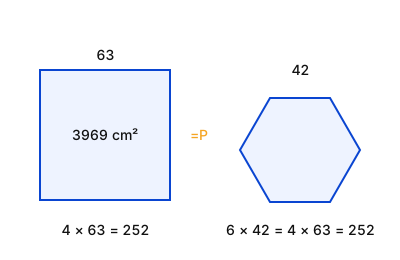
The area of a square is 3969 cm2. Its perimeter is equal to the perimeter of a regular hexagon. What is the area (in cm2) of the hexagon?
एक वर्ग का क्षेत्रफल 3969 cm2 है। इसका परिमाप एक समषट्भुज के परिमाप के बराबर है। षट्भुज का क्षेत्रफल (cm2 में) क्या है?
  1. A2600
  2. B2608
  3. C26623
  4. D26463
Show answer

Concept: Area of a regular hexagon =332a2; equal perimeters link the square and hexagon.

  1. Square side =3969=63 cm, perimeter =4×63=252 cm.
  2. Hexagon side a=2526=42 cm.
  3. Area =332×422=332×1764=26463cm2.

Trick: 632=3969 (since 63=9×7); hexagon side =23 of square side when perimeters are equal.

Answer: (D) 26463

अवधारणा: सम षट्भुज का क्षेत्रफल =332a2; बराबर परिमाप से वर्ग और षट्भुज जुड़ते हैं।

  1. वर्ग की भुजा =3969=63 cm, परिमाप =4×63=252 cm।
  2. षट्भुज की भुजा a=2526=42 cm।
  3. क्षेत्रफल =332×422=332×1764=26463cm2।

ट्रिक: 632=3969 (63=9×7); परिमाप बराबर हों तो षट्भुज की भुजा = वर्ग की भुजा का 23।

उत्तर: (D) 26463

RRB NTPC Graduate CBT 1MathematicsMensuration – Regular HexagonRRB NTPC Graduate CBT 1 2025 · 19 Mar Shift 2 →
Q6046.
If 4 lines of a print, in a column of a book, contain 36 words, how many words will a column of 93 lines contain?
यदि किसी पुस्तक के एक कॉलम में छपी 4 पंक्तियों में 36 शब्द हैं, तो 93 पंक्तियों वाले कॉलम में कितने शब्द होंगे?
  1. A833
  2. B841
  3. C837
  4. D847
Show answer

Concept: Words are directly proportional to the number of lines.

  1. 4 lines → 36 words ⇒ 1 line → 9 words.
  2. 93 lines → 93×9=837 words.

Trick: 93×9=93×10−93=930−93=837.

Answer: (C) 837

अवधारणा: शब्द, पंक्तियों की संख्या के सीधे अनुपात में हैं।

  1. 4 पंक्तियाँ → 36 शब्द ⇒ 1 पंक्ति → 9 शब्द।
  2. 93 पंक्तियाँ → 93×9=837 शब्द।

ट्रिक: 93×9=93×10−93=930−93=837।

उत्तर: (C) 837

RRB NTPC Graduate CBT 1MathematicsUnitary MethodRRB NTPC Graduate CBT 1 2025 · 19 Mar Shift 2 →
Q6047.
P and Q are two stations. A train travels from P to Q at a speed of 144 km/h and returns to P at a slower speed. If the average speed for the entire journey is 126 km/h, find the speed at which the train returns.
P और Q दो स्टेशन हैं। एक रेलगाड़ी P से Q तक 144 km/h की चाल से जाती है और धीमी चाल से P लौटती है। यदि पूरी यात्रा की औसत चाल 126 km/h है, तो रेलगाड़ी की लौटते समय की चाल ज्ञात कीजिए।
  1. A124 km/h
  2. B128 km/h
  3. C121 km/h
  4. D112 km/h
Show answer

Concept: For equal distances, average speed =2uvu+v.

  1. 2×144×v144+v=126.
  2. 288v=126×144+126v⇒162v=18144.
  3. v=112km/h.

Trick: 1v=2126−1144=163−1144=144−639072=819072=1112.

Answer: (D) 112 km/h

अवधारणा: समान दूरी के लिए औसत चाल =2uvu+v।

  1. 2×144×v144+v=126।
  2. 288v=126×144+126v⇒162v=18144।
  3. v=112km/h।

ट्रिक: 1v=2126−1144=163−1144=819072=1112।

उत्तर: (D) 112 km/h

RRB NTPC Graduate CBT 1MathematicsAverage SpeedRRB NTPC Graduate CBT 1 2025 · 19 Mar Shift 2 →
Q6048.
In a certain code language,
A + B means ‘A is the son of B’
A – B means ‘A is the brother of B’
A x B means ‘A is the wife of B’
A ÷ B means ‘A is the father of B’
Based on the above, how is W related to G if ‘W – O x R + K ÷ G’?
एक निश्चित कूट भाषा में,
A + B का अर्थ है ‘A, B का पुत्र है’
A – B का अर्थ है ‘A, B का भाई है’
A x B का अर्थ है ‘A, B की पत्नी है’
A ÷ B का अर्थ है ‘A, B का पिता है’
उपर्युक्त के आधार पर, यदि ‘W – O x R + K ÷ G’ है, तो W का G से क्या संबंध है?
  1. ABrother's wife's brotherभाई की पत्नी का भाई
  2. BBrother's wife's fatherभाई की पत्नी का पिता
  3. CWife's fatherपत्नी का पिता
  4. DWife's brotherपत्नी का भाई
Show answer

Concept: Decode the expression pair by pair and build the family tree.

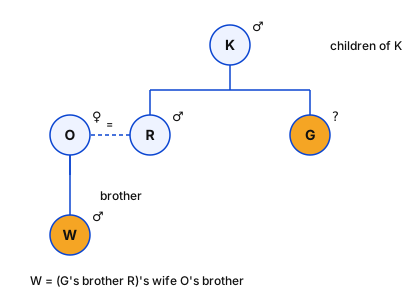
  1. W – O: W is the brother of O. O x R: O is the wife of R. R + K: R is the son of K. K ÷ G: K is the father of G.
  2. So R and G are children of K, i.e. R is G's brother.
  3. O is R's wife = G's brother's wife; W is O's brother.
  4. Hence W is G's brother's wife's brother.

Trick: Always start from the person asked about at the end (G) and walk back along the chain.

Answer: (A) Brother's wife's brother

अवधारणा: व्यंजक को जोड़ी-जोड़ी में decode करके वंश-वृक्ष बनाइए।

  1. W – O: W, O का भाई। O x R: O, R की पत्नी। R + K: R, K का पुत्र। K ÷ G: K, G का पिता।
  2. अतः R और G दोनों K की संतान हैं, यानी R, G का भाई है।
  3. O, R की पत्नी = G के भाई की पत्नी; W, O का भाई।
  4. इसलिए W, G के भाई की पत्नी का भाई है।

ट्रिक: जिसके बारे में पूछा गया है (G) उससे शुरू करके श्रृंखला में पीछे चलें।

उत्तर: (A) Brother's wife's brother (भाई की पत्नी का भाई)

RRB NTPC Graduate CBT 1General Intelligence and ReasoningBlood RelationsRRB NTPC Graduate CBT 1 2025 · 19 Mar Shift 2 →
Q6049.
10 is related to 120 following a certain logic. Following the same logic, 12 is related to 168. To which of the following is 18 related, following the same logic?
​
(NOTE: Operations should be performed on the whole numbers, without breaking down the numbers into their constituent digits. E.g. 13 – Operations on 13 such as
adding/subtracting/multiplying etc. to 13, can be performed. Breaking down 13 into 1 and 3 and then performing mathematical operations on 1 and 3 is not allowed.)
10 एक निश्चित तर्क के अनुसार 120 से संबंधित है। उसी तर्क के अनुसार 12, 168 से संबंधित है। उसी तर्क के अनुसार 18 निम्नलिखित में से किससे संबंधित है?
​
(नोट: संक्रियाएँ पूर्ण संख्याओं पर की जानी चाहिए, संख्याओं को उनके घटक अंकों में तोड़े बिना। उदाहरण के लिए 13 – 13 पर संक्रियाएँ जैसे 13 में जोड़ना/घटाना/गुणा करना आदि की जा सकती हैं। 13 को 1 और 3 में तोड़कर फिर 1 और 3 पर गणितीय संक्रियाएँ करने की अनुमति नहीं है।)
  1. A324
  2. B256
  3. C360
  4. D400
Show answer

Concept: Find one rule that links both given pairs and apply it to the new number.

  1. 10→120: 10×12=10×(10+2)=120.
  2. 12→168: 12×14=12×(12+2)=168. Rule: n×(n+2).
  3. 18→18×20=360.

Trick: Equivalent form: n2+2n. Check: 100+20=120 ✓, 144+24=168 ✓, 324+36=360.

Answer: (C) 360

अवधारणा: दोनों दी गई जोड़ियों पर लागू होने वाला एक नियम खोजें और नई संख्या पर लगाएँ।

  1. 10→120: 10×12=10×(10+2)=120।
  2. 12→168: 12×14=12×(12+2)=168। नियम: n×(n+2)।
  3. 18→18×20=360।

ट्रिक: दूसरा रूप: n2+2n। जाँच: 100+20=120 ✓, 144+24=168 ✓, 324+36=360।

उत्तर: (C) 360

RRB NTPC Graduate CBT 1General Intelligence and ReasoningNumber AnalogyRRB NTPC Graduate CBT 1 2025 · 19 Mar Shift 2 →
Q6050.
X, Y, Z, S, T and U live on six different floors of the same building. The lowermost floor in the building is numbered 1, the floor above it is numbered 2, and so on till the topmost floor is numbered 6. X lives on an even numbered floor but not on floor number 4. Only two people live between X and T. S lives on an odd numbered floor but not on the lowermost floor. Only two people live between S and Y. Z lives immediately below S. How many people live between U and Z?
X, Y, Z, S, T और U एक ही इमारत की छह अलग-अलग मंज़िलों पर रहते हैं। इमारत की सबसे निचली मंज़िल की संख्या 1 है, उसके ऊपर की मंज़िल की संख्या 2 है, और इसी प्रकार सबसे ऊपरी मंज़िल की संख्या 6 है। X एक सम संख्या वाली मंज़िल पर रहता है, परंतु मंज़िल संख्या 4 पर नहीं। X और T के बीच केवल दो व्यक्ति रहते हैं। S एक विषम संख्या वाली मंज़िल पर रहता है, परंतु सबसे निचली मंज़िल पर नहीं। S और Y के बीच केवल दो व्यक्ति रहते हैं। Z, S के ठीक नीचे रहता है। U और Z के बीच कितने व्यक्ति रहते हैं?
  1. ATwoदो
  2. BThreeतीन
  3. CFourचार
  4. DOneएक
Show answer

Concept: Fix the most restricted person first (X), test each case and discard contradictions.

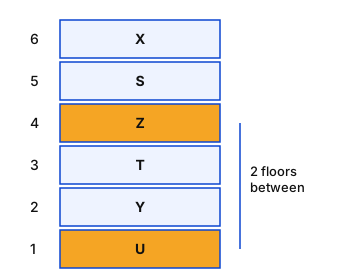
  1. X is on an even floor other than 4 ⇒ X =2 or 6. Two people between X and T ⇒ (X, T) =(2,5) or (6,3).
  2. S is odd but not 1 ⇒ S =3 or 5; two between S and Y ⇒ (S, Y) =(3,6) or (5,2); Z is just below S.
  3. If X =2, T =5: S =3 makes Z =2 (clash with X) and S =5 clashes with T. Rejected.
  4. So X =6, T =3, S =5, Y =2, Z =4 and U gets floor 1. Between U (1) and Z (4): floors 2 and 3 – two people.

Trick: "Immediately below" clues are the fastest contradiction-finders – test them first in each case.

Answer: (A) Two

अवधारणा: सबसे अधिक प्रतिबंधित व्यक्ति (X) को पहले रखें, हर स्थिति जाँचें और विरोधाभास हटाएँ।

  1. X सम मंज़िल पर है पर 4 पर नहीं ⇒ X =2 या 6। X और T के बीच दो लोग ⇒ (X, T) =(2,5) या (6,3)।
  2. S विषम पर 1 नहीं ⇒ S =3 या 5; S और Y के बीच दो ⇒ (S, Y) =(3,6) या (5,2); Z ठीक S के नीचे।
  3. X =2, T =5 लें: S =3 से Z =2 (X से टकराव), S =5 T से टकराता है। अस्वीकार।
  4. अतः X =6, T =3, S =5, Y =2, Z =4, U मंज़िल 1 पर। U (1) और Z (4) के बीच मंज़िल 2 और 3 – दो लोग।

ट्रिक: "ठीक नीचे/ऊपर" वाले सुराग सबसे जल्दी विरोधाभास पकड़ते हैं – हर case में इन्हें पहले जाँचें।

उत्तर: (A) Two (दो)

RRB NTPC Graduate CBT 1General Intelligence and ReasoningFloor PuzzleRRB NTPC Graduate CBT 1 2025 · 19 Mar Shift 2 →
Q6051.
In a certain code language, ‘WINS’ is coded as ‘8246’ and ‘NORM’ is coded as ‘3851’. What is the code for 'N’ in the given code language?
एक निश्चित कूट भाषा में, ‘WINS’ को ‘8246’ के रूप में कूटबद्ध किया जाता है और ‘NORM’ को ‘3851’ के रूप में कूटबद्ध किया जाता है। उस कूट भाषा में 'N' का कूट क्या है?
  1. A4
  2. B3
  3. C8
  4. D1
Show answer

Concept: In number-coding of words, a letter common to two words gets the digit common to both codes.

  1. WINS → 8 2 4 6 and NORM → 3 8 5 1.
  2. Only letter common to both words: N. Only digit common to both codes: 8.
  3. So N =8.

Trick: Compare letters and digits side by side – the single overlap gives the answer in one look.

Answer: (C) 8

अवधारणा: शब्दों की संख्या-कोडिंग में दोनों शब्दों का साझा अक्षर, दोनों कोड के साझा अंक से कोड होता है।

  1. WINS → 8 2 4 6 और NORM → 3 8 5 1।
  2. दोनों शब्दों में साझा अक्षर केवल N; दोनों कोड में साझा अंक केवल 8।
  3. अतः N =8।

ट्रिक: अक्षरों और अंकों को आमने-सामने रखें – एक ही overlap से उत्तर मिल जाता है।

उत्तर: (C) 8

RRB NTPC Graduate CBT 1General Intelligence and ReasoningCoding–DecodingRRB NTPC Graduate CBT 1 2025 · 19 Mar Shift 2 →
Q6052.
If 1 is added to each odd digit and 2 is subtracted from each even digit in the number 8371456, what will be the sum of the digits that are second from the left and second from the right in the new number thus formed?
यदि संख्या 8371456 में प्रत्येक विषम अंक में 1 जोड़ा जाए और प्रत्येक सम अंक में से 2 घटाया जाए, तो इस प्रकार बनी नई संख्या में बाएँ से दूसरे और दाएँ से दूसरे अंकों का योग क्या होगा?
  1. A9
  2. B8
  3. C11
  4. D10
Show answer

Concept: Apply the rule digit by digit, then read the required positions in the new number.

  1. 8 3 7 1 4 5 6: odd digits +1, even digits −2.
  2. 8→6, 3→4, 7→8, 1→2, 4→2, 5→6, 6→4 ⇒ new number 6 4 8 2 2 6 4.
  3. Second from left =4, second from right =6; sum =10.

Trick: Write the new digits directly below the old ones – positions never get mixed up.

Answer: (D) 10

अवधारणा: नियम हर अंक पर लगाएँ, फिर नई संख्या में माँगे गए स्थान पढ़ें।

  1. 8 3 7 1 4 5 6: विषम अंक +1, सम अंक −2।
  2. 8→6, 3→4, 7→8, 1→2, 4→2, 5→6, 6→4 ⇒ नई संख्या 6 4 8 2 2 6 4।
  3. बाएँ से दूसरा =4, दाएँ से दूसरा =6; योग =10।

ट्रिक: नए अंक पुराने अंकों के ठीक नीचे लिखें – स्थान कभी नहीं गड़बड़ाते।

उत्तर: (D) 10

RRB NTPC Graduate CBT 1General Intelligence and ReasoningNumber OperationsRRB NTPC Graduate CBT 1 2025 · 19 Mar Shift 2 →
Q6053.
Which of the given letter-number clusters will replace the question mark (?) in the following series to make it logically complete?
YQM 2 SKG 6 MEA 12 GYU 20 ?
निम्नलिखित श्रृंखला को तार्किक रूप से पूर्ण करने के लिए दिए गए अक्षर-संख्या समूहों में से कौन-सा प्रश्नचिह्न (?) के स्थान पर आएगा?
YQM 2 SKG 6 MEA 12 GYU 20 ?
  1. ABTP 32
  2. BASO 30
  3. CDZP 30
  4. DLWY 30
Show answer

Concept: Treat the letters and the numbers as two separate series.

  1. Letters: Y→S→M→G (each −6), so G−6= A. Q→K→E→Y (also −6), so Y−6= S. M→G→A→U, so U−6= O. Cluster: ASO.
  2. Numbers: 2, 6, 12, 20 – differences 4, 6, 8, so next difference 10 ⇒30.

Trick: 2, 6, 12, 20, 30 is n(n+1): 1×2, 2×3, 3×4, 4×5, 5×6.

Answer: (B) ASO 30

अवधारणा: अक्षरों और संख्याओं को दो अलग श्रृंखलाओं की तरह देखें।

  1. अक्षर: Y→S→M→G (हर बार −6), अतः G−6= A। Q→K→E→Y (−6), अतः S। M→G→A→U, अतः O। समूह: ASO।
  2. संख्याएँ: 2, 6, 12, 20 – अंतर 4, 6, 8, अगला अंतर 10 ⇒30।

ट्रिक: 2, 6, 12, 20, 30 =n(n+1): 1×2, 2×3, 3×4, 4×5, 5×6।

उत्तर: (B) ASO 30

RRB NTPC Graduate CBT 1General Intelligence and ReasoningLetter–Number SeriesRRB NTPC Graduate CBT 1 2025 · 19 Mar Shift 2 →
Q6054.
Based on the English alphabetical order, three of the following four are alike in a certain way and thus form a group. Which is the one that does not belong to that group? (Note: The odd man out is not based on the number of consonants/vowels or their position in the letter cluster)
अंग्रेज़ी वर्णमाला क्रम के आधार पर, निम्नलिखित चार में से तीन एक निश्चित प्रकार से समान हैं और इस प्रकार एक समूह बनाते हैं। वह कौन-सा है जो उस समूह से संबंधित नहीं है? (नोट: असंगत का चयन व्यंजनों/स्वरों की संख्या या अक्षर समूह में उनकी स्थिति के आधार पर नहीं किया गया है)
  1. AEHJ
  2. BNQS
  3. CBEG
  4. DDGH
Show answer

Concept: Check the gaps between consecutive letters in each cluster.

  1. EHJ: E→+3H→+2J. NQS: +3,+2. BEG: +3,+2.
  2. DGH: D→+3G→+1H – the second gap is +1, not +2.

Trick: Convert to positions (E5 H8 J10, D4 G7 H8) – the differing gap jumps out.

Answer: (D) DGH

अवधारणा: हर समूह में क्रमागत अक्षरों के बीच का अंतर देखें।

  1. EHJ: E→+3H→+2J। NQS: +3,+2। BEG: +3,+2।
  2. DGH: D→+3G→+1H – दूसरा अंतर +1 है, +2 नहीं।

ट्रिक: स्थान-संख्या लिखें (E5 H8 J10, D4 G7 H8) – अलग अंतर तुरंत दिखता है।

उत्तर: (D) DGH

RRB NTPC Graduate CBT 1General Intelligence and ReasoningLetter Cluster – Odd One OutRRB NTPC Graduate CBT 1 2025 · 19 Mar Shift 2 →
Q6055.
Which of the following letter-clusters should replace # and % so that the pattern and relationship followed between the letter-cluster pair on the left side of :: is the same as that on the right side of :: ?
# : LHN :: PLR : %
निम्नलिखित में से कौन-से अक्षर-समूह # और % के स्थान पर आने चाहिए ताकि :: के बाईं ओर के अक्षर-समूह युग्म के बीच पालन किया गया पैटर्न और संबंध, :: के दाईं ओर के युग्म के समान हो?
# : LHN :: PLR : %
  1. A# = MIP , % = OKQ
  2. B# = MIO , % = OKQ
  3. C# = MIO , % = OLQ
  4. D# = MIO , % = OKR
Show answer

Concept: The same letter-shift must turn # into LHN and PLR into %. Test the pattern suggested by the options.

  1. Options give # = MIO (mostly). MIO → LHN: M−1=L, I−1=H, O−1=N – each letter −1.
  2. Apply the same to PLR: P−1=O, L−1=K, R−1=Q ⇒ % = OKQ.
  3. Only option B has both # = MIO and % = OKQ.

Trick: When the left term is unknown, work backwards from the second pair and eliminate options with a single mismatched letter.

Answer: (B) # = MIO , % = OKQ

अवधारणा: एक ही अक्षर-परिवर्तन से # → LHN और PLR → % बनना चाहिए। विकल्पों से पैटर्न जाँचें।

  1. विकल्पों में # = MIO (अधिकतर)। MIO → LHN: M−1=L, I−1=H, O−1=N – हर अक्षर −1।
  2. PLR पर वही: P−1=O, L−1=K, R−1=Q ⇒ % = OKQ।
  3. केवल विकल्प B में # = MIO और % = OKQ दोनों हैं।

ट्रिक: बायाँ पद अज्ञात हो तो दूसरी जोड़ी से उल्टा चलें और एक अक्षर के अंतर वाले विकल्प हटाएँ।

उत्तर: (B) # = MIO , % = OKQ

RRB NTPC Graduate CBT 1General Intelligence and ReasoningLetter AnalogyRRB NTPC Graduate CBT 1 2025 · 19 Mar Shift 2 →
Q6056.
In a certain code language, ‘MINT’ is coded as ‘6134’ and ‘TIME’ is coded as ‘4365’. What is the code for ‘E’ in the given code language?
एक निश्चित कूट भाषा में, ‘MINT’ को ‘6134’ के रूप में कूटबद्ध किया जाता है और ‘TIME’ को ‘4365’ के रूप में कूटबद्ध किया जाता है। उस कूट भाषा में ‘E’ का कूट क्या है?
  1. A4
  2. B5
  3. C3
  4. D6
Show answer

Concept: Letters common to both words take the digits common to both codes; the leftover letter takes the leftover digit.

  1. MINT → 6 1 3 4; TIME → 4 3 6 5.
  2. Common letters M, I, T ↔ common digits 6, 3, 4.
  3. The extra letter in TIME is E and the extra digit is 5, so E =5.

Trick: Cross out the common letters and common digits – whatever is left is the pair you need.

Answer: (B) 5

अवधारणा: दोनों शब्दों के साझा अक्षर, साझा अंक लेते हैं; बचा हुआ अक्षर बचे हुए अंक का कोड है।

  1. MINT → 6 1 3 4; TIME → 4 3 6 5।
  2. साझा अक्षर M, I, T ↔ साझा अंक 6, 3, 4।
  3. TIME में अतिरिक्त अक्षर E और अतिरिक्त अंक 5, अतः E =5।

ट्रिक: साझा अक्षर और साझा अंक काट दें – जो बचे वही जोड़ी उत्तर है।

उत्तर: (B) 5

RRB NTPC Graduate CBT 1General Intelligence and ReasoningCoding–DecodingRRB NTPC Graduate CBT 1 2025 · 19 Mar Shift 2 →
Q6057.
P, Q, R, S, T, U and V sit around a circular table facing the centre. Only two people sit between P and U when counted from the right of P. Only two people sit between U and V. Only three people sit between P and T. S sits to the immediate left of R. How many people sit between P and Q when counted from the right of Q?
P, Q, R, S, T, U और V एक वृत्ताकार मेज़ के चारों ओर केंद्र की ओर मुख करके बैठे हैं। P के दाईं ओर से गिनने पर P और U के बीच केवल दो व्यक्ति बैठे हैं। U और V के बीच केवल दो व्यक्ति बैठे हैं। P और T के बीच केवल तीन व्यक्ति बैठे हैं। S, R के ठीक बाईं ओर बैठा है। Q के दाईं ओर से गिनने पर P और Q के बीच कितने व्यक्ति बैठे हैं?
  1. A1
  2. B3
  3. C4
  4. D2
Show answer

Concept: Facing the centre, "left" means clockwise and "right" means anticlockwise. Place P first and count carefully.

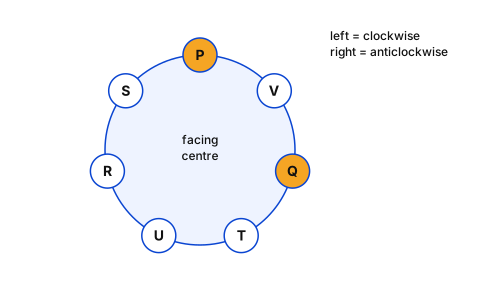
  1. From P's right (anticlockwise) two people, then U. Two between U and V and three between P and T fix V next to P (clockwise) and T between V-side and U, as in the figure.
  2. Remaining seats: one between V and T, and two between U and P. S is to the immediate left (clockwise) of R, so R and S take the two adjacent seats; Q takes the single seat between V and T.
  3. From the right (anticlockwise) of Q: V, then P. Only one person (V) sits between P and Q.

Trick: Draw 7 dots, mark "right = anticlockwise" once at the top, and never re-think direction mid-question.

Answer: (A) 1

अवधारणा: केंद्र की ओर मुख होने पर "बायाँ" = दक्षिणावर्त (clockwise) और "दायाँ" = वामावर्त (anticlockwise)। P को पहले रखें।

  1. P के दाएँ (anticlockwise) दो लोग, फिर U। U–V के बीच दो और P–T के बीच तीन लोग होने से V, P के बगल (clockwise) और T चित्र जैसा स्थिर हो जाता है।
  2. बची सीटें: V और T के बीच एक, U और P के बीच दो। S, R के ठीक बाएँ (clockwise) है, अतः R, S पास-पास वाली दो सीटों पर; Q, V और T के बीच की अकेली सीट पर।
  3. Q के दाएँ (anticlockwise) से: V, फिर P। P और Q के बीच केवल एक व्यक्ति (V)।

ट्रिक: 7 बिंदु बनाएँ, ऊपर एक बार "दायाँ = anticlockwise" लिख लें और बीच में दिशा दोबारा न सोचें।

उत्तर: (A) 1

RRB NTPC Graduate CBT 1General Intelligence and ReasoningCircular SeatingRRB NTPC Graduate CBT 1 2025 · 19 Mar Shift 2 →
Q6058.
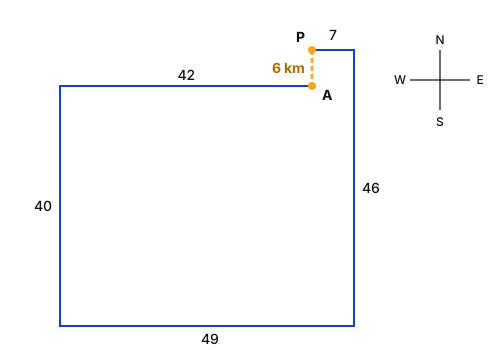
Fardin starts from Point A and drives 42 km towards the West. He then takes a left turn, drives 40 km, turns left and drives 49 km. He then takes a left turn and drives 46 km. He takes a final left turn, drives 7 km and stops at Point P. How far (shortest distance) and towards which direction should he drive in order to reach Point A again? (All turns are 90-degree turns only unless specified.)
फ़रदीन बिंदु A से चलना शुरू करता है और पश्चिम की ओर 42 km गाड़ी चलाता है। फिर वह बाएँ मुड़ता है, 40 km चलता है, बाएँ मुड़ता है और 49 km चलता है। फिर वह बाएँ मुड़ता है और 46 km चलता है। वह अंतिम बार बाएँ मुड़ता है, 7 km चलता है और बिंदु P पर रुक जाता है। बिंदु A पर पुनः पहुँचने के लिए उसे कितनी दूर (न्यूनतम दूरी) और किस दिशा में गाड़ी चलानी चाहिए? (जब तक अन्यथा न कहा जाए, सभी मोड़ केवल 90 डिग्री के हैं।)
  1. A7 km to the South7 km दक्षिण की ओर
  2. B8 km to the South8 km दक्षिण की ओर
  3. C5 km to the South5 km दक्षिण की ओर
  4. D6 km to the South6 km दक्षिण की ओर
Show answer

Concept: Plot the path on axes (East =+x, North =+y); a left turn rotates the heading anticlockwise: W → S → E → N → W.

  1. A(0,0) →W42 (−42,0) →S40 (−42,−40) →E49 (7,−40).
  2. →N46 (7,6) →W7 P(0,6).
  3. P is directly 6 km north of A, so he must drive 6 km South to reach A.

Trick: Net E–W: −42+49−7=0; net N–S: −40+46=+6 (north). Just net the opposite legs.

Answer: (D) 6 km to the South

अवधारणा: पथ को अक्षों पर रखें (पूर्व =+x, उत्तर =+y); बायाँ मोड़ दिशा को वामावर्त घुमाता है: W → S → E → N → W।

  1. A(0,0) →W42 (−42,0) →S40 (−42,−40) →E49 (7,−40)।
  2. →N46 (7,6) →W7 P(0,6)।
  3. P, A से ठीक 6 km उत्तर में है, अतः A पहुँचने के लिए 6 km दक्षिण चलना होगा।

ट्रिक: शुद्ध पूर्व–पश्चिम: −42+49−7=0; शुद्ध उत्तर–दक्षिण: −40+46=+6 (उत्तर)। विपरीत भुजाओं का net निकालें।

उत्तर: (D) 6 km to the South (6 km दक्षिण)

RRB NTPC Graduate CBT 1General Intelligence and ReasoningDirection & DistanceRRB NTPC Graduate CBT 1 2025 · 19 Mar Shift 2 →
Q6059.
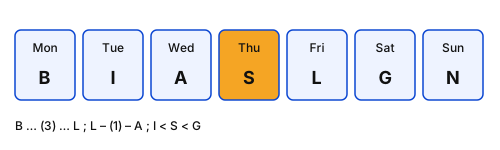
Each of A, B, L, I, N, G and S has exam on a different day of a week starting from Monday and ending on Sunday of the same week. B has exam on first day of the week. Only three people have exam between B and L. Only one person has exam between L and A. N has exam on Sunday. S has exam on one of the days after I but on one of the days before G. Who has exam on Thursday?
A, B, L, I, N, G और S में से प्रत्येक की परीक्षा एक ही सप्ताह में सोमवार से शुरू होकर रविवार को समाप्त होने वाले सप्ताह के अलग-अलग दिन है। B की परीक्षा सप्ताह के पहले दिन है। B और L के बीच केवल तीन व्यक्तियों की परीक्षा है। L और A के बीच केवल एक व्यक्ति की परीक्षा है। N की परीक्षा रविवार को है। S की परीक्षा I के बाद के किसी एक दिन परंतु G से पहले के किसी एक दिन है। गुरुवार को किसकी परीक्षा है?
  1. AG
  2. BI
  3. CA
  4. DS
Show answer

Concept: Pin the fixed days first (B on Monday, N on Sunday), then use the "between" clues.

  1. B = Monday. Three people between B and L ⇒ L = Friday.
  2. One person between L and A ⇒ A = Wednesday or Sunday; Sunday is N, so A = Wednesday.
  3. Remaining days Tue, Thu, Sat for I, S, G with I before S before G ⇒ I = Tue, S = Thu, G = Sat.
  4. Thursday: S.

Trick: "Only three between" from Monday always lands on Friday (Mon +4).

Answer: (D) S

अवधारणा: पहले निश्चित दिन रखें (B सोमवार, N रविवार), फिर "बीच में" वाले सुराग लगाएँ।

  1. B = सोमवार। B और L के बीच तीन लोग ⇒ L = शुक्रवार।
  2. L और A के बीच एक ⇒ A = बुधवार या रविवार; रविवार N का है, अतः A = बुधवार।
  3. बचे दिन मंगल, गुरु, शनि – I, S, G के लिए, क्रम I, फिर S, फिर G ⇒ I = मंगल, S = गुरु, G = शनि।
  4. गुरुवार: S।

ट्रिक: सोमवार से "केवल तीन बीच में" हमेशा शुक्रवार (Mon +4) देता है।

उत्तर: (D) S

RRB NTPC Graduate CBT 1General Intelligence and ReasoningScheduling Puzzle (Days)RRB NTPC Graduate CBT 1 2025 · 19 Mar Shift 2 →
Q6060.
In this question, a question is followed by two statements numbered (I) and (II). You have to decide whether the data provided in the statements are sufficient to answer the question. Read both the statements and decide the appropriate answer.
Question:
Among 5 trees, L, M, N, T and V each having a different height, which tree is the shortest?
Statements:
(I) N is shorter than only three trees.
(II) N is taller than M but shorter than T.
इस प्रश्न में, एक प्रश्न के बाद (I) और (II) क्रमांकित दो कथन दिए गए हैं। आपको यह तय करना है कि कथनों में दिए गए आँकड़े प्रश्न का उत्तर देने के लिए पर्याप्त हैं या नहीं। दोनों कथनों को पढ़िए और उपयुक्त उत्तर चुनिए।
प्रश्न:
5 पेड़ों L, M, N, T और V में, जिनमें से प्रत्येक की ऊँचाई अलग-अलग है, कौन-सा पेड़ सबसे छोटा है?
कथन:
(I) N केवल तीन पेड़ों से छोटा है।
(II) N, M से लंबा परंतु T से छोटा है।
  1. ABoth statements I and II together are NOT sufficient to answer the questionकथन I और II दोनों मिलकर भी प्रश्न का उत्तर देने के लिए पर्याप्त नहीं हैं
  2. BData in Statement II alone is sufficient to answer the question while data in statement I is notकेवल कथन II के आँकड़े प्रश्न का उत्तर देने के लिए पर्याप्त हैं, जबकि कथन I के आँकड़े पर्याप्त नहीं हैं
  3. CData in Statement I alone is sufficient to answer the question while data in statement II is notकेवल कथन I के आँकड़े प्रश्न का उत्तर देने के लिए पर्याप्त हैं, जबकि कथन II के आँकड़े पर्याप्त नहीं हैं
  4. DBoth statements I and II together (and not statement 1 alone or statement II alone) are sufficient to answer the questionकथन I और II दोनों मिलकर (न कि अकेले कथन I या अकेले कथन II) प्रश्न का उत्तर देने के लिए पर्याप्त हैं
Show answer

Concept: Test each statement alone, then both together; stop as soon as the shortest tree is uniquely fixed.

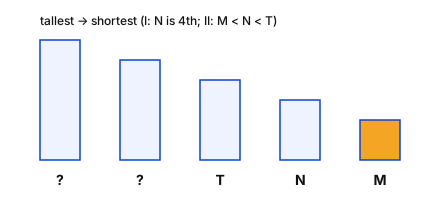
  1. (I) alone: N is shorter than only three ⇒ N is 4th tallest, i.e. exactly one tree is shorter than N – but we don't know which. Not sufficient.
  2. (II) alone: M < N < T. L and V are unplaced, so the shortest could be M, L or V. Not sufficient.
  3. Together: only one tree is below N, and (II) says M is below N ⇒ M is the shortest. Sufficient.

Trick: "Shorter than only three" = 4th position in a group of 5 – convert such phrases to ranks immediately.

Answer: (D) Both statements I and II together (and not statement I alone or statement II alone) are sufficient

अवधारणा: पहले हर कथन अकेले, फिर दोनों साथ जाँचें; जैसे ही सबसे छोटा पेड़ अद्वितीय रूप से तय हो, रुक जाएँ।

  1. (I) अकेले: N केवल तीन से छोटा ⇒ N चौथे स्थान पर, यानी N से छोटा ठीक एक पेड़ है – पर कौन, पता नहीं। अपर्याप्त।
  2. (II) अकेले: M < N < T। L और V का स्थान नहीं, सबसे छोटा M, L या V हो सकता है। अपर्याप्त।
  3. दोनों साथ: N से नीचे केवल एक पेड़, और (II) कहता है M, N से छोटा ⇒ M सबसे छोटा। पर्याप्त।

ट्रिक: "केवल तीन से छोटा" = 5 में चौथा स्थान – ऐसे वाक्यों को तुरंत रैंक में बदलें।

उत्तर: (D) दोनों कथन I और II मिलकर पर्याप्त हैं

RRB NTPC Graduate CBT 1General Intelligence and ReasoningData SufficiencyRRB NTPC Graduate CBT 1 2025 · 19 Mar Shift 2 →