Question bank

Q&A: practice questions with answers

Search questions on any topic. Filter by exam category, exam, subject and topic, try the question, then open the answer and explanation.

Courses – airGurukul

7,077 questions found.

Q6121.
The distance between two points on a map is 4 cm. The scale of the map is 1 : 829483. The actual distance between the two points (in km) is:
(Round off your answer to two decimal places.)
एक मानचित्र पर दो बिंदुओं के बीच की दूरी 4 cm है। मानचित्र का पैमाना 1 : 829483 है। दोनों बिंदुओं के बीच की वास्तविक दूरी (km में) है:
(अपने उत्तर को दो दशमलव स्थानों तक पूर्णांकित करें।)
  1. A38.85
  2. B33.63
  3. C30.25
  4. D33.18
Show answer

Concept: Scale 1 : 829483 means 1 cm on the map = 829483 cm on the ground.

  1. Actual distance = 4×829483=3,317,932 cm.
  2. Convert: 1 km = 100000 cm, so 3317932100000=33.17932 km.
  3. Rounded to two decimals: 33.18 km.

Trick: 829483 cm≈8.29 km; 4×8.295≈33.18.

Answer: (D) 33.18

अवधारणा: पैमाना 1 : 829483 का अर्थ – मानचित्र का 1 cm = ज़मीन पर 829483 cm।

  1. वास्तविक दूरी = 4×829483=3,317,932 cm।
  2. 1 km = 100000 cm, अतः 3317932100000=33.17932 km।
  3. दो दशमलव तक: 33.18 km।

ट्रिक: 829483 cm≈8.29 km; 4×8.295≈33.18।

उत्तर: (D) 33.18

RRB NTPC Graduate CBT 1MathematicsRatio – Map ScaleRRB NTPC Graduate CBT 1 2025 · 19 Mar Shift 1 →
Q6122.
Solve the following system of linear equations:
−p+2q−3r=−9
p−3q+r=6
2p−5q+5r=17
रैखिक समीकरणों के निम्नलिखित निकाय को हल करें:
−p+2q−3r=−9
p−3q+r=6
2p−5q+5r=17
  1. Ap = −1, q = 3, r = 2
  2. Bp = 1, q = −1, r = 2
  3. Cp = 1, q = 1, r = −2
  4. Dp = −1, q = −1, r = 3
Show answer

Concept: Add equations to eliminate one variable, or simply verify the options.

  1. Adding (1) and (2): −q−2r=−3⇒q+2r=3.
  2. (2)×2 − (3): 2p−6q+2r−2p+5q−5r=12−17⇒−q−3r=−5⇒q+3r=5.
  3. Subtracting: r=2, q=3−4=−1; from (2): p=6+3q−r=6−3−2=1.
  4. Check (1): −1−2−6=−9 ✓.

Trick: Put each option in the easiest equation p−3q+r=6: only (B) gives 1+3+2=6.

Answer: (B) p=1, q=−1, r=2

अवधारणा: समीकरण जोड़कर एक चर हटाएँ, या विकल्पों की जाँच करें।

  1. (1)+(2): −q−2r=−3⇒q+2r=3।
  2. (2)×2 − (3): −q−3r=−5⇒q+3r=5।
  3. घटाने पर r=2, q=3−4=−1; (2) से p=6+3q−r=6−3−2=1।
  4. जाँच (1): −1−2−6=−9 ✓।

ट्रिक: हर विकल्प को सबसे सरल समीकरण p−3q+r=6 में रखें: केवल (B) से 1+3+2=6।

उत्तर: (B) p=1, q=−1, r=2

RRB NTPC Graduate CBT 1MathematicsLinear Equations in Three VariablesRRB NTPC Graduate CBT 1 2025 · 19 Mar Shift 1 →
Q6123.
Evaluate: (-9) - (-56) ÷ (-14) + (-4) × 8
मान ज्ञात करें: (-9) - (-56) ÷ (-14) + (-4) × 8
  1. A-48
  2. B-47
  3. C-44
  4. D-45
Show answer

Concept: Division and multiplication first, then addition/subtraction from left to right.

  1. (−56)÷(−14)=4 and (−4)×8=−32.
  2. Expression = −9−4+(−32)=−13−32=−45.

Trick: Negative ÷ negative = positive; watch the minus sign before the division result.

Answer: (D) −45

अवधारणा: पहले भाग और गुणा, फिर बाएँ से दाएँ जोड़/घटाव।

  1. (−56)÷(−14)=4 तथा (−4)×8=−32।
  2. व्यंजक = −9−4+(−32)=−13−32=−45।

ट्रिक: ऋण ÷ ऋण = धन; भाग के परिणाम से पहले लगे ऋण चिह्न का ध्यान रखें।

उत्तर: (D) −45

RRB NTPC Graduate CBT 1MathematicsSimplification – BODMASRRB NTPC Graduate CBT 1 2025 · 19 Mar Shift 1 →
Q6124.
What is the median if the mode of distribution is 48 and the mean is 72?
यदि किसी बंटन का बहुलक (mode) 48 और माध्य (mean) 72 है, तो माध्यिका (median) क्या है?
  1. A62
  2. B64
  3. C54
  4. D60
Show answer

Concept: For a moderately skewed distribution, Mode=3Median−2Mean.

  1. 48=3Median−2×72=3Median−144.
  2. 3Median=192⇒Median=64.

Trick: Median always lies between mode and mean, one-third of the way from the mean: 72−72−483=64.

Answer: (B) 64

अवधारणा: मध्यम विषम बंटन के लिए Mode=3Median−2Mean।

  1. 48=3Median−2×72=3Median−144।
  2. 3Median=192⇒Median=64।

ट्रिक: माध्यिका (median) सदैव बहुलक और माध्य के बीच, माध्य से एक-तिहाई दूरी पर: 72−72−483=64।

उत्तर: (B) 64

RRB NTPC Graduate CBT 1MathematicsStatistics – Empirical RelationRRB NTPC Graduate CBT 1 2025 · 19 Mar Shift 1 →
Q6125.
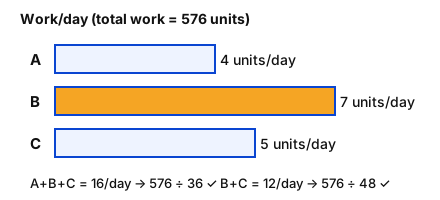
A, B and C together can complete a certain work in 36 days. B and C together can complete the same work in 48 days. B is 75% more efficient than A. A, B and C work together for 15 days. B alone will complete the remaining work in:
A, B और C मिलकर एक निश्चित काम को 36 दिनों में पूरा कर सकते हैं। B और C मिलकर उसी काम को 48 दिनों में पूरा कर सकते हैं। B, A से 75% अधिक कार्यकुशल है। A, B और C 15 दिनों तक मिलकर काम करते हैं। B अकेला शेष काम को कितने समय में पूरा करेगा:
  1. A48 days48 दिन
  2. B51 days51 दिन
  3. C53 days53 दिन
  4. D44 days44 दिन
Show answer

Concept: Take total work = LCM; efficiency ratio converts to units per day.

  1. Total work = LCM(36, 48) = 144 units. (A+B+C) = 4/day, (B+C) = 3/day → A = 1/day.
  2. B is 75% more efficient than A → B = 1.75/day; C = 3−1.75=1.25/day. To avoid decimals multiply by 4: work = 576, A = 4, B = 7, C = 5, total 16/day.
  3. Work done in 15 days = 15×16=240; remaining = 576−240=336.
  4. B alone: 3367=48 days.

Trick: 15 of 36 days done → 2136=712 of work left; B does 7576 per day → 712×5767=48.

Answer: (A) 48 days

अवधारणा: कुल कार्य = LCM; दक्षता-अनुपात को प्रतिदिन इकाइयों में बदलें।

  1. कुल कार्य = LCM(36, 48) = 144 इकाई। (A+B+C) = 4/दिन, (B+C) = 3/दिन → A = 1/दिन।
  2. B, A से 75% अधिक दक्ष → B = 1.75/दिन; C = 3−1.75=1.25/दिन। दशमलव हटाने के लिए 4 से गुणा: कार्य = 576, A = 4, B = 7, C = 5, कुल 16/दिन।
  3. 15 दिन में कार्य = 15×16=240; शेष = 576−240=336।
  4. B अकेला: 3367=48 दिन।

ट्रिक: 36 में से 15 दिन हो गए → 712 कार्य शेष; B प्रतिदिन 7576 करता है → 712×5767=48।

उत्तर: (A) 48 days

RRB NTPC Graduate CBT 1MathematicsTime and Work – EfficiencyRRB NTPC Graduate CBT 1 2025 · 19 Mar Shift 1 →
Q6126.
The number of ordered pair of positive integral solutions (a, b) such that the HCF of a and b is 28 and a + b = 868 is
धनात्मक पूर्णांक हलों के क्रमित युग्मों (ordered pairs) (a, b) की संख्या, जिनके लिए a और b का HCF 28 है तथा a + b = 868 है, है
  1. A20
  2. B25
  3. C15
  4. D30
Show answer

Concept: If HCF(a, b) = 28, write a=28x, b=28y with HCF(x, y) = 1.

  1. 28x+28y=868⇒x+y=86828=31.
  2. 31 is prime, so any pair with x+y=31 is automatically co-prime (a common factor of x and y would divide 31).
  3. x can be 1, 2, …, 30 → 30 ordered pairs (a, b).

Trick: Number of co-prime ordered pairs with sum n = ϕ(n); for prime 31 it is 30.

Answer: (D) 30

अवधारणा: HCF(a, b) = 28 हो तो a=28x, b=28y जहाँ HCF(x, y) = 1।

  1. 28x+28y=868⇒x+y=86828=31।
  2. 31 अभाज्य है, अतः x+y=31 वाला हर युग्म स्वतः सह-अभाज्य है (x, y का उभयनिष्ठ गुणनखंड 31 को विभाजित करता)।
  3. x = 1, 2, …, 30 → 30 क्रमित युग्म (a, b)।

ट्रिक: योग n वाले सह-अभाज्य क्रमित युग्मों की संख्या = ϕ(n); अभाज्य 31 के लिए 30।

उत्तर: (D) 30

RRB NTPC Graduate CBT 1MathematicsHCF – Co-prime PairsRRB NTPC Graduate CBT 1 2025 · 19 Mar Shift 1 →
Q6127.
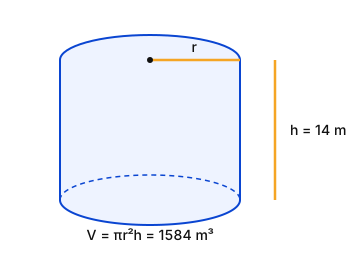
The volume of a cylindrical tank is 1584 cubic meters. If the height of the tank is 14 m, then find the diameter of the tank. (Use π=227)
एक बेलनाकार टंकी का आयतन 1584 घन मीटर है। यदि टंकी की ऊँचाई 14 m है, तो टंकी का व्यास ज्ञात करें। (Use π=227)
  1. A6 m
  2. B12 m
  3. C18 m
  4. D9 m
Show answer

Concept: Volume of a cylinder V=πr2h.

  1. 227×r2×14=1584⇒44r2=1584.
  2. r2=36⇒r=6 m.
  3. Diameter =2r=12 m.

Trick: πh=227×14=44; so r2=158444=36.

Answer: (B) 12 m

अवधारणा: बेलन का आयतन V=πr2h।

  1. 227×r2×14=1584⇒44r2=1584।
  2. r2=36⇒r=6 m।
  3. व्यास =2r=12 m।

ट्रिक: πh=227×14=44; अतः r2=158444=36।

उत्तर: (B) 12 m

RRB NTPC Graduate CBT 1MathematicsMensuration – CylinderRRB NTPC Graduate CBT 1 2025 · 19 Mar Shift 1 →
Q6128.
There are 46 members in group A, 15 members in group B and 11 members in group C. All the members of these groups went to a restaurant. The average amounts spent on each member of groups A, B and C are ₹496, ₹106 and ₹406, respectively. The overall average amount (in ₹) spent per member is:
समूह A में 46 सदस्य, समूह B में 15 सदस्य और समूह C में 11 सदस्य हैं। इन समूहों के सभी सदस्य एक रेस्तरां में गए। समूह A, B और C के प्रत्येक सदस्य पर खर्च की गई औसत राशि क्रमशः ₹496, ₹106 और ₹406 है। प्रति सदस्य खर्च की गई समग्र औसत राशि (₹ में) है:
  1. A403
  2. B396
  3. C399
  4. D401
Show answer

Concept: Overall average = total amount ÷ total members.

  1. Total = 46×496+15×106+11×406=22816+1590+4466=28872.
  2. Members = 46+15+11=72.
  3. Average = 2887272=401.

Trick: Deviations from 400: 46×96−15×294+11×6=4416−4410+66=72; 7272=1 → 401.

Answer: (D) 401

अवधारणा: कुल औसत = कुल राशि ÷ कुल सदस्य।

  1. कुल = 46×496+15×106+11×406=22816+1590+4466=28872।
  2. सदस्य = 46+15+11=72।
  3. औसत = 2887272=401।

ट्रिक: 400 से विचलन: 46×96−15×294+11×6=4416−4410+66=72; 7272=1 → 401।

उत्तर: (D) 401

RRB NTPC Graduate CBT 1MathematicsWeighted AverageRRB NTPC Graduate CBT 1 2025 · 19 Mar Shift 1 →
Q6129.
If x+y+z=10, x2+y2+z2=38, 5xyz=150 and (xy+yz+zx)=31, then what is the value of 2(x3+y3+z3)?
यदि x+y+z=10, x2+y2+z2=38, 5xyz=150 और (xy+yz+zx)=31 है, तो 2(x3+y3+z3) का मान क्या है?
  1. A520
  2. B320
  3. C260
  4. D160
Show answer

Concept: x3+y3+z3−3xyz=(x+y+z)(x2+y2+z2−xy−yz−zx).

  1. 5xyz=150⇒xyz=30.
  2. x3+y3+z3=10×(38−31)+3×30=70+90=160.
  3. 2(x3+y3+z3)=320.

Trick: Check consistency: (x+y+z)2=38+2×31=100 ✓, so the data fits.

Answer: (B) 320

अवधारणा: x3+y3+z3−3xyz=(x+y+z)(x2+y2+z2−xy−yz−zx)।

  1. 5xyz=150⇒xyz=30।
  2. x3+y3+z3=10×(38−31)+3×30=70+90=160।
  3. 2(x3+y3+z3)=320।

ट्रिक: जाँच: (x+y+z)2=38+2×31=100 ✓, अतः आँकड़े सही हैं।

उत्तर: (B) 320

RRB NTPC Graduate CBT 1MathematicsAlgebraic IdentitiesRRB NTPC Graduate CBT 1 2025 · 19 Mar Shift 1 →
Q6130.
During a sale 35% of the goods are sold at 22% profit, 40% of the remaining goods are sold at 37% profit and the still remaining goods are sold at a loss of 38%. If there is an overall profit of x%, then what is the value of x?
एक सेल (sale) के दौरान 35% वस्तुएँ 22% लाभ पर बेची जाती हैं, शेष वस्तुओं का 40% भाग 37% लाभ पर बेचा जाता है और फिर भी बची हुई वस्तुएँ 38% की हानि पर बेची जाती हैं। यदि कुल मिलाकर x% का लाभ होता है, तो x का मान क्या है?
  1. A10.8
  2. B5.4
  3. C2.5
  4. D6.8
Show answer

Concept: Take total cost = 100; overall profit % = weighted sum of profits of each part.

  1. Part 1: 35% at 22% profit → 35×0.22=7.7.
  2. Remaining 65%; 40% of it = 26% at 37% profit → 26×0.37=9.62.
  3. Rest = 65−26=39% at 38% loss → 39×0.38=14.82 loss.
  4. Net = 7.7+9.62−14.82=2.5, so x=2.5.

Trick: Split goods as 35 : 26 : 39 and multiply by +22, +37, −38 respectively.

Answer: (C) 2.5

अवधारणा: कुल लागत = 100 मानें; कुल लाभ % = हर भाग के लाभ का भारित योग।

  1. भाग 1: 35% पर 22% लाभ → 35×0.22=7.7।
  2. शेष 65%; इसका 40% = 26% पर 37% लाभ → 26×0.37=9.62।
  3. बाकी = 65−26=39% पर 38% हानि → 39×0.38=14.82 हानि।
  4. शुद्ध = 7.7+9.62−14.82=2.5, अतः x=2.5।

ट्रिक: माल को 35 : 26 : 39 में बाँटें और क्रमशः +22, +37, −38 से गुणा करें।

उत्तर: (C) 2.5

RRB NTPC Graduate CBT 1MathematicsProfit and Loss – Mixed SaleRRB NTPC Graduate CBT 1 2025 · 19 Mar Shift 1 →
Q6131.
Subrata gets double the amount in 8 years when invested at compound interest, compounded annually. In how many years will the amount become eight times itself?
वार्षिक रूप से संयोजित चक्रवृद्धि ब्याज पर निवेश करने पर सुब्रत को 8 वर्षों में दोगुनी राशि प्राप्त होती है। कितने वर्षों में यह राशि अपने आप की आठ गुनी हो जाएगी?
  1. A24
  2. B64
  3. C32
  4. D16
Show answer

Concept: Under compound interest, if money becomes k times in n years, it becomes km times in mn years.

  1. Doubles in 8 years: (1+r)8=2.
  2. Eight times =23 → (1+r)24=23=8.
  3. Time = 3×8=24 years.

Trick: 2× in 8 yrs → 4× in 16 yrs → 8× in 24 yrs (keep multiplying by 2 every 8 years).

Answer: (A) 24

अवधारणा: चक्रवृद्धि ब्याज में यदि धन n वर्ष में k गुना हो, तो mn वर्ष में km गुना होता है।

  1. 8 वर्ष में दोगुना: (1+r)8=2।
  2. आठ गुना =23 → (1+r)24=23=8।
  3. समय = 3×8=24 वर्ष।

ट्रिक: 8 वर्ष में 2× → 16 वर्ष में 4× → 24 वर्ष में 8× (हर 8 वर्ष में 2 से गुणा)।

उत्तर: (A) 24

RRB NTPC Graduate CBT 1MathematicsCompound Interest – DoublingRRB NTPC Graduate CBT 1 2025 · 19 Mar Shift 1 →
Q6132.
In what duration (in years) will ₹8,400 fetch a simple interest of ₹840 at 4% per annum rate of interest?
4% वार्षिक ब्याज दर पर ₹8,400 कितनी अवधि (वर्षों में) में ₹840 का साधारण ब्याज अर्जित करेगा?
  1. A1.5
  2. B2.5
  3. C3.5
  4. D5
Show answer

Concept: SI=P×R×T100.

  1. 840=8400×4×T100=336T.
  2. T=840336=2.5 years.

Trick: SI is 10% of principal; at 4% per year that needs 104=2.5 years.

Answer: (B) 2.5

अवधारणा: SI=P×R×T100।

  1. 840=8400×4×T100=336T।
  2. T=840336=2.5 वर्ष।

ट्रिक: ब्याज मूलधन का 10% है; 4% वार्षिक दर पर 104=2.5 वर्ष लगेंगे।

उत्तर: (B) 2.5

RRB NTPC Graduate CBT 1MathematicsSimple InterestRRB NTPC Graduate CBT 1 2025 · 19 Mar Shift 1 →
Q6133.
Find the value of m, satisfying equation:
(174)9×(417)8×(174)15=(417)5m+15
समीकरण को संतुष्ट करने वाले m का मान ज्ञात करें:
(174)9×(417)8×(174)15=(417)5m+15
  1. A−395
  2. B−405
  3. C−325
  4. D−315
Show answer

Concept: (ab)−n=(ba)n and am×an=am+n.

  1. Write (417)8=(174)−8. LHS =(174)9−8+15=(174)16.
  2. (174)16=(417)−16, so 5m+15=−16.
  3. 5m=−31⇒m=−315.

Trick: Bring every term to the same base 417: powers become −9,+8,−15 → sum −16.

Answer: (D) −315

अवधारणा: (ab)−n=(ba)n तथा am×an=am+n।

  1. (417)8=(174)−8 लिखें। LHS =(174)9−8+15=(174)16।
  2. (174)16=(417)−16, अतः 5m+15=−16।
  3. 5m=−31⇒m=−315।

ट्रिक: हर पद को एक ही आधार 417 में लाएँ: घातें −9,+8,−15 → योग −16।

उत्तर: (D) −315

RRB NTPC Graduate CBT 1MathematicsIndices – Laws of ExponentsRRB NTPC Graduate CBT 1 2025 · 19 Mar Shift 1 →
Q6134.
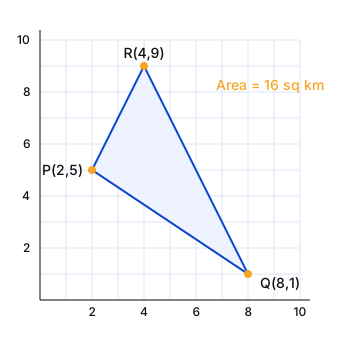
A geological survey team has established three research stations forming a triangular monitoring zone. The stations are located at coordinates P(2,5), Q(8,1), and R(4,9) on a coordinate grid where each unit represents 1 kilometer. What is the area of the triangular monitoring zone?
एक भूवैज्ञानिक सर्वेक्षण दल ने तीन अनुसंधान स्टेशन स्थापित किए हैं जो एक त्रिभुजाकार निगरानी क्षेत्र बनाते हैं। स्टेशन एक निर्देशांक ग्रिड पर निर्देशांक P(2,5), Q(8,1) और R(4,9) पर स्थित हैं, जहाँ प्रत्येक इकाई 1 किलोमीटर दर्शाती है। त्रिभुजाकार निगरानी क्षेत्र का क्षेत्रफल क्या है?
  1. A10 square kilometers10 वर्ग किलोमीटर
  2. B14 square kilometers14 वर्ग किलोमीटर
  3. C12 square kilometers12 वर्ग किलोमीटर
  4. D16 square kilometers16 वर्ग किलोमीटर
Show answer

Concept: Area of a triangle with vertices (x1,y1),(x2,y2),(x3,y3) is 12|x1(y2−y3)+x2(y3−y1)+x3(y1−y2)|.

  1. P(2,5), Q(8,1), R(4,9): 2(1−9)+8(9−5)+4(5−1).
  2. =−16+32+16=32.
  3. Area =12×32=16 square km.

Trick: Shoelace method – write the three points in a column, repeat the first, cross-multiply down and up, halve the difference.

Answer: (D) 16 square kilometers

अवधारणा: शीर्ष (x1,y1),(x2,y2),(x3,y3) वाले त्रिभुज का क्षेत्रफल =12|x1(y2−y3)+x2(y3−y1)+x3(y1−y2)|।

  1. P(2,5), Q(8,1), R(4,9): 2(1−9)+8(9−5)+4(5−1)।
  2. =−16+32+16=32।
  3. क्षेत्रफल =12×32=16 वर्ग km।

ट्रिक: शूलेस (shoelace) विधि – तीनों बिंदु एक कॉलम में लिखें, पहला दोहराएँ, नीचे-ऊपर क्रॉस गुणा करें, अंतर का आधा लें।

उत्तर: (D) 16 वर्ग किलोमीटर

RRB NTPC Graduate CBT 1MathematicsCoordinate geometry – area of triangleRRB NTPC Graduate CBT 1 2025 · 19 Mar Shift 1 →
Q6135.
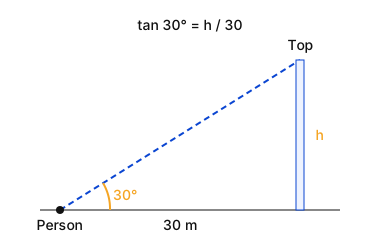
In a park, there is a flagpole. A person standing 30 m away from the flagpole observes that the angle of elevation of the top of the flagpole is 30°. Determine the height (in metres) of the flagpole.
एक पार्क में एक ध्वज-स्तंभ (flagpole) है। ध्वज-स्तंभ से 30 m दूर खड़ा एक व्यक्ति देखता है कि ध्वज-स्तंभ के शीर्ष का उन्नयन कोण 30° है। ध्वज-स्तंभ की ऊँचाई (मीटर में) निर्धारित करें।
  1. A403
  2. B203
  3. C103
  4. D303
Show answer

Concept: In the right triangle formed by the pole, the ground and the line of sight, tanθ=heightdistance.

  1. tan30∘=h30.
  2. h=30×13=303=103 m.

Trick: With 30∘ the height is always the base divided by 3; with 60∘ it is the base times 3.

Answer: (C) 103

अवधारणा: खंभे, ज़मीन और दृष्टि-रेखा से बने समकोण त्रिभुज में tanθ=ऊँचाईदूरी।

  1. tan30∘=h30।
  2. h=30×13=303=103 m।

ट्रिक: 30∘ पर ऊँचाई = आधार ÷3; 60∘ पर ऊँचाई = आधार ×3।

उत्तर: (C) 103

RRB NTPC Graduate CBT 1MathematicsHeights and distancesRRB NTPC Graduate CBT 1 2025 · 19 Mar Shift 1 →
Q6136.
What is the average of 7, 9 and 11?
7, 9 और 11 का औसत क्या है?
  1. A9
  2. B7
  3. C10
  4. D8
Show answer

Concept: Average =sum of termsnumber of terms.

  1. 7+9+11=27.
  2. 273=9.

Trick: For numbers in arithmetic progression the average is simply the middle term – here 9.

Answer: (A) 9

अवधारणा: औसत =पदों का योगपदों की संख्या।

  1. 7+9+11=27।
  2. 273=9।

ट्रिक: समांतर श्रेणी (AP) की संख्याओं का औसत बीच वाला पद होता है – यहाँ 9।

उत्तर: (A) 9

RRB NTPC Graduate CBT 1MathematicsAverageRRB NTPC Graduate CBT 1 2025 · 19 Mar Shift 1 →
Q6137.
What is the value of (7x+6y), if mean of the following distribution is 50?
Class0-2020-4040-6060-8080-100Total
Frequency619x5y59
यदि निम्नलिखित बंटन का माध्य 50 है, तो (7x+6y) का मान क्या है?
वर्ग0-2020-4040-6060-8080-100कुल
बारंबारता619x5y59
  1. A190
  2. B200
  3. C182
  4. D170
Show answer

Concept: For grouped data, mean =∑fixi∑fi where xi is the class mark. Two unknowns need two equations: the total frequency and the mean.

  1. Total: 6+19+x+5+y=59⇒x+y=29.
  2. Class marks 10, 30, 50, 70, 90: ∑fixi=60+570+50x+350+90y=980+50x+90y.
  3. Mean 50: 980+50x+90y=50×59=2950⇒5x+9y=197.
  4. Put x=29−y: 145+4y=197⇒y=13, x=16. So 7x+6y=112+78=190.

Trick: Use the assumed mean 50: deviations −40,−20,0,20,40 give −240−380+100+40y=0⇒y=13 in one line.

Answer: (A) 190

अवधारणा: वर्गीकृत आँकड़ों का माध्य =∑fixi∑fi, जहाँ xi वर्ग-चिह्न है। दो अज्ञात के लिए दो समीकरण: कुल बारंबारता और माध्य।

  1. कुल: 6+19+x+5+y=59⇒x+y=29।
  2. वर्ग-चिह्न 10, 30, 50, 70, 90: ∑fixi=60+570+50x+350+90y=980+50x+90y।
  3. माध्य 50: 980+50x+90y=50×59=2950⇒5x+9y=197।
  4. x=29−y रखें: 145+4y=197⇒y=13, x=16। अतः 7x+6y=112+78=190।

ट्रिक: कल्पित माध्य 50 लें: विचलन −40,−20,0,20,40 से −240−380+100+40y=0⇒y=13 एक ही पंक्ति में।

उत्तर: (A) 190

RRB NTPC Graduate CBT 1MathematicsStatistics – mean of grouped dataRRB NTPC Graduate CBT 1 2025 · 19 Mar Shift 1 →
Q6138.
The ratio of the salaries of A and B is 4 : 5. If A's salary is increased by 20% and B's salary is decreased by 10%, what is the new ratio of their salaries?
A और B के वेतन का अनुपात 4 : 5 है। यदि A के वेतन में 20% की वृद्धि की जाती है और B के वेतन में 10% की कमी की जाती है, तो उनके वेतन का नया अनुपात क्या है?
  1. A16 : 15
  2. B14 : 13
  3. C15 : 14
  4. D13 : 12
Show answer

Concept: Multiply each part of the ratio by its own percentage factor.

  1. A: 4×120100=4.8; B: 5×90100=4.5.
  2. New ratio 4.8:4.5=48:45=16:15.

Trick: 4×12:5×9=48:45 – drop the 100s, they cancel.

Answer: (A) 16 : 15

अवधारणा: अनुपात के हर भाग को उसके अपने प्रतिशत गुणक से गुणा करें।

  1. A: 4×120100=4.8; B: 5×90100=4.5।
  2. नया अनुपात 4.8:4.5=48:45=16:15।

ट्रिक: 4×12:5×9=48:45 – 100 आपस में कट जाते हैं।

उत्तर: (A) 16 : 15

RRB NTPC Graduate CBT 1MathematicsRatio – percentage changeRRB NTPC Graduate CBT 1 2025 · 19 Mar Shift 1 →
Q6139.
If a boat travels with a speed of 12 km/hr in still water and the speed of stream is 3 km/hr, what would be the time taken (in hours) by boat to go 60 km downstream?
यदि एक नाव शांत जल में 12 km/hr की चाल से चलती है और धारा की चाल 3 km/hr है, तो नाव को धारा के अनुकूल 60 km जाने में कितना समय (घंटों में) लगेगा?
  1. A4
  2. B9
  3. C5
  4. D6
Show answer

Concept: Downstream speed = speed in still water + speed of stream; time =distancespeed.

  1. Downstream speed =12+3=15km/h.
  2. Time =6015=4 hours.

Trick: Down = add, Up = subtract. Downstream is always the faster, shorter trip.

Answer: (A) 4

अवधारणा: धारा के अनुकूल चाल = शांत जल की चाल + धारा की चाल; समय =दूरीचाल।

  1. अनुकूल चाल =12+3=15km/h।
  2. समय =6015=4 घंटे।

ट्रिक: अनुकूल = जोड़ें, प्रतिकूल = घटाएँ। अनुकूल यात्रा हमेशा तेज़ और कम समय की होती है।

उत्तर: (A) 4

RRB NTPC Graduate CBT 1MathematicsBoats and streamsRRB NTPC Graduate CBT 1 2025 · 19 Mar Shift 1 →
Q6140.
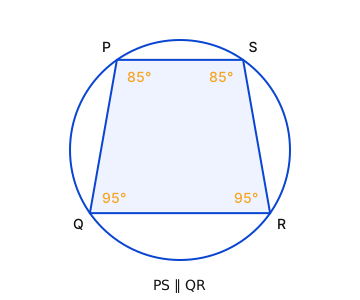
PQRS is a cyclic trapezium with PS parallel to QR. If ­∠P = 85°, then the other three angles are:
PQRS एक चक्रीय समलंब (cyclic trapezium) है जिसमें PS, QR के समांतर है। यदि ∠P = 85° है, तो अन्य तीन कोण हैं:
  1. A∠Q = 85°, ­∠R = 95°, ­∠S = 95°
  2. B∠Q = 85°, ­∠R = 85°, ­∠S = 95°
  3. C∠Q = 95°, ­∠R = 85°, ­∠S = 95°
  4. D∠Q = 95°, ­∠R = 95°, ­∠S = 85°
Show answer

Concept: Opposite angles of a cyclic quadrilateral add to 180∘; co-interior angles between parallel sides also add to 180∘.

  1. PS ∥ QR, PQ is a transversal: ∠P+∠Q=180∘⇒∠Q=95∘.
  2. Cyclic: ∠P+∠R=180∘⇒∠R=95∘.
  3. Cyclic: ∠Q+∠S=180∘⇒∠S=85∘.

Trick: A cyclic trapezium is always isosceles – base angles equal in pairs: ∠P=∠S, ∠Q=∠R.

Answer: (D) ∠Q=95∘, ∠R=95∘, ∠S=85∘

अवधारणा: चक्रीय चतुर्भुज के सम्मुख कोणों का योग 180∘; समांतर भुजाओं के बीच सह-अंतः कोणों का योग भी 180∘।

  1. PS ∥ QR, PQ तिर्यक रेखा: ∠P+∠Q=180∘⇒∠Q=95∘।
  2. चक्रीय: ∠P+∠R=180∘⇒∠R=95∘।
  3. चक्रीय: ∠Q+∠S=180∘⇒∠S=85∘।

ट्रिक: चक्रीय समलंब हमेशा समद्विबाहु होता है – आधार कोण जोड़े में बराबर: ∠P=∠S, ∠Q=∠R।

उत्तर: (D) ∠Q=95∘, ∠R=95∘, ∠S=85∘

RRB NTPC Graduate CBT 1MathematicsCyclic quadrilateralRRB NTPC Graduate CBT 1 2025 · 19 Mar Shift 1 →