Question bank

Q&A: practice questions with answers

Search questions on any topic. Filter by exam category, exam, subject and topic, try the question, then open the answer and explanation.

Courses – airGurukul

7,077 questions found.

Q6141.
A boat moves at a speed of 7 km/h in still water. The boat goes 40 km downstream and then 40 km upstream. It is observed that the total time taken for this journey is 560 minutes less than the time it would take if the speed of the stream were 2 km/h faster. What is the initial speed (in km/h) of the stream?
एक नाव शांत जल में 7 km/h की चाल से चलती है। नाव धारा के अनुकूल 40 km जाती है और फिर धारा के प्रतिकूल 40 km जाती है। यह देखा गया है कि इस यात्रा में लगा कुल समय उस समय से 560 मिनट कम है जो धारा की चाल 2 km/h अधिक होने पर लगता। धारा की प्रारंभिक चाल (km/h में) क्या है?
  1. A3.5
  2. B4.5
  3. C4
  4. D3
Show answer

Concept: Round-trip time with boat speed b and stream s: db+s+db−s=2bdb2−s2.

  1. With b=7, d=40: time =56049−s2 hours.
  2. 560 minutes =283 h. Condition: 56049−(s+2)2−56049−s2=283.
  3. Try s=3: 56024−56040=703−14=283. ✓

Trick: Options are small – plug them in. 49−s2 should divide 560 nicely: s=3 gives 40 and s=5 gives 24.

Answer: (D) 3

अवधारणा: नाव की चाल b, धारा s पर आने-जाने का समय: db+s+db−s=2bdb2−s2।

  1. b=7, d=40: समय =56049−s2 घंटे।
  2. 560 मिनट =283 घंटे। शर्त: 56049−(s+2)2−56049−s2=283।
  3. s=3 रखें: 56024−56040=703−14=283। ✓

ट्रिक: विकल्प छोटे हैं – सीधे रखकर देखें। 49−s2 से 560 साफ़ कटना चाहिए: s=3 पर 40 और s=5 पर 24।

उत्तर: (D) 3

RRB NTPC Graduate CBT 1MathematicsBoats and streamsRRB NTPC Graduate CBT 1 2025 · 19 Mar Shift 1 →
Q6142.
Which of the following is equivalent to the expression 1.20.3+2.40.6?
निम्नलिखित में से कौन-सा व्यंजक 1.20.3+2.40.6 के समतुल्य है?
  1. A4
  2. B6
  3. C5
  4. D8
Show answer

Concept: Multiply numerator and denominator by 10 to remove decimals, then divide.

  1. 1.20.3=123=4.
  2. 2.40.6=246=4.
  3. Sum =4+4=8.

Trick: 0.3×4=1.2 and 0.6×4=2.4 – both quotients are 4 by inspection.

Answer: (D) 8

अवधारणा: अंश और हर को 10 से गुणा कर दशमलव हटाएँ, फिर भाग दें।

  1. 1.20.3=123=4।
  2. 2.40.6=246=4।
  3. योग =4+4=8।

ट्रिक: 0.3×4=1.2 और 0.6×4=2.4 – दोनों भागफल देखते ही 4।

उत्तर: (D) 8

RRB NTPC Graduate CBT 1MathematicsDecimal fractionsRRB NTPC Graduate CBT 1 2025 · 19 Mar Shift 1 →
Q6143.
A shopkeeper purchased 52 dozens of articles at the rate of ₹400 per dozen. He sold each one of them at the rate of ₹58. What percentage profit did he make?
एक दुकानदार ने ₹400 प्रति दर्जन की दर से 52 दर्जन वस्तुएँ खरीदीं। उसने उनमें से प्रत्येक को ₹58 की दर से बेचा। उसने कितने प्रतिशत लाभ अर्जित किया?
  1. A73%
  2. B74%
  3. C71%
  4. D75%
Show answer

Concept: Profit% =SP−CPCP×100; compare on the same unit (one dozen).

  1. CP of a dozen = ₹400. SP of a dozen =58×12= ₹696.
  2. Profit per dozen =696−400=296.
  3. Profit% =296400×100=74%.

Trick: The '52 dozens' is a distraction – percentage profit is the same for one dozen.

Answer: (B) 74%

अवधारणा: लाभ% =SP−CPCP×100; एक ही इकाई (एक दर्जन) पर तुलना करें।

  1. एक दर्जन का CP = ₹400। एक दर्जन का SP =58×12= ₹696।
  2. प्रति दर्जन लाभ =696−400=296।
  3. लाभ% =296400×100=74%।

ट्रिक: '52 दर्जन' केवल भटकाने के लिए है – प्रतिशत लाभ एक दर्जन पर भी वही है।

उत्तर: (B) 74%

RRB NTPC Graduate CBT 1MathematicsProfit and lossRRB NTPC Graduate CBT 1 2025 · 19 Mar Shift 1 →
Q6144.
In a business, A, B, and C invest in the ratio 3 : 5 : 4. Out of the total profit, B gives ₹15,000 to A such that A’s share of the profit becomes equal to C’s share. What is the total profit (in ₹) of the business?
एक व्यापार में A, B और C 3 : 5 : 4 के अनुपात में निवेश करते हैं। कुल लाभ में से B, A को ₹15,000 देता है जिससे A का लाभ का हिस्सा C के हिस्से के बराबर हो जाता है। व्यापार का कुल लाभ (₹ में) क्या है?
  1. A1,20,000
  2. B2,40,000
  3. C1,50,000
  4. D1,80,000
Show answer

Concept: Profit is shared in the ratio of investments (same time). Let the total profit be 12k (sum of ratio parts).

  1. A =3k, B =5k, C =4k.
  2. After B gives ₹15,000 to A: 3k+15000=4k⇒k=15000.
  3. Total profit =12k=12×15000= ₹1,80,000.

Trick: The transfer equals the gap between A and C, i.e. one ratio part – so one part = ₹15,000 and total = 12 parts.

Answer: (D) 1,80,000

अवधारणा: समान समय पर लाभ निवेश के अनुपात में बँटता है। कुल लाभ 12k मानें (अनुपात के भागों का योग)।

  1. A =3k, B =5k, C =4k।
  2. B द्वारा A को ₹15,000 देने पर: 3k+15000=4k⇒k=15000।
  3. कुल लाभ =12k=12×15000= ₹1,80,000।

ट्रिक: दी गई राशि A और C के अंतर यानी एक भाग के बराबर है – अतः एक भाग = ₹15,000 और कुल = 12 भाग।

उत्तर: (D) 1,80,000

RRB NTPC Graduate CBT 1MathematicsPartnershipRRB NTPC Graduate CBT 1 2025 · 19 Mar Shift 1 →
Q6145.
A shopkeeper fixes the marked price of an item 100% above its cost price. What percentage of discount on marked price should be allowed to gain 2%?
एक दुकानदार किसी वस्तु का अंकित मूल्य उसके क्रय मूल्य से 100% अधिक निर्धारित करता है। 2% लाभ प्राप्त करने के लिए अंकित मूल्य पर कितने प्रतिशत की छूट दी जानी चाहिए?
  1. A49%
  2. B48%
  3. C50%
  4. D47%
Show answer

Concept: Take CP = 100; marked price and selling price follow from the given percentages.

  1. MP =100+100%=200. Required SP for 2% gain =102.
  2. Discount =200−102=98.
  3. Discount% =98200×100=49%.

Trick: MP×(1−d)=CP×(1+g): 2(1−d)=1.02⇒d=0.49.

Answer: (A) 49%

अवधारणा: CP = 100 मानें; अंकित मूल्य और विक्रय मूल्य दिए प्रतिशतों से निकालें।

  1. MP =100+100%=200। 2% लाभ के लिए SP =102।
  2. छूट =200−102=98।
  3. छूट% =98200×100=49%।

ट्रिक: MP×(1−d)=CP×(1+g): 2(1−d)=1.02⇒d=0.49।

उत्तर: (A) 49%

RRB NTPC Graduate CBT 1MathematicsDiscount and marked priceRRB NTPC Graduate CBT 1 2025 · 19 Mar Shift 1 →
Q6146.
A school employs trained and untrained teachers in the ratio 5 : 3. The salaries of a trained and an untrained teachers are in the ratio 4 : 1. If the total salary paid to all teachers in a month is ₹4,60,000, how much total salary is paid to the untrained teachers?
एक विद्यालय प्रशिक्षित और अप्रशिक्षित शिक्षकों को 5 : 3 के अनुपात में नियोजित करता है। एक प्रशिक्षित और एक अप्रशिक्षित शिक्षक के वेतन 4 : 1 के अनुपात में हैं। यदि एक माह में सभी शिक्षकों को दिया गया कुल वेतन ₹4,60,000 है, तो अप्रशिक्षित शिक्षकों को कुल कितना वेतन दिया जाता है?
  1. A₹45,000
  2. B₹1,20,000
  3. C₹60,000
  4. D₹75,000
Show answer

Concept: Total salary ratio = (number ratio) × (salary ratio) for each group.

  1. Trained : Untrained total =5×4:3×1=20:3.
  2. Untrained share =323×4,60,000.
  3. 4,60,000÷23=20,000; ×3= ₹60,000.

Trick: 4,60,000 is exactly 23×20,000 – the clean division confirms the 20:3 split.

Answer: (C) ₹60,000

अवधारणा: कुल वेतन का अनुपात = (संख्या का अनुपात) × (वेतन का अनुपात), हर समूह के लिए।

  1. प्रशिक्षित : अप्रशिक्षित कुल =5×4:3×1=20:3।
  2. अप्रशिक्षित का हिस्सा =323×4,60,000।
  3. 4,60,000÷23=20,000; ×3= ₹60,000।

ट्रिक: 4,60,000 ठीक 23×20,000 है – साफ़ भाग 20:3 के बँटवारे की पुष्टि करता है।

उत्तर: (C) ₹60,000

RRB NTPC Graduate CBT 1MathematicsRatio and proportionRRB NTPC Graduate CBT 1 2025 · 19 Mar Shift 1 →
Q6147.
What should come in place of ‘?’ in the given series?
23 26 32 41 53 ?
दी गई श्रेणी में ‘?’ के स्थान पर क्या आना चाहिए?
23 26 32 41 53 ?
  1. A66
  2. B68
  3. C72
  4. D70
Show answer

Concept: Take successive differences and look for a simple pattern in them.

  1. 23 → 26 → 32 → 41 → 53: differences 3,6,9,12 (multiples of 3).
  2. Next difference =15, so 53+15=68.

Trick: Differences growing by a constant means the next term = last term + (last difference + that constant).

Answer: (B) 68

अवधारणा: क्रमागत अंतर निकालें और उनमें सरल पैटर्न खोजें।

  1. 23 → 26 → 32 → 41 → 53: अंतर 3,6,9,12 (3 के गुणज)।
  2. अगला अंतर =15, अतः 53+15=68।

ट्रिक: अंतर एक स्थिर मान से बढ़ें तो अगला पद = अंतिम पद + (अंतिम अंतर + वह स्थिरांक)।

उत्तर: (B) 68

RRB NTPC Graduate CBT 1MathematicsNumber seriesRRB NTPC Graduate CBT 1 2025 · 19 Mar Shift 1 →
Q6148.
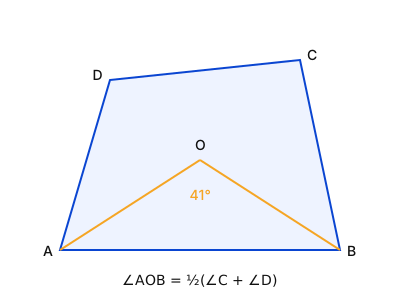
In quadrilateral ABCD, the bisectors of ∠A and ∠B meet at O and ∠AOB=41∘. The value of ∠C+∠D is:
चतुर्भुज ABCD में, ∠A और ∠B के समद्विभाजक O पर मिलते हैं और ∠AOB=41∘। ∠C+∠D का मान है:
  1. A41∘
  2. B98∘
  3. C82∘
  4. D49∘
Show answer

Concept: If the bisectors of ∠A and ∠B of quadrilateral ABCD meet at O, then ∠AOB=12(∠C+∠D).

  1. In △AOB: ∠AOB=180∘−∠A+∠B2.
  2. Since ∠A+∠B=360∘−(∠C+∠D), we get ∠AOB=∠C+∠D2.
  3. ∠C+∠D=2×41∘=82∘.

Trick: Angle between two adjacent angle bisectors of a quadrilateral = half the sum of the other two angles.

Answer: (C) 82∘

अवधारणा: चतुर्भुज ABCD में ∠A और ∠B के समद्विभाजक O पर मिलें तो ∠AOB=12(∠C+∠D)।

  1. △AOB में: ∠AOB=180∘−∠A+∠B2।
  2. चूँकि ∠A+∠B=360∘−(∠C+∠D), अतः ∠AOB=∠C+∠D2।
  3. ∠C+∠D=2×41∘=82∘।

ट्रिक: चतुर्भुज के दो आसन्न कोणों के समद्विभाजकों के बीच का कोण = शेष दो कोणों के योग का आधा।

उत्तर: (C) 82∘

RRB NTPC Graduate CBT 1MathematicsQuadrilateral – angle bisectorsRRB NTPC Graduate CBT 1 2025 · 19 Mar Shift 1 →
Q6149.
Based on the alphabetical order, three of the following four are alike in a certain way and thus form a group. Which is the one that does not belong to that group?
(Note: The odd man out is not based on the number of consonants/vowels or their position in the letter cluster.)
वर्णमाला क्रम के आधार पर, निम्नलिखित चार में से तीन एक निश्चित प्रकार से समान हैं और इस प्रकार एक समूह बनाते हैं। वह कौन-सा है जो उस समूह से संबंधित नहीं है?
(नोट: विषम का चयन व्यंजनों/स्वरों की संख्या या अक्षर-समूह में उनकी स्थिति के आधार पर नहीं किया गया है।)
  1. AMIL
  2. BQMO
  3. CSOQ
  4. DOKM
Show answer

Concept: Write the alphabetical positions and find the gap pattern between letters.

  1. QMO: Q(17) − 4 = M(13), M(13) + 2 = O(15).
  2. SOQ: S(19) − 4 = O(15), O(15) + 2 = Q(17). OKM: O(15) − 4 = K(11), K(11) + 2 = M(13).
  3. MIL: M(13) − 4 = I(9) ✓ but I(9) + 2 = K(11), not L(12). Pattern breaks.

Trick: Pattern is (−4, +2) in each cluster; MIL has (−4, +3).

Answer: (A) MIL

अवधारणा: अक्षरों के स्थान (position) लिखकर उनके बीच का अंतर देखें।

  1. QMO: Q(17) − 4 = M(13), M(13) + 2 = O(15)।
  2. SOQ: S(19) − 4 = O(15), O(15) + 2 = Q(17)। OKM: O(15) − 4 = K(11), K(11) + 2 = M(13)।
  3. MIL: M(13) − 4 = I(9) ✓ परंतु I(9) + 2 = K(11), L(12) नहीं। पैटर्न टूटता है।

ट्रिक: हर समूह में पैटर्न (−4, +2) है; MIL में (−4, +3) है।

उत्तर: (A) MIL

RRB NTPC Graduate CBT 1General Intelligence and ReasoningLetter Cluster ClassificationRRB NTPC Graduate CBT 1 2025 · 19 Mar Shift 1 →
Q6150.
Which of the following letter-number clusters will replace the question mark (?) in the given series to make it logically complete?
MPL 79 KNJ 87 ILH 95 GJF 103 ?
निम्नलिखित में से कौन-सा अक्षर-संख्या समूह दी गई श्रेणी में प्रश्नचिह्न (?) के स्थान पर आकर उसे तार्किक रूप से पूर्ण करेगा?
MPL 79 KNJ 87 ILH 95 GJF 103 ?
  1. AEJP 110
  2. BEIC 111
  3. CEGC 110
  4. DEHD 111
Show answer

Concept: Treat letters and numbers as two separate series.

  1. Letters: M→K→I→G (each −2), P→N→L→J (−2), L→J→H→F (−2). Next: G−2 = E, J−2 = H, F−2 = D → EHD.
  2. Numbers: 79, 87, 95, 103 (+8 each). Next: 103 + 8 = 111.

Trick: Only option with EHD is (D); number 111 confirms it.

Answer: (D) EHD 111

अवधारणा: अक्षरों और संख्याओं को दो अलग श्रृंखलाओं की तरह देखें।

  1. अक्षर: M→K→I→G (हर बार −2), P→N→L→J (−2), L→J→H→F (−2)। अगला: G−2 = E, J−2 = H, F−2 = D → EHD।
  2. संख्याएँ: 79, 87, 95, 103 (हर बार +8)। अगला: 103 + 8 = 111।

ट्रिक: EHD केवल विकल्प (D) में है; 111 इसकी पुष्टि करता है।

उत्तर: (D) EHD 111

RRB NTPC Graduate CBT 1General Intelligence and ReasoningAlphanumeric SeriesRRB NTPC Graduate CBT 1 2025 · 19 Mar Shift 1 →
Q6151.
Select the set in which the numbers are related in the same way as are the numbers of the following sets.
(NOTE: Operations should be performed on the whole numbers, without breaking down the numbers into its constituent digits. E.g. 13 – Operations on 13 such as
adding/subtracting/multiplying etc. to 13 can be performed. Breaking down 13 into 1 and 3 and then performing mathematical operations on 1 and 3 is not allowed.) (9, 17, 7)
(6, 12, 5)
उस समुच्चय का चयन करें जिसमें संख्याएँ उसी प्रकार संबंधित हैं जिस प्रकार निम्नलिखित समुच्चयों की संख्याएँ संबंधित हैं।
(नोट: संक्रियाएँ पूर्ण संख्याओं पर की जानी चाहिए, संख्याओं को उनके घटक अंकों में तोड़े बिना। उदाहरण के लिए 13 – 13 पर संक्रियाएँ जैसे
13 में जोड़ना/घटाना/गुणा करना आदि की जा सकती हैं। 13 को 1 और 3 में तोड़कर फिर 1 और 3 पर गणितीय संक्रियाएँ करने की अनुमति नहीं है।) (9, 17, 7)
(6, 12, 5)
  1. A(6, 12, 4)
  2. B(4, 9, 4)
  3. C(2, 5, 3)
  4. D(9, 17, 5)
Show answer

Concept: Find one rule connecting the three numbers that works for both given sets.

  1. (9, 17, 7): 9+7+1=17 ✓. (6, 12, 5): 6+5+1=12 ✓. Rule: first + third + 1 = middle.
  2. (4, 9, 4): 4+4+1=9 ✓.
  3. (6, 12, 4): 11 ✗; (2, 5, 3): 6 ✗; (9, 17, 5): 15 ✗.

Trick: Middle − (first + third) = 1 in every valid set.

Answer: (B) (4, 9, 4)

अवधारणा: ऐसा नियम खोजें जो तीनों संख्याओं को जोड़े और दोनों दिए गए सेटों में चले।

  1. (9, 17, 7): 9+7+1=17 ✓। (6, 12, 5): 6+5+1=12 ✓। नियम: पहली + तीसरी + 1 = बीच वाली।
  2. (4, 9, 4): 4+4+1=9 ✓।
  3. (6, 12, 4): 11 ✗; (2, 5, 3): 6 ✗; (9, 17, 5): 15 ✗।

ट्रिक: हर सही सेट में बीच वाली − (पहली + तीसरी) = 1।

उत्तर: (B) (4, 9, 4)

RRB NTPC Graduate CBT 1General Intelligence and ReasoningNumber AnalogyRRB NTPC Graduate CBT 1 2025 · 19 Mar Shift 1 →
Q6152.
In a certain code language, ‘LITE’ is coded as ‘3492’ and ‘TIME’ is coded as ‘3954’. What is the code for ‘M’ in the given code language?
एक निश्चित कूट भाषा में, ‘LITE’ को ‘3492’ के रूप में कूटबद्ध किया जाता है और ‘TIME’ को ‘3954’ के रूप में कूटबद्ध किया जाता है। दी गई कूट भाषा में ‘M’ का कूट क्या है?
  1. A3
  2. B4
  3. C9
  4. D5
Show answer

Concept: Common letters in two words get common digits; the leftover letter gets the leftover digit.

  1. LITE → 3 4 9 2 and TIME → 3 9 5 4.
  2. Common letters I, T, E ↔ common digits 3, 4, 9.
  3. Leftover in TIME is M ↔ leftover digit 5.

Trick: Cancel the common letters and digits; what remains is the code.

Answer: (D) 5

अवधारणा: दो शब्दों के उभयनिष्ठ अक्षरों के कोड भी उभयनिष्ठ होते हैं; बचा अक्षर = बचा अंक।

  1. LITE → 3 4 9 2 और TIME → 3 9 5 4।
  2. उभयनिष्ठ अक्षर I, T, E ↔ उभयनिष्ठ अंक 3, 4, 9।
  3. TIME में बचा अक्षर M ↔ बचा अंक 5।

ट्रिक: उभयनिष्ठ अक्षर और अंक काट दें; जो बचे वही कोड है।

उत्तर: (D) 5

RRB NTPC Graduate CBT 1General Intelligence and ReasoningCoding–DecodingRRB NTPC Graduate CBT 1 2025 · 19 Mar Shift 1 →
Q6153.
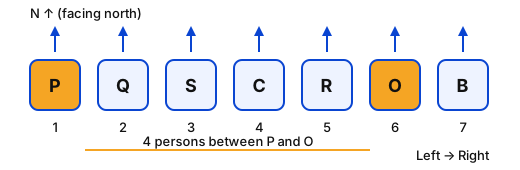
Seven people, B, C, O, P, Q, R and S, are sitting in a straight line, facing north. Q sits second from the left end of the line. Only two people sit between Q and R. C sits immediately to the right of S. O sits immediately to the left of B. Only one person sits between R and S. How many people sit between P and O?
सात व्यक्ति, B, C, O, P, Q, R और S, एक सीधी पंक्ति में उत्तर की ओर मुख करके बैठे हैं। Q पंक्ति के बाएँ छोर से दूसरे स्थान पर बैठा है। Q और R के बीच केवल दो व्यक्ति बैठे हैं। C, S के ठीक दाएँ बैठा है। O, B के ठीक बाएँ बैठा है। R और S के बीच केवल एक व्यक्ति बैठा है। P और O के बीच कितने व्यक्ति बैठे हैं?
  1. AThreeतीन
  2. BOneएक
  3. CTwoदो
  4. DFourचार
Show answer

Concept: Number the seats 1–7 from the left (all face north, so right = higher number) and place the fixed person first.

  1. Q is at seat 2. Two people between Q and R → R at seat 5.
  2. One person between R and S → S at 3 (seat 7 would leave no room for C on S's right). C immediately right of S → C at 4.
  3. Seats 1, 6, 7 are left for P, O, B. O immediately left of B → O at 6, B at 7, so P at 1.
  4. Between P (1) and O (6): Q, S, C, R = four people.

Trick: Final order P Q S C R O B.

Answer: (D) Four

अवधारणा: बाएँ से सीटें 1–7 मानें (सभी उत्तर की ओर, अतः दायाँ = बड़ी संख्या) और पहले निश्चित व्यक्ति रखें।

  1. Q सीट 2 पर। Q और R के बीच दो लोग → R सीट 5 पर।
  2. R और S के बीच एक व्यक्ति → S सीट 3 पर (सीट 7 पर S के दाएँ C के लिए जगह नहीं)। C, S के ठीक दाएँ → C सीट 4 पर।
  3. सीट 1, 6, 7 बचीं P, O, B के लिए। O, B के ठीक बाएँ → O = 6, B = 7, अतः P = 1।
  4. P (1) और O (6) के बीच: Q, S, C, R = चार लोग।

ट्रिक: अंतिम क्रम P Q S C R O B।

उत्तर: (D) Four

RRB NTPC Graduate CBT 1General Intelligence and ReasoningLinear Seating ArrangementRRB NTPC Graduate CBT 1 2025 · 19 Mar Shift 1 →
Q6154.
If ‘A’ stands for ‘÷’, ‘B’ stands for ‘×’, ‘C’ stands for ‘+’ and ‘D’ stands for ‘−’, then what will come in place of the question mark (?) in the following equation?
19 D 54 A 6 C 4 B 2 = ?
यदि ‘A’ का अर्थ ‘÷’, ‘B’ का अर्थ ‘×’, ‘C’ का अर्थ ‘+’ और ‘D’ का अर्थ ‘−’ है, तो निम्नलिखित समीकरण में प्रश्नचिह्न (?) के स्थान पर क्या आएगा?
19 D 54 A 6 C 4 B 2 = ?
  1. A16
  2. B17
  3. C18
  4. D14
Show answer

Concept: Replace the letters by the given signs, then apply BODMAS.

  1. 19 D 54 A 6 C 4 B 2 → 19−54÷6+4×2.
  2. 54÷6=9, 4×2=8.
  3. 19−9+8=18.

Trick: Do ÷ and × first, then go left to right.

Answer: (C) 18

अवधारणा: अक्षरों की जगह दिए गए चिह्न रखें, फिर BODMAS लगाएँ।

  1. 19 D 54 A 6 C 4 B 2 → 19−54÷6+4×2।
  2. 54÷6=9, 4×2=8।
  3. 19−9+8=18।

ट्रिक: पहले ÷ और ×, फिर बाएँ से दाएँ।

उत्तर: (C) 18

RRB NTPC Graduate CBT 1General Intelligence and ReasoningMathematical OperationsRRB NTPC Graduate CBT 1 2025 · 19 Mar Shift 1 →
Q6155.
Refer to the following number and symbol series and answer the question that follows. All numbers are single-digit numbers only.
(Left) $ 8 6 2 @ $ # 1 5 # % * 9 7 5 @ 3 # 1 * 4 $ (Right)
If all the symbols are dropped from the series, which of the following will be sixth from the right?
निम्नलिखित संख्या और प्रतीक श्रेणी को देखें और उसके बाद दिए गए प्रश्न का उत्तर दें। सभी संख्याएँ केवल एक अंक की संख्याएँ हैं।
(बाएँ) $ 8 6 2 @ $ # 1 5 # % * 9 7 5 @ 3 # 1 * 4 $ (दाएँ)
यदि श्रेणी से सभी प्रतीकों को हटा दिया जाए, तो निम्नलिखित में से कौन-सा दाएँ से छठा होगा?
  1. A5
  2. B9
  3. C3
  4. D7
Show answer

Concept: Remove every symbol and count from the right end of what remains.

  1. Digits only (left to right): 8 6 2 1 5 9 7 5 3 1 4 – eleven digits.
  2. From the right: 4 (1st), 1 (2nd), 3 (3rd), 5 (4th), 7 (5th), 9 (6th).

Trick: 6th from right of 11 items = 6th from left: 8, 6, 2, 1, 5, 9.

Answer: (B) 9

अवधारणा: सभी प्रतीक हटाएँ और बची श्रृंखला में दाएँ से गिनें।

  1. केवल अंक (बाएँ से दाएँ): 8 6 2 1 5 9 7 5 3 1 4 – ग्यारह अंक।
  2. दाएँ से: 4 (पहला), 1 (दूसरा), 3 (तीसरा), 5 (चौथा), 7 (पाँचवाँ), 9 (छठा)।

ट्रिक: 11 में से दाएँ से छठा = बाएँ से छठा: 8, 6, 2, 1, 5, 9।

उत्तर: (B) 9

RRB NTPC Graduate CBT 1General Intelligence and ReasoningNumber–Symbol SeriesRRB NTPC Graduate CBT 1 2025 · 19 Mar Shift 1 →
Q6156.
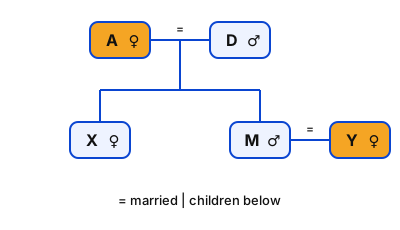
A is the wife of D. D has a daughter named X and a son named M. M is married to Y. How is Y related to A?
A, D की पत्नी है। D की X नाम की एक पुत्री और M नाम का एक पुत्र है। M का विवाह Y से हुआ है। Y, A से किस प्रकार संबंधित है?
  1. ASon's sonपुत्र का पुत्र
  2. BSon's wifeपुत्र की पत्नी
  3. CDaughter's sonपुत्री का पुत्र
  4. DFatherपिता
Show answer

Concept: Draw the family tree generation by generation.

  1. A is the wife of D → A and D are a couple.
  2. D's children are X (daughter) and M (son) → they are A's children too.
  3. M is married to Y → Y is the wife of A's son.

Trick: Son's wife = daughter-in-law (bahu).

Answer: (B) Son's wife

अवधारणा: पीढ़ी दर पीढ़ी वंश-वृक्ष बनाएँ।

  1. A, D की पत्नी है → A और D दंपति हैं।
  2. D की संतानें X (पुत्री) और M (पुत्र) → वे A की भी संतानें हैं।
  3. M का विवाह Y से हुआ → Y, A के पुत्र की पत्नी है।

ट्रिक: पुत्र की पत्नी = बहू (daughter-in-law)।

उत्तर: (B) Son's wife

RRB NTPC Graduate CBT 1General Intelligence and ReasoningBlood RelationsRRB NTPC Graduate CBT 1 2025 · 19 Mar Shift 1 →
Q6157.
Read the given statements and conclusions carefully. Assuming that the information given in the statements is true, even if it appears to be at variance with commonly known facts, decide which of the given conclusion(s) logically follow(s) from the statements.
Statements:
All gorillas are monkeys. Some monkeys are baboons. All baboons are chimpanzees. Conclusions:
(I) All chimpanzees are monkeys.
(II) Some chimpanzees are gorillas.
दिए गए कथनों और निष्कर्षों को ध्यानपूर्वक पढ़ें। कथनों में दी गई जानकारी को सत्य मानते हुए, भले ही वह सामान्य रूप से ज्ञात तथ्यों से भिन्न प्रतीत होती हो, निर्णय करें कि दिए गए निष्कर्षों में से कौन-सा/से निष्कर्ष कथनों का तार्किक रूप से अनुसरण करता है/करते हैं।
कथन:
सभी गोरिल्ला बंदर हैं। कुछ बंदर बबून हैं। सभी बबून चिंपैंजी हैं। निष्कर्ष:
(I) सभी चिंपैंजी बंदर हैं।
(II) कुछ चिंपैंजी गोरिल्ला हैं।
  1. ANeither conclusion (I) nor (II) follows.न तो निष्कर्ष (I) और न ही (II) अनुसरण करता है।
  2. BOnly conclusion (II) follows.केवल निष्कर्ष (II) अनुसरण करता है।
  3. COnly conclusion (I) follows.केवल निष्कर्ष (I) अनुसरण करता है।
  4. DBoth conclusions (I) and (II) follow.निष्कर्ष (I) और (II) दोनों अनुसरण करते हैं।
Show answer

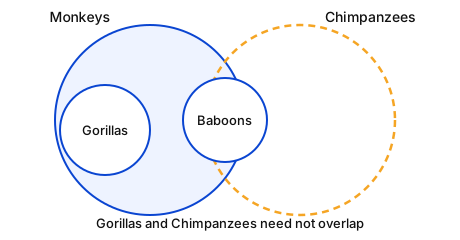
Concept: Draw the Venn diagram with the least possible overlap and test each conclusion.

  1. Gorillas lie inside Monkeys; Baboons partly overlap Monkeys; Baboons lie inside Chimpanzees.
  2. (I) 'All chimpanzees are monkeys' – only baboons are forced inside Chimpanzees; other chimpanzees can be outside Monkeys. Does not follow.
  3. (II) 'Some chimpanzees are gorillas' – Gorillas and Chimpanzees need not touch at all. Does not follow.

Trick: 'All A are B' never gives 'All B are A'; and a 'Some' link in the chain breaks any definite conclusion.

Answer: (A) Neither conclusion (I) nor (II) follows.

अवधारणा: न्यूनतम ओवरलैप वाला वेन आरेख बनाएँ और हर निष्कर्ष जाँचें।

  1. Gorillas, Monkeys के अंदर; Baboons का Monkeys से आंशिक ओवरलैप; Baboons, Chimpanzees के अंदर।
  2. (I) 'सभी chimpanzees monkeys हैं' – केवल baboons का Chimpanzees में होना तय है; बाकी chimpanzees Monkeys के बाहर हो सकते हैं। नहीं निकलता।
  3. (II) 'कुछ chimpanzees gorillas हैं' – Gorillas और Chimpanzees का मिलना ज़रूरी नहीं। नहीं निकलता।

ट्रिक: 'All A are B' से कभी 'All B are A' नहीं निकलता; श्रृंखला में 'Some' आते ही निश्चित निष्कर्ष टूट जाता है।

उत्तर: (A) Neither conclusion (I) nor (II) follows.

RRB NTPC Graduate CBT 1General Intelligence and ReasoningSyllogismRRB NTPC Graduate CBT 1 2025 · 19 Mar Shift 1 →
Q6158.
What should come in place of ‘?’ in the given series?
35 37 40 45 52 ?
दी गई श्रेणी में ‘?’ के स्थान पर क्या आना चाहिए?
35 37 40 45 52 ?
  1. A65
  2. B66
  3. C62
  4. D63
Show answer

Concept: Look at the differences between consecutive terms.

  1. 37−35 = 2, 40−37 = 3, 45−40 = 5, 52−45 = 7.
  2. Differences are consecutive primes 2, 3, 5, 7 → next prime 11.
  3. 52+11=63.

Trick: When differences are 2, 3, 5, 7 – think primes, not +1 steps.

Answer: (D) 63

अवधारणा: क्रमागत पदों के अंतर देखें।

  1. 37−35 = 2, 40−37 = 3, 45−40 = 5, 52−45 = 7।
  2. अंतर क्रमागत अभाज्य 2, 3, 5, 7 हैं → अगला अभाज्य 11।
  3. 52+11=63।

ट्रिक: अंतर 2, 3, 5, 7 दिखें तो अभाज्य संख्याएँ सोचें।

उत्तर: (D) 63

RRB NTPC Graduate CBT 1General Intelligence and ReasoningNumber SeriesRRB NTPC Graduate CBT 1 2025 · 19 Mar Shift 1 →
Q6159.
Which of the following letter-clusters should replace # and % so that the pattern and relationship followed between the letter-cluster pair on the left side of :: is the same as that on the right side of :: ?
# : KQM :: OUQ : %
निम्नलिखित में से किन अक्षर-समूहों को # और % के स्थान पर रखा जाना चाहिए ताकि :: के बाईं ओर के अक्षर-समूह युग्म के बीच अनुसरण किया गया पैटर्न और संबंध वही हो जो :: के दाईं ओर है?
# : KQM :: OUQ : %
  1. A# = LRM , % = NTP
  2. B# = LRN , % = NTP
  3. C# = LRN , % = NSP
  4. D# = LRN , % = NTO
Show answer

Concept: Find a rule that turns # into KQM and apply the same rule to OUQ.

  1. Try option (B): LRN → KQM: L−1 = K, R−1 = Q, N−1 = M. Rule: each letter −1.
  2. OUQ → %: O−1 = N, U−1 = T, Q−1 = P → NTP ✓ matches option (B).
  3. Options (A), (C), (D) break the rule in one letter each (LRM, NSP, NTO).

Trick: Test the pair that must satisfy the rule twice; only (B) is consistent on both sides.

Answer: (B) # = LRN, % = NTP

अवधारणा: ऐसा नियम खोजें जो # को KQM बनाए और वही OUQ पर लगाएँ।

  1. विकल्प (B): LRN → KQM: L−1 = K, R−1 = Q, N−1 = M। नियम: हर अक्षर −1।
  2. OUQ → %: O−1 = N, U−1 = T, Q−1 = P → NTP ✓ विकल्प (B) से मेल।
  3. विकल्प (A), (C), (D) में एक-एक अक्षर नियम तोड़ता है (LRM, NSP, NTO)।

ट्रिक: नियम दोनों ओर लागू होना चाहिए; केवल (B) दोनों ओर सही है।

उत्तर: (B) # = LRN, % = NTP

RRB NTPC Graduate CBT 1General Intelligence and ReasoningLetter Cluster AnalogyRRB NTPC Graduate CBT 1 2025 · 19 Mar Shift 1 →
Q6160.
Which of the following letter-number clusters will replace the question mark “?” in the given series to make it logically complete?
AIW 8, YGU 14, WES 20, UCQ 26, ?
निम्नलिखित में से कौन-सा अक्षर-संख्या समूह दी गई श्रेणी में प्रश्नचिह्न “?” के स्थान पर आकर उसे तार्किक रूप से पूर्ण करेगा?
AIW 8, YGU 14, WES 20, UCQ 26, ?
  1. ATAN 33
  2. BSAO 32
  3. CRZN 32
  4. DSZM 32
Show answer

Concept: Separate the letter pattern and the number pattern.

  1. Letters: A→Y→W→U (−2 each), I→G→E→C (−2), W→U→S→Q (−2). Next: U−2 = S, C−2 = A, Q−2 = O → SAO.
  2. Numbers: 8, 14, 20, 26 (+6 each) → 32.

Trick: A−2 wraps around to Y; count backwards through the alphabet circle.

Answer: (B) SAO 32

अवधारणा: अक्षर पैटर्न और संख्या पैटर्न अलग-अलग देखें।

  1. अक्षर: A→Y→W→U (हर बार −2), I→G→E→C (−2), W→U→S→Q (−2)। अगला: U−2 = S, C−2 = A, Q−2 = O → SAO।
  2. संख्याएँ: 8, 14, 20, 26 (+6) → 32।

ट्रिक: A−2 घूमकर Y बनता है; वर्णमाला को वृत्त की तरह पीछे गिनें।

उत्तर: (B) SAO 32

RRB NTPC Graduate CBT 1General Intelligence and ReasoningAlphanumeric SeriesRRB NTPC Graduate CBT 1 2025 · 19 Mar Shift 1 →