Question bank

Q&A: practice questions with answers

Search questions on any topic. Filter by exam category, exam, subject and topic, try the question, then open the answer and explanation.

Courses – airGurukul

7,077 questions found.

Q6221.
Which of the values of a, b, c given in the options satisfy the following equations?
3a−4b+2c=−9
−4a+4b+10c=32
−a+2b−7c=−7
विकल्पों में दिए गए a, b, c के कौन-से मान निम्नलिखित समीकरणों को संतुष्ट करते हैं?
3a−4b+2c=−9
−4a+4b+10c=32
−a+2b−7c=−7
  1. A(1, 4, 2)
  2. B(2, 1, 4)
  3. C(5, 1, 1)
  4. D(3, 2, 2)
Show answer

Concept: When the options give the values, substitute each option into all three equations – the one satisfying all is the answer.

  1. Try (a,b,c)=(1,4,2): 3(1)−4(4)+2(2)=3−16+4=−9 ✓
  2. −4(1)+4(4)+10(2)=−4+16+20=32 ✓
  3. −(1)+2(4)−7(2)=−1+8−14=−7 ✓ – all three hold, so (1,4,2) is the solution.

Trick: Check the shortest equation first (−a+2b−7c=−7): (3,2,2) gives −13, (2,1,4) gives −28, (5,1,1) gives −10 – only (1,4,2) survives; then confirm with another equation.

Answer: (A) (1, 4, 2)

अवधारणा: जब विकल्पों में मान दिए हों, तो हर विकल्प तीनों समीकरणों में रखें – जो सबमें सही बैठे वही उत्तर।

  1. (a,b,c)=(1,4,2) रखें: 3(1)−4(4)+2(2)=3−16+4=−9 ✓
  2. −4(1)+4(4)+10(2)=−4+16+20=32 ✓
  3. −(1)+2(4)−7(2)=−1+8−14=−7 ✓ – तीनों सही, अतः (1,4,2) हल है।

ट्रिक: सबसे छोटा समीकरण (−a+2b−7c=−7) पहले जाँचें: (3,2,2) से −3+4−14=−13, (2,1,4) से −28, (5,1,1) से −10 – केवल (1,4,2) बचता है; फिर दूसरे समीकरण से पुष्टि करें।

उत्तर: (A) (1, 4, 2)
RRB NTPC Graduate CBT 1MathematicsLinear Equations (Verification)RRB NTPC Graduate CBT 1 2025 · 18 Mar Shift 3 →
Q6222.
What is the maximum value that must be assigned to A so that the 8-digit number 713A8845 is divisible by 3?
A को अधिकतम कौन-सा मान दिया जाना चाहिए ताकि 8 अंकों की संख्या 713A8845, 3 से विभाज्य हो?
  1. A9
  2. B8
  3. C6
  4. D7
Show answer

Concept: A number is divisible by 3 when the sum of its digits is divisible by 3.

  1. Digit sum of 713A8845 =7+1+3+A+8+8+4+5=36+A.
  2. 36 is already a multiple of 3, so A must be a multiple of 3: A=0,3,6 or 9.
  3. The maximum single digit is A=9 (sum =45, divisible by 3).

Trick: If the known digits already sum to a multiple of 3, the missing digit can be 0, 3, 6 or 9 – take 9 for 'maximum'.

Answer: (A) 9

अवधारणा: कोई संख्या 3 से विभाज्य होती है जब उसके अंकों का योग 3 से विभाज्य हो।

  1. 713A8845 का अंक-योग =7+1+3+A+8+8+4+5=36+A।
  2. 36 पहले से 3 का गुणज है, अतः A भी 3 का गुणज: A=0,3,6 या 9।
  3. अधिकतम एक-अंकीय मान A=9 (योग =45, 3 से विभाज्य)।

ट्रिक: ज्ञात अंकों का योग पहले से 3 का गुणज हो तो लुप्त अंक 0, 3, 6 या 9 – 'अधिकतम' के लिए 9 लें।

उत्तर: (A) 9

RRB NTPC Graduate CBT 1MathematicsDivisibility Rule of 3RRB NTPC Graduate CBT 1 2025 · 18 Mar Shift 3 →
Q6223.
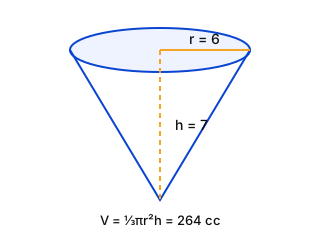
A cone has a base radius of 6 cm and a height of 7 cm. It is to be filled with water, and for every 180 cc of water poured into the cone, an additional 20 cc of water is spilled while pouring. If the spillage is proportional as described, how much water (in cc) will be required to fill the cone to its brim? (Use π = 22/7 and give your answer correct to two decimal places.)
एक शंकु के आधार की त्रिज्या 6 cm और ऊँचाई 7 cm है। इसे पानी से भरा जाना है, और शंकु में डाले गए प्रत्येक 180 cc पानी पर डालते समय अतिरिक्त 20 cc पानी छलक जाता है। यदि छलकाव वर्णित अनुसार समानुपाती है, तो शंकु को उसके किनारे तक भरने के लिए कितने पानी (cc में) की आवश्यकता होगी? (π = 22/7 का प्रयोग कीजिए और अपना उत्तर दशमलव के दो स्थानों तक सही दीजिए।)
  1. A295.67
  2. B296.67
  3. C283.33
  4. D293.33
Show answer

Concept: Volume of a cone =13πr2h; then account for the spillage ratio.

  1. V=13×227×62×7=13×22×36=264cc.
  2. For every 180cc that goes in, 20cc spills, so 200cc must be poured to retain 180cc.
  3. Water required =264×200180=264×109=293.33cc.

Trick: Spillage of 20 per 180 means pour 109 of the volume: 264×109=293.33.

Answer: (D) 293.33

अवधारणा: शंकु का आयतन =13πr2h; फिर छलकने का अनुपात लगाएँ।

  1. V=13×227×62×7=13×22×36=264cc।
  2. हर 180cc अंदर जाने पर 20cc छलकता है, यानी 180cc रखने के लिए 200cc डालना पड़ता है।
  3. आवश्यक पानी =264×200180=264×109=293.33cc।

ट्रिक: 180 पर 20 छलकना = आयतन का 109 डालना: 264×109=293.33।

उत्तर: (D) 293.33

RRB NTPC Graduate CBT 1MathematicsMensuration – Volume of ConeRRB NTPC Graduate CBT 1 2025 · 18 Mar Shift 3 →
Q6224.
Find the value of m, satisfying equation:
(1310)4×(1013)16×(1310)17=(1013)3m+18
समीकरण को संतुष्ट करने वाले m का मान ज्ञात कीजिए:
(1310)4×(1013)16×(1310)17=(1013)3m+18
  1. A−293
  2. B−333
  3. C−243
  4. D−233
Show answer

Concept: Write every base as the same fraction: (1013)n=(1310)−n, then equate the powers.

  1. LHS =(1310)4×(1310)−16×(1310)17=(1310)4−16+17=(1310)5.
  2. RHS =(1013)3m+18=(1310)−(3m+18).
  3. So −(3m+18)=5⇒3m=−23⇒m=−233.

Trick: Flipping a fraction changes the sign of the power; collect all powers on one base before equating.

Answer: (D) −233

अवधारणा: हर आधार को एक ही भिन्न में लिखें: (1013)n=(1310)−n, फिर घातें बराबर करें।

  1. LHS =(1310)4×(1310)−16×(1310)17=(1310)5।
  2. RHS =(1013)3m+18=(1310)−(3m+18)।
  3. अतः −(3m+18)=5⇒3m=−23⇒m=−233।

ट्रिक: भिन्न पलटने से घात का चिह्न बदलता है; बराबर करने से पहले सारी घातें एक आधार पर लाएँ।

उत्तर: (D) −233

RRB NTPC Graduate CBT 1MathematicsLaws of IndicesRRB NTPC Graduate CBT 1 2025 · 18 Mar Shift 3 →
Q6225.
If cosecA=53, then find the value of 9(1+cot2A)80(1−secA)(1+secA).
यदि cosecA=53 है, तो 9(1+cot2A)80(1−secA)(1+secA) का मान ज्ञात कीजिए।
  1. A57
  2. B−79
  3. C37
  4. D−59
Show answer

Concept: Use 1+cot2A=csc2A and (1−secA)(1+secA)=1−sec2A=−tan2A.

  1. cscA=53⇒sinA=35, cosA=45, tanA=34.
  2. Numerator =9csc2A=9×259=25.
  3. Denominator =80×(1−sec2A)=80×(−tan2A)=80×(−916)=−45.
  4. Value =25−45=−59.

Trick: The 3-4-5 triangle does it all: csc=53 means opposite 3, hypotenuse 5, adjacent 4. 1−sec2 is always negative, so look for a negative option.

Answer: (D) −59

अवधारणा: 1+cot2A=csc2A और (1−secA)(1+secA)=1−sec2A=−tan2A का प्रयोग करें।

  1. cscA=53⇒sinA=35, cosA=45, tanA=34।
  2. अंश =9csc2A=9×259=25।
  3. हर =80×(1−sec2A)=80×(−tan2A)=80×(−916)=−45।
  4. मान =25−45=−59।

ट्रिक: 3-4-5 त्रिभुज से सब मिल जाता है: csc=53 यानी लंब 3, कर्ण 5, आधार 4। 1−sec2 हमेशा ऋणात्मक – ऋणात्मक विकल्प देखें।

उत्तर: (D) −59

RRB NTPC Graduate CBT 1MathematicsTrigonometric IdentitiesRRB NTPC Graduate CBT 1 2025 · 18 Mar Shift 3 →
Q6226.
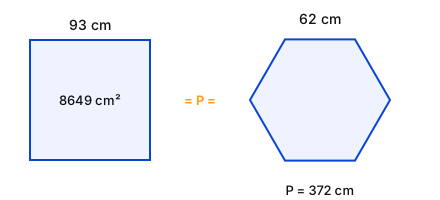
The area of a square is 8649 cm2. Its perimeter is equal to the perimeter of a regular hexagon. What is the area (in cm2) of the hexagon?
एक वर्ग का क्षेत्रफल 8649 cm2 है। इसका परिमाप एक सम षट्भुज के परिमाप के बराबर है। षट्भुज का क्षेत्रफल (cm2 में) क्या है?
  1. A5758
  2. B5716
  3. C57623
  4. D57663
Show answer

Concept: Equal perimeters give the hexagon's side; area of a regular hexagon =332a2.

  1. Side of square =8649=93cm; perimeter =4×93=372cm.
  2. Hexagon side a=3726=62cm.
  3. Area =332×622=332×3844=57663cm2.

Trick: Hexagon side =46=23 of the square's side; a regular hexagon is 6 equilateral triangles, so area =6×34a2.

Answer: (D) 57663

अवधारणा: बराबर परिमाप से षट्भुज की भुजा मिलती है; सम षट्भुज का क्षेत्रफल =332a2।

  1. वर्ग की भुजा =8649=93cm; परिमाप =4×93=372cm।
  2. षट्भुज की भुजा a=3726=62cm।
  3. क्षेत्रफल =332×622=332×3844=57663cm2।

ट्रिक: षट्भुज की भुजा = वर्ग की भुजा का 23; सम षट्भुज = 6 समबाहु त्रिभुज, अतः क्षेत्रफल =6×34a2।

उत्तर: (D) 57663

RRB NTPC Graduate CBT 1MathematicsMensuration – Square and Regular HexagonRRB NTPC Graduate CBT 1 2025 · 18 Mar Shift 3 →
Q6227.
The monthly incomes of two friends Mohan and David, are in the ratio 6 : 7 respectively and each of them saves ₹69,000 every month. If the ratio of their monthly expenditure is 2 : 3, find the monthly income of Mohan (in ₹).
दो मित्रों मोहन और डेविड की मासिक आय का अनुपात क्रमशः 6 : 7 है और उनमें से प्रत्येक प्रति माह ₹69,000 की बचत करता है। यदि उनके मासिक व्यय का अनुपात 2 : 3 है, तो मोहन की मासिक आय (₹ में) ज्ञात कीजिए।
  1. A1,03,500
  2. B1,04,500
  3. C1,44,900
  4. D1,02,500
Show answer

Concept: Income − Savings = Expenditure; equate the expenditure ratio.

  1. Let incomes be 6x and 7x. Expenditures: 6x−69000 and 7x−69000.
  2. 6x−690007x−69000=23⇒18x−207000=14x−138000⇒4x=69000⇒x=17250.
  3. Mohan's income =6x=6×17250= ₹1,03,500.

Trick: Equal savings → income1−income2=exp1−exp2: x=(one part of expenditure); here 7x−6x=3k−2k gives x=k, so 6k−69000=2k⇒k=17250.

Answer: (A) 1,03,500

अवधारणा: आय − बचत = व्यय; व्यय का अनुपात बराबर रखें।

  1. आय 6x और 7x मानें। व्यय: 6x−69000 और 7x−69000।
  2. 6x−690007x−69000=23⇒18x−207000=14x−138000⇒4x=69000⇒x=17250।
  3. मोहन की आय =6x=6×17250= ₹1,03,500।

ट्रिक: बचत बराबर → आय का अंतर = व्यय का अंतर: 7x−6x=3k−2k⇒x=k; तब 6k−69000=2k⇒k=17250।

उत्तर: (A) 1,03,500

RRB NTPC Graduate CBT 1MathematicsRatio – Income, Expenditure and SavingsRRB NTPC Graduate CBT 1 2025 · 18 Mar Shift 3 →
Q6228.
If the mean proportional of two numbers is 14 and their third proportional is 112, then the numbers are:
यदि दो संख्याओं का मध्यानुपाती 14 है और उनका तृतीयानुपाती 112 है, तो संख्याएँ हैं:
  1. A14, 14
  2. B7, 28
  3. C4, 44
  4. D4, 49
Show answer

Concept: For numbers a and b: mean proportional =ab, third proportional =b2a.

  1. ab=14⇒ab=196.
  2. b2a=112⇒b2=112a. Multiply by b: b3=112ab=112×196=21952=283⇒b=28.
  3. a=19628=7. Numbers: 7 and 28.

Trick: Test options: product must be 196 → only (14,14) and (7,28); third proportional of 7, 28 =2827=112 ✓.

Answer: (B) 7, 28

अवधारणा: संख्याओं a, b के लिए: मध्यानुपाती =ab, तृतीयानुपाती =b2a।

  1. ab=14⇒ab=196।
  2. b2a=112⇒b2=112a। b से गुणा: b3=112ab=112×196=21952=283⇒b=28।
  3. a=19628=7। संख्याएँ: 7 और 28।

ट्रिक: विकल्प जाँचें: गुणनफल 196 चाहिए → केवल (14,14) और (7,28); 7, 28 का तृतीयानुपाती =2827=112 ✓।

उत्तर: (B) 7, 28

RRB NTPC Graduate CBT 1MathematicsMean and Third ProportionalRRB NTPC Graduate CBT 1 2025 · 18 Mar Shift 3 →
Q6229.
If the diameter of a circle is 14 cm, then what is the circumference of the circle? (Use π=227)
यदि एक वृत्त का व्यास 14 cm है, तो वृत्त की परिधि क्या है? (π=227 का प्रयोग कीजिए)
  1. A36 cm
  2. B44 cm
  3. C22 cm
  4. D24 cm
Show answer

Concept: Circumference =πd=2πr.

  1. d=14cm, so circumference =227×14.
  2. =22×2=44cm.

Trick: With π=227, a diameter that is a multiple of 7 cancels neatly: 14→44, 7→22, 21→66.

Answer: (B) 44 cm

अवधारणा: परिधि =πd=2πr।

  1. d=14cm, अतः परिधि =227×14।
  2. =22×2=44cm।

ट्रिक: π=227 के साथ 7 के गुणज वाला व्यास सीधा कटता है: 14→44, 7→22, 21→66।

उत्तर: (B) 44 cm

RRB NTPC Graduate CBT 1MathematicsCircumference of a CircleRRB NTPC Graduate CBT 1 2025 · 18 Mar Shift 3 →
Q6230.
Evaluate: (−9) − (−56) ÷ (−14) + (−2) × 9
मान ज्ञात कीजिए: (−9) − (−56) ÷ (−14) + (−2) × 9
  1. A−33
  2. B−31
  3. C−30
  4. D−34
Show answer

Concept: Do division and multiplication before addition and subtraction; mind the signs.

  1. (−56)÷(−14)=4 and (−2)×9=−18.
  2. Expression =(−9)−4+(−18)=−9−4−18=−31.

Trick: Negative ÷ negative = positive; then '− (positive)' subtracts. Keep a running total: −9→−13→−31.

Answer: (B) −31

अवधारणा: जोड़-घटाव से पहले भाग और गुणा करें; चिह्नों का ध्यान रखें।

  1. (−56)÷(−14)=4 और (−2)×9=−18।
  2. व्यंजक =(−9)−4+(−18)=−9−4−18=−31।

ट्रिक: ऋण ÷ ऋण = धन; फिर '− (धन)' घटता है। चलता योग रखें: −9→−13→−31।

उत्तर: (B) −31

RRB NTPC Graduate CBT 1MathematicsBODMAS with IntegersRRB NTPC Graduate CBT 1 2025 · 18 Mar Shift 3 →
Q6231.
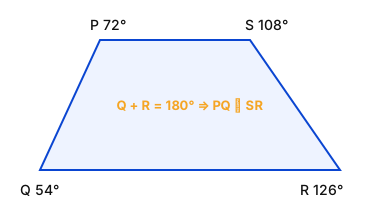
If ∠P, ∠Q, ∠R and ∠S of a quadrilateral PQRS, taken in order, are in the ratio 4 : 3 : 7 : 6, then quadrilateral PQRS will be of which type?
यदि एक चतुर्भुज PQRS के ∠P, ∠Q, ∠R और ∠S, क्रम से लेने पर, 4 : 3 : 7 : 6 के अनुपात में हैं, तो चतुर्भुज PQRS किस प्रकार का होगा?
  1. AKiteपतंग (Kite)
  2. BParallelogramसमांतर चतुर्भुज
  3. CRhombusसमचतुर्भुज
  4. DTrapeziumसमलंब
Show answer

Concept: Angle sum of a quadrilateral =360∘; if a pair of co-interior (adjacent) angles adds to 180∘, the sides containing them are parallel.

  1. 4x+3x+7x+6x=20x=360∘⇒x=18∘. Angles: P=72∘, Q=54∘, R=126∘, S=108∘.
  2. Q+R=54∘+126∘=180∘ (and P+S=180∘) → PQ∥SR. But P+Q=126∘≠180∘, so PS is not parallel to QR.
  3. Exactly one pair of opposite sides parallel, and opposite angles are unequal → a trapezium (not a parallelogram, rhombus or kite).

Trick: Opposite angles equal → parallelogram/rhombus; only one pair of adjacent angles supplementary → trapezium. Here 4 : 3 : 7 : 6 has unequal opposite terms.

Answer: (D) Trapezium

अवधारणा: चतुर्भुज का कोण-योग =360∘; यदि संलग्न (co-interior) कोणों का योग 180∘ हो, तो उन्हें मिलाने वाली भुजाएँ समांतर होती हैं।

  1. 4x+3x+7x+6x=20x=360∘⇒x=18∘। कोण: P=72∘, Q=54∘, R=126∘, S=108∘।
  2. Q+R=54∘+126∘=180∘ (और P+S=180∘) → PQ∥SR। पर P+Q=126∘≠180∘, अतः PS, QR के समांतर नहीं।
  3. सम्मुख भुजाओं का ठीक एक युग्म समांतर और सम्मुख कोण असमान → समलंब (trapezium), न कि समांतर चतुर्भुज, समचतुर्भुज या पतंग।

ट्रिक: सम्मुख कोण बराबर → समांतर चतुर्भुज/समचतुर्भुज; केवल एक युग्म संलग्न कोण संपूरक → समलंब। यहाँ 4 : 3 : 7 : 6 में सम्मुख पद असमान हैं।

उत्तर: (D) समलंब (Trapezium)

RRB NTPC Graduate CBT 1MathematicsQuadrilaterals – Angle PropertiesRRB NTPC Graduate CBT 1 2025 · 18 Mar Shift 3 →
Q6232.
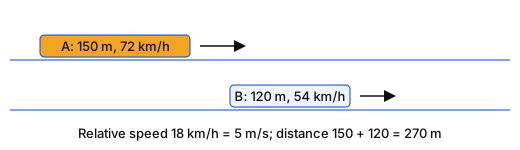
Two trains, Train A and Train B, are running on parallel tracks in the same direction. Train A, which is 150 metres long, is moving at 72 km/hr, while Train B, which is 120 metres long, is moving at 54 km/hr. How long will it take for Train A to completely overtake Train B?
दो रेलगाड़ियाँ, रेलगाड़ी A और रेलगाड़ी B, समांतर पटरियों पर एक ही दिशा में चल रही हैं। रेलगाड़ी A, जो 150 मीटर लंबी है, 72 km/hr की चाल से चल रही है, जबकि रेलगाड़ी B, जो 120 मीटर लंबी है, 54 km/hr की चाल से चल रही है। रेलगाड़ी A को रेलगाड़ी B को पूरी तरह पार करने में कितना समय लगेगा?
  1. A58 seconds58 सेकंड
  2. B50 seconds50 सेकंड
  3. C54 seconds54 सेकंड
  4. D52 seconds52 सेकंड
Show answer

Concept: Same direction → relative speed = difference of speeds; distance to overtake = sum of lengths.

  1. Relative speed =72−54=18km/h=18×518=5m/s.
  2. Distance =150+120=270m.
  3. Time =2705=54s.

Trick: km/h → m/s: multiply by 518; 18 km/h is exactly 5 m/s – a value worth memorising.

Answer: (C) 54 seconds

अवधारणा: समान दिशा → सापेक्ष चाल = चालों का अंतर; पार करने की दूरी = लंबाइयों का योग।

  1. सापेक्ष चाल =72−54=18km/h=18×518=5m/s।
  2. दूरी =150+120=270m।
  3. समय =2705=54s।

ट्रिक: km/h → m/s: 518 से गुणा; 18 km/h ठीक 5 m/s – याद रखने लायक मान।

उत्तर: (C) 54 सेकंड

RRB NTPC Graduate CBT 1MathematicsTrains – Same DirectionRRB NTPC Graduate CBT 1 2025 · 18 Mar Shift 3 →
Q6233.
At what rate (in percentage, rounded off to two decimal place) per year will a sum of money double itself in 18 years on simple interest?
साधारण ब्याज पर एक धनराशि 18 वर्षों में स्वयं की दोगुनी किस वार्षिक दर (प्रतिशत में, दशमलव के दो स्थानों तक पूर्णांकित) पर हो जाएगी?
  1. A5.56
  2. B3.56
  3. C11.12
  4. D7.56
Show answer

Concept: A sum doubles under simple interest when the interest equals the principal, i.e. P×R×T100=P⇒R×T=100.

  1. Here T=18 years, so R=10018.
  2. 10018=5.555…≈5.56% per year.

Trick: Doubling → R×T=100; tripling → R×T=200; n times → R×T=100(n−1).

Answer: (A) 5.56

अवधारणा: साधारण ब्याज में राशि तब दोगुनी होती है जब ब्याज = मूलधन, अर्थात P×R×T100=P⇒R×T=100।

  1. यहाँ T=18 वर्ष, अतः R=10018।
  2. 10018=5.555…≈5.56% प्रति वर्ष।

ट्रिक: दोगुना → R×T=100; तिगुना → R×T=200; n गुना → R×T=100(n−1)।

उत्तर: (A) 5.56

RRB NTPC Graduate CBT 1MathematicsSimple Interest – DoublingRRB NTPC Graduate CBT 1 2025 · 18 Mar Shift 3 →
Q6234.
Two taps can fill a cistern in 4 hours and 28 hours respectively. A third tap can empty it in 28 hours. How long (in hours) will it take to fill one-fourth of the empty cistern, if all of them are opened together?
दो नल एक टंकी को क्रमशः 4 घंटे और 28 घंटे में भर सकते हैं। एक तीसरा नल इसे 28 घंटे में खाली कर सकता है। यदि इन सभी को एक साथ खोल दिया जाए, तो खाली टंकी के एक-चौथाई भाग को भरने में कितना समय (घंटों में) लगेगा?
  1. A2
  2. B4
  3. C3
  4. D1
Show answer

Concept: Net work per hour = sum of filling rates − emptying rate.

  1. Net rate =14+128−128=14 of the cistern per hour (the second tap and the emptying tap cancel).
  2. Full cistern takes 4 hours, so one-fourth takes 4×14=1 hour.

Trick: Equal filling and emptying times cancel each other – spot this before doing LCM work.

Answer: (D) 1

अवधारणा: प्रति घंटे शुद्ध कार्य = भरने की दरों का योग − खाली करने की दर।

  1. शुद्ध दर =14+128−128=14 टंकी प्रति घंटा (दूसरा नल और खाली करने वाला नल एक-दूसरे को काट देते हैं)।
  2. पूरी टंकी 4 घंटे में, अतः एक-चौथाई 4×14=1 घंटे में।

ट्रिक: बराबर भरने और खाली करने के समय एक-दूसरे को रद्द कर देते हैं – LCM से पहले यही देखें।

उत्तर: (D) 1

RRB NTPC Graduate CBT 1MathematicsPipes and CisternsRRB NTPC Graduate CBT 1 2025 · 18 Mar Shift 3 →
Q6235.
A typist takes 40 minutes to type 2 pages. How long (in minutes) will he take to type 89 pages?
एक टाइपिस्ट 2 पृष्ठ टाइप करने में 40 मिनट लेता है। 89 पृष्ठ टाइप करने में वह कितना समय (मिनटों में) लेगा?
  1. A1770
  2. B1780
  3. C1790
  4. D1785
Show answer

Concept: Time is directly proportional to the number of pages.

  1. Time per page =402=20 minutes.
  2. For 89 pages: 89×20=1780 minutes.

Trick: 89×20=(90−1)×20=1800−20=1780.

Answer: (B) 1780

अवधारणा: समय पृष्ठों की संख्या के समानुपाती है।

  1. प्रति पृष्ठ समय =402=20 मिनट।
  2. 89 पृष्ठों के लिए: 89×20=1780 मिनट।

ट्रिक: 89×20=(90−1)×20=1800−20=1780।

उत्तर: (B) 1780

RRB NTPC Graduate CBT 1MathematicsUnitary MethodRRB NTPC Graduate CBT 1 2025 · 18 Mar Shift 3 →
Q6236.
P sells an item to Q at 50% profit. Q sells the same item to R at 32% loss. If R paid ₹ 5406 for the item, then at what price (in ₹) is the item purchased by P?
P एक वस्तु Q को 50% लाभ पर बेचता है। Q वही वस्तु R को 32% हानि पर बेचता है। यदि R ने वस्तु के लिए ₹ 5406 का भुगतान किया, तो P ने वस्तु किस मूल्य (₹ में) पर खरीदी थी?
  1. A5300
  2. B5301
  3. C5302
  4. D5299
Show answer

Concept: Apply the multipliers in sequence: Final price=CP×1.5×0.68.

  1. Let P's cost price be x. Q pays 1.5x; R pays 1.5x×0.68=1.02x.
  2. 1.02x=5406⇒x=54061.02=5300.

Trick: Net change for +50% then −32% is 50−32−50×32100=+2%, so 5406=102% of CP → CP = 5300.

Answer: (A) 5300

अवधारणा: गुणकों को क्रम से लगाएँ: अंतिम मूल्य=CP×1.5×0.68।

  1. P का क्रय मूल्य x मानें। Q देता है 1.5x; R देता है 1.5x×0.68=1.02x।
  2. 1.02x=5406⇒x=54061.02=5300।

ट्रिक: +50% फिर −32% का शुद्ध परिवर्तन 50−32−50×32100=+2%, अतः 5406=102% CP → CP = 5300।

उत्तर: (A) 5300

RRB NTPC Graduate CBT 1MathematicsSuccessive Profit and LossRRB NTPC Graduate CBT 1 2025 · 18 Mar Shift 3 →
Q6237.
There are 53 members in group A, 86 members in group B and 57 members in group C. All the members of these groups went to a restaurant. The average amounts spent on each member of groups A, B and C are ₹424, ₹337 and ₹122, respectively. The overall average amount (in ₹) spent per member is:
समूह A में 53 सदस्य, समूह B में 86 सदस्य और समूह C में 57 सदस्य हैं। इन समूहों के सभी सदस्य एक रेस्तराँ में गए। समूह A, B और C के प्रत्येक सदस्य पर खर्च की गई औसत राशि क्रमशः ₹424, ₹337 और ₹122 है। प्रति सदस्य खर्च की गई समग्र औसत राशि (₹ में) है:
  1. A297
  2. B298
  3. C303
  4. D302
Show answer

Concept: Overall average =total amounttotal members.

  1. Total =53×424+86×337+57×122=22472+28982+6954=58408.
  2. Members =53+86+57=196.
  3. Average =58408196=298.

Trick: Use deviations from 300: 53(124)+86(37)+57(−178)=6572+3182−10146=−392; −392196=−2 → 300−2=298.

Answer: (B) 298

अवधारणा: कुल औसत =कुल राशिकुल सदस्य।

  1. कुल =53×424+86×337+57×122=22472+28982+6954=58408।
  2. सदस्य =53+86+57=196।
  3. औसत =58408196=298।

ट्रिक: 300 से विचलन लें: 53(124)+86(37)+57(−178)=6572+3182−10146=−392; −392196=−2 → 300−2=298।

उत्तर: (B) 298

RRB NTPC Graduate CBT 1MathematicsWeighted AverageRRB NTPC Graduate CBT 1 2025 · 18 Mar Shift 3 →
Q6238.
Find the mean proportional of 425 and 17.
425 और 17 का मध्यानुपाती ज्ञात कीजिए।
  1. A85
  2. B95
  3. C75
  4. D65
Show answer

Concept: Mean proportional of a and b is ab.

  1. 425×17=25×17×17.
  2. =5×17=85.

Trick: Factor instead of multiplying: 425=25×17, so the root is 5×17 directly.

Answer: (A) 85

अवधारणा: a और b का मध्यानुपाती ab होता है।

  1. 425×17=25×17×17।
  2. =5×17=85।

ट्रिक: गुणा करने के बजाय गुणनखंड करें: 425=25×17, अतः मूल सीधे 5×17।

उत्तर: (A) 85

RRB NTPC Graduate CBT 1MathematicsMean ProportionalRRB NTPC Graduate CBT 1 2025 · 18 Mar Shift 3 →
Q6239.
If the mode of a data exceeds its mean by 26.7, then the mode exceeds the median by _____. (Use empirical formula to find the answer)
यदि किसी आँकड़े का बहुलक उसके माध्य से 26.7 अधिक है, तो बहुलक, माध्यिका से _____ अधिक है। (उत्तर ज्ञात करने के लिए आनुभविक सूत्र का प्रयोग कीजिए)
  1. A10.5
  2. B8.5
  3. C17.8
  4. D12.4
Show answer

Concept: Empirical relation: Mode=3Median−2Mean, which gives Mode−Median=23(Mode−Mean).

  1. Given Mode−Mean=26.7.
  2. Mode−Median=23×26.7=17.8.

Trick: Mean, Median, Mode divide the gap in ratio 1 : 2 – Median is one-third of the way from Mean to Mode, so Mode − Median is two-thirds of Mode − Mean.

Answer: (C) 17.8

अवधारणा: आनुभविक संबंध: Mode=3Median−2Mean, जिससे Mode−Median=23(Mode−Mean)।

  1. दिया है Mode−Mean=26.7।
  2. Mode−Median=23×26.7=17.8।

ट्रिक: माध्य, माध्यिका, बहुलक अंतर को 1 : 2 में बाँटते हैं – माध्यिका, माध्य से बहुलक की ओर एक-तिहाई दूरी पर है, अतः बहुलक − माध्यिका = दो-तिहाई (बहुलक − माध्य)।

उत्तर: (C) 17.8

RRB NTPC Graduate CBT 1MathematicsMean, Median, ModeRRB NTPC Graduate CBT 1 2025 · 18 Mar Shift 3 →
Q6240.
If 7 : 63 :: 6.5 : x and 7 : 42 :: 4 : y, then what is the ratio of x to y?
यदि 7 : 63 :: 6.5 : x और 7 : 42 :: 4 : y है, तो x का y से अनुपात क्या है?
  1. A43 : 26
  2. B37 : 17
  3. C39 : 16
  4. D40 : 14
Show answer

Concept: In a:b::c:d, d=b×ca.

  1. x=63×6.57=9×6.5=58.5.
  2. y=42×47=6×4=24.
  3. x:y=58.5:24=117:48=39:16.

Trick: 7:63=1:9 and 7:42=1:6, so x=9×6.5, y=6×4 – no cross-multiplication needed.

Answer: (C) 39:16

अवधारणा: a:b::c:d में d=b×ca।

  1. x=63×6.57=9×6.5=58.5।
  2. y=42×47=6×4=24।
  3. x:y=58.5:24=117:48=39:16।

ट्रिक: 7:63=1:9 और 7:42=1:6, अतः x=9×6.5, y=6×4 – वज्र-गुणन की ज़रूरत नहीं।

उत्तर: (C) 39:16

RRB NTPC Graduate CBT 1MathematicsProportionRRB NTPC Graduate CBT 1 2025 · 18 Mar Shift 3 →