Question bank

Q&A: practice questions with answers

Search questions on any topic. Filter by exam category, exam, subject and topic, try the question, then open the answer and explanation.

Courses – airGurukul

7,077 questions found.

Q6241.
Piyush has ₹1407 with him. He divides this amount between his two sons, Manoj and Anand, and asks them to invest their respective shares at a compound interest rate of 10% per annum, compounded annually. It is observed that Manoj’s investment amounts to the same value after 16 years as Anand’s investment does after 17 years. How much (in ₹) did Piyush give to Anand?
पीयूष के पास ₹1407 हैं। वह इस राशि को अपने दो पुत्रों, मनोज और आनंद, के बीच बाँटता है और उन्हें अपने-अपने हिस्से को 10% वार्षिक चक्रवृद्धि ब्याज की दर पर, वार्षिक रूप से संयोजित, निवेश करने को कहता है। यह देखा गया है कि मनोज का निवेश 16 वर्षों के बाद उतना ही हो जाता है जितना आनंद का निवेश 17 वर्षों के बाद होता है। पीयूष ने आनंद को कितनी राशि (₹ में) दी?
  1. A520
  2. B737
  3. C670
  4. D837
Show answer

Concept: Equal amounts at different times: M(1.1)16=A(1.1)17.

  1. Cancel (1.1)16: M=1.1A, i.e. Manoj : Anand =11:10.
  2. Total =21 parts =1407⇒1 part =67.
  3. Anand's share =10×67=670.

Trick: If amounts are equal after n and n+1 years, the shares are in the ratio (100+R):100 – here 110:100=11:10.

Answer: (C) 670

अवधारणा: अलग-अलग समय पर बराबर मिश्रधन: M(1.1)16=A(1.1)17।

  1. (1.1)16 काटने पर: M=1.1A, अर्थात मनोज : आनंद =11:10।
  2. कुल =21 भाग =1407⇒1 भाग =67।
  3. आनंद का हिस्सा =10×67=670।

ट्रिक: यदि n और n+1 वर्ष बाद मिश्रधन बराबर हों, तो हिस्से (100+R):100 के अनुपात में – यहाँ 110:100=11:10।

उत्तर: (C) 670

RRB NTPC Graduate CBT 1MathematicsCompound Interest – Division of SumRRB NTPC Graduate CBT 1 2025 · 18 Mar Shift 3 →
Q6242.
If a=7+43, then evaluate (a3+1a3).
यदि a=7+43 है, तो (a3+1a3) का मान ज्ञात कीजिए।
  1. A15603
  2. B−2702
  3. C−15603
  4. D2702
Show answer

Concept: If a=7+43, then 1a=7−43 (rationalising, since (7+43)(7−43)=49−48=1), and a3+1a3=(a+1a)3−3(a+1a).

  1. a+1a=(7+43)+(7−43)=14.
  2. a3+1a3=143−3×14=2744−42=2702.

Trick: Whenever a=p+qr with p2−q2r=1, a+1a=2p instantly – here 2×7=14.

Answer: (D) 2702

अवधारणा: यदि a=7+43, तो 1a=7−43 (परिमेयकरण, क्योंकि (7+43)(7−43)=49−48=1), और a3+1a3=(a+1a)3−3(a+1a)।

  1. a+1a=(7+43)+(7−43)=14।
  2. a3+1a3=143−3×14=2744−42=2702।

ट्रिक: जब a=p+qr और p2−q2r=1 हो, तो a+1a=2p तुरंत – यहाँ 2×7=14।

उत्तर: (D) 2702

RRB NTPC Graduate CBT 1MathematicsSurds – Algebraic IdentitiesRRB NTPC Graduate CBT 1 2025 · 18 Mar Shift 3 →
Q6243.
A shopkeeper fixes the marked price of an item 140% above its cost price. What percentage of discount on marked price should be allowed to gain 68%?
एक दुकानदार किसी वस्तु का अंकित मूल्य उसके क्रय मूल्य से 140% अधिक निर्धारित करता है। 68% लाभ प्राप्त करने के लिए अंकित मूल्य पर कितने प्रतिशत छूट दी जानी चाहिए?
  1. A32%
  2. B28%
  3. C30%
  4. D29%
Show answer

Concept: Take CP = 100; then MP = 240 and required SP = 168; Discount%=MP−SPMP×100.

  1. MP =100+140=240; SP for 68% gain =168.
  2. Discount =240−168=72; 72240×100=30%.

Trick: SPMP=168240=0.7 → 70% of MP is kept, so discount = 30%.

Answer: (C) 30%

अवधारणा: CP = 100 लें; तब MP = 240 और वांछित SP = 168; छूट%=MP−SPMP×100।

  1. MP =100+140=240; 68% लाभ के लिए SP =168।
  2. छूट =240−168=72; 72240×100=30%।

ट्रिक: SPMP=168240=0.7 → MP का 70% रखा गया, अतः छूट = 30%।

उत्तर: (C) 30%

RRB NTPC Graduate CBT 1MathematicsMarked Price and DiscountRRB NTPC Graduate CBT 1 2025 · 18 Mar Shift 3 →
Q6244.
The HCF of two numbers is 6 and their LCM is 72. If one of the numbers is 18, find the other number.
दो संख्याओं का HCF 6 है और उनका LCM 72 है। यदि उनमें से एक संख्या 18 है, तो दूसरी संख्या ज्ञात कीजिए।
  1. A24
  2. B12
  3. C48
  4. D36
Show answer

Concept: For two numbers, HCF×LCM=product of the numbers.

  1. Other number =6×7218.
  2. =43218=24.

Trick: Check: HCF(18, 24) = 6 and LCM(18, 24) = 72 ✓ – always verify with the pair.

Answer: (A) 24

अवधारणा: दो संख्याओं के लिए HCF×LCM=संख्याओं का गुणनफल।

  1. दूसरी संख्या =6×7218।
  2. =43218=24।

ट्रिक: जाँच: HCF(18, 24) = 6 और LCM(18, 24) = 72 ✓ – जोड़े से हमेशा सत्यापित करें।

उत्तर: (A) 24

RRB NTPC Graduate CBT 1MathematicsHCF and LCMRRB NTPC Graduate CBT 1 2025 · 18 Mar Shift 3 →
Q6245.
In an election between two candidates, 80% of the registered voters cast their vote and 20% of the votes polled were found invalid. Winning candidate got 55% of the valid votes and won the election by a margin of 368 votes. How many voters were
registered?
दो उम्मीदवारों के बीच एक चुनाव में, पंजीकृत मतदाताओं में से 80% ने अपना मत डाला और डाले गए मतों में से 20% अवैध पाए गए। विजयी उम्मीदवार को वैध मतों के 55% मत मिले और उसने 368 मतों के अंतर से चुनाव जीता। कितने मतदाता
पंजीकृत थे?
  1. A5747
  2. B5751
  3. C5750
  4. D5749
Show answer

Concept: Margin = difference of the two candidates' shares of valid votes.

  1. Let registered voters =N. Polled =0.8N; valid =0.8×0.8N=0.64N.
  2. Winner 55%, loser 45% → margin =10% of valid =0.064N.
  3. 0.064N=368⇒N=3680.064=5750.

Trick: Margin % of registered =80%×80%×10%=6.4%; 368÷0.064=5750.

Answer: (C) 5750

अवधारणा: अंतर (margin) = वैध मतों में दोनों उम्मीदवारों के हिस्सों का अंतर।

  1. पंजीकृत मतदाता =N मानें। डाले गए =0.8N; वैध =0.8×0.8N=0.64N।
  2. विजेता 55%, हारने वाला 45% → अंतर = वैध का 10%=0.064N।
  3. 0.064N=368⇒N=3680.064=5750।

ट्रिक: पंजीकृत का अंतर % =80%×80%×10%=6.4%; 368÷0.064=5750।

उत्तर: (C) 5750

RRB NTPC Graduate CBT 1MathematicsPercentage – ElectionsRRB NTPC Graduate CBT 1 2025 · 18 Mar Shift 3 →
Q6246.
If the mean of the following data is 41, then the value of X is:
xi30405595
fi31X5017
यदि निम्नलिखित आँकड़ों का माध्य 41 है, तो X का मान है:
xi : 30, 40, 55, 95
fi : 31, X, 50, 17
  1. A1293
  2. B1281
  3. C1277
  4. D1298
Show answer

Concept: Mean=∑fixi∑fi.

  1. ∑fixi=30×31+40X+55×50+95×17=930+40X+2750+1615=5295+40X.
  2. ∑fi=31+X+50+17=98+X.
  3. 5295+40X98+X=41⇒5295+40X=4018+41X⇒X=1277.

Trick: Use deviations from 41: 31(−11)+X(−1)+50(14)+17(54)=0⇒−341−X+700+918=0⇒X=1277.

Answer: (C) 1277

अवधारणा: माध्य=∑fixi∑fi।

  1. ∑fixi=30×31+40X+55×50+95×17=930+40X+2750+1615=5295+40X।
  2. ∑fi=31+X+50+17=98+X।
  3. 5295+40X98+X=41⇒5295+40X=4018+41X⇒X=1277।

ट्रिक: 41 से विचलन लें: 31(−11)+X(−1)+50(14)+17(54)=0⇒−341−X+700+918=0⇒X=1277।

उत्तर: (C) 1277

RRB NTPC Graduate CBT 1MathematicsMean of Grouped DataRRB NTPC Graduate CBT 1 2025 · 18 Mar Shift 3 →
Q6247.
Find the maximum value of the quadratic expression Ax2+Bx+C=0, where A<0.
द्विघात व्यंजक Ax2+Bx+C=0 का अधिकतम मान ज्ञात कीजिए, जहाँ A<0 है।
  1. AAC−B24A
  2. B4AC−B24A
  3. C4AC−B24
  4. DB2−AC4A
Show answer

Concept: For Ax2+Bx+C with A<0 the parabola opens downward, so the vertex gives the maximum: at x=−B2A, value =4AC−B24A.

  1. Complete the square: Ax2+Bx+C=A(x+B2A)2+C−B24A.
  2. Since A<0, the squared term is ≤0; the maximum is C−B24A=4AC−B24A.

Trick: Extreme value of a quadratic =−D4A where D=B2−4AC – maximum if A<0, minimum if A>0.

Answer: (B) 4AC−B24A

अवधारणा: Ax2+Bx+C में A<0 होने पर परवलय नीचे की ओर खुलता है, अतः शीर्ष पर अधिकतम मान: x=−B2A पर मान =4AC−B24A।

  1. पूर्ण वर्ग बनाएँ: Ax2+Bx+C=A(x+B2A)2+C−B24A।
  2. A<0 होने से वर्ग वाला पद ≤0; अधिकतम =C−B24A=4AC−B24A।

ट्रिक: द्विघात का चरम मान =−D4A जहाँ D=B2−4AC – A<0 पर अधिकतम, A>0 पर न्यूनतम।

उत्तर: (B) 4AC−B24A

RRB NTPC Graduate CBT 1MathematicsQuadratic Expression – Maximum ValueRRB NTPC Graduate CBT 1 2025 · 18 Mar Shift 3 →
Q6248.
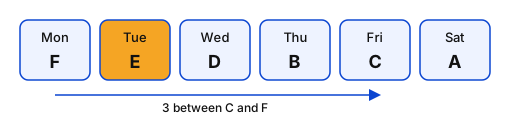
Each of A, B, C, D, E and F has a badminton match on a different day of a week starting from Monday and ending on Saturday of the same week. C has match on Friday. Only three people have matches between C and F. D has match immediately after E but immediately before B. On which day of the week does E have the match?
A, B, C, D, E और F में से प्रत्येक का बैडमिंटन मैच एक ही सप्ताह के सोमवार से शुरू होकर शनिवार तक समाप्त होने वाले सप्ताह के अलग-अलग दिन है। C का मैच शुक्रवार को है। C और F के बीच केवल तीन व्यक्तियों के मैच हैं। D का मैच E के ठीक बाद लेकिन B के ठीक पहले है। E का मैच सप्ताह के किस दिन है?
  1. AThursdayबृहस्पतिवार
  2. BWednesdayबुधवार
  3. CTuesdayमंगलवार
  4. DMondayसोमवार
Show answer

Concept: Place the fixed person first, then use the 'gap' clue and the consecutive block.

  1. C → Friday. Three people between C and F → F is on Monday (Tuesday–Thursday are the three days between).
  2. E, D, B are on consecutive days in that order (E, then D, then B). The only three consecutive free days are Tue, Wed, Thu → E = Tuesday, D = Wednesday, B = Thursday.
  3. A takes the remaining day, Saturday.

Trick: Fix the definite clue (C = Friday), then slot the three-in-a-row block E–D–B; the answer appears without trial and error.

Answer: (C) Tuesday

अवधारणा: पहले निश्चित व्यक्ति रखें, फिर 'बीच में' वाला संकेत और लगातार दिनों का ब्लॉक लगाएँ।

  1. C → शुक्रवार। C और F के बीच तीन लोग → F सोमवार को (मंगल–गुरु बीच के तीन दिन)।
  2. E, D, B लगातार दिनों पर इसी क्रम में हैं। तीन लगातार खाली दिन सिर्फ़ मंगल, बुध, गुरु → E = मंगलवार, D = बुधवार, B = गुरुवार।
  3. A बचे दिन शनिवार को।

ट्रिक: पक्का संकेत (C = शुक्रवार) पहले लगाएँ, फिर E–D–B का लगातार ब्लॉक – उत्तर बिना ट्रायल के मिल जाता है।

उत्तर: (C) मंगलवार (Tuesday)

RRB NTPC Graduate CBT 1General Intelligence and ReasoningScheduling Puzzle (Days)RRB NTPC Graduate CBT 1 2025 · 18 Mar Shift 3 →
Q6249.
In a certain code language, ‘BUST’ is coded as ‘3519’ and ‘LIDS’ is coded as ‘6894’. What is the code for ‘S’ in that language?
एक निश्चित कूट भाषा में, ‘BUST’ को ‘3519’ के रूप में कूटबद्ध किया जाता है और ‘LIDS’ को ‘6894’ के रूप में कूटबद्ध किया जाता है। उस भाषा में ‘S’ का कूट क्या है?
  1. A1
  2. B9
  3. C4
  4. D6
Show answer

Concept: When two words share exactly one letter, the common digit in their codes is the code of that letter.

  1. BUST → 3, 5, 1, 9 and LIDS → 6, 8, 9, 4.
  2. The only common letter is S; the only common digit is 9.
  3. So S = 9.

Trick: Match the common letters with the common digits – no need to decode the whole word.

Answer: (B) 9

अवधारणा: जब दो शब्दों में ठीक एक अक्षर समान हो, तो कोडों का समान अंक उसी अक्षर का कोड होता है।

  1. BUST → 3, 5, 1, 9 और LIDS → 6, 8, 9, 4।
  2. समान अक्षर केवल S; समान अंक केवल 9।
  3. अतः S = 9।

ट्रिक: समान अक्षरों को समान अंकों से मिलाइए – पूरा शब्द डिकोड करने की ज़रूरत नहीं।

उत्तर: (B) 9

RRB NTPC Graduate CBT 1General Intelligence and ReasoningCoding–Decoding (Common Letter)RRB NTPC Graduate CBT 1 2025 · 18 Mar Shift 3 →
Q6250.
What should come in place of the question mark (?) in the given series?
145 141 133 121 105 ?
दी गई श्रृंखला में प्रश्नवाचक चिह्न (?) के स्थान पर क्या आना चाहिए?
145 141 133 121 105 ?
  1. A87
  2. B81
  3. C83
  4. D85
Show answer

Concept: Look at the differences between consecutive terms.

  1. 145−141=4, 141−133=8, 133−121=12, 121−105=16.
  2. The differences 4, 8, 12, 16 increase by 4, so the next difference is 20.
  3. 105−20=85.

Trick: When the series falls slowly then faster, check for differences in an arithmetic pattern (multiples of a number).

Answer: (D) 85

अवधारणा: क्रमागत पदों के अंतर देखें।

  1. 145−141=4, 141−133=8, 133−121=12, 121−105=16।
  2. अंतर 4, 8, 12, 16 हर बार 4 बढ़ रहे हैं, अगला अंतर 20।
  3. 105−20=85।

ट्रिक: जब श्रृंखला धीरे-धीरे फिर तेज़ी से घटे, तो अंतरों में समांतर पैटर्न (किसी संख्या के गुणज) जाँचें।

उत्तर: (D) 85

RRB NTPC Graduate CBT 1General Intelligence and ReasoningNumber SeriesRRB NTPC Graduate CBT 1 2025 · 18 Mar Shift 3 →
Q6251.
Which of the given letter-number clusters will replace the question mark (?) in the following series to make it logically complete?
TRZ 2 RPX 5 PNV 8 NLT 11 ?
निम्नलिखित श्रृंखला को तार्किक रूप से पूर्ण करने के लिए दिए गए अक्षर-संख्या समूहों में से कौन-सा प्रश्नवाचक चिह्न (?) को प्रतिस्थापित करेगा?
TRZ 2 RPX 5 PNV 8 NLT 11 ?
  1. AMCA 15
  2. BAFU 14
  3. CKDY 15
  4. DLJR 14
Show answer

Concept: Treat the letters and the number as two separate series.

  1. Letters: TRZ → RPX → PNV → NLT: each letter moves 2 steps back (T→R→P→N, R→P→N→L, Z→X→V→T). Next: N−2 = L, L−2 = J, T−2 = R → LJR.
  2. Numbers: 2, 5, 8, 11 → +3 each → next 14.
  3. Required cluster: LJR 14.

Trick: Note that the first letter of each cluster is the second letter of the previous one (T R Z → R P X → P N V…) – a quick confirmation that letters shift by −2.

Answer: (D) LJR 14

अवधारणा: अक्षरों और संख्या को दो अलग श्रृंखलाएँ मानें।

  1. अक्षर: TRZ → RPX → PNV → NLT: हर अक्षर 2 स्थान पीछे (T→R→P→N, R→P→N→L, Z→X→V→T)। अगला: N−2 = L, L−2 = J, T−2 = R → LJR।
  2. संख्या: 2, 5, 8, 11 → हर बार +3 → अगला 14।
  3. अभीष्ट समूह: LJR 14।

ट्रिक: हर समूह का पहला अक्षर पिछले समूह का दूसरा अक्षर है (T R Z → R P X → P N V…) – यह −2 वाले पैटर्न की तुरंत पुष्टि है।

उत्तर: (D) LJR 14

RRB NTPC Graduate CBT 1General Intelligence and ReasoningLetter–Number SeriesRRB NTPC Graduate CBT 1 2025 · 18 Mar Shift 3 →
Q6252.
In a certain code language, ‘BITE’ is coded as ‘4568’ and ‘TIME’ is coded as ‘4826’. What is the code for ‘M’ in the given code language?
एक निश्चित कूट भाषा में, ‘BITE’ को ‘4568’ के रूप में कूटबद्ध किया जाता है और ‘TIME’ को ‘4826’ के रूप में कूटबद्ध किया जाता है। दी गई कूट भाषा में ‘M’ का कूट क्या है?
  1. A8
  2. B4
  3. C2
  4. D6
Show answer

Concept: Letters common to both words get the digits common to both codes; the leftover letter gets the leftover digit.

  1. BITE → 4, 5, 6, 8 and TIME → 4, 8, 2, 6.
  2. Common letters: I, T, E → common digits 4, 6, 8.
  3. The letter only in TIME is M; the digit only in its code is 2. So M = 2.

Trick: Elimination: strike out the shared digits (4, 6, 8) from TIME's code – what remains (2) is M.

Answer: (C) 2

अवधारणा: दोनों शब्दों के समान अक्षरों को समान अंक मिलते हैं; बचा अक्षर = बचा अंक।

  1. BITE → 4, 5, 6, 8 और TIME → 4, 8, 2, 6।
  2. समान अक्षर: I, T, E → समान अंक 4, 6, 8।
  3. केवल TIME में M है; उसके कोड में केवल 2 बचता है। अतः M = 2।

ट्रिक: विलोपन: TIME के कोड से साझे अंक (4, 6, 8) काट दें – जो बचे (2) वही M।

उत्तर: (C) 2

RRB NTPC Graduate CBT 1General Intelligence and ReasoningCoding–Decoding (Common Letters)RRB NTPC Graduate CBT 1 2025 · 18 Mar Shift 3 →
Q6253.
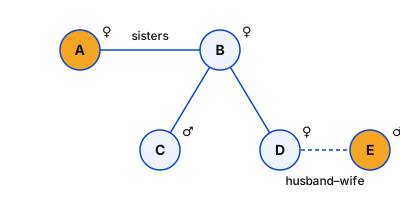
A is the sister of B. C is the brother of D. E is the husband of D. B is the mother of C. How is A related to E?
A, B की बहन है। C, D का भाई है। E, D का पति है। B, C की माता है। A, E से किस प्रकार संबंधित है?
  1. AWife's motherपत्नी की माता
  2. BWife's mother's sisterपत्नी की माता की बहन
  3. CMotherमाता
  4. DMother's motherमाता की माता
Show answer

Concept: Build the family tree generation by generation, then read the relation from E's side.

  1. B is the mother of C and D (C is D's brother). A is B's sister → A is the maternal aunt of D.
  2. E is D's husband → D is E's wife. A is the sister of E's wife's mother.
  3. So A is E's wife's mother's sister.

Trick: Write 'E's wife = D' first; whatever A is to D, prefix it with 'wife's'. A = D's mother's sister → wife's mother's sister.

Answer: (B) Wife's mother's sister

अवधारणा: पीढ़ी-दर-पीढ़ी वंश-वृक्ष बनाएँ, फिर E की ओर से संबंध पढ़ें।

  1. B, C और D की माँ है (C, D का भाई)। A, B की बहन → A, D की मौसी।
  2. E, D का पति → D, E की पत्नी। A, E की पत्नी की माँ की बहन है।
  3. अतः A, E की पत्नी की माँ की बहन (wife's mother's sister)।

ट्रिक: पहले 'E की पत्नी = D' लिखें; A का D से जो रिश्ता है उसके आगे 'पत्नी की' जोड़ दें। A = D की माँ की बहन → पत्नी की माँ की बहन।

उत्तर: (B) पत्नी की माँ की बहन (Wife's mother's sister)

RRB NTPC Graduate CBT 1General Intelligence and ReasoningBlood RelationsRRB NTPC Graduate CBT 1 2025 · 18 Mar Shift 3 →
Q6254.
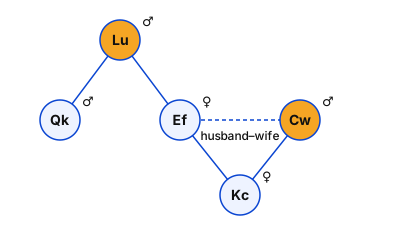
Kc is the daughter of Cw. Lu is the father of Qk. Ef is the mother of Kc. Qk is the brother of Ef. How is Lu related to Cw?
Kc, Cw की पुत्री है। Lu, Qk का पिता है। Ef, Kc की माता है। Qk, Ef का भाई है। Lu, Cw से किस प्रकार संबंधित है?
  1. AWife’s fatherपत्नी का पिता
  2. BDaughter’s husbandपुत्री का पति
  3. CWife’s brotherपत्नी का भाई
  4. DSister’s daughterबहन की पुत्री
Show answer

Concept: Fix the couple first: Kc's mother is Ef and Kc's father is Cw, so Ef and Cw are husband and wife.

  1. Qk is Ef's brother and Lu is Qk's father → Lu is also Ef's father.
  2. Ef is Cw's wife, so Lu is Cw's wife's father (father-in-law).

Trick: Whenever two persons are mother and father of the same child, link them as a couple at once – the chain shortens immediately.

Answer: (A) Wife's father

अवधारणा: पहले दंपति तय करें: Kc की माँ Ef और पिता Cw, अतः Ef और Cw पति-पत्नी।

  1. Qk, Ef का भाई और Lu, Qk का पिता → Lu, Ef का भी पिता।
  2. Ef, Cw की पत्नी है, अतः Lu, Cw की पत्नी का पिता (ससुर)।

ट्रिक: जब दो व्यक्ति एक ही बच्चे के माता और पिता हों, उन्हें तुरंत दंपति के रूप में जोड़ें – श्रृंखला छोटी हो जाती है।

उत्तर: (A) पत्नी का पिता (Wife's father)

RRB NTPC Graduate CBT 1General Intelligence and ReasoningBlood Relations (Coded Names)RRB NTPC Graduate CBT 1 2025 · 18 Mar Shift 3 →
Q6255.
Refer to the following letter, symbol series and answer the question. Counting to be done from left to right only.
(Left) K { J % I + H = G * F / D : - ! B C ? A # (Right)
How many such symbols are there, each of which is immediately preceded by a letter and also immediately followed by another letter?
निम्नलिखित अक्षर, प्रतीक श्रृंखला को देखिए और प्रश्न का उत्तर दीजिए। गणना केवल बाएँ से दाएँ की जानी है।
(बायाँ) K { J % I + H = G * F / D : - ! B C ? A # (दायाँ)
ऐसे कितने प्रतीक हैं, जिनमें से प्रत्येक के ठीक पहले एक अक्षर है और ठीक बाद भी एक अन्य अक्षर है?
  1. ASEVENसात
  2. BFOURचार
  3. CTHREEतीन
  4. DTWOदो
Show answer

Concept: Scan each symbol and check both neighbours: letter on the left AND letter on the right.

  1. Series: K { J % I + H = G * F / D : - ! B C ? A #.
  2. Qualifying symbols: { (K…J), % (J…I), + (I…H), = (H…G), * (G…F), / (F…D), ? (C…A) – 7 symbols.
  3. Rejected: ':' and '!' are next to '-', '-' is between two symbols, and '#' has nothing on its right.

Trick: Underline every symbol, then tick only those sandwiched between two letters; symbols adjacent to another symbol or at the end are out.

Answer: (A) SEVEN

अवधारणा: हर प्रतीक के दोनों पड़ोसी देखें: बाएँ भी अक्षर और दाएँ भी अक्षर।

  1. श्रृंखला: K { J % I + H = G * F / D : - ! B C ? A #।
  2. मान्य प्रतीक: { (K…J), % (J…I), + (I…H), = (H…G), * (G…F), / (F…D), ? (C…A) – 7 प्रतीक।
  3. अमान्य: ':' और '!' के पास '-' है, '-' दो प्रतीकों के बीच है, और '#' के दाएँ कुछ नहीं।

ट्रिक: हर प्रतीक को रेखांकित करें, फिर केवल दो अक्षरों के बीच वालों पर टिक लगाएँ; दूसरे प्रतीक से सटे या अंत वाले बाहर।

उत्तर: (A) SEVEN

RRB NTPC Graduate CBT 1General Intelligence and ReasoningLetter–Symbol SeriesRRB NTPC Graduate CBT 1 2025 · 18 Mar Shift 3 →
Q6256.
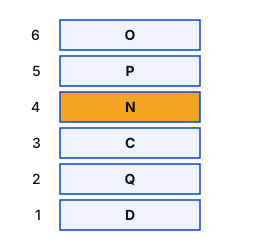
C, D, N, O, P and Q live on six different floors of the same building. The lowermost floor in the building is numbered 1, the floor above it is numbered 2 and so on, till the topmost floor, which is numbered 6. D lives on the floor numbered 1. Only two people live between Q and P. Q lives below C. Only two people live between O and C. Only one person lives between D and C. How many people live above N?
C, D, N, O, P और Q एक ही इमारत की छह अलग-अलग मंज़िलों पर रहते हैं। इमारत की सबसे निचली मंज़िल की संख्या 1 है, उसके ऊपर की मंज़िल की संख्या 2 है और इसी प्रकार सबसे ऊपरी मंज़िल तक, जिसकी संख्या 6 है। D मंज़िल संख्या 1 पर रहता है। Q और P के बीच केवल दो व्यक्ति रहते हैं। Q, C के नीचे रहता है। O और C के बीच केवल दो व्यक्ति रहते हैं। D और C के बीच केवल एक व्यक्ति रहता है। N के ऊपर कितने व्यक्ति रहते हैं?
  1. ATwoदो
  2. BFourचार
  3. COneएक
  4. DThreeतीन
Show answer

Concept: Start from the fixed floor and use the 'only n between' clues; six floors, 1 at the bottom.

  1. D = 1. Only one person between D and C → C = 3. Only two between O and C → O = 6 (floor 0 does not exist).
  2. Q is below C with two people between Q and P: Q = 2 and P = 5 (Q = 1 is taken by D).
  3. The last person N takes floor 4. Above N are P (5) and O (6) → two people.

Trick: Build the tower bottom-up: 1-D, 2-Q, 3-C, 4-N, 5-P, 6-O. 'Above N' = floors higher than 4.

Answer: (A) Two

अवधारणा: निश्चित मंज़िल से शुरू करें और 'बीच में केवल n' वाले संकेत लगाएँ; छह मंज़िलें, 1 सबसे नीचे।

  1. D = 1। D और C के बीच केवल एक → C = 3। O और C के बीच केवल दो → O = 6 (मंज़िल 0 नहीं है)।
  2. Q, C से नीचे और Q–P के बीच दो लोग: Q = 2, P = 5 (मंज़िल 1 पर D है)।
  3. बचा N मंज़िल 4 पर। N के ऊपर P (5) और O (6) → दो लोग।

ट्रिक: नीचे से ऊपर टावर बनाएँ: 1-D, 2-Q, 3-C, 4-N, 5-P, 6-O। 'N के ऊपर' = 4 से ऊँची मंज़िलें।

उत्तर: (A) दो (Two)

RRB NTPC Graduate CBT 1General Intelligence and ReasoningFloor PuzzleRRB NTPC Graduate CBT 1 2025 · 18 Mar Shift 3 →
Q6257.
63 is related to 159 following a certain logic. Following the same logic, 44 is related to 102. To which of the following is 57 related, following the same logic?
(NOTE : Operations should be performed on the whole numbers, without breaking down the numbers into its constituent digits. E.g. 13 – Operations on 13 such as adding /subtracting /multiplying etc. to 13 can be performed. Breaking down 13 into 1 and 3 and then performing mathematical operations on 1 and 3 is not allowed.)
63 एक निश्चित तर्क के अनुसार 159 से संबंधित है। उसी तर्क के अनुसार, 44, 102 से संबंधित है। उसी तर्क के अनुसार 57 निम्नलिखित में से किससे संबंधित है?
(नोट : संक्रियाएँ पूर्ण संख्याओं पर की जानी चाहिए, संख्याओं को उनके घटक अंकों में तोड़े बिना। उदाहरण के लिए 13 – 13 पर संक्रियाएँ जैसे 13 में जोड़ना/घटाना/गुणा करना आदि की जा सकती हैं। 13 को 1 और 3 में तोड़कर फिर 1 और 3 पर गणितीय संक्रियाएँ करने की अनुमति नहीं है।)
  1. A152
  2. B139
  3. C141
  4. D127
Show answer

Concept: Find one operation on the whole number that works for both given pairs.

  1. 63×3=189, 189−30=159 ✓
  2. 44×3=132, 132−30=102 ✓ – rule: 3n−30.
  3. 57×3−30=171−30=141.

Trick: Check the difference of the pairs: 159−102=57 and 63−44=19; 57=3×19, so the multiplier is 3, then adjust the constant.

Answer: (C) 141

अवधारणा: पूरी संख्या पर एक ऐसी संक्रिया खोजें जो दोनों दिए गए युग्मों पर लागू हो।

  1. 63×3=189, 189−30=159 ✓
  2. 44×3=132, 132−30=102 ✓ – नियम: 3n−30।
  3. 57×3−30=171−30=141।

ट्रिक: युग्मों का अंतर देखें: 159−102=57 और 63−44=19; 57=3×19, अतः गुणक 3, फिर स्थिरांक मिलाएँ।

उत्तर: (C) 141

RRB NTPC Graduate CBT 1General Intelligence and ReasoningNumber AnalogyRRB NTPC Graduate CBT 1 2025 · 18 Mar Shift 3 →
Q6258.
Which of the following letter-clusters should replace # and % so that the pattern and relationship followed between the letter-cluster pair on the left side of :: is the same as that on the right side of :: ?
# : KUC :: XHP : %
निम्नलिखित में से कौन-से अक्षर-समूह # और % को प्रतिस्थापित करने चाहिए ताकि :: के बाईं ओर के अक्षर-समूह युग्म के बीच अनुसरण किया गया पैटर्न और संबंध वही हो जो :: के दाईं ओर है?
# : KUC :: XHP : %
  1. A# = EOX % = DNV
  2. B# = FOW % = DNV
  3. C# = EOW % = DNO
  4. D# = EOW % = DNV
Show answer

Concept: Find the shift from the right-hand pair where both terms are partly known, then apply it (in reverse) on the left.

  1. Right side XHP : %. Testing option letters: X(24)+6 = 30 → D(4), H(8)+6 = N(14), P(16)+6 = V(22) → % = DNV (each letter +6, cyclic).
  2. So the rule is 'first + 6 = second'. On the left, # + 6 = KUC → # = K−6 = E, U−6 = O, C−6 = W (3−6 = −3 → 23 = W).
  3. # = EOW, % = DNV.

Trick: Only option (D) has both EOW and DNV; options with DNO or FOW break the uniform +6 shift.

Answer: (D) # = EOW % = DNV

अवधारणा: दाएँ युग्म (जिसका एक पद ज्ञात है) से शिफ्ट पता करें, फिर उसे बाईं ओर उल्टा लगाएँ।

  1. दाईं ओर XHP : %। विकल्पों से जाँच: X(24)+6 = 30 → D(4), H(8)+6 = N(14), P(16)+6 = V(22) → % = DNV (हर अक्षर +6, चक्रीय)।
  2. नियम 'पहला + 6 = दूसरा'। बाईं ओर # + 6 = KUC → # = K−6 = E, U−6 = O, C−6 = W (3−6 = −3 → 23 = W)।
  3. # = EOW, % = DNV।

ट्रिक: केवल विकल्प (D) में EOW और DNV दोनों हैं; DNO या FOW वाले विकल्प समान +6 शिफ्ट तोड़ते हैं।

उत्तर: (D) # = EOW % = DNV

RRB NTPC Graduate CBT 1General Intelligence and ReasoningLetter-Cluster AnalogyRRB NTPC Graduate CBT 1 2025 · 18 Mar Shift 3 →
Q6259.
RILA is related to SKOE in a certain way based on the English alphabetical order. In the same way, KEPO is related to LGSS. To which of the following is MJRT related, following the same logic?
RILA, अंग्रेज़ी वर्णमाला क्रम के आधार पर एक निश्चित प्रकार से SKOE से संबंधित है। उसी प्रकार, KEPO, LGSS से संबंधित है। उसी तर्क के अनुसार MJRT निम्नलिखित में से किससे संबंधित है?
  1. ANOYZ
  2. BNLUX
  3. CNMWX
  4. DNKTY
Show answer

Concept: Compare letter positions in the given pair to find the position-wise shift.

  1. RILA → SKOE: R+1 = S, I+2 = K, L+3 = O, A+4 = E. Pattern +1, +2, +3, +4.
  2. Check: KEPO → K+1 = L, E+2 = G, P+3 = S, O+4 = S → LGSS ✓
  3. MJRT → M+1 = N, J+2 = L, R+3 = U, T+4 = X → NLUX.

Trick: When the first letters differ by 1 and the last by 4, suspect the +1, +2, +3, +4 staircase.

Answer: (B) NLUX

अवधारणा: दिए गए युग्म में अक्षरों की स्थितियाँ मिलाकर स्थान-वार शिफ्ट निकालें।

  1. RILA → SKOE: R+1 = S, I+2 = K, L+3 = O, A+4 = E। पैटर्न +1, +2, +3, +4।
  2. जाँच: KEPO → K+1 = L, E+2 = G, P+3 = S, O+4 = S → LGSS ✓
  3. MJRT → M+1 = N, J+2 = L, R+3 = U, T+4 = X → NLUX।

ट्रिक: जब पहले अक्षर में 1 और अंतिम में 4 का अंतर हो, तो +1, +2, +3, +4 सीढ़ी का संदेह करें।

उत्तर: (B) NLUX

RRB NTPC Graduate CBT 1General Intelligence and ReasoningLetter-Cluster AnalogyRRB NTPC Graduate CBT 1 2025 · 18 Mar Shift 3 →
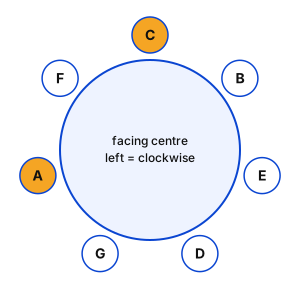
Q6260.
A, B, C, D, E, F and G sit around a circular table, facing the centre.
Only one person sits between D and B when counted from the left of B. F sits third to the right of E. C sits third to the left of G. F sits to the immediate right of C. A is not an immediate neighbour of C.
How many people sit between A and C when counted from the left of A?
A, B, C, D, E, F और G एक वृत्ताकार मेज़ के चारों ओर केंद्र की ओर मुख करके बैठे हैं।
B के बाईं ओर से गिनने पर D और B के बीच केवल एक व्यक्ति बैठा है। F, E के दाईं ओर तीसरे स्थान पर बैठा है। C, G के बाईं ओर तीसरे स्थान पर बैठा है। F, C के ठीक दाईं ओर बैठा है। A, C का निकटतम पड़ोसी नहीं है।
A के बाईं ओर से गिनने पर A और C के बीच कितने व्यक्ति बैठे हैं?
  1. A2
  2. B1
  3. C4
  4. D3
Show answer

Concept: Facing the centre: 'left' means clockwise and 'right' means anticlockwise. Start with the clue linking two fixed people.

  1. F is to the immediate right of C. C is third to the left of G, so G is third to the right of C. F is third to the right of E → E is third to the left of F.
  2. Going clockwise from C: C, _, E, _, G, _, F (E is 3 places left of F, G is 3 right of C, F just right of C).
  3. Only one person between D and B counted from the left of B → D is 2nd to the left of B. The empty seats are the 1st, 3rd and 5th clockwise from C; A is not next to C, so A is at the 5th seat (between G and F), B at the 1st and D at the 3rd.
  4. From A's left (clockwise): F, then C → one person between A and C.

Trick: Draw 7 dots, mark C, and put F anticlockwise of C at once; the rest of the clues fill in without any trial.

Answer: (B) 1

अवधारणा: केंद्र की ओर मुख: 'बाएँ' = दक्षिणावर्त (clockwise), 'दाएँ' = वामावर्त। दो लोगों को जोड़ने वाले संकेत से शुरू करें।

  1. F, C के तुरंत दाएँ। C, G के बाएँ तीसरा → G, C के दाएँ तीसरा। F, E के दाएँ तीसरा → E, F के बाएँ तीसरा।
  2. C से दक्षिणावर्त: C, _, E, _, G, _, F।
  3. B के बाएँ से गिनने पर D और B के बीच केवल एक → D, B के बाएँ दूसरा। खाली सीटें C से 1ली, 3री, 5वीं; A, C के पास नहीं → A 5वीं सीट पर (G और F के बीच), B 1ली पर, D 3री पर।
  4. A के बाएँ से: F, फिर C → A और C के बीच एक व्यक्ति।

ट्रिक: 7 बिंदु बनाएँ, C लिखें और F को तुरंत C के वामावर्त रखें; बाकी संकेत बिना ट्रायल के भर जाते हैं।

उत्तर: (B) 1

RRB NTPC Graduate CBT 1General Intelligence and ReasoningCircular SeatingRRB NTPC Graduate CBT 1 2025 · 18 Mar Shift 3 →