Question bank

Q&A: practice questions with answers

Search questions on any topic. Filter by exam category, exam, subject and topic, try the question, then open the answer and explanation.

Courses – airGurukul

7,077 questions found.

Q6421.
If 34% of 50−46×5123×36=y, then the value of y is
यदि 34%, 50−46×5123×36=y का है, तो y का मान है
  1. A-18
  2. B-15
  3. C-12
  4. D-10
Show answer

Concept: Evaluate percentages, roots and products first, then subtract (BODMAS).

  1. 34% of 50=34100×50=17.
  2. 5123=8, 36=6, so 46×8×6=32.
  3. y=17−32=−15.

Trick: The 6 cancels with the denominator 6, leaving 4×8=32 instantly.

Answer: (B) −15

अवधारणा: पहले प्रतिशत, मूल और गुणा निकालें, फिर घटाएँ (BODMAS)।

  1. 50 का 34%=34100×50=17।
  2. 5123=8, 36=6, अतः 46×8×6=32।
  3. y=17−32=−15।

ट्रिक: 6 हर के 6 से कट जाता है, सीधे 4×8=32।

उत्तर: (B) −15

RRB NTPC Graduate CBT 1MathematicsSimplification (BODMAS)RRB NTPC Graduate CBT 1 2025 · 18 Mar Shift 1 →
Q6422.
A tank is filled by three pipes, P, Q and R, with uniform flow. The first two pipes P and Q, operating simultaneously, fill the tank in the same amount of time that it takes for the tank to be filled by pipe R alone. Pipe Q fills the tank 15 hours faster than the first pipe and 12 hours slower than pipe R. What is the time required by pipe P to fill the tank?
एक टंकी को तीन पाइपों P, Q और R द्वारा एकसमान प्रवाह से भरा जाता है। पहले दो पाइप P और Q, एक साथ चलकर, टंकी को उतने ही समय में भरते हैं जितने समय में अकेला पाइप R टंकी को भरता है। पाइप Q टंकी को पहले पाइप से 15 घंटे तेज़ और पाइप R से 12 घंटे धीमे भरता है। पाइप P को टंकी भरने में कितना समय लगेगा?
  1. A32 hours32 घंटे
  2. B45 hours45 घंटे
  3. C25 hours25 घंटे
  4. D47 hours47 घंटे
Show answer

Concept: Rates add: if P, Q, R take p,q,r hours, then 1p+1q=1r when P + Q together equal R.

  1. Let P take t h. Then Q takes t−15 h and R takes t−15−12=t−27 h.
  2. 1t+1t−15=1t−27.
  3. Try t=45: 145+130=2+390=118, and 45−27=18 ✓.

Trick: Put the options directly: only t=45 makes t−15 and t−27 both divide a common LCM neatly.

Answer: (B) 45 hours

अवधारणा: दरें जुड़ती हैं: यदि P, Q, R क्रमशः p,q,r घंटे लें और P + Q मिलकर R के बराबर हों, तो 1p+1q=1r।

  1. माना P को t घंटे लगते हैं। तब Q को t−15 और R को t−15−12=t−27 घंटे।
  2. 1t+1t−15=1t−27।
  3. t=45 रखें: 145+130=2+390=118, और 45−27=18 ✓।

ट्रिक: विकल्प सीधे रखें: केवल t=45 पर t−15 और t−27 साफ़-साफ़ मेल खाते हैं।

उत्तर: (B) 45 hours

RRB NTPC Graduate CBT 1MathematicsPipes and CisternsRRB NTPC Graduate CBT 1 2025 · 18 Mar Shift 1 →
Q6423.
What is the ratio between fourth proportional of 10, 80, 30 and fourth proportional of 7, 28, 19?
10, 80, 30 के चतुर्थानुपाती और 7, 28, 19 के चतुर्थानुपाती के बीच अनुपात क्या है?
  1. A29:26
  2. B60:19
  3. C10:7
  4. D30:19
Show answer

Concept: Fourth proportional of a,b,c is d=b×ca.

  1. For 10, 80, 30: d1=80×3010=240.
  2. For 7, 28, 19: d2=28×197=76.
  3. Ratio =240:76=60:19.

Trick: Divide both by 4: 240÷4=60, 76÷4=19.

Answer: (B) 60:19

अवधारणा: a,b,c का चतुर्थानुपाती d=b×ca।

  1. 10, 80, 30 के लिए: d1=80×3010=240।
  2. 7, 28, 19 के लिए: d2=28×197=76।
  3. अनुपात =240:76=60:19।

ट्रिक: दोनों को 4 से भाग दें: 240÷4=60, 76÷4=19।

उत्तर: (B) 60:19

RRB NTPC Graduate CBT 1MathematicsProportionRRB NTPC Graduate CBT 1 2025 · 18 Mar Shift 1 →
Q6424.
Find the minimum value of the quadratic expression 7x2 − 7x + 22.
द्विघात व्यंजक 7x2 − 7x + 22 का न्यूनतम मान ज्ञात कीजिए।
  1. A554
  2. B814
  3. C834
  4. D654
Show answer

Concept: For ax2+bx+c with a>0, minimum value =c−b24a (at x=−b2a).

  1. a=7, b=−7, c=22.
  2. b24a=4928=74.
  3. Minimum =22−74=88−74=814.

Trick: Minimum =4ac−b24a=616−4928=56728=814.

Answer: (B) 814

अवधारणा: ax2+bx+c (a>0) का न्यूनतम मान =c−b24a (x=−b2a पर)।

  1. a=7, b=−7, c=22।
  2. b24a=4928=74।
  3. न्यूनतम =22−74=88−74=814।

ट्रिक: न्यूनतम =4ac−b24a=616−4928=56728=814।

उत्तर: (B) 814

RRB NTPC Graduate CBT 1MathematicsQuadratic – Minimum ValueRRB NTPC Graduate CBT 1 2025 · 18 Mar Shift 1 →
Q6425.
The population of a village was 2,90,000. It increased by 15% in the first year and increased by 25% in the second year. Its population after two years is _______.
एक गाँव की जनसंख्या 2,90,000 थी। पहले वर्ष में इसमें 15% की वृद्धि हुई और दूसरे वर्ष में 25% की वृद्धि हुई। दो वर्षों के बाद इसकी जनसंख्या _______ है।
  1. A3,33,500
  2. B3,62,500
  3. C4,16,875
  4. D4,06,000
Show answer

Concept: Successive increases of a% and b% multiply: new =P(1+a100)(1+b100).

  1. After year 1: 290000×115100=333500.
  2. After year 2: 333500×125100=416875.

Trick: Net change =15+25+15×25100=43.75%; 290000×1.4375=416875.

Answer: (C) 4,16,875

अवधारणा: a% और b% की क्रमिक वृद्धियाँ गुणा होती हैं: नया =P(1+a100)(1+b100)।

  1. पहले वर्ष बाद: 290000×115100=333500।
  2. दूसरे वर्ष बाद: 333500×125100=416875।

ट्रिक: कुल परिवर्तन =15+25+15×25100=43.75%; 290000×1.4375=416875।

उत्तर: (C) 4,16,875

RRB NTPC Graduate CBT 1MathematicsSuccessive Percentage ChangeRRB NTPC Graduate CBT 1 2025 · 18 Mar Shift 1 →
Q6426.
There are 75 members in group A, 47 members in group B and 15 members in group C. All the members of these groups went to a restaurant. The average amounts spent on each member of groups A, B and C are ₹493, ₹397 and ₹465, respectively. The overall average amount (in ₹) spent per member is:
समूह A में 75 सदस्य, समूह B में 47 सदस्य और समूह C में 15 सदस्य हैं। इन समूहों के सभी सदस्य एक रेस्तरां में गए। समूह A, B और C के प्रत्येक सदस्य पर खर्च की गई औसत राशि क्रमशः ₹493, ₹397 और ₹465 है। प्रति सदस्य खर्च की गई कुल औसत राशि (₹ में) है:
  1. A457
  2. B461
  3. C462
  4. D455
Show answer

Concept: Overall average =∑(count×average)total count.

  1. Total spent =75×493+47×397+15×465=36975+18659+6975=62609.
  2. Total members =75+47+15=137.
  3. Average =62609137=457.

Trick: Take 457 as base: deviations 75×36−47×60+15×8=2700−2820+120=0, so the average is exactly 457.

Answer: (A) 457

अवधारणा: कुल औसत =∑(संख्या×औसत)कुल संख्या।

  1. कुल खर्च =75×493+47×397+15×465=36975+18659+6975=62609।
  2. कुल सदस्य =75+47+15=137।
  3. औसत =62609137=457।

ट्रिक: 457 को आधार मानें: विचलन 75×36−47×60+15×8=2700−2820+120=0, अतः औसत ठीक 457।

उत्तर: (A) 457

RRB NTPC Graduate CBT 1MathematicsWeighted AverageRRB NTPC Graduate CBT 1 2025 · 18 Mar Shift 1 →
Q6427.
Girish scored 416 marks in an examination and was 79 marks short of 33% of maximum marks. In the same examination, his friend scored 555 marks. What is the percentage of marks scored by his friend?
गिरीश ने एक परीक्षा में 416 अंक प्राप्त किए और वह अधिकतम अंकों के 33% से 79 अंक कम रहा। उसी परीक्षा में, उसके मित्र ने 555 अंक प्राप्त किए। उसके मित्र द्वारा प्राप्त अंकों का प्रतिशत क्या है?
  1. A39%
  2. B37%
  3. C38%
  4. D36%
Show answer

Concept: First find the maximum marks from the given percentage, then compute the friend's percentage.

  1. 33% of maximum =416+79=495.
  2. Maximum marks =495×10033=1500.
  3. Friend's percentage =5551500×100=37%.

Trick: 1% of 1500 = 15; 555÷15=37.

Answer: (B) 37%

अवधारणा: पहले दिए प्रतिशत से अधिकतम अंक निकालें, फिर मित्र का प्रतिशत।

  1. अधिकतम का 33%=416+79=495।
  2. अधिकतम अंक =495×10033=1500।
  3. मित्र का प्रतिशत =5551500×100=37%।

ट्रिक: 1500 का 1%=15; 555÷15=37।

उत्तर: (B) 37%

RRB NTPC Graduate CBT 1MathematicsPercentageRRB NTPC Graduate CBT 1 2025 · 18 Mar Shift 1 →
Q6428.
If x+1x=−3, find the value of x3+1x3.
यदि x+1x=−3 है, तो x3+1x3 का मान ज्ञात कीजिए।
  1. A0
  2. B−18
  3. C−3
  4. D9
Show answer

Concept: x3+1x3=(x+1x)3−3(x+1x).

  1. Put x+1x=−3.
  2. (−3)3−3(−3)=−27+9=−18.

Trick: For x+1x=a: x3+1x3=a3−3a (and x2+1x2=a2−2).

Answer: (B) −18

अवधारणा: x3+1x3=(x+1x)3−3(x+1x)।

  1. x+1x=−3 रखें।
  2. (−3)3−3(−3)=−27+9=−18।

ट्रिक: x+1x=a हो तो x3+1x3=a3−3a (और x2+1x2=a2−2)।

उत्तर: (B) −18

RRB NTPC Graduate CBT 1MathematicsAlgebra – Cubic IdentityRRB NTPC Graduate CBT 1 2025 · 18 Mar Shift 1 →
Q6429.
Two automated lab machines start a calibration cycle at the same time.
Machine A completes one cycle every 12 minutes.
Machine B completes one cycle every 18 minutes.
After how many minutes will both machines complete a cycle together again?
दो स्वचालित प्रयोगशाला मशीनें एक ही समय पर अंशांकन (calibration) चक्र शुरू करती हैं।
मशीन A प्रत्येक 12 मिनट में एक चक्र पूरा करती है।
मशीन B प्रत्येक 18 मिनट में एक चक्र पूरा करती है।
कितने मिनट बाद दोनों मशीनें फिर से एक साथ एक चक्र पूरा करेंगी?
  1. A48
  2. B24
  3. C30
  4. D36
Show answer

Concept: Events repeating every a and b minutes coincide again after LCM(a,b) minutes.

  1. 12=22×3, 18=2×32.
  2. LCM=22×32=36.
  3. After 36 minutes A finishes 3 cycles and B finishes 2 cycles together.

Trick: LCM=12×18HCF=2166=36.

Answer: (D) 36

अवधारणा: हर a और b मिनट में दोहराने वाली घटनाएँ LCM(a,b) मिनट बाद फिर साथ होती हैं।

  1. 12=22×3, 18=2×32।
  2. LCM=22×32=36।
  3. 36 मिनट बाद A के 3 चक्र और B के 2 चक्र एक साथ पूरे होंगे।

ट्रिक: LCM=12×18HCF=2166=36।

उत्तर: (D) 36

RRB NTPC Graduate CBT 1MathematicsLCM – ApplicationRRB NTPC Graduate CBT 1 2025 · 18 Mar Shift 1 →
Q6430.
What is the diameter of a circle if the numerical value of its area is equal to twice the numerical value of its perimeter?
एक वृत्त का व्यास क्या है यदि उसके क्षेत्रफल का संख्यात्मक मान उसकी परिधि के संख्यात्मक मान के दोगुने के बराबर है?
  1. A6 units6 इकाई
  2. B8 units8 इकाई
  3. C4 units4 इकाई
  4. D2 units2 इकाई
Show answer

Concept: Area =πr2, perimeter (circumference) =2πr.

  1. Given πr2=2×2πr.
  2. Divide by πr: r=4 units.
  3. Diameter =2r=8 units.

Trick: Area =k× circumference gives r=2k; here k=2, so r=4, d=8.

Answer: (B) 8 units

अवधारणा: क्षेत्रफल =πr2, परिमाप (परिधि) =2πr।

  1. दिया है πr2=2×2πr।
  2. πr से भाग दें: r=4 इकाई।
  3. व्यास =2r=8 इकाई।

ट्रिक: क्षेत्रफल =k× परिधि हो तो r=2k; यहाँ k=2, अतः r=4, d=8।

उत्तर: (B) 8 units

RRB NTPC Graduate CBT 1MathematicsMensuration – CircleRRB NTPC Graduate CBT 1 2025 · 18 Mar Shift 1 →
Q6431.
Kartik has ₹1407 with him. He divides this amount between his two sons, Ishan and Krish, and asks them to invest their respective shares at a compound interest rate of 10% per annum, compounded annually. It is observed that Ishan’s investment amounts to the same value after 11 years as Krish’s investment does after 12 years. How much (in ₹) did Kartik give to Krish?
कार्तिक के पास ₹1407 हैं। वह इस राशि को अपने दो पुत्रों, ईशान और कृष, के बीच बाँटता है और उन्हें अपने-अपने हिस्से को 10% वार्षिक चक्रवृद्धि ब्याज की दर पर, वार्षिक रूप से संयोजित, निवेश करने के लिए कहता है। यह देखा गया कि ईशान का निवेश 11 वर्षों बाद उतना ही हो जाता है जितना कृष का निवेश 12 वर्षों बाद होता है। कार्तिक ने कृष को कितनी राशि (₹ में) दी?
  1. A670
  2. B837
  3. C520
  4. D737
Show answer

Concept: Equal amounts after different periods: I(1+r)11=K(1+r)12.

  1. Cancel (1.1)11: I=K×1.1, so I:K=11:10.
  2. Total 21 parts =1407, one part =67.
  3. Krish's share =10×67=670.

Trick: The one who invests for an extra year gets the smaller share, in ratio 100:(100+r) – here 10:11.

Answer: (A) 670

अवधारणा: अलग-अलग अवधि के बाद समान मिश्रधन: I(1+r)11=K(1+r)12।

  1. (1.1)11 काटें: I=K×1.1, अतः I:K=11:10।
  2. कुल 21 भाग =1407, एक भाग =67।
  3. कृष का हिस्सा =10×67=670।

ट्रिक: जो एक वर्ष अधिक निवेश करता है उसका हिस्सा छोटा होता है, अनुपात 100:(100+r) – यहाँ 10:11।

उत्तर: (A) 670

RRB NTPC Graduate CBT 1MathematicsCompound Interest – Division of AmountRRB NTPC Graduate CBT 1 2025 · 18 Mar Shift 1 →
Q6432.
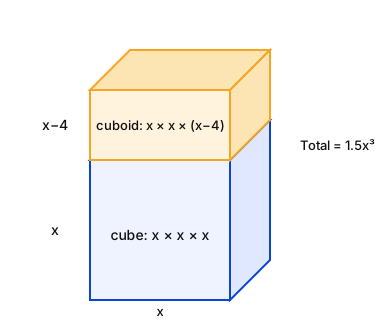
A solid is composed of a cube surmounted by a cuboid. The edge of the cube is x cm. The cuboid placed on top has a square base exactly fitting the top face of the cube, and its height is (x − 4) cm. If the total volume of the solid is 1.5 times the volume of the cube, what is the value of x?
एक ठोस एक घन से बना है जिसके ऊपर एक घनाभ रखा है। घन की भुजा x cm है। ऊपर रखे घनाभ का वर्गाकार आधार घन के ऊपरी फलक पर ठीक-ठीक बैठता है, और इसकी ऊँचाई (x − 4) cm है। यदि ठोस का कुल आयतन घन के आयतन का 1.5 गुना है, तो x का मान क्या है?
  1. A6
  2. B8
  3. C7
  4. D5
Show answer

Concept: Volume of the solid = volume of cube + volume of cuboid on top.

  1. Cube: x3. Cuboid: base x×x, height (x−4) → x2(x−4).
  2. x3+x2(x−4)=1.5x3.
  3. x2(x−4)=0.5x3⇒x−4=0.5x⇒x=8.

Trick: The cuboid must be half the cube, so its height is half the edge: x−4=x2.

Answer: (B) 8

अवधारणा: ठोस का आयतन = घन का आयतन + ऊपर रखे घनाभ का आयतन।

  1. घन: x3। घनाभ: आधार x×x, ऊँचाई (x−4) → x2(x−4)।
  2. x3+x2(x−4)=1.5x3।
  3. x2(x−4)=0.5x3⇒x−4=0.5x⇒x=8।

ट्रिक: घनाभ, घन का आधा होना चाहिए, अतः उसकी ऊँचाई भुजा की आधी: x−4=x2।

उत्तर: (B) 8

RRB NTPC Graduate CBT 1MathematicsMensuration – Composite SolidRRB NTPC Graduate CBT 1 2025 · 18 Mar Shift 1 →
Q6433.
Mr. X travelled 810 km, 492 km and 988 km at a speed of 30 km/hr, 12 km/hr and 38 km/hr, respectively. Find his average speed in km/hr.
श्री X ने 810 km, 492 km और 988 km की दूरी क्रमशः 30 km/hr, 12 km/hr और 38 km/hr की चाल से तय की। उनकी औसत चाल km/hr में ज्ञात कीजिए।
  1. A241847
  2. B241747
  3. C252047
  4. D241647
Show answer

Concept: Average speed=Total distanceTotal time – never average the speeds directly.

  1. Times: 81030=27 h, 49212=41 h, 98838=26 h.
  2. Total time =27+41+26=94 h; total distance =810+492+988=2290 km.
  3. Average speed =229094=243494=241747 km/h.

Trick: Divide each distance by its speed first – here all three come out as whole hours, so the only work is one final division.

Answer: (B) 241747

अवधारणा: औसत चाल=कुल दूरीकुल समय – चालों का सीधा औसत कभी न लें।

  1. समय: 81030=27 घंटे, 49212=41 घंटे, 98838=26 घंटे।
  2. कुल समय =27+41+26=94 घंटे; कुल दूरी =810+492+988=2290 km।
  3. औसत चाल =229094=243494=241747 km/h।

ट्रिक: पहले हर दूरी को उसकी चाल से भाग दें – यहाँ तीनों पूर्ण घंटे आते हैं, तो बस एक अंतिम भाग करना है।

उत्तर: (B) 241747

RRB NTPC Graduate CBT 1MathematicsAverage speedRRB NTPC Graduate CBT 1 2025 · 18 Mar Shift 1 →
Q6434.
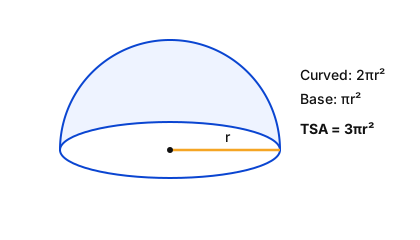
The total surface area of a solid hemisphere is 272 cm2. Its radius (in cm) is: (Take π=227)
एक ठोस अर्धगोले का कुल पृष्ठीय क्षेत्रफल 272 cm2 है। इसकी त्रिज्या (cm में) है: (π=227 लीजिए)
  1. A96233
  2. B96833
  3. C95233
  4. D94633
Show answer

Concept: Total surface area of a solid hemisphere =2πr2+πr2=3πr2.

  1. 3×227×r2=272
  2. r2=272×766=190466=95233
  3. r=95233 cm.

Trick: Solid hemisphere → 3πr2 (curved + flat base); hollow bowl → only 2πr2. Don't drop the base.

Answer: (C) 95233

अवधारणा: ठोस अर्धगोले का कुल पृष्ठीय क्षेत्रफल =2πr2+πr2=3πr2।

  1. 3×227×r2=272
  2. r2=272×766=190466=95233
  3. r=95233 cm।

ट्रिक: ठोस अर्धगोला → 3πr2 (वक्र + समतल आधार); खोखला कटोरा → केवल 2πr2। आधार छोड़ना नहीं।

उत्तर: (C) 95233

RRB NTPC Graduate CBT 1MathematicsMensuration – hemisphereRRB NTPC Graduate CBT 1 2025 · 18 Mar Shift 1 →
Q6435.
A dealer buys two articles X and Y for ₹500 each. He marks each of them at the same price. He sells X by giving two successive discounts of 20% and 45% and still earns ₹636 as profit. If he sells Y at a single discount of 67%, then what is the profit
percentage on Y?
एक व्यापारी दो वस्तुएँ X और Y प्रत्येक ₹500 में खरीदता है। वह दोनों पर एक समान मूल्य अंकित करता है। वह X को 20% और 45% की दो क्रमिक छूट देकर बेचता है और फिर भी ₹636 का लाभ कमाता है। यदि वह Y को 67% की एकल छूट पर बेचता है, तो Y पर लाभ
प्रतिशत क्या है?
  1. A69.4%
  2. B69%
  3. C70%
  4. D70.4%
Show answer

Concept: Two successive discounts of a% and b% leave (100−a)(100−b)100% of the marked price.

  1. SP of X =500+636=1136. After 20% and 45%: SP=MP×0.8×0.55=0.44MP.
  2. So 0.44MP=1136.
  3. Y at 67% discount: SPY=0.33MP=1136×0.330.44=1136×34=852.
  4. Profit =852−500=352; profit% =352500×100=70.4%.

Trick: You never need MP itself – 0.330.44=34, so SP of Y is just 34 of SP of X.

Answer: (D) 70.4%

अवधारणा: a% और b% की दो क्रमिक छूट के बाद अंकित मूल्य का (100−a)(100−b)100% बचता है।

  1. X का SP =500+636=1136। 20% और 45% के बाद: SP=MP×0.8×0.55=0.44MP।
  2. अतः 0.44MP=1136।
  3. Y पर 67% छूट: SPY=0.33MP=1136×0.330.44=1136×34=852।
  4. लाभ =852−500=352; लाभ% =352500×100=70.4%।

ट्रिक: MP निकालने की ज़रूरत ही नहीं – 0.330.44=34, तो Y का SP, X के SP का बस 34 है।

उत्तर: (D) 70.4%

RRB NTPC Graduate CBT 1MathematicsSuccessive discountsRRB NTPC Graduate CBT 1 2025 · 18 Mar Shift 1 →
Q6436.
A shopkeeper purchased 47 dozens of articles at the rate of ₹480 per dozen. He sold each one of them at the rate of ₹78. What percentage profit did he make?
एक दुकानदार ने ₹480 प्रति दर्जन की दर से 47 दर्जन वस्तुएँ खरीदीं। उसने उनमें से प्रत्येक को ₹78 की दर से बेचा। उसने कितने प्रतिशत लाभ कमाया?
  1. A92%
  2. B93%
  3. C98%
  4. D95%
Show answer

Concept: Compare cost and selling price of one unit; Profit%=SP−CPCP×100.

  1. CP of one article =48012= ₹40.
  2. SP of one article = ₹78, profit =78−40= ₹38.
  3. Profit% =3840×100=95%.

Trick: "47 dozens" is a distraction – percentage profit is the same for one article as for all of them.

Answer: (D) 95%

अवधारणा: एक इकाई का क्रय और विक्रय मूल्य तुलना करें; लाभ%=SP−CPCP×100।

  1. एक वस्तु का CP =48012= ₹40।
  2. एक वस्तु का SP = ₹78, लाभ =78−40= ₹38।
  3. लाभ% =3840×100=95%।

ट्रिक: "47 दर्जन" सिर्फ़ भटकाने के लिए है – एक वस्तु पर लाभ प्रतिशत और सभी पर लाभ प्रतिशत बराबर होता है।

उत्तर: (D) 95%

RRB NTPC Graduate CBT 1MathematicsProfit percentageRRB NTPC Graduate CBT 1 2025 · 18 Mar Shift 1 →
Q6437.
Walking at 37 of his normal speed from his home, Lakshya is 20 minutes late in reaching his office. The usual time taken by him to cover the distance between his home and his office is
अपने घर से अपनी सामान्य चाल के 37 से चलने पर, लक्ष्य अपने कार्यालय पहुँचने में 20 मिनट देर हो जाता है। अपने घर और कार्यालय के बीच की दूरी तय करने में उसके द्वारा लिया जाने वाला सामान्य समय है
  1. A13 minutes13 मिनट
  2. B11 minutes11 मिनट
  3. C15 minutes15 मिनट
  4. D5 minutes5 मिनट
Show answer

Concept: For a fixed distance, time is inversely proportional to speed.

  1. Speed becomes 37 of normal → time becomes 73 of normal time T.
  2. Extra time =73T−T=43T=20 minutes.
  3. T=20×34=15 minutes.

Trick: Speed ratio 3:7 → time ratio 7:3; the difference of 4 parts = 20 min, so 1 part = 5 min and usual time = 3 parts = 15 min.

Answer: (C) 15 minutes

अवधारणा: निश्चित दूरी के लिए समय, चाल के व्युत्क्रमानुपाती होता है।

  1. चाल सामान्य की 37 हो गई → समय सामान्य समय T का 73 हो गया।
  2. अतिरिक्त समय =73T−T=43T=20 मिनट।
  3. T=20×34=15 मिनट।

ट्रिक: चाल अनुपात 3:7 → समय अनुपात 7:3; 4 भागों का अंतर = 20 मिनट, तो 1 भाग = 5 मिनट और सामान्य समय = 3 भाग = 15 मिनट।

उत्तर: (C) 15 मिनट

RRB NTPC Graduate CBT 1MathematicsSpeed and timeRRB NTPC Graduate CBT 1 2025 · 18 Mar Shift 1 →
Q6438.
The following table shows the distribution of marks obtained by students in a test. Find the mode. (Round off to two decimal places.)
Marks Range0-1010-2020-3030-4040-50
Number of Students512182510
निम्नलिखित तालिका एक परीक्षा में विद्यार्थियों द्वारा प्राप्त अंकों का बंटन दर्शाती है। बहुलक ज्ञात कीजिए। (दो दशमलव स्थानों तक पूर्णांकित कीजिए।)
अंक सीमा: 0-10, 10-20, 20-30, 30-40, 40-50
विद्यार्थियों की संख्या: 5, 12, 18, 25, 10
  1. A32.56
  2. B33.65
  3. C33.18
  4. D32.84
Show answer

Concept: Mode=l+f1−f02f1−f0−f2×h for grouped data.

  1. Modal class = 30–40 (highest frequency f1=25); l=30, h=10, f0=18, f2=10.
  2. Mode=30+25−1850−18−10×10=30+7022
  3. =30+3.18=33.18.

Trick: The mode always lies inside the modal class – only option (C) and (D) are between 30 and 40 and close; compute 7022≈3.18 to settle it.

Answer: (C) 33.18

अवधारणा: वर्गीकृत आँकड़ों के लिए बहुलक=l+f1−f02f1−f0−f2×h।

  1. बहुलक वर्ग = 30–40 (सबसे अधिक बारंबारता f1=25); l=30, h=10, f0=18, f2=10।
  2. बहुलक=30+25−1850−18−10×10=30+7022
  3. =30+3.18=33.18।

ट्रिक: बहुलक हमेशा बहुलक वर्ग के भीतर होता है; 7022≈3.18 निकालते ही उत्तर तय।

उत्तर: (C) 33.18

RRB NTPC Graduate CBT 1MathematicsStatistics – modeRRB NTPC Graduate CBT 1 2025 · 18 Mar Shift 1 →
Q6439.
Find the value of m, satisfying equation:
(165)13×(516)16×(165)5=(516)6m+16
समीकरण को संतुष्ट करने वाले m का मान ज्ञात कीजिए:
(165)13×(516)16×(165)5=(516)6m+16
  1. A9
  2. B−3
  3. C−1
  4. D6
Show answer

Concept: (ab)−n=(ba)n and am×an=am+n; write every term with the same base.

  1. (516)16=(165)−16, so LHS =(165)13−16+5=(165)2.
  2. (165)2=(516)−2.
  3. Equate powers: 6m+16=−2⇒6m=−18⇒m=−3.

Trick: Flipping the fraction flips the sign of the exponent – convert everything to base 516: −13+16−5=−2.

Answer: (B) −3

अवधारणा: (ab)−n=(ba)n और am×an=am+n; हर पद को एक ही आधार में लिखें।

  1. (516)16=(165)−16, अतः LHS =(165)13−16+5=(165)2।
  2. (165)2=(516)−2।
  3. घातें बराबर करें: 6m+16=−2⇒6m=−18⇒m=−3।

ट्रिक: भिन्न उलटने से घात का चिह्न उलट जाता है – सब कुछ आधार 516 में लाएँ: −13+16−5=−2।

उत्तर: (B) −3

RRB NTPC Graduate CBT 1MathematicsLaws of indicesRRB NTPC Graduate CBT 1 2025 · 18 Mar Shift 1 →
Q6440.
By selling an article at 25 of its actual selling price, Akash incurs a loss of 24%. If he sells it at 84% of its actual selling price, then the profit percentage is
किसी वस्तु को उसके वास्तविक विक्रय मूल्य के 25 पर बेचने पर, आकाश को 24% की हानि होती है। यदि वह इसे इसके वास्तविक विक्रय मूल्य के 84% पर बेचता है, तो लाभ प्रतिशत है
  1. A59.6%
  2. B58.3%
  3. C57.8%
  4. D61.6%
Show answer

Concept: Express both selling prices as fractions of the cost price.

  1. Let actual SP =S and CP =C. 25S=0.76C⇒S=0.76×52C=1.9C.
  2. New SP =0.84S=0.84×1.9C=1.596C.
  3. Profit% =(1.596−1)×100=59.6%.

Trick: Take CP = 100: 25S=76⇒S=190; 84% of 190 = 159.6 → profit 59.6%.

Answer: (A) 59.6%

अवधारणा: दोनों विक्रय मूल्यों को क्रय मूल्य के भिन्न के रूप में लिखें।

  1. वास्तविक SP =S और CP =C लें। 25S=0.76C⇒S=0.76×52C=1.9C।
  2. नया SP =0.84S=0.84×1.9C=1.596C।
  3. लाभ% =(1.596−1)×100=59.6%।

ट्रिक: CP = 100 लें: 25S=76⇒S=190; 190 का 84% = 159.6 → लाभ 59.6%।

उत्तर: (A) 59.6%

RRB NTPC Graduate CBT 1MathematicsProfit and lossRRB NTPC Graduate CBT 1 2025 · 18 Mar Shift 1 →