Question bank

Q&A: practice questions with answers

Search questions on any topic. Filter by exam category, exam, subject and topic, try the question, then open the answer and explanation.

Courses – airGurukul

7,077 questions found.

Q6441.
At what rate (in percentage, rounded off to two decimal place) per year will a sum of money 5 times itself in 22 years on simple interest?
साधारण ब्याज पर कोई धनराशि 22 वर्षों में स्वयं की 5 गुनी किस वार्षिक दर (प्रतिशत में, दो दशमलव स्थानों तक पूर्णांकित) पर हो जाएगी?
  1. A20.18
  2. B18.18
  3. C16.18
  4. D36.36
Show answer

Concept: If a sum becomes n times in T years at SI, interest =(n−1)P, so R=(n−1)×100T.

  1. Sum becomes 5 times → SI =4P in 22 years.
  2. R=4×10022=40022=18.18% per year.

Trick: "5 times" means 4 times the principal as interest – never use 5; 50022=22.7 is the trap value.

Answer: (B) 18.18

अवधारणा: SI पर राशि T वर्ष में n गुना हो तो ब्याज =(n−1)P, अतः R=(n−1)×100T।

  1. राशि 5 गुना → SI =4P, 22 वर्ष में।
  2. R=4×10022=40022=18.18% प्रति वर्ष।

ट्रिक: "5 गुना" का अर्थ है ब्याज = मूलधन का 4 गुना – 5 का प्रयोग कभी न करें; 50022=22.7 जाल है।

उत्तर: (B) 18.18

RRB NTPC Graduate CBT 1MathematicsSimple interestRRB NTPC Graduate CBT 1 2025 · 18 Mar Shift 1 →
Q6442.
If the median of a data is 77.74 less than its mode, then the median of the data exceeds its mean by _____. (Use the empirical formula to find the answer)
यदि किसी आँकड़े की माध्यिका उसके बहुलक से 77.74 कम है, तो आँकड़े की माध्यिका उसके माध्य से _____ अधिक है। (उत्तर ज्ञात करने के लिए आनुभविक सूत्र का प्रयोग कीजिए)
  1. A37.09
  2. B44.11
  3. C35.13
  4. D38.87
Show answer

Concept: Empirical formula: Mode=3Median−2Mean.

  1. Rearrange: Mode−Median=2(Median−Mean).
  2. Given Mode−Median=77.74.
  3. Median−Mean=77.742=38.87.

Trick: Mode, Median, Mean lie in ratio gaps 2:1 – (Mode − Median) is always twice (Median − Mean). Just halve.

Answer: (D) 38.87

अवधारणा: आनुभविक सूत्र: बहुलक=3माध्यिका−2माध्य।

  1. पुनर्व्यवस्थित करें: बहुलक−माध्यिका=2(माध्यिका−माध्य)।
  2. दिया है बहुलक−माध्यिका=77.74।
  3. माध्यिका−माध्य=77.742=38.87।

ट्रिक: (बहुलक − माध्यिका) हमेशा (माध्यिका − माध्य) का दोगुना होता है। बस आधा करें।

उत्तर: (D) 38.87

RRB NTPC Graduate CBT 1MathematicsStatistics – empirical relationRRB NTPC Graduate CBT 1 2025 · 18 Mar Shift 1 →
Q6443.
How many solutions for given three unknowns are possible to satisfy all these equations?
−3α+2β−5γ=−14
2α−3β+4γ=10
α+β+γ=4
दिए गए तीन अज्ञातों के लिए इन सभी समीकरणों को संतुष्ट करने वाले कितने हल संभव हैं?
−3α+2β−5γ=−14
2α−3β+4γ=10
α+β+γ=4
  1. AUnique solutionअद्वितीय हल
  2. BInfinite solutionsअनंत हल
  3. CNo solutionकोई हल नहीं
  4. DTwo solutionsदो हल
Show answer

Concept: If one equation is a combination of the other two (dependent system with same RHS), the system has infinitely many solutions.

  1. Equations: (1) −3α+2β−5γ=−14, (2) 2α−3β+4γ=10, (3) α+β+γ=4.
  2. Add (2) and (3): 3α−2β+5γ=14, i.e. −(2)−(3) gives −3α+2β−5γ=−14 – exactly equation (1).
  3. Determinant of coefficients =−3(−3−4)−2(2−4)−5(2+3)=21+4−25=0 and the equations are consistent → infinitely many solutions.

Trick: Before computing determinants, try adding/subtracting equations – (2) + (3) is the negative of (1), which immediately shows dependence.

Answer: (B) Infinite solutions

अवधारणा: यदि एक समीकरण अन्य दो का संयोजन हो (समान RHS वाला आश्रित निकाय), तो निकाय के अनंत हल होते हैं।

  1. समीकरण: (1) −3α+2β−5γ=−14, (2) 2α−3β+4γ=10, (3) α+β+γ=4।
  2. (2) + (3): 3α−2β+5γ=14, अर्थात −(2)−(3) देता है −3α+2β−5γ=−14 – ठीक समीकरण (1)।
  3. गुणांकों का सारणिक =−3(−3−4)−2(2−4)−5(2+3)=21+4−25=0 और समीकरण संगत हैं → अनंत हल।

ट्रिक: सारणिक से पहले समीकरणों को जोड़ने/घटाने की कोशिश करें – (2) + (3), (1) का ऋणात्मक है, जो तुरंत आश्रितता दिखा देता है।

उत्तर: (B) Infinite solutions (अनंत हल)

RRB NTPC Graduate CBT 1MathematicsLinear equations – consistencyRRB NTPC Graduate CBT 1 2025 · 18 Mar Shift 1 →
Q6444.
If x=asinθ and y=acosθ, then find the relation between x, y and a.
यदि x=asinθ और y=acosθ है, तो x, y और a के बीच संबंध ज्ञात कीजिए।
  1. Ax2−y2=−a2
  2. Bx2−y2=a2
  3. Cx2+y2=−a2
  4. Dx2+y2=a2
Show answer

Concept: Eliminate θ using sin2θ+cos2θ=1.

  1. x2=a2sin2θ, y2=a2cos2θ.
  2. x2+y2=a2(sin2θ+cos2θ)=a2.

Trick: Whenever two quantities are asinθ and acosθ, their squares add to a2 – it is the equation of a circle of radius a.

Answer: (D) x2+y2=a2

अवधारणा: sin2θ+cos2θ=1 से θ हटाएँ।

  1. x2=a2sin2θ, y2=a2cos2θ।
  2. x2+y2=a2(sin2θ+cos2θ)=a2।

ट्रिक: जब दो राशियाँ asinθ और acosθ हों, उनके वर्गों का योग a2 होता है – यह त्रिज्या a के वृत्त का समीकरण है।

उत्तर: (D) x2+y2=a2

RRB NTPC Graduate CBT 1MathematicsTrigonometric identityRRB NTPC Graduate CBT 1 2025 · 18 Mar Shift 1 →
Q6445.
Four years ago from now, the average age of Amit, Bharat and Chitra was 36 years. Six years ago from now, the average age of Amit and Bharat was 30 years. What was the age of Chitra three years ago from now?
आज से चार वर्ष पहले, अमित, भरत और चित्रा की औसत आयु 36 वर्ष थी। आज से छह वर्ष पहले, अमित और भरत की औसत आयु 30 वर्ष थी। आज से तीन वर्ष पहले चित्रा की आयु क्या थी?
  1. A45 years45 वर्ष
  2. B42 years42 वर्ष
  3. C40 years40 वर्ष
  4. D43 years43 वर्ष
Show answer

Concept: Average × number = total; shifting every age by the same years shifts the total by (years × number).

  1. Four years ago, A + B + C =3×36=108 → today =108+12=120.
  2. Six years ago, A + B =2×30=60 → today =60+12=72.
  3. Chitra today =120−72=48; three years ago =45 years.

Trick: Bring every statement to "today" first (add years × persons), then subtract.

Answer: (A) 45 years

अवधारणा: औसत × संख्या = योग; हर आयु को समान वर्ष खिसकाने पर योग (वर्ष × संख्या) से खिसकता है।

  1. चार वर्ष पहले A + B + C =3×36=108 → आज =108+12=120।
  2. छह वर्ष पहले A + B =2×30=60 → आज =60+12=72।
  3. चित्रा आज =120−72=48; तीन वर्ष पहले =45 वर्ष।

ट्रिक: हर कथन को पहले "आज" पर लाएँ (वर्ष × व्यक्ति जोड़ें), फिर घटाएँ।

उत्तर: (A) 45 वर्ष

RRB NTPC Graduate CBT 1MathematicsAverage – agesRRB NTPC Graduate CBT 1 2025 · 18 Mar Shift 1 →
Q6446.
What is the maximum value that must be assigned to A so that the 8-digit number 588A9792 is divisible by 4?
A को अधिकतम कौन-सा मान दिया जाना चाहिए ताकि 8-अंकीय संख्या 588A9792, 4 से विभाज्य हो?
  1. A5
  2. B7
  3. C6
  4. D9
Show answer

Concept: A number is divisible by 4 when the number formed by its last two digits is divisible by 4.

  1. Last two digits of 588A9792 are 92, and 92÷4=23 – divisible for any value of A.
  2. So A can be any digit 0–9; the maximum value is 9.

Trick: For divisibility by 4 (or 8), only the last 2 (or 3) digits matter – a digit in the middle never changes the result.

Answer: (D) 9

अवधारणा: कोई संख्या 4 से विभाज्य होती है जब उसके अंतिम दो अंकों से बनी संख्या 4 से विभाज्य हो।

  1. 588A9792 के अंतिम दो अंक 92 हैं, और 92÷4=23 – A के किसी भी मान पर विभाज्य।
  2. अतः A कोई भी अंक 0–9 हो सकता है; अधिकतम मान 9।

ट्रिक: 4 (या 8) की विभाज्यता में केवल अंतिम 2 (या 3) अंक मायने रखते हैं – बीच का अंक परिणाम कभी नहीं बदलता।

उत्तर: (D) 9

RRB NTPC Graduate CBT 1MathematicsDivisibilityRRB NTPC Graduate CBT 1 2025 · 18 Mar Shift 1 →
Q6447.
If 6 machines can manufacture 480 components in 8 hours, how many components can 10 machines manufacture in 12 hours, assuming all machines work at the same constant rate?
यदि 6 मशीनें 8 घंटे में 480 पुर्जे बना सकती हैं, तो 10 मशीनें 12 घंटे में कितने पुर्जे बना सकती हैं, यह मानते हुए कि सभी मशीनें समान स्थिर दर से कार्य करती हैं?
  1. A1200
  2. B1000
  3. C1440
  4. D900
Show answer

Concept: Output is proportional to (machines × hours): M1H1W1=M2H2W2.

  1. Rate per machine-hour =4806×8=10 components.
  2. 10 machines × 12 hours = 120 machine-hours → 120×10=1200 components.

Trick: Machines ×106 and hours ×128 → 480×53×32=480×2.5=1200.

Answer: (A) 1200

अवधारणा: उत्पादन (मशीनें × घंटे) के समानुपाती है: M1H1W1=M2H2W2।

  1. प्रति मशीन-घंटा दर =4806×8=10 पुर्ज़े।
  2. 10 मशीनें × 12 घंटे = 120 मशीन-घंटे → 120×10=1200 पुर्ज़े।

ट्रिक: मशीनें ×106 और घंटे ×128 → 480×53×32=480×2.5=1200।

उत्तर: (A) 1200

RRB NTPC Graduate CBT 1MathematicsWork – chain ruleRRB NTPC Graduate CBT 1 2025 · 18 Mar Shift 1 →
Q6448.
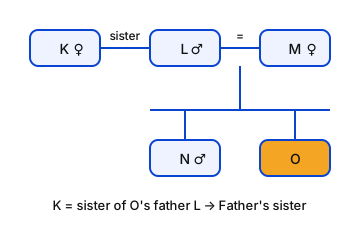
​In a certain code language,
A + B means ‘A is the sister of B’,
A – B means ‘A is the husband of B’,
A × B means ‘A is the mother of B’ and
A ÷ B means ‘A is the brother of B’.
Based on the above information, how is K related to O if ‘K + L – M × N ÷ O’?
​एक निश्चित कूट भाषा में,
A + B का अर्थ है ‘A, B की बहन है’,
A – B का अर्थ है ‘A, B का पति है’,
A × B का अर्थ है ‘A, B की माँ है’ और
A ÷ B का अर्थ है ‘A, B का भाई है’।
उपर्युक्त जानकारी के आधार पर, यदि ‘K + L – M × N ÷ O’ है, तो K का O से क्या संबंध है?
  1. AMother's sisterमाँ की बहन
  2. BFather's sisterपिता की बहन
  3. CFather's motherपिता की माँ
  4. DMother's motherमाँ की माँ
Show answer

Concept: Decode each symbol from left to right and build the family tree.

  1. K + L: K is the sister of L (K female).
  2. L – M: L is the husband of M, so L is male.
  3. M × N: M is the mother of N; N ÷ O: N is the brother of O. So L and M are the parents of N and O.
  4. L is O's father and K is L's sister, i.e. O's father's sister.

Trick: Find the generation first: K is in the parents' generation of O, and she is on the father's (L's) side.

Answer: (B) Father's sister

अवधारणा: हर चिह्न को बाएँ से दाएँ डिकोड करके वंश-वृक्ष (family tree) बनाइए।

  1. K + L: K, L की बहन है (K स्त्री)।
  2. L – M: L, M का पति है, अतः L पुरुष।
  3. M × N: M, N की माता; N ÷ O: N, O का भाई। अतः L और M, N व O के माता-पिता हैं।
  4. L, O का पिता है और K, L की बहन है — यानी O के पिता की बहन।

ट्रिक: पहले पीढ़ी तय करें: K, O के माता-पिता की पीढ़ी में है और पिता (L) की ओर से है।

उत्तर: (B) Father's sister (बुआ)

RRB NTPC Graduate CBT 1General Intelligence and ReasoningBlood Relations (Coded)RRB NTPC Graduate CBT 1 2025 · 18 Mar Shift 1 →
Q6449.
In a certain code language, ‘kids are playing’ is coded as ‘pu rs bp’ and ‘people love kids’ is coded as ‘rs gu xc’. How is ‘kids’ coded in that language?
एक निश्चित कूट भाषा में, ‘kids are playing’ को ‘pu rs bp’ के रूप में कूटबद्ध किया जाता है और ‘people love kids’ को ‘rs gu xc’ के रूप में कूटबद्ध किया जाता है। उस भाषा में ‘kids’ को कैसे कूटबद्ध किया जाएगा?
  1. Axc
  2. Bbp
  3. Cpu
  4. Drs
Show answer

Concept: A word common to two sentences has a code common to both.

  1. 'kids are playing' → pu rs bp; 'people love kids' → rs gu xc.
  2. Only 'kids' is common to both sentences and only 'rs' is common to both codes.
  3. So kids = rs.

Trick: Match the common word with the common code – no need to decode the rest.

Answer: (D) rs

अवधारणा: दो वाक्यों में जो शब्द समान है, उसका कोड भी दोनों में समान होगा।

  1. 'kids are playing' → pu rs bp; 'people love kids' → rs gu xc।
  2. दोनों वाक्यों में केवल 'kids' समान है और कोड में केवल 'rs' समान है।
  3. अतः kids = rs।

ट्रिक: समान शब्द को समान कोड से मिलाइए — बाकी डिकोड करने की ज़रूरत नहीं।

उत्तर: (D) rs

RRB NTPC Graduate CBT 1General Intelligence and ReasoningCoding-Decoding (Sentence)RRB NTPC Graduate CBT 1 2025 · 18 Mar Shift 1 →
Q6450.
In the following number-pairs, the second number is obtained by applying certain mathematical operations to the first number. Select the set in which the numbers are related in the same way as are the numbers of the following sets.
(NOTE : Operations should be performed on the whole numbers, without breaking down the numbers into its constituent digits. E.g. 13 – Operations on 13 such as adding / subtracting /multiplying etc. to 13 can be performed. Breaking down 13 into 1 and 3 and then performing mathematical operations on 1 and 3 is not allowed.)
15, 29
32, 63
निम्नलिखित संख्या-युग्मों में, पहली संख्या पर कुछ गणितीय संक्रियाएँ करके दूसरी संख्या प्राप्त की जाती है। उस समुच्चय का चयन कीजिए जिसमें संख्याएँ उसी प्रकार संबंधित हैं जिस प्रकार निम्नलिखित समुच्चयों की संख्याएँ संबंधित हैं।
(नोट : संक्रियाएँ पूर्ण संख्याओं पर की जानी चाहिए, संख्याओं को उनके घटक अंकों में तोड़े बिना। उदाहरण के लिए 13 – 13 पर संक्रियाएँ जैसे 13 में जोड़ना / घटाना / गुणा करना आदि की जा सकती हैं। 13 को 1 और 3 में तोड़कर फिर 1 और 3 पर गणितीय संक्रियाएँ करने की अनुमति नहीं है।)
15, 29
32, 63
  1. A11, 34
  2. B14, 44
  3. C17, 33
  4. D23, 49
Show answer

Concept: Find one operation on the whole first number that gives the second in both given pairs.

  1. 15→29: 2×15−1=29.
  2. 32→63: 2×32−1=63.
  3. Options: 2×11−1=21≠34; 2×14−1=27≠44; 2×17−1=33 ✓; 2×23−1=45≠49.

Trick: Second number is odd and just under double the first → test 2n−1 first.

Answer: (C) 17, 33

अवधारणा: पूरी पहली संख्या पर ऐसी एक संक्रिया खोजिए जो दोनों दिए जोड़ों में दूसरी संख्या दे।

  1. 15→29: 2×15−1=29।
  2. 32→63: 2×32−1=63।
  3. विकल्प: 2×11−1=21≠34; 2×14−1=27≠44; 2×17−1=33 ✓; 2×23−1=45≠49।

ट्रिक: दूसरी संख्या विषम है और पहली के दोगुने से ज़रा कम → पहले 2n−1 जाँचें।

उत्तर: (C) 17, 33

RRB NTPC Graduate CBT 1General Intelligence and ReasoningNumber AnalogyRRB NTPC Graduate CBT 1 2025 · 18 Mar Shift 1 →
Q6451.
In a certain code language, ‘LITE’ is coded as ‘1527’ and ‘EDIT’ is coded as ‘5124’. What is the code for ‘D’ in the given code language?
एक निश्चित कूट भाषा में, ‘LITE’ को ‘1527’ के रूप में कूटबद्ध किया जाता है और ‘EDIT’ को ‘5124’ के रूप में कूटबद्ध किया जाता है। दी गई कूट भाषा में ‘D’ का कूट क्या है?
  1. A4
  2. B5
  3. C1
  4. D2
Show answer

Concept: Letters common to both words get the common digits; the leftover letter gets the leftover digit.

  1. LITE → 1527, EDIT → 5124.
  2. Common letters I, T, E ↔ common digits 1, 2, 5.
  3. In LITE the extra letter L ↔ extra digit 7; in EDIT the extra letter D ↔ extra digit 4.

Trick: Don't decode every letter – just isolate the odd one out in each word.

Answer: (A) 4

अवधारणा: दोनों शब्दों के समान अक्षरों को समान अंक मिलते हैं; बचा अक्षर बचे अंक से जुड़ता है।

  1. LITE → 1527, EDIT → 5124।
  2. समान अक्षर I, T, E ↔ समान अंक 1, 2, 5।
  3. LITE में अतिरिक्त अक्षर L ↔ अतिरिक्त अंक 7; EDIT में अतिरिक्त D ↔ अतिरिक्त अंक 4।

ट्रिक: हर अक्षर डिकोड न करें — बस हर शब्द का अलग अक्षर और अलग अंक पकड़ें।

उत्तर: (A) 4

RRB NTPC Graduate CBT 1General Intelligence and ReasoningCoding-Decoding (Letters to digits)RRB NTPC Graduate CBT 1 2025 · 18 Mar Shift 1 →
Q6452.
Read the given statements and conclusions carefully. Assuming that the information given in the statements is true, even if it appears to be at variance with commonly known facts, decide which of the given conclusion(s) logically follow(s) from the statements.
Statements:
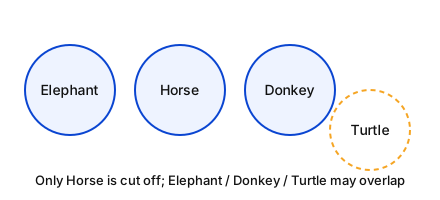
No elephant is a horse. No horse is a donkey. No horse is a turtle.
Conclusions:
(I) No elephant is a donkey.
(II) Some turtles are donkeys.
दिए गए कथनों और निष्कर्षों को ध्यानपूर्वक पढ़िए। यह मानते हुए कि कथनों में दी गई जानकारी सत्य है, भले ही वह सामान्यतः ज्ञात तथ्यों से भिन्न प्रतीत होती हो, निर्णय कीजिए कि दिए गए निष्कर्षों में से कौन-सा/कौन-से निष्कर्ष कथनों का तार्किक रूप से अनुसरण करता है/करते हैं।
कथन:
कोई हाथी घोड़ा नहीं है। कोई घोड़ा गधा नहीं है। कोई घोड़ा कछुआ नहीं है।
निष्कर्ष:
(I) कोई हाथी गधा नहीं है।
(II) कुछ कछुए गधे हैं।
  1. ANeither conclusion (I) nor (II) follows.न तो निष्कर्ष (I) और न ही (II) अनुसरण करता है।
  2. BOnly conclusion (I) follows.केवल निष्कर्ष (I) अनुसरण करता है।
  3. COnly conclusion (II) follows.केवल निष्कर्ष (II) अनुसरण करता है।
  4. DBoth conclusions (I) and (II) follow.निष्कर्ष (I) और (II) दोनों अनुसरण करते हैं।
Show answer

Concept: Two negative (No/No) statements give no definite conclusion; draw the possible Venn diagram.

  1. All three statements only say that Horse is separate from Elephant, Donkey and Turtle.
  2. Elephant and Donkey may or may not overlap, so (I) "No elephant is a donkey" does not follow.
  3. Turtle and Donkey may or may not overlap, so (II) "Some turtles are donkeys" is only a possibility, not a certainty.

Trick: Conclusion from two "No" premises is never definite ("No + No = No conclusion").

Answer: (A) Neither conclusion (I) nor (II) follows.

अवधारणा: दो नकारात्मक (No/No) कथनों से कोई निश्चित निष्कर्ष नहीं निकलता; संभावित वेन आरेख बनाइए।

  1. तीनों कथन केवल यह कहते हैं कि Horse, Elephant, Donkey और Turtle से अलग है।
  2. Elephant और Donkey में संबंध हो भी सकता है, नहीं भी — अतः (I) "No elephant is a donkey" निश्चित नहीं।
  3. Turtle और Donkey भी मिल सकते हैं या नहीं — अतः (II) केवल संभावना है, निश्चित नहीं।

ट्रिक: दो "No" कथनों से कभी निश्चित निष्कर्ष नहीं ("No + No = No conclusion")।

उत्तर: (A) Neither conclusion (I) nor (II) follows.

RRB NTPC Graduate CBT 1General Intelligence and ReasoningSyllogismRRB NTPC Graduate CBT 1 2025 · 18 Mar Shift 1 →
Q6453.
FIBA is related to EJAB in a certain way based on the English alphabetical order. In the same way, ZELU is related to YFKV. To which of the following is COIS related, following the same logic?
अंग्रेज़ी वर्णमाला क्रम के आधार पर FIBA, EJAB से एक निश्चित प्रकार से संबंधित है। उसी प्रकार, ZELU, YFKV से संबंधित है। उसी तर्क का अनुसरण करते हुए, COIS निम्नलिखित में से किससे संबंधित है?
  1. ABQJV
  2. BBQGS
  3. CBOMS
  4. DBPHT
Show answer

Concept: Find the position shift of each letter and apply the same pattern.

  1. FIBA → EJAB: F−1=E, I+1=J, B−1=A, A+1=B. Pattern: −1,+1,−1,+1.
  2. ZELU → YFKV: Z−1=Y, E+1=F, L−1=K, U+1=V ✓.
  3. COIS: C−1=B, O+1=P, I−1=H, S+1=T → BPHT.

Trick: Alternating −1,+1: odd positions go back, even positions go forward.

Answer: (D) BPHT

अवधारणा: हर अक्षर का स्थान-परिवर्तन निकालें और वही पैटर्न लागू करें।

  1. FIBA → EJAB: F−1=E, I+1=J, B−1=A, A+1=B। पैटर्न: −1,+1,−1,+1।
  2. ZELU → YFKV: Z−1=Y, E+1=F, L−1=K, U+1=V ✓।
  3. COIS: C−1=B, O+1=P, I−1=H, S+1=T → BPHT।

ट्रिक: बारी-बारी −1,+1: विषम स्थान पीछे, सम स्थान आगे।

उत्तर: (D) BPHT

RRB NTPC Graduate CBT 1General Intelligence and ReasoningLetter AnalogyRRB NTPC Graduate CBT 1 2025 · 18 Mar Shift 1 →
Q6454.
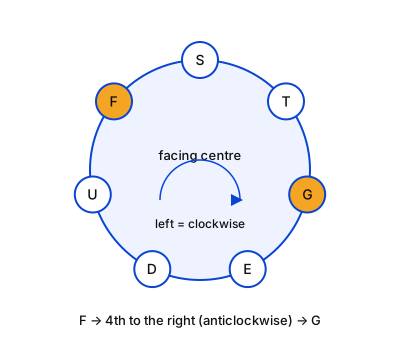
D, E, F, G, S, T and U are sitting around a circular table facing the centre. T sits to the immediate left of S. U sits to the immediate left of D. D sits second to the left of G. E sits third to the left of S. Who sits fourth to the right of F?
D, E, F, G, S, T और U एक गोल मेज़ के चारों ओर केंद्र की ओर मुख करके बैठे हैं। T, S के ठीक बाईं ओर बैठा है। U, D के ठीक बाईं ओर बैठा है। D, G के बाईं ओर दूसरे स्थान पर बैठा है। E, S के बाईं ओर तीसरे स्थान पर बैठा है। F के दाईं ओर चौथे स्थान पर कौन बैठा है?
  1. AS
  2. BG
  3. CD
  4. DT
Show answer

Concept: Facing the centre, "left" is clockwise and "right" is anticlockwise.

  1. Place S; T is immediately left (clockwise) of S. E is third to the left of S.
  2. D is second to the left of G and U is immediately left of D. The only free seats fit G next to T, then D, then U.
  3. The last seat, between U and S, is F.
  4. Counting four seats to the right (anticlockwise) from F: U, D, E, G → G.

Trick: With 7 seats, 4th to the right = 3rd to the left – either way you land on G.

Answer: (B) G

अवधारणा: केंद्र की ओर मुख होने पर "बायाँ" = दक्षिणावर्त (clockwise) और "दायाँ" = वामावर्त।

  1. S रखें; T, S के तुरंत बाएँ (clockwise)। E, S के बाएँ तीसरा।
  2. D, G के बाएँ दूसरा और U, D के तुरंत बाएँ। खाली सीटों में G, T के बगल में, फिर D, फिर U ही बैठ सकते हैं।
  3. U और S के बीच बची अंतिम सीट F की।
  4. F से दाएँ (वामावर्त) चार सीट: U, D, E, G → G।

ट्रिक: 7 सीटों में दाएँ चौथा = बाएँ तीसरा — दोनों तरह से G ही मिलता है।

उत्तर: (B) G

RRB NTPC Graduate CBT 1General Intelligence and ReasoningCircular Seating ArrangementRRB NTPC Graduate CBT 1 2025 · 18 Mar Shift 1 →
Q6455.
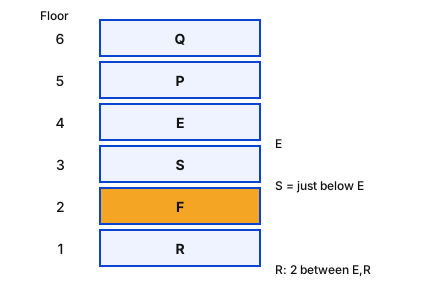
P, Q, R, S, E and F live on six different floors of the same building. The lowermost floor in the building is numbered 1, the floor above it, number 2 and so on till the topmost floor is numbered 6.
E lives on floor number 4. Only two people live between E and R. Only P lives between E and Q. S lives immediately below E.
Who lives on floor number 2?
P, Q, R, S, E और F एक ही इमारत की छह अलग-अलग मंज़िलों पर रहते हैं। इमारत की सबसे निचली मंज़िल की संख्या 1 है, उसके ऊपर वाली मंज़िल की संख्या 2 है और इसी प्रकार सबसे ऊपरी मंज़िल की संख्या 6 है।
E मंज़िल संख्या 4 पर रहता है। E और R के बीच केवल दो व्यक्ति रहते हैं। E और Q के बीच केवल P रहता है। S, E के ठीक नीचे रहता है।
मंज़िल संख्या 2 पर कौन रहता है?
  1. AS
  2. BQ
  3. CR
  4. DF
Show answer

Concept: Fix the definite clue first, then place the others around it.

  1. E is on floor 4. Exactly two people between E and R → R is on floor 1 (floor 7 does not exist).
  2. S is immediately below E → S on floor 3.
  3. Only P between E and Q: floors 2–3 are taken/blocked, so P = 5 and Q = 6.
  4. The remaining person F is on floor 2.

Trick: "Two between" from floor 4 can only go downward to 1 – that fixes R instantly.

Answer: (D) F

अवधारणा: पहले निश्चित सूचना रखें, फिर बाकी को उसके चारों ओर जमाएँ।

  1. E मंज़िल 4 पर। E और R के बीच ठीक दो लोग → R मंज़िल 1 पर (मंज़िल 7 है ही नहीं)।
  2. S, E के ठीक नीचे → S मंज़िल 3 पर।
  3. E और Q के बीच केवल P: नीचे की ओर 3 भरी है, अतः P = 5 और Q = 6।
  4. बचा व्यक्ति F मंज़िल 2 पर।

ट्रिक: मंज़िल 4 से "बीच में दो" केवल नीचे 1 तक जा सकता है — R तुरंत तय।

उत्तर: (D) F

RRB NTPC Graduate CBT 1General Intelligence and ReasoningFloor PuzzleRRB NTPC Graduate CBT 1 2025 · 18 Mar Shift 1 →
Q6456.
If ‘+’ means ‘−’, ‘−’ means ‘×’, ‘×’ means ‘÷’, ‘÷’ means ‘+’, then what will come in place of the question mark (?) in the following equation?
57 − 7 ÷ 119 + 288 × 2 = ?
यदि ‘+’ का अर्थ ‘−’ है, ‘−’ का अर्थ ‘×’ है, ‘×’ का अर्थ ‘÷’ है, ‘÷’ का अर्थ ‘+’ है, तो निम्नलिखित समीकरण में प्रश्नचिह्न (?) के स्थान पर क्या आएगा?
57 − 7 ÷ 119 + 288 × 2 = ?
  1. A345
  2. B311
  3. C329
  4. D374
Show answer

Concept: Replace the symbols with their real meanings, then apply BODMAS.

  1. 57−7÷119+288×2 becomes 57×7+119−288÷2.
  2. 57×7=399, 288÷2=144.
  3. 399+119−144=374.

Trick: Do division and multiplication first (399 and 144), then add/subtract left to right.

Answer: (D) 374

अवधारणा: चिह्नों को उनके वास्तविक अर्थ से बदलें, फिर BODMAS लगाएँ।

  1. 57−7÷119+288×2 बनता है 57×7+119−288÷2।
  2. 57×7=399, 288÷2=144।
  3. 399+119−144=374।

ट्रिक: पहले भाग और गुणा (399 और 144), फिर बाएँ से दाएँ जोड़-घटाव।

उत्तर: (D) 374

RRB NTPC Graduate CBT 1General Intelligence and ReasoningMathematical Operations (Symbol Substitution)RRB NTPC Graduate CBT 1 2025 · 18 Mar Shift 1 →
Q6457.
Which of the following letter-number clusters will replace the question mark (?) in the given series to make it logically complete?
DCE 19 FEG 14 HGI 9 JIK 4 ?
निम्नलिखित में से कौन-सा अक्षर-संख्या समूह दी गई शृंखला में प्रश्नचिह्न (?) के स्थान पर आकर उसे तार्किक रूप से पूर्ण करेगा?
DCE 19 FEG 14 HGI 9 JIK 4 ?
  1. ALKM -1
  2. BLPU -2
  3. CLJL -2
  4. DLLL -1
Show answer

Concept: Treat the letter clusters and the numbers as two separate series.

  1. Letters: DCE, FEG, HGI, JIK – each cluster is (n+1, n, n+2) and the start letter moves +2: D, F, H, J, L → LKM.
  2. Numbers: 19, 14, 9, 4 – each time −5, so next =4−5=−1.
  3. Required cluster: LKM −1.

Trick: Only option (A) starts with the correct L-K-M pattern (second letter one less than the first).

Answer: (A) LKM −1

अवधारणा: अक्षर-समूह और संख्याओं को दो अलग श्रृंखलाएँ मानें।

  1. अक्षर: DCE, FEG, HGI, JIK – हर समूह (n+1, n, n+2) है और प्रारंभिक अक्षर +2 बढ़ता है: D, F, H, J, L → LKM।
  2. संख्याएँ: 19, 14, 9, 4 – हर बार −5, अतः अगली =4−5=−1।
  3. अभीष्ट समूह: LKM −1।

ट्रिक: केवल विकल्प (A) में सही L-K-M पैटर्न है (दूसरा अक्षर पहले से एक कम)।

उत्तर: (A) LKM −1

RRB NTPC Graduate CBT 1General Intelligence and ReasoningLetter-Number SeriesRRB NTPC Graduate CBT 1 2025 · 18 Mar Shift 1 →
Q6458.
Refer to the following number and symbol series and answer the question that follows. All numbers are single-digit numbers only.
(Left) 7 8 @ 1 # 4 $ 5 % + ? 8 & 6 % 4 8 9 % (Right)
If all the symbols are dropped from the series, which of the following will be seventh from the right?
निम्नलिखित संख्या और प्रतीक शृंखला को देखिए और उसके बाद दिए गए प्रश्न का उत्तर दीजिए। सभी संख्याएँ केवल एक-अंकीय संख्याएँ हैं।
(बाएँ) 7 8 @ 1 # 4 $ 5 % + ? 8 & 6 % 4 8 9 % (दाएँ)
यदि शृंखला से सभी प्रतीकों को हटा दिया जाए, तो निम्नलिखित में से कौन-सा दाएँ से सातवाँ होगा?
  1. A4
  2. B9
  3. C8
  4. D6
Show answer

Concept: Remove the symbols, rewrite the series, then count from the right.

  1. Numbers only (left to right): 7 8 1 4 5 8 6 4 8 9.
  2. From the right: 9 (1st), 8 (2nd), 4 (3rd), 6 (4th), 8 (5th), 5 (6th), 4 (7th).

Trick: 10 numbers in all, so 7th from right = 4th from left = 4.

Answer: (A) 4

अवधारणा: चिह्न हटाकर श्रृंखला फिर लिखें, फिर दाएँ से गिनें।

  1. केवल संख्याएँ (बाएँ से दाएँ): 7 8 1 4 5 8 6 4 8 9।
  2. दाएँ से: 9 (पहला), 8 (दूसरा), 4 (तीसरा), 6 (चौथा), 8 (पाँचवाँ), 5 (छठा), 4 (सातवाँ)।

ट्रिक: कुल 10 संख्याएँ, अतः दाएँ से 7वाँ = बाएँ से 4था = 4।

उत्तर: (A) 4

RRB NTPC Graduate CBT 1General Intelligence and ReasoningNumber-Symbol SeriesRRB NTPC Graduate CBT 1 2025 · 18 Mar Shift 1 →
Q6459.
GOAT is related to IQCV in a certain way based on the English alphabetical order. In the same way, OWIB is related to QYKD. To which of the following options is UCOH related, following the same logic?
अंग्रेज़ी वर्णमाला क्रम के आधार पर GOAT, IQCV से एक निश्चित प्रकार से संबंधित है। उसी प्रकार, OWIB, QYKD से संबंधित है। उसी तर्क का अनुसरण करते हुए, UCOH निम्नलिखित में से किस विकल्प से संबंधित है?
  1. AWERT
  2. BWJQE
  3. CWEQJ
  4. DQJYU
Show answer

Concept: Find the uniform shift applied to every letter.

  1. GOAT → IQCV: G+2=I, O+2=Q, A+2=C, T+2=V. Every letter +2.
  2. OWIB → QYKD: O+2=Q, W+2=Y, I+2=K, B+2=D ✓.
  3. UCOH: U+2=W, C+2=E, O+2=Q, H+2=J → WEQJ.

Trick: Check the last letter first: H+2=J rules out (A) and (B) at once.

Answer: (C) WEQJ

अवधारणा: हर अक्षर पर लगा समान शिफ्ट निकालें।

  1. GOAT → IQCV: G+2=I, O+2=Q, A+2=C, T+2=V। हर अक्षर +2।
  2. OWIB → QYKD: O+2=Q, W+2=Y, I+2=K, B+2=D ✓।
  3. UCOH: U+2=W, C+2=E, O+2=Q, H+2=J → WEQJ।

ट्रिक: पहले अंतिम अक्षर जाँचें: H+2=J से (A) और (B) तुरंत कट जाते हैं।

उत्तर: (C) WEQJ

RRB NTPC Graduate CBT 1General Intelligence and ReasoningLetter AnalogyRRB NTPC Graduate CBT 1 2025 · 18 Mar Shift 1 →
Q6460.
JELU is related to NHNV in a certain way based on the English alphabetical order. In the same way, BGMQ is related to FJOR. To which of the following is GKNP related, following the same logic?
अंग्रेज़ी वर्णमाला क्रम के आधार पर JELU, NHNV से एक निश्चित प्रकार से संबंधित है। उसी प्रकार, BGMQ, FJOR से संबंधित है। उसी तर्क का अनुसरण करते हुए, GKNP निम्नलिखित में से किससे संबंधित है?
  1. AKNPQ
  2. BHMNQ
  3. CLOQQ
  4. DJMOQ
Show answer

Concept: Find the shift for each position and apply it.

  1. JELU → NHNV: J+4=N, E+3=H, L+2=N, U+1=V. Pattern: +4,+3,+2,+1.
  2. BGMQ → FJOR: B+4=F, G+3=J, M+2=O, Q+1=R ✓.
  3. GKNP: G+4=K, K+3=N, N+2=P, P+1=Q → KNPQ.

Trick: Decreasing shifts 4-3-2-1; the first letter G+4=K leaves only option (A).

Answer: (A) KNPQ

अवधारणा: हर स्थान का शिफ्ट निकालें और लागू करें।

  1. JELU → NHNV: J+4=N, E+3=H, L+2=N, U+1=V। पैटर्न: +4,+3,+2,+1।
  2. BGMQ → FJOR: B+4=F, G+3=J, M+2=O, Q+1=R ✓।
  3. GKNP: G+4=K, K+3=N, N+2=P, P+1=Q → KNPQ।

ट्रिक: घटते शिफ्ट 4-3-2-1; पहला अक्षर G+4=K से केवल विकल्प (A) बचता है।

उत्तर: (A) KNPQ

RRB NTPC Graduate CBT 1General Intelligence and ReasoningLetter AnalogyRRB NTPC Graduate CBT 1 2025 · 18 Mar Shift 1 →