Question bank

Q&A: practice questions with answers

Search questions on any topic. Filter by exam category, exam, subject and topic, try the question, then open the answer and explanation.

Courses – airGurukul

7,077 questions found.

Q6521.
20% of a number is more than 20% of 620 by 220. The number is:
किसी संख्या का 20%, 620 के 20% से 220 अधिक है। वह संख्या है:
  1. A1570
  2. B1770
  3. C1720
  4. D1820
Show answer

Concept: Translate the sentence directly into an equation: 20% of x =20% of 620+220.

  1. 20% of 620=124.
  2. 0.2x=124+220=344.
  3. x=3440.2=1720.

Trick: 20%=15, so x=5×344=1720; or note the number exceeds 620 by 2200.2=1100.

Answer: (C) 1720

अवधारणा: वाक्य को सीधे समीकरण में बदलें: x का 20% =620 का 20%+220।

  1. 620 का 20%=124।
  2. 0.2x=124+220=344।
  3. x=3440.2=1720।

ट्रिक: 20%=15, अतः x=5×344=1720; या संख्या 620 से 2200.2=1100 अधिक है।

उत्तर: (C) 1720

RRB NTPC Graduate CBT 1MathematicsPercentageRRB NTPC Graduate CBT 1 2025 · 17 Mar Shift 3 →
Q6522.
A man bought two types of chocolates, one at ₹8 for 9 chocolates and the other at ₹8 per chocolate. He purchased an equal number of each type and sold all the chocolates at ₹8 per piece. Find his percentage profit.
एक व्यक्ति ने दो प्रकार की चॉकलेट खरीदीं, एक ₹8 में 9 चॉकलेट की दर से और दूसरी ₹8 प्रति चॉकलेट की दर से। उसने प्रत्येक प्रकार की समान संख्या में चॉकलेट खरीदीं और सभी चॉकलेट ₹8 प्रति नग की दर से बेच दीं। उसका प्रतिशत लाभ ज्ञात कीजिए।
  1. A78%
  2. B84%
  3. C82%
  4. D80%
Show answer

Concept: Take a convenient equal number of each type (LCM of 9 and 1 = 9), find total CP and SP, then Profit%=SP−CPCP×100.

  1. Buy 9 of each: first type costs ₹8 for all 9; second type costs 9×8= ₹72. Total CP =8+72= ₹80.
  2. Sold 18 chocolates at ₹8 each: SP =18×8= ₹144.
  3. Profit =144−80=64; Profit%=6480×100=80%.

Trick: Second type is sold at cost (no gain); the whole profit comes from the cheap type: ₹8 → ₹72. Overall 6480=80%.

Answer: (D) 80%

अवधारणा: दोनों प्रकार की समान सुविधाजनक संख्या लें (9 और 1 का LCM = 9), कुल CP और SP निकालें, फिर लाभ%=SP−CPCP×100।

  1. प्रत्येक के 9 खरीदे: पहले प्रकार के 9 = ₹8; दूसरे प्रकार के 9 =9×8= ₹72। कुल CP =80।
  2. 18 चॉकलेट ₹8 प्रति के भाव से: SP =18×8= ₹144।
  3. लाभ =144−80=64; लाभ%=6480×100=80%।

ट्रिक: दूसरा प्रकार लागत पर बिका (लाभ शून्य); पूरा लाभ सस्ते प्रकार से: ₹8 → ₹72। कुल 6480=80%।

उत्तर: (D) 80%

RRB NTPC Graduate CBT 1MathematicsProfit and LossRRB NTPC Graduate CBT 1 2025 · 17 Mar Shift 3 →
Q6523.
Two taps can fill a cistern in 4 hours and 31 hours respectively. A third tap can empty it in 31 hours. How long (in hours) will it take to fill one-fourth of the empty cistern, if all of them are opened together?
दो नल एक टंकी को क्रमशः 4 घंटे और 31 घंटे में भर सकते हैं। एक तीसरा नल इसे 31 घंटे में खाली कर सकता है। यदि सभी नल एक साथ खोल दिए जाएँ, तो खाली टंकी का एक-चौथाई भाग भरने में कितना समय (घंटों में) लगेगा?
  1. A2
  2. B4
  3. C3
  4. D1
Show answer

Concept: Add the filling rates and subtract the emptying rate (work per hour).

  1. Rates: 14+131−131=14 of the cistern per hour.
  2. The second tap and the emptying tap cancel each other exactly.
  3. One-fourth of the cistern at 14 per hour → 1 hour.

Trick: Same time to fill and to empty (31 h) → the pair does nothing; only the 4-hour tap counts.

Answer: (D) 1

अवधारणा: भरने की दरें जोड़ें और खाली करने की दर घटाएँ (प्रति घंटा कार्य)।

  1. दरें: 14+131−131=14 टंकी प्रति घंटा।
  2. दूसरा नल और खाली करने वाला नल एक-दूसरे को पूरी तरह काट देते हैं।
  3. एक-चौथाई टंकी, 14 प्रति घंटा की दर से → 1 घंटा।

ट्रिक: भरने और खाली करने का समय समान (31 h) → यह जोड़ी निष्प्रभावी; केवल 4 घंटे वाला नल गिनें।

उत्तर: (D) 1

RRB NTPC Graduate CBT 1MathematicsPipes and CisternsRRB NTPC Graduate CBT 1 2025 · 17 Mar Shift 3 →
Q6524.
Three positive integers a, b, and c satisfy: gcd(a, b)=12, gcd(b, c)=18, gcd(c, a)=6. If a+b+c=6k for some positive integer k, then the minimum possible value of k is:
तीन धनात्मक पूर्णांक a, b और c इस प्रकार हैं कि: gcd(a, b)=12, gcd(b, c)=18, gcd(c, a)=6। यदि किसी धनात्मक पूर्णांक k के लिए a+b+c=6k है, तो k का न्यूनतम संभव मान है:
  1. A11
  2. B10
  3. C12
  4. D9
Show answer

Concept: Each number must be a multiple of every gcd it is part of; choose the smallest such numbers and verify the gcds.

  1. b is a multiple of 12 and 18 → multiple of LCM=36; a is a multiple of 12 and 6 → of 12; c is a multiple of 18 and 6 → of 18.
  2. Smallest choice: a=12, b=36, c=18. Check: gcd(12,36)=12, gcd(36,18)=18, gcd(18,12)=6 ✓.
  3. a+b+c=66=6×11 → minimum k=11.

Trick: Minimum sum =12+36+18=66; any smaller a,b,c would violate a gcd, so k=666=11.

Answer: (A) 11

अवधारणा: हर संख्या उन सभी gcd की गुणज होनी चाहिए जिनमें वह शामिल है; सबसे छोटी ऐसी संख्याएँ चुनकर gcd जाँचें।

  1. b, 12 और 18 का गुणज → LCM=36 का गुणज; a → 12 का; c → 18 का गुणज।
  2. सबसे छोटा चयन: a=12, b=36, c=18। जाँच: gcd(12,36)=12, gcd(36,18)=18, gcd(18,12)=6 ✓।
  3. a+b+c=66=6×11 → न्यूनतम k=11।

ट्रिक: न्यूनतम योग =12+36+18=66; इससे छोटे a,b,c कोई gcd तोड़ देंगे, अतः k=666=11।

उत्तर: (A) 11

RRB NTPC Graduate CBT 1MathematicsHCF – Minimum SumRRB NTPC Graduate CBT 1 2025 · 17 Mar Shift 3 →
Q6525.
The average of 5 numbers is 20. If one number is excluded, the average of the remaining numbers is 18. What is the excluded number?
5 संख्याओं का औसत 20 है। यदि एक संख्या को हटा दिया जाए, तो शेष संख्याओं का औसत 18 हो जाता है। हटाई गई संख्या क्या है?
  1. A32
  2. B25
  3. C28
  4. D30
Show answer

Concept: Sum = average × count; the excluded number is the difference of the two sums.

  1. Sum of 5 numbers =5×20=100.
  2. Sum of remaining 4 numbers =4×18=72.
  3. Excluded number =100−72=28.

Trick: Excluded = new average + (old count) × (drop in average) =18+5×2=28.

Answer: (C) 28

अवधारणा: योग = औसत × संख्या; निकाली गई संख्या दोनों योगों का अंतर है।

  1. 5 संख्याओं का योग =5×20=100।
  2. शेष 4 का योग =4×18=72।
  3. निकाली गई संख्या =100−72=28।

ट्रिक: निकाली गई = नया औसत + (पुरानी गिनती) × (औसत में गिरावट) =18+5×2=28।

उत्तर: (C) 28

RRB NTPC Graduate CBT 1MathematicsAverageRRB NTPC Graduate CBT 1 2025 · 17 Mar Shift 3 →
Q6526.
A data scientist finds that the mean proportional between two experimental values 18 and 32 needs to be increased by 25% for optimal model performance. If this new increased value becomes the mean proportional between 18 and another value y, what is y?
एक डेटा वैज्ञानिक पाता है कि दो प्रायोगिक मानों 18 और 32 के बीच के मध्यानुपाती (mean proportional) को इष्टतम मॉडल प्रदर्शन के लिए 25% बढ़ाने की आवश्यकता है। यदि यह नया बढ़ा हुआ मान 18 और किसी अन्य मान y के बीच का मध्यानुपाती बन जाता है, तो y क्या है?
  1. A45
  2. B50
  3. C54
  4. D48
Show answer

Concept: Mean proportional between a and b is ab; if m is the mean proportional between a and y, then m2=ay.

  1. 18×32=576=24.
  2. Increase by 25%: 24×54=30.
  3. 302=18y⇒y=90018=50.

Trick: 18×32=576=242 – spot it as (25−1)2; then y=30218=50.

Answer: (B) 50

अवधारणा: a और b का मध्यानुपाती ab; यदि m, a और y का मध्यानुपाती है तो m2=ay।

  1. 18×32=576=24।
  2. 25% वृद्धि: 24×54=30।
  3. 302=18y⇒y=90018=50।

ट्रिक: 18×32=576=242 पहचानें; फिर y=30218=50।

उत्तर: (B) 50

RRB NTPC Graduate CBT 1MathematicsMean ProportionalRRB NTPC Graduate CBT 1 2025 · 17 Mar Shift 3 →
Q6527.
Which of the following is not a quadratic equation?
निम्नलिखित में से कौन-सा द्विघात समीकरण नहीं है?
  1. A(x – 1)(x + 2) = x² + 3
  2. Bx² + 2x + 1 = 0
  3. Cx(x – 3) = 2
  4. D3x² – 5x + 2 = 0
Show answer

Concept: An equation is quadratic only if, after simplification, the highest power of x is exactly 2 (coefficient of x2≠0).

  1. (A) (x−1)(x+2)=x2+3⇒x2+x−2=x2+3⇒x−5=0 – the x2 terms cancel → linear, not quadratic.
  2. (B) x2+2x+1=0 and (D) 3x2−5x+2=0 are already in the form ax2+bx+c=0.
  3. (C) x(x−3)=2⇒x2−3x−2=0 – quadratic.

Trick: Whenever x2 appears on both sides, expand and check whether it cancels.

Answer: (A) (x – 1)(x + 2) = x2 + 3

अवधारणा: समीकरण द्विघात तभी है जब सरलीकरण के बाद x की उच्चतम घात ठीक 2 हो (x2 का गुणांक ≠0)।

  1. (A) (x−1)(x+2)=x2+3⇒x2+x−2=x2+3⇒x−5=0 – x2 कट गया → रैखिक, द्विघात नहीं।
  2. (B) x2+2x+1=0 और (D) 3x2−5x+2=0 पहले से ax2+bx+c=0 रूप में हैं।
  3. (C) x(x−3)=2⇒x2−3x−2=0 – द्विघात।

ट्रिक: जब x2 दोनों ओर हो, तो फैलाकर देखें कि वह कटता है या नहीं।

उत्तर: (A) (x – 1)(x + 2) = x2 + 3

RRB NTPC Graduate CBT 1MathematicsQuadratic EquationsRRB NTPC Graduate CBT 1 2025 · 17 Mar Shift 3 →
Q6528.
Evaluate: (-9) - (-56) ÷ (-14) + (-4) × 6
मान ज्ञात कीजिए: (-9) - (-56) ÷ (-14) + (-4) × 6
  1. A-40
  2. B-37
  3. C-36
  4. D-39
Show answer

Concept: Do division and multiplication first, then addition and subtraction; watch the signs.

  1. (−56)÷(−14)=4 and (−4)×6=−24.
  2. Expression becomes (−9)−4+(−24).
  3. −9−4−24=−37.

Trick: Negative ÷ negative = positive; the minus sign before it then makes it −4.

Answer: (B) -37

अवधारणा: पहले भाग और गुणा, फिर जोड़ और घटाव; चिह्नों पर ध्यान दें।

  1. (−56)÷(−14)=4 और (−4)×6=−24।
  2. व्यंजक बनता है (−9)−4+(−24)।
  3. −9−4−24=−37।

ट्रिक: ऋण ÷ ऋण = धन; उसके आगे का ऋण चिह्न उसे −4 बना देता है।

उत्तर: (B) -37

RRB NTPC Graduate CBT 1MathematicsSimplification (BODMAS with Integers)RRB NTPC Graduate CBT 1 2025 · 17 Mar Shift 3 →
Q6529.
There are 42 members in group A, 14 members in group B and 21 members in group C. All the members of these groups went to a restaurant. The average amounts spent on each member of groups A, B and C are ₹275, ₹430 and ₹498, respectively. The overall average amount (in ₹) spent per member is:
समूह A में 42 सदस्य, समूह B में 14 सदस्य और समूह C में 21 सदस्य हैं। इन समूहों के सभी सदस्य एक रेस्तरां में गए। समूह A, B और C के प्रत्येक सदस्य पर खर्च की गई औसत राशि क्रमशः ₹275, ₹430 और ₹498 है। प्रति सदस्य खर्च की गई समग्र औसत राशि (₹ में) है:
  1. A366
  2. B369
  3. C364
  4. D365
Show answer

Concept: Overall average=∑(members×average)total members.

  1. Totals: 42×275=11550, 14×430=6020, 21×498=10458.
  2. Grand total =11550+6020+10458=28028; members =42+14+21=77.
  3. 2802877=364.

Trick: Members are in ratio 6:2:3 (÷7): 6×275+2×430+3×49811=1650+860+149411=400411=364.

Answer: (C) 364

अवधारणा: कुल औसत=∑(सदस्य×औसत)कुल सदस्य।

  1. कुल राशि: 42×275=11550, 14×430=6020, 21×498=10458।
  2. महायोग =28028; सदस्य =42+14+21=77।
  3. 2802877=364।

ट्रिक: सदस्य अनुपात 6:2:3 (÷7): 6×275+2×430+3×49811=400411=364।

उत्तर: (C) 364

RRB NTPC Graduate CBT 1MathematicsWeighted AverageRRB NTPC Graduate CBT 1 2025 · 17 Mar Shift 3 →
Q6530.
The monthly incomes of A and B are in the ratio 4 : 5, and their monthly expenditures are in the ratio 3 : 4. A saves ₹10,000 while B saves ₹12,000, find the monthly income of A (in ₹)
A और B की मासिक आय का अनुपात 4 : 5 है, और उनके मासिक व्यय का अनुपात 3 : 4 है। A ₹10,000 की बचत करता है जबकि B ₹12,000 की बचत करता है, A की मासिक आय (₹ में) ज्ञात कीजिए।
  1. A14,000
  2. B16,000
  3. C15,000
  4. D13,000
Show answer

Concept: Income − Expenditure = Savings. Let incomes be 4x,5x and expenditures 3y,4y, then solve two equations.

  1. 4x−3y=10000 … (i) and 5x−4y=12000 … (ii).
  2. (i)×4: 16x−12y=40000; (ii)×3: 15x−12y=36000. Subtract: x=4000.
  3. Income of A =4x= ₹16,000 (check: y=2000, B saves 20000−8000=12000 ✓).

Trick: Eliminate y by making its coefficients equal (12y); then x comes out in one subtraction.

Answer: (B) 16,000

अवधारणा: आय − व्यय = बचत। आय 4x,5x और व्यय 3y,4y मानकर दो समीकरण हल करें।

  1. 4x−3y=10000 … (i) और 5x−4y=12000 … (ii)।
  2. (i)×4: 16x−12y=40000; (ii)×3: 15x−12y=36000। घटाने पर x=4000।
  3. A की आय =4x= ₹16,000 (जाँच: y=2000, B की बचत 20000−8000=12000 ✓)।

ट्रिक: y के गुणांक बराबर (12y) करके उसे हटाएँ; एक घटाव में x मिल जाता है।

उत्तर: (B) 16,000

RRB NTPC Graduate CBT 1MathematicsRatio – Income and ExpenditureRRB NTPC Graduate CBT 1 2025 · 17 Mar Shift 3 →
Q6531.
The value of [0.72−0.420.33] is:
[0.72−0.420.33] का मान है:
  1. A0.65
  2. B1
  3. C2
  4. D1.5
Show answer

Concept: Use a2−b2=(a+b)(a−b) instead of squaring decimals.

  1. 0.72−0.42=(0.7+0.4)(0.7−0.4)=1.1×0.3=0.33.
  2. 0.330.33=1.

Trick: When the denominator equals (a+b)(a−b), the answer is simply 1 – no decimal multiplication needed.

Answer: (B) 1

अवधारणा: दशमलवों का वर्ग करने के बजाय a2−b2=(a+b)(a−b) का प्रयोग करें।

  1. 0.72−0.42=(0.7+0.4)(0.7−0.4)=1.1×0.3=0.33।
  2. 0.330.33=1।

ट्रिक: जब हर (a+b)(a−b) के बराबर हो, उत्तर सीधे 1 – दशमलव गुणा की ज़रूरत नहीं।

उत्तर: (B) 1

RRB NTPC Graduate CBT 1MathematicsSimplification – Difference of SquaresRRB NTPC Graduate CBT 1 2025 · 17 Mar Shift 3 →
Q6532.
P sells an item to Q at 30% profit. Q sells the same item to R at 52% loss. If R paid ₹ 3900 for the item, then at what price (in ₹) is the item purchased by P?
P एक वस्तु Q को 30% लाभ पर बेचता है। Q वही वस्तु R को 52% हानि पर बेचता है। यदि R ने उस वस्तु के लिए ₹ 3900 का भुगतान किया, तो P ने वह वस्तु किस मूल्य (₹ में) पर खरीदी थी?
  1. A6250
  2. B6252
  3. C6253
  4. D6248
Show answer

Concept: Work backwards: each sale multiplies the price by (1±rate), so divide to go back.

  1. R paid ₹3900 after Q's 52% loss, so Q's cost =39000.48=8125.
  2. Q's cost is P's selling price at 30% profit: P's cost =81251.30=6250.
  3. Check: 6250×1.3=8125, 8125×0.48=3900 ✓.

Trick: Combined multiplier =1.3×0.48=0.624; 39000.624=6250 in one step.

Answer: (A) 6250

अवधारणा: पीछे से चलें: हर बिक्री कीमत को (1±दर) से गुणा करती है, इसलिए वापस जाने के लिए भाग दें।

  1. R ने Q की 52% हानि के बाद ₹3900 दिए, अतः Q की लागत =39000.48=8125।
  2. Q की लागत = P का 30% लाभ वाला विक्रय मूल्य: P की लागत =81251.30=6250।
  3. जाँच: 6250×1.3=8125, 8125×0.48=3900 ✓।

ट्रिक: संयुक्त गुणक =1.3×0.48=0.624; एक ही चरण में 39000.624=6250।

उत्तर: (A) 6250

RRB NTPC Graduate CBT 1MathematicsProfit and loss – successive transactionsRRB NTPC Graduate CBT 1 2025 · 17 Mar Shift 3 →
Q6533.
The arithmetic mean of 10 observations is 6 and the sum of nine of the observations is 49. Find the tenth observation.
10 प्रेक्षणों का समांतर माध्य 6 है और उनमें से नौ प्रेक्षणों का योग 49 है। दसवाँ प्रेक्षण ज्ञात कीजिए।
  1. A9
  2. B10
  3. C13
  4. D11
Show answer

Concept: Sum of observations=Mean×Number of observations.

  1. Total of 10 observations =6×10=60.
  2. Sum of nine of them =49.
  3. Tenth observation =60−49=11.

Trick: Mean questions almost always start with 'total = mean × n'.

Answer: (D) 11

अवधारणा: प्रेक्षणों का योग=माध्य×प्रेक्षणों की संख्या।

  1. 10 प्रेक्षणों का योग =6×10=60।
  2. नौ प्रेक्षणों का योग =49।
  3. दसवाँ प्रेक्षण =60−49=11।

ट्रिक: माध्य के प्रश्न लगभग हमेशा 'योग = माध्य × n' से शुरू होते हैं।

उत्तर: (D) 11

RRB NTPC Graduate CBT 1MathematicsStatistics – arithmetic meanRRB NTPC Graduate CBT 1 2025 · 17 Mar Shift 3 →
Q6534.
A, B and C together can complete a certain work in 40 days. B and C together can complete the same work in 72 days. B is 50% more efficient than A. A, B and C work together for 16 days. B alone will complete the remaining work in:
A, B और C मिलकर एक निश्चित कार्य को 40 दिनों में पूरा कर सकते हैं। B और C मिलकर उसी कार्य को 72 दिनों में पूरा कर सकते हैं। B, A से 50% अधिक कार्यकुशल है। A, B और C 16 दिनों तक एक साथ कार्य करते हैं। B अकेला शेष कार्य को पूरा करेगा:
  1. A36 days36 दिनों में
  2. B34 days34 दिनों में
  3. C38 days38 दिनों में
  4. D35 days35 दिनों में
Show answer

Concept: Work per day is additive: A=(A+B+C)−(B+C). Efficiency ratio gives individual rates.

  1. A's one-day work =140−172=9−5360=190.
  2. B is 50% more efficient: B's one-day work =190×32=160, so B alone takes 60 days.
  3. In 16 days all three do 1640=25; remaining =35.
  4. B needs 35×60=36 days.

Trick: Take total work =360 units (LCM of 40, 72): all three 9/day, B+C 5/day, A 4/day, B 6/day; left 360−144=216; 216÷6=36.

Answer: (A) 36 days

अवधारणा: प्रतिदिन कार्य जोड़े-घटाए जा सकते हैं: A=(A+B+C)−(B+C)। दक्षता अनुपात से व्यक्तिगत दर मिलती है।

  1. A का एक दिन का कार्य =140−172=9−5360=190।
  2. B 50% अधिक दक्ष: B का एक दिन का कार्य =190×32=160, अतः B अकेले 60 दिन लेगा।
  3. 16 दिनों में तीनों ने 1640=25 किया; शेष =35।
  4. B को 35×60=36 दिन लगेंगे।

ट्रिक: कुल कार्य =360 इकाई (40, 72 का LCM) लें: तीनों 9/दिन, B+C 5/दिन, A 4/दिन, B 6/दिन; शेष 360−144=216; 216÷6=36।

उत्तर: (A) 36 days

RRB NTPC Graduate CBT 1MathematicsTime and work – efficiencyRRB NTPC Graduate CBT 1 2025 · 17 Mar Shift 3 →
Q6535.
Simplify: (4+4cot2A)tanA(3+3tan2A)cosecA
सरल कीजिए: (4+4cot2A)tanA(3+3tan2A)cosecA
  1. A4sinA3
  2. B4cosA3
  3. CsinA3
  4. DcosA3
Show answer

Concept: 1+cot2A=csc2A and 1+tan2A=sec2A.

  1. Numerator =4(1+cot2A)tanA=4csc2AtanA; denominator =3(1+tan2A)cscA=3sec2AcscA.
  2. Ratio =4csc2AtanA3sec2AcscA=43·cscAtanAsec2A.
  3. cscAtanA=1sinA·sinAcosA=secA, so the ratio =43·secAsec2A=4cosA3.

Trick: Put A=45∘: numerator =4·2·1=8, denominator =3·2·2; ratio =432=4cos45∘3 ✓.

Answer: (B) 4cosA3

अवधारणा: 1+cot2A=csc2A तथा 1+tan2A=sec2A।

  1. अंश =4(1+cot2A)tanA=4csc2AtanA; हर =3(1+tan2A)cscA=3sec2AcscA।
  2. अनुपात =4csc2AtanA3sec2AcscA=43·cscAtanAsec2A।
  3. cscAtanA=1sinA·sinAcosA=secA, अतः अनुपात =43·secAsec2A=4cosA3।

ट्रिक: A=45∘ रखें: अंश =4·2·1=8, हर =3·2·2; अनुपात =432=4cos45∘3 ✓।

उत्तर: (B) 4cosA3

RRB NTPC Graduate CBT 1MathematicsTrigonometry – identitiesRRB NTPC Graduate CBT 1 2025 · 17 Mar Shift 3 →
Q6536.
The speeds of two vehicles are 20 km/h and 45 km/h. Find the mean proportional between the two speeds.
दो वाहनों की चाल 20 km/h और 45 km/h है। दोनों चालों के बीच का मध्यानुपाती (mean proportional) ज्ञात कीजिए।
  1. A30 km/h
  2. B25 km/h
  3. C32 km/h
  4. D35 km/h
Show answer

Concept: Mean proportional between a and b is ab (since a:x=x:b).

  1. x=20×45=900.
  2. x=30 km/h.

Trick: 20×45=900=302 – spot perfect squares quickly.

Answer: (A) 30 km/h

अवधारणा: a और b के बीच मध्यानुपाती =ab (क्योंकि a:x=x:b)।

  1. x=20×45=900।
  2. x=30 km/h।

ट्रिक: 20×45=900=302 – पूर्ण वर्ग तुरंत पहचानें।

उत्तर: (A) 30 km/h

RRB NTPC Graduate CBT 1MathematicsRatio – mean proportionalRRB NTPC Graduate CBT 1 2025 · 17 Mar Shift 3 →
Q6537.
Girish scored 831 marks in an examination and was 72 marks short of 35% of maximum marks. In the same examination, his friend scored 774 marks. What is the percentage of marks scored by his friend?
गिरीश ने एक परीक्षा में 831 अंक प्राप्त किए और वह अधिकतम अंकों के 35% से 72 अंक कम रहा। उसी परीक्षा में उसके मित्र ने 774 अंक प्राप्त किए। उसके मित्र द्वारा प्राप्त अंकों का प्रतिशत क्या है?
  1. A28%
  2. B34%
  3. C30%
  4. D32%
Show answer

Concept: First find the maximum marks from the given shortfall, then compute the friend's percentage.

  1. 35% of maximum =831+72=903, so maximum =903×10035=2580.
  2. Friend's percentage =7742580×100=30%.

Trick: 2580×0.3=774 – check options by multiplying rather than dividing.

Answer: (C) 30%

अवधारणा: दी गई कमी से पहले अधिकतम अंक निकालें, फिर मित्र का प्रतिशत।

  1. अधिकतम का 35% =831+72=903, अतः अधिकतम =903×10035=2580।
  2. मित्र का प्रतिशत =7742580×100=30%।

ट्रिक: 2580×0.3=774 – भाग देने के बजाय विकल्पों को गुणा करके जाँचें।

उत्तर: (C) 30%

RRB NTPC Graduate CBT 1MathematicsPercentageRRB NTPC Graduate CBT 1 2025 · 17 Mar Shift 3 →
Q6538.
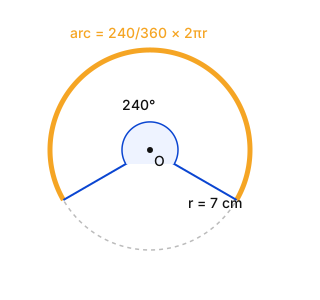
A circle has a radius of 7 cm. Calculate the length of an arc that subtends a central angle of 240°. (Give your answer in cm, rounded up to two decimal places; Use π = 22/7)
एक वृत्त की त्रिज्या 7 cm है। उस चाप की लंबाई की गणना कीजिए जो 240° का केंद्रीय कोण अंतरित करता है। (अपना उत्तर cm में, दो दशमलव स्थानों तक पूर्णांकित करके दीजिए; π = 22/7 का उपयोग कीजिए)
  1. A27.33 cm
  2. B28.67 cm
  3. C29.33 cm
  4. D31.33 cm
Show answer

Concept: Arc length =θ360∘×2πr.

  1. 240360=23.
  2. Circumference =2×227×7=44 cm.
  3. Arc =23×44=29.33 cm.

Trick: 240∘ is two-thirds of a full turn, so take two-thirds of the circumference.

Answer: (C) 29.33 cm

अवधारणा: चाप की लंबाई =θ360∘×2πr।

  1. 240360=23।
  2. परिधि =2×227×7=44 cm।
  3. चाप =23×44=29.33 cm।

ट्रिक: 240∘ पूरे चक्कर का दो-तिहाई है, इसलिए परिधि का दो-तिहाई लें।

उत्तर: (C) 29.33 cm

RRB NTPC Graduate CBT 1MathematicsCircle – arc lengthRRB NTPC Graduate CBT 1 2025 · 17 Mar Shift 3 →
Q6539.
What should come in place of ‘?’ in the given series?
81 79 76 71 64 ?
दी गई श्रेणी में ‘?’ के स्थान पर क्या आना चाहिए?
81 79 76 71 64 ?
  1. A54
  2. B53
  3. C55
  4. D51
Show answer

Concept: Look at the differences between consecutive terms.

  1. 81−79=2, 79−76=3, 76−71=5, 71−64=7 – differences are prime numbers.
  2. Next prime is 11, so ?=64−11=53.

Trick: Differences 2, 3, 5, 7, 11, 13… (primes) is a favourite pattern.

Answer: (B) 53

अवधारणा: क्रमागत पदों के अंतर देखें।

  1. 81−79=2, 79−76=3, 76−71=5, 71−64=7 – अंतर अभाज्य संख्याएँ हैं।
  2. अगली अभाज्य 11, अतः ?=64−11=53।

ट्रिक: अंतर 2, 3, 5, 7, 11, 13… (अभाज्य) एक पसंदीदा पैटर्न है।

उत्तर: (B) 53

RRB NTPC Graduate CBT 1MathematicsNumber seriesRRB NTPC Graduate CBT 1 2025 · 17 Mar Shift 3 →
Q6540.
At what rate (in percentage, rounded off to two decimal place) per year will a sum of money 5 times itself in 24 years on simple interest?
साधारण ब्याज पर प्रति वर्ष किस दर (प्रतिशत में, दो दशमलव स्थानों तक पूर्णांकित) से कोई धनराशि 24 वर्षों में स्वयं की 5 गुनी हो जाएगी?
  1. A16.67
  2. B14.67
  3. C33.34
  4. D18.67
Show answer

Concept: If a sum becomes n times at SI, interest =(n−1)P and R=(n−1)×100T.

  1. Amount =5P, so SI =4P in 24 years.
  2. R=4P×100P×24=40024=16.67%.

Trick: 'n times in T years' → R=100(n−1)T; here 40024.

Answer: (A) 16.67

अवधारणा: यदि राशि SI पर n गुनी हो, तो ब्याज =(n−1)P और R=(n−1)×100T।

  1. मिश्रधन =5P, अतः SI =4P (24 वर्ष में)।
  2. R=4P×100P×24=40024=16.67%।

ट्रिक: 'T वर्ष में n गुना' → R=100(n−1)T; यहाँ 40024।

उत्तर: (A) 16.67

RRB NTPC Graduate CBT 1MathematicsSimple interestRRB NTPC Graduate CBT 1 2025 · 17 Mar Shift 3 →