Question bank

Q&A: practice questions with answers

Search questions on any topic. Filter by exam category, exam, subject and topic, try the question, then open the answer and explanation.

Courses – airGurukul

7,077 questions found.

Q6541.
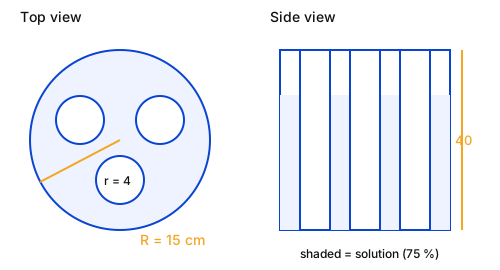
A chemical engineer designs a cylindrical reaction vessel with inner radius 15 cm and height 40 cm. Inside this vessel, three identical cylindrical cooling tubes (each with radius 4 cm and same height as the vessel) are installed vertically. If the remaining space is filled to 75% capacity with reactive solution, what volume of solution (in liters) does the vessel contain? (Use π = 3.14) (Round your answer off to two decimal places.)
एक रासायनिक इंजीनियर 15 cm आंतरिक त्रिज्या और 40 cm ऊँचाई वाला एक बेलनाकार अभिक्रिया पात्र डिज़ाइन करता है। इस पात्र के अंदर तीन समरूप बेलनाकार शीतलन नलिकाएँ (प्रत्येक की त्रिज्या 4 cm और ऊँचाई पात्र के समान) ऊर्ध्वाधर रूप से लगाई गई हैं। यदि शेष स्थान को अभिक्रियाशील विलयन से 75% क्षमता तक भरा जाता है, तो पात्र में विलयन का आयतन (लीटर में) कितना है? (π = 3.14 का उपयोग कीजिए) (अपने उत्तर को दो दशमलव स्थानों तक पूर्णांकित कीजिए।)
  1. A16.67 liters16.67 लीटर
  2. B18.15 liters18.15 लीटर
  3. C19.33 liters19.33 लीटर
  4. D17.42 liters17.42 लीटर
Show answer

Concept: Volume of cylinder =πr2h; free space = vessel volume − volume of tubes; 1 litre =1000 cm³.

  1. Vessel: π×152×40=9000π cm³.
  2. Three tubes: 3×π×42×40=1920π cm³.
  3. Free space =7080π=7080×3.14=22231.2 cm³.
  4. Solution =75% of it =16673.4 cm³ ≈16.67 litres.

Trick: Keep π till the end: 0.75×7080π=5310π, then multiply by 3.14 once.

Answer: (A) 16.67 liters

अवधारणा: बेलन का आयतन =πr2h; खाली स्थान = बर्तन का आयतन − नलियों का आयतन; 1 लीटर =1000 cm³।

  1. बर्तन: π×152×40=9000π cm³।
  2. तीन नलियाँ: 3×π×42×40=1920π cm³।
  3. खाली स्थान =7080π=7080×3.14=22231.2 cm³।
  4. घोल = इसका 75%=16673.4 cm³ ≈16.67 लीटर।

ट्रिक: π अंत तक रखें: 0.75×7080π=5310π, फिर एक बार 3.14 से गुणा करें।

उत्तर: (A) 16.67 liters
RRB NTPC Graduate CBT 1MathematicsMensuration – cylinderRRB NTPC Graduate CBT 1 2025 · 17 Mar Shift 3 →
Q6542.
A shopkeeper fixes the marked price of an item 180% above its cost price. What percentage of discount on marked price should be allowed to gain 152%?
एक दुकानदार किसी वस्तु का अंकित मूल्य उसके क्रय मूल्य से 180% अधिक निर्धारित करता है। 152% लाभ प्राप्त करने के लिए अंकित मूल्य पर कितने प्रतिशत छूट दी जानी चाहिए?
  1. A8%
  2. B9%
  3. C7%
  4. D10%
Show answer

Concept: Take CP =100; MP=CP(1+markup), SP=CP(1+gain), discount is on MP.

  1. MP =100+180=280; required SP =100+152=252.
  2. Discount =280−252=28.
  3. Discount% =28280×100=10%.

Trick: (1+markup)(1−d)=(1+gain): 2.8(1−d)=2.52⇒1−d=0.9.

Answer: (D) 10%

अवधारणा: CP =100 लें; MP=CP(1+वृद्धि), SP=CP(1+लाभ), छूट MP पर होती है।

  1. MP =100+180=280; अभीष्ट SP =100+152=252।
  2. छूट =280−252=28।
  3. छूट% =28280×100=10%।

ट्रिक: (1+वृद्धि)(1−d)=(1+लाभ): 2.8(1−d)=2.52⇒1−d=0.9।

उत्तर: (D) 10%

RRB NTPC Graduate CBT 1MathematicsProfit and loss – discountRRB NTPC Graduate CBT 1 2025 · 17 Mar Shift 3 →
Q6543.
Amit invested the same sum at simple and compound interest (compounded annually) for 2 years at 4% per annum. The difference between the compound interest and the simple interest is ₹47. Find the sum (in ₹) invested in each case.
अमित ने समान धनराशि 2 वर्षों के लिए 4% वार्षिक दर से साधारण ब्याज और चक्रवृद्धि ब्याज (वार्षिक रूप से संयोजित) पर निवेश की। चक्रवृद्धि ब्याज और साधारण ब्याज के बीच का अंतर ₹47 है। प्रत्येक स्थिति में निवेश की गई धनराशि (₹ में) ज्ञात कीजिए।
  1. A29,725
  2. B29,375
  3. C28,625
  4. D28,475
Show answer

Concept: For 2 years, CI−SI=P(R100)2.

  1. P×(4100)2=47.
  2. P×1610000=47⇒P=47×1000016=29375.

Trick: 2-year difference =PR210000; 3-year difference =PR2(300+R)106.

Answer: (B) 29,375

अवधारणा: 2 वर्ष के लिए, CI−SI=P(R100)2।

  1. P×(4100)2=47।
  2. P×1610000=47⇒P=47×1000016=29375।

ट्रिक: 2 वर्ष का अंतर =PR210000; 3 वर्ष का अंतर =PR2(300+R)106।

उत्तर: (B) 29,375

RRB NTPC Graduate CBT 1MathematicsCI – SI differenceRRB NTPC Graduate CBT 1 2025 · 17 Mar Shift 3 →
Q6544.
Walking at 47 of his normal speed from his home, Lakshya is 15 minutes late in reaching his office. The usual time taken by him to cover the distance between his home and his office is
अपने घर से अपनी सामान्य चाल के 47 से चलते हुए, लक्ष्य अपने कार्यालय पहुँचने में 15 मिनट देर हो जाता है। अपने घर और कार्यालय के बीच की दूरी तय करने में उसे सामान्यतः लगने वाला समय है
  1. A20 minutes20 मिनट
  2. B29 minutes29 मिनट
  3. C23 minutes23 मिनट
  4. D16 minutes16 मिनट
Show answer

Concept: For a fixed distance, time is inversely proportional to speed.

  1. Speed becomes 47 of usual ⇒ time becomes 74 of usual time t.
  2. Extra time =74t−t=34t=15 minutes.
  3. t=15×43=20 minutes.

Trick: Speed ratio 4:7 ⇒ time ratio 7:4; the difference of 3 parts =15 min ⇒ 1 part =5, usual =4×5=20.

Answer: (A) 20 minutes

अवधारणा: निश्चित दूरी के लिए समय, चाल के व्युत्क्रमानुपाती होता है।

  1. चाल सामान्य की 47 ⇒ समय सामान्य समय t का 74।
  2. अतिरिक्त समय =74t−t=34t=15 मिनट।
  3. t=15×43=20 मिनट।

ट्रिक: चाल अनुपात 4:7 ⇒ समय अनुपात 7:4; 3 भागों का अंतर =15 मिनट ⇒ 1 भाग =5, सामान्य =4×5=20।

उत्तर: (A) 20 minutes

RRB NTPC Graduate CBT 1MathematicsSpeed and time – late/earlyRRB NTPC Graduate CBT 1 2025 · 17 Mar Shift 3 →
Q6545.
Evaluate: 16 + 18 ÷ 6 - 2 × 4
मान ज्ञात कीजिए: 16 + 18 ÷ 6 - 2 × 4
  1. A13
  2. B11
  3. C14
  4. D10
Show answer

Concept: Do division and multiplication before addition and subtraction (BODMAS).

  1. 18÷6=3 and 2×4=8.
  2. 16+3−8=11.

Trick: Underline all ÷ and × first, solve them, then run left to right.

Answer: (B) 11

अवधारणा: जोड़-घटाव से पहले भाग और गुणा करें (BODMAS)।

  1. 18÷6=3 और 2×4=8।
  2. 16+3−8=11।

ट्रिक: पहले सभी ÷ और × रेखांकित करके हल करें, फिर बाएँ से दाएँ चलें।

उत्तर: (B) 11

RRB NTPC Graduate CBT 1MathematicsSimplification – BODMASRRB NTPC Graduate CBT 1 2025 · 17 Mar Shift 3 →
Q6546.
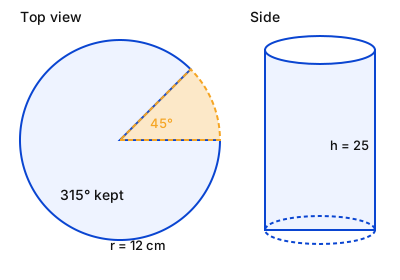
The radius of a solid cylinder is 12 cm, and its height is 25 cm. A three- dimensional sector with a sector angle of 45o is removed from it, all along the height of the cylinder. What is the volume (in cm3) of the larger piece of the cylinder?
एक ठोस बेलन की त्रिज्या 12 cm है और इसकी ऊँचाई 25 cm है। इससे 45o त्रिज्यखंड कोण वाला एक त्रि-विमीय त्रिज्यखंड बेलन की पूरी ऊँचाई के अनुदिश निकाल दिया जाता है। बेलन के बड़े टुकड़े का आयतन (cm3 में) क्या है?
  1. A3150π
  2. B3200π
  3. C3000π
  4. D3250π
Show answer

Concept: A sector of angle θ cut along the height takes θ360∘ of the cylinder's volume πr2h.

  1. Full volume =π×122×25=3600π cm³.
  2. Removed piece =45360=18 of it; larger piece =78.
  3. Larger piece =78×3600π=3150π cm³.

Trick: 45∘ is one-eighth of a turn – keep 78, remove 18.

Answer: (A) 3150π

अवधारणा: ऊँचाई के साथ काटा गया θ कोण का त्रिज्यखंड बेलन के आयतन πr2h का θ360∘ भाग लेता है।

  1. पूरा आयतन =π×122×25=3600π cm³।
  2. हटाया भाग =45360=18; बड़ा टुकड़ा =78।
  3. बड़ा टुकड़ा =78×3600π=3150π cm³।

ट्रिक: 45∘ पूरे चक्कर का आठवाँ भाग – 78 रखें, 18 हटाएँ।

उत्तर: (A) 3150π

RRB NTPC Graduate CBT 1MathematicsMensuration – cylinder sectorRRB NTPC Graduate CBT 1 2025 · 17 Mar Shift 3 →
Q6547.
At present, Vanraj is three times as old as his son, and his daughter is 3 years younger than the son. If the sum of the ages of these three people 3 years ago was 58 years, then Vanraj's present age (in years) is:
वर्तमान में, वनराज की आयु अपने पुत्र की आयु की तीन गुनी है, और उसकी पुत्री पुत्र से 3 वर्ष छोटी है। यदि 3 वर्ष पहले इन तीनों की आयु का योग 58 वर्ष था, तो वनराज की वर्तमान आयु (वर्षों में) है:
  1. A42
  2. B36
  3. C33
  4. D45
Show answer

Concept: Let the son's present age be x; express every age in x and shift all three back by 3 years.

  1. Son =x, daughter =x−3, Vanraj =3x; present sum =5x−3.
  2. Three years ago the sum is 9 less: 5x−3−9=58⇒5x=70⇒x=14.
  3. Vanraj =3×14=42 years.

Trick: For n people 'k years ago', subtract nk from the present total – here 3×3=9.

Answer: (A) 42

अवधारणा: पुत्र की वर्तमान आयु x लें; हर आयु x में लिखें और तीनों को 3 वर्ष पीछे ले जाएँ।

  1. पुत्र =x, पुत्री =x−3, वनराज =3x; वर्तमान योग =5x−3।
  2. तीन वर्ष पहले योग 9 कम: 5x−3−9=58⇒5x=70⇒x=14।
  3. वनराज =3×14=42 वर्ष।

ट्रिक: n लोगों के लिए 'k वर्ष पहले', वर्तमान योग से nk घटाएँ – यहाँ 3×3=9।

उत्तर: (A) 42

RRB NTPC Graduate CBT 1MathematicsAgesRRB NTPC Graduate CBT 1 2025 · 17 Mar Shift 3 →
Q6548.
If x+118x=3, then the value of 18x3+1324x3 is:
यदि x+118x=3 है, तो 18x3+1324x3 का मान है:
  1. A491
  2. B431
  3. C465
  4. D477
Show answer

Concept: If a+b=k then a3+b3=k3−3ab·k.

  1. Take a=x, b=118x; then ab=118 and a+b=3.
  2. x3+15832x3=a3+b3=27−3×118×3=27−12=532.
  3. 18x3+1324x3=18(x3+15832x3)=18×532=477.

Trick: Note 324=182 and 5832=183 – the expression is just 18(a3+b3).

Answer: (D) 477

अवधारणा: यदि a+b=k तो a3+b3=k3−3ab·k।

  1. a=x, b=118x लें; तब ab=118 और a+b=3।
  2. x3+15832x3=a3+b3=27−3×118×3=27−12=532।
  3. 18x3+1324x3=18(x3+15832x3)=18×532=477।

ट्रिक: ध्यान दें 324=182 और 5832=183 – व्यंजक बस 18(a3+b3) है।

उत्तर: (D) 477

RRB NTPC Graduate CBT 1MathematicsAlgebra – cubes identityRRB NTPC Graduate CBT 1 2025 · 17 Mar Shift 3 →
Q6549.
FKEP is related to EIBL in a certain way based on the English alphabetical order. In the same way, JMHT is related to IKEP. To which of the following is PQNW related, following the same logic?
अंग्रेज़ी वर्णमाला क्रम के आधार पर FKEP, EIBL से एक निश्चित प्रकार से संबंधित है। उसी प्रकार, JMHT, IKEP से संबंधित है। उसी तर्क का अनुसरण करते हुए, PQNW निम्नलिखित में से किससे संबंधित है?
  1. AOOLS
  2. BOQKT
  3. COPJS
  4. DOOKS
Show answer

Concept: Compare each letter of the first cluster with the matching letter of the second and note the shift.

  1. FKEP → EIBL: F−1=E, K−2=I, E−3=B, P−4=L. Pattern −1,−2,−3,−4.
  2. Check: JMHT → J−1=I, M−2=K, H−3=E, T−4=P = IKEP ✓.
  3. Apply to PQNW: P−1=O, Q−2=O, N−3=K, W−4=S → OOKS.

Trick: Write the shifts under the letters; a sequence like −1,−2,−3,−4 is the commonest NTPC pattern.

Answer: (D) OOKS

अवधारणा: पहले समूह के हर अक्षर की तुलना दूसरे समूह के उसी स्थान के अक्षर से करें और shift देखें।

  1. FKEP → EIBL: F−1=E, K−2=I, E−3=B, P−4=L। पैटर्न −1,−2,−3,−4।
  2. जाँच: JMHT → I, K, E, P = IKEP ✓।
  3. PQNW: P−1=O, Q−2=O, N−3=K, W−4=S → OOKS।

ट्रिक: अक्षरों के नीचे shift लिखें; −1,−2,−3,−4 जैसा क्रम NTPC में सबसे आम पैटर्न है।

उत्तर: (D) OOKS

RRB NTPC Graduate CBT 1General Intelligence and ReasoningLetter Cluster AnalogyRRB NTPC Graduate CBT 1 2025 · 17 Mar Shift 3 →
Q6550.
In a certain code language, ‘LIME’ is coded as ‘4839’ and ‘TIME’ is coded as ‘9324’. What is the code for ‘T’ in the given code language?
एक निश्चित कूट भाषा में, ‘LIME’ को ‘4839’ के रूप में कूटबद्ध किया जाता है और ‘TIME’ को ‘9324’ के रूप में कूटबद्ध किया जाता है। दी गई कूट भाषा में ‘T’ का कूट क्या है?
  1. A4
  2. B9
  3. C3
  4. D2
Show answer

Concept: Letters common to both words get the common digits; the letter that is left over gets the digit that is left over.

  1. LIME → 4839 and TIME → 9324 share I, M, E.
  2. Common digits of the two codes: {4,8,3,9}∩{9,3,2,4}={4,3,9} → these belong to I, M, E.
  3. So L = 8 (the digit only in LIME) and T = 2 (the digit only in TIME).

Trick: Don’t try to match letter positions – just find the digit that appears in only one code.

Answer: (D) 2

अवधारणा: दोनों शब्दों में समान अक्षरों को समान अंक मिलते हैं; जो अक्षर बचता है उसे बचा हुआ अंक।

  1. LIME → 4839 और TIME → 9324 में I, M, E समान हैं।
  2. दोनों कोड के समान अंक: {4,8,3,9}∩{9,3,2,4}={4,3,9} → ये I, M, E के हैं।
  3. अतः L = 8 और T = 2 (जो अंक सिर्फ़ TIME के कोड में है)।

ट्रिक: अक्षरों की स्थिति मिलाने की कोशिश न करें – बस वह अंक ढूँढें जो केवल एक कोड में है।

उत्तर: (D) 2

RRB NTPC Graduate CBT 1General Intelligence and ReasoningCoding–Decoding (Common Letters)RRB NTPC Graduate CBT 1 2025 · 17 Mar Shift 3 →
Q6551.
What should come in place of ‘?’ in the given series?
7 11 19 31 47 ?
दी गई श्रेणी में ‘?’ के स्थान पर क्या आना चाहिए?
7 11 19 31 47 ?
  1. A67
  2. B69
  3. C63
  4. D65
Show answer

Concept: Find the differences between consecutive terms; they often form a simple pattern.

  1. Differences: 11−7=4, 19−11=8, 31−19=12, 47−31=16.
  2. Differences increase by 4 each time → next difference =20.
  3. 47+20=67.

Trick: Differences 4,8,12,16,20 are multiples of 4 – the series is n2+n+5 type, but differences are faster.

Answer: (A) 67

अवधारणा: क्रमागत पदों के अंतर निकालें; वे प्रायः सरल पैटर्न बनाते हैं।

  1. अंतर: 11−7=4, 19−11=8, 31−19=12, 47−31=16।
  2. अंतर हर बार 4 बढ़ रहा है → अगला अंतर =20।
  3. 47+20=67।

ट्रिक: अंतर 4,8,12,16,20 – 4 के गुणज; अंतर निकालना सबसे तेज़ तरीका है।

उत्तर: (A) 67

RRB NTPC Graduate CBT 1General Intelligence and ReasoningNumber SeriesRRB NTPC Graduate CBT 1 2025 · 17 Mar Shift 3 →
Q6552.
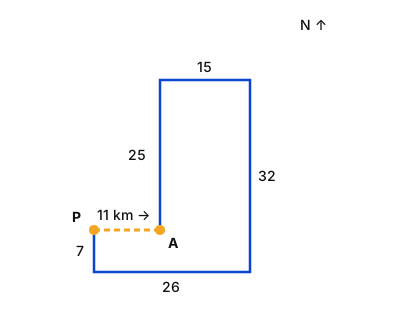
Pawan starts from Point A and drives 25 km towards North. He then takes a right turn, drives 15 km, turns right and drives 32 km. He then takes a right turn and drives 26 km. He takes a final right turn, drives 7 km and stops at Point P. How far (shortest distance) and towards which direction should he drive in order to reach Point A again? (All turns are 90 degrees turns only unless specified)
पवन बिंदु A से शुरू करके उत्तर की ओर 25 km गाड़ी चलाता है। फिर वह दाएँ मुड़ता है, 15 km चलता है, दाएँ मुड़ता है और 32 km चलता है। फिर वह दाएँ मुड़कर 26 km चलता है। वह अंतिम बार दाएँ मुड़ता है, 7 km चलता है और बिंदु P पर रुक जाता है। बिंदु A पर पुनः पहुँचने के लिए उसे कितनी दूर (न्यूनतम दूरी) और किस दिशा में गाड़ी चलानी चाहिए? (जब तक अन्यथा निर्दिष्ट न हो, सभी मोड़ केवल 90 डिग्री के मोड़ हैं)
  1. A10 km to the eastपूर्व की ओर 10 km
  2. B11 km to the westपश्चिम की ओर 11 km
  3. C11 km to the eastपूर्व की ओर 11 km
  4. D10 km to the westपश्चिम की ओर 10 km
Show answer

Concept: Take A as origin; North = +y, East = +x. Every right turn rotates clockwise: N → E → S → W → N.

  1. A(0,0) → 25 km North → (0,25) → right (East) 15 km → (15,25).
  2. Right (South) 32 km → (15,−7) → right (West) 26 km → (−11,−7) → right (North) 7 km → P(−11,0).
  3. P is 11 km west of A on the same horizontal line, so he must drive 11 km towards the East.

Trick: Net North–South: 25−32+7=0; net East–West: 15−26=−11 → 11 km west of A, so go East.

Answer: (C) 11 km to the east

अवधारणा: A को मूल बिंदु मानें; उत्तर = +y, पूर्व = +x। हर दायाँ मोड़ दक्षिणावर्त घूमता है: N → E → S → W → N।

  1. A(0,0) → 25 km उत्तर → (0,25) → दाएँ (पूर्व) 15 km → (15,25)।
  2. दाएँ (दक्षिण) 32 km → (15,−7) → दाएँ (पश्चिम) 26 km → (−11,−7) → दाएँ (उत्तर) 7 km → P(−11,0)।
  3. P, A से 11 km पश्चिम में उसी रेखा पर है, अतः A पहुँचने के लिए 11 km पूर्व की ओर चलना होगा।

ट्रिक: शुद्ध उत्तर–दक्षिण: 25−32+7=0; शुद्ध पूर्व–पश्चिम: 15−26=−11 → A से 11 km पश्चिम, इसलिए पूर्व चलें।

उत्तर: (C) 11 km to the east

RRB NTPC Graduate CBT 1General Intelligence and ReasoningDirection and DistanceRRB NTPC Graduate CBT 1 2025 · 17 Mar Shift 3 →
Q6553.
Refer to the following number, symbol series and answer the question. Counting to be done from left to right only. All numbers are single digit numbers only.
(Left) ^ 5 % 5 \ 6 # + # + 1 6 ? # 6 & 7 & 9 < % (Right)
How many such numbers are there, each of which is immediately preceded by a symbol and also immediately followed by a symbol?
निम्नलिखित संख्या, प्रतीक श्रेणी को देखिए और प्रश्न का उत्तर दीजिए। गिनती केवल बाएँ से दाएँ की जानी है। सभी संख्याएँ केवल एक-अंकीय संख्याएँ हैं।
(बाएँ) ^ 5 % 5 \ 6 # + # + 1 6 ? # 6 & 7 & 9 < % (दाएँ)
ऐसी कितनी संख्याएँ हैं, जिनमें से प्रत्येक के ठीक पहले एक प्रतीक है और ठीक बाद भी एक प्रतीक है?
  1. AFiveपाँच
  2. BFourचार
  3. CSixछह
  4. DSevenसात
Show answer

Concept: Scan the series left to right and test every number: is the element before it a symbol AND the element after it a symbol?

  1. Series: ^ 5 % 5 \ 6 # + # + 1 6 ? # 6 & 7 & 9 < %
  2. Qualifying numbers: 5 (^…%), 5 (%…\), 6 (\…#), 6 (#…&), 7 (&…&), 9 (&…<).
  3. Rejected: “1” (followed by 6) and the second “6” (preceded by 1). Total = 6.

Trick: Underline every “symbol–number–symbol” triplet as you read; overlapping triplets are allowed.

Answer: (C) Six

अवधारणा: श्रृंखला को बाएँ से दाएँ पढ़ें और हर संख्या जाँचें: उससे पहले प्रतीक है और बाद में भी प्रतीक है?

  1. श्रृंखला: ^ 5 % 5 \ 6 # + # + 1 6 ? # 6 & 7 & 9 < %
  2. योग्य संख्याएँ: 5 (^…%), 5 (%…\), 6 (\…#), 6 (#…&), 7 (&…&), 9 (&…<)।
  3. अस्वीकृत: “1” (बाद में 6) और दूसरा “6” (पहले 1)। कुल = 6।

ट्रिक: पढ़ते समय हर “प्रतीक–संख्या–प्रतीक” त्रिक को रेखांकित करें; overlapping त्रिक मान्य हैं।

उत्तर: (C) Six

RRB NTPC Graduate CBT 1General Intelligence and ReasoningSymbol–Number Series CountingRRB NTPC Graduate CBT 1 2025 · 17 Mar Shift 3 →
Q6554.
Based on the English alphabetical order, three of the following four letter cluster pairs are alike in a certain way and thus form a group. Which is the one that does not belong to that group?
(Note: The odd man out is not based on the number of consonants/vowels or their position in the letter cluster)
अंग्रेज़ी वर्णमाला क्रम के आधार पर, निम्नलिखित चार अक्षर-समूह युग्मों में से तीन एक निश्चित प्रकार से समान हैं और इस प्रकार एक समूह बनाते हैं। वह कौन-सा है जो उस समूह से संबंधित नहीं है?
(नोट: विषम युग्म व्यंजनों/स्वरों की संख्या या अक्षर-समूह में उनकी स्थिति पर आधारित नहीं है)
  1. AEG-IK
  2. BJL-NP
  3. CTU-WX
  4. DCE-GI
Show answer

Concept: Find the gap inside each cluster and between the two clusters of a pair.

  1. EG–IK: E+2=G, G+2=I, I+2=K → every gap is 2.
  2. JL–NP: J+2=L, L+2=N, N+2=P ✓; CE–GI: C+2=E, E+2=G, G+2=I ✓.
  3. TU–WX: T+1=U, U+2=W, W+1=X → gaps 1,2,1 – different, so odd one out.

Trick: Three pairs are chains of alternate letters (E G I K); TU–WX uses consecutive letters.

Answer: (C) TU-WX

अवधारणा: हर समूह के अंदर और युग्म के दोनों समूहों के बीच का अंतर देखें।

  1. EG–IK: E+2=G, G+2=I, I+2=K → हर अंतर 2।
  2. JL–NP: J+2=L, L+2=N, N+2=P ✓; CE–GI: C+2=E, E+2=G, G+2=I ✓।
  3. TU–WX: T+1=U, U+2=W, W+1=X → अंतर 1,2,1 – भिन्न, अतः यही अलग है।

ट्रिक: तीन युग्म एक-एक अक्षर छोड़कर बनी शृंखलाएँ हैं (E G I K); TU–WX में लगातार अक्षर हैं।

उत्तर: (C) TU-WX

RRB NTPC Graduate CBT 1General Intelligence and ReasoningLetter Cluster ClassificationRRB NTPC Graduate CBT 1 2025 · 17 Mar Shift 3 →
Q6555.
MUNI is related to OSPG in a certain way based on the English alphabetical order. In the same way, SDIK is related to UBKI. To which of the following is BZMP related, following the same logic?
अंग्रेज़ी वर्णमाला क्रम के आधार पर MUNI, OSPG से एक निश्चित प्रकार से संबंधित है। उसी प्रकार, SDIK, UBKI से संबंधित है। उसी तर्क का अनुसरण करते हुए, BZMP निम्नलिखित में से किससे संबंधित है?
  1. ADXNQ
  2. BEYPO
  3. CDXON
  4. DCWNM
Show answer

Concept: Compare position-wise; here the shifts alternate in sign.

  1. MUNI → OSPG: M+2=O, U−2=S, N+2=P, I−2=G. Pattern +2,−2,+2,−2.
  2. Check: SDIK → S+2=U, D−2=B, I+2=K, K−2=I = UBKI ✓.
  3. BZMP: B+2=D, Z−2=X, M+2=O, P−2=N → DXON.

Trick: Alternate +2/−2 – note Z−2 = X (no wrap-around needed).

Answer: (C) DXON

अवधारणा: स्थान-वार तुलना करें; यहाँ shift के चिह्न बारी-बारी बदलते हैं।

  1. MUNI → OSPG: M+2=O, U−2=S, N+2=P, I−2=G। पैटर्न +2,−2,+2,−2।
  2. जाँच: SDIK → U, B, K, I = UBKI ✓।
  3. BZMP: B+2=D, Z−2=X, M+2=O, P−2=N → DXON।

ट्रिक: बारी-बारी +2/−2 – Z−2 = X (wrap-around की ज़रूरत नहीं)।

उत्तर: (C) DXON

RRB NTPC Graduate CBT 1General Intelligence and ReasoningLetter Cluster AnalogyRRB NTPC Graduate CBT 1 2025 · 17 Mar Shift 3 →
Q6556.
In a certain code language,
A + B means ‘A is the sister of B’
A - B means ‘A is the husband of B’
A × B means ‘A is the mother of B’
A ÷ B means ‘A is the father of B’.
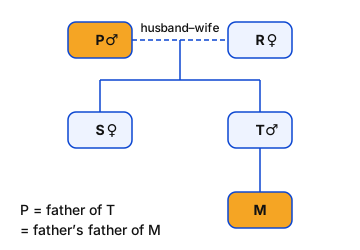
Based on the above, how is P related to M if ‘P - R × S + T ÷ M’?
एक निश्चित कूट भाषा में,
A + B का अर्थ है ‘A, B की बहन है’
A - B का अर्थ है ‘A, B का पति है’
A × B का अर्थ है ‘A, B की माता है’
A ÷ B का अर्थ है ‘A, B का पिता है’।
उपर्युक्त के आधार पर, यदि ‘P - R × S + T ÷ M’ है, तो P, M से किस प्रकार संबंधित है?
  1. AMother’s fatherमाता का पिता
  2. BFather’s brotherपिता का भाई
  3. CSister’s husbandबहन का पति
  4. DFather’s fatherपिता का पिता
Show answer

Concept: Decode each symbol step by step and build the family tree.

  1. P − R: P is the husband of R. R × S: R is the mother of S → P is S’s father.
  2. S + T: S is the sister of T → T is also a child of P and R.
  3. T ÷ M: T is the father of M → P is the father of M’s father, i.e. M’s father’s father (paternal grandfather).

Trick: Husband of the mother = father; father of the father = paternal grandfather (dada).

Answer: (D) Father’s father

अवधारणा: हर प्रतीक को क्रम से डिकोड कर वंश-वृक्ष बनाएँ।

  1. P − R: P, R का पति। R × S: R, S की माँ → P, S का पिता।
  2. S + T: S, T की बहन → T भी P और R की संतान।
  3. T ÷ M: T, M का पिता → P, M के पिता का पिता (दादा)।

ट्रिक: माँ का पति = पिता; पिता का पिता = दादा।

उत्तर: (D) Father’s father

RRB NTPC Graduate CBT 1General Intelligence and ReasoningBlood Relations (Coded)RRB NTPC Graduate CBT 1 2025 · 17 Mar Shift 3 →
Q6557.
If ‘A’ stands for ‘÷’, ‘B’ stands for ‘×’, ‘C’ stands for ‘+’, and ‘D’ stands for ‘−’, what will come in place of the question mark (?) in the following equation?
18 A 2 B 5 C 7 D 9 = ?
यदि ‘A’ का अर्थ ‘÷’, ‘B’ का अर्थ ‘×’, ‘C’ का अर्थ ‘+’ और ‘D’ का अर्थ ‘−’ है, तो निम्नलिखित समीकरण में प्रश्नचिह्न (?) के स्थान पर क्या आएगा?
18 A 2 B 5 C 7 D 9 = ?
  1. A40
  2. B43
  3. C42
  4. D41
Show answer

Concept: Replace the letters by the given operators and apply BODMAS.

  1. 18 A 2 B 5 C 7 D 9 → 18÷2×5+7−9.
  2. Division/multiplication first: 18÷2=9, 9×5=45.
  3. Then 45+7−9=43.

Trick: Do ÷ and × from left to right before + and −.

Answer: (B) 43

अवधारणा: अक्षरों की जगह दिए गए चिह्न रखें और BODMAS लागू करें।

  1. 18 A 2 B 5 C 7 D 9 → 18÷2×5+7−9।
  2. पहले भाग/गुणा: 18÷2=9, 9×5=45।
  3. फिर 45+7−9=43।

ट्रिक: + और − से पहले ÷ और × बाएँ से दाएँ करें।

उत्तर: (B) 43

RRB NTPC Graduate CBT 1General Intelligence and ReasoningMathematical Operations (Substitution)RRB NTPC Graduate CBT 1 2025 · 17 Mar Shift 3 →
Q6558.
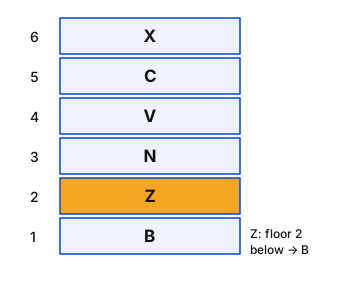
B, C, N, V, X and Z live on six different floors of the same building. The lowermost floor in the building is numbered 1, the floor above it, number 2 and so on till the topmost floor is numbered 6.
N lives on an odd numbered floor but not 5. The sum of floors on which N and Z live is 5. Only 3 people live between Z and X. C lives immediately above V. How many people live below Z?
B, C, N, V, X और Z एक ही भवन की छह अलग-अलग मंज़िलों पर रहते हैं। भवन की सबसे निचली मंज़िल की संख्या 1 है, उसके ऊपर की मंज़िल की संख्या 2 है और इसी प्रकार सबसे ऊपरी मंज़िल की संख्या 6 है।
N एक विषम संख्या वाली मंज़िल पर रहता है, परंतु 5 पर नहीं। N और Z जिन मंज़िलों पर रहते हैं, उनकी संख्याओं का योग 5 है। Z और X के बीच केवल 3 व्यक्ति रहते हैं। C, V के ठीक ऊपर रहता है। Z के नीचे कितने व्यक्ति रहते हैं?
  1. A1
  2. B4
  3. C2
  4. D3
Show answer

Concept: Start from the most restrictive clue (N’s floor and the sum with Z) and place the rest.

  1. N is on an odd floor but not 5 → N = 1 or 3. N + Z = 5 → (N, Z) = (1, 4) or (3, 2).
  2. Exactly 3 people between Z and X → Z and X are on floors (1, 5) or (2, 6). Z = 4 is impossible, so Z = 2, N = 3, X = 6.
  3. Floors 1, 4, 5 remain for B, C, V; C immediately above V → V = 4, C = 5, B = 1. Below Z (floor 2) lives only B → 1 person.

Trick: “Sum of floors = 5” plus “3 between” fixes Z in one step; always test the pair options against both clues.

Answer: (A) 1

अवधारणा: सबसे कठोर संकेत (N की मंज़िल और Z के साथ योग) से शुरू कर बाकी को रखें।

  1. N विषम मंज़िल पर, पर 5 नहीं → N = 1 या 3। N + Z = 5 → (N, Z) = (1, 4) या (3, 2)।
  2. Z और X के बीच ठीक 3 लोग → Z, X मंज़िल (1, 5) या (2, 6) पर। Z = 4 संभव नहीं, अतः Z = 2, N = 3, X = 6।
  3. B, C, V के लिए 1, 4, 5 बचे; C, V के ठीक ऊपर → V = 4, C = 5, B = 1। Z (मंज़िल 2) के नीचे केवल B → 1 व्यक्ति।

ट्रिक: “मंज़िलों का योग 5” और “बीच में 3” मिलकर Z को एक कदम में तय कर देते हैं; युग्म-विकल्पों को दोनों संकेतों पर परखें।

उत्तर: (A) 1

RRB NTPC Graduate CBT 1General Intelligence and ReasoningFloor PuzzleRRB NTPC Graduate CBT 1 2025 · 17 Mar Shift 3 →
Q6559.
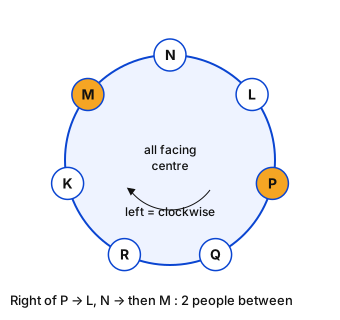
Seven people, K, L, M, N, P, Q and R, are sitting around a circular table facing the centre of the table but not necessarily in the same order. Q sits third to the left of N. M sits second to the left of R. N is the immediate neighbour of both L and M. K is not an immediate neighbour of Q. How many people sit between P and M when counted from the right of P?
सात व्यक्ति, K, L, M, N, P, Q और R, एक वृत्ताकार मेज़ के चारों ओर मेज़ के केंद्र की ओर मुख करके बैठे हैं, परंतु आवश्यक नहीं कि इसी क्रम में हों। Q, N के बाएँ से तीसरे स्थान पर बैठा है। M, R के बाएँ से दूसरे स्थान पर बैठा है। N, L और M दोनों का निकटतम पड़ोसी है। K, Q का निकटतम पड़ोसी नहीं है। P के दाएँ से गिनने पर P और M के बीच कितने व्यक्ति बैठे हैं?
  1. AOneएक
  2. BThreeतीन
  3. CFourचार
  4. DTwoदो
Show answer

Concept: When all face the centre, “left” means clockwise and “right” means anticlockwise. Fix N first and place the others.

  1. Number seats 1–7 clockwise with N at 1. Q is 3rd to the left of N → Q at 4. L and M are N’s neighbours → seats 2 and 7.
  2. M is 2nd to the left of R → R is 2 seats to the right (anticlockwise) of M. If M = 2, R = 7, but 7 is L – not possible. So M = 7, L = 2, R = 5.
  3. Seats 3 and 6 remain for K, P; K is not a neighbour of Q (4) → K = 6, P = 3. From the right of P: L (2), N (1), then M (7) → 2 people between.

Trick: Draw the circle, mark N at the top, and always count clockwise for “left” when facing the centre.

Answer: (D) Two

अवधारणा: सब केंद्र की ओर मुख किए हों तो “बाएँ” = दक्षिणावर्त और “दाएँ” = वामावर्त। पहले N को रखें।

  1. N को सीट 1 पर रखकर सीटें 1–7 दक्षिणावर्त गिनें। Q, N के बाएँ तीसरा → Q = 4। L और M, N के पड़ोसी → सीट 2 और 7।
  2. M, R के बाएँ दूसरा → R, M के दाएँ (वामावर्त) 2 सीट। M = 2 हो तो R = 7, पर 7 पर L है – असंभव। अतः M = 7, L = 2, R = 5।
  3. K, P के लिए सीट 3 और 6 बचीं; K, Q (4) का पड़ोसी नहीं → K = 6, P = 3। P के दाएँ से: L (2), N (1), फिर M (7) → बीच में 2 लोग।

ट्रिक: वृत्त बनाएँ, N को ऊपर रखें, और केंद्र की ओर मुख होने पर “बाएँ” के लिए हमेशा दक्षिणावर्त गिनें।

उत्तर: (D) Two

RRB NTPC Graduate CBT 1General Intelligence and ReasoningCircular Seating ArrangementRRB NTPC Graduate CBT 1 2025 · 17 Mar Shift 3 →
Q6560.
Refer to the following letter, symbol series and answer the question. Counting to be done from left to right only.
(Left) L U & P % F A & D $ # K Q * M Ω Y @ E T * £ R (Right)
How many such symbols are there, each of which is immediately preceded by a letter and also immediately followed by another symbol?
निम्नलिखित अक्षर, प्रतीक श्रेणी को देखिए और प्रश्न का उत्तर दीजिए। गिनती केवल बाएँ से दाएँ की जानी है।
(बाएँ) L U & P % F A & D $ # K Q * M Ω Y @ E T * £ R (दाएँ)
ऐसे कितने प्रतीक हैं, जिनमें से प्रत्येक के ठीक पहले एक अक्षर है और ठीक बाद एक अन्य प्रतीक है?
  1. ATwoदो
  2. BOneएक
  3. CNoneकोई नहीं
  4. DThreeतीन
Show answer

Concept: For each symbol check its neighbours: a letter immediately before it and another symbol immediately after it.

  1. Series: L U & P % F A & D $ # K Q * M Ω Y @ E T * £ R
  2. $: before D (letter), after # (symbol) ✓. * (after T): before T (letter), after £ (symbol) ✓.
  3. Others fail: & (U…P), % (P…F), & (A…D), # ($…K), * (Q…M), @ (Y…E), £ (*…R) – each is followed by a letter or preceded by a symbol. Total = 2.

Trick: Look only for “letter–symbol–symbol” runs; two adjacent symbols are needed, which happens at just two places.

Answer: (A) Two

अवधारणा: हर प्रतीक के पड़ोसी देखें: ठीक पहले अक्षर और ठीक बाद दूसरा प्रतीक।

  1. श्रृंखला: L U & P % F A & D $ # K Q * M Ω Y @ E T * £ R
  2. $: पहले D (अक्षर), बाद # (प्रतीक) ✓। * (T के बाद): पहले T, बाद £ ✓।
  3. बाकी असफल: & (U…P), % (P…F), & (A…D), # ($…K), * (Q…M), @ (Y…E), £ (*…R)। कुल = 2।

ट्रिक: केवल “अक्षर–प्रतीक–प्रतीक” क्रम खोजें; दो सटे प्रतीक चाहिए, जो सिर्फ़ दो जगह हैं।

उत्तर: (A) Two

RRB NTPC Graduate CBT 1General Intelligence and ReasoningLetter–Symbol Series CountingRRB NTPC Graduate CBT 1 2025 · 17 Mar Shift 3 →