Question bank

Q&A: practice questions with answers

Search questions on any topic. Filter by exam category, exam, subject and topic, try the question, then open the answer and explanation.

Courses – airGurukul

7,077 questions found.

Q6561.
Each of F, G, H, L, M, N and O has an exam on a different day of a week starting from Monday and ending on Sunday of the same week.
G has exam on Friday. Only two people have exams between M and G. Only four people have exams between F and M. N has exam immediately after O. L doesn’t have exam on Monday.
How many people have exams between L and H?
F, G, H, L, M, N और O में से प्रत्येक की परीक्षा एक ही सप्ताह के, सोमवार से शुरू होकर रविवार को समाप्त होने वाले, अलग-अलग दिन है।
G की परीक्षा शुक्रवार को है। M और G के बीच केवल दो व्यक्तियों की परीक्षाएँ हैं। F और M के बीच केवल चार व्यक्तियों की परीक्षाएँ हैं। N की परीक्षा O के ठीक बाद है। L की परीक्षा सोमवार को नहीं है।
L और H के बीच कितने व्यक्तियों की परीक्षाएँ हैं?
  1. ATwoदो
  2. BFourचार
  3. COneएक
  4. DThreeतीन
Show answer

Concept: Fix the given day (G = Friday) and use the “people between” clues, remembering the week cannot extend past Sunday.
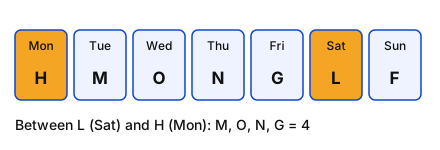
  1. Two between M and G → M = Tuesday (Friday + 3 would be beyond Sunday).
  2. Four between F and M → F = Sunday. N immediately after O, with free days Mon, Wed, Thu, Sat → O = Wed, N = Thu.
  3. L is not on Monday → L = Saturday, H = Monday. Between L (Sat) and H (Mon): Tue, Wed, Thu, Fri → 4 people.

Trick: Write Mon–Sun in a row first; one-direction constraints (week ends on Sunday) kill the second possibility instantly.

Answer: (B) Four

अवधारणा: दिया गया दिन (G = शुक्रवार) तय करें और “बीच में लोग” वाले संकेत लगाएँ; सप्ताह रविवार से आगे नहीं जाता।

  1. M और G के बीच दो → M = मंगलवार (शुक्रवार + 3 रविवार से परे होगा)।
  2. F और M के बीच चार → F = रविवार। N, O के ठीक बाद, खाली दिन सोम, बुध, गुरु, शनि → O = बुध, N = गुरु।
  3. L सोमवार को नहीं → L = शनिवार, H = सोमवार। L (शनि) और H (सोम) के बीच: मंगल, बुध, गुरु, शुक्र → 4 लोग।

ट्रिक: पहले सोम–रवि एक पंक्ति में लिखें; एक-दिशा वाली सीमा (सप्ताह रविवार को खत्म) दूसरी संभावना तुरंत हटा देती है।

उत्तर: (B) Four
RRB NTPC Graduate CBT 1General Intelligence and ReasoningDay-based Scheduling PuzzleRRB NTPC Graduate CBT 1 2025 · 17 Mar Shift 3 →
Q6562.
In a certain code language, ‘WEAR’ is coded as ‘8246’ and ‘CAST’ is coded as ‘3851’. What is the code for 'A’ in the given code language?
एक निश्चित कूट भाषा में, ‘WEAR’ को ‘8246’ के रूप में कूटबद्ध किया जाता है और ‘CAST’ को ‘3851’ के रूप में कूटबद्ध किया जाता है। दी गई कूट भाषा में 'A’ का कूट क्या है?
  1. A8
  2. B3
  3. C4
  4. D1
Show answer

Concept: The only letter common to both words must get the only digit common to both codes.

  1. WEAR → 8246 and CAST → 3851 share just one letter: A.
  2. Common digit: {8,2,4,6}∩{3,8,5,1}={8}.
  3. Hence A = 8.

Trick: One common letter ↔ one common digit; no need to decode the other letters.

Answer: (A) 8

अवधारणा: दोनों शब्दों में एकमात्र समान अक्षर को दोनों कोड का एकमात्र समान अंक मिलेगा।

  1. WEAR → 8246 और CAST → 3851 में केवल A समान है।
  2. समान अंक: {8,2,4,6}∩{3,8,5,1}={8}।
  3. अतः A = 8।

ट्रिक: एक समान अक्षर ↔ एक समान अंक; बाकी अक्षर डिकोड करने की ज़रूरत नहीं।

उत्तर: (A) 8

RRB NTPC Graduate CBT 1General Intelligence and ReasoningCoding–Decoding (Common Letters)RRB NTPC Graduate CBT 1 2025 · 17 Mar Shift 3 →
Q6563.
Select the set in which the numbers are related in the same way as are the numbers of the following sets.
(NOTE : Operations should be performed on the whole numbers, without breaking down the numbers into their constituent digits. E.g. 13 – Operations on 13 such as adding / subtracting / multiplying etc. to 13 can be performed. Breaking down 13 into 1 and 3 and then performing mathematical operations on 1 and 3 is not allowed.)
(9,11,24)
(15,14,27)
उस समुच्चय का चयन कीजिए जिसमें संख्याएँ उसी प्रकार संबंधित हैं जिस प्रकार निम्नलिखित समुच्चयों की संख्याएँ संबंधित हैं।
(नोट: संक्रियाएँ पूर्ण संख्याओं पर की जानी चाहिए, संख्याओं को उनके घटक अंकों में तोड़े बिना। उदाहरण के लिए 13 – 13 पर संक्रियाएँ जैसे 13 में जोड़ना / घटाना / गुणा करना आदि की जा सकती हैं। 13 को 1 और 3 में तोड़कर फिर 1 और 3 पर गणितीय संक्रियाएँ करने की अनुमति नहीं है।)
(9,11,24)
(15,14,27)
  1. A(18,2,12)
  2. B(23,1,31)
  3. C(2,11,31)
  4. D(26,6,12)
Show answer

Concept: Find one rule linking the first two numbers to the third that works for both given sets, then test the options.

  1. (9, 11, 24): 3×11−9=33−9=24 ✓. (15, 14, 27): 3×14−15=42−15=27 ✓. Rule: third =3×second − first.
  2. (2, 11, 31): 3×11−2=33−2=31 ✓.
  3. Others fail: (18, 2, 12): 6−18=−12; (23, 1, 31): 3−23=−20; (26, 6, 12): 18−26=−8.

Trick: When a+b or a×b fails, try 3b−a, 2b+a, a2−b type combinations – here 3b−a fits both sets.

Answer: (C) (2,11,31)

अवधारणा: पहले दो अंकों को तीसरे से जोड़ने वाला एक नियम खोजें जो दोनों समुच्चयों पर चले, फिर विकल्प जाँचें।

  1. (9, 11, 24): 3×11−9=24 ✓। (15, 14, 27): 3×14−15=27 ✓। नियम: तीसरा =3×दूसरा − पहला।
  2. (2, 11, 31): 3×11−2=31 ✓।
  3. बाकी असफल: (18, 2, 12): 6−18=−12; (23, 1, 31): 3−23=−20; (26, 6, 12): 18−26=−8।

ट्रिक: जब a+b या a×b न चले तो 3b−a, 2b+a, a2−b जैसे संयोजन आज़माएँ – यहाँ 3b−a दोनों पर सही है।

उत्तर: (C) (2,11,31)

RRB NTPC Graduate CBT 1General Intelligence and ReasoningNumber Set AnalogyRRB NTPC Graduate CBT 1 2025 · 17 Mar Shift 3 →
Q6564.
Refer to the following letter, number and symbol series and answer the question that follows.
(NOTE: All numbers are single-digit numbers only.)
(Left) @ © € E 8 9 X © 7 6 9 4 S N % $ 2 © 1 # O N (Right)
If all the numbers are dropped from the series, which of the following will be eighth from the left?
निम्नलिखित अक्षर, संख्या और प्रतीक श्रेणी को देखिए और उसके बाद दिए गए प्रश्न का उत्तर दीजिए।
(नोट: सभी संख्याएँ केवल एक-अंकीय संख्याएँ हैं।)
(बाएँ) @ © € E 8 9 X © 7 6 9 4 S N % $ 2 © 1 # O N (दाएँ)
यदि श्रेणी से सभी संख्याएँ हटा दी जाएँ, तो निम्नलिखित में से कौन-सा बाएँ से आठवाँ होगा?
  1. AN
  2. BS
  3. C@
  4. D%
Show answer

Concept: Remove the specified elements and then count from the given end.

  1. Series: @ © € E 8 9 X © 7 6 9 4 S N % $ 2 © 1 # O N.
  2. Dropping all numbers (8, 9, 7, 6, 9, 4, 2, 1): @ © € E X © S N % $ © # O N.
  3. Counting from the left: 1-@, 2-©, 3-€, 4-E, 5-X, 6-©, 7-S, 8-N.

Trick: Write the reduced series on rough sheet and number it – avoids skipping symbols.

Answer: (A) N

अवधारणा: बताए गए तत्व हटाएँ और फिर दिए गए सिरे से गिनें।

  1. श्रृंखला: @ © € E 8 9 X © 7 6 9 4 S N % $ 2 © 1 # O N।
  2. सभी संख्याएँ (8, 9, 7, 6, 9, 4, 2, 1) हटाने पर: @ © € E X © S N % $ © # O N।
  3. बाएँ से गिनें: 1-@, 2-©, 3-€, 4-E, 5-X, 6-©, 7-S, 8-N।

ट्रिक: घटी हुई श्रृंखला रफ शीट पर लिखकर क्रमांक दें – प्रतीक छूटने से बचेंगे।

उत्तर: (A) N

RRB NTPC Graduate CBT 1General Intelligence and ReasoningAlphanumeric seriesRRB NTPC Graduate CBT 1 2025 · 17 Mar Shift 3 →
Q6565.
Select the pair which follows the same pattern as that followed by the two sets of pairs given below. Both pairs follow the same pattern.
LUB : OSE
RQH : UOK
उस युग्म का चयन कीजिए जो नीचे दिए गए दो युग्मों के समुच्चयों द्वारा अनुसरण किए गए पैटर्न का ही अनुसरण करता है। दोनों युग्म एक ही पैटर्न का अनुसरण करते हैं।
LUB : OSE
RQH : UOK
  1. AKGY : OBC
  2. BGOQ : LMV
  3. CKMT : MHV
  4. DXMN : AKQ
Show answer

Concept: Find the position shift of each letter from the first cluster to the second.

  1. LUB → OSE: L+3=O, U−2=S, B+3=E. RQH → UOK: R+3=U, Q−2=O, H+3=K. Pattern (+3,−2,+3).
  2. XMN → AKQ: X+3=A (wrapping after Z), M−2=K, N+3=Q ✓.
  3. Others fail: KGY→OBC is (+4,−5,+4); GOQ→LMV is (+5,−2,+5); KMT→MHV is (+2,−5,+2).

Trick: Check the first letter's shift across all options first – it eliminates three options in seconds.

Answer: (D) XMN : AKQ

अवधारणा: पहले समूह से दूसरे तक प्रत्येक अक्षर का स्थान-परिवर्तन निकालें।

  1. LUB → OSE: L+3=O, U−2=S, B+3=E। RQH → UOK: R+3=U, Q−2=O, H+3=K। पैटर्न (+3,−2,+3)।
  2. XMN → AKQ: X+3=A (Z के बाद घूमकर), M−2=K, N+3=Q ✓।
  3. अन्य गलत: KGY→OBC (+4,−5,+4); GOQ→LMV (+5,−2,+5); KMT→MHV (+2,−5,+2)।

ट्रिक: पहले सभी विकल्पों में पहले अक्षर का शिफ्ट जाँचें – सेकंडों में तीन विकल्प कट जाते हैं।

उत्तर: (D) XMN : AKQ

RRB NTPC Graduate CBT 1General Intelligence and ReasoningLetter analogyRRB NTPC Graduate CBT 1 2025 · 17 Mar Shift 3 →
Q6566.
Read the given statements and conclusions carefully. Assuming that the information given in the statements is true, even if it appears to be at variance with commonly known facts, decide which of the given conclusions logically follow(s) from the statements.
Statements:
All flats are villas. All villas are apartments. Some apartments are buildings.
Conclusions:
(I) All flats are apartments.
(II) Some villas are buildings.
दिए गए कथनों और निष्कर्षों को ध्यानपूर्वक पढ़िए। यह मानते हुए कि कथनों में दी गई जानकारी सत्य है, भले ही वह सामान्यतः ज्ञात तथ्यों से भिन्न प्रतीत होती हो, निर्णय लीजिए कि दिए गए निष्कर्षों में से कौन-सा/कौन-से कथनों का तार्किक रूप से अनुसरण करता है/करते हैं।
कथन:
सभी फ्लैट विला हैं। सभी विला अपार्टमेंट हैं। कुछ अपार्टमेंट भवन हैं।
निष्कर्ष:
(I) सभी फ्लैट अपार्टमेंट हैं।
(II) कुछ विला भवन हैं।
  1. ANeither conclusion (I) nor (II) followsन तो निष्कर्ष (I) और न ही (II) अनुसरण करता है
  2. BOnly conclusion (I) followsकेवल निष्कर्ष (I) अनुसरण करता है
  3. COnly conclusion (II) followsकेवल निष्कर्ष (II) अनुसरण करता है
  4. DBoth conclusions (I) and (II) followनिष्कर्ष (I) और (II) दोनों अनुसरण करते हैं
Show answer

Concept: Draw the sets: 'All A are B' puts A inside B; 'Some' gives only a partial overlap that may or may not touch the inner sets.

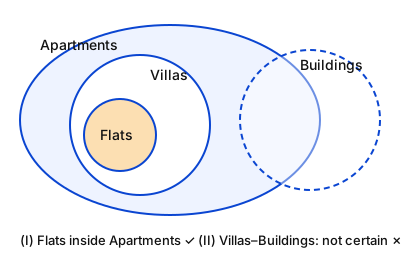
  1. All flats are villas and all villas are apartments ⇒ flats lie inside apartments ⇒ (I) 'All flats are apartments' follows.
  2. 'Some apartments are buildings' – the overlap with buildings may be in the part of apartments outside villas, so 'Some villas are buildings' is not certain ⇒ (II) does not follow.

Trick: Two 'All' statements chain into an 'All'; an 'All' followed by 'Some' gives no definite conclusion.

Answer: (B) Only conclusion (I) follows

अवधारणा: समुच्चय बनाएँ: 'सभी A, B हैं' A को B के अंदर रखता है; 'कुछ' केवल आंशिक ओवरलैप देता है जो भीतरी समुच्चयों को छू भी सकता है और नहीं भी।

  1. सभी flats, villas हैं और सभी villas, apartments हैं ⇒ flats apartments के अंदर ⇒ (I) 'All flats are apartments' निष्कर्ष निकलता है।
  2. 'Some apartments are buildings' – buildings का ओवरलैप apartments के उस भाग में हो सकता है जो villas से बाहर है, अतः 'Some villas are buildings' निश्चित नहीं ⇒ (II) नहीं निकलता।

ट्रिक: दो 'All' कथन मिलकर 'All' देते हैं; 'All' के बाद 'Some' से कोई निश्चित निष्कर्ष नहीं।

उत्तर: (B) Only conclusion (I) follows

RRB NTPC Graduate CBT 1General Intelligence and ReasoningSyllogismRRB NTPC Graduate CBT 1 2025 · 17 Mar Shift 3 →
Q6567.
Below are given two sets of numbers. In each set of numbers, a certain mathematical operation on the first number results in the second number. Similarly, certain
mathematical operations on the second number result in the third number and so on. Which of the given options follows the same set of operations as in question? (NOTE – A two/three-digit number cannot be broken into individual digits for operations, e.g., if 37 is followed by 10, the operation cannot be 3+7 as a two-digit number cannot be broken into individual digits.)
25 – 40 – 65 – 100; 70 – 85 – 110 – 145
नीचे संख्याओं के दो समुच्चय दिए गए हैं। संख्याओं के प्रत्येक समुच्चय में, पहली संख्या पर एक निश्चित गणितीय संक्रिया करने से दूसरी संख्या प्राप्त होती है। इसी प्रकार, दूसरी संख्या पर कुछ
गणितीय संक्रियाएँ करने से तीसरी संख्या प्राप्त होती है, और इसी प्रकार आगे भी। दिए गए विकल्पों में से कौन-सा प्रश्न में दी गई संक्रियाओं के समुच्चय का ही अनुसरण करता है? (नोट – संक्रियाओं के लिए दो/तीन-अंकीय संख्या को अलग-अलग अंकों में नहीं तोड़ा जा सकता, उदाहरण के लिए, यदि 37 के बाद 10 आता है, तो संक्रिया 3+7 नहीं हो सकती क्योंकि दो-अंकीय संख्या को अलग-अलग अंकों में नहीं तोड़ा जा सकता।)
25 – 40 – 65 – 100; 70 – 85 – 110 – 145
  1. A65 – 80 – 105 – 150
  2. B15 – 30 – 65 – 90
  3. C95 – 110 – 130 – 170
  4. D50 – 65 – 90 – 125
Show answer

Concept: Find the operation from term to term in the given chains and apply it to the options.

  1. 25→40→65→100: +15, +25, +35.  70→85→110→145: +15, +25, +35.
  2. Option D: 50→65→90→125: +15, +25, +35 ✓.
  3. Others: A +15,+25,+45; B +15,+35,+25; C +15,+20,+40 – all break the pattern.

Trick: Successive differences themselves growing by 10 (15,25,35) – check all three gaps, not just the first.

Answer: (D) 50 – 65 – 90 – 125

अवधारणा: दी गई श्रृंखलाओं में पद-से-पद संक्रिया निकालें और विकल्पों पर लागू करें।

  1. 25→40→65→100: +15, +25, +35।  70→85→110→145: +15, +25, +35।
  2. विकल्प D: 50→65→90→125: +15, +25, +35 ✓।
  3. अन्य: A +15,+25,+45; B +15,+35,+25; C +15,+20,+40 – सभी पैटर्न तोड़ते हैं।

ट्रिक: क्रमागत अंतर स्वयं 10 से बढ़ रहे हैं (15,25,35) – तीनों अंतर जाँचें, केवल पहला नहीं।

उत्तर: (D) 50 – 65 – 90 – 125

RRB NTPC Graduate CBT 1General Intelligence and ReasoningNumber analogy (chain operations)RRB NTPC Graduate CBT 1 2025 · 17 Mar Shift 3 →
Q6568.
If 1 is added to each odd digit and 2 is subtracted from each even digit in the number 5267341, which of the following digits will be second from the left end in the new number thus formed?
यदि संख्या 5267341 के प्रत्येक विषम अंक में 1 जोड़ा जाए और प्रत्येक सम अंक से 2 घटाया जाए, तो इस प्रकार बनी नई संख्या में निम्नलिखित में से कौन-सा अंक बाएँ छोर से दूसरा होगा?
  1. A2
  2. B0
  3. C6
  4. D4
Show answer

Concept: Apply the rule digit by digit: odd digit +1, even digit −2.

  1. 5267341: 5→6, 2→0, 6→4, 7→8, 3→4, 4→2, 1→2.
  2. New number =6048422.
  3. Second digit from the left =0.

Trick: Write the original digits in a row and the new ones directly below – no mix-ups.

Answer: (B) 0

अवधारणा: नियम अंक-दर-अंक लागू करें: विषम अंक +1, सम अंक −2।

  1. 5267341: 5→6, 2→0, 6→4, 7→8, 3→4, 4→2, 1→2।
  2. नई संख्या =6048422।
  3. बाएँ से दूसरा अंक =0।

ट्रिक: मूल अंक एक पंक्ति में और नए अंक ठीक नीचे लिखें – गड़बड़ नहीं होगी।

उत्तर: (B) 0

RRB NTPC Graduate CBT 1General Intelligence and ReasoningNumber operationsRRB NTPC Graduate CBT 1 2025 · 17 Mar Shift 3 →
Q6569.
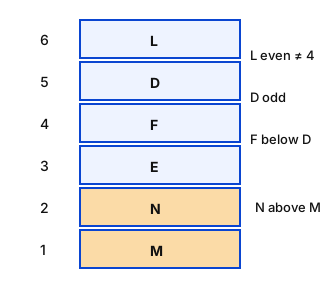
L, M, N, D, E and F live on six different floors of the same building. The lowermost floor in the building is numbered 1, the floor above it is numbered 2 and so on till the topmost floor is numbered 6. L lives on an even numbered floor, but not on floor number 4. Only two people live between L and E. D lives on an odd numbered floor, but not on the lowermost floor. Only two people live between D and N. F lives immediately below D. Who lives immediately above M?
L, M, N, D, E और F एक ही भवन की छह अलग-अलग मंज़िलों पर रहते हैं। भवन की सबसे निचली मंज़िल की संख्या 1 है, उसके ऊपर की मंज़िल की संख्या 2 है और इसी प्रकार सबसे ऊपरी मंज़िल की संख्या 6 है। L एक सम संख्या वाली मंज़िल पर रहता है, परंतु मंज़िल संख्या 4 पर नहीं। L और E के बीच केवल दो व्यक्ति रहते हैं। D एक विषम संख्या वाली मंज़िल पर रहता है, परंतु सबसे निचली मंज़िल पर नहीं। D और N के बीच केवल दो व्यक्ति रहते हैं। F, D के ठीक नीचे रहता है। M के ठीक ऊपर कौन रहता है?
  1. AE
  2. BF
  3. CD
  4. DN
Show answer

Concept: Fix the most restricted person first, then test the remaining cases.

  1. D is on an odd floor but not 1 ⇒ D = 3 or 5; F is immediately below D ⇒ F = 2 or 4.
  2. Two people between D and N: D=3 ⇒ N=6; D=5 ⇒ N=2. L is even but not 4 ⇒ L = 2 or 6.
  3. If D=3, N=6, F=2 then L has no floor left ✗. So D=5, F=4, N=2, L=6.
  4. Two between L(6) and E ⇒ E=3; M takes floor 1. Immediately above M(1) is N(2).

Trick: Count 'two people between' as a gap of 3 floors (positions differ by 3).

Answer: (D) N

अवधारणा: सबसे अधिक प्रतिबंधित व्यक्ति पहले तय करें, फिर बचे हुए केस जाँचें।

  1. D विषम मंज़िल पर, पर 1 नहीं ⇒ D = 3 या 5; F ठीक नीचे ⇒ F = 2 या 4।
  2. D और N के बीच दो लोग: D=3 ⇒ N=6; D=5 ⇒ N=2। L सम पर, पर 4 नहीं ⇒ L = 2 या 6।
  3. यदि D=3, N=6, F=2 तो L के लिए कोई मंज़िल नहीं बचती ✗। अतः D=5, F=4, N=2, L=6।
  4. L(6) और E के बीच दो ⇒ E=3; M को मंज़िल 1। M(1) के ठीक ऊपर N(2)।

ट्रिक: 'बीच में दो लोग' = मंज़िल संख्याओं का अंतर 3।

उत्तर: (D) N

RRB NTPC Graduate CBT 1General Intelligence and ReasoningFloor puzzleRRB NTPC Graduate CBT 1 2025 · 17 Mar Shift 3 →
Q6570.
In this question, a question is followed by two statements numbered (I) and (II). You have to decide whether the data provided in the statements are sufficient to answer the question. Read both the statements and decide the appropriate answer.
Question:
Among 5 trees, L, M, N, T and V each having a different height, which tree is the shortest?
Statements:
(I) N is taller than L.
(II) V is taller than N. M is only shorter than one tree.
इस प्रश्न में, एक प्रश्न के बाद (I) और (II) क्रमांकित दो कथन दिए गए हैं। आपको यह निर्णय लेना है कि कथनों में दिए गए डेटा प्रश्न का उत्तर देने के लिए पर्याप्त हैं या नहीं। दोनों कथनों को पढ़िए और उचित उत्तर का निर्णय लीजिए।
प्रश्न:
5 पेड़ों L, M, N, T और V में से, जिनमें से प्रत्येक की ऊँचाई अलग-अलग है, कौन-सा पेड़ सबसे छोटा है?
कथन:
(I) N, L से ऊँचा है।
(II) V, N से ऊँचा है। M केवल एक पेड़ से छोटा है।
  1. AData in Statement I alone is sufficient to answer the question while data in statement II is notकथन I के डेटा अकेले प्रश्न का उत्तर देने के लिए पर्याप्त हैं, जबकि कथन II के डेटा पर्याप्त नहीं हैं
  2. BData in Statement II alone is sufficient to answer the question while data in statement I is notकथन II के डेटा अकेले प्रश्न का उत्तर देने के लिए पर्याप्त हैं, जबकि कथन I के डेटा पर्याप्त नहीं हैं
  3. CBoth statements I and II together (and not statement 1 alone or statement II alone) are sufficient to answer the questionकथन I और II दोनों मिलकर (न कि कथन I अकेले या कथन II अकेले) प्रश्न का उत्तर देने के लिए पर्याप्त हैं
  4. DBoth statements I and II together are NOT sufficient to answer the questionकथन I और II दोनों मिलकर भी प्रश्न का उत्तर देने के लिए पर्याप्त नहीं हैं
Show answer

Concept: A statement is sufficient only if it fixes a unique answer; test each alone, then both together.

  1. (I) alone: N > L – nothing about M, T, V ⇒ insufficient.
  2. (II) alone: V > N and M is 2nd tallest – L and T unknown ⇒ insufficient.
  3. Together: V > N > L, M is 2nd. Two orders remain: T > M > V > N > L (shortest L) or V > M > … with T and L at the bottom in either order (shortest T or L).
  4. The shortest cannot be fixed ⇒ even together not sufficient.

Trick: If you can build two valid arrangements with different answers, the data is insufficient – stop there.

Answer: (D) Both statements I and II together are NOT sufficient to answer the question

अवधारणा: कोई कथन तभी पर्याप्त है जब वह एक अद्वितीय उत्तर तय करे; पहले अकेले, फिर दोनों साथ जाँचें।

  1. (I) अकेले: N > L – M, T, V के बारे में कुछ नहीं ⇒ अपर्याप्त।
  2. (II) अकेले: V > N और M दूसरा सबसे लंबा – L और T अज्ञात ⇒ अपर्याप्त।
  3. दोनों साथ: V > N > L, M दूसरा। दो क्रम संभव: T > M > V > N > L (सबसे छोटा L) या V > M > … जिसमें T और L नीचे किसी भी क्रम में (सबसे छोटा T या L)।
  4. सबसे छोटा तय नहीं हो सकता ⇒ साथ में भी अपर्याप्त।

ट्रिक: यदि अलग-अलग उत्तर वाली दो वैध व्यवस्थाएँ बन जाएँ, तो डेटा अपर्याप्त है – वहीं रुकें।

उत्तर: (D) Both statements I and II together are NOT sufficient to answer the question

RRB NTPC Graduate CBT 1General Intelligence and ReasoningData sufficiency – orderingRRB NTPC Graduate CBT 1 2025 · 17 Mar Shift 3 →
Q6571.
Which of the following letter-number clusters will replace the question mark “?” in the given series to make it logically complete?
BWJ 12, YUI 17, VSH 22, SQG 27, ?
दी गई श्रेणी को तार्किक रूप से पूर्ण करने के लिए निम्नलिखित में से कौन-सा अक्षर-संख्या समूह प्रश्नचिह्न “?” के स्थान पर आएगा?
BWJ 12, YUI 17, VSH 22, SQG 27, ?
  1. APOF 32
  2. BROD 32
  3. CQOE 33
  4. DPND 32
Show answer

Concept: Track each position of the cluster and the number separately.

  1. 1st letters B, Y, V, S: −3 each ⇒ next P.
  2. 2nd letters W, U, S, Q: −2 each ⇒ next O.
  3. 3rd letters J, I, H, G: −1 each ⇒ next F.
  4. Numbers 12, 17, 22, 27: +5 ⇒ 32. Answer POF 32.

Trick: Shifts −3,−2,−1 – the number pattern (+5) alone already removes option C.

Answer: (A) POF 32

अवधारणा: समूह की हर स्थिति और संख्या को अलग-अलग ट्रैक करें।

  1. पहले अक्षर B, Y, V, S: हर बार −3 ⇒ अगला P।
  2. दूसरे अक्षर W, U, S, Q: −2 ⇒ अगला O।
  3. तीसरे अक्षर J, I, H, G: −1 ⇒ अगला F।
  4. संख्याएँ 12, 17, 22, 27: +5 ⇒ 32। उत्तर POF 32।

ट्रिक: शिफ्ट −3,−2,−1 – संख्या पैटर्न (+5) अकेले ही विकल्प C हटा देता है।

उत्तर: (A) POF 32

RRB NTPC Graduate CBT 1General Intelligence and ReasoningLetter-number seriesRRB NTPC Graduate CBT 1 2025 · 17 Mar Shift 3 →
Q6572.
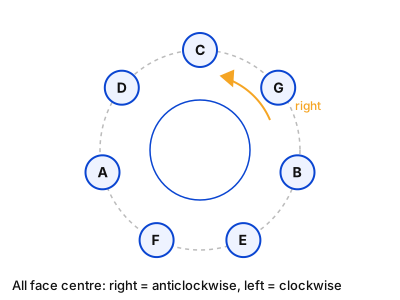
A, B, C, D, E, F and G are sitting around a circular table facing the centre, but not necessarily in the same order. Only two people sit between B and D when counted from the right of B. Only three people sit between E and C when counted from the right of C. D sits to the immediate right of C. F sits to the immediate right of A.
Match each of the persons in Column I to their neighbour to the immediate left in Column II and select the correct answer from the given options.
Column I (Boy)Column II (Neighbour to his immediate left )
i. G(W) G
ii. E(X) D
iii. A(Y) F
iv. C(Z) B
A, B, C, D, E, F और G एक वृत्ताकार मेज़ के चारों ओर केंद्र की ओर मुख करके बैठे हैं, परंतु आवश्यक नहीं कि इसी क्रम में हों। B के दाएँ से गिनने पर B और D के बीच केवल दो व्यक्ति बैठे हैं। C के दाएँ से गिनने पर E और C के बीच केवल तीन व्यक्ति बैठे हैं। D, C के ठीक दाएँ बैठा है। F, A के ठीक दाएँ बैठा है।
कॉलम I के प्रत्येक व्यक्ति को कॉलम II में उसके ठीक बाएँ बैठे पड़ोसी से सुमेलित कीजिए और दिए गए विकल्पों में से सही उत्तर का चयन कीजिए।
कॉलम I (लड़का)कॉलम II (उसके ठीक बाएँ का पड़ोसी)
i. G(W) G
ii. E(X) D
iii. A(Y) F
iv. C(Z) B
  1. Ai-Z, ii-Y, iii-X, iv-W
  2. Bi-X, ii-W, iii-Z, iv-Y
  3. Ci-Y, ii-W, iii-Z, iv-X
  4. Di-W, ii-Y, iii-Z, iv-X
Show answer

Concept: Facing the centre, 'right' means anticlockwise and 'left' means clockwise. Start with the direct clue.

  1. D is immediately right of C. Counting from the right of B, two people then D ⇒ B is 3 places to the left of D (going right: B, _, _, D).
  2. Three people between E and C counted from the right of C ⇒ going right from C: C, D, _, _, E. So the two gaps after D are filled before E.
  3. F is immediately right of A ⇒ A and F take those two seats: C, D, A, F, E, B, G (G gets the last seat).
  4. Immediate left (clockwise neighbour): G→B (Z), E→F (Y), A→D (X), C→G (W).

Trick: Place the fixed pair (C–D) first, then fit the 'gap' clues around it.

Answer: (A) i-Z, ii-Y, iii-X, iv-W

अवधारणा: केंद्र की ओर मुख होने पर 'दाएँ' = वामावर्त (anticlockwise) और 'बाएँ' = दक्षिणावर्त। सीधे सुराग से शुरू करें।

  1. D, C के ठीक दाएँ। B के दाएँ से गिनने पर दो लोग फिर D ⇒ दाएँ चलते हुए B, _, _, D।
  2. C के दाएँ से गिनने पर E और C के बीच तीन लोग ⇒ C से दाएँ: C, D, _, _, E। अतः D के बाद की दो सीटें E से पहले भरेंगी।
  3. F, A के ठीक दाएँ ⇒ A और F वही दो सीटें लेते हैं: C, D, A, F, E, B, G (अंतिम सीट G को)।
  4. ठीक बाएँ (दक्षिणावर्त पड़ोसी): G→B (Z), E→F (Y), A→D (X), C→G (W)।

ट्रिक: पहले निश्चित जोड़ी (C–D) रखें, फिर 'बीच में इतने लोग' वाले सुराग उसके चारों ओर बिठाएँ।

उत्तर: (A) i-Z, ii-Y, iii-X, iv-W

RRB NTPC Graduate CBT 1General Intelligence and ReasoningCircular seatingRRB NTPC Graduate CBT 1 2025 · 17 Mar Shift 3 →
Q6573.
Read the given statements and conclusions carefully. Assuming that the information given in the statements is true, even if it appears to be at variance with commonly known facts, decide which of the given conclusion(s) logically follow(s) from the statements.
Statements:
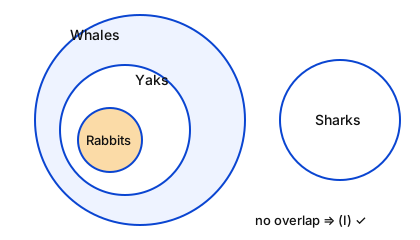
All rabbits are yaks. All yaks are whales. No whale is a shark.
Conclusions:
(I) No rabbit is a shark.
(II) Some whales are rabbits.
दिए गए कथनों और निष्कर्षों को ध्यानपूर्वक पढ़िए। यह मानते हुए कि कथनों में दी गई जानकारी सत्य है, भले ही वह सामान्यतः ज्ञात तथ्यों से भिन्न प्रतीत होती हो, निर्णय लीजिए कि दिए गए निष्कर्षों में से कौन-सा/कौन-से कथनों का तार्किक रूप से अनुसरण करता है/करते हैं।
कथन:
सभी खरगोश याक हैं। सभी याक व्हेल हैं। कोई व्हेल शार्क नहीं है।
निष्कर्ष:
(I) कोई खरगोश शार्क नहीं है।
(II) कुछ व्हेल खरगोश हैं।
  1. AOnly conclusion (II) follows.केवल निष्कर्ष (II) अनुसरण करता है।
  2. BBoth conclusions (I) and (II) follow.निष्कर्ष (I) और (II) दोनों अनुसरण करते हैं।
  3. CNeither conclusion (I) nor (II) follows.न तो निष्कर्ष (I) और न ही (II) अनुसरण करता है।
  4. DOnly conclusion (I) follows.केवल निष्कर्ष (I) अनुसरण करता है।
Show answer

Concept: Chain the 'All' statements into nested sets; a 'No' statement makes the sets completely separate.

  1. All rabbits are yaks, all yaks are whales ⇒ rabbits sit inside whales. No whale is a shark ⇒ rabbits can't be sharks ⇒ (I) follows.
  2. Since every rabbit is a whale, at least those whales are rabbits ⇒ 'Some whales are rabbits' (II) follows (conversion of 'All A are B' to 'Some B are A').

Trick: 'All A are B' always gives 'Some B are A'; 'All A are B + No B is C' always gives 'No A is C'.

Answer: (B) Both conclusions (I) and (II) follow.

अवधारणा: 'All' कथनों को एक के अंदर एक समुच्चय बनाएँ; 'No' कथन समुच्चयों को पूरी तरह अलग कर देता है।

  1. सभी rabbits, yaks हैं; सभी yaks, whales हैं ⇒ rabbits, whales के अंदर। कोई whale, shark नहीं ⇒ rabbit, shark नहीं हो सकता ⇒ (I) निकलता है।
  2. हर rabbit एक whale है, अतः कम से कम वे whales, rabbits हैं ⇒ 'Some whales are rabbits' (II) भी निकलता है ('All A are B' का रूपांतरण 'Some B are A')।

ट्रिक: 'All A are B' से हमेशा 'Some B are A'; 'All A are B + No B is C' से हमेशा 'No A is C'।

उत्तर: (B) Both conclusions (I) and (II) follow.

RRB NTPC Graduate CBT 1General Intelligence and ReasoningSyllogismRRB NTPC Graduate CBT 1 2025 · 17 Mar Shift 3 →
Q6574.
Based on the English alphabetical order, three of the following four are alike in a certain way and thus form a group. Which is the one
that does not belong to that group?
(Note: The odd one out is not based on the number of consonants/vowels or their position in the letter cluster.)
अंग्रेज़ी वर्णमाला क्रम के आधार पर, निम्नलिखित चार में से तीन एक निश्चित प्रकार से समान हैं और इस प्रकार एक समूह बनाते हैं। वह कौन-सा है
जो उस समूह से संबंधित नहीं है?
(नोट: विषम अक्षर-समूह व्यंजनों/स्वरों की संख्या या अक्षर-समूह में उनकी स्थिति पर आधारित नहीं है।)
  1. AKFN
  2. BWUZ
  3. CMKP
  4. DECH
Show answer

Concept: Convert letters to positions and compare the gaps inside each cluster.

  1. WUZ: 23, 21, 26 ⇒ −2, +5. MKP: 13, 11, 16 ⇒ −2, +5. ECH: 5, 3, 8 ⇒ −2, +5.
  2. KFN: 11, 6, 14 ⇒ −5, +8 – different pattern, so KFN is the odd one.

Trick: Compute gaps for all four; three identical gap-pairs will show the rule, the fourth is the answer.

Answer: (A) KFN

अवधारणा: अक्षरों को स्थान-संख्या में बदलें और हर समूह के अंतर तुलना करें।

  1. WUZ: 23, 21, 26 ⇒ −2, +5। MKP: 13, 11, 16 ⇒ −2, +5। ECH: 5, 3, 8 ⇒ −2, +5।
  2. KFN: 11, 6, 14 ⇒ −5, +8 – अलग पैटर्न, अतः KFN विषम है।

ट्रिक: चारों के अंतर निकालें; तीन समान अंतर-युग्म नियम दिखा देंगे, चौथा उत्तर है।

उत्तर: (A) KFN

RRB NTPC Graduate CBT 1General Intelligence and ReasoningLetter classificationRRB NTPC Graduate CBT 1 2025 · 17 Mar Shift 3 →
Q6575.
Select the set in which the numbers are related in the same way as are the numbers of the following sets.
(NOTE: Operations should be performed on the whole numbers, without breaking down the numbers into its constituent digits. E.g. 13 – Operations on 13 such as
adding/subtracting/multiplying etc. to 13 can be performed. Breaking down 13 into 1 and 3 and then performing mathematical operations on 1 and 3 is not allowed.) (8, 128, 2)
(9, 243, 3)
उस समुच्चय का चयन कीजिए जिसमें संख्याएँ उसी प्रकार संबंधित हैं जिस प्रकार निम्नलिखित समुच्चयों की संख्याएँ संबंधित हैं।
(नोट: संक्रियाएँ पूर्ण संख्याओं पर की जानी चाहिए, संख्याओं को उनके घटक अंकों में तोड़े बिना। उदाहरण के लिए 13 – 13 पर संक्रियाएँ जैसे 13 में
जोड़ना/घटाना/गुणा करना आदि की जा सकती हैं। 13 को 1 और 3 में तोड़कर फिर 1 और 3 पर गणितीय संक्रियाएँ करने की अनुमति नहीं है।) (8, 128, 2)
(9, 243, 3)
  1. A(7, 343, 7)
  2. B(10, 500, 4)
  3. C(6, 216, 3)
  4. D(11, 331, 5)
Show answer

Concept: Find one rule linking the three numbers of each given set and test it on the options.

  1. (8, 128, 2): 82×2=64×2=128 ✓. (9, 243, 3): 92×3=81×3=243 ✓. Rule: 1st2×3rd=2nd.
  2. (7, 343, 7): 72×7=343 ✓.
  3. Others: 102×4=400≠500; 62×3=108≠216; 112×5=605≠331.

Trick: When the middle number is largest, try a2×c or a×c2 first.

Answer: (A) (7, 343, 7)

अवधारणा: हर दिए गए समुच्चय की तीनों संख्याओं को जोड़ने वाला एक नियम खोजें और विकल्पों पर जाँचें।

  1. (8, 128, 2): 82×2=64×2=128 ✓। (9, 243, 3): 92×3=81×3=243 ✓। नियम: पहली2×तीसरी=दूसरी।
  2. (7, 343, 7): 72×7=343 ✓।
  3. अन्य: 102×4=400≠500; 62×3=108≠216; 112×5=605≠331।

ट्रिक: जब बीच की संख्या सबसे बड़ी हो, पहले a2×c या a×c2 आज़माएँ।

उत्तर: (A) (7, 343, 7)

RRB NTPC Graduate CBT 1General Intelligence and ReasoningNumber set relationRRB NTPC Graduate CBT 1 2025 · 17 Mar Shift 3 →
Q6576.
Which of the given letter-number clusters will replace the question mark (?) in the following series to make it logically complete?
DRJ 50 WKC 45 PDV 40 IWO 35 ?
निम्नलिखित श्रेणी को तार्किक रूप से पूर्ण करने के लिए दिए गए अक्षर-संख्या समूहों में से कौन-सा प्रश्नचिह्न (?) के स्थान पर आएगा?
DRJ 50 WKC 45 PDV 40 IWO 35 ?
  1. ALEF 30
  2. BCJE 35
  3. CBPH 30
  4. DAJD 32
Show answer

Concept: Check each letter position for a constant shift (wrapping from A back to Z) and the numbers separately.

  1. 1st letters D(4), W(23), P(16), I(9): −7 each ⇒ I−7 = B(2).
  2. 2nd letters R(18), K(11), D(4), W(23): −7 ⇒ W−7 = P(16).
  3. 3rd letters J(10), C(3), V(22), O(15): −7 ⇒ O−7 = H(8).
  4. Numbers 50, 45, 40, 35: −5 ⇒ 30. Answer BPH 30.

Trick: Numbers give 30 instantly – only options A and C remain; then check just the first letter (I−7 = B).

Answer: (C) BPH 30

अवधारणा: हर अक्षर-स्थिति में स्थिर शिफ्ट (A से पीछे Z पर घूमते हुए) और संख्याएँ अलग से जाँचें।

  1. पहले अक्षर D(4), W(23), P(16), I(9): हर बार −7 ⇒ I−7 = B(2)।
  2. दूसरे अक्षर R(18), K(11), D(4), W(23): −7 ⇒ W−7 = P(16)।
  3. तीसरे अक्षर J(10), C(3), V(22), O(15): −7 ⇒ O−7 = H(8)।
  4. संख्याएँ 50, 45, 40, 35: −5 ⇒ 30। उत्तर BPH 30।

ट्रिक: संख्याओं से तुरंत 30 – केवल A और C बचते हैं; फिर सिर्फ पहला अक्षर जाँचें (I−7 = B)।

उत्तर: (C) BPH 30

RRB NTPC Graduate CBT 1General Intelligence and ReasoningLetter-number seriesRRB NTPC Graduate CBT 1 2025 · 17 Mar Shift 3 →
Q6577.
In a certain code language,
X + Y means ‘X is the husband of Y’,
X – Y means ‘X is the mother of Y’,
X × Y means ‘X is the brother of Y’ and
X ÷ Y means ‘X is the father of Y’.
Based on the above information, how is P related to T if ‘P + Q – R × S ÷ T’?
एक निश्चित कूट भाषा में,
X + Y का अर्थ है ‘X, Y का पति है’,
X – Y का अर्थ है ‘X, Y की माता है’,
X × Y का अर्थ है ‘X, Y का भाई है’ और
X ÷ Y का अर्थ है ‘X, Y का पिता है’।
उपर्युक्त जानकारी के आधार पर, यदि ‘P + Q – R × S ÷ T’ है, तो P, T से किस प्रकार संबंधित है?
  1. AFather's brotherपिता का भाई
  2. BFather's fatherपिता का पिता
  3. CMother's brotherमाता का भाई
  4. DMother's fatherमाता का पिता
Show answer

Concept: Decode the symbols one by one and build the family tree.

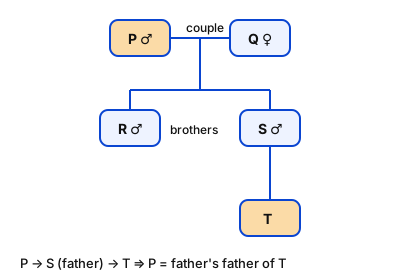
  1. P + Q: P is husband of Q. Q – R: Q is mother of R ⇒ P is father of R.
  2. R × S: R is brother of S ⇒ S is also P's child (P is father of S).
  3. S ÷ T: S is father of T.
  4. So P is the father of T's father ⇒ father's father (paternal grandfather).

Trick: Husband of the mother = father; father of the father = father's father.

Answer: (B) Father's father

अवधारणा: प्रतीकों को एक-एक करके डिकोड करें और वंश-वृक्ष बनाएँ।

  1. P + Q: P, Q का पति। Q – R: Q, R की माता ⇒ P, R का पिता।
  2. R × S: R, S का भाई ⇒ S भी P की संतान (P, S का पिता)।
  3. S ÷ T: S, T का पिता।
  4. अतः P, T के पिता का पिता ⇒ Father's father (दादा)।

ट्रिक: माता का पति = पिता; पिता का पिता = दादा।

उत्तर: (B) Father's father

RRB NTPC Graduate CBT 1General Intelligence and ReasoningBlood relations – codedRRB NTPC Graduate CBT 1 2025 · 17 Mar Shift 3 →
Q6578.
Wheat is mainly a crop of which season in India?
भारत में गेहूँ मुख्य रूप से किस ऋतु की फसल है?
  1. AZaidज़ायद
  2. BKharifखरीफ
  3. CRabiरबी
  4. DPre-monsoonमानसून-पूर्व
Show answer

Concept: India has three cropping seasons – Kharif (monsoon), Rabi (winter) and Zaid (summer).

  1. Wheat is sown in October–December and harvested in March–April, so it is the chief Rabi crop.
  2. Rice, maize, cotton and jute are Kharif crops; watermelon and cucumber are Zaid crops.
  3. Punjab, Haryana, UP and MP are the main wheat producers.

Yaad rakhein: Rabi = winter sowing (wheat, gram, mustard, barley); Kharif = rain sowing (rice, cotton, jute).

Answer: (C) Rabi

अवधारणा: भारत में तीन फसल ऋतुएँ हैं – खरीफ (मानसून), रबी (शीत) और ज़ायद (ग्रीष्म)।

  1. गेहूँ अक्टूबर–दिसंबर में बोया और मार्च–अप्रैल में काटा जाता है, इसलिए यह प्रमुख रबी फसल है।
  2. चावल, मक्का, कपास, जूट खरीफ फसलें हैं; तरबूज, खीरा ज़ायद फसलें हैं।
  3. पंजाब, हरियाणा, UP और MP मुख्य गेहूँ उत्पादक हैं।

याद रखें: रबी = सर्दी की बुवाई (गेहूँ, चना, सरसों, जौ); खरीफ = बारिश की बुवाई (चावल, कपास, जूट)।

उत्तर: (C) रबी

RRB NTPC Graduate CBT 1General AwarenessIndian Agriculture – Cropping SeasonsRRB NTPC Graduate CBT 1 2025 · 17 Mar Shift 2 →
Q6579.
Raising an object from the ground results in the storage of which type of energy?
किसी वस्तु को ज़मीन से ऊपर उठाने पर किस प्रकार की ऊर्जा संचित होती है?
  1. AElectrical energyविद्युत ऊर्जा
  2. BHeat energyऊष्मा ऊर्जा
  3. CPotential energyस्थितिज ऊर्जा
  4. DKinetic energyगतिज ऊर्जा
Show answer

Concept: Energy stored in a body because of its position or height is gravitational potential energy, PE=mgh.

  1. Lifting an object does work against gravity; this work is stored as potential energy.
  2. Kinetic energy (12mv2) belongs to a moving body, not a raised body at rest.

Yaad rakhein: Height → Potential; Motion → Kinetic.

Answer: (C) Potential energy

अवधारणा: स्थिति या ऊँचाई के कारण वस्तु में संचित ऊर्जा गुरुत्वीय स्थितिज ऊर्जा (potential energy) है, PE=mgh।

  1. वस्तु उठाने में गुरुत्व के विरुद्ध कार्य होता है; यही कार्य स्थितिज ऊर्जा के रूप में संचित रहता है।
  2. गतिज ऊर्जा (12mv2) गतिशील वस्तु की होती है, स्थिर उठी हुई वस्तु की नहीं।

याद रखें: ऊँचाई → स्थितिज; गति → गतिज।

उत्तर: (C) स्थितिज ऊर्जा

RRB NTPC Graduate CBT 1General AwarenessPhysics – Forms of EnergyRRB NTPC Graduate CBT 1 2025 · 17 Mar Shift 2 →
Q6580.
Which cell organelle is responsible for maintaining cell shape and providing structural support?
कौन-सा कोशिकांग कोशिका के आकार को बनाए रखने और संरचनात्मक सहारा देने के लिए उत्तरदायी है?
  1. APeroxisomeपरॉक्सिसोम (Peroxisome)
  2. BCytoskeletonकोशिका कंकाल (Cytoskeleton)
  3. CNucleusकेंद्रक (Nucleus)
  4. DGolgi apparatusगॉल्जी उपकरण (Golgi apparatus)
Show answer

Concept: The cytoskeleton is a network of protein filaments (microtubules, microfilaments, intermediate filaments) in the cytoplasm.

  1. It maintains cell shape, gives mechanical support and helps in cell movement and transport of organelles.
  2. Nucleus controls the cell, Golgi packages proteins, peroxisomes break down fatty acids and H2O2.

Yaad rakhein: Cyto-skeleton = "skeleton of the cell" → shape and support.

Answer: (B) Cytoskeleton

अवधारणा: साइटोस्केलेटन (cytoskeleton) कोशिकाद्रव्य में प्रोटीन तंतुओं (microtubules, microfilaments, intermediate filaments) का जाल है।

  1. यह कोशिका का आकार बनाए रखता है, यांत्रिक सहारा देता है और कोशिका की गति व कोशिकांगों के परिवहन में मदद करता है।
  2. केंद्रक कोशिका को नियंत्रित करता है, Golgi प्रोटीन पैक करता है, peroxisome वसा अम्ल व H2O2 तोड़ता है।

याद रखें: साइटो-स्केलेटन = "कोशिका का कंकाल" → आकार और सहारा।

उत्तर: (B) साइटोस्केलेटन

RRB NTPC Graduate CBT 1General AwarenessBiology – Cell OrganellesRRB NTPC Graduate CBT 1 2025 · 17 Mar Shift 2 →