Question bank

Q&A: practice questions with answers

Search questions on any topic. Filter by exam category, exam, subject and topic, try the question, then open the answer and explanation.

Courses – airGurukul

7,077 questions found.

Q6621.
What is the maximum value that must be assigned to A so that the 8-digit number 718A5104 is divisible by 4?
A को अधिकतम कौन-सा मान दिया जाना चाहिए ताकि 8 अंकों की संख्या 718A5104, 4 से विभाज्य हो?
  1. A4
  2. B6
  3. C9
  4. D5
Show answer

Concept: A number is divisible by 4 if the number formed by its last two digits is divisible by 4.

  1. Last two digits of 718A5104 are 04, and 04÷4=1 – divisible for every value of A.
  2. A can be any digit 0–9; the maximum value is 9.

Trick: Divisibility by 4 depends only on the last two digits, by 8 on the last three — a digit far from the end never matters.

Answer: (C) 9

अवधारणा: कोई संख्या 4 से विभाज्य है यदि उसके अंतिम दो अंकों से बनी संख्या 4 से विभाज्य हो।

  1. 718A5104 के अंतिम दो अंक 04 हैं और 04÷4=1 – A के हर मान पर विभाज्य।
  2. A कोई भी अंक 0–9 हो सकता है; अधिकतम मान 9।

ट्रिक: 4 की विभाज्यता केवल अंतिम दो अंकों पर, 8 की अंतिम तीन पर निर्भर है — अंत से दूर का अंक कभी मायने नहीं रखता।

उत्तर: (C) 9
RRB NTPC Graduate CBT 1MathematicsDivisibility RulesRRB NTPC Graduate CBT 1 2025 · 17 Mar Shift 2 →
Q6622.
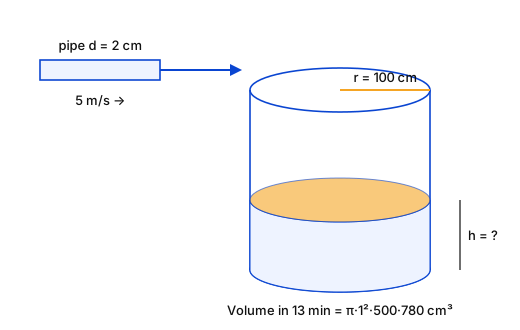
Water flows out through a circular pipe, whose internal diameter is 2 cm, at the rate of 5 metres per second into a cylindrical tank, the radius of whose base is 100 cm. By how much will the level of water rise in 13 minutes?
एक वृत्ताकार पाइप, जिसका आंतरिक व्यास 2 cm है, से पानी 5 मीटर प्रति सेकंड की दर से एक बेलनाकार टंकी में बहता है, जिसके आधार की त्रिज्या 100 cm है। 13 मिनट में पानी का स्तर कितना बढ़ जाएगा?
  1. A30 cm
  2. B31 cm
  3. C40 cm
  4. D39 cm
Show answer

Concept: Volume delivered by a pipe = (area of cross-section) × (speed) × (time); this equals the volume of the rise in the tank.

  1. Pipe radius =1cm, speed =500cm/s, time =13×60=780s.
  2. Volume =π×12×500×780=390000πcm3.
  3. Tank: π×1002×h=390000π⇒h=39cm.

Trick: h=rpipe2×speed×timeRtank2 – the π always cancels, so never multiply it out.

Answer: (D) 39 cm

अवधारणा: पाइप से आया आयतन = (अनुप्रस्थ काट का क्षेत्रफल) × (चाल) × (समय); यही टंकी में जल-स्तर की वृद्धि का आयतन है।

  1. पाइप की त्रिज्या =1cm, चाल =500cm/s, समय =13×60=780s।
  2. आयतन =π×12×500×780=390000πcm3।
  3. टंकी: π×1002×h=390000π⇒h=39cm।

ट्रिक: h=rpipe2×चाल×समयRtank2 – π हमेशा कट जाता है, उसे कभी गुणा न करें।

उत्तर: (D) 39 cm

RRB NTPC Graduate CBT 1MathematicsMensuration – Pipe and CylinderRRB NTPC Graduate CBT 1 2025 · 17 Mar Shift 2 →
Q6623.
If sinA=37, and A is an acute angle, then find the value of 23secAcosecA.
यदि sinA=37, और A एक न्यून कोण है, तो 23secAcosecA का मान ज्ञात कीजिए।
  1. A14345
  2. B14463
  3. C734
  4. D4966
Show answer

Concept: secA·cosecA=1sinAcosA; find cosA from sinA using a right triangle.

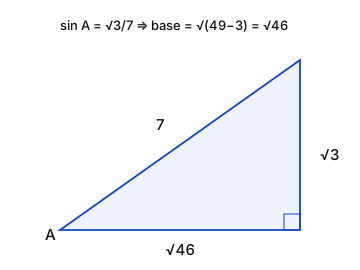
  1. sinA=37 → perpendicular 3, hypotenuse 7, base =49−3=46, so cosA=467.
  2. secA·cosecA=493×46=49138.
  3. 23×49138=496=4966.

Trick: 138=23×6 – spot the factor 23 to cancel instantly.

Answer: (D) 4966

अवधारणा: secA·cosecA=1sinAcosA; समकोण त्रिभुज से sinA द्वारा cosA निकालें।

  1. sinA=37 → लम्ब 3, कर्ण 7, आधार =49−3=46, अतः cosA=467।
  2. secA·cosecA=493×46=49138।
  3. 23×49138=496=4966।

ट्रिक: 138=23×6 – 23 का गुणनखंड पहचानते ही तुरंत कट जाता है।

उत्तर: (D) 4966

RRB NTPC Graduate CBT 1MathematicsTrigonometric RatiosRRB NTPC Graduate CBT 1 2025 · 17 Mar Shift 2 →
Q6624.
In an election between two candidates, a candidate got 38% of the total votes and lost the election by 28,800 votes. What is the total number of voters?
दो उम्मीदवारों के बीच हुए एक चुनाव में, एक उम्मीदवार को कुल मतों के 38% मत मिले और वह 28,800 मतों से चुनाव हार गया। मतदाताओं की कुल संख्या क्या है?
  1. A1,22,800
  2. B1,22,000
  3. C1,20,000
  4. D1,24,000
Show answer

Concept: With two candidates, the loser's margin = difference of their vote percentages.

  1. Loser 38%, winner 100−38=62%; margin =62−38=24%.
  2. 24% of total =28800⇒ total =2880024×100=1,20,000.

Trick: Margin % =100−2×(loser%); here 100−76=24%.

Answer: (C) 1,20,000

अवधारणा: दो उम्मीदवारों में हार का अंतर = उनके मत-प्रतिशतों का अंतर।

  1. हारने वाला 38%, जीतने वाला 100−38=62%; अंतर =62−38=24%।
  2. कुल का 24%=28800⇒ कुल =2880024×100=1,20,000।

ट्रिक: अंतर % =100−2×(हारने वाले का%); यहाँ 100−76=24%।

उत्तर: (C) 1,20,000

RRB NTPC Graduate CBT 1MathematicsPercentage – ElectionsRRB NTPC Graduate CBT 1 2025 · 17 Mar Shift 2 →
Q6625.
A shopkeeper purchased 42 dozens of articles at the rate of ₹630 per dozen. He sold each one of them at the rate of ₹63. What percentage profit did he make?
एक दुकानदार ने ₹630 प्रति दर्जन की दर से 42 दर्जन वस्तुएँ खरीदीं। उसने उनमें से प्रत्येक को ₹63 की दर से बेच दिया। उसे कितने प्रतिशत लाभ हुआ?
  1. A21%
  2. B23%
  3. C20%
  4. D17%
Show answer

Concept: Profit% =SP−CPCP×100 – compare per article.

  1. CP per article =63012=52.5 rupees; SP =63 rupees.
  2. Profit =63−52.5=10.5; Profit% =10.552.5×100=20%.

Trick: SP of a dozen =63×12=756 vs CP 630 → 126630=15=20%; the 42 dozens are irrelevant.

Answer: (C) 20%

अवधारणा: लाभ% =SP−CPCP×100 – प्रति वस्तु तुलना करें।

  1. प्रति वस्तु CP =63012=52.5 रुपये; SP =63 रुपये।
  2. लाभ =63−52.5=10.5; लाभ% =10.552.5×100=20%।

ट्रिक: एक दर्जन का SP =63×12=756 बनाम CP 630 → 126630=15=20%; 42 दर्जन का आँकड़ा बेकार है।

उत्तर: (C) 20%

RRB NTPC Graduate CBT 1MathematicsProfit and LossRRB NTPC Graduate CBT 1 2025 · 17 Mar Shift 2 →
Q6626.
Raghav earns a monthly salary of ₹24,000. He spends ₹7,500 on house rent and ₹3,500 on food and utility bills every month. The remaining amount is his monthly savings. In the month of his birthday, he spends his entire monthly saving on celebrations. Find Raghav’s total savings in a year (in ₹).
राघव का मासिक वेतन ₹24,000 है। वह प्रति माह मकान के किराए पर ₹7,500 और भोजन तथा उपयोगिता बिलों पर ₹3,500 खर्च करता है। शेष राशि उसकी मासिक बचत है। अपने जन्मदिन के महीने में वह अपनी पूरी मासिक बचत उत्सव पर खर्च कर देता है। एक वर्ष में राघव की कुल बचत (₹ में) ज्ञात कीजिए।
  1. A1,45,000
  2. B1,36,000
  3. C1,43,000
  4. D1,38,000
Show answer

Concept: Monthly saving = salary − expenses; yearly saving counts only the months in which he actually saves.

  1. Monthly saving =24000−(7500+3500)=13000 rupees.
  2. Birthday month saving = 0, so savings happen in 11 months.
  3. Yearly saving =13000×11=1,43,000 rupees.

Trick: 13000×12=1,56,000 is not an option – that confirms the birthday month must be dropped.

Answer: (C) 1,43,000

अवधारणा: मासिक बचत = वेतन − खर्च; वार्षिक बचत में केवल वे महीने गिनें जिनमें वास्तव में बचत हुई।

  1. मासिक बचत =24000−(7500+3500)=13000 रुपये।
  2. जन्मदिन के महीने की बचत 0, अतः 11 महीने बचत हुई।
  3. वार्षिक बचत =13000×11=1,43,000 रुपये।

ट्रिक: 13000×12=1,56,000 विकल्प में नहीं है – इससे पक्का होता है कि जन्मदिन का महीना हटाना है।

उत्तर: (C) 1,43,000

RRB NTPC Graduate CBT 1MathematicsArithmetic – SavingsRRB NTPC Graduate CBT 1 2025 · 17 Mar Shift 2 →
Q6627.
Find the mean of the given data (correct to two places of decimal).
Class interval0-88-1616-2424-3232-4040-48
Frequency247536
दिए गए आँकड़ों का माध्य (दशमलव के दो स्थानों तक सही) ज्ञात कीजिए।
वर्ग अंतराल: 0-8, 8-16, 16-24, 24-32, 32-40, 40-48
बारंबारता: 2, 4, 7, 5, 3, 6
  1. A21.56
  2. B24.38
  3. C29.29
  4. D26.22
Show answer

Concept: Mean =∑fixi∑fi, where xi is the class mid-point.

  1. Mid-points: 4, 12, 20, 28, 36, 44; frequencies: 2, 4, 7, 5, 3, 6 (∑f=27).
  2. ∑fx=8+48+140+140+108+264=708.
  3. Mean =70827=26.22.

Trick: Use assumed mean a=20: deviations −16,−8,0,8,16,24 → ∑fd=168, mean =20+16827=26.22.

Answer: (D) 26.22

अवधारणा: माध्य =∑fixi∑fi, जहाँ xi वर्ग का मध्य-बिंदु है।

  1. मध्य-बिंदु: 4, 12, 20, 28, 36, 44; बारंबारता: 2, 4, 7, 5, 3, 6 (∑f=27)।
  2. ∑fx=8+48+140+140+108+264=708।
  3. माध्य =70827=26.22।

ट्रिक: कल्पित माध्य a=20 लें: विचलन −16,−8,0,8,16,24 → ∑fd=168, माध्य =20+16827=26.22।

उत्तर: (D) 26.22

RRB NTPC Graduate CBT 1MathematicsStatistics – Mean of Grouped DataRRB NTPC Graduate CBT 1 2025 · 17 Mar Shift 2 →
Q6628.
Anirudh travels 48 km at 12 km/h, 52 km at 13 km/h, and 120 km at 15 km/h. What is his average speed (in km/h)?
अनिरुद्ध 48 km की दूरी 12 km/h की चाल से, 52 km की दूरी 13 km/h की चाल से और 120 km की दूरी 15 km/h की चाल से तय करता है। उसकी औसत चाल (km/h में) क्या है?
  1. A13.75
  2. B12.5
  3. C14.5
  4. D15
Show answer

Concept: Average speed =total distancetotal time, never the average of speeds.

  1. Times: 4812=4 h, 5213=4 h, 12015=8 h → total 16 h.
  2. Total distance =48+52+120=220 km.
  3. Average speed =22016=13.75km/h.

Trick: Distances here are exact multiples of the speeds, so the times are whole numbers – a sign the question is built for quick division.

Answer: (A) 13.75

अवधारणा: औसत चाल =कुल दूरीकुल समय, चालों का औसत कभी नहीं।

  1. समय: 4812=4 घंटे, 5213=4 घंटे, 12015=8 घंटे → कुल 16 घंटे।
  2. कुल दूरी =48+52+120=220 km।
  3. औसत चाल =22016=13.75km/h।

ट्रिक: यहाँ दूरियाँ चालों के पूर्ण गुणज हैं, इसलिए समय पूर्ण संख्याएँ हैं – प्रश्न त्वरित भाग के लिए बना है।

उत्तर: (A) 13.75

RRB NTPC Graduate CBT 1MathematicsAverage SpeedRRB NTPC Graduate CBT 1 2025 · 17 Mar Shift 2 →
Q6629.
A shopkeeper professes to sell his goods at a 55% loss but uses a false balance and gains 75%. The actual weight (rounded off to one decimal place) he uses for 1 kg is:
एक दुकानदार अपना सामान 55% हानि पर बेचने का दावा करता है, परंतु वह गलत तुला का उपयोग करता है और 75% लाभ कमाता है। 1 kg के लिए वह वास्तव में जो भार (एक दशमलव स्थान तक पूर्णांकित) प्रयोग करता है, वह है:
  1. A253.1 gm
  2. B260.7 gm
  3. C257.1 gm
  4. D258.4 gm
Show answer

Concept: Let cost be ₹1 per gram. He charges for 1000 g at 55% loss but hands over only w g, on which he gains 75%.

  1. Money received =45% of 1000=450 rupees.
  2. Cost of goods actually given =w rupees; gain 75% → 450=1.75w.
  3. w=4501.75=257.14≈257.1 g.

Trick: weight used=100−loss%100+gain%×1000=45175×1000=257.1 g.

Answer: (C) 257.1 gm

अवधारणा: लागत ₹1 प्रति ग्राम मानें। वह 1000 g का दाम 55% हानि पर लेता है पर देता केवल w g है, जिस पर 75% लाभ होता है।

  1. प्राप्त राशि =1000 का 45%=450 रुपये।
  2. वास्तव में दिए माल की लागत =w रुपये; 75% लाभ → 450=1.75w।
  3. w=4501.75=257.14≈257.1 g।

ट्रिक: प्रयुक्त बाट=100−हानि%100+लाभ%×1000=45175×1000=257.1 g।

उत्तर: (C) 257.1 gm

RRB NTPC Graduate CBT 1MathematicsProfit and Loss – False WeightsRRB NTPC Graduate CBT 1 2025 · 17 Mar Shift 2 →
Q6630.
Three friends X, Y and Z started a business by investing a sum of money in the ratio of 5 : 3 : 7. After 6 months, X withdraws half of his capital. If the sum invested by Z is ₹14,000, then out of a total annual profit of ₹55,000, what is the difference between X's and Y's profit?
तीन मित्र X, Y और Z ने 5 : 3 : 7 के अनुपात में धनराशि निवेश करके एक व्यापार शुरू किया। 6 महीने बाद X अपनी पूँजी का आधा भाग निकाल लेता है। यदि Z द्वारा निवेश की गई राशि ₹14,000 है, तो ₹55,000 के कुल वार्षिक लाभ में से X और Y के लाभ के बीच का अंतर क्या है?
  1. A₹1910
  2. B₹4465
  3. C₹3000
  4. D₹3440
Show answer

Concept: Profit is shared in the ratio of (capital × time).

  1. Ratio 5:3:7, Z = ₹14,000 ⇒ 1 part = ₹2,000; X = ₹10,000, Y = ₹6,000.
  2. X: 10000×6+5000×6=90,000; Y: 6000×12=72,000; Z: 14000×12=1,68,000.
  3. Ratio 90:72:168=15:12:28 (sum 55). Profit ₹55,000 ⇒ 1 part = ₹1,000.
  4. X − Y =(15−12)×1000= ₹3,000.

Trick: Only the ratio matters – work with 5,3,7: X =5×6+2.5×6=45, Y =36, Z =84; total 165 → ₹55,000, so 1 unit = ₹10003 and 9 units = ₹3,000.

Answer: (C) ₹3000

अवधारणा: लाभ (पूँजी × समय) के अनुपात में बँटता है।

  1. अनुपात 5:3:7, Z = ₹14,000 ⇒ 1 भाग = ₹2,000; X = ₹10,000, Y = ₹6,000।
  2. X: 10000×6+5000×6=90,000; Y: 6000×12=72,000; Z: 14000×12=1,68,000।
  3. अनुपात 90:72:168=15:12:28 (योग 55)। लाभ ₹55,000 ⇒ 1 भाग = ₹1,000।
  4. X − Y =(15−12)×1000= ₹3,000।

ट्रिक: केवल अनुपात काफी है – 5,3,7 से चलें: X =5×6+2.5×6=45, Y =36, Z =84; कुल 165 → ₹55,000, अतः 1 इकाई = ₹10003 और 9 इकाई = ₹3,000।

उत्तर: (C) ₹3000

RRB NTPC Graduate CBT 1MathematicsPartnershipRRB NTPC Graduate CBT 1 2025 · 17 Mar Shift 2 →
Q6631.
Ishan has ₹1407 with him. He divides this amount between his two sons, Krish and Veer, and asks them to invest their respective shares at a compound interest rate of 10% per annum, compounded annually. It is observed that Krish’s investment amounts to the same value after 13 years as Veer’s investment does after 14 years. How much (in ₹) did Ishan give to Veer?
ईशान के पास ₹1407 हैं। वह इस राशि को अपने दो पुत्रों, कृष और वीर, के बीच बाँटता है और उन्हें अपने-अपने हिस्से को 10% वार्षिक चक्रवृद्धि ब्याज की दर पर, वार्षिक रूप से संयोजित, निवेश करने के लिए कहता है। यह देखा गया कि कृष का निवेश 13 वर्षों के बाद उतना ही मिश्रधन देता है जितना वीर का निवेश 14 वर्षों के बाद देता है। ईशान ने वीर को कितनी राशि (₹ में) दी?
  1. A737
  2. B520
  3. C670
  4. D837
Show answer

Concept: Amount =P(1+r100)n; equal amounts give the ratio of principals.

  1. K(1.1)13=V(1.1)14⇒K=1.1V⇒K:V=11:10.
  2. Total 21 parts = ₹1407 ⇒ 1 part = ₹67.
  3. Veer's share =10×67= ₹670.

Trick: If amounts are equal after n and n+1 years, the shares are in ratio (100+r):100. Here 110:100=11:10.

Answer: (C) 670

अवधारणा: मिश्रधन =P(1+r100)n; बराबर मिश्रधन से मूलधनों का अनुपात मिलता है।

  1. K(1.1)13=V(1.1)14⇒K=1.1V⇒K:V=11:10।
  2. कुल 21 भाग = ₹1407 ⇒ 1 भाग = ₹67।
  3. वीर का हिस्सा =10×67= ₹670।

ट्रिक: यदि n और n+1 वर्ष बाद मिश्रधन बराबर हों, तो हिस्से (100+r):100 के अनुपात में होते हैं। यहाँ 110:100=11:10।

उत्तर: (C) 670

RRB NTPC Graduate CBT 1MathematicsCompound Interest – division of sumRRB NTPC Graduate CBT 1 2025 · 17 Mar Shift 2 →
Q6632.
Evaluate: (-9) - (-56) ÷ (-14) + (-2) × 8
मान ज्ञात कीजिए: (-9) - (-56) ÷ (-14) + (-2) × 8
  1. A-31
  2. B-28
  3. C-32
  4. D-29
Show answer

Concept: Follow BODMAS – division and multiplication before addition and subtraction.

  1. (−56)÷(−14)=4 and (−2)×8=−16.
  2. Expression =(−9)−4+(−16).
  3. =−9−4−16=−29.

Trick: Negative ÷ negative = positive; then everything subtracts: 9+4+16=29 with a minus sign.

Answer: (D) −29

अवधारणा: BODMAS – भाग व गुणा पहले, जोड़-घटाव बाद में।

  1. (−56)÷(−14)=4 तथा (−2)×8=−16।
  2. व्यंजक =(−9)−4+(−16)।
  3. =−9−4−16=−29।

ट्रिक: ऋण ÷ ऋण = धन; फिर सब घटता है: 9+4+16=29, ऋण चिह्न के साथ।

उत्तर: (D) −29

RRB NTPC Graduate CBT 1MathematicsSimplification – BODMASRRB NTPC Graduate CBT 1 2025 · 17 Mar Shift 2 →
Q6633.
At what rate (in percentage, rounded off to two decimal place) per year will a sum of money double itself in 15 years on simple interest?
साधारण ब्याज पर कोई धनराशि 15 वर्षों में स्वयं की दुगुनी किस वार्षिक दर (प्रतिशत में, दो दशमलव स्थानों तक पूर्णांकित) पर हो जाएगी?
  1. A13.34
  2. B6.67
  3. C4.67
  4. D8.67
Show answer

Concept: A sum doubles on SI when interest = principal, i.e. R×T=100.

  1. R×15=100.
  2. R=10015=6.666…≈6.67%.

Trick: Doubling: RT=100; tripling: RT=200; n times: RT=100(n−1).

Answer: (B) 6.67

अवधारणा: साधारण ब्याज में राशि तब दोगुनी होती है जब ब्याज = मूलधन, अर्थात R×T=100।

  1. R×15=100।
  2. R=10015=6.666…≈6.67%।

ट्रिक: दोगुना: RT=100; तिगुना: RT=200; n गुना: RT=100(n−1)।

उत्तर: (B) 6.67

RRB NTPC Graduate CBT 1MathematicsSimple Interest – doublingRRB NTPC Graduate CBT 1 2025 · 17 Mar Shift 2 →
Q6634.
A motorboat has a speed of 25 km/h in still water. It takes 4 hours to cover a distance of 80 km upstream. Find the total time required by the boat to travel the same distance upstream and then return downstream.
एक मोटरबोट की शांत जल में चाल 25 km/h है। धारा के प्रतिकूल 80 km की दूरी तय करने में इसे 4 घंटे लगते हैं। नाव को धारा के प्रतिकूल उतनी ही दूरी तय करने और फिर धारा के अनुकूल वापस आने में लगने वाला कुल समय ज्ञात कीजिए।
  1. A5 hours 30 minutes5 घंटे 30 मिनट
  2. B6 hours 40 minutes6 घंटे 40 मिनट
  3. C6 hours 20 minutes6 घंटे 20 मिनट
  4. D5 hours 42 minutes5 घंटे 42 मिनट
Show answer

Concept: Upstream speed =u−v, downstream speed =u+v.

  1. Upstream speed =804=20 km/h ⇒ stream speed =25−20=5 km/h.
  2. Downstream speed =25+5=30 km/h; time =8030=223 h = 2 h 40 min.
  3. Total =4 h+2 h 40 min=6 hours 40 minutes.

Trick: Downstream speed =2×still−upstream=50−20=30.

Answer: (B) 6 hours 40 minutes

अवधारणा: धारा के प्रतिकूल चाल =u−v, अनुकूल चाल =u+v।

  1. प्रतिकूल चाल =804=20 km/h ⇒ धारा की चाल =25−20=5 km/h।
  2. अनुकूल चाल =25+5=30 km/h; समय =8030=223 घंटे = 2 घंटे 40 मिनट।
  3. कुल =4 घंटे +2 घंटे 40 मिनट =6 घंटे 40 मिनट।

ट्रिक: अनुकूल चाल =2×स्थिर जल चाल−प्रतिकूल चाल=50−20=30।

उत्तर: (B) 6 घंटे 40 मिनट

RRB NTPC Graduate CBT 1MathematicsBoats and StreamsRRB NTPC Graduate CBT 1 2025 · 17 Mar Shift 2 →
Q6635.
Bell A rings every 18 minutes, bell B rings every 24 minutes and bell C rings every 30 minutes. They all ring together for the first time at 6:30 AM. Find the time at which the bells ring together for the third time.
घंटी A प्रत्येक 18 मिनट में, घंटी B प्रत्येक 24 मिनट में और घंटी C प्रत्येक 30 मिनट में बजती है। वे सभी पहली बार एक साथ 6:30 AM पर बजती हैं। वह समय ज्ञात कीजिए जब घंटियाँ तीसरी बार एक साथ बजेंगी।
  1. A9:30 PM
  2. B3:30 PM
  3. C6:30 PM
  4. D12:30 PM
Show answer

Concept: Bells ring together after every LCM of their intervals.

  1. LCM(18,24,30)=360 minutes =6 hours.
  2. 1st time 6:30 AM, 2nd time 12:30 PM, 3rd time 6:30 AM+12 h= 6:30 PM.

Trick: n-th time together = start +(n−1)×LCM – don't add n×LCM.

Answer: (C) 6:30 PM

अवधारणा: घंटियाँ अंतरालों के LCM के बाद एक साथ बजती हैं।

  1. LCM(18,24,30)=360 मिनट =6 घंटे।
  2. पहली बार 6:30 AM, दूसरी बार 12:30 PM, तीसरी बार 6:30 AM+12 घंटे = 6:30 PM।

ट्रिक: n-वीं बार एक साथ = प्रारंभ +(n−1)×LCM – n×LCM न जोड़ें।

उत्तर: (C) 6:30 PM

RRB NTPC Graduate CBT 1MathematicsLCM – bells ringing togetherRRB NTPC Graduate CBT 1 2025 · 17 Mar Shift 2 →
Q6636.
The sum of the squares of two consecutive odd natural numbers is 5002. The sum of the numbers is:
दो क्रमागत विषम प्राकृत संख्याओं के वर्गों का योग 5002 है। संख्याओं का योग है:
  1. A112
  2. B100
  3. C96
  4. D110
Show answer

Concept: Let the numbers be n and n+2.

  1. n2+(n+2)2=5002⇒2n2+4n+4=5002⇒n2+2n−2499=0.
  2. (n+51)(n−49)=0⇒n=49.
  3. Numbers 49 and 51; sum =100.

Trick: Each square ≈50022=2501≈502, so the numbers are around 50: 492+512=2401+2601=5002 ✓.

Answer: (B) 100

अवधारणा: संख्याएँ n और n+2 मानें।

  1. n2+(n+2)2=5002⇒2n2+4n+4=5002⇒n2+2n−2499=0।
  2. (n+51)(n−49)=0⇒n=49।
  3. संख्याएँ 49 और 51; योग =100।

ट्रिक: प्रत्येक वर्ग ≈50022=2501≈502, अतः संख्याएँ 50 के आसपास: 492+512=2401+2601=5002 ✓।

उत्तर: (B) 100

RRB NTPC Graduate CBT 1MathematicsQuadratic – consecutive odd numbersRRB NTPC Graduate CBT 1 2025 · 17 Mar Shift 2 →
Q6637.
A shopkeeper fixes the marked price of an item 150% above its cost price. What percentage of discount on marked price should be allowed to gain 130%?
एक दुकानदार किसी वस्तु का अंकित मूल्य उसके क्रय मूल्य से 150% अधिक निर्धारित करता है। 130% लाभ प्राप्त करने के लिए अंकित मूल्य पर कितने प्रतिशत छूट दी जानी चाहिए?
  1. A5%
  2. B7%
  3. C10%
  4. D8%
Show answer

Concept: Assume CP =100; find MP and required SP.

  1. MP =100+150=250; required SP for 130% gain =230.
  2. Discount =250−230=20.
  3. Discount% =20250×100=8%.

Trick: Discount%=MP−SPMP×100 with CP =100 – no algebra needed.

Answer: (D) 8%

अवधारणा: CP =100 मानकर MP और आवश्यक SP निकालें।

  1. MP =100+150=250; 130% लाभ के लिए SP =230।
  2. छूट =250−230=20।
  3. छूट% =20250×100=8%।

ट्रिक: छूट%=MP−SPMP×100, CP =100 लेकर – कोई बीजगणित नहीं।

उत्तर: (D) 8%

RRB NTPC Graduate CBT 1MathematicsProfit & Loss – discount on marked priceRRB NTPC Graduate CBT 1 2025 · 17 Mar Shift 2 →
Q6638.
There are 30 members in group A, 72 members in group B and 75 members in group C. All the members of these groups went to a restaurant. The average amounts spent on each member of groups A, B and C are ₹434, ₹324 and ₹280, respectively. The overall average amount (in ₹) spent per member is:
समूह A में 30 सदस्य, समूह B में 72 सदस्य और समूह C में 75 सदस्य हैं। इन समूहों के सभी सदस्य एक रेस्तरां में गए। समूह A, B और C के प्रत्येक सदस्य पर खर्च की गई औसत राशि क्रमशः ₹434, ₹324 और ₹280 है। प्रति सदस्य खर्च की गई समग्र औसत राशि (₹ में) है:
  1. A326
  2. B321
  3. C324
  4. D323
Show answer

Concept: Overall average =total amounttotal members.

  1. Total =30×434+72×324+75×280=13020+23328+21000=57348.
  2. Members =30+72+75=177.
  3. Average =57348177=324.

Trick: Take 324 as base: deviations 30×110=+3300 and 75×(−44)=−3300 cancel exactly, so the average is 324.

Answer: (C) 324

अवधारणा: कुल औसत =कुल राशिकुल सदस्य।

  1. कुल =30×434+72×324+75×280=13020+23328+21000=57348।
  2. सदस्य =30+72+75=177।
  3. औसत =57348177=324।

ट्रिक: 324 को आधार लें: विचलन 30×110=+3300 और 75×(−44)=−3300 ठीक कट जाते हैं, अतः औसत 324।

उत्तर: (C) 324

RRB NTPC Graduate CBT 1MathematicsWeighted AverageRRB NTPC Graduate CBT 1 2025 · 17 Mar Shift 2 →
Q6639.
Solve the following system of equations:
3x−4y=6z−16
−4x+y+z=−5
x=3y+2(z−1)
समीकरणों के निम्नलिखित निकाय को हल कीजिए:
3x−4y=6z−16
−4x+y+z=−5
x=3y+2(z−1)
  1. Ax=3, y=−2, z=5
  2. Bx=3, y=−2, z=2
  3. Cx=2, y=−2, z=5
  4. Dx=2, y=−3, z=5
Show answer

Concept: Rearrange and eliminate; or verify the options directly.

  1. Equations: 3x−4y−6z=−16, −4x+y+z=−5, x−3y−2z=−2.
  2. From (2): y+z=4x−5. Try x=2: y+z=3; with y=−2, z=5.
  3. Check (1): 6+8−30=−16 ✓; (3): 2+6−10=−2 ✓.

Trick: Put each option in the simplest equation −4x+y+z=−5: options A and B give −9, option D gives −6; only option C gives −5.

Answer: (C) x=2, y=−2, z=5

अवधारणा: पुनर्व्यवस्थित कर विलोपन करें; या सीधे विकल्प जाँचें।

  1. समीकरण: 3x−4y−6z=−16, −4x+y+z=−5, x−3y−2z=−2।
  2. (2) से: y+z=4x−5। x=2 लें: y+z=3; y=−2, z=5।
  3. जाँच (1): 6+8−30=−16 ✓; (3): 2+6−10=−2 ✓।

ट्रिक: हर विकल्प को सबसे सरल समीकरण −4x+y+z=−5 में रखें: A और B से −9, D से −6 आता है; केवल C से −5 मिलता है।

उत्तर: (C) x=2, y=−2, z=5

RRB NTPC Graduate CBT 1MathematicsLinear equations in three variablesRRB NTPC Graduate CBT 1 2025 · 17 Mar Shift 2 →
Q6640.
Find the mean deviation from the mean for the following data set.
58, 65, 42, 66, 49, 59, 44, 45, 62, 60
निम्नलिखित आँकड़ों के लिए माध्य से माध्य विचलन ज्ञात कीजिए।
58, 65, 42, 66, 49, 59, 44, 45, 62, 60
  1. A7
  2. B8
  3. C7.4
  4. D7.7
Show answer

Concept: M.D.=∑|xi−x¯|n.

  1. Sum =58+65+42+66+49+59+44+45+62+60=550; mean x¯=55010=55.
  2. |xi−55|: 3,10,13,11,6,4,11,10,7,5; total =80.
  3. M.D. =8010=8.

Trick: Deviations above 55 sum to 3+10+11+4+7+5=40 and below sum to 13+6+11+10=40; they always balance, so just double one side.

Answer: (B) 8

अवधारणा: माध्य विचलन=∑|xi−x¯|n।

  1. योग =58+65+42+66+49+59+44+45+62+60=550; माध्य x¯=55010=55।
  2. |xi−55|: 3,10,13,11,6,4,11,10,7,5; कुल =80।
  3. माध्य विचलन =8010=8।

ट्रिक: माध्य से ऊपर के विचलन 3+10+11+4+7+5=40 और नीचे के 13+6+11+10=40 – ये सदा बराबर होते हैं, अतः एक ओर का योग दोगुना कर लें।

उत्तर: (B) 8

RRB NTPC Graduate CBT 1MathematicsMean DeviationRRB NTPC Graduate CBT 1 2025 · 17 Mar Shift 2 →