Question bank

Q&A: practice questions with answers

Search questions on any topic. Filter by exam category, exam, subject and topic, try the question, then open the answer and explanation.

Courses – airGurukul

7,077 questions found.

Q6661.
Based on the English alphabetical order, three of the following four letter-clusters are alike in a certain way and thus form a group. Which is the letter-cluster that DOES NOT belong to that group?
(Note: The odd one out is not based on the number of consonants/vowels or their position in the letter-cluster.)
अंग्रेज़ी वर्णमाला क्रम के आधार पर, निम्नलिखित चार अक्षर-समूहों में से तीन एक निश्चित प्रकार से समान हैं और इस प्रकार एक समूह बनाते हैं। वह अक्षर-समूह कौन-सा है जो उस समूह से संबंधित नहीं है?
(नोट: असंगत विकल्प व्यंजनों/स्वरों की संख्या या अक्षर-समूह में उनकी स्थिति पर आधारित नहीं है।)
  1. AMQO
  2. BSWU
  3. CCHE
  4. DZDB
Show answer

Concept: Use letter positions (A=1 … Z=26) and compare the gaps.

  1. MQO: M(13) +4 → Q(17) −2 → O(15).
  2. SWU: S(19) +4 → W(23) −2 → U(21); ZDB: Z(26) +4 → D(4) −2 → B(2) (cyclic).
  3. CHE: C(3) +5 → H(8) −3 → E(5) – different gaps, so it is the odd one.

Trick: Write the gaps as a pattern (+4, −2) and the odd cluster shows itself.

Answer: (C) CHE

अवधारणा: अक्षर स्थान (A=1 … Z=26) लें और अंतराल तुलना करें।

  1. MQO: M(13) +4 → Q(17) −2 → O(15)।
  2. SWU: S(19) +4 → W(23) −2 → U(21); ZDB: Z(26) +4 → D(4) −2 → B(2) (चक्रीय)।
  3. CHE: C(3) +5 → H(8) −3 → E(5) – अलग अंतराल, अतः यही विषम है।

ट्रिक: अंतरालों को पैटर्न (+4, −2) की तरह लिखें, विषम समूह खुद दिख जाता है।

उत्तर: (C) CHE
RRB NTPC Graduate CBT 1General Intelligence and ReasoningLetter Cluster ClassificationRRB NTPC Graduate CBT 1 2025 · 17 Mar Shift 2 →
Q6662.
Based on the English alphabetical order, three of the following four letter cluster pairs are alike in a certain way and thus form a group. Which is the one that does not belong to that group?
(Note: The odd one out is not based on the number of consonants/vowels or their position in the letter cluster)
अंग्रेज़ी वर्णमाला क्रम के आधार पर, निम्नलिखित चार अक्षर-समूह युग्मों में से तीन एक निश्चित प्रकार से समान हैं और इस प्रकार एक समूह बनाते हैं। वह कौन-सा है जो उस समूह से संबंधित नहीं है?
(नोट: असंगत विकल्प व्यंजनों/स्वरों की संख्या या अक्षर-समूह में उनकी स्थिति पर आधारित नहीं है)
  1. ACG-FJ
  2. BWA-ZD
  3. CYC-BE
  4. DAE-DH
Show answer

Concept: Compare how each letter of the first cluster moves to the second.

  1. CG → FJ: C+3 = F, G+3 = J. WA → ZD: W+3 = Z, A+3 = D. AE → DH: A+3 = D, E+3 = H.
  2. YC → BE: Y+3 = B (cyclic) but C+2 = E – the second letter breaks the +3 rule.

Trick: Check both letters of every pair; the odd one usually hides the error in the second letter.

Answer: (C) YC-BE

अवधारणा: देखें कि पहले समूह का हर अक्षर दूसरे में कैसे बदलता है।

  1. CG → FJ: C+3 = F, G+3 = J। WA → ZD: W+3 = Z, A+3 = D। AE → DH: A+3 = D, E+3 = H।
  2. YC → BE: Y+3 = B (चक्रीय) पर C+2 = E – दूसरा अक्षर +3 नियम तोड़ता है।

ट्रिक: हर युग्म के दोनों अक्षर जाँचें; विषम युग्म की गड़बड़ी प्रायः दूसरे अक्षर में छिपी होती है।

उत्तर: (C) YC-BE

RRB NTPC Graduate CBT 1General Intelligence and ReasoningLetter Pair ClassificationRRB NTPC Graduate CBT 1 2025 · 17 Mar Shift 2 →
Q6663.
If 1 is added to each odd digit and 2 is subtracted from each even digit in the number 8134576, which of the following digits will be second from the left in the new number thus formed?
यदि संख्या 8134576 में प्रत्येक विषम अंक में 1 जोड़ा जाए और प्रत्येक सम अंक से 2 घटाया जाए, तो इस प्रकार बनी नई संख्या में बाएँ से दूसरा अंक निम्नलिखित में से कौन-सा होगा?
  1. A2
  2. B6
  3. C8
  4. D4
Show answer

Concept: Apply the rule digit by digit: odd → +1, even → −2.

  1. 8 1 3 4 5 7 6 → 6 2 4 2 6 8 4.
  2. New number 6242684; second digit from the left is 2.

Trick: Only the asked position matters – the second digit 1 is odd → 1 + 1 = 2. Done in one step.

Answer: (A) 2

अवधारणा: नियम अंक-दर-अंक लगाएँ: विषम → +1, सम → −2।

  1. 8 1 3 4 5 7 6 → 6 2 4 2 6 8 4।
  2. नई संख्या 6242684; बाएँ से दूसरा अंक 2।

ट्रिक: केवल पूछा गया स्थान मायने रखता है – दूसरा अंक 1 विषम है → 1 + 1 = 2। एक चरण में हल।

उत्तर: (A) 2

RRB NTPC Graduate CBT 1General Intelligence and ReasoningNumber Operations (Digit Manipulation)RRB NTPC Graduate CBT 1 2025 · 17 Mar Shift 2 →
Q6664.
108 is related to 12 following a certain logic. Following the same logic, 234 is related to 26. To which of the following is 198 related, following the same logic?
(NOTE: Operations should be performed on the whole numbers, without breaking down the numbers into their constituent digits. E.g. 13 – Operations on 13 such as adding/ subtracting /multiplying to 13 can be performed. Breaking down 13 into 1 and 3 and then performing mathematical operations on 1 and 3 is not allowed.)
एक निश्चित तर्क के अनुसार 108, 12 से संबंधित है। उसी तर्क के अनुसार 234, 26 से संबंधित है। उसी तर्क के अनुसार 198 निम्नलिखित में से किससे संबंधित है?
(नोट: संक्रियाएँ पूर्ण संख्याओं पर की जानी चाहिए, संख्याओं को उनके घटक अंकों में तोड़े बिना। उदाहरण के लिए 13 – 13 पर संक्रियाएँ जैसे 13 में जोड़ना/घटाना/गुणा करना की जा सकती हैं। 13 को 1 और 3 में तोड़कर फिर 1 और 3 पर गणितीय संक्रियाएँ करने की अनुमति नहीं है।)
  1. A28
  2. B18
  3. C34
  4. D22
Show answer

Concept: Find the operation linking the first number to the second in both pairs.

  1. 108÷9=12 and 234÷9=26 – rule: second = first ÷9.
  2. 198÷9=22.

Trick: When the first number is much larger, try division first; 108, 234, 198 are all multiples of 9 (digit sums 9, 9, 18).

Answer: (D) 22

अवधारणा: दोनों युग्मों में पहली संख्या को दूसरी से जोड़ने वाली संक्रिया खोजें।

  1. 108÷9=12 और 234÷9=26 – नियम: दूसरी = पहली ÷9।
  2. 198÷9=22।

ट्रिक: पहली संख्या बहुत बड़ी हो तो पहले भाग आज़माएँ; 108, 234, 198 सभी 9 के गुणज हैं (अंक योग 9, 9, 18)।

उत्तर: (D) 22

RRB NTPC Graduate CBT 1General Intelligence and ReasoningNumber AnalogyRRB NTPC Graduate CBT 1 2025 · 17 Mar Shift 2 →
Q6665.
In a certain code language,
A + B means ‘A is the mother of B’
A – B means ‘A is the brother of B’
A x B means ‘A is the wife of B’
A % B means ‘A is the father of B’
A # B means ‘A is the daughter of B’
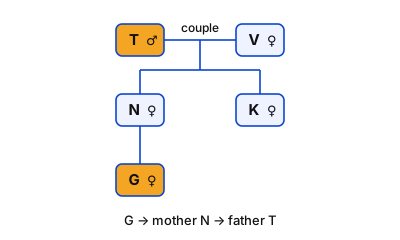
Based on the above, how is T related to G if ‘G # N # V + K # T’?
एक निश्चित कूट भाषा में,
A + B का अर्थ है ‘A, B की माता है’
A – B का अर्थ है ‘A, B का भाई है’
A x B का अर्थ है ‘A, B की पत्नी है’
A % B का अर्थ है ‘A, B का पिता है’
A # B का अर्थ है ‘A, B की पुत्री है’
उपर्युक्त के आधार पर, यदि ‘G # N # V + K # T’ है, तो T, G से किस प्रकार संबंधित है?
  1. ASister’s daughterबहन की पुत्री
  2. BMother’s fatherमाता का पिता
  3. CDaughter’s daughterपुत्री की पुत्री
  4. DMother’s sisterमाता की बहन
Show answer

Concept: Decode each symbol step by step and build the family tree.

  1. G # N: G is daughter of N. N # V: N is daughter of V. V + K: V is mother of K. K # T: K is daughter of T.
  2. V and T are both parents of K, so T is the father (V is female). Hence T is also the father of N.
  3. N is G's mother → T is G's mother's father.

Trick: Start decoding from the person asked about (G) and move link by link; fix genders from 'mother/daughter' words.

Answer: (B) Mother's father

अवधारणा: हर चिह्न को चरणबद्ध डिकोड करें और वंश-वृक्ष बनाएँ।

  1. G # N: G, N की बेटी। N # V: N, V की बेटी। V + K: V, K की माँ। K # T: K, T की बेटी।
  2. V और T दोनों K के माता-पिता हैं, अतः T पिता है (V महिला है)। इसलिए T, N का भी पिता है।
  3. N, G की माँ → T, G की माँ का पिता (नाना)।

ट्रिक: जिसके बारे में पूछा है (G) उससे डिकोड शुरू करें और कड़ी-दर-कड़ी बढ़ें; 'माँ/बेटी' शब्दों से लिंग तय करें।

उत्तर: (B) माँ का पिता (नाना)

RRB NTPC Graduate CBT 1General Intelligence and ReasoningBlood Relations (Coded)RRB NTPC Graduate CBT 1 2025 · 17 Mar Shift 2 →
Q6666.
Read the given statements and conclusions carefully. Assuming that the information given in the statements is true, even if it appears to be at variance with commonly known facts, decide which of the given conclusion(s) logically follow(s) from the statement.
Statements:
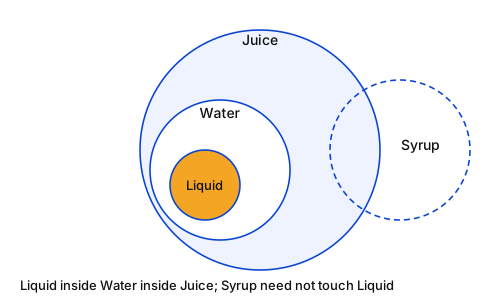
All liquid is water. All water is juice. Some juices are syrup.
Conclusions:
(I) All liquid is juice.
(II) Some syrups are liquid.
दिए गए कथनों और निष्कर्षों को ध्यानपूर्वक पढ़िए। यह मानते हुए कि कथनों में दी गई जानकारी सत्य है, भले ही वह सामान्यतः ज्ञात तथ्यों से भिन्न प्रतीत होती हो, निर्णय कीजिए कि दिए गए निष्कर्षों में से कौन-सा/से निष्कर्ष कथनों का तार्किक रूप से अनुसरण करता है/करते हैं।
कथन:
सभी द्रव, जल हैं। सभी जल, जूस हैं। कुछ जूस, सिरप हैं।
निष्कर्ष:
(I) सभी द्रव, जूस हैं।
(II) कुछ सिरप, द्रव हैं।
  1. AOnly conclusion (II) follows.केवल निष्कर्ष (II) अनुसरण करता है।
  2. BBoth conclusions (I) and (II) follow.निष्कर्ष (I) और (II) दोनों अनुसरण करते हैं।
  3. COnly conclusion (I) follows.केवल निष्कर्ष (I) अनुसरण करता है।
  4. DNeither conclusion (I) nor (II) follows.न तो निष्कर्ष (I) और न ही (II) अनुसरण करता है।
Show answer

Concept: 'All A are B' and 'All B are C' give 'All A are C'; a 'Some' statement passes nothing definite backwards.

  1. All liquid is water, all water is juice → All liquid is juice. Conclusion I follows.
  2. Some juices are syrup: the syrup part of juice may lie entirely outside water and liquid, so 'Some syrups are liquid' is not certain. Conclusion II does not follow.

Trick: Draw the smallest possible Venn: nested circles for 'All', and put the 'Some' overlap as far from the inner circle as you can.

Answer: (C) Only conclusion (I) follows.

अवधारणा: 'सभी A, B हैं' और 'सभी B, C हैं' से 'सभी A, C हैं' मिलता है; 'कुछ' वाला कथन पीछे की ओर कुछ निश्चित नहीं देता।

  1. सभी liquid, water हैं; सभी water, juice हैं → सभी liquid, juice हैं। निष्कर्ष I सही।
  2. कुछ juice, syrup हैं: juice का syrup वाला भाग water और liquid से पूरी तरह बाहर हो सकता है, अतः 'कुछ syrup, liquid हैं' निश्चित नहीं। निष्कर्ष II नहीं निकलता।

ट्रिक: सबसे छोटा संभव Venn बनाएँ: 'सभी' के लिए एक-दूसरे के अंदर वृत्त, और 'कुछ' वाले ओवरलैप को भीतरी वृत्त से जितना दूर हो सके रखें।

उत्तर: (C) केवल निष्कर्ष (I) निकलता है।

RRB NTPC Graduate CBT 1General Intelligence and ReasoningSyllogismRRB NTPC Graduate CBT 1 2025 · 17 Mar Shift 2 →
Q6667.
Which of the following letter-clusters should replace # and % so that the pattern and relationship followed between the letter-cluster pair on the left side of :: is the same as that on the right side of :: ?
# : KUC :: VFN : %
निम्नलिखित में से कौन-से अक्षर-समूह # और % के स्थान पर आने चाहिए ताकि :: के बाईं ओर के अक्षर-समूह युग्म के बीच का पैटर्न और संबंध वही हो जो :: के दाईं ओर है?
# : KUC :: VFN : %
  1. A# = DNV % = CMU
  2. B# = DNV % = CMP
  3. C# = DUV % = CMU
  4. D# = DNV % = CNU
Show answer

Concept: Find the uniform letter shift that links the given pair, then apply it to the other pair.

  1. Try option A: DNV : KUC → D+7=K, N+7=U, V+7=C. Each letter moves +7.
  2. Apply +7 to VFN: V+7=C, F+7=M, N+7=U ⇒ CMU.
  3. Only option A has both # = DNV and % = CMU.

Trick: Check the second pair first – VFN +7 = CMU eliminates B and D at once; then DNV vs DUV decides A.

Answer: (A) # = DNV % = CMU

अवधारणा: दिए गए युग्म में अक्षरों का समान shift पहचानें और दूसरे युग्म पर लगाएँ।

  1. विकल्प A लें: DNV : KUC → D+7=K, N+7=U, V+7=C। हर अक्षर +7 बढ़ता है।
  2. VFN पर +7: V+7=C, F+7=M, N+7=U ⇒ CMU।
  3. केवल विकल्प A में # = DNV और % = CMU दोनों हैं।

ट्रिक: पहले दूसरा युग्म जाँचें – VFN +7 = CMU से B और D तुरंत कटते हैं; फिर DNV बनाम DUV से A तय होता है।

उत्तर: (A) # = DNV % = CMU

RRB NTPC Graduate CBT 1General Intelligence and ReasoningLetter-cluster analogyRRB NTPC Graduate CBT 1 2025 · 17 Mar Shift 2 →
Q6668.
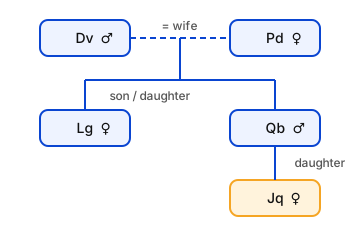
Lg is the daughter of Dv. Jq is the daughter of Qb. Pd is the wife of Dv. Qb is the brother of Lg. How is Jq related to Dv?
Lg, Dv की पुत्री है। Jq, Qb की पुत्री है। Pd, Dv की पत्नी है। Qb, Lg का भाई है। Jq, Dv से किस प्रकार संबंधित है?
  1. ADaughter’s daughterपुत्री की पुत्री
  2. BSon’s wifeपुत्र की पत्नी
  3. CFather’s fatherपिता का पिता
  4. DSon’s daughterपुत्र की पुत्री
Show answer

Concept: Build the family tree generation by generation.

  1. Lg is Dv's daughter; Qb is Lg's brother ⇒ Qb is Dv's son.
  2. Jq is Qb's daughter ⇒ Jq is the daughter of Dv's son.
  3. So Jq is Dv's son's daughter (granddaughter).

Trick: Brother of a daughter = son of the same parent. Sibling links always share the parent.

Answer: (D) Son's daughter

अवधारणा: पीढ़ी-दर-पीढ़ी परिवार वृक्ष बनाएँ।

  1. Lg, Dv की बेटी है; Qb, Lg का भाई है ⇒ Qb, Dv का बेटा है।
  2. Jq, Qb की बेटी है ⇒ Jq, Dv के बेटे की बेटी है।
  3. अतः Jq, Dv की पोती (बेटे की बेटी) है।

ट्रिक: बेटी का भाई = उसी माता-पिता का बेटा। भाई-बहन का संबंध माता-पिता साझा करता है।

उत्तर: (D) बेटे की बेटी

RRB NTPC Graduate CBT 1General Intelligence and ReasoningBlood RelationsRRB NTPC Graduate CBT 1 2025 · 17 Mar Shift 2 →
Q6669.
Which of the following letter-clusters should replace # and % so that the pattern and relationship followed between the letter-cluster pair on the left side of :: is the same as that on the right side of ::?
# : CGW :: LDM : %
निम्नलिखित में से कौन-से अक्षर-समूह # और % के स्थान पर आने चाहिए ताकि :: के बाईं ओर के अक्षर-समूह युग्म के बीच का पैटर्न और संबंध वही हो जो :: के दाईं ओर है?
# : CGW :: LDM : %
  1. A# = BET, % = MFP
  2. B# = AET, % = MFO
  3. C# = ADS, % = NEO
  4. D# = BDT, % = MEP
Show answer

Concept: Each letter position may have its own shift; find the pattern from the options.

  1. Option A: BET : CGW → B+1=C, E+2=G, T+3=W – shifts +1,+2,+3.
  2. Apply to LDM: L+1=M, D+2=F, M+3=P ⇒ MFP.
  3. Option A gives exactly # = BET and % = MFP.

Trick: Shifts +1,+2,+3 are the most common RRB pattern – test it first.

Answer: (A) # = BET, % = MFP

अवधारणा: हर अक्षर-स्थान का अपना shift हो सकता है; विकल्पों से पैटर्न पहचानें।

  1. विकल्प A: BET : CGW → B+1=C, E+2=G, T+3=W – shift +1,+2,+3।
  2. LDM पर लगाएँ: L+1=M, D+2=F, M+3=P ⇒ MFP।
  3. विकल्प A में ठीक # = BET और % = MFP है।

ट्रिक: +1,+2,+3 RRB का सबसे आम पैटर्न है – इसे पहले जाँचें।

उत्तर: (A) # = BET, % = MFP

RRB NTPC Graduate CBT 1General Intelligence and ReasoningLetter-cluster analogyRRB NTPC Graduate CBT 1 2025 · 17 Mar Shift 2 →
Q6670.
Two sets of numbers are given below. In each set of numbers, certain mathematical operation(s) on the first number result(s) in the second number. Similarly, certain mathematical operation(s) on the second number result(s) in the third number and so on. Which of the given options follows the same set of operations as in the given sets? (NOTE: Operations should be performed on the whole numbers, without breaking down the numbers into their constituent digits. E.g. 13 – Operations on 13 such as adding / subtracting /multiplying to 13 can be performed. Breaking down 13 into 1 and 3 and then performing mathematical operations on 1 and 3 is not allowed.)
8 – 64 – 84 – 252; 12 – 144 – 164 – 492
नीचे संख्याओं के दो समुच्चय दिए गए हैं। संख्याओं के प्रत्येक समुच्चय में, पहली संख्या पर कुछ निश्चित गणितीय संक्रिया(एँ) करने से दूसरी संख्या प्राप्त होती है। इसी प्रकार, दूसरी संख्या पर कुछ निश्चित गणितीय संक्रिया(एँ) करने से तीसरी संख्या प्राप्त होती है, और इसी तरह आगे। दिए गए विकल्पों में से कौन-सा दिए गए समुच्चयों के समान संक्रियाओं के समुच्चय का अनुसरण करता है? (नोट: संक्रियाएँ पूर्ण संख्याओं पर की जानी चाहिए, संख्याओं को उनके घटक अंकों में तोड़े बिना। उदाहरण के लिए 13 – 13 पर संक्रियाएँ जैसे 13 में जोड़ना/घटाना/गुणा करना की जा सकती हैं। 13 को 1 और 3 में तोड़कर फिर 1 और 3 पर गणितीय संक्रियाएँ करने की अनुमति नहीं है।)
8 – 64 – 84 – 252; 12 – 144 – 164 – 492
  1. A9 – 81 – 121 – 423
  2. B14 – 256 – 456 – 969
  3. C4 – 16 – 46 – 153
  4. D5 – 25 – 45 – 135
Show answer

Concept: Find the chain of operations that works for both given sets.

  1. 8→82=64→64+20=84→84×3=252.
  2. 12→122=144→144+20=164→164×3=492. Pattern: square, +20, ×3.
  3. Option D: 5→25→45→135 ✓. (A: 81+20=101≠121; B: 142=196≠256; C: 16+20=36≠46.)

Trick: Check the first step alone (n2) – it kills option B; then the +20 step kills A and C.

Answer: (D) 5 – 25 – 45 – 135

अवधारणा: दोनों दिए गए समुच्चयों पर लागू संक्रियाओं की शृंखला पहचानें।

  1. 8→82=64→64+20=84→84×3=252।
  2. 12→122=144→144+20=164→164×3=492। पैटर्न: वर्ग, +20, ×3।
  3. विकल्प D: 5→25→45→135 ✓। (A: 81+20=101≠121; B: 142=196≠256; C: 16+20=36≠46।)

ट्रिक: पहला चरण (n2) ही B को काट देता है; फिर +20 से A और C कटते हैं।

उत्तर: (D) 5 – 25 – 45 – 135

RRB NTPC Graduate CBT 1General Intelligence and ReasoningNumber operation seriesRRB NTPC Graduate CBT 1 2025 · 17 Mar Shift 2 →
Q6671.
What should come in place of ‘?’ in the given series?
98 100 103 108 115 ?
दी गई श्रेणी में ‘?’ के स्थान पर क्या आना चाहिए?
98 100 103 108 115 ?
  1. A128
  2. B126
  3. C125
  4. D127
Show answer

Concept: Look at the differences between consecutive terms.

  1. Differences: 100−98=2, 103−100=3, 108−103=5, 115−108=7.
  2. 2,3,5,7 are consecutive primes; next prime is 11.
  3. ?=115+11=126.

Trick: Small irregular gaps like 2, 3, 5, 7 almost always mean primes.

Answer: (B) 126

अवधारणा: क्रमागत पदों के अंतर देखें।

  1. अंतर: 100−98=2, 103−100=3, 108−103=5, 115−108=7।
  2. 2,3,5,7 क्रमागत अभाज्य हैं; अगला अभाज्य 11।
  3. ?=115+11=126।

ट्रिक: 2, 3, 5, 7 जैसे छोटे अनियमित अंतर प्रायः अभाज्य संख्याएँ होते हैं।

उत्तर: (B) 126

RRB NTPC Graduate CBT 1General Intelligence and ReasoningNumber SeriesRRB NTPC Graduate CBT 1 2025 · 17 Mar Shift 2 →
Q6672.
Read the given statements and conclusions carefully. Assuming that the information given in the statements is true, even if it appears to be at variance with commonly known facts, decide which of the given conclusion(s) logically follow(s) from the statements.
Statements:
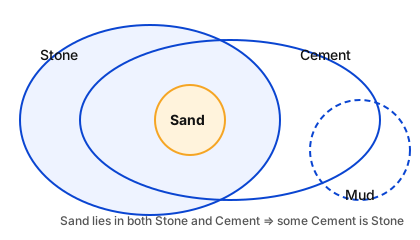
All sand is stone. All sand is cement. Some cements are mud.
Conclusions:
(I) Some muds are sand.
(II) Some cements are stone.
दिए गए कथनों और निष्कर्षों को ध्यानपूर्वक पढ़िए। यह मानते हुए कि कथनों में दी गई जानकारी सत्य है, भले ही वह सामान्यतः ज्ञात तथ्यों से भिन्न प्रतीत होती हो, निर्णय कीजिए कि दिए गए निष्कर्षों में से कौन-सा/से निष्कर्ष कथनों का तार्किक रूप से अनुसरण करता है/करते हैं।
कथन:
सभी बालू, पत्थर हैं। सभी बालू, सीमेंट हैं। कुछ सीमेंट, कीचड़ हैं।
निष्कर्ष:
(I) कुछ कीचड़, बालू हैं।
(II) कुछ सीमेंट, पत्थर हैं।
  1. AOnly conclusion (II) follows.केवल निष्कर्ष (II) अनुसरण करता है।
  2. BNeither conclusion (I) nor (II) follows.न तो निष्कर्ष (I) और न ही (II) अनुसरण करता है।
  3. COnly conclusion (I) follows.केवल निष्कर्ष (I) अनुसरण करता है।
  4. DBoth conclusions (I) and (II) follow.निष्कर्ष (I) और (II) दोनों अनुसरण करते हैं।
Show answer

Concept: Draw a Venn diagram that satisfies all statements with the least overlap.

  1. All sand is stone and all sand is cement ⇒ the sand region lies inside both stone and cement, so some cement is stone – conclusion (II) definitely follows.
  2. 'Some cements are mud' – the mud part of cement may be entirely outside sand, so 'some muds are sand' is only possible, not certain – conclusion (I) does not follow.

Trick: Two 'All A is B' and 'All A is C' statements always give 'Some B is C'. A 'Some' statement cannot pass a definite link onward.

Answer: (A) Only conclusion (II) follows.

अवधारणा: सभी कथनों को न्यूनतम overlap के साथ संतुष्ट करने वाला वेन आरेख बनाएँ।

  1. सभी sand, stone है और सभी sand, cement है ⇒ sand का क्षेत्र stone और cement दोनों के अंदर है, अतः कुछ cement, stone है – निष्कर्ष (II) निश्चित रूप से सही।
  2. 'कुछ cement, mud है' – cement का mud वाला भाग sand से पूरी तरह बाहर हो सकता है, अतः 'कुछ mud, sand है' केवल संभव है, निश्चित नहीं – निष्कर्ष (I) नहीं निकलता।

ट्रिक: 'सभी A, B है' और 'सभी A, C है' से हमेशा 'कुछ B, C है' निकलता है। 'कुछ' वाला कथन निश्चित संबंध आगे नहीं पहुँचाता।

उत्तर: (A) केवल निष्कर्ष (II) अनुसरण करता है।

RRB NTPC Graduate CBT 1General Intelligence and ReasoningSyllogismRRB NTPC Graduate CBT 1 2025 · 17 Mar Shift 2 →
Q6673.
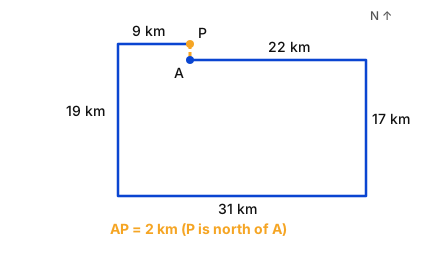
Hemant starts from Point A and drives 22 km towards East. He then takes a right turn, drives 17 km, turns right and drives 31 km. He then takes a right turn and drives 19 km. He takes a final right turn, drives 9 km and stops at Point P. How far (shortest distance) and towards which direction should he drive in order to reach Point A again? (All turns are 90 degrees turns only unless specified)
हेमंत बिंदु A से चलना शुरू करता है और पूर्व की ओर 22 km गाड़ी चलाता है। फिर वह दाएँ मुड़ता है, 17 km गाड़ी चलाता है, दाएँ मुड़ता है और 31 km गाड़ी चलाता है। फिर वह दाएँ मुड़ता है और 19 km गाड़ी चलाता है। वह अंतिम बार दाएँ मुड़ता है, 9 km गाड़ी चलाता है और बिंदु P पर रुक जाता है। पुनः बिंदु A पर पहुँचने के लिए उसे कितनी दूर (न्यूनतम दूरी) और किस दिशा में गाड़ी चलानी चाहिए? (जब तक अन्यथा निर्दिष्ट न हो, सभी मोड़ केवल 90 डिग्री के मोड़ हैं)
  1. A2 km to the Northउत्तर की ओर 2 km
  2. B3 km to the Northउत्तर की ओर 3 km
  3. C2 km to the Southदक्षिण की ओर 2 km
  4. D3 km to the Southदक्षिण की ओर 3 km
Show answer

Concept: Track the position with coordinates; every right turn rotates clockwise (E→S→W→N→E).

  1. A(0,0) →E22 (22,0) →S17 (22,−17) →W31 (−9,−17) →N19 (−9,2) →E9 P(0,2).
  2. P is directly above A by 2 km, i.e. P is 2 km north of A.
  3. To return to A he must drive 2 km towards the South.

Trick: Net E–W =22−31+9=0; net N–S =−17+19=+2 (north). Return = opposite direction.

Answer: (C) 2 km to the South

अवधारणा: निर्देशांक से स्थिति ट्रैक करें; हर दायाँ मोड़ clockwise घुमाता है (E→S→W→N→E)।

  1. A(0,0) →E22 (22,0) →S17 (22,−17) →W31 (−9,−17) →N19 (−9,2) →E9 P(0,2)।
  2. P, A के ठीक ऊपर 2 km है, अर्थात P, A से 2 km उत्तर में है।
  3. A पर लौटने के लिए उसे 2 km दक्षिण की ओर चलना होगा।

ट्रिक: शुद्ध E–W =22−31+9=0; शुद्ध N–S =−17+19=+2 (उत्तर)। वापसी = विपरीत दिशा।

उत्तर: (C) 2 km दक्षिण की ओर

RRB NTPC Graduate CBT 1General Intelligence and ReasoningDirection and DistanceRRB NTPC Graduate CBT 1 2025 · 17 Mar Shift 2 →
Q6674.
Which of the following letter-number clusters will replace the question mark (?) in the given series to make it logically complete?
STQ 54 NOL 61 IJG 68 DEB 75 ?
दी गई श्रेणी को तार्किक रूप से पूर्ण करने के लिए निम्नलिखित में से कौन-सा अक्षर-संख्या समूह प्रश्नचिह्न (?) के स्थान पर आएगा?
STQ 54 NOL 61 IJG 68 DEB 75 ?
  1. AYZW 82
  2. BYAV 82
  3. CYDJ 81
  4. DYYV 81
Show answer

Concept: Treat letters and numbers as separate series.

  1. 1st letters S, N, I, D: each −5 ⇒ D−5=Y (wrap around).
  2. 2nd letters T, O, J, E: −5 ⇒ Z; 3rd letters Q, L, G, B: −5 ⇒ W.
  3. Numbers 54, 61, 68, 75: +7 ⇒ 82. Term = YZW 82.

Trick: Each cluster is 'n−1, n, n−3' pattern shifted by 5; just confirm the first letter Y and number 82 – only option A matches.

Answer: (A) YZW 82

अवधारणा: अक्षरों और संख्याओं को अलग-अलग शृंखला मानें।

  1. पहले अक्षर S, N, I, D: प्रत्येक −5 ⇒ D−5=Y (चक्र में)।
  2. दूसरे अक्षर T, O, J, E: −5 ⇒ Z; तीसरे अक्षर Q, L, G, B: −5 ⇒ W।
  3. संख्याएँ 54, 61, 68, 75: +7 ⇒ 82। पद = YZW 82।

ट्रिक: बस पहला अक्षर Y और संख्या 82 पक्की करें – केवल विकल्प A मेल खाता है।

उत्तर: (A) YZW 82

RRB NTPC Graduate CBT 1General Intelligence and ReasoningLetter-number seriesRRB NTPC Graduate CBT 1 2025 · 17 Mar Shift 2 →
Q6675.
Refer to the following number, symbol series and answer the question. Counting to be done from left to right only. All numbers are single digit numbers only.
(Left) £ 9 2 9 £ # 4 9 8 2 9 © © 7 @ 6 8 € 7 € € # (Right)
How many such numbers are there each of which is immediately preceded by a number and also immediately followed by a number?
निम्नलिखित संख्या, प्रतीक श्रेणी को देखिए और प्रश्न का उत्तर दीजिए। गिनती केवल बाएँ से दाएँ की जानी है। सभी संख्याएँ केवल एक अंक की संख्याएँ हैं।
(बाएँ) £ 9 2 9 £ # 4 9 8 2 9 © © 7 @ 6 8 € 7 € € # (दाएँ)
ऐसी कितनी संख्याएँ हैं, जिनमें से प्रत्येक के ठीक पहले एक संख्या है और ठीक बाद एक संख्या भी है?
  1. A4
  2. B6
  3. C5
  4. D3
Show answer

Concept: Scan each number and check both immediate neighbours.

  1. Series: £ 9 2 9 £ # 4 9 8 2 9 © © 7 @ 6 8 € 7 € € #.
  2. Number–number–number triples: 9 2 9; 4 9 8; 9 8 2; 8 2 9.
  3. 7, 6, 8 near @ and € fail. Count =4.

Trick: In a run of k consecutive digits, exactly k−2 qualify: run '929' → 1, run '49829' → 3; total 4.

Answer: (A) 4

अवधारणा: हर संख्या के दोनों निकटवर्ती पड़ोसी जाँचें।

  1. शृंखला: £ 9 2 9 £ # 4 9 8 2 9 © © 7 @ 6 8 € 7 € € #।
  2. संख्या–संख्या–संख्या त्रिक: 9 2 9; 4 9 8; 9 8 2; 8 2 9।
  3. @ और € के पास 7, 6, 8 शर्त पूरी नहीं करते। गिनती =4।

ट्रिक: k लगातार अंकों की कड़ी में ठीक k−2 अंक योग्य होते हैं: '929' → 1, '49829' → 3; कुल 4।

उत्तर: (A) 4

RRB NTPC Graduate CBT 1General Intelligence and ReasoningSymbol-number series countingRRB NTPC Graduate CBT 1 2025 · 17 Mar Shift 2 →
Q6676.
Which of the given letter-number clusters will replace the question mark (?) in the following series to make it logically complete?
UBE 14 IPS 28 WDG 42 KRU 56 ?
निम्नलिखित श्रेणी को तार्किक रूप से पूर्ण करने के लिए दिए गए अक्षर-संख्या समूहों में से कौन-सा प्रश्नचिह्न (?) के स्थान पर आएगा?
UBE 14 IPS 28 WDG 42 KRU 56 ?
  1. AXEG 72
  2. BSDH 72
  3. CYFI 70
  4. DVIF 70
Show answer

Concept: Separate letter positions and the numbers.

  1. 1st letters U, I, W, K: +14 each ⇒ K+14=Y.
  2. 2nd letters B, P, D, R: +14 ⇒ F; 3rd letters E, S, G, U: +14 ⇒ I.
  3. Numbers 14, 28, 42, 56: +14 ⇒ 70. Term = YFI 70.

Trick: Everything moves by 14 – letters and numbers alike; +14 on letters is the same as −12.

Answer: (C) YFI 70

अवधारणा: अक्षर-स्थानों और संख्याओं को अलग करें।

  1. पहले अक्षर U, I, W, K: प्रत्येक +14 ⇒ K+14=Y।
  2. दूसरे अक्षर B, P, D, R: +14 ⇒ F; तीसरे अक्षर E, S, G, U: +14 ⇒ I।
  3. संख्याएँ 14, 28, 42, 56: +14 ⇒ 70। पद = YFI 70।

ट्रिक: सब कुछ 14 से बढ़ता है – अक्षर भी, संख्या भी; अक्षरों पर +14 = −12।

उत्तर: (C) YFI 70

RRB NTPC Graduate CBT 1General Intelligence and ReasoningLetter-number seriesRRB NTPC Graduate CBT 1 2025 · 17 Mar Shift 2 →
Q6677.
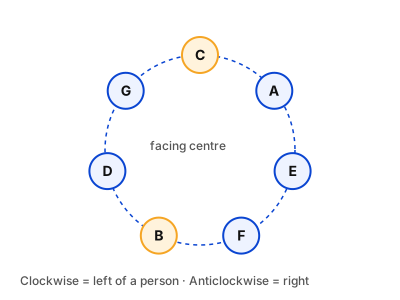
A, B, C, D, E, F and G sit around a circular table, facing the centre. F sits third to the left of C. G sits second to the left of B. C is an immediate neighbour of both A and G. D sits to the immediate right of G. How many people sit between B and C when counted from the right of C?
A, B, C, D, E, F और G एक वृत्ताकार मेज़ के चारों ओर केंद्र की ओर मुख करके बैठे हैं। F, C के बाएँ तीसरे स्थान पर बैठा है। G, B के बाएँ दूसरे स्थान पर बैठा है। C, A और G दोनों का निकटतम पड़ोसी है। D, G के ठीक दाएँ बैठा है। C के दाएँ से गिनने पर B और C के बीच कितने व्यक्ति बैठे हैं?
  1. A3
  2. B1
  3. C4
  4. D2
Show answer

Concept: Facing the centre: left = clockwise, right = anticlockwise.

  1. Fix C. F is 3rd to the left (3 places clockwise) of C. C's neighbours are A and G.
  2. D is immediately right (anticlockwise) of G. If G were clockwise of C, D would land on C – impossible; so G is anticlockwise of C, A is clockwise, D next to G.
  3. G is 2nd to the left of B ⇒ B is 2 places anticlockwise of G, i.e. next to F. E fills the last seat. Order clockwise: C, A, E, F, B, D, G.
  4. From the right of C (anticlockwise): G, D, then B ⇒ 2 people between.

Trick: Start with the person having the most clues (C: neighbours A and G, and F's position) and test the two possible placements of G.

Answer: (D) 2

अवधारणा: केंद्र की ओर मुख: बायाँ = clockwise, दायाँ = anticlockwise।

  1. C को स्थिर करें। F, C के बाएँ तीसरा (3 स्थान clockwise)। C के पड़ोसी A और G।
  2. D, G के तुरंत दाएँ (anticlockwise)। यदि G, C के clockwise हो तो D, C पर आ जाता – असंभव; अतः G, C के anticlockwise, A clockwise, D, G के पास।
  3. G, B के बाएँ दूसरा ⇒ B, G से 2 स्थान anticlockwise, अर्थात F के पास। बची सीट पर E। Clockwise क्रम: C, A, E, F, B, D, G।
  4. C के दाएँ से (anticlockwise): G, D, फिर B ⇒ बीच में 2 लोग।

ट्रिक: सबसे अधिक सुराग वाले व्यक्ति (C: पड़ोसी A व G, और F की स्थिति) से शुरू करें और G की दोनों संभावित जगहें जाँचें।

उत्तर: (D) 2

RRB NTPC Graduate CBT 1General Intelligence and ReasoningCircular Seating ArrangementRRB NTPC Graduate CBT 1 2025 · 17 Mar Shift 2 →
Q6678.
The revised methodology from 2025 for calculating Green Credit for tree plantation requires certain thresholds before a claim can be submitted. Which is the correct eligibility pair?
वृक्षारोपण के लिए ग्रीन क्रेडिट (Green Credit) की गणना की 2025 से संशोधित कार्यप्रणाली के अनुसार दावा प्रस्तुत करने से पहले कुछ निश्चित सीमाएँ (thresholds) पूरी करना आवश्यक है। सही पात्रता युग्म कौन-सा है?
  1. A7 years of restoration + 40% canopy density7 वर्ष का पुनर्स्थापन + 40% वितान घनत्व (canopy density)
  2. B3 years of restoration + 30% canopy density3 वर्ष का पुनर्स्थापन + 30% वितान घनत्व
  3. C5 years of restoration + 60% canopy density5 वर्ष का पुनर्स्थापन + 60% वितान घनत्व
  4. D5 years of restoration + 40% canopy density5 वर्ष का पुनर्स्थापन + 40% वितान घनत्व
Show answer

Concept: The Green Credit Rules, 2023 (MoEFCC) reward tree plantation on degraded forest land; the methodology was revised in 2025.

  1. Under the revised methodology, a green-credit claim can be made only after 5 years of restoration work.
  2. The plantation must also have reached at least 40% canopy density before credits are issued.
  3. Other combinations (7 years, 3 years, 60%) are not the notified thresholds.

Yaad rakhein: Green Credit = 5 years + 40% canopy; credits are issued by ICFRE (Dehradun).

Answer: (D) 5 years of restoration + 40% canopy density

अवधारणा: ग्रीन क्रेडिट नियम, 2023 (पर्यावरण मंत्रालय) के तहत निम्नीकृत वन भूमि पर वृक्षारोपण पर क्रेडिट मिलते हैं; 2025 में इसकी कार्यप्रणाली संशोधित हुई।

  1. संशोधित प्रणाली में दावा (claim) 5 वर्ष के पुनर्स्थापन कार्य के बाद ही किया जा सकता है।
  2. साथ ही वृक्षारोपण का छत्र घनत्व (canopy density) कम से कम 40% होना चाहिए।
  3. 7 वर्ष, 3 वर्ष या 60% वाली जोड़ियाँ अधिसूचित सीमाएँ नहीं हैं।

याद रखें: ग्रीन क्रेडिट = 5 वर्ष + 40% canopy; क्रेडिट जारी करता है ICFRE (देहरादून)।

उत्तर: (D) 5 वर्ष पुनर्स्थापन + 40% छत्र घनत्व

RRB NTPC Graduate CBT 1General AwarenessGreen Credit ProgrammeRRB NTPC Graduate CBT 1 2025 · 17 Mar Shift 1 →
Q6679.
As of December 2025, under the Pradhan Mantri Jan-Dhan Yojana (PMJDY), eligible account holders can access an overdraft facility of up to:
दिसंबर 2025 की स्थिति के अनुसार, प्रधानमंत्री जन-धन योजना (PMJDY) के अंतर्गत पात्र खाताधारक अधिकतम कितनी राशि तक की ओवरड्राफ्ट सुविधा प्राप्त कर सकते हैं?
  1. A₹10,000
  2. B₹8,000
  3. C₹15,000
  4. D₹5,000
Show answer

Concept: PMJDY (launched 28 Aug 2014) gives basic savings accounts with an overdraft (OD) facility.

  1. The OD limit was raised from ₹5,000 to ₹10,000 in 2018 and remains ₹10,000 (as of Dec 2025).
  2. OD up to ₹2,000 is given without conditions; upper age limit for OD is 65 years.
  3. Accident insurance cover on RuPay card is ₹2 lakh for accounts opened after 28 Aug 2018.

Yaad rakhein: Jan-Dhan OD = ₹10,000; RuPay accident cover = ₹2 lakh.

Answer: (A) ₹10,000

अवधारणा: PMJDY (28 अगस्त 2014) में मूल बचत खाते के साथ ओवरड्राफ्ट (OD) सुविधा मिलती है।

  1. OD सीमा 2018 में ₹5,000 से बढ़ाकर ₹10,000 की गई और दिसंबर 2025 तक यही है।
  2. ₹2,000 तक का OD बिना शर्त मिलता है; OD के लिए अधिकतम आयु 65 वर्ष।
  3. 28 अगस्त 2018 के बाद खुले खातों पर RuPay कार्ड दुर्घटना बीमा ₹2 लाख।

याद रखें: जन-धन OD = ₹10,000; RuPay दुर्घटना बीमा = ₹2 लाख।

उत्तर: (A) ₹10,000

RRB NTPC Graduate CBT 1General AwarenessPMJDYRRB NTPC Graduate CBT 1 2025 · 17 Mar Shift 1 →
Q6680.
Which dynasty ruled over Kannauj during the Tripartite Struggle?
त्रिपक्षीय संघर्ष के दौरान कन्नौज पर किस राजवंश का शासन था?
  1. ARashtrakutasराष्ट्रकूट
  2. BChalukyasचालुक्य
  3. CPalas - Cholasपाल - चोल
  4. DGurjara-Pratiharasगुर्जर-प्रतिहार
Show answer

Concept: The Tripartite Struggle (8th–10th century) for Kannauj was fought among the Gurjara-Pratiharas, Palas and Rashtrakutas.

  1. Kannauj finally came under the Gurjara-Pratiharas; Nagabhata II captured it and Mihira Bhoja made it his capital.
  2. The Rashtrakutas (Dhruva, Govinda III) raided Kannauj but did not rule it; the Palas (Dharmapala) only installed a puppet ruler briefly.

Yaad rakhein: Kannauj contest: Pratihara (west) – Pala (east) – Rashtrakuta (south); winner Pratihara.

Answer: (D) Gurjara-Pratiharas

अवधारणा: कन्नौज के लिए त्रिपक्षीय संघर्ष (8वीं–10वीं सदी) गुर्जर-प्रतिहार, पाल और राष्ट्रकूटों के बीच हुआ।

  1. अंततः कन्नौज गुर्जर-प्रतिहारों के अधीन आया; नागभट्ट II ने इसे जीता और मिहिर भोज ने राजधानी बनाया।
  2. राष्ट्रकूटों (ध्रुव, गोविंद III) ने आक्रमण किए पर शासन नहीं किया; पालों (धर्मपाल) ने थोड़े समय कठपुतली शासक बैठाया।

याद रखें: कन्नौज संघर्ष: प्रतिहार (पश्चिम) – पाल (पूर्व) – राष्ट्रकूट (दक्षिण); विजेता प्रतिहार।

उत्तर: (D) गुर्जर-प्रतिहार

RRB NTPC Graduate CBT 1General AwarenessTripartite StruggleRRB NTPC Graduate CBT 1 2025 · 17 Mar Shift 1 →