Question bank

Q&A: practice questions with answers

Search questions on any topic. Filter by exam category, exam, subject and topic, try the question, then open the answer and explanation.

Courses – airGurukul

7,077 questions found.

Q661.
Evaluate: 82 × 111
मान ज्ञात कीजिए: 82 × 111
  1. A9092
  2. B9202
  3. C9102
  4. D9112
Show answer

Concept: Multiply by 111 using 111=100+10+1.

  1. 82×100=8200, 82×10=820, 82×1=82.
  2. 8200+820+82=9102.

Trick: For a 2-digit ab×111: write a,(a+b),(a+b),b with carry → 8, 10, 10, 2 → 9102.

Answer: (C) 9102

अवधारणा: 111=100+10+1 लेकर गुणा करें।

  1. 82×100=8200, 82×10=820, 82×1=82।
  2. 8200+820+82=9102।

ट्रिक: दो अंकों की ab×111: a,(a+b),(a+b),b लिखें, हासिल जोड़ें → 8, 10, 10, 2 → 9102।

उत्तर: (C) 9102
RRB NTPC Graduate CBT 1MathematicsMultiplicationRRB NTPC Graduate CBT 1 2024 · 21 Jun Shift 3 →
Q662.
A total profit of ₹12,200 is to be distributed amongst P, Q, and R such that P : Q = 15 : 4 and Q : R = 3 : 1. The share (in ₹) of R in the profit is:
₹12,200 के कुल लाभ को P, Q और R के बीच इस प्रकार बाँटा जाना है कि P : Q = 15 : 4 और Q : R = 3 : 1 हो। लाभ में R का हिस्सा (₹ में) है:
  1. A700
  2. B800
  3. C650
  4. D750
Show answer

Concept: Make Q common in both ratios to combine them.

  1. P:Q=15:4=45:12 and Q:R=3:1=12:4.
  2. P:Q:R=45:12:4; total parts =61.
  3. One part =1220061=200; R's share =4×200=800.

Trick: Total 12,200 is divisible by 61 – a quick check that the ratio is right.

Answer: (B) 800

अवधारणा: दोनों अनुपातों में Q को समान बनाएँ।

  1. P:Q=15:4=45:12 और Q:R=3:1=12:4।
  2. P:Q:R=45:12:4; कुल भाग =61।
  3. एक भाग =1220061=200; R का हिस्सा =4×200=800।

ट्रिक: 12,200 का 61 से पूरा भाग होना – अनुपात सही होने की त्वरित जाँच।

उत्तर: (B) 800

RRB NTPC Graduate CBT 1MathematicsRatio and PartnershipRRB NTPC Graduate CBT 1 2024 · 21 Jun Shift 3 →
Q663.
At what rate (in percentage) per annum on simple interest will a sum of money triple itself in 10 years?
साधारण ब्याज पर किस वार्षिक दर (प्रतिशत में) से कोई धनराशि 10 वर्षों में तीन गुनी हो जाएगी?
  1. A20%
  2. B30%
  3. C29%
  4. D19%
Show answer

Concept: SI=P×R×T100.

  1. Amount =3P, so SI=2P.
  2. 2P=P×R×10100⇒R=20%.

Trick: To become n times in T years: R=(n−1)×100T=2×10010=20%.

Answer: (A) 20%

अवधारणा: SI=P×R×T100।

  1. मिश्रधन =3P, अतः SI=2P।
  2. 2P=P×R×10100⇒R=20%।

ट्रिक: T वर्ष में n गुना: R=(n−1)×100T=2×10010=20%।

उत्तर: (A) 20%

RRB NTPC Graduate CBT 1MathematicsSimple InterestRRB NTPC Graduate CBT 1 2024 · 21 Jun Shift 3 →
Q664.
If 20% of a number is equal to 34 of another number, then what is the ratio of the first number to the second number?
यदि एक संख्या का 20%, दूसरी संख्या के 34 के बराबर है, तो पहली संख्या का दूसरी संख्या से अनुपात क्या है?
  1. A15 : 4
  2. B13 : 5
  3. C20 : 1
  4. D10 : 7
Show answer

Concept: Write the condition as an equation and find ab.

  1. 20100a=34b⇒a5=3b4.
  2. ab=34×5=154.
  3. Ratio a:b=15:4.

Trick: If x% of A = y of B, then A:B=y:x100 → 34:15=15:4.

Answer: (A) 15 : 4

अवधारणा: शर्त को समीकरण में लिखकर ab निकालें।

  1. 20100a=34b⇒a5=3b4।
  2. ab=34×5=154।
  3. अनुपात a:b=15:4।

ट्रिक: यदि A का x% = B का y, तो A:B=y:x100 → 34:15=15:4।

उत्तर: (A) 15 : 4

RRB NTPC Graduate CBT 1MathematicsPercentage and RatioRRB NTPC Graduate CBT 1 2024 · 21 Jun Shift 3 →
Q665.
If a + b = 70 and (a − b)2 = 208, find the value of the product of a and b.
यदि a + b = 70 और (a − b)2 = 208 है, तो a और b के गुणनफल का मान ज्ञात कीजिए।
  1. A1173
  2. B1254
  3. C1223
  4. D1240
Show answer

Concept: (a+b)2−(a−b)2=4ab.

  1. (a+b)2=702=4900.
  2. 4ab=4900−208=4692.
  3. ab=46924=1173.

Trick: ab=(a+b)2−(a−b)24 – one line.

Answer: (A) 1173

अवधारणा: (a+b)2−(a−b)2=4ab।

  1. (a+b)2=702=4900।
  2. 4ab=4900−208=4692।
  3. ab=46924=1173।

ट्रिक: ab=(a+b)2−(a−b)24 – एक पंक्ति में।

उत्तर: (A) 1173

RRB NTPC Graduate CBT 1MathematicsAlgebraic IdentitiesRRB NTPC Graduate CBT 1 2024 · 21 Jun Shift 3 →
Q666.
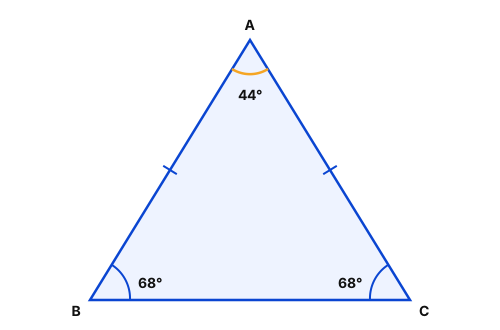
In an isosceles triangle, the vertex angle measures 44°. What is the measure of each of the base angles?
एक समद्विबाहु त्रिभुज में, शीर्ष कोण 44° का है। प्रत्येक आधार कोण की माप क्या है?
  1. A58° and 58°58° और 58°
  2. B65° and 65°65° और 65°
  3. C68° and 68°68° और 68°
  4. D64° and 64°64° और 64°
Show answer

Concept: In an isosceles triangle the two base angles are equal, and the angles add up to 180∘.

  1. Let each base angle be x: 44∘+2x=180∘.
  2. 2x=136∘⇒x=68∘.

Trick: Base angle =90∘−vertex2=90∘−22∘=68∘.

Answer: (C) 68∘ and 68∘

अवधारणा: समद्विबाहु त्रिभुज में दोनों आधार कोण बराबर होते हैं और कोणों का योग 180∘ है।

  1. प्रत्येक आधार कोण x: 44∘+2x=180∘।
  2. 2x=136∘⇒x=68∘।

ट्रिक: आधार कोण =90∘−शीर्ष कोण2=90∘−22∘=68∘।

उत्तर: (C) 68∘ और 68∘

RRB NTPC Graduate CBT 1MathematicsTrianglesRRB NTPC Graduate CBT 1 2024 · 21 Jun Shift 3 →
Q667.
A man sold an article at a gain of 39%. If he had sold it for ₹558 more, he would have gained 64%. The cost price (in ₹) of the article is:
एक व्यक्ति ने एक वस्तु 39% के लाभ पर बेची। यदि उसने इसे ₹558 अधिक में बेचा होता, तो उसे 64% का लाभ होता। वस्तु का क्रय मूल्य (₹ में) है:
  1. A2,230
  2. B2,232
  3. C2,231
  4. D2,233
Show answer

Concept: Extra selling price corresponds to the extra gain percentage on the cost price.

  1. Gain rises from 39% to 64% → difference =25% of CP.
  2. 25% of CP =₹558.
  3. CP =558×4=₹2232.

Trick: Difference in gain % × CP = difference in SP.

Answer: (B) 2,232

अवधारणा: अतिरिक्त विक्रय मूल्य, लागत पर अतिरिक्त लाभ प्रतिशत के बराबर है।

  1. लाभ 39% से 64% → अंतर =25% लागत मूल्य का।
  2. लागत का 25% =₹558।
  3. लागत =558×4=₹2232।

ट्रिक: लाभ % का अंतर × लागत = विक्रय मूल्य का अंतर।

उत्तर: (B) 2,232

RRB NTPC Graduate CBT 1MathematicsProfit and LossRRB NTPC Graduate CBT 1 2024 · 21 Jun Shift 3 →
Q668.
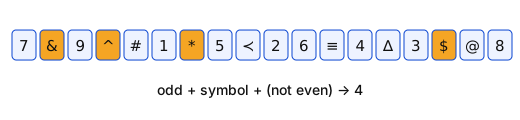
Refer to the following number and symbol series and answer the question that follows. Counting to be done from left to right only.
(Left) 7 & 9 ^ # 1 * 5 ≺ 2 6 ≡ 4 ∆ 3 $ @ 8 (Right)
How many such symbols are there, each of which is immediately preceded by an odd number but NOT immediately followed by an even number?
(Note: a combination of three elements should be considered while answering this question.)
निम्नलिखित संख्या और प्रतीक श्रृंखला को देखिए और नीचे दिए गए प्रश्न का उत्तर दीजिए। गिनती केवल बाएँ से दाएँ की जानी है।
(बाएँ) 7 & 9 ^ # 1 * 5 ≺ 2 6 ≡ 4 ∆ 3 $ @ 8 (दाएँ)
ऐसे कितने प्रतीक हैं, जिनमें से प्रत्येक के ठीक पहले एक विषम संख्या है, लेकिन ठीक बाद एक सम संख्या नहीं है?
(नोट: इस प्रश्न का उत्तर देते समय तीन तत्वों के संयोजन पर विचार किया जाना चाहिए।)
  1. ATwoदो
  2. BThreeतीन
  3. COneएक
  4. DMore than threeतीन से अधिक
Show answer

Concept: Check every symbol: the element just before it must be an odd number and the element just after it must NOT be an even number.

  1. & : 7 before, 9 after → ✔
  2. ^ : 9 before, # after → ✔
  3. * : 1 before, 5 after → ✔ ; ≺ : 5 before but 2 after → ✘
  4. $ : 3 before, @ after → ✔ ; others (#, ≡, ∆, @) are not preceded by an odd number.
  5. Total = 4, i.e. more than three.

Trick: First list symbols after odd numbers (&, ^, *, ≺, $), then strike out those followed by an even number (≺).

Answer: (D) More than three

अवधारणा: हर प्रतीक जाँचें: उसके ठीक पहले विषम संख्या हो और ठीक बाद सम संख्या न हो।

  1. & : पहले 7, बाद में 9 → ✔
  2. ^ : पहले 9, बाद में # → ✔
  3. * : पहले 1, बाद में 5 → ✔ ; ≺ : पहले 5 पर बाद में 2 → ✘
  4. $ : पहले 3, बाद में @ → ✔ ; बाकी (#, ≡, ∆, @) के पहले विषम संख्या नहीं है।
  5. कुल = 4, अर्थात तीन से अधिक।

ट्रिक: पहले विषम संख्या के बाद वाले प्रतीक चुनें (&, ^, *, ≺, $), फिर जिनके बाद सम संख्या है उन्हें हटाएँ (≺)।

उत्तर: (D) तीन से अधिक

RRB NTPC Graduate CBT 1General Intelligence and ReasoningNumber–Symbol SeriesRRB NTPC Graduate CBT 1 2024 · 21 Jun Shift 3 →
Q669.
If ‘P’ stands for ‘×’, ‘Q’ stands for ‘÷’, ‘R’ stands for ‘−’ and ‘S’ stands for ‘+’, then what will come in place of the question mark (?) in the following equation?
81 S 28 R 39 S (98 Q 7) = ?
यदि ‘P’ का अर्थ ‘×’, ‘Q’ का अर्थ ‘÷’, ‘R’ का अर्थ ‘−’ और ‘S’ का अर्थ ‘+’ है, तो निम्नलिखित समीकरण में प्रश्न चिह्न (?) के स्थान पर क्या आएगा?
81 S 28 R 39 S (98 Q 7) = ?
  1. A72
  2. B96
  3. C84
  4. D68
Show answer

Concept: Replace letters by signs (S = +, R = −, Q = ÷) and use BODMAS.

  1. 81+28−39+(98÷7)
  2. =81+28−39+14
  3. =84

Trick: Bracket first, then add/subtract left to right.

Answer: (C) 84

अवधारणा: अक्षरों के स्थान पर चिह्न रखें (S = +, R = −, Q = ÷) और BODMAS लगाएँ।

  1. 81+28−39+(98÷7)
  2. =81+28−39+14
  3. =84

ट्रिक: पहले कोष्ठक, फिर बाएँ से दाएँ जोड़-घटाव।

उत्तर: (C) 84

RRB NTPC Graduate CBT 1General Intelligence and ReasoningMathematical OperationsRRB NTPC Graduate CBT 1 2024 · 21 Jun Shift 3 →
Q670.
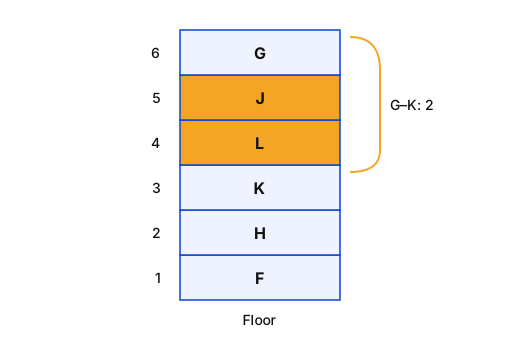
F, G, H, J, K and L live on six different floors of the same building. The lowermost floor in the building is numbered 1, the floor above it, number 2 and so on till the topmost floor is numbered 6. J lives immediately above L. Only two people live between F and L. F lives on an odd numbered floor. H lives immediately below K. How many people live between G and K?
F, G, H, J, K और L एक ही इमारत की छह अलग-अलग मंज़िलों पर रहते हैं। इमारत की सबसे निचली मंज़िल की संख्या 1 है, उसके ऊपर वाली मंज़िल की संख्या 2 है और इसी प्रकार सबसे ऊपरी मंज़िल की संख्या 6 है। J, L के ठीक ऊपर रहता है। F और L के बीच केवल दो व्यक्ति रहते हैं। F एक विषम संख्या वाली मंज़िल पर रहता है। H, K के ठीक नीचे रहता है। G और K के बीच कितने व्यक्ति रहते हैं?
  1. AFourचार
  2. BTwoदो
  3. COneएक
  4. DThreeतीन
Show answer

Concept: Place the fixed pair J–L, then test where F (odd floor, two people between F and L) can fit, and finally fit the H–K pair.

  1. L = 2, J = 3 → F = 5, but no two consecutive floors are left for H–K ✘. L = 3 or 5 → F would be on 6 or 2 (even) ✘. L = 1 → F = 4 (even) ✘.
  2. L = 4, J = 5 → F = 1 (odd) ✔. Free floors 2, 3, 6 → H = 2, K = 3, G = 6.
  3. Between G (6) and K (3): J and L → two people.

Trick: Start with the pair whose position is most restricted (J–L with F odd); only one case survives.

Answer: (B) Two

अवधारणा: जोड़ी J–L रखें, फिर देखें F (विषम मंज़िल, F और L के बीच दो लोग) कहाँ आ सकता है, अंत में H–K जोड़ी रखें।

  1. L = 2, J = 3 → F = 5, पर H–K के लिए लगातार दो मंज़िलें नहीं बचतीं ✘। L = 3 या 5 → F सम मंज़िल पर ✘। L = 1 → F = 4 (सम) ✘।
  2. L = 4, J = 5 → F = 1 (विषम) ✔। खाली 2, 3, 6 → H = 2, K = 3, G = 6।
  3. G (6) और K (3) के बीच: J और L → दो व्यक्ति।

ट्रिक: सबसे सीमित जोड़ी (J–L, F विषम) से शुरू करें; केवल एक स्थिति बचती है।

उत्तर: (B) दो

RRB NTPC Graduate CBT 1General Intelligence and ReasoningFloor PuzzleRRB NTPC Graduate CBT 1 2024 · 21 Jun Shift 3 →
Q671.
In this question, a group of numbers/symbols are coded using letter codes as per the codes given below and the conditions that follow. The correct combination of codes (following only the condition/s that apply) is your answer.
Note: If none of the conditions apply, then codes for the respective number/symbol are to be followed directly as given in the table.
Number/symbol4#$7926@3&5+%8
CodeBWQCATJNPDGEYS

Conditions:
(i) If the first element is a number and the last element is a symbol, then the codes for the first and last element are interchanged.
(ii) If the first element is divisible by 2 and the last element is divisible by 3, then the first and last elements are to be coded *.
(iii) If the first element is a symbol and the last element is an even number, then their codes (i.e. first and last element) are to be changed to the code for 3.
What is the code for the following?
@&238
इस प्रश्न में, संख्याओं/प्रतीकों के एक समूह को नीचे दिए गए कूटों और उसके बाद दी गई शर्तों के अनुसार अक्षर कूटों का उपयोग करके कूटबद्ध किया गया है। कूटों का सही संयोजन (केवल लागू होने वाली शर्त/शर्तों का पालन करते हुए) आपका उत्तर है।
नोट: यदि कोई भी शर्त लागू नहीं होती है, तो संबंधित संख्या/प्रतीक के लिए कूटों का सीधे तालिका में दिए गए अनुसार पालन किया जाना है।
संख्या/प्रतीक4#$7926@3&5+%8
कूटBWQCATJNPDGEYS

शर्तें:
(i) यदि पहला तत्व एक संख्या है और अंतिम तत्व एक प्रतीक है, तो पहले और अंतिम तत्व के कूट आपस में बदल दिए जाते हैं।
(ii) यदि पहला तत्व 2 से विभाज्य है और अंतिम तत्व 3 से विभाज्य है, तो पहले और अंतिम तत्व को * के रूप में कूटबद्ध किया जाना है।
(iii) यदि पहला तत्व एक प्रतीक है और अंतिम तत्व एक सम संख्या है, तो उनके कूटों (अर्थात् पहले और अंतिम तत्व) को 3 के कूट में बदल दिया जाना है।
निम्नलिखित के लिए कूट क्या है?
@&238
  1. ANDTPS
  2. BNDTPP
  3. CPDTPP
  4. DPDTPS
Show answer

Concept: Write the direct codes, then check which condition applies to the first and last elements.

  1. @&238: first @ (symbol), last 8 (even number) → condition (iii) applies; (i) and (ii) need a number first, so they fail.
  2. Direct codes: @ = N, & = D, 2 = T, 3 = P, 8 = S.
  3. By (iii) first and last both become the code for 3 = P → P D T P P.

Trick: Always check the type of first and last element (number/symbol, even/odd) before coding.

Answer: (C) PDTPP

अवधारणा: पहले सीधे कोड लिखें, फिर देखें पहले और अंतिम तत्व पर कौन-सी शर्त लागू होती है।

  1. @&238: पहला @ (प्रतीक), अंतिम 8 (सम संख्या) → शर्त (iii) लागू; (i) और (ii) में पहला तत्व संख्या होना चाहिए।
  2. सीधे कोड: @ = N, & = D, 2 = T, 3 = P, 8 = S।
  3. (iii) से पहला और अंतिम दोनों 3 का कोड = P → P D T P P।

ट्रिक: कोड लिखने से पहले पहले व अंतिम तत्व का प्रकार (संख्या/प्रतीक, सम/विषम) जाँचें।

उत्तर: (C) PDTPP

RRB NTPC Graduate CBT 1General Intelligence and ReasoningCoding with ConditionsRRB NTPC Graduate CBT 1 2024 · 21 Jun Shift 3 →
Q672.
This question is based on the five, three-digit numbers given below.
(Left) 325 503 158 391 144 (Right)
(Example- 697 – First digit = 6, second digit = 9 and third digit = 7)
(NOTE: All operations to be done from left to right.)
What will be the resultant if the second digit of the highest number is added to the first digit of the lowest number?
यह प्रश्न नीचे दी गई तीन अंकों वाली पाँच संख्याओं पर आधारित है।
(बाएँ) 325 503 158 391 144 (दाएँ)
(उदाहरण- 697 – पहला अंक = 6, दूसरा अंक = 9 और तीसरा अंक = 7)
(नोट: सभी संक्रियाएँ बाएँ से दाएँ की जानी हैं।)
यदि सबसे बड़ी संख्या के दूसरे अंक को सबसे छोटी संख्या के पहले अंक में जोड़ा जाए, तो परिणाम क्या होगा?
  1. A3
  2. B4
  3. C1
  4. D2
Show answer

Concept: Identify the highest and lowest numbers first, then pick the required digits.

  1. Highest = 503 → second digit 0.
  2. Lowest = 144 → first digit 1.
  3. 0+1=1

Trick: Arrange: 144 < 158 < 325 < 391 < 503.

Answer: (C) 1

अवधारणा: पहले सबसे बड़ी और सबसे छोटी संख्या पहचानें, फिर आवश्यक अंक लें।

  1. सबसे बड़ी = 503 → दूसरा अंक 0।
  2. सबसे छोटी = 144 → पहला अंक 1।
  3. 0+1=1

ट्रिक: क्रम: 144 < 158 < 325 < 391 < 503।

उत्तर: (C) 1

RRB NTPC Graduate CBT 1General Intelligence and ReasoningThree-digit Number OperationsRRB NTPC Graduate CBT 1 2024 · 21 Jun Shift 3 →
Q673.
72 is related to 9 following a certain logic. Following the same logic, 24 is related to 3. To which of the following is 64 related, following the same logic?
(NOTE: Operations should be performed on the whole numbers, without breaking down the numbers into their constituent digits. E.g. 13 – Operations on 13 such as
adding/subtracting/multiplying to 13 can be performed. Breaking down 13 into 1 and 3 and then performing mathematical operations on 1 and 3 is not allowed.)
72 एक निश्चित तर्क का अनुसरण करते हुए 9 से संबंधित है। उसी तर्क का अनुसरण करते हुए, 24, 3 से संबंधित है। उसी तर्क का अनुसरण करते हुए, 64 निम्नलिखित में से किससे संबंधित है?
(नोट: संख्याओं को उनके घटक अंकों में विभाजित किए बिना, पूर्ण संख्याओं पर संक्रियाएँ की जानी चाहिए। उदाहरण 13 – 13 पर संक्रियाएँ जैसे
13 में जोड़ना/घटाना/गुणा करना आदि किया जा सकता है। 13 को 1 और 3 में विभाजित करना और फिर 1 और 3 पर गणितीय संक्रियाएँ करने की अनुमति नहीं है।)
  1. A6
  2. B8
  3. C7
  4. D9
Show answer

Concept: Find one operation that turns the first number into the second in both given pairs.

  1. 72÷8=9 and 24÷8=3 → rule: divide by 8
  2. 64÷8=8

Trick: Both pairs share the same ratio 8 : 1 – check division first when the second number is much smaller.

Answer: (B) 8

अवधारणा: एक ऐसी संक्रिया खोजें जो दोनों युग्मों में पहली संख्या को दूसरी में बदल दे।

  1. 72÷8=9 तथा 24÷8=3 → नियम: 8 से भाग
  2. 64÷8=8

ट्रिक: जब दूसरी संख्या बहुत छोटी हो, पहले भाग का नियम जाँचें।

उत्तर: (B) 8

RRB NTPC Graduate CBT 1General Intelligence and ReasoningNumber AnalogyRRB NTPC Graduate CBT 1 2024 · 21 Jun Shift 3 →
Q674.
If 2 is added to each even digit and 2 is subtracted from each odd digit in the number 6597423, what will be the sum of all the even digits in the new number thus formed?
यदि संख्या 6597423 में प्रत्येक सम अंक में 2 जोड़ा जाए और प्रत्येक विषम अंक में से 2 घटाया जाए, तो इस प्रकार बनी नई संख्या में सभी सम अंकों का योग क्या होगा?
  1. A20
  2. B14
  3. C16
  4. D18
Show answer

Concept: Change each digit as instructed, then add the even digits of the new number.

  1. 6597423 → 6+2 = 8, 5−2 = 3, 9−2 = 7, 7−2 = 5, 4+2 = 6, 2+2 = 4, 3−2 = 1
  2. New number: 8375641
  3. Even digits 8, 6, 4 → sum = 18

Trick: Adding/subtracting 2 keeps parity: only the old even digits (6, 4, 2) stay even → 8 + 6 + 4.

Answer: (D) 18

अवधारणा: निर्देश अनुसार हर अंक बदलें, फिर नई संख्या के सम अंकों को जोड़ें।

  1. 6597423 → 6+2 = 8, 5−2 = 3, 9−2 = 7, 7−2 = 5, 4+2 = 6, 2+2 = 4, 3−2 = 1
  2. नई संख्या: 8375641
  3. सम अंक 8, 6, 4 → योग = 18

ट्रिक: 2 जोड़ने/घटाने से सम-विषम नहीं बदलता: पुराने सम अंक (6, 4, 2) ही सम रहते हैं → 8 + 6 + 4।

उत्तर: (D) 18

RRB NTPC Graduate CBT 1General Intelligence and ReasoningDigit OperationsRRB NTPC Graduate CBT 1 2024 · 21 Jun Shift 3 →
Q675.
What should come in place of the question mark (?) in the given series?
135 123 109 93 75 ?
दी गई श्रृंखला में प्रश्न चिह्न (?) के स्थान पर क्या आना चाहिए?
135 123 109 93 75 ?
  1. A65
  2. B55
  3. C45
  4. D75
Show answer

Concept: Look at the differences between consecutive terms.

  1. 135 → 123 → 109 → 93 → 75: differences −12, −14, −16, −18
  2. Next difference −20 → 75 − 20 = 55

Trick: Differences grow by 2 each time.

Answer: (B) 55

अवधारणा: क्रमागत पदों का अंतर देखें।

  1. 135 → 123 → 109 → 93 → 75: अंतर −12, −14, −16, −18
  2. अगला अंतर −20 → 75 − 20 = 55

ट्रिक: अंतर हर बार 2 बढ़ता है।

उत्तर: (B) 55

RRB NTPC Graduate CBT 1General Intelligence and ReasoningNumber SeriesRRB NTPC Graduate CBT 1 2024 · 21 Jun Shift 3 →
Q676.
Which of the given letter-clusters should replace # and % so that the pattern and relationship followed between the letter-cluster pair on the left side of :: is the same as that on the right side of ::?
# : PKN :: TOR : %
दिए गए अक्षर-समूहों में से कौन-सा # और % को प्रतिस्थापित करे ताकि :: के बाईं ओर के अक्षर-समूह युग्म के बीच का पैटर्न और संबंध वही हो जो :: के दाईं ओर है?
# : PKN :: TOR : %
  1. A# = KFI, % = YTW
  2. B# = KFL, % = YPG
  3. C# = KPJ, % = YOJ
  4. D# = LJY, % = YVX
Show answer

Concept: Find the letter-wise shift in the right pair and apply the same shift on the left.

  1. Option (A): KFI → PKN: K+5 = P, F+5 = K, I+5 = N.
  2. TOR → YTW: T+5 = Y, O+5 = T, R+5 = W.
  3. Both pairs follow +5 on every letter.

Trick: Use place values: K(11)→P(16), T(20)→Y(25) – same +5 shift.

Answer: (A) # = KFI, % = YTW

अवधारणा: दाएँ युग्म में अक्षरवार अंतर देखें और वही अंतर बाएँ युग्म पर लगाएँ।

  1. विकल्प (A): KFI → PKN: K+5 = P, F+5 = K, I+5 = N।
  2. TOR → YTW: T+5 = Y, O+5 = T, R+5 = W।
  3. दोनों में हर अक्षर +5।

ट्रिक: स्थानीय मान: K(11)→P(16), T(20)→Y(25) – समान +5।

उत्तर: (A) # = KFI, % = YTW

RRB NTPC Graduate CBT 1General Intelligence and ReasoningLetter AnalogyRRB NTPC Graduate CBT 1 2024 · 21 Jun Shift 3 →
Q677.
Based on the English alphabetical order, three of the following four letter-clusters are alike in a certain way and thus form a group. Which letter-cluster DOES NOT belong to that group?
(Note: The odd one out is not based on the number of consonants/vowels or their position in the letter-cluster.)
अंग्रेज़ी वर्णमाला क्रम के आधार पर, निम्नलिखित चार अक्षर-समूहों में से तीन किसी निश्चित प्रकार से एकसमान हैं और इस प्रकार एक समूह बनाते हैं। कौन-सा अक्षर-समूह उस समूह से संबंधित नहीं है?
(नोट: असंगत अक्षर-समूह, उस अक्षर-समूह में व्यंजनों/स्वरों की संख्या या उनके स्थान पर आधारित नहीं है।)
  1. AGLOS
  2. BEJNQ
  3. CZEHL
  4. DYDGK
Show answer

Concept: Write the alphabet positions and check the gaps between letters (wrap around after Z).

  1. GLOS: 7, 12, 15, 19 → +5, +3, +4
  2. ZEHL: 26, 5, 8, 12 → +5, +3, +4 ; YDGK: 25, 4, 7, 11 → +5, +3, +4
  3. EJNQ: 5, 10, 14, 17 → +5, +4, +3 – different order

Trick: After Z continue A = 27, so Z→E is +5.

Answer: (B) EJNQ

अवधारणा: अक्षरों के स्थान लिखें और अंतर जाँचें (Z के बाद फिर A)।

  1. GLOS: 7, 12, 15, 19 → +5, +3, +4
  2. ZEHL: 26, 5, 8, 12 → +5, +3, +4 ; YDGK: 25, 4, 7, 11 → +5, +3, +4
  3. EJNQ: 5, 10, 14, 17 → +5, +4, +3 – क्रम अलग

ट्रिक: Z के बाद A = 27 मानें, तो Z→E = +5।

उत्तर: (B) EJNQ

RRB NTPC Graduate CBT 1General Intelligence and ReasoningOdd One Out – LettersRRB NTPC Graduate CBT 1 2024 · 21 Jun Shift 3 →
Q678.
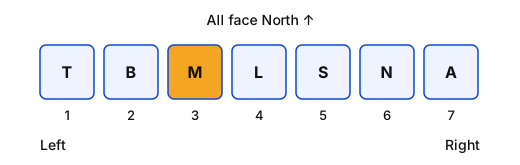
Seven people, A, B, L, M, N, S, and T are sitting in a row, facing north. Only five people sit between T and A. N sits to the immediate left of A. Only one person sits between N and L. M sits at some place to the left of S but at some place to the right of B. Who sits third from the left end of the line?
सात व्यक्ति, A, B, L, M, N, S और T, उत्तर की ओर मुख करके एक पंक्ति में बैठे हैं। T और A के बीच केवल पाँच व्यक्ति बैठे हैं। N, A के ठीक बाईं ओर बैठा है। N और L के बीच केवल एक व्यक्ति बैठा है। M, S के बाईं ओर किसी स्थान पर, लेकिन B के दाईं ओर किसी स्थान पर बैठा है। पंक्ति के बाएँ छोर से तीसरे स्थान पर कौन बैठा है?
  1. AA
  2. BT
  3. CM
  4. DB
Show answer

Concept: Seven seats; five people between T and A puts them at the two ends.

  1. N is immediately left of A, so A cannot be at the left end → A = 7, N = 6, T = 1.
  2. One person between N and L → L = 4.
  3. Seats 2, 3, 5 remain for B, M, S with B left of M left of S → B = 2, M = 3, S = 5.
  4. Third from the left = M.

Trick: In a row of 7, '5 between' always means both are at the ends.

Answer: (C) M

अवधारणा: सात सीटें; T और A के बीच पाँच लोग → दोनों सिरों पर।

  1. N, A के ठीक बाएँ है, अतः A बाएँ सिरे पर नहीं → A = 7, N = 6, T = 1।
  2. N और L के बीच एक व्यक्ति → L = 4।
  3. सीट 2, 3, 5 पर B, M, S; B, M के बाएँ और M, S के बाएँ → B = 2, M = 3, S = 5।
  4. बाएँ से तीसरा = M।

ट्रिक: 7 की पंक्ति में 'बीच में 5' = दोनों सिरों पर।

उत्तर: (C) M

RRB NTPC Graduate CBT 1General Intelligence and ReasoningLinear SeatingRRB NTPC Graduate CBT 1 2024 · 21 Jun Shift 3 →
Q679.
In a certain code language, ‘please go down’ is coded as ‘ta wk vb’ and ‘down the drain’ is coded as ‘cm dg wk’. How is ‘down’ coded in the given language?
एक निश्चित कूट भाषा में, ‘please go down’ को ‘ta wk vb’ के रूप में कूटबद्ध किया जाता है और ‘down the drain’ को ‘cm dg wk’ के रूप में कूटबद्ध किया जाता है। दी गई भाषा में ‘down’ को किस प्रकार कूटबद्ध किया जाता है?
  1. Avb
  2. Bcm
  3. Cdg
  4. Dwk
Show answer

Concept: A word common to two sentences takes the code common to both.

  1. 'please go down' → ta wk vb
  2. 'down the drain' → cm dg wk
  3. Common word 'down', common code 'wk'.

Trick: Common word ↔ common code.

Answer: (D) wk

अवधारणा: दो वाक्यों में समान शब्द का कोड भी समान होता है।

  1. 'please go down' → ta wk vb
  2. 'down the drain' → cm dg wk
  3. समान शब्द 'down', समान कोड 'wk'।

ट्रिक: समान शब्द ↔ समान कोड।

उत्तर: (D) wk

RRB NTPC Graduate CBT 1General Intelligence and ReasoningCoding–DecodingRRB NTPC Graduate CBT 1 2024 · 21 Jun Shift 3 →
Q680.
KORJ is related to DHKC in a certain way based on the English alphabetical order. In the same way, IMPH is related to BFIA. To which of the given options is NRUM related, following the same logic?
अंग्रेज़ी वर्णमाला क्रम के आधार पर KORJ एक निश्चित प्रकार से DHKC से संबंधित है। उसी प्रकार, IMPH, BFIA से संबंधित है। उसी तर्क का अनुसरण करते हुए, NRUM दिए गए विकल्पों में से किससे संबंधित है?
  1. AKGFN
  2. BGKNF
  3. CKGNF
  4. DGKFN
Show answer

Concept: Each letter is moved by a fixed number of places in the alphabet.

  1. KORJ → DHKC: K(11)→D(4), O(15)→H(8), R(18)→K(11), J(10)→C(3); each letter −7.
  2. Check IMPH → BFIA: I(9)→B(2), M→F, P→I, H→A; again −7.
  3. NRUM: N(14)→G(7), R(18)→K(11), U(21)→N(14), M(13)→F(6).

Trick: Find the shift with the first letter only, verify with one more pair, then apply.

Answer: (B) GKNF

अवधारणा: हर अक्षर को वर्णमाला में एक निश्चित संख्या से खिसकाया गया है।

  1. KORJ → DHKC: K(11)→D(4), O(15)→H(8), R(18)→K(11), J(10)→C(3); हर अक्षर −7।
  2. जाँच IMPH → BFIA: I(9)→B(2), M→F, P→I, H→A; फिर से −7।
  3. NRUM: N(14)→G(7), R(18)→K(11), U(21)→N(14), M(13)→F(6)।

ट्रिक: पहले अक्षर से shift निकालें, एक और जोड़ी से जाँचें, फिर लागू करें।

उत्तर: (B) GKNF

RRB NTPC Graduate CBT 1General Intelligence and ReasoningLetter AnalogyRRB NTPC Graduate CBT 1 2024 · 21 Jun Shift 3 →