Question bank

Q&A: practice questions with answers

Search questions on any topic. Filter by exam category, exam, subject and topic, try the question, then open the answer and explanation.

Courses – airGurukul

7,077 questions found.

Q6821.
During a sale 50% of the goods are sold at 16% profit, 40% of the remaining goods are sold at 35% profit and the still remaining goods are sold at a loss of 25%. If there is an overall profit of x%, then what is the value of x?
एक बिक्री के दौरान 50% वस्तुएँ 16% लाभ पर बेची जाती हैं, शेष वस्तुओं का 40% भाग 35% लाभ पर बेचा जाता है और उसके बाद शेष बची वस्तुएँ 25% हानि पर बेची जाती हैं। यदि कुल मिलाकर x% लाभ होता है, तो x का मान क्या है?
  1. A7.5
  2. B8
  3. C6
  4. D9
Show answer

Concept: Take total cost as 100 and add the profit (or loss) of each part.

  1. 50% of goods at 16% profit: profit =50×0.16=8.
  2. 40% of the remaining 50% = 20% of goods at 35% profit: 20×0.35=7.
  3. Remaining 30% at 25% loss: 30×0.25=7.5 loss.
  4. Net =8+7−7.5=7.5 on cost 100, so x=7.5.

Trick: Weighted average: 0.5(16)+0.2(35)+0.3(−25)=8+7−7.5=7.5%.

Answer: (A) 7.5

अवधारणा: कुल लागत 100 मानकर हर भाग का लाभ/हानि जोड़ें।

  1. 50% माल 16% लाभ पर: 50×0.16=8।
  2. शेष 50% का 40% = 20% माल 35% लाभ पर: 20×0.35=7।
  3. बचा 30% माल 25% हानि पर: 30×0.25=7.5 हानि।
  4. कुल =8+7−7.5=7.5, अतः x=7.5।

ट्रिक: भारित औसत: 0.5(16)+0.2(35)+0.3(−25)=7.5%।

उत्तर: (A) 7.5

RRB NTPC Graduate CBT 1MathematicsProfit and loss – mixed saleRRB NTPC Graduate CBT 1 2025 · 16 Mar Shift 3 →
Q6822.
A shopkeeper fixes the marked price of an item 180% above its cost price. What percentage of discount on marked price should be allowed to gain 12%?
एक दुकानदार किसी वस्तु का अंकित मूल्य उसके क्रय मूल्य से 180% अधिक निर्धारित करता है। 12% लाभ प्राप्त करने के लिए अंकित मूल्य पर कितने प्रतिशत छूट दी जानी चाहिए?
  1. A60%
  2. B58%
  3. C57%
  4. D62%
Show answer

Concept: Discount%=MP−SPMP×100.

  1. Let CP = 100. MP = 180% above CP = 280.
  2. For 12% gain, SP = 112.
  3. Discount =280−112=168; 168280×100=60%.

Trick: SPMP=112280=25=40%, so discount =60%.

Answer: (A) 60%

अवधारणा: छूट%=MP−SPMP×100।

  1. CP = 100 मानें। MP = CP से 180% अधिक = 280।
  2. 12% लाभ के लिए SP = 112।
  3. छूट =280−112=168; 168280×100=60%।

ट्रिक: SPMP=112280=25=40%, अतः छूट =60%।

उत्तर: (A) 60%

RRB NTPC Graduate CBT 1MathematicsDiscount and marked priceRRB NTPC Graduate CBT 1 2025 · 16 Mar Shift 3 →
Q6823.
A shopkeeper purchased 62 dozens of articles at the rate of ₹100 per dozen. He sold each one of them at the rate of ₹75. What percentage profit did he make?
एक दुकानदार ने ₹100 प्रति दर्जन की दर से 62 दर्जन वस्तुएँ खरीदीं। उसने उनमें से प्रत्येक को ₹75 की दर से बेच दिया। उसने कितने प्रतिशत लाभ अर्जित किया?
  1. A800%
  2. B801%
  3. C797%
  4. D798%
Show answer

Concept: Compare cost and selling price of one article, then Profit%=SP−CPCP×100.

  1. CP of one article =10012=253 rupees.
  2. SP of one article =75; profit =75−253=2003.
  3. Profit%=200/325/3×100=8×100=800%.

Trick: SPCP=75×12100=9, so SP is 9 times CP → profit =800%. The '62 dozens' is a distractor.

Answer: (A) 800%

अवधारणा: एक वस्तु का CP और SP तुलना करें, फिर लाभ%=SP−CPCP×100।

  1. एक वस्तु का CP =10012=253 रुपये।
  2. SP =75; लाभ =75−253=2003।
  3. लाभ%=200/325/3×100=800%।

ट्रिक: SPCP=75×12100=9, अर्थात SP = 9 × CP → लाभ =800%। '62 दर्जन' केवल भटकाने के लिए है।

उत्तर: (A) 800%

RRB NTPC Graduate CBT 1MathematicsProfit percentageRRB NTPC Graduate CBT 1 2025 · 16 Mar Shift 3 →
Q6824.
Find the average of 312, 126, 100 and 99.
312, 126, 100 और 99 का औसत ज्ञात कीजिए।
  1. A157.25
  2. B159.25
  3. C156.25
  4. D158.25
Show answer

Concept: Average=SumCount.

  1. Sum =312+126+100+99=637.
  2. Average =6374=159.25.

Trick: Take 100 as base: deviations +212,+26,0,−1 sum to 237; 2374=59.25 → 159.25.

Answer: (B) 159.25

अवधारणा: औसत=योगसंख्या।

  1. योग =312+126+100+99=637।
  2. औसत =6374=159.25।

ट्रिक: 100 आधार लें: विचलन +212,+26,0,−1 का योग 237; 2374=59.25 → 159.25।

उत्तर: (B) 159.25

RRB NTPC Graduate CBT 1MathematicsAverageRRB NTPC Graduate CBT 1 2025 · 16 Mar Shift 3 →
Q6825.
There are 72 members in group A, 12 members in group B and 87 members in group C. All the members of these groups went to a restaurant. The average amounts spent on each member of groups A, B and C are ₹404, ₹316 and ₹424, respectively. The overall average amount (in ₹) spent per member is:
समूह A में 72 सदस्य, समूह B में 12 सदस्य और समूह C में 87 सदस्य हैं। इन समूहों के सभी सदस्य एक रेस्तरां में गए। समूह A, B और C के प्रत्येक सदस्य पर खर्च की गई औसत राशि क्रमशः ₹404, ₹316 और ₹424 है। प्रति सदस्य खर्च की गई कुल औसत राशि (₹ में) है:
  1. A404
  2. B412
  3. C408
  4. D409
Show answer

Concept: Overall average=∑(members×average)total members.

  1. Total spent =72×404+12×316+87×424=29088+3792+36888=69768.
  2. Total members =72+12+87=171.
  3. Average =69768171=408.

Trick: Take 400 as base: deviations 72×4+12×(−84)+87×24=288−1008+2088=1368; 1368171=8 → 408.

Answer: (C) 408

अवधारणा: कुल औसत=∑(सदस्य×औसत)कुल सदस्य।

  1. कुल खर्च =72×404+12×316+87×424=69768।
  2. कुल सदस्य =171।
  3. औसत =69768171=408।

ट्रिक: 400 आधार लें: विचलन 72×4+12×(−84)+87×24=1368; 1368171=8 → 408।

उत्तर: (C) 408

RRB NTPC Graduate CBT 1MathematicsWeighted averageRRB NTPC Graduate CBT 1 2025 · 16 Mar Shift 3 →
Q6826.
If 160% of 75% of A is equal to two times the value of 150% of B, then A is more/less than B by how much percentage?
यदि A के 75% का 160%, B के 150% के मान के दोगुने के बराबर है, तो A, B से कितने प्रतिशत अधिक/कम है?
  1. A150%, less150%, कम
  2. B150%, more150%, अधिक
  3. C60%, less60%, कम
  4. D60%, more60%, अधिक
Show answer

Concept: Form the equation, find the ratio A : B, then compare with B as base.

  1. 160% of 75% of A=1.6×0.75A=1.2A.
  2. 2×150% of B=3B. So 1.2A=3B⇒A=2.5B.
  3. A exceeds B by 1.5B, i.e. 150% more.

Trick: A:B=3:1.2=5:2; difference 3 on base 2 =150%.

Answer: (B) 150%, more

अवधारणा: समीकरण बनाएँ, A : B निकालें, फिर B को आधार मानकर तुलना करें।

  1. A का 75% का 160% =1.6×0.75A=1.2A।
  2. B के 150% का दोगुना =3B। अतः 1.2A=3B⇒A=2.5B।
  3. A, B से 1.5B अधिक अर्थात 150% अधिक।

ट्रिक: A:B=3:1.2=5:2; आधार 2 पर अंतर 3 =150%।

उत्तर: (B) 150%, more

RRB NTPC Graduate CBT 1MathematicsPercentage comparisonRRB NTPC Graduate CBT 1 2025 · 16 Mar Shift 3 →
Q6827.
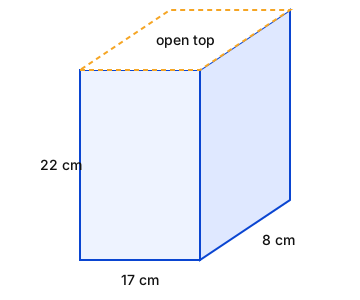
The internal surface area (in cm2) of an open (at the top) cuboidal box whose internal length, breadth and height are 8 cm, 17 cm and 22 cm, respectively, is:
ऊपर से खुले एक घनाभाकार बक्से का आंतरिक पृष्ठीय क्षेत्रफल (cm2 में) कितना है, जिसकी आंतरिक लंबाई, चौड़ाई और ऊँचाई क्रमशः 8 cm, 17 cm और 22 cm है?
  1. A1236
  2. B1215
  3. C1189
  4. D1238
Show answer

Concept: An open box has 5 faces: base + 4 walls. Internal surface area =lb+2h(l+b).

  1. l=8, b=17, h=22 (cm).
  2. Base =8×17=136.
  3. Walls =2×22×(8+17)=44×25=1100.
  4. Total =136+1100=1236cm2.

Trick: Total surface area 2(lb+bh+hl) minus one lb gives the open-box area; here 2(136+374+176)−136=1236.

Answer: (A) 1236

अवधारणा: खुले डिब्बे की 5 सतहें: आधार + 4 दीवारें। आंतरिक पृष्ठीय क्षेत्रफल =lb+2h(l+b)।

  1. l=8, b=17, h=22 (cm)।
  2. आधार =8×17=136।
  3. दीवारें =2×22×(8+17)=1100।
  4. कुल =136+1100=1236cm2।

ट्रिक: पूर्ण पृष्ठीय क्षेत्रफल 2(lb+bh+hl) में से एक lb घटाएँ: 2(136+374+176)−136=1236।

उत्तर: (A) 1236

RRB NTPC Graduate CBT 1MathematicsMensuration – open cuboidRRB NTPC Graduate CBT 1 2025 · 16 Mar Shift 3 →
Q6828.
Three positive integers, A, B, and C, are such that the least common multiple of A and B is 24, the least common multiple of B and C is 36, and the least common multiple of C and A is 72. If the numbers are taken to be as small as possible, the value of A + B + C is:
तीन धनात्मक पूर्णांक A, B और C इस प्रकार हैं कि A और B का लघुत्तम समापवर्त्य 24 है, B और C का लघुत्तम समापवर्त्य 36 है, और C और A का लघुत्तम समापवर्त्य 72 है। यदि संख्याओं को यथासंभव छोटा लिया जाए, तो A + B + C का मान है:
  1. A25
  2. B27
  3. C29
  4. D31
Show answer

Concept: The LCM of two numbers carries the highest power of each prime present in either number.

  1. 24=23×3, 36=22×32, 72=23×32.
  2. 23 appears in LCM(A,B) and LCM(C,A) but not in LCM(B,C), so 23 must be in A (not B, not C).
  3. 32 appears in LCM(B,C) and LCM(C,A) but not in LCM(A,B), so 32 is in C.
  4. Smallest: A=8, C=9; B needs a 3 (for LCM 24) and a 4 (for LCM 36) → B=12. Sum =8+12+9=29.

Trick: A prime power missing from exactly one LCM must sit in the number not involved in that LCM.

Answer: (C) 29

अवधारणा: दो संख्याओं के LCM में हर अभाज्य की सबसे ऊँची घात आती है।

  1. 24=23×3, 36=22×32, 72=23×32।
  2. 23 LCM(A,B) और LCM(C,A) में है पर LCM(B,C) में नहीं → 23 केवल A में।
  3. 32 LCM(B,C) और LCM(C,A) में है पर LCM(A,B) में नहीं → 32 केवल C में।
  4. न्यूनतम: A=8, C=9; B में 3 (LCM 24 के लिए) और 4 (LCM 36 के लिए) चाहिए → B=12। योग =29।

ट्रिक: जो अभाज्य-घात ठीक एक LCM से गायब है, वह उस संख्या में है जो उस LCM में शामिल नहीं।

उत्तर: (C) 29

RRB NTPC Graduate CBT 1MathematicsLCM – prime factor logicRRB NTPC Graduate CBT 1 2025 · 16 Mar Shift 3 →
Q6829.
Find the median from the following data.
Age in years20-3030-4040-5050-6060-7070-8080-90
No. of patients11182815223113
निम्नलिखित आँकड़ों से माध्यिका (median) ज्ञात कीजिए।
आयु (वर्षों में): 20-30, 30-40, 40-50, 50-60, 60-70, 70-80, 80-90
रोगियों की संख्या: 11, 18, 28, 15, 22, 31, 13
  1. A60
  2. B55
  3. C58
  4. D69
Show answer

Concept: Median=l+N2−cff×h, where l = lower limit of the median class.

  1. N=11+18+28+15+22+31+13=138, so N2=69.
  2. Cumulative frequencies: 11, 29, 57, 72, … → 69 falls in class 50–60 (cf=57, f=15, h=10).
  3. Median=50+69−5715×10=50+8=58.

Trick: The median class is the first class whose cumulative frequency reaches N2.

Answer: (C) 58

अवधारणा: माध्यिका=l+N2−cff×h, जहाँ l = माध्यिका वर्ग की निचली सीमा।

  1. N=138, अतः N2=69।
  2. संचयी बारंबारता: 11, 29, 57, 72, … → 69 वर्ग 50–60 में (cf=57, f=15, h=10)।
  3. माध्यिका=50+69−5715×10=58।

ट्रिक: माध्यिका वर्ग वह पहला वर्ग है जिसकी संचयी बारंबारता N2 तक पहुँचे।

उत्तर: (C) 58

RRB NTPC Graduate CBT 1MathematicsStatistics – median of grouped dataRRB NTPC Graduate CBT 1 2025 · 16 Mar Shift 3 →
Q6830.
Six years hence, a father's age will be 3 times the age of his son. Six years ago, the father was 7 times as old as his son. Find the present ages (in years) of the father and son.
छह वर्ष बाद, एक पिता की आयु अपने पुत्र की आयु की 3 गुनी होगी। छह वर्ष पहले, पिता की आयु पुत्र की आयु की 7 गुनी थी। पिता और पुत्र की वर्तमान आयु (वर्षों में) ज्ञात कीजिए।
  1. A50 and 1450 और 14
  2. B46 and 1046 और 10
  3. C52 and 1652 और 16
  4. D48 and 1248 और 12
Show answer

Concept: Let present ages be F and S; write one equation for each time statement.

  1. Six years hence: F+6=3(S+6)⇒F=3S+12.
  2. Six years ago: F−6=7(S−6)⇒F=7S−36.
  3. 3S+12=7S−36⇒4S=48⇒S=12, F=48.

Trick: Check with options: 48+6=54=3×18 ✓ and 48−6=42=7×6 ✓.

Answer: (D) 48 and 12

अवधारणा: वर्तमान आयु F और S मानें; हर समय-कथन का एक समीकरण बनाएँ।

  1. छह वर्ष बाद: F+6=3(S+6)⇒F=3S+12।
  2. छह वर्ष पहले: F−6=7(S−6)⇒F=7S−36।
  3. 3S+12=7S−36⇒S=12, F=48।

ट्रिक: विकल्प से जाँच: 48+6=54=3×18 ✓ और 48−6=42=7×6 ✓।

उत्तर: (D) 48 और 12

RRB NTPC Graduate CBT 1MathematicsProblems on agesRRB NTPC Graduate CBT 1 2025 · 16 Mar Shift 3 →
Q6831.
If 30% of 80−47×7293×49=y, then the value of y is
यदि 30% of 80−47×7293×49=y, तो y का मान है
  1. A-7
  2. B-3
  3. C-12
  4. D-8
Show answer

Concept: Evaluate percentages and roots first, then multiply, then subtract (BODMAS).

  1. 30% of 80=24.
  2. 7293=9, 49=7, so 47×9×7=36.
  3. y=24−36=−12.

Trick: The 7 in 47 cancels with 49=7, leaving 4×9=36 instantly.

Answer: (C) −12

अवधारणा: पहले प्रतिशत और मूल निकालें, फिर गुणा, फिर घटाव (BODMAS)।

  1. 80 का 30% =24।
  2. 7293=9, 49=7, अतः 47×9×7=36।
  3. y=24−36=−12।

ट्रिक: 47 का 7, 49=7 से कट जाता है; बचा 4×9=36।

उत्तर: (C) −12

RRB NTPC Graduate CBT 1MathematicsSimplification – roots and percentageRRB NTPC Graduate CBT 1 2025 · 16 Mar Shift 3 →
Q6832.
A typist takes 40 minutes to type 2 pages. How long (in minutes) will he take to type 91 pages?
एक टाइपिस्ट 2 पृष्ठ टाइप करने में 40 मिनट लेता है। 91 पृष्ठ टाइप करने में वह कितना समय (मिनट में) लेगा?
  1. A1825
  2. B1810
  3. C1820
  4. D1830
Show answer

Concept: Time is directly proportional to the number of pages.

  1. Time per page =402=20 minutes.
  2. For 91 pages: 91×20=1820 minutes.

Trick: 91×2=182, add a zero → 1820.

Answer: (C) 1820

अवधारणा: समय पृष्ठों की संख्या के समानुपाती है।

  1. एक पृष्ठ का समय =402=20 मिनट।
  2. 91 पृष्ठ: 91×20=1820 मिनट।

ट्रिक: 91×2=182, एक शून्य जोड़ें → 1820।

उत्तर: (C) 1820

RRB NTPC Graduate CBT 1MathematicsUnitary methodRRB NTPC Graduate CBT 1 2025 · 16 Mar Shift 3 →
Q6833.
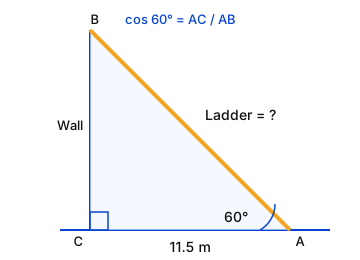
Find the length of the ladder if the angle of elevation of the ladder against a wall is 60° and the foot of the ladder is 11.5 m away from the wall.
यदि दीवार के सहारे रखी एक सीढ़ी का उन्नयन कोण 60° है और सीढ़ी का पाद दीवार से 11.5 m की दूरी पर है, तो सीढ़ी की लंबाई ज्ञात कीजिए।
  1. A23 m
  2. B2332 m
  3. C233 cm
  4. D11.5 m
Show answer

Concept: The ladder, wall and ground form a right triangle. With the angle of elevation θ at the foot, cosθ=distance from wallladder.

  1. Foot of ladder from wall =11.5m, θ=60∘.
  2. cos60∘=12=11.5L
  3. L=2×11.5=23m.

Trick: At 60∘ the hypotenuse is always double the side next to the angle (1:3:2 triangle).

Answer: (A) 23 m

अवधारणा: सीढ़ी, दीवार और ज़मीन एक समकोण त्रिभुज बनाते हैं। पाद पर उन्नयन कोण θ हो तो cosθ=दीवार से दूरीसीढ़ी।

  1. सीढ़ी का पाद दीवार से 11.5m, θ=60∘।
  2. cos60∘=12=11.5L
  3. L=2×11.5=23m।

ट्रिक: 60∘ पर कर्ण हमेशा कोण से लगी भुजा का दोगुना होता है (1:3:2 त्रिभुज)।

उत्तर: (A) 23 m

RRB NTPC Graduate CBT 1MathematicsHeights and DistancesRRB NTPC Graduate CBT 1 2025 · 16 Mar Shift 3 →
Q6834.
If 45% of 20−46×7293×36=y, then the value of y is
यदि 45% का 20−46×7293×36=y, तो y का मान है
  1. A-27
  2. B-35
  3. C-30
  4. D-21
Show answer

Concept: Evaluate roots and percentages first, then multiply, then subtract (BODMAS).

  1. 45% of 20=9; 7293=9; 36=6.
  2. 46×9×6=4×9=36.
  3. y=9−36=−27.

Trick: 46×6 cancels at once to 4 – avoid decimals.

Answer: (A) −27

अवधारणा: पहले मूल और प्रतिशत निकालें, फिर गुणा, फिर घटाव (BODMAS)।

  1. 20 का 45%=9; 7293=9; 36=6।
  2. 46×9×6=4×9=36।
  3. y=9−36=−27।

ट्रिक: 46×6 सीधे 4 हो जाता है – दशमलव से बचें।

उत्तर: (A) −27

RRB NTPC Graduate CBT 1MathematicsSimplification (BODMAS)RRB NTPC Graduate CBT 1 2025 · 16 Mar Shift 3 →
Q6835.
What should come in place of ‘?’ in the given series?
33 40 54 75 103 ?
दी गई श्रेणी में ‘?’ के स्थान पर क्या आना चाहिए?
33 40 54 75 103 ?
  1. A142
  2. B140
  3. C138
  4. D145
Show answer

Concept: Check the differences between consecutive terms.

  1. 40−33=7, 54−40=14, 75−54=21, 103−75=28.
  2. Differences are multiples of 7: 7,14,21,28, so next is 35.
  3. 103+35=138.

Trick: Differences in a table of a number (here 7) is the commonest CBT 1 pattern.

Answer: (C) 138

अवधारणा: क्रमागत पदों के अंतर देखें।

  1. 40−33=7, 54−40=14, 75−54=21, 103−75=28।
  2. अंतर 7 के गुणज हैं: 7,14,21,28, अगला 35।
  3. 103+35=138।

ट्रिक: किसी संख्या के पहाड़े में अंतर (यहाँ 7) CBT 1 का सबसे आम पैटर्न है।

उत्तर: (C) 138

RRB NTPC Graduate CBT 1MathematicsNumber SeriesRRB NTPC Graduate CBT 1 2025 · 16 Mar Shift 3 →
Q6836.
If (a+1a)=4, then what is the value of (a5+1a5)?
यदि (a+1a)=4, तो (a5+1a5) का मान क्या है?
  1. A724
  2. B709
  3. C776
  4. D770
Show answer

Concept: From a+1a build higher powers: a2+1a2=(a+1a)2−2, a3+1a3=(a+1a)3−3(a+1a), and a5+1a5=(a2+1a2)(a3+1a3)−(a+1a).

  1. a2+1a2=16−2=14.
  2. a3+1a3=64−12=52.
  3. a5+1a5=14×52−4=728−4=724.

Trick: Multiply the 2nd and 3rd power sums and subtract the 1st – works for any a+1a.

Answer: (A) 724

अवधारणा: a+1a से ऊँची घातें बनाएँ: a2+1a2=(a+1a)2−2, a3+1a3=(a+1a)3−3(a+1a), और a5+1a5=(a2+1a2)(a3+1a3)−(a+1a)।

  1. a2+1a2=16−2=14।
  2. a3+1a3=64−12=52।
  3. a5+1a5=14×52−4=728−4=724।

ट्रिक: दूसरी और तीसरी घात के योग गुणा करें, पहली घटा दें – हर a+1a पर लागू।

उत्तर: (A) 724

RRB NTPC Graduate CBT 1MathematicsAlgebra – Power IdentitiesRRB NTPC Graduate CBT 1 2025 · 16 Mar Shift 3 →
Q6837.
If 4 : 28 :: 4.1 : x and 4 : 32 :: 3 : y, then what is the ratio of x to y?
यदि 4 : 28 :: 4.1 : x और 4 : 32 :: 3 : y, तो x और y का अनुपात क्या है?
  1. A287 : 240
  2. B285 : 241
  3. C288 : 238
  4. D291 : 250
Show answer

Concept: In a:b::c:d, d=b×ca.

  1. x=28×4.14=7×4.1=28.7.
  2. y=32×34=24.
  3. x:y=28.7:24=287:240.

Trick: 4:28 means ×7 and 4:32 means ×8 – just multiply 4.1×7 and 3×8.

Answer: (A) 287 : 240

अवधारणा: a:b::c:d में d=b×ca।

  1. x=28×4.14=7×4.1=28.7।
  2. y=32×34=24।
  3. x:y=28.7:24=287:240।

ट्रिक: 4:28 यानी ×7 और 4:32 यानी ×8 – बस 4.1×7 और 3×8 करें।

उत्तर: (A) 287 : 240

RRB NTPC Graduate CBT 1MathematicsProportionRRB NTPC Graduate CBT 1 2025 · 16 Mar Shift 3 →
Q6838.
Madhu and Madhuri start a business by investing in the ratio 31 : 34. If total profit is ₹44,850, then what is the difference between the shares of profit (in ₹) of Madhu and Madhuri?
मधु और माधुरी 31 : 34 के अनुपात में निवेश करके एक व्यापार शुरू करते हैं। यदि कुल लाभ ₹44,850 है, तो मधु और माधुरी के लाभ के हिस्सों (₹ में) के बीच अंतर क्या है?
  1. A₹3,570
  2. B₹1,570
  3. C₹570
  4. D₹2,070
Show answer

Concept: With equal time, profit is shared in the ratio of investments.

  1. Ratio 31:34, total parts =65; difference of parts =3.
  2. One part =4485065=690.
  3. Difference =3×690= ₹2,070.

Trick: Directly compute difference of ratiosum of ratio×profit=365×44850.

Answer: (D) ₹2,070

अवधारणा: समान समय पर लाभ निवेश के अनुपात में बँटता है।

  1. अनुपात 31:34, कुल भाग =65; भागों का अंतर =3।
  2. एक भाग =4485065=690।
  3. अंतर =3×690= ₹2,070।

ट्रिक: सीधे अनुपात का अंतरअनुपात का योग×लाभ=365×44850 निकालें।

उत्तर: (D) ₹2,070

RRB NTPC Graduate CBT 1MathematicsPartnershipRRB NTPC Graduate CBT 1 2025 · 16 Mar Shift 3 →
Q6839.
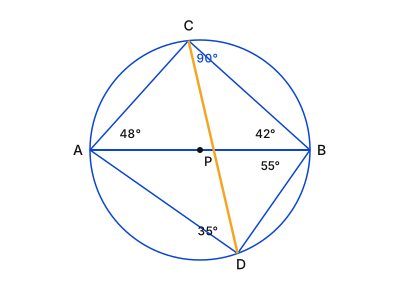
AB is the diameter of a circle with centre P. C and D are two points on the circle on either side of AB, such that ∠CAB=48∘ and ∠ABD=55∘. What is the difference between the measures of ∠CBD and ∠CAD?
AB, केंद्र P वाले एक वृत्त का व्यास है। C और D वृत्त पर AB के दोनों ओर स्थित दो बिंदु इस प्रकार हैं कि ∠CAB=48∘ और ∠ABD=55∘। ∠CBD और ∠CAD के मापों के बीच अंतर क्या है?
  1. A14∘
  2. B11∘
  3. C18∘
  4. D8∘
Show answer

Concept: The angle in a semicircle is 90∘, and the angles of a triangle add to 180∘.

  1. In △ACB: ∠ACB=90∘, ∠CAB=48∘ → ∠CBA=42∘.
  2. In △ADB: ∠ADB=90∘, ∠ABD=55∘ → ∠BAD=35∘.
  3. C and D are on opposite sides of AB, so ∠CBD=42∘+55∘=97∘ and ∠CAD=48∘+35∘=83∘.
  4. Difference =97∘−83∘=14∘.

Trick: ∠CBD+∠CAD=180∘ (opposite angles of cyclic quadrilateral ACBD); difference =(42+55)−(48+35).

Answer: (A) 14∘

अवधारणा: अर्धवृत्त का कोण 90∘ होता है और त्रिभुज के कोणों का योग 180∘।

  1. △ACB में: ∠ACB=90∘, ∠CAB=48∘ → ∠CBA=42∘।
  2. △ADB में: ∠ADB=90∘, ∠ABD=55∘ → ∠BAD=35∘।
  3. C और D, AB के विपरीत ओर हैं, अतः ∠CBD=42∘+55∘=97∘ और ∠CAD=48∘+35∘=83∘।
  4. अंतर =97∘−83∘=14∘।

ट्रिक: ∠CBD+∠CAD=180∘ (चक्रीय चतुर्भुज ACBD के सम्मुख कोण); अंतर =(42+55)−(48+35)।

उत्तर: (A) 14∘

RRB NTPC Graduate CBT 1MathematicsCircle – Angle in a SemicircleRRB NTPC Graduate CBT 1 2025 · 16 Mar Shift 3 →
Q6840.
100 men have provisions for 27 days. If 55 men have left, for how many days the same provisions would last for the remaining men?
100 आदमियों के लिए 27 दिनों की खाद्य-सामग्री है। यदि 55 आदमी चले जाएँ, तो वही खाद्य-सामग्री शेष आदमियों के लिए कितने दिनों तक चलेगी?
  1. A60
  2. B64
  3. C62
  4. D58
Show answer

Concept: Provisions are fixed, so men×days is constant.

  1. Remaining men =100−55=45.
  2. 100×27=45×d.
  3. d=270045=60 days.

Trick: Fewer men → more days; 10045=209, so 27×209=60.

Answer: (A) 60

अवधारणा: राशन निश्चित है, अतः आदमी×दिन स्थिर रहता है।

  1. बचे आदमी =100−55=45।
  2. 100×27=45×d।
  3. d=270045=60 दिन।

ट्रिक: कम आदमी → ज़्यादा दिन; 10045=209, अतः 27×209=60।

उत्तर: (A) 60

RRB NTPC Graduate CBT 1MathematicsInverse Variation (Men & Provisions)RRB NTPC Graduate CBT 1 2025 · 16 Mar Shift 3 →