Question bank

Q&A: practice questions with answers

Search questions on any topic. Filter by exam category, exam, subject and topic, try the question, then open the answer and explanation.

Courses – airGurukul

7,077 questions found.

Q6841.
The price of each article of type P, Q, and R is ₹280, ₹180 and ₹115, respectively. Tejas buys articles of each type in the ratio 4 : 2 : 5 for ₹6,165. How many articles of type Q did he purchase?
P, Q और R प्रकार की प्रत्येक वस्तु का मूल्य क्रमशः ₹280, ₹180 और ₹115 है। तेजस ₹6,165 में प्रत्येक प्रकार की वस्तुएँ 4 : 2 : 5 के अनुपात में खरीदता है। उसने Q प्रकार की कितनी वस्तुएँ खरीदीं?
  1. A14
  2. B6
  3. C3
  4. D12
Show answer

Concept: Let the numbers bought be 4k,2k,5k and equate total cost.

  1. Cost =4k×280+2k×180+5k×115=1120k+360k+575k=2055k.
  2. 2055k=6165⇒k=3.
  3. Articles of type Q =2k=6.

Trick: Cost of one 'set' (4P+2Q+5R) =2055; 6165÷2055=3 sets.

Answer: (B) 6

अवधारणा: खरीदी संख्याएँ 4k,2k,5k मानकर कुल लागत बराबर रखें।

  1. लागत =4k×280+2k×180+5k×115=1120k+360k+575k=2055k।
  2. 2055k=6165⇒k=3।
  3. Q प्रकार की वस्तुएँ =2k=6।

ट्रिक: एक 'सेट' (4P+2Q+5R) की लागत =2055; 6165÷2055=3 सेट।

उत्तर: (B) 6

RRB NTPC Graduate CBT 1MathematicsRatio – Cost of ArticlesRRB NTPC Graduate CBT 1 2025 · 16 Mar Shift 3 →
Q6842.
Find the mode of the following frequency distribution. (Round off the answer to two decimal places.)
Class0-1010-2020-3030-4040-50
Frequency58122010
निम्नलिखित बारंबारता बंटन का बहुलक (mode) ज्ञात कीजिए। (उत्तर को दो दशमलव स्थानों तक पूर्णांकित कीजिए।)
वर्ग: 0-10, 10-20, 20-30, 30-40, 40-50
बारंबारता: 5, 8, 12, 20, 10
  1. A32.25
  2. B31.51
  3. C33.35
  4. D34.44
Show answer

Concept: Mode=l+f1−f02f1−f0−f2×h, where f1 is the highest frequency.

  1. Modal class =30–40 (f1=20), l=30, h=10, f0=12, f2=10.
  2. Mode=30+20−1240−12−10×10=30+8018.
  3. =30+4.44=34.44.

Trick: Mode always lies inside the modal class (30–40) – only option D qualifies.

Answer: (D) 34.44

अवधारणा: बहुलक=l+f1−f02f1−f0−f2×h, जहाँ f1 सबसे अधिक बारंबारता है।

  1. बहुलक वर्ग =30–40 (f1=20), l=30, h=10, f0=12, f2=10।
  2. बहुलक=30+20−1240−12−10×10=30+8018।
  3. =30+4.44=34.44।

ट्रिक: बहुलक हमेशा बहुलक वर्ग (30–40) के भीतर होता है – केवल विकल्प D इसमें है।

उत्तर: (D) 34.44

RRB NTPC Graduate CBT 1MathematicsStatistics – ModeRRB NTPC Graduate CBT 1 2025 · 16 Mar Shift 3 →
Q6843.
What should come in place of ‘?’ in the given series?
45 65 81 93 101 ?
दी गई श्रेणी में ‘?’ के स्थान पर क्या आना चाहिए?
45 65 81 93 101 ?
  1. A105
  2. B103
  3. C106
  4. D104
Show answer

Concept: Look at consecutive differences.

  1. 65−45=20, 81−65=16, 93−81=12, 101−93=8.
  2. Differences fall by 4 each time: 20,16,12,8 → next 4.
  3. 101+4=105.

Trick: Decreasing differences in an arithmetic pattern – just continue the step.

Answer: (A) 105

अवधारणा: क्रमागत अंतर देखें।

  1. 65−45=20, 81−65=16, 93−81=12, 101−93=8।
  2. अंतर हर बार 4 घटता है: 20,16,12,8 → अगला 4।
  3. 101+4=105।

ट्रिक: समांतर रूप से घटते अंतर – बस अगला कदम बढ़ाएँ।

उत्तर: (A) 105

RRB NTPC Graduate CBT 1MathematicsNumber SeriesRRB NTPC Graduate CBT 1 2025 · 16 Mar Shift 3 →
Q6844.
A woman travelled at a speed of 20 m/min for 90 min, and at a speed of 55 m/min for 60 min. Her average speed (in m/min) for the entire journey is:
एक महिला 90 मिनट तक 20 m/min की चाल से और 60 मिनट तक 55 m/min की चाल से यात्रा करती है। संपूर्ण यात्रा के लिए उसकी औसत चाल (m/min में) है:
  1. A27
  2. B40
  3. C38
  4. D34
Show answer

Concept: Average speed=total distancetotal time.

  1. Distance 1 =20×90=1800m; distance 2 =55×60=3300m.
  2. Total distance =5100m, total time =150 min.
  3. Average =5100150=34m/min.

Trick: Time-weighted mean: 20×3+55×25=1705=34.

Answer: (D) 34

अवधारणा: औसत चाल=कुल दूरीकुल समय।

  1. दूरी 1 =20×90=1800m; दूरी 2 =55×60=3300m।
  2. कुल दूरी =5100m, कुल समय =150 मिनट।
  3. औसत =5100150=34m/min।

ट्रिक: समय-भारित माध्य: 20×3+55×25=1705=34।

उत्तर: (D) 34

RRB NTPC Graduate CBT 1MathematicsAverage SpeedRRB NTPC Graduate CBT 1 2025 · 16 Mar Shift 3 →
Q6845.
Three friends travel along three consecutive segments: from P to Q, Q to R, and R to S. Their speeds on these segments are 48 km/h, 72 km/h, and 96 km/h, respectively. The distances of the three segments are in the ratio 2 : 3 : 1, and the total distance from P to S is 480 km. Calculate the average speed for the entire journey.
तीन मित्र तीन क्रमागत खंडों पर यात्रा करते हैं: P से Q, Q से R, और R से S। इन खंडों पर उनकी चाल क्रमशः 48 km/h, 72 km/h और 96 km/h है। तीन खंडों की दूरियाँ 2 : 3 : 1 के अनुपात में हैं, और P से S तक की कुल दूरी 480 km है। संपूर्ण यात्रा के लिए औसत चाल की गणना कीजिए।
  1. A58 km/h
  2. B64 km/h
  3. C65 km/h
  4. D68 km/h
Show answer

Concept: Average speed =total distancetotal time; find each segment's time.

  1. Distances =2:3:1 of 480 → 160,240,80 km.
  2. Times: 16048=103 h, 24072=103 h, 8096=56 h.
  3. Total time =103+103+56=456=7.5 h.
  4. Average speed =4807.5=64km/h.

Trick: Work with 1 km units: 248+372+196=4+4+196=996 h per 6 km → 6×969=64.

Answer: (B) 64 km/h

अवधारणा: औसत चाल =कुल दूरीकुल समय; हर खंड का समय निकालें।

  1. दूरियाँ 480 का 2:3:1 → 160,240,80 km।
  2. समय: 16048=103 h, 24072=103 h, 8096=56 h।
  3. कुल समय =103+103+56=456=7.5 h।
  4. औसत चाल =4807.5=64km/h।

ट्रिक: इकाई दूरी से: 248+372+196=996 h प्रति 6 km → 6×969=64।

उत्तर: (B) 64 km/h

RRB NTPC Graduate CBT 1MathematicsAverage SpeedRRB NTPC Graduate CBT 1 2025 · 16 Mar Shift 3 →
Q6846.
The total surface area of a solid cube each side of which is 84 cm long is:
एक ठोस घन, जिसकी प्रत्येक भुजा 84 cm लंबी है, का कुल पृष्ठीय क्षेत्रफल है:
  1. A42365 cm2
  2. B42292 cm2
  3. C42359 cm2
  4. D42336 cm2
Show answer

Concept: Total surface area of a cube =6a2.

  1. a=84 cm → a2=7056.
  2. 6×7056=42336cm2.

Trick: 842=(80+4)2=6400+640+16=7056; unit digit 6×6=36 → ends in 6, only option D.

Answer: (D) 42336cm2

अवधारणा: घन का कुल पृष्ठीय क्षेत्रफल =6a2।

  1. a=84 cm → a2=7056।
  2. 6×7056=42336cm2।

ट्रिक: 842=(80+4)2=6400+640+16=7056; इकाई अंक 6×6=36 → 6 पर समाप्त, केवल विकल्प D।

उत्तर: (D) 42336cm2

RRB NTPC Graduate CBT 1MathematicsMensuration – CubeRRB NTPC Graduate CBT 1 2025 · 16 Mar Shift 3 →
Q6847.
At what rate per annum will a sum of money become five times itself in 5 years under simple interest?
साधारण ब्याज पर कोई धनराशि 5 वर्षों में अपने से पाँच गुनी किस वार्षिक दर पर हो जाएगी?
  1. A82%
  2. B160%
  3. C80%
  4. D78%
Show answer

Concept: If a sum becomes n times under SI, interest =(n−1)P and R=(n−1)×100T.

  1. Five times → SI =4P in 5 years.
  2. R=4×1005=80% per annum.

Trick: R×T=(n−1)×100 → R=4005=80.

Answer: (C) 80%

अवधारणा: साधारण ब्याज में राशि n गुना हो तो ब्याज =(n−1)P और R=(n−1)×100T।

  1. पाँच गुना → SI =4P, 5 वर्ष में।
  2. R=4×1005=80% वार्षिक।

ट्रिक: R×T=(n−1)×100 → R=4005=80।

उत्तर: (C) 80%

RRB NTPC Graduate CBT 1MathematicsSimple InterestRRB NTPC Graduate CBT 1 2025 · 16 Mar Shift 3 →
Q6848.
Shan has ₹1407 with him. He divides this amount between his two sons, Piyush and Manoj, and asks them to invest their respective shares at a compound interest rate of 10% per annum, compounded annually. It is observed that Piyush’s investment amounts to the same value after 18 years as Manoj’s investment does after 19 years. How much (in ₹) did Shan give to Manoj?
शान के पास ₹1407 हैं। वह इस राशि को अपने दो पुत्रों, पीयूष और मनोज, के बीच बाँटता है और उन्हें अपने-अपने हिस्से को 10% वार्षिक चक्रवृद्धि ब्याज की दर पर, वार्षिक रूप से संयोजित, निवेश करने के लिए कहता है। यह देखा गया कि पीयूष का निवेश 18 वर्षों के बाद उसी मूल्य का हो जाता है जितना मनोज का निवेश 19 वर्षों के बाद होता है। शान ने मनोज को कितनी राशि (₹ में) दी?
  1. A670
  2. B837
  3. C737
  4. D520
Show answer

Concept: If amounts are equal after different periods, the shares are in the inverse ratio of growth factors.

  1. P(1.1)18=M(1.1)19⇒P=1.1M.
  2. Piyush : Manoj =11:10; total 21 parts =1407 → one part =67.
  3. Manoj =10×67= ₹670.

Trick: One extra year at 10% → ratio 11:10; the big '18 years / 19 years' is only to scare.

Answer: (A) 670

अवधारणा: अलग-अलग अवधि के बाद मिश्रधन बराबर हो तो हिस्से वृद्धि-गुणकों के व्युत्क्रम अनुपात में होते हैं।

  1. P(1.1)18=M(1.1)19⇒P=1.1M।
  2. पीयूष : मनोज =11:10; कुल 21 भाग =1407 → एक भाग =67।
  3. मनोज =10×67= ₹670।

ट्रिक: 10% पर एक अतिरिक्त वर्ष → अनुपात 11:10; '18 वर्ष / 19 वर्ष' केवल डराने के लिए है।

उत्तर: (A) 670

RRB NTPC Graduate CBT 1MathematicsCompound Interest – Equal AmountsRRB NTPC Graduate CBT 1 2025 · 16 Mar Shift 3 →
Q6849.
In an election between two candidates, 80% of the registered voters cast their vote and 10% of the votes polled were found invalid. Winning candidate got 89% of the valid votes and won the election by a margin of 351 votes. How many voters were registered?
दो उम्मीदवारों के बीच एक चुनाव में, पंजीकृत मतदाताओं के 80% ने मतदान किया और डाले गए मतों के 10% अवैध पाए गए। विजेता उम्मीदवार को वैध मतों के 89% मत मिले और वह 351 मतों के अंतर से चुनाव जीता। कितने मतदाता पंजीकृत थे?
  1. A625
  2. B650
  3. C600
  4. D675
Show answer

Concept: Margin = (winner % − loser %) of valid votes; chain the percentages back to registered voters.

  1. Let registered voters =N. Polled =0.8N; valid =90% of that =0.72N.
  2. Winner 89%, loser 11% → margin =78% of 0.72N=0.5616N.
  3. 0.5616N=351⇒N=625.

Trick: 351=0.78×450, and 450=0.72×625.

Answer: (A) 625

अवधारणा: अंतर = वैध मतों का (विजेता % − पराजित %); प्रतिशतों को पंजीकृत मतदाताओं तक पीछे जोड़ें।

  1. पंजीकृत मतदाता =N मानें। डाले गए =0.8N; वैध = उसका 90%=0.72N।
  2. विजेता 89%, पराजित 11% → अंतर =0.72N का 78%=0.5616N।
  3. 0.5616N=351⇒N=625।

ट्रिक: 351=0.78×450, और 450=0.72×625।

उत्तर: (A) 625

RRB NTPC Graduate CBT 1MathematicsPercentage – ElectionsRRB NTPC Graduate CBT 1 2025 · 16 Mar Shift 3 →
Q6850.
Based on the English alphabetical order, three of the following four letter-cluster pairs are alike in a certain way and thus form a group. Which is the one that does not belong to that group?
(Note: The odd man out is not based on the number of consonants/vowels or their position in the letter-cluster.)
अंग्रेज़ी वर्णमाला क्रम के आधार पर, निम्नलिखित चार अक्षर-समूह युग्मों में से तीन एक निश्चित प्रकार से समान हैं और इस प्रकार एक समूह बनाते हैं। वह कौन-सा है जो उस समूह से संबंधित नहीं है?
(नोट: असंगत विकल्प व्यंजनों/स्वरों की संख्या या अक्षर-समूह में उनकी स्थिति पर आधारित नहीं है।)
  1. ARV−WA
  2. BPT−UY
  3. CGK−LP
  4. DEI−IP
Show answer

Concept: Write the alphabet positions and look for a common gap inside each pair.

  1. RV–WA: R(18)→V(22) is +4; W(23)→A(1) is +4 (after Z we wrap to A).
  2. PT–UY: P(16)→T(20) +4; U(21)→Y(25) +4. GK–LP: G(7)→K(11) +4; L(12)→P(16) +4.
  3. Also the second cluster starts just after the first cluster's last letter (V→W, T→U, K→L).
  4. EI–IP: E(5)→I(9) +4, but I(9)→P(16) is +7, and the second cluster starts at I, not J. Pattern broken.

Trick: In such questions check the gap inside each cluster first; the pair whose second cluster has a different gap is the odd one.

Answer: (D) EI−IP

अवधारणा: अक्षरों की स्थिति लिखकर हर जोड़े के अंदर का अंतर देखें।

  1. RV–WA: R(18)→V(22) = +4; W(23)→A(1) = +4 (Z के बाद A)।
  2. PT–UY: +4, +4। GK–LP: +4, +4।
  3. दूसरा समूह पहले समूह के अंतिम अक्षर के ठीक बाद वाले अक्षर से शुरू होता है (V→W, T→U, K→L)।
  4. EI–IP: E→I = +4, पर I(9)→P(16) = +7; पैटर्न टूट गया।

ट्रिक: पहले हर समूह के भीतर का अंतर जाँचें; जिस जोड़े के दूसरे समूह का अंतर अलग हो वही odd one है।

उत्तर: (D) EI−IP

RRB NTPC Graduate CBT 1General Intelligence and ReasoningLetter-cluster classificationRRB NTPC Graduate CBT 1 2025 · 16 Mar Shift 3 →
Q6851.
DIME is related to HNIZ in a certain way based on the English alphabetical order. In the same way, LSEU is related to PXAP. To which of the following is TCWK related, following the same logic?
अंग्रेज़ी वर्णमाला क्रम के आधार पर DIME, HNIZ से एक निश्चित प्रकार से संबंधित है। उसी प्रकार, LSEU, PXAP से संबंधित है। उसी तर्क का अनुसरण करते हुए, TCWK निम्नलिखित में से किससे संबंधित है?
  1. AYGTE
  2. BWIRG
  3. CVHSD
  4. DXHSF
Show answer

Concept: Find the position shift of each letter in the given pairs and apply the same shifts.

  1. DIME → HNIZ: D+4=H, I+5=N, M−4=I, E−5=Z (going back past A wraps to Z).
  2. LSEU → PXAP: L+4=P, S+5=X, E−4=A, U−5=P ✓ (pattern +4, +5, −4, −5).
  3. TCWK: T+4=X, C+5=H, W−4=S, K−5=F → XHSF.

Trick: Verify the rule on the second given pair before applying it; here the signs alternate (+4, +5, −4, −5).

Answer: (D) XHSF

अवधारणा: दिए गए जोड़ों में हर अक्षर का स्थान-परिवर्तन निकालें और वही नियम लगाएँ।

  1. DIME → HNIZ: D+4=H, I+5=N, M−4=I, E−5=Z (A से पीछे जाने पर Z)।
  2. LSEU → PXAP: L+4=P, S+5=X, E−4=A, U−5=P ✓ (नियम +4, +5, −4, −5)।
  3. TCWK: T+4=X, C+5=H, W−4=S, K−5=F → XHSF।

ट्रिक: नियम को दूसरे दिए गए जोड़े पर जाँच लें; यहाँ चिह्न बदलते हैं (+4, +5, −4, −5)।

उत्तर: (D) XHSF

RRB NTPC Graduate CBT 1General Intelligence and ReasoningLetter-cluster analogyRRB NTPC Graduate CBT 1 2025 · 16 Mar Shift 3 →
Q6852.
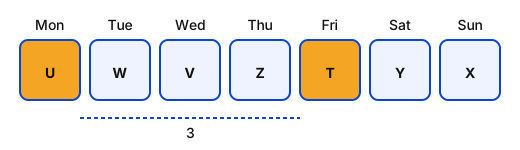
Each of T, U, V, W, X, Y and Z has an engagement on a different day of a week starting from Monday and ending on Sunday of the same week. V has
engagement on the third day of the week. Only one person has engagement after Y. Only three people have engagement between V and X. Only one person has engagement between W and Z. T has engagement immediately after Z. How many people have engagement between U and T?
T, U, V, W, X, Y और Z में से प्रत्येक का एक ही सप्ताह के सोमवार से रविवार तक के अलग-अलग दिन एक कार्यक्रम (engagement) है। V का
कार्यक्रम सप्ताह के तीसरे दिन है। Y के बाद केवल एक व्यक्ति का कार्यक्रम है। V और X के बीच केवल तीन व्यक्तियों का कार्यक्रम है। W और Z के बीच केवल एक व्यक्ति का कार्यक्रम है। T का कार्यक्रम Z के ठीक बाद है। U और T के बीच कितने व्यक्तियों का कार्यक्रम है?
  1. AOneएक
  2. BThreeतीन
  3. CFourचार
  4. DTwoदो
Show answer

Concept: Fix the definite positions first (V, Y, X), then fit the pair Z–T and W.

  1. V = Wednesday. Only one after Y → Y = Saturday. Three between V and X → X = Sunday.
  2. Z and T are consecutive (T right after Z) in the free days Mon, Tue, Thu, Fri. If Z = Mon, T = Tue, then W would need to be Wed – taken. So Z = Thu, T = Fri.
  3. One between W and Z → W = Tue (Sat is taken). U gets Monday.
  4. Between U (Mon) and T (Fri): Tue, Wed, Thu = three people.

Trick: Draw seven boxes; the 'only one after Y' type clue pins a position instantly.

Answer: (B) Three

अवधारणा: पहले निश्चित स्थान (V, Y, X) भरें, फिर Z–T की जोड़ी और W बैठाएँ।

  1. V = बुधवार। Y के बाद केवल एक → Y = शनिवार। V और X के बीच तीन → X = रविवार।
  2. Z के ठीक बाद T; खाली दिन सोम, मंगल, गुरु, शुक्र। Z = सोम, T = मंगल लें तो W बुध पर आएगा – व्यस्त। अतः Z = गुरु, T = शुक्र।
  3. W और Z के बीच एक → W = मंगल। U = सोमवार।
  4. U (सोम) और T (शुक्र) के बीच: मंगल, बुध, गुरु = तीन।

ट्रिक: सात खाने बनाएँ; 'Y के बाद केवल एक' जैसा सुराग तुरंत स्थान तय कर देता है।

उत्तर: (B) Three

RRB NTPC Graduate CBT 1General Intelligence and ReasoningScheduling puzzle (days)RRB NTPC Graduate CBT 1 2025 · 16 Mar Shift 3 →
Q6853.
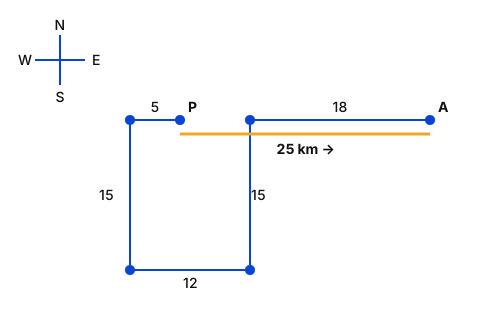
Logan starts from Point A and drives 18 km towards west. He then takes a left turn, drives 15 km, turns right and drives 12 km. He then takes a right turn and drives 15 km. He takes a final right turn, drives 5 km and stops at Point P. How far (shortest distance) and towards which direction should he drive in order to reach Point A again? (All turns are 90-degree turns only, unless specified.)
लोगन बिंदु A से शुरू होकर 18 km पश्चिम की ओर गाड़ी चलाता है। फिर वह बाएँ मुड़ता है, 15 km चलता है, दाएँ मुड़ता है और 12 km चलता है। फिर वह दाएँ मुड़ता है और 15 km चलता है। वह अंतिम बार दाएँ मुड़ता है, 5 km चलता है और बिंदु P पर रुक जाता है। बिंदु A पर पुनः पहुँचने के लिए उसे कितनी दूर (न्यूनतम दूरी) और किस दिशा में गाड़ी चलानी चाहिए? (जब तक अन्यथा न कहा जाए, सभी मोड़ केवल 90 डिग्री के हैं।)
  1. A18 km towards south18 km दक्षिण की ओर
  2. B15 km towards west15 km पश्चिम की ओर
  3. C25 km towards east25 km पूर्व की ओर
  4. D5 km towards north5 km उत्तर की ओर
Show answer

Concept: Plot the path on a grid; left/right depends on the direction currently faced.

  1. A → 18 km west. Left turn (facing west) = south, 15 km. Right turn = west, 12 km.
  2. Right turn (facing west) = north, 15 km – he is back on the line of A, 30 km west of it.
  3. Final right turn = east, 5 km → P is 25 km due west of A.
  4. So he must drive 25 km towards east.

Trick: The two 15 km legs (south, then north) cancel; net west =18+12−5=25 km.

Answer: (C) 25 km towards east

अवधारणा: रास्ते को ग्रिड पर बनाएँ; बायाँ/दायाँ उस समय की दिशा पर निर्भर है।

  1. A → 18 km पश्चिम। बायाँ मोड़ (पश्चिम मुख) = दक्षिण, 15 km। दायाँ = पश्चिम, 12 km।
  2. दायाँ (पश्चिम मुख) = उत्तर, 15 km – वह A की सीध में, उससे 30 km पश्चिम में आ गया।
  3. अंतिम दायाँ = पूर्व, 5 km → P, A से 25 km पश्चिम।
  4. अतः उसे 25 km पूर्व चलना होगा।

ट्रिक: 15 km दक्षिण और 15 km उत्तर कट जाते हैं; शुद्ध पश्चिम =18+12−5=25 km।

उत्तर: (C) 25 km पूर्व की ओर

RRB NTPC Graduate CBT 1General Intelligence and ReasoningDirection and distanceRRB NTPC Graduate CBT 1 2025 · 16 Mar Shift 3 →
Q6854.
Which of the given letter-number clusters will replace the question mark (?) in the following series to make it logically complete?
CLW 31 LUF 33 UDO 35 DMX 37 ?
निम्नलिखित श्रेणी को तार्किक रूप से पूर्ण करने के लिए दिए गए अक्षर-संख्या समूहों में से कौन-सा प्रश्नचिह्न (?) के स्थान पर आएगा?
CLW 31 LUF 33 UDO 35 DMX 37 ?
  1. ANUR 39
  2. BMVG 39
  3. CLST 39
  4. DXSH 38
Show answer

Concept: Treat letters and numbers separately.

  1. Numbers: 31, 33, 35, 37 → +2 each → next 39.
  2. Letters: C→L→U→D: +9 each (C=3, L=12, U=21, D=30−26=4). Same for the 2nd and 3rd letters: L→U→D→M, W→F→O→X.
  3. Next: D+9=M, M+9=V, X+9=G → MVG 39.

Trick: Check the first letters down the column (C, L, U, D, ?) – a constant +9 jump shows immediately.

Answer: (B) MVG 39

अवधारणा: अक्षरों और संख्याओं को अलग-अलग देखें।

  1. संख्याएँ: 31, 33, 35, 37 → हर बार +2 → अगली 39।
  2. अक्षर: C→L→U→D में हर बार +9 (3, 12, 21, 30−26=4)। दूसरे-तीसरे अक्षर भी: L→U→D→M, W→F→O→X।
  3. अगला: D+9=M, M+9=V, X+9=G → MVG 39।

ट्रिक: पहले अक्षरों का कॉलम (C, L, U, D, ?) देखें – +9 की छलाँग तुरंत दिखती है।

उत्तर: (B) MVG 39

RRB NTPC Graduate CBT 1General Intelligence and ReasoningLetter-number seriesRRB NTPC Graduate CBT 1 2025 · 16 Mar Shift 3 →
Q6855.
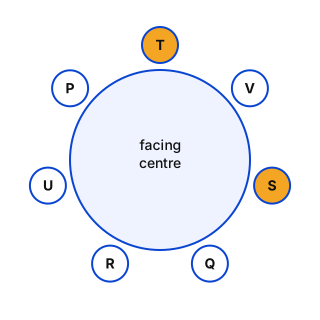
P, Q, R, S, T, U and V sit around a circular table facing the centre.
V sits to the immediate left of T. U sits to the immediate left of R. R sits second to the left of S. Q sits third to the left of T.
Who sits 2nd to the right of S?
P, Q, R, S, T, U और V एक वृत्ताकार मेज़ के चारों ओर केंद्र की ओर मुख करके बैठे हैं।
V, T के ठीक बाएँ बैठा है। U, R के ठीक बाएँ बैठा है। R, S के बाएँ दूसरे स्थान पर बैठा है। Q, T के बाएँ तीसरे स्थान पर बैठा है।
S के दाएँ दूसरे स्थान पर कौन बैठा है?
  1. AP
  2. BR
  3. CT
  4. DU
Show answer

Concept: For people facing the centre, 'left' means clockwise and 'right' means anticlockwise.

  1. Put T at seat 1 (clockwise numbering). V is immediately left of T → seat 2. Q is third to the left of T → seat 4.
  2. R is 2nd left of S and U is immediately left of R, so S, R, U occupy seats n,n+2,n+3 among the free seats 3, 5, 6, 7 → S = 3, R = 5, U = 6, and P = 7.
  3. Second to the right of S (seat 3) = two seats anticlockwise = seat 1 = T.

Trick: Number the seats and convert every clue to +n (left) or −n (right); then it is pure arithmetic.

Answer: (C) T

अवधारणा: केंद्र की ओर मुख वाले लोगों के लिए 'बायाँ' = दक्षिणावर्त (clockwise), 'दायाँ' = वामावर्त।

  1. T को सीट 1 पर रखें (दक्षिणावर्त गिनती)। V, T के तुरंत बाएँ → सीट 2। Q, T के बाएँ तीसरा → सीट 4।
  2. R, S के बाएँ दूसरा और U, R के तुरंत बाएँ, अतः S, R, U = सीट n,n+2,n+3; खाली सीटें 3, 5, 6, 7 → S = 3, R = 5, U = 6, P = 7।
  3. S (सीट 3) के दाएँ दूसरा = दो सीट वामावर्त = सीट 1 = T।

ट्रिक: सीटों को नंबर दें और हर सुराग को +n (बाएँ) या −n (दाएँ) में बदलें – फिर केवल गिनती बचती है।

उत्तर: (C) T

RRB NTPC Graduate CBT 1General Intelligence and ReasoningCircular seating arrangementRRB NTPC Graduate CBT 1 2025 · 16 Mar Shift 3 →
Q6856.
In this question, a question is followed by two statements numbered (I) and (II). You have to decide whether the data provided in the statements are sufficient to answer the question. Read both the statements and decide the appropriate answer.
Q. Five students – Alok, Bharti, Celine, Darpan, and Ema – obtained different marks in an examination.
Who scored the third highest marks?
(I) Darpan scored more than Alok and Bharti but less than Celine.
(II) Ema scored more than Darpan but less than Celine.
इस प्रश्न में, एक प्रश्न के बाद (I) और (II) क्रमांकित दो कथन दिए गए हैं। आपको यह निर्णय करना है कि कथनों में दिए गए आँकड़े प्रश्न का उत्तर देने के लिए पर्याप्त हैं या नहीं। दोनों कथनों को पढ़िए और उचित उत्तर का चयन कीजिए।
प्रश्न: पाँच विद्यार्थियों – आलोक, भारती, सेलीन, दर्पण और ईमा – ने एक परीक्षा में अलग-अलग अंक प्राप्त किए।
तीसरे सबसे अधिक अंक किसने प्राप्त किए?
(I) दर्पण ने आलोक और भारती से अधिक परंतु सेलीन से कम अंक प्राप्त किए।
(II) ईमा ने दर्पण से अधिक परंतु सेलीन से कम अंक प्राप्त किए।
  1. AData in Statement I alone is sufficient to answer the question while data in Statement II is notप्रश्न का उत्तर देने के लिए केवल कथन I के आँकड़े पर्याप्त हैं, जबकि कथन II के आँकड़े पर्याप्त नहीं हैं
  2. BData in Statement II alone is sufficient to answer the question while data in Statement I is notप्रश्न का उत्तर देने के लिए केवल कथन II के आँकड़े पर्याप्त हैं, जबकि कथन I के आँकड़े पर्याप्त नहीं हैं
  3. CBoth statements I and II together (and not statement I alone or statement II alone) are sufficient to answer the questionप्रश्न का उत्तर देने के लिए कथन I और II दोनों मिलकर (न कि केवल कथन I या केवल कथन II) पर्याप्त हैं
  4. DBoth statements I and II together are NOT sufficient to answer the questionप्रश्न का उत्तर देने के लिए कथन I और II दोनों मिलकर भी पर्याप्त नहीं हैं
Show answer

Concept: Test each statement alone, then both together.

  1. (I): Celine > Darpan > Alok, Bharti. Ema's position is unknown – she could be above Celine or anywhere below. Not sufficient.
  2. (II): Celine > Ema > Darpan; nothing about Alok and Bharti. Not sufficient.
  3. Together: Celine > Ema > Darpan > (Alok, Bharti). Third highest = Darpan, uniquely.

Trick: You only need the top three fixed; the order of Alok and Bharti does not matter.

Answer: (C) Both statements together are sufficient, neither alone

अवधारणा: हर कथन अकेले जाँचें, फिर दोनों मिलाकर।

  1. (I): Celine > Darpan > Alok, Bharti। Ema का स्थान अज्ञात – वह Celine से ऊपर भी हो सकती है। अपर्याप्त।
  2. (II): Celine > Ema > Darpan; Alok और Bharti का पता नहीं। अपर्याप्त।
  3. दोनों मिलाकर: Celine > Ema > Darpan > (Alok, Bharti)। तीसरा सर्वाधिक = Darpan, निश्चित।

ट्रिक: केवल शीर्ष तीन तय होने चाहिए; Alok और Bharti का क्रम मायने नहीं रखता।

उत्तर: (C) दोनों कथन मिलाकर पर्याप्त, कोई अकेला नहीं

RRB NTPC Graduate CBT 1General Intelligence and ReasoningData sufficiency – orderingRRB NTPC Graduate CBT 1 2025 · 16 Mar Shift 3 →
Q6857.
Based on the alphabetical order, three of the following four are alike in a certain way and thus form a group. Which is the one that does not belong to that group?
(Note: The odd man out is not based on the number of consonants/vowels or their position in the letter cluster.)
वर्णमाला क्रम के आधार पर, निम्नलिखित चार में से तीन एक निश्चित प्रकार से समान हैं और इस प्रकार एक समूह बनाते हैं। वह कौन-सा है जो उस समूह से संबंधित नहीं है?
(नोट: असंगत विकल्प व्यंजनों/स्वरों की संख्या या अक्षर-समूह में उनकी स्थिति पर आधारित नहीं है।)
  1. AOTP
  2. BINK
  3. CKPL
  4. DMRN
Show answer

Concept: Find the gaps between consecutive letters in each cluster.

  1. OTP: O(15)→T(20) +5, T→P(16) −4.
  2. KPL: K(11)→P(16) +5, P→L(12) −4. MRN: M(13)→R(18) +5, R→N(14) −4.
  3. INK: I(9)→N(14) +5, but N→K(11) is −3. Odd one out.

Trick: In every cluster the third letter is one place after the first (O→P, K→L, M→N) – INK gives I→K, two places.

Answer: (B) INK

अवधारणा: हर समूह में क्रमागत अक्षरों के अंतर निकालें।

  1. OTP: +5, −4। KPL: +5, −4। MRN: +5, −4।
  2. INK: I→N +5, पर N→K −3। यही अलग है।

ट्रिक: हर समूह में तीसरा अक्षर पहले से एक स्थान आगे है (O→P, K→L, M→N) – INK में I→K दो स्थान।

उत्तर: (B) INK

RRB NTPC Graduate CBT 1General Intelligence and ReasoningLetter-cluster classificationRRB NTPC Graduate CBT 1 2025 · 16 Mar Shift 3 →
Q6858.
Which of the following letter-clusters should replace # and % so that the pattern and relationship followed between the letter-cluster pair on the left side of :: is the same as that on the right side of :: ?
# : MWE :: KUC : %
निम्नलिखित में से कौन-से अक्षर-समूह # और % के स्थान पर आने चाहिए ताकि :: के बाईं ओर के अक्षर-समूह युग्म के बीच अनुसरण किया गया पैटर्न और संबंध वही हो जो :: के दाईं ओर के युग्म में है?
# : MWE :: KUC : %
  1. A# = BLT % = VFN
  2. B# = BLT % = VCN
  3. C# = KLT % = VFN
  4. D# = BLT % = VFM
Show answer

Concept: Find a rule that works for # : MWE and KUC : % with the same shift.

  1. Test option A: BLT → MWE: B(2)+11=M(13), L(12)+11=W(23), T(20)+11=31−26=E(5) ✓ – each letter +11.
  2. KUC with +11: K(11)+11=V(22), U(21)+11=32−26=F(6), C(3)+11=N(14) → VFN ✓.
  3. Options B and D break the +11 rule at one letter; option C uses KLT, not BLT.

Trick: When the first term is unknown, start from the known pair KUC → ? using the shift that the options suggest and verify both sides.

Answer: (A) # = BLT, % = VFN

अवधारणा: ऐसा नियम खोजें जो # : MWE और KUC : % दोनों में समान हो।

  1. विकल्प A: BLT → MWE: B+11=M, L+11=W, T(20)+11=31−26=E ✓ – हर अक्षर +11।
  2. KUC में +11: K→V, U(21)+11=32−26=F, C→N → VFN ✓।
  3. विकल्प B, D में एक अक्षर +11 नियम तोड़ता है; C में KLT है, BLT नहीं।

ट्रिक: पहला पद अज्ञात हो तो ज्ञात जोड़े KUC → ? से शुरू करें और दोनों पक्षों में नियम जाँचें।

उत्तर: (A) # = BLT, % = VFN

RRB NTPC Graduate CBT 1General Intelligence and ReasoningLetter-cluster analogyRRB NTPC Graduate CBT 1 2025 · 16 Mar Shift 3 →
Q6859.
If ‘A’ stands for ‘÷’, ‘B’ stands for ‘×’, ‘C’ stands for ‘+’ and ‘D’ stands for ‘−’, then what will come in place of the question mark (?) in the following equation?
9 B 4 C 6 D 45 A 5 = ?
यदि ‘A’ का अर्थ ‘÷’, ‘B’ का अर्थ ‘×’, ‘C’ का अर्थ ‘+’ और ‘D’ का अर्थ ‘−’ है, तो निम्नलिखित समीकरण में प्रश्नचिह्न (?) के स्थान पर क्या आएगा?
9 B 4 C 6 D 45 A 5 = ?
  1. A34
  2. B32
  3. C31
  4. D33
Show answer

Concept: Replace the letters with the given operators and apply BODMAS.

  1. 9 B 4 C 6 D 45 A 5 → 9×4+6−45÷5.
  2. Division and multiplication first: 45÷5=9, 9×4=36.
  3. 36+6−9=33.

Trick: Write the converted expression fully before calculating; most errors come from doing + before ÷.

Answer: (D) 33

अवधारणा: अक्षरों की जगह दिए गए चिह्न रखें और BODMAS लगाएँ।

  1. 9 B 4 C 6 D 45 A 5 → 9×4+6−45÷5।
  2. पहले भाग और गुणा: 45÷5=9, 9×4=36।
  3. 36+6−9=33।

ट्रिक: पूरा व्यंजक बदलकर लिखें, फिर हल करें; अधिकतर गलती ÷ से पहले + करने से होती है।

उत्तर: (D) 33

RRB NTPC Graduate CBT 1General Intelligence and ReasoningMathematical operations (symbol substitution)RRB NTPC Graduate CBT 1 2025 · 16 Mar Shift 3 →
Q6860.
18 is related to 59 following a certain logic. Following the same logic, 27 is related to 86. To which of the following is 37 related, following the same logic?
(NOTE : Operations should be performed on the whole numbers, without breaking down the numbers into its constituent digits. E.g. 13 – Operations on 13 such as adding /subtracting /multiplying etc. to 13 can be performed. Breaking down 13 into 1 and 3 and then performing mathematical operations on 1 and 3 is not allowed.)
एक निश्चित तर्क के अनुसार 18, 59 से संबंधित है। उसी तर्क के अनुसार 27, 86 से संबंधित है। उसी तर्क का अनुसरण करते हुए, 37 निम्नलिखित में से किससे संबंधित है?
(नोट: संक्रियाएँ पूर्ण संख्याओं पर की जानी चाहिए, संख्याओं को उनके घटक अंकों में तोड़े बिना। उदाहरण के लिए 13 – 13 पर संक्रियाएँ जैसे 13 में जोड़ना/घटाना/गुणा करना आदि किया जा सकता है। 13 को 1 और 3 में तोड़कर फिर 1 और 3 पर गणितीय संक्रियाएँ करने की अनुमति नहीं है।)
  1. A101
  2. B132
  3. C123
  4. D116
Show answer

Concept: Find one operation on the whole number that fits both given pairs.

  1. 18×3+5=59 ✓ and 27×3+5=86 ✓.
  2. Apply to 37: 37×3+5=111+5=116.

Trick: Check the difference of outputs: 86−59=27=3×(27−18), so the multiplier is 3; then the constant is 59−54=5.

Answer: (D) 116

अवधारणा: पूरी संख्या पर एक ऐसी संक्रिया खोजें जो दोनों जोड़ों पर लागू हो।

  1. 18×3+5=59 ✓ और 27×3+5=86 ✓।
  2. 37 पर: 37×3+5=116।

ट्रिक: परिणामों का अंतर 86−59=27=3×(27−18) → गुणक 3; फिर स्थिरांक 59−54=5।

उत्तर: (D) 116

RRB NTPC Graduate CBT 1General Intelligence and ReasoningNumber analogyRRB NTPC Graduate CBT 1 2025 · 16 Mar Shift 3 →