Question bank

Q&A: practice questions with answers

Search questions on any topic. Filter by exam category, exam, subject and topic, try the question, then open the answer and explanation.

Courses – airGurukul

7,077 questions found.

Q741.
Kalpana and Sudha got 624 and 720 marks, respectively, in the same examination. If Kalpana scored 26% marks, then what is the percentage of marks scored by Sudha?
एक ही परीक्षा में कल्पना और सुधा ने क्रमशः 624 और 720 अंक प्राप्त किए। यदि कल्पना ने 26% अंक प्राप्त किए, तो सुधा द्वारा प्राप्त अंकों का प्रतिशत कितना है?
  1. A30%
  2. B29%
  3. C33%
  4. D27%
Show answer

Concept: Both sat the same exam, so maximum marks are the same: Max=markspercent×100.

  1. 26% of Max =624⇒Max=624×10026=2400
  2. Sudha: 7202400×100=30%

Trick: Percent is proportional to marks: 26×720624=26×1513=30%.

Answer: (A) 30%

अवधारणा: दोनों की परीक्षा एक ही है, अतः पूर्णांक समान: पूर्णांक=अंकप्रतिशत×100

  1. 26% = 624 ⇒पूर्णांक=624×10026=2400
  2. सुधा: 7202400×100=30%

ट्रिक: प्रतिशत अंकों के समानुपाती: 26×720624=26×1513=30%

उत्तर: (A) 30%

RRB NTPC Graduate CBT 1MathematicsPercentageRRB NTPC Graduate CBT 1 2024 · 21 Jun Shift 2 →
Q742.
If a sum of ₹8,20,000 is invested for a year at 6% per annum compounded half yearly, then find the compound interest.
यदि ₹8,20,000 की राशि को 6% वार्षिक ब्याज दर पर, अर्धवार्षिक रूप से संयोजित चक्रवृद्धि ब्याज पर एक वर्ष के लिए निवेश किया जाता है, तो चक्रवृद्धि ब्याज ज्ञात कीजिए।
  1. A₹50,028
  2. B₹49,938
  3. C₹49,685
  4. D₹48,444
Show answer

Concept: Half-yearly compounding: rate is halved and time is doubled.

  1. Rate =62=3% per half-year, n=2
  2. CI=820000[(1.03)2−1]=820000×0.0609
  3. =49938 (₹)

Trick: Effective rate for two periods of 3%: 3+3+3×3100=6.09% → 6.09% of 820000.

Answer: (B) ₹49,938

अवधारणा: अर्धवार्षिक चक्रवृद्धि: दर आधी और समय दोगुना।

  1. दर =62=3% प्रति छमाही, n=2
  2. CI=820000[(1.03)2−1]=820000×0.0609
  3. =49938 (₹)

ट्रिक: 3% की दो अवधियों की प्रभावी दर: 3+3+3×3100=6.09% → 820000 का 6.09%

उत्तर: (B) ₹49,938

RRB NTPC Graduate CBT 1MathematicsCompound InterestRRB NTPC Graduate CBT 1 2024 · 21 Jun Shift 2 →
Q743.
Simplify the following:
229×223×567+834
निम्नलिखित को सरल कीजिए:
229×223×567+834
  1. A3347.25
  2. B3364.35
  3. C3368.75
  4. D3372.15
Show answer

Concept: Convert mixed fractions to improper fractions, then use BODMAS (multiply before adding).

  1. 229=209, 223=83, 834=8.75
  2. 209×83×567=16027×567=160×21=3360
  3. 3360+8.75=3368.75

Trick: 567=27×21 cancels the denominator 27; answer must end in .75 → only (C).

Answer: (C) 3368.75

अवधारणा: मिश्र भिन्नों को विषम भिन्न में बदलें, फिर BODMAS (पहले गुणा, फिर जोड़)।

  1. 229=209, 223=83, 834=8.75
  2. 209×83×567=16027×567=160×21=3360
  3. 3360+8.75=3368.75

ट्रिक: 567=27×21 से हर 27 कट जाता है; उत्तर .75 पर समाप्त → केवल (C)।

उत्तर: (C) 3368.75

RRB NTPC Graduate CBT 1MathematicsSimplification – Mixed FractionsRRB NTPC Graduate CBT 1 2024 · 21 Jun Shift 2 →
Q744.
An electric pump can fill a tank in 4 hours. Due to a leakage in the tank, it takes 913 hours to fill the tank. How much time will this leak take to empty the full tank if water does not get in or out of the tank through any other point during this period?
एक विद्युत पंप किसी टंकी को 4 घंटे में भर सकता है। टंकी में रिसाव के कारण, टंकी को भरने में 913 घंटे लगते हैं। यदि इस अवधि के दौरान टंकी में किसी अन्य स्थान से पानी अंदर या बाहर नहीं जाता है, तो यह रिसाव पूरी भरी टंकी को खाली करने में कितना समय लेगा?
  1. A15 hours15 घंटे
  2. B2 hours2 घंटे
  3. C17 hours17 घंटे
  4. D7 hours7 घंटे
Show answer

Concept: Work per hour: pump fills 14; with the leak the net filling is 1913=328.

  1. Leak per hour =14−328=7−328=428=17
  2. So the leak alone empties the full tank in 7 hours.

Trick: Shortcut: Leak time=a×bb−a=4×283283−4=11216=7.

Answer: (D) 7 hours

अवधारणा: प्रति घंटा कार्य: पंप 14 भरता है; रिसाव के साथ शुद्ध भराव 1913=328

  1. रिसाव प्रति घंटा =14−328=7−328=428=17
  2. अतः अकेला रिसाव भरी टंकी को 7 घंटे में खाली करेगा।

ट्रिक: शॉर्टकट: रिसाव समय=a×bb−a=4×283283−4=11216=7

उत्तर: (D) 7 घंटे

RRB NTPC Graduate CBT 1MathematicsPipes and CisternsRRB NTPC Graduate CBT 1 2024 · 21 Jun Shift 2 →
Q745.
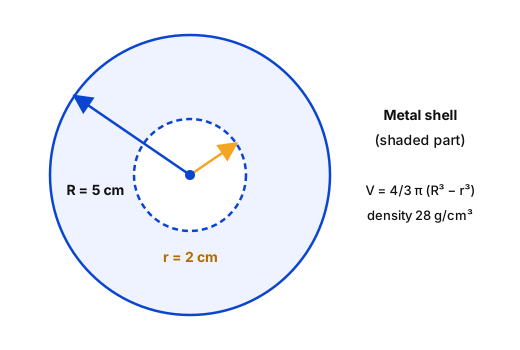
A hollow spherical shell is made of a metal of density 28 g/cm3. Its internal and external radii are 2 cm and 5 cm, respectively. What is the approximate weight (in kg) of the shell?
(Take π=227, Density=MassVolume)
एक खोखला गोलीय कोश 28 g/cm3 घनत्व वाली धातु से बना है। इसकी आंतरिक और बाहरी त्रिज्याएँ क्रमशः 2 cm और 5 cm हैं। कोश का अनुमानित भार (kg में) कितना है?
(π=227, Density=MassVolume लीजिए)
  1. A13.728
  2. B15.12
  3. C10.728
  4. D15.49
Show answer

Concept: Volume of a hollow sphere =43π(R3−r3); mass = density × volume.

  1. R3−r3=125−8=117cm3
  2. V=43×227×117=1029621≈490.29cm3
  3. Mass =28×1029621=43×10296=13728g=13.728kg

Trick: 28 and the 21 in the denominator cancel to 43: mass =43×43×22×117 g.

Answer: (A) 13.728 kg

अवधारणा: खोखले गोले का आयतन =43π(R3−r3); द्रव्यमान = घनत्व × आयतन।

  1. R3−r3=125−8=117cm3
  2. V=43×227×117=1029621≈490.29cm3
  3. द्रव्यमान =28×1029621=43×10296=13728g=13.728kg

ट्रिक: 28 और हर का 21 कटकर 43: द्रव्यमान =43×43×22×117 g

उत्तर: (A) 13.728 kg

RRB NTPC Graduate CBT 1MathematicsMensuration – SphereRRB NTPC Graduate CBT 1 2024 · 21 Jun Shift 2 →
Q746.
If α and β are the roots of the equation x2 − x − 6 = 0, find the value of α4 + β4.
यदि α और β समीकरण x2 − x − 6 = 0 के मूल हैं, तो α4 + β4 का मान ज्ञात कीजिए।
  1. A100
  2. B90
  3. C95
  4. D97
Show answer

Concept: For x2−x−6=0: α+β=1, αβ=−6. Use α4+β4=(α2+β2)2−2(αβ)2.

  1. α2+β2=(α+β)2−2αβ=1+12=13
  2. α4+β4=132−2×36=169−72=97

Trick: Roots are 3 and −2: 34+(−2)4=81+16=97.

Answer: (D) 97

अवधारणा: x2−x−6=0 के लिए: α+β=1, αβ=−6; सूत्र α4+β4=(α2+β2)2−2(αβ)2

  1. α2+β2=(α+β)2−2αβ=1+12=13
  2. α4+β4=132−2×36=169−72=97

ट्रिक: मूल 3 और −2 हैं: 34+(−2)4=81+16=97

उत्तर: (D) 97

RRB NTPC Graduate CBT 1MathematicsQuadratic Equations – RootsRRB NTPC Graduate CBT 1 2024 · 21 Jun Shift 2 →
Q747.
The mode of the observations 24, 33, 32, 24, 28, 24, 29, 25, 25, 34, 27, 26, 22, 34, 27, 24 and 30 is:
प्रेक्षणों 24, 33, 32, 24, 28, 24, 29, 25, 25, 34, 27, 26, 22, 34, 27, 24 और 30 का बहुलक (mode) कितना है?
  1. A33
  2. B28
  3. C24
  4. D32
Show answer

Concept: Mode is the observation that occurs most often.

  1. Frequencies: 24 → 4 times; 25, 27, 34 → 2 times each; all others once.
  2. Highest frequency is for 24.

Trick: Just tally the repeats – no calculation needed.

Answer: (C) 24

अवधारणा: बहुलक (mode) वह प्रेक्षण है जो सबसे अधिक बार आता है।

  1. बारंबारता: 24 → 4 बार; 25, 27, 34 → 2-2 बार; बाकी एक-एक बार।
  2. सर्वाधिक बारंबारता 24 की है।

ट्रिक: बस दोहराव गिनें – गणना की ज़रूरत नहीं।

उत्तर: (C) 24

RRB NTPC Graduate CBT 1MathematicsStatistics – ModeRRB NTPC Graduate CBT 1 2024 · 21 Jun Shift 2 →
Q748.
If 56% of a number is equal to 59 of another number, then what is the ratio of the first number to the second number?
यदि एक संख्या का 56%, दूसरी संख्या के 59 के बराबर है, तो पहली संख्या का दूसरी संख्या से अनुपात कितना है?
  1. A123:128
  2. B128:125
  3. C130:131
  4. D125:126
Show answer

Concept: Write the condition as an equation and form the ratio.

  1. 56100a=59b⇒ab=59×10056
  2. =500504=125126
  3. So a:b=125:126

Trick: a×56%=b×59⇒a:b=59:56100 – cross-multiply.

Answer: (D) 125:126

अवधारणा: शर्त को समीकरण में लिखें और अनुपात बनाएँ।

  1. 56100a=59b⇒ab=59×10056
  2. =500504=125126
  3. अतः a:b=125:126

ट्रिक: a×56%=b×59⇒a:b=59:56100 – तिरछा गुणा करें।

उत्तर: (D) 125:126

RRB NTPC Graduate CBT 1MathematicsRatio and PercentageRRB NTPC Graduate CBT 1 2024 · 21 Jun Shift 2 →
Q749.
The simplified value of 81 - 4 × (5 + 2) + 54 is:
81 - 4 × (5 + 2) + 54 का सरलीकृत मान कितना है?
  1. A108
  2. B110
  3. C107
  4. D114
Show answer

Concept: BODMAS: Brackets, then Multiplication, then Addition/Subtraction from left to right.

  1. Bracket: 5+2=7
  2. Multiply: 4×7=28
  3. 81−28+54=107

Trick: Never subtract before multiplying: 81−4 first would give a wrong value.

Answer: (C) 107

अवधारणा: BODMAS: पहले कोष्ठक, फिर गुणा, फिर बाएँ से दाएँ जोड़/घटाव।

  1. कोष्ठक: 5+2=7
  2. गुणा: 4×7=28
  3. 81−28+54=107

ट्रिक: गुणा से पहले घटाव न करें: पहले 81−4 करने पर गलत उत्तर आएगा।

उत्तर: (C) 107

RRB NTPC Graduate CBT 1MathematicsSimplification – BODMASRRB NTPC Graduate CBT 1 2024 · 21 Jun Shift 2 →
Q750.
A car travels 60 km in the first hour, 80 km in the second hour, and 100 km in the third hour. What is the average speed of the car over the 3 hours?
एक कार पहले घंटे में 60 km, दूसरे घंटे में 80 km और तीसरे घंटे में 100 km की यात्रा करती है। 3 घंटों में कार की औसत चाल कितनी है?
  1. A85 km/hr
  2. B90 km/hr
  3. C75 km/hr
  4. D80 km/hr
Show answer

Concept: Average speed=Total distanceTotal time

  1. Total distance =60+80+100=240km
  2. Total time =3 h
  3. Average speed =2403=80km/h

Trick: Equal time intervals → average speed = simple average of the speeds.

Answer: (D) 80km/h

अवधारणा: औसत चाल=कुल दूरीकुल समय

  1. कुल दूरी =60+80+100=240km
  2. कुल समय =3 h
  3. औसत चाल =2403=80km/h

ट्रिक: समान समय-अंतराल → औसत चाल = चालों का साधारण औसत।

उत्तर: (D) 80km/h

RRB NTPC Graduate CBT 1MathematicsSpeed – Average SpeedRRB NTPC Graduate CBT 1 2024 · 21 Jun Shift 2 →
Q751.
A sum of money is to be distributed among A, B, C, and D in the ratio of 14 : 7 : 11 : 10. If C gets ₹196 more than B, how much did A receive?
एक धनराशि को A, B, C और D के बीच 14 : 7 : 11 : 10 के अनुपात में बाँटा जाना है। यदि C को B से ₹196 अधिक मिलते हैं, तो A को कितनी राशि प्राप्त हुई?
  1. A₹684
  2. B₹686
  3. C₹688
  4. D₹685
Show answer

Concept: Find the value of one ratio part from the given difference.

  1. C − B =11−7=4 parts =196 (₹)
  2. 1 part =1964=49 (₹)
  3. A =14×49=686 (₹)

Trick: A is 144 of the difference: 196×3.5=686.

Answer: (B) ₹686

अवधारणा: दिए गए अंतर से एक भाग का मान निकालें।

  1. C − B =11−7=4 भाग =196 (₹)
  2. 1 भाग =1964=49 (₹)
  3. A =14×49=686 (₹)

ट्रिक: A अंतर का 144 गुना: 196×3.5=686

उत्तर: (B) ₹686

RRB NTPC Graduate CBT 1MathematicsRatio and ProportionRRB NTPC Graduate CBT 1 2024 · 21 Jun Shift 2 →
Q752.
If 674 bananas were distributed among three monkeys in the ratio 172:146:25 respectively, how many bananas did the third monkey get?
यदि 674 केलों को तीन बंदरों में क्रमशः 172:146:25 के अनुपात में बाँटा गया, तो तीसरे बंदर को कितने केले मिले?
  1. A24
  2. B23
  3. C22
  4. D25
Show answer

Concept: Convert a ratio of fractions into whole numbers by multiplying each term by the LCM of the denominators.

  1. Ratio =172:146:25=172:73:25.
  2. LCM of 2, 3, 5 is 30: 172×30=255, 73×30=70, 25×30=12.
  3. Sum =255+70+12=337 parts; one part =674337=2.
  4. Third monkey =12×2=24.

Trick: 674 is exactly 2×337, so each part is 2 bananas.

Answer: (A) 24

अवधारणा: भिन्नों वाले अनुपात को हरों के LCM से गुणा करके पूर्णांक अनुपात बनाएँ।

  1. अनुपात =172:146:25=172:73:25।
  2. 2, 3, 5 का LCM 30: 172×30=255, 73×30=70, 25×30=12।
  3. कुल =255+70+12=337 भाग; एक भाग =674337=2।
  4. तीसरा बंदर =12×2=24।

ट्रिक: 674 ठीक 2×337 है, यानी हर भाग = 2 केले।

उत्तर: (A) 24

RRB NTPC Graduate CBT 1MathematicsRatio and ProportionRRB NTPC Graduate CBT 1 2024 · 21 Jun Shift 2 →
Q753.
Nandan had some marbles. When he distributed the marbles equally among 32 children, he found that 4 marbles were left. Had he distributed the marbles equally among 41 children and 48 children, he still would have had 13 and 20 marbles, respectively, left with him. But when he distributed them equally among 53 children, no marble was left. The number of marbles that Nandan initially had may lie between __________.
नंदन के पास कुछ कंचे थे। जब उसने कंचों को 32 बच्चों में बराबर-बराबर बाँटा, तो उसने पाया कि 4 कंचे बच गए। यदि वह कंचों को 41 बच्चों और 48 बच्चों में बराबर-बराबर बाँटता, तो भी उसके पास क्रमशः 13 और 20 कंचे बच जाते। लेकिन जब उसने उन्हें 53 बच्चों में बराबर-बराबर बाँटा, तो कोई कंचा नहीं बचा। नंदन के पास आरंभ में कंचों की संख्या __________ के बीच हो सकती है।
  1. A7814 and 78247814 और 7824
  2. B7794 and 78047794 और 7804
  3. C7864 and 78747864 और 7874
  4. D7834 and 78547834 और 7854
Show answer

Concept: If divisor − remainder is the same for all divisors, the number = k × LCM − (that common difference).

  1. 32−4=28, 41−13=28, 48−20=28, so N+28 is divisible by 32, 41 and 48.
  2. LCM(32,41,48)=96×41=3936, so N=3936k−28.
  3. k=1: 3908 (not divisible by 53). k=2: 7872−28=7844=53×148 ✓.
  4. N=7844, which lies between 7834 and 7854.

Trick: Common 'shortfall' 28 → subtract it from multiples of the LCM, then test the extra condition.

Answer: (D) 7834 and 7854

अवधारणा: यदि हर भाजक के लिए (भाजक − शेषफल) समान हो, तो संख्या = k × LCM − वह अंतर।

  1. 32−4=28, 41−13=28, 48−20=28, अतः N+28 संख्या 32, 41 और 48 से विभाज्य है।
  2. LCM(32,41,48)=96×41=3936, अतः N=3936k−28।
  3. k=1: 3908 (53 से विभाज्य नहीं)। k=2: 7872−28=7844=53×148 ✓।
  4. N=7844, जो 7834 और 7854 के बीच है।

ट्रिक: समान 'कमी' 28 → LCM के गुणजों में से 28 घटाएँ, फिर अतिरिक्त शर्त जाँचें।

उत्तर: (D) 7834 और 7854

RRB NTPC Graduate CBT 1MathematicsLCM – RemaindersRRB NTPC Graduate CBT 1 2024 · 21 Jun Shift 2 →
Q754.
Find the value of 7secA(1+sinA)(secA−tanA)−4.
7secA(1+sinA)(secA−tanA)−4 का मान ज्ञात कीजिए।
  1. A7
  2. B3
  3. C10
  4. D4
Show answer

Concept: Use secA−tanA=1−sinAcosA and 1−sin2A=cos2A.

  1. secA(1+sinA)(secA−tanA)=1cosA×(1+sinA)×1−sinAcosA.
  2. =1−sin2Acos2A=cos2Acos2A=1.
  3. Expression =7×1−4=3.

Trick: Put A=0∘: 7×1×1×1−4=3.

Answer: (B) 3

अवधारणा: secA−tanA=1−sinAcosA तथा 1−sin2A=cos2A का प्रयोग करें।

  1. secA(1+sinA)(secA−tanA)=1cosA×(1+sinA)×1−sinAcosA।
  2. =1−sin2Acos2A=cos2Acos2A=1।
  3. व्यंजक =7×1−4=3।

ट्रिक: A=0∘ रखें: 7×1×1×1−4=3।

उत्तर: (B) 3

RRB NTPC Graduate CBT 1MathematicsTrigonometric IdentitiesRRB NTPC Graduate CBT 1 2024 · 21 Jun Shift 2 →
Q755.
If the length of a cuboid is 33 cm, breadth is 4 cm and volume is 7524 cm3, then find the height (in cm) of the cuboid.
यदि एक घनाभ की लंबाई 33 cm, चौड़ाई 4 cm और आयतन 7524 cm3 है, तो घनाभ की ऊँचाई (cm में) ज्ञात कीजिए।
  1. A60
  2. B57
  3. C54
  4. D67
Show answer

Concept: Volume of cuboid =l×b×h.

  1. 7524=33×4×h=132h.
  2. h=7524132=57cm.

Trick: Unit digit check: 132×57 ends in 4 (2×7=14) ✓.

Answer: (B) 57

अवधारणा: घनाभ का आयतन =l×b×h।

  1. 7524=33×4×h=132h।
  2. h=7524132=57cm।

ट्रिक: इकाई अंक जाँच: 132×57 का अंतिम अंक 4 (2×7=14) ✓।

उत्तर: (B) 57

RRB NTPC Graduate CBT 1MathematicsMensuration – CuboidRRB NTPC Graduate CBT 1 2024 · 21 Jun Shift 2 →
Q756.
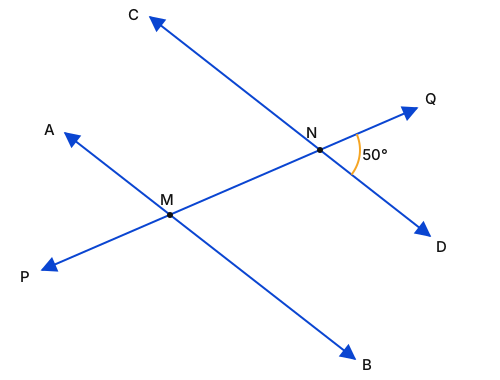
In the given figure, AB and CD are two parallel lines and PQ is a transversal line. Find the measure of ∠PMB.
दी गई आकृति में, AB और CD दो समांतर रेखाएँ हैं और PQ एक तिर्यक रेखा है। ∠PMB का माप ज्ञात कीजिए।
  1. A50°
  2. B100°
  3. C130°
  4. D120°
Show answer

Concept: When a transversal cuts two parallel lines, corresponding angles are equal and angles on a straight line add up to 180∘.

  1. ∠QND=50∘ (given).
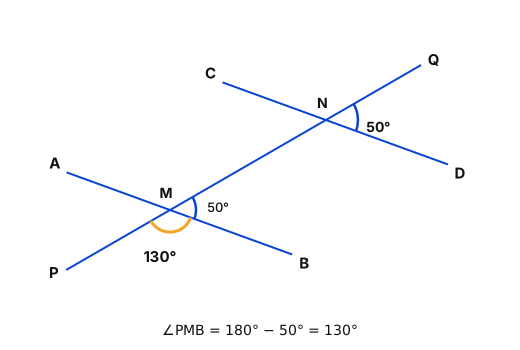
  2. ∠QMB and ∠QND are corresponding angles (AB∥CD), so ∠QMB=50∘.
  3. ∠PMB and ∠QMB form a linear pair: ∠PMB=180∘−50∘=130∘.

Trick: The angle at N is acute (50∘); ∠PMB opens on the other side of the transversal, so it is obtuse =180∘−50∘.

Answer: (C) 130∘

अवधारणा: जब एक तिर्यक रेखा दो समांतर रेखाओं को काटती है तो संगत कोण बराबर होते हैं और सरल रेखा पर बने कोणों का योग 180∘ होता है।

  1. ∠QND=50∘ (दिया है)।
  2. ∠QMB और ∠QND संगत कोण हैं (AB∥CD), अतः ∠QMB=50∘।
  3. ∠PMB और ∠QMB रैखिक युग्म हैं: ∠PMB=180∘−50∘=130∘।

ट्रिक: N पर कोण न्यून (50∘) है; ∠PMB तिर्यक रेखा की दूसरी ओर है, अतः अधिक कोण =180∘−50∘।

उत्तर: (C) 130∘

RRB NTPC Graduate CBT 1MathematicsLines and Angles – Parallel LinesRRB NTPC Graduate CBT 1 2024 · 21 Jun Shift 2 →
Q757.
A sells a smartphone to B at a loss of 60% and B sells the smartphone to C at a profit of 25%. If C purchased the smartphone for ₹42,206, then what was the cost (in ₹) of the smartphone for A?
A एक स्मार्टफ़ोन B को 60% की हानि पर बेचता है और B वह स्मार्टफ़ोन C को 25% के लाभ पर बेचता है। यदि C ने स्मार्टफ़ोन ₹42,206 में खरीदा, तो A के लिए स्मार्टफ़ोन का क्रय मूल्य (₹ में) कितना था?
  1. A84,412
  2. B84,415
  3. C84,407
  4. D84,406
Show answer

Concept: Successive selling: final price = original cost × product of the multipliers.

  1. Loss 60% → multiplier 0.4; profit 25% → multiplier 1.25.
  2. C's price =x×0.4×1.25=0.5x.
  3. 0.5x=42206⇒x=84412.

Trick: 0.4×1.25=12, so A's cost is just double C's price.

Answer: (A) ₹84,412

अवधारणा: क्रमिक बिक्री: अंतिम मूल्य = मूल लागत × सभी गुणकों का गुणनफल।

  1. हानि 60% → गुणक 0.4; लाभ 25% → गुणक 1.25।
  2. C का मूल्य =x×0.4×1.25=0.5x।
  3. 0.5x=42206⇒x=84412।

ट्रिक: 0.4×1.25=12, अतः A की लागत = C के मूल्य का दोगुना।

उत्तर: (A) ₹84,412

RRB NTPC Graduate CBT 1MathematicsProfit and Loss – SuccessiveRRB NTPC Graduate CBT 1 2024 · 21 Jun Shift 2 →
Q758.
A pipe can fill a tank in 27 hours. Another pipe can empty the filled tank in 28 hours. If both the pipes are opened simultaneously, then the time (in hours) in which the tank will be one-fourth filled, is:
एक पाइप किसी टंकी को 27 घंटे में भर सकता है। दूसरा पाइप भरी हुई टंकी को 28 घंटे में खाली कर सकता है। यदि दोनों पाइप एक साथ खोल दिए जाएँ, तो टंकी कितने समय (घंटों में) में एक-चौथाई भर जाएगी?
  1. A567
  2. B378
  3. C756
  4. D189
Show answer

Concept: Net filling rate = filling rate − emptying rate.

  1. Net rate =127−128=28−27756=1756 tank per hour.
  2. Full tank takes 756 hours.
  3. One-fourth tank =7564=189 hours.

Trick: For consecutive numbers n,n+1: net time =n(n+1); here 27×28=756.

Answer: (D) 189

अवधारणा: शुद्ध भरने की दर = भरने की दर − खाली करने की दर।

  1. शुद्ध दर =127−128=28−27756=1756 टंकी प्रति घंटा।
  2. पूरी टंकी 756 घंटे में भरेगी।
  3. एक-चौथाई टंकी =7564=189 घंटे।

ट्रिक: क्रमागत संख्याओं n,n+1 के लिए शुद्ध समय =n(n+1); यहाँ 27×28=756।

उत्तर: (D) 189

RRB NTPC Graduate CBT 1MathematicsPipes and CisternRRB NTPC Graduate CBT 1 2024 · 21 Jun Shift 2 →
Q759.
The population of a village was 1,20,000. It increased by 10% in the first year and increased by 30% in the second year. Its population after two years is _______.
एक गाँव की जनसंख्या 1,20,000 थी। पहले वर्ष में इसमें 10% की वृद्धि हुई और दूसरे वर्ष में 30% की वृद्धि हुई। दो वर्ष बाद इसकी जनसंख्या _______ है।
  1. A1,68,000
  2. B1,32,000
  3. C1,71,600
  4. D1,56,000
Show answer

Concept: Successive percentage increases are applied one after another as multipliers.

  1. After year 1: 120000×1.10=132000.
  2. After year 2: 132000×1.30=171600.

Trick: Net change =10+30+10×30100=43%; 120000×1.43=171600.

Answer: (C) 1,71,600

अवधारणा: क्रमिक प्रतिशत वृद्धि को गुणकों के रूप में एक के बाद एक लगाएँ।

  1. पहले वर्ष के बाद: 120000×1.10=132000।
  2. दूसरे वर्ष के बाद: 132000×1.30=171600।

ट्रिक: कुल वृद्धि =10+30+10×30100=43%; 120000×1.43=171600।

उत्तर: (C) 1,71,600

RRB NTPC Graduate CBT 1MathematicsPopulation GrowthRRB NTPC Graduate CBT 1 2024 · 21 Jun Shift 2 →
Q760.
The percentage profit earned by selling a table lamp for ₹863 is equal to the percentage loss incurred by selling the same table lamp for ₹433. At what price (in ₹) should the table lamp be sold to make 25% profit?
एक टेबल लैंप को ₹863 में बेचने पर अर्जित प्रतिशत लाभ, उसी टेबल लैंप को ₹433 में बेचने पर हुई प्रतिशत हानि के बराबर है। 25% लाभ प्राप्त करने के लिए टेबल लैंप को किस मूल्य (₹ में) पर बेचा जाना चाहिए?
  1. A812
  2. B810
  3. C811
  4. D813
Show answer

Concept: If profit % at one SP equals loss % at another SP, the cost price is the average of the two SPs.

  1. 863−CPCP=CP−433CP⇒CP=863+4332=648.
  2. SP for 25% profit =648×125100=810.

Trick: Equal profit% and loss% → CP=SP1+SP22.

Answer: (B) ₹810

अवधारणा: यदि एक विक्रय मूल्य पर लाभ% दूसरे पर हानि% के बराबर हो, तो क्रय मूल्य दोनों SP का औसत होता है।

  1. 863−CPCP=CP−433CP⇒CP=863+4332=648।
  2. 25% लाभ हेतु SP =648×125100=810।

ट्रिक: लाभ% = हानि% → CP=SP1+SP22।

उत्तर: (B) ₹810

RRB NTPC Graduate CBT 1MathematicsProfit and LossRRB NTPC Graduate CBT 1 2024 · 21 Jun Shift 2 →