Question bank

Q&A: practice questions with answers

Search questions on any topic. Filter by exam category, exam, subject and topic, try the question, then open the answer and explanation.

Courses – airGurukul

2,400 questions found.

Q61.
P and Q can complete a piece of work in 20 days and 30 days, respectively. They decide to work alternatively; one day P and next day Q, until the job is finished. How many days will it take for the work to be completed, if P starts the work?
P और Q एक कार्य को क्रमशः 20 दिनों और 30 दिनों में पूरा कर सकते हैं। वे एकांतर रूप से कार्य करने का निर्णय लेते हैं; एक दिन P और अगले दिन Q, जब तक कार्य समाप्त न हो जाए। यदि P कार्य शुरू करता है, तो कार्य पूरा होने में कितने दिन लगेंगे?
  1. A24 days24 दिन
  2. B18 days18 दिन
  3. C21 days21 दिन
  4. D25 days25 दिन
Show answer

Concept: Take total work = LCM of the days; find the work done in one 2-day cycle.

  1. Total work =LCM(20,30)=60 units; P does 3/day, Q does 2/day.
  2. One cycle (P day + Q day) =5 units in 2 days.
  3. 12 cycles =60 units exactly ⇒12×2=24 days, finishing on Q's day with no remainder.

Trick: Always check whether the total divides exactly by the cycle work – here 60÷5=12, so no fractional last day.

Answer: (A) 24 days

अवधारणा: कुल कार्य = दिनों का LCM लें; एक 2-दिन चक्र का कार्य निकालें।

  1. कुल कार्य =LCM(20,30)=60 इकाई; P 3/दिन, Q 2/दिन।
  2. एक चक्र (P का दिन + Q का दिन) =5 इकाई, 2 दिन में।
  3. 12 चक्र =60 इकाई ठीक-ठीक ⇒12×2=24 दिन, Q के दिन पर काम पूरा, कुछ शेष नहीं।

ट्रिक: हमेशा जाँचें कि कुल कार्य चक्र के कार्य से पूरा विभाजित होता है या नहीं – यहाँ 60÷5=12, इसलिए अंतिम दिन भिन्न नहीं।

उत्तर: (A) 24 days
RRB NTPC Graduate CBT 1MathematicsTime and Work – Alternate DaysRRB NTPC Graduate CBT 1 2025 · 27 Mar Shift 3 →
Q62.
Salil’s salary is ₹18000 per month. He spends ₹5500 on house rent, ₹1500 on bills and the rest of the amount is his monthly savings. Find his savings (in ₹) in a year, if in the month of his birthday, he spent his complete monthly saving for birthday
celebration.
सलिल का वेतन ₹18000 प्रति माह है। वह मकान किराए पर ₹5500, बिलों पर ₹1500 खर्च करता है और शेष राशि उसकी मासिक बचत है। एक वर्ष में उसकी बचत (₹ में) ज्ञात कीजिए, यदि अपने जन्मदिन के महीने में उसने अपनी पूरी मासिक बचत जन्मदिन
समारोह पर खर्च कर दी।
  1. A99000
  2. B132000
  3. C110000
  4. D121000
Show answer

Concept: Monthly saving = salary − expenses; count only the months in which the saving is actually kept.

  1. Saving per month =18000−5500−1500=11000.
  2. In the birthday month the whole saving is spent ⇒ only 11 months of saving.
  3. Yearly saving =11×11000=121000.

Trick: Option B (132000=12×11000) is the trap for those who forget the birthday month.

Answer: (D) 121000

अवधारणा: मासिक बचत = वेतन − खर्च; केवल उन महीनों को गिनें जिनमें बचत सचमुच बचती है।

  1. प्रति माह बचत =18000−5500−1500=11000।
  2. जन्मदिन के महीने में पूरी बचत खर्च ⇒ केवल 11 महीनों की बचत।
  3. वार्षिक बचत =11×11000=121000।

ट्रिक: विकल्प B (132000=12×11000) उनके लिए जाल है जो जन्मदिन का महीना भूल जाते हैं।

उत्तर: (D) 121000

RRB NTPC Graduate CBT 1MathematicsIncome and SavingsRRB NTPC Graduate CBT 1 2025 · 27 Mar Shift 3 →
Q63.
Solve the following system of 3 equations in 3 unknowns.
2x + y − 3z = −4
4x − 2y + z = 9
3x + 5y − 2z = 5
3 अज्ञात राशियों वाले निम्नलिखित 3 समीकरणों के निकाय को हल कीजिए।
2x + y − 3z = −4
4x − 2y + z = 9
3x + 5y − 2z = 5
  1. Ax = 2, y = −1, z = −3
  2. Bx = 2, y = 1, z = 3
  3. Cx = −2, y = −1, z = 3
  4. Dx = −2, y = 1, z = 3
Show answer

Concept: With options given, substitute; or eliminate one variable.

  1. Add 2×(eq.1) to (eq.2): 8x−5z=1. Subtract (eq.3) from 5×(eq.1): 7x−13z=−25.
  2. From 8x−5z=1, x=1+5z8; substituting gives 7+35z−104z=−200⇒z=3, x=2.
  3. Eq.1: 4+y−9=−4⇒y=1. Check eq.2: 8−2+3=9 ✓.

Trick: In the exam just test options in the first equation: only (2,1,3) and (2,−1,−3) survive; eq.2 then kills (2,−1,−3) (8+2−3≠9).

Answer: (B) x = 2, y = 1, z = 3

अवधारणा: विकल्प दिए हों तो प्रतिस्थापन करें; या एक चर हटाएँ।

  1. 2×(समी.1) + (समी.2): 8x−5z=1। 5×(समी.1) − (समी.3): 7x−13z=−25।
  2. 8x−5z=1 से x=1+5z8; रखने पर 7+35z−104z=−200⇒z=3, x=2।
  3. समी.1: 4+y−9=−4⇒y=1। समी.2 जाँच: 8−2+3=9 ✓।

ट्रिक: परीक्षा में विकल्प पहले समीकरण में रखें: केवल (2,1,3) और (2,−1,−3) बचते हैं; समी.2 से (2,−1,−3) कट जाता है (8+2−3≠9)।

उत्तर: (B) x = 2, y = 1, z = 3

RRB NTPC Graduate CBT 1MathematicsLinear Equations – Three VariablesRRB NTPC Graduate CBT 1 2025 · 27 Mar Shift 3 →
Q64.
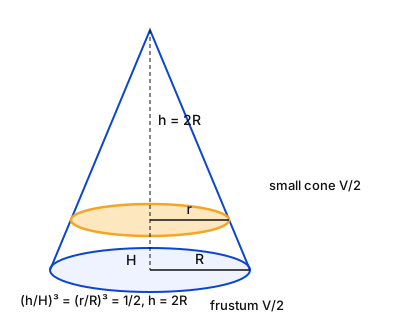
A solid cone is cut into two pieces (a smaller cone and a frustum) of equal volume by making a cut parallel to its flat surface. The height of the small cone is equal to the diameter of the bigger flat area of the frustum. The radius of the small cone is ____ times its height.
एक ठोस शंकु को उसके समतल पृष्ठ के समांतर काटकर समान आयतन के दो टुकड़ों (एक छोटा शंकु और एक छिन्नक) में काटा जाता है। छोटे शंकु की ऊँचाई छिन्नक के बड़े समतल पृष्ठ के व्यास के बराबर है। छोटे शंकु की त्रिज्या उसकी ऊँचाई की ____ गुनी है।
  1. A1223
  2. B123
  3. C1333
  4. D1233
Show answer

Concept: A cut parallel to the base gives a similar smaller cone: rh=RH and V1V=(hH)3.

  1. Equal volumes ⇒V1=V2⇒(hH)3=12⇒hH=123.
  2. Given h= diameter of the frustum's bigger face =2R, so H=2R23.
  3. rh=RH=R2R23=1223.

Trick: Similar solids – lengths scale by k, areas by k2, volumes by k3; "half the volume" means k=123.

Answer: (A) 1223

अवधारणा: आधार के समांतर काटने से समरूप छोटा शंकु बनता है: rh=RH और V1V=(hH)3।

  1. समान आयतन ⇒V1=V2⇒(hH)3=12⇒hH=123।
  2. दिया है h= छिन्नक के बड़े फलक का व्यास =2R, अतः H=2R23।
  3. rh=RH=R2R23=1223।

ट्रिक: समरूप ठोस – लंबाई k गुना, क्षेत्रफल k2 गुना, आयतन k3 गुना; "आधा आयतन" का अर्थ k=123।

उत्तर: (A) 1223

RRB NTPC Graduate CBT 1MathematicsMensuration – Cone and FrustumRRB NTPC Graduate CBT 1 2025 · 27 Mar Shift 3 →
Q65.
Find the value of y, satisfying 12×3×940÷2209=y+716
y का वह मान ज्ञात कीजिए, जो 12×3×940÷2209=y+716 को संतुष्ट करता है।
  1. A0
  2. B4
  3. C-6
  4. D3
Show answer

Concept: Evaluate the root first, then multiplication/division left to right.

  1. 2209=47 (since 472=2209).
  2. 12×3×940=33840; 33840÷47=720.
  3. 720=y+716⇒y=4.

Trick: 940=47×20, so 12×3×940÷47=36×20=720 without long division.

Answer: (B) 4

अवधारणा: पहले वर्गमूल निकालें, फिर बाएँ से दाएँ गुणा/भाग करें।

  1. 2209=47 (क्योंकि 472=2209)।
  2. 12×3×940=33840; 33840÷47=720।
  3. 720=y+716⇒y=4।

ट्रिक: 940=47×20, अतः 12×3×940÷47=36×20=720 – लंबे भाग की ज़रूरत नहीं।

उत्तर: (B) 4

RRB NTPC Graduate CBT 1MathematicsSimplification – BODMASRRB NTPC Graduate CBT 1 2025 · 27 Mar Shift 3 →
Q66.
Arjun has ₹1394 with him. He divides this amount between his two sons, Kartik and Ishan, and asks them to invest their respective shares at a compound interest rate of 5% per annum, compounded annually. It is observed that Kartik’s investment amounts to the same value after 17 years as Ishan’s investment does after 18 years. How much (in ₹) did Arjun give to Ishan?
अर्जुन के पास ₹1394 हैं। वह इस राशि को अपने दो पुत्रों, कार्तिक और ईशान, के बीच बाँटता है और उनसे अपने-अपने हिस्से को 5% वार्षिक चक्रवृद्धि ब्याज की दर पर, वार्षिक रूप से संयोजित, निवेश करने के लिए कहता है। यह देखा गया कि कार्तिक का निवेश 17 वर्षों के बाद उतनी ही राशि हो जाता है जितनी ईशान का निवेश 18 वर्षों के बाद होता है। अर्जुन ने ईशान को कितनी राशि (₹ में) दी?
  1. A530
  2. B714
  3. C680
  4. D814
Show answer

Concept: If K(1+r)n=I(1+r)n+1, then KI=(1+r) – one extra year of growth for the smaller share.

  1. K(1.05)17=I(1.05)18⇒K=1.05I⇒K:I=21:20.
  2. Total 41 parts =1394⇒ 1 part =34.
  3. Ishan =20×34=680.

Trick: Shares are inversely proportional to the growth factor: the one invested longer gets the smaller share, ratio 100:(100+r).

Answer: (C) 680

अवधारणा: यदि K(1+r)n=I(1+r)n+1, तो KI=(1+r) – छोटे हिस्से को एक वर्ष अधिक वृद्धि मिलती है।

  1. K(1.05)17=I(1.05)18⇒K=1.05I⇒K:I=21:20।
  2. कुल 41 भाग =1394⇒ 1 भाग =34।
  3. ईशान =20×34=680।

ट्रिक: हिस्से वृद्धि-गुणक के व्युत्क्रमानुपाती होते हैं: जो अधिक समय निवेश करता है उसे छोटा हिस्सा, अनुपात 100:(100+r)।

उत्तर: (C) 680

RRB NTPC Graduate CBT 1MathematicsCompound Interest – Equal AmountsRRB NTPC Graduate CBT 1 2025 · 27 Mar Shift 3 →
Q67.
Three positive integers, P, Q, and R, are such that the highest common factor of P and Q is 15, the highest common factor of Q and R is 10, and the highest common factor of R and P is 5. If the sum P + Q + R is as small as possible, the value of P × Q × R is:
तीन धनात्मक पूर्णांक P, Q और R इस प्रकार हैं कि P और Q का महत्तम समापवर्तक 15 है, Q और R का महत्तम समापवर्तक 10 है, और R और P का महत्तम समापवर्तक 5 है। यदि योग P + Q + R यथासंभव न्यूनतम है, तो P × Q × R का मान है:
  1. A4500
  2. B3000
  3. C6000
  4. D1500
Show answer

Concept: Each number must be a multiple of every HCF it is part of; choose the smallest such multiples that keep the HCFs exact.

  1. Q is a multiple of both 15 and 10 ⇒ Q ≥LCM(15,10)=30.
  2. P multiple of 15 and 5 ⇒ P =15; R multiple of 10 and 5 ⇒ R =10.
  3. Check: HCF(15,30)=15, HCF(30,10)=10, HCF(10,15)=5 ✓.
  4. P×Q×R=15×30×10=4500.

Trick: The number appearing in two HCF conditions must be at least the LCM of those two HCFs.

Answer: (A) 4500

अवधारणा: हर संख्या उन सभी HCF का गुणज होनी चाहिए जिनमें वह शामिल है; सबसे छोटे ऐसे गुणज चुनें जो HCF सही रखें।

  1. Q, 15 और 10 दोनों का गुणज ⇒ Q ≥LCM(15,10)=30।
  2. P, 15 और 5 का गुणज ⇒ P =15; R, 10 और 5 का गुणज ⇒ R =10।
  3. जाँच: HCF(15,30)=15, HCF(30,10)=10, HCF(10,15)=5 ✓।
  4. P×Q×R=15×30×10=4500।

ट्रिक: जो संख्या दो HCF शर्तों में आती है वह उन दोनों HCF के LCM से कम नहीं हो सकती।

उत्तर: (A) 4500

RRB NTPC Graduate CBT 1MathematicsHCF – Minimum SumRRB NTPC Graduate CBT 1 2025 · 27 Mar Shift 3 →
Q68.
A building contractor employs 25 skilled workers and 5 unskilled workers. To a skilled worker he pays ₹30 per hour and to an unskilled worker ₹24 per hour. The average wage per hour (in ₹) paid by the contractor is:
एक भवन ठेकेदार 25 कुशल श्रमिकों और 5 अकुशल श्रमिकों को नियुक्त करता है। वह एक कुशल श्रमिक को ₹30 प्रति घंटा और एक अकुशल श्रमिक को ₹24 प्रति घंटा भुगतान करता है। ठेकेदार द्वारा भुगतान की गई प्रति घंटा औसत मजदूरी (₹ में) है:
  1. A29
  2. B32
  3. C27
  4. D25
Show answer

Concept: Average wage =total wagestotal workers.

  1. Total per hour =25×30+5×24=750+120=870.
  2. Average =87030=29.

Trick: Alligation: workers 25:5=5:1, so the average sits 5 times closer to 30 than to 24: 24+56×6=29.

Answer: (A) 29

अवधारणा: औसत मजदूरी =कुल मजदूरीकुल श्रमिक।

  1. प्रति घंटा कुल =25×30+5×24=750+120=870।
  2. औसत =87030=29।

ट्रिक: मिश्रण विधि: श्रमिक 25:5=5:1, अतः औसत 24 की तुलना में 30 के 5 गुना पास: 24+56×6=29।

उत्तर: (A) 29

RRB NTPC Graduate CBT 1MathematicsWeighted AverageRRB NTPC Graduate CBT 1 2025 · 27 Mar Shift 3 →
Q69.
The price of each article of type P, Q, and R is ₹280, ₹180 and ₹115, respectively. Ranu buys articles of each type in the ratio 4 : 4 : 3 for ₹6,555. How many articles of type Q did he purchase?
P, Q और R प्रकार की प्रत्येक वस्तु का मूल्य क्रमशः ₹280, ₹180 और ₹115 है। रानू प्रत्येक प्रकार की वस्तुएँ 4 : 4 : 3 के अनुपात में ₹6,555 में खरीदता है। उसने Q प्रकार की कितनी वस्तुएँ खरीदीं?
  1. A9
  2. B12
  3. C20
  4. D18
Show answer

Concept: Let the numbers bought be 4x,4x,3x; total cost =∑(price×quantity).

  1. Cost =280(4x)+180(4x)+115(3x)=1120x+720x+345x=2185x.
  2. 2185x=6555⇒x=3.
  3. Articles of type Q =4x=12.

Trick: 6555÷2185: since 2185×3=6555 exactly, spot it by 2000×3=6000 and 185×3=555.

Answer: (B) 12

अवधारणा: खरीदी गई संख्याएँ 4x,4x,3x मानें; कुल लागत =∑(मूल्य×संख्या)।

  1. लागत =280(4x)+180(4x)+115(3x)=1120x+720x+345x=2185x।
  2. 2185x=6555⇒x=3।
  3. Q प्रकार की वस्तुएँ =4x=12।

ट्रिक: 6555÷2185: 2185×3=6555 ठीक है – 2000×3=6000 और 185×3=555 से तुरंत पकड़ें।

उत्तर: (B) 12

RRB NTPC Graduate CBT 1MathematicsRatio – Total CostRRB NTPC Graduate CBT 1 2025 · 27 Mar Shift 3 →
Q70.
20% of a number is more than 20% of 620 by 160. The number is:
एक संख्या का 20%, 620 के 20% से 160 अधिक है। वह संख्या है:
  1. A1520
  2. B1270
  3. C1470
  4. D1420
Show answer

Concept: Translate the sentence directly into an equation.

  1. 20% of 620=124.
  2. 20% of N=124+160=284.
  3. N=2840.2=284×5=1420.

Trick: 20%=15, so the number is simply 5×284. Or: 160 is 20% of 800, hence N=620+800=1420.

Answer: (D) 1420

अवधारणा: वाक्य को सीधे समीकरण में बदलें।

  1. 620 का 20%=124।
  2. N का 20%=124+160=284।
  3. N=2840.2=284×5=1420।

ट्रिक: 20%=15, अतः संख्या =5×284। या: 160, 800 का 20% है, इसलिए N=620+800=1420।

उत्तर: (D) 1420

RRB NTPC Graduate CBT 1MathematicsPercentageRRB NTPC Graduate CBT 1 2025 · 27 Mar Shift 3 →
Q71.
Based on the English alphabetical order, three of the following four letter cluster pairs are alike in a certain way and thus form a group. Which is the one that does not belong to that group? (Note: The odd man out is not based on the number of
consonants/vowels or their position in the letter cluster)
अंग्रेज़ी वर्णमाला क्रम के आधार पर, निम्नलिखित चार अक्षर-समूह युग्मों में से तीन किसी निश्चित प्रकार से एक समान हैं और इस प्रकार एक समूह बनाते हैं। वह कौन-सा है जो उस समूह से संबंधित नहीं है? (नोट: असंगत युग्म व्यंजनों/स्वरों की संख्या या अक्षर-समूह में उनकी स्थिति पर
आधारित नहीं है)
  1. ANP-RT
  2. BKM-OQ
  3. CIK-MO
  4. DCE-HJ
Show answer

Concept: Check the gap between corresponding letters of the two clusters.

  1. NP–RT: N+4=R, P+4=T.
  2. KM–OQ: K+4=O, M+4=Q; IK–MO: I+4=M, K+4=O.
  3. CE–HJ: C+5=H, E+5=J → different pattern.

Trick: Write positions (N14 P16 → R18 T20) and compare differences quickly.

Answer: (D) CE-HJ

अवधारणा: दोनों समूहों के संगत अक्षरों का अंतर देखें।

  1. NP–RT: N+4=R, P+4=T।
  2. KM–OQ: K+4=O, M+4=Q; IK–MO: I+4=M, K+4=O।
  3. CE–HJ: C+5=H, E+5=J → अलग पैटर्न।

ट्रिक: अक्षरों की स्थिति लिखें (N14 P16 → R18 T20) और अंतर तुरंत तुलना करें।

उत्तर: (D) CE-HJ

RRB NTPC Graduate CBT 1General Intelligence and ReasoningLetter Cluster AnalogyRRB NTPC Graduate CBT 1 2025 · 27 Mar Shift 3 →
Q72.
Below are given two sets of numbers. In each set of numbers, a certain mathematical operation on the first number results in the second number. Similarly, a certain mathematical operation on the second number results in the third number, and so on. Which of the given options follows the same set of operations as in the question? (NOTE: A two-/three-digit number cannot be broken into individual digits for operations, e.g. if 37 is followed by 10, the operation cannot be 3 + 7, as a two-digit number cannot be broken into individual digits.)
14 – 196 – 186 – 166 ; 18 – 324 – 314 – 294
नीचे संख्याओं के दो समुच्चय दिए गए हैं। संख्याओं के प्रत्येक समुच्चय में, पहली संख्या पर कोई निश्चित गणितीय संक्रिया करने पर दूसरी संख्या प्राप्त होती है। इसी प्रकार, दूसरी संख्या पर कोई निश्चित गणितीय संक्रिया करने पर तीसरी संख्या प्राप्त होती है, और इसी प्रकार आगे भी। दिए गए विकल्पों में से कौन-सा विकल्प प्रश्न में दी गई संक्रियाओं के समान समुच्चय का अनुसरण करता है? (नोट: संक्रियाओं के लिए दो/तीन अंकों की संख्या को उसके अलग-अलग अंकों में विभाजित नहीं किया जा सकता, उदाहरण के लिए यदि 37 के बाद 10 आता है, तो संक्रिया 3 + 7 नहीं हो सकती, क्योंकि दो अंकों की संख्या को अलग-अलग अंकों में विभाजित नहीं किया जा सकता।)
14 – 196 – 186 – 166 ; 18 – 324 – 314 – 294
  1. A21 – 441 – 431 – 451
  2. B16 – 256 – 266 – 246
  3. C18 – 320 – 330 – 350
  4. D11 – 121 – 111 – 91
Show answer

Concept: Find the chain of operations in the given sets and test each option.

  1. 14→142=196→196−10=186→186−20=166; 18→324→314→294 — same: square, −10, −20.
  2. Option D: 112=121, 121−10=111, 111−20=91 ✓.
  3. A: 431+20; B: 256+10; C: 182≠320 — all fail.

Trick: Second number is a perfect square of the first → check squares first.

Answer: (D) 11 – 121 – 111 – 91

अवधारणा: दिए गए सेटों में संक्रियाओं की श्रृंखला पहचानें और हर विकल्प जाँचें।

  1. 14→142=196→196−10=186→186−20=166; 18→324→314→294 — वही: वर्ग, −10, −20।
  2. विकल्प D: 112=121, 121−10=111, 111−20=91 ✓।
  3. A: 431+20; B: 256+10; C: 182≠320 — सब गलत।

ट्रिक: दूसरी संख्या पहली का पूर्ण वर्ग है → पहले वर्ग जाँचें।

उत्तर: (D) 11 – 121 – 111 – 91

RRB NTPC Graduate CBT 1General Intelligence and ReasoningNumber Operations SeriesRRB NTPC Graduate CBT 1 2025 · 27 Mar Shift 3 →
Q73.
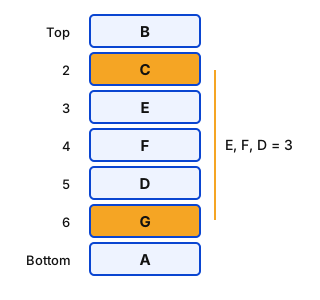
Seven boxes, A, B, C, D, E, F and G, are kept one over the other but not necessarily in the same order. Only B is kept above C. Only E is kept between C and F. Only A is kept below G. How many boxes are kept between C and G?
सात बक्से A, B, C, D, E, F और G एक के ऊपर एक रखे गए हैं, लेकिन आवश्यक नहीं कि इसी क्रम में हों। केवल B को C के ऊपर रखा गया है। C और F के बीच केवल E रखा गया है। केवल A को G के नीचे रखा गया है। C और G के बीच कितने बक्से रखे गए हैं?
  1. A4
  2. B3
  3. C2
  4. D1
Show answer

Concept: Fix the extremes first, then fill the middle.

  1. Only B above C → B is top, C is 2nd. Only A below G → G is 6th, A is bottom.
  2. Only E between C and F → E 3rd, F 4th; remaining D is 5th.
  3. Order (top→bottom): B, C, E, F, D, G, A. Between C and G: E, F, D = 3 boxes.

Trick: "Only X is above/below Y" pins both boxes at an end instantly.

Answer: (B) 3

अवधारणा: पहले सिरे तय करें, फिर बीच के स्थान भरें।

  1. केवल B, C के ऊपर → B सबसे ऊपर, C दूसरा। केवल A, G के नीचे → G छठा, A सबसे नीचे।
  2. C और F के बीच केवल E → E तीसरा, F चौथा; बचा D पाँचवाँ।
  3. क्रम (ऊपर→नीचे): B, C, E, F, D, G, A। C और G के बीच: E, F, D = 3 बॉक्स।

ट्रिक: "केवल X, Y के ऊपर/नीचे" दोनों बॉक्स तुरंत सिरे पर फिक्स कर देता है।

उत्तर: (B) 3

RRB NTPC Graduate CBT 1General Intelligence and ReasoningBox ArrangementRRB NTPC Graduate CBT 1 2025 · 27 Mar Shift 3 →
Q74.
Below are given two sets of numbers. In each set of numbers, a certain mathematical operation on the first number results in the second number. Similarly, a certain mathematical operation on the second number results in the third number and so on. Which of the given options follows the same set of operations as in the question? (NOTE – A two/three-digit number cannot be broken into individual digits for
operations. E.g. if 37 is followed by 10, the operation cannot be 3+7 as a two-digit number cannot be broken into individual digits.)
3 – 30 – 150 – 151
9 – 90 – 450 – 451
नीचे संख्याओं के दो समुच्चय दिए गए हैं। संख्याओं के प्रत्येक समुच्चय में, पहली संख्या पर कोई निश्चित गणितीय संक्रिया करने पर दूसरी संख्या प्राप्त होती है। इसी प्रकार, दूसरी संख्या पर कोई निश्चित गणितीय संक्रिया करने पर तीसरी संख्या प्राप्त होती है और इसी प्रकार आगे भी। दिए गए विकल्पों में से कौन-सा विकल्प प्रश्न में दी गई संक्रियाओं के समान समुच्चय का अनुसरण करता है? (नोट – संक्रियाओं के लिए दो/तीन अंकों की संख्या को उसके अलग-अलग अंकों में विभाजित नहीं किया जा
सकता। उदाहरण के लिए, यदि 37 के बाद 10 आता है, तो संक्रिया 3+7 नहीं हो सकती, क्योंकि दो अंकों की संख्या को अलग-अलग अंकों में विभाजित नहीं किया जा सकता।)
3 – 30 – 150 – 151
9 – 90 – 450 – 451
  1. A6 – 60 – 30 – 150
  2. B12 – 120 – 600 – 601
  3. C15 – 150 – 750 – 749
  4. D8 – 80 – 400 – 40
Show answer

Concept: Identify the operation chain and apply it to each option.

  1. 3→3×10=30→30×5=150→150+1=151; 9→90→450→451 ✓ (×10, ×5, +1).
  2. Option B: 12×10=120, 120×5=600, 600+1=601 ✓.
  3. A: 60→30 (÷2); C: 750→749 (−1); D: 400→40 — fail.

Trick: Check the last step (+1) first – only B ends with +1.

Answer: (B) 12 – 120 – 600 – 601

अवधारणा: संक्रिया श्रृंखला पहचानें और हर विकल्प पर लागू करें।

  1. 3→3×10=30→30×5=150→150+1=151; 9→90→450→451 ✓ (×10, ×5, +1)।
  2. विकल्प B: 12×10=120, 120×5=600, 600+1=601 ✓।
  3. A: 60→30 (÷2); C: 750→749 (−1); D: 400→40 — गलत।

ट्रिक: अंतिम चरण (+1) पहले जाँचें – केवल B में +1 है।

उत्तर: (B) 12 – 120 – 600 – 601

RRB NTPC Graduate CBT 1General Intelligence and ReasoningNumber Operations SeriesRRB NTPC Graduate CBT 1 2025 · 27 Mar Shift 3 →
Q75.
Read the given statements and conclusions carefully. Assuming that the information given in the statements is true, even if it appears to be at variance with commonly known facts, decide which of the given conclusion(s) logically follow(s) from the statements.
Statements:
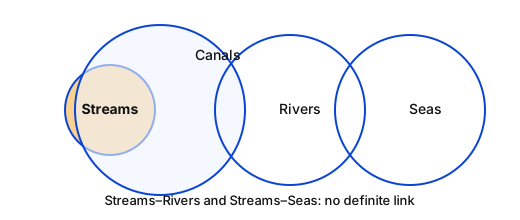
All streams are canals. Some canals are rivers. Some rivers are seas.
Conclusions:
(I) Some seas are streams.
(II) Some rivers are streams.
दिए गए कथनों और निष्कर्षों को ध्यानपूर्वक पढ़िए। यह मानते हुए कि कथनों में दी गई जानकारी सत्य है, भले ही वह सामान्यतः ज्ञात तथ्यों से भिन्न प्रतीत होती हो, निर्णय लीजिए कि दिए गए निष्कर्षों में से कौन-सा/से निष्कर्ष कथनों का तार्किक रूप से अनुसरण करता/करते है/हैं।
कथन:
सभी धाराएँ नहरें हैं। कुछ नहरें नदियाँ हैं। कुछ नदियाँ समुद्र हैं।
निष्कर्ष:
(I) कुछ समुद्र धाराएँ हैं।
(II) कुछ नदियाँ धाराएँ हैं।
  1. AOnly conclusion (I) follows.केवल निष्कर्ष (I) अनुसरण करता है।
  2. BOnly conclusion (II) follows.केवल निष्कर्ष (II) अनुसरण करता है।
  3. CNeither conclusion (I) nor (II) follows.न तो निष्कर्ष (I) और न ही (II) अनुसरण करता है।
  4. DBoth conclusions (I) and (II) follow.निष्कर्ष (I) और (II) दोनों अनुसरण करते हैं।
Show answer

Concept: Draw a Venn diagram; a conclusion follows only if it is true in every possible diagram.

  1. All streams ⊂ canals; only some canals are rivers – streams may lie entirely in the non-river part of canals.
  2. So "some rivers are streams" (II) is not definite; seas are linked only through rivers, so "some seas are streams" (I) is not definite either.

Trick: Two "some" statements in a chain never give a definite "some" conclusion across them.

Answer: (C) Neither conclusion (I) nor (II) follows.

अवधारणा: वेन आरेख बनाएँ; निष्कर्ष तभी मान्य है जब वह हर संभव आरेख में सत्य हो।

  1. सभी streams ⊂ canals; केवल कुछ canals rivers हैं – streams पूरी तरह canals के गैर-river भाग में हो सकते हैं।
  2. अतः "कुछ rivers, streams हैं" (II) निश्चित नहीं; seas केवल rivers से जुड़े हैं, इसलिए "कुछ seas, streams हैं" (I) भी निश्चित नहीं।

ट्रिक: श्रृंखला में दो "कुछ" कथन कभी पार करके निश्चित "कुछ" निष्कर्ष नहीं देते।

उत्तर: (C) Neither conclusion (I) nor (II) follows.

RRB NTPC Graduate CBT 1General Intelligence and ReasoningSyllogismRRB NTPC Graduate CBT 1 2025 · 27 Mar Shift 3 →
Q76.
SP 12 is related to WT 16 in a certain way. In the same way, MJ 15 is related to QN 19. To which of the following is EB 24 related, following the same logic?
SP 12, WT 16 से एक निश्चित प्रकार से संबंधित है। उसी प्रकार, MJ 15, QN 19 से संबंधित है। समान तर्क का अनुसरण करते हुए, EB 24 निम्नलिखित में से किससे संबंधित है?
  1. AJF 28
  2. BJG 29
  3. CIG 29
  4. DIF 28
Show answer

Concept: Find how each letter and the number change from the first term to the second.

  1. SP 12 → WT 16: S+4=W, P+4=T, 12+4=16.
  2. MJ 15 → QN 19: M+4=Q, J+4=N, 15+4=19 ✓ same rule.
  3. EB 24 → E+4=I, B+4=F, 24+4=28 → IF 28.

Trick: Everything shifts by +4 – letters and number alike.

Answer: (D) IF 28

अवधारणा: पहले पद से दूसरे पद तक हर अक्षर और संख्या का परिवर्तन देखें।

  1. SP 12 → WT 16: S+4=W, P+4=T, 12+4=16।
  2. MJ 15 → QN 19: M+4=Q, J+4=N, 15+4=19 ✓ वही नियम।
  3. EB 24 → E+4=I, B+4=F, 24+4=28 → IF 28।

ट्रिक: सब कुछ +4 से बढ़ता है – अक्षर भी, संख्या भी।

उत्तर: (D) IF 28

RRB NTPC Graduate CBT 1General Intelligence and ReasoningLetter-Number AnalogyRRB NTPC Graduate CBT 1 2025 · 27 Mar Shift 3 →
Q77.
Refer to the following letter and symbol series and answer the question that follows. Counting to be done from left to right only.
(Left) ? A ? M V R ? F @ D E Q * ? R V M / % * M (Right)
How many such letters are there each of which is immediately preceded by a letter and also immediately followed by a symbol?
निम्नलिखित अक्षर और प्रतीक शृंखला को देखिए और उसके बाद दिए गए प्रश्न का उत्तर दीजिए। गिनती केवल बाएँ से दाएँ की ओर की जानी है।
(बाएँ) ? A ? M V R ? F @ D E Q * ? R V M / % * M (दाएँ)
ऐसे कितने अक्षर हैं, जिनमें से प्रत्येक के ठीक पहले एक अक्षर है और ठीक बाद एक प्रतीक है?
  1. AOneएक
  2. BThreeतीन
  3. CNoneकोई नहीं
  4. DTwoदो
Show answer

Concept: Look for the pattern letter – LETTER – symbol moving left to right.

  1. Series: ? A ? M V R ? F @ D E Q * ? R V M / % * M.
  2. V R ? ✓ ; E Q * ✓ ; V M / ✓.
  3. F is preceded by a symbol (?), so it does not count. Total = 3.

Trick: First mark every symbol, then check only the letter just before each symbol.

Answer: (B) Three

अवधारणा: बाएँ से दाएँ अक्षर – अक्षर – प्रतीक पैटर्न खोजें।

  1. श्रृंखला: ? A ? M V R ? F @ D E Q * ? R V M / % * M।
  2. V R ? ✓ ; E Q * ✓ ; V M / ✓।
  3. F से पहले प्रतीक (?) है, इसलिए वह नहीं गिना जाएगा। कुल = 3।

ट्रिक: पहले हर प्रतीक चिह्नित करें, फिर केवल उससे ठीक पहले वाला अक्षर जाँचें।

उत्तर: (B) Three

RRB NTPC Graduate CBT 1General Intelligence and ReasoningLetter-Symbol SeriesRRB NTPC Graduate CBT 1 2025 · 27 Mar Shift 3 →
Q78.
In a certain code language,
Q + W means ‘Q is the father of W',
Q @ W means ‘Q is the brother of W',
Q $ W means ‘Q is the mother of W', and
Q # W means ‘Q is the sister of W'.
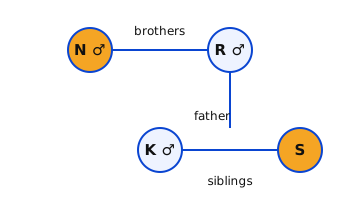
Based on the above, how is N related to S if ' N @ R + K @ S ’?
एक निश्चित कूट भाषा में,
Q + W का अर्थ है ‘Q, W का पिता है',
Q @ W का अर्थ है ‘Q, W का भाई है',
Q $ W का अर्थ है ‘Q, W की माता है', और
Q # W का अर्थ है ‘Q, W की बहन है'।
उपर्युक्त के आधार पर, यदि ' N @ R + K @ S ’ है, तो N, S से किस प्रकार संबंधित है?
  1. ASonपुत्र
  2. BBrother's sonभाई का पुत्र
  3. CFather's brotherपिता का भाई
  4. DBrotherभाई
Show answer

Concept: Decode each symbol and build the family tree.

  1. N @ R → N is brother of R; R + K → R is father of K; K @ S → K is brother of S.
  2. So R is the father of K and S; N is R's brother.
  3. N is the father's brother (uncle) of S.

Trick: Brother of the father = "Father's brother" (chacha/tau).

Answer: (C) Father's brother

अवधारणा: हर प्रतीक को डिकोड करके वंश-वृक्ष बनाएँ।

  1. N @ R → N, R का भाई; R + K → R, K का पिता; K @ S → K, S का भाई।
  2. अतः R, K और S का पिता है; N, R का भाई है।
  3. N, S के पिता का भाई (चाचा/ताऊ) है।

ट्रिक: पिता का भाई = "Father's brother" (चाचा/ताऊ)।

उत्तर: (C) Father's brother

RRB NTPC Graduate CBT 1General Intelligence and ReasoningBlood Relations (Coded)RRB NTPC Graduate CBT 1 2025 · 27 Mar Shift 3 →
Q79.
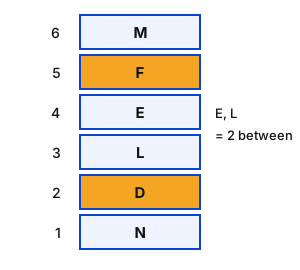
L, M, N, D, E and F live on six different floors of the same building. The lowermost floor in the building is numbered 1, the floor above it is numbered 2 and so on till the topmost floor is numbered 6. M lives on the topmost floor. Only three people live between M and D. N lives on a floor below D. E lives on an even numbered floor. L lives on an odd numbered floor, but not on floor number 5. How many people live between F and D?
L, M, N, D, E और F एक ही इमारत की छह अलग-अलग मंजिलों पर रहते हैं। इमारत की सबसे निचली मंजिल की संख्या 1 है, उसके ऊपर की मंजिल की संख्या 2 है और इसी प्रकार सबसे ऊपरी मंजिल की संख्या 6 है। M सबसे ऊपरी मंजिल पर रहता है। M और D के बीच केवल तीन व्यक्ति रहते हैं। N, D से नीचे की किसी मंजिल पर रहता है। E सम संख्या वाली मंजिल पर रहता है। L विषम संख्या वाली मंजिल पर रहता है, लेकिन मंजिल संख्या 5 पर नहीं। F और D के बीच कितने व्यक्ति रहते हैं?
  1. AThreeतीन
  2. BFourचार
  3. COneएक
  4. DTwoदो
Show answer

Concept: Place the definite clues first, then use parity (odd/even) clues.

  1. M on 6; three people between M and D → D on 2; N below D → N on 1.
  2. E on an even floor → 4 (2 and 6 taken). L odd but not 5 → 3. F gets 5.
  3. Between F (5) and D (2): floors 3 and 4 → E and L = two people.

Trick: Draw six boxes and strike floors as you fill them.

Answer: (D) Two

अवधारणा: पहले निश्चित सुराग रखें, फिर सम/विषम वाले सुराग प्रयोग करें।

  1. M छठी मंज़िल पर; M और D के बीच तीन लोग → D दूसरी पर; N, D से नीचे → N पहली पर।
  2. E सम मंज़िल पर → 4 (2 और 6 भर चुके)। L विषम पर पर 5 नहीं → 3। F को 5 मिली।
  3. F (5) और D (2) के बीच: मंज़िल 3 और 4 → E और L = दो लोग।

ट्रिक: छह डिब्बे बनाएँ और भरते जाएँ।

उत्तर: (D) Two

RRB NTPC Graduate CBT 1General Intelligence and ReasoningFloor PuzzleRRB NTPC Graduate CBT 1 2025 · 27 Mar Shift 3 →
Q80.
In a certain code language, ‘MODE’ is coded as ‘3519’ and ‘DIGS’ is coded as ‘6894’. What is the code for ‘D’ in that language?
एक निश्चित कूट भाषा में, ‘MODE’ को ‘3519’ के रूप में कूटबद्ध किया जाता है और ‘DIGS’ को ‘6894’ के रूप में कूटबद्ध किया जाता है। उस भाषा में ‘D’ का कूट क्या है?
  1. A9
  2. B1
  3. C4
  4. D6
Show answer

Concept: Common letters in two coded words share the common digit.

  1. MODE → 3519 and DIGS → 6894.
  2. Only common letter: D; only common digit: 9.
  3. Hence D = 9.

Trick: Intersect the letters and intersect the digits – the match is the code.

Answer: (A) 9

अवधारणा: दो कोडित शब्दों के साझा अक्षर का कोड साझा अंक होता है।

  1. MODE → 3519 और DIGS → 6894।
  2. एकमात्र साझा अक्षर: D; एकमात्र साझा अंक: 9।
  3. अतः D = 9।

ट्रिक: अक्षरों का उभयनिष्ठ और अंकों का उभयनिष्ठ निकालें – वही कोड है।

उत्तर: (A) 9

RRB NTPC Graduate CBT 1General Intelligence and ReasoningCoding-DecodingRRB NTPC Graduate CBT 1 2025 · 27 Mar Shift 3 →