Question bank

Q&A: practice questions with answers

Search questions on any topic. Filter by exam category, exam, subject and topic, try the question, then open the answer and explanation.

Courses – airGurukul

7,077 questions found.

Q861.
Three water pipes m, n and p, take 5, 6 and 12 hours, respectively, to fill a water tank. If all three pipes are opened at the same time, then the required time to fill the water tank will be:
तीन पानी के पाइप m, n और p, एक पानी की टंकी को भरने में क्रमशः 5, 6 और 12 घंटे लेते हैं। यदि तीनों पाइप एक साथ खोल दिए जाएँ, तो पानी की टंकी को भरने में लगने वाला आवश्यक समय होगा:
  1. A227 hours227 घंटे
  2. B119 hours119 घंटे
  3. C219 hours219 घंटे
  4. D229 hours229 घंटे
Show answer

Concept: Take tank capacity = LCM of the times and add the hourly units.
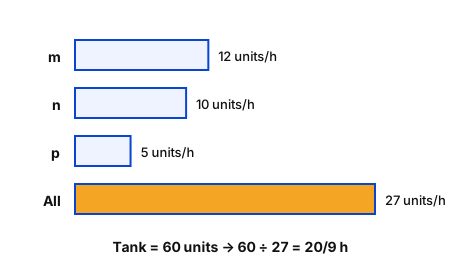
  1. Capacity =LCM(5,6,12)=60 units
  2. m =12, n =10, p =5 units/hour
  3. Together =27 units/hour
  4. Time =6027=209=229 hours

Trick: 15+16+112=12+10+560=2760, invert it.

Answer: (D) 229 hours

अवधारणा: टंकी की क्षमता = समयों का LCM मानें और प्रति घंटा इकाइयाँ जोड़ें।

  1. क्षमता =LCM(5,6,12)=60 इकाई
  2. m =12, n =10, p =5 इकाई/घंटा
  3. एक साथ =27 इकाई/घंटा
  4. समय =6027=209=229 घंटे

ट्रिक: 15+16+112=2760, फिर उल्टा करें।

उत्तर: (D) 229 घंटे

RRB NTPC Graduate CBT 1MathematicsPipes and CisternsRRB NTPC Graduate CBT 1 2024 · 21 Jun Shift 1 →
Q862.
A pouch contains 50 Paisa, 25 Paisa and 10 Paisa coins in the ratio 18 : 12 : 10, amounting to ₹130. Find the number of 10 Paisa coins.
एक थैली में 50 पैसे, 25 पैसे और 10 पैसे के सिक्के 18 : 12 : 10 के अनुपात में हैं, जिनकी कुल राशि ₹130 है। 10 पैसे के सिक्कों की संख्या ज्ञात कीजिए।
  1. A149
  2. B184
  3. C100
  4. D180
Show answer

Concept: Value of each coin group = number of coins × coin value.

  1. Let coins be 18k,12k,10k
  2. Value: 0.50×18k+0.25×12k+0.10×10k=9k+3k+k=13k
  3. 13k=130⇒k=10
  4. 10 paise coins =10×10=100

Trick: Value ratio 9:3:1 → ₹130 splits as ₹90 : ₹30 : ₹10; ₹10 in 10-paise coins =100 coins.

Answer: (C) 100

अवधारणा: हर समूह का मूल्य = सिक्कों की संख्या × सिक्के का मान।

  1. सिक्के 18k,12k,10k
  2. मूल्य: 0.50×18k+0.25×12k+0.10×10k=9k+3k+k=13k
  3. 13k=130⇒k=10
  4. 10 पैसे के सिक्के =10×10=100

ट्रिक: मूल्य अनुपात 9:3:1 → ₹130 = ₹90 : ₹30 : ₹10; ₹10 में 10 पैसे के 100 सिक्के।

उत्तर: (C) 100

RRB NTPC Graduate CBT 1MathematicsRatio – CoinsRRB NTPC Graduate CBT 1 2024 · 21 Jun Shift 1 →
Q863.
The average of fifty numbers is 34. If two numbers, namely 34 and 22 are discarded, the average of the remaining numbers is:
पचास संख्याओं का औसत 34 है। यदि दो संख्याएँ, अर्थात् 34 और 22 हटा दी जाएँ, तो शेष संख्याओं का औसत है:
  1. A32.25
  2. B35.25
  3. C34.25
  4. D31.25
Show answer

Concept: Sum = average × count; remove the discarded numbers and divide by the new count.

  1. Sum of 50 numbers =50×34=1700
  2. After removing 34 and 22: 1700−56=1644
  3. New average =164448=34.25

Trick: Removing 34 (= average) changes nothing; removing 22 (12 below) raises average by 1248=0.25.

Answer: (C) 34.25

अवधारणा: योग = औसत × संख्या; हटाई गई संख्याएँ घटाकर नई संख्या से भाग दें।

  1. 50 संख्याओं का योग =50×34=1700
  2. 34 और 22 हटाने पर: 1700−56=1644
  3. नया औसत =164448=34.25

ट्रिक: 34 (= औसत) हटाने से कोई असर नहीं; 22 (12 कम) हटाने से औसत 1248=0.25 बढ़ता है।

उत्तर: (C) 34.25

RRB NTPC Graduate CBT 1MathematicsAverageRRB NTPC Graduate CBT 1 2024 · 21 Jun Shift 1 →
Q864.
Find the value of (3+3tan2A)cotA(1+cot2A)secA.
(3+3tan2A)cotA(1+cot2A)secA का मान ज्ञात कीजिए।
  1. AtanA
  2. BsinA
  3. C3sinA
  4. D3tanA
Show answer

Concept: Use 1+tan2A=sec2A and 1+cot2A=csc2A.

  1. Numerator =3(1+tan2A)cotA=3sec2AcotA
  2. Denominator =csc2AsecA
  3. Ratio =3secAcotAcsc2A=3·1cosA·cosAsinA·sin2A
  4. =3sinA

Trick: Check with A=45∘: 6·122=32=3sin45∘ ✓.

Answer: (C) 3sinA

अवधारणा: 1+tan2A=sec2A और 1+cot2A=csc2A का प्रयोग करें।

  1. अंश =3(1+tan2A)cotA=3sec2AcotA
  2. हर =csc2AsecA
  3. अनुपात =3secAcotAcsc2A=3·1cosA·cosAsinA·sin2A
  4. =3sinA

ट्रिक: A=45∘ रखें: 6·122=32=3sin45∘ ✓।

उत्तर: (C) 3sinA

RRB NTPC Graduate CBT 1MathematicsTrigonometric IdentitiesRRB NTPC Graduate CBT 1 2024 · 21 Jun Shift 1 →
Q865.
The average of 10 observations is 40. It was realised later that an observation was misread as 31 in place of 50. Find the correct average.
10 प्रेक्षणों का औसत 40 है। बाद में ज्ञात हुआ कि एक प्रेक्षण को 50 के स्थान पर गलती से 31 पढ़ लिया गया था। सही औसत ज्ञात कीजिए।
  1. A41.9
  2. B44.9
  3. C40.9
  4. D42.9
Show answer

Concept: Correct sum = wrong sum − wrong value + correct value.

  1. Wrong sum =10×40=400
  2. Correct sum =400−31+50=419
  3. Correct average =41910=41.9

Trick: Average changes by 50−3110=1.9 → 40+1.9=41.9.

Answer: (A) 41.9

अवधारणा: सही योग = गलत योग − गलत मान + सही मान।

  1. गलत योग =10×40=400
  2. सही योग =400−31+50=419
  3. सही औसत =41910=41.9

ट्रिक: औसत में बदलाव 50−3110=1.9 → 40+1.9=41.9।

उत्तर: (A) 41.9

RRB NTPC Graduate CBT 1MathematicsAverage – CorrectionRRB NTPC Graduate CBT 1 2024 · 21 Jun Shift 1 →
Q866.
Which positive number should replace both question marks in the following equation?
?11=275?
निम्नलिखित समीकरण में दोनों प्रश्नचिह्नों के स्थान पर कौन-सी धनात्मक संख्या आनी चाहिए?
?11=275?
  1. A55
  2. B54
  3. C49
  4. D46
Show answer

Concept: If x11=275x, cross-multiply to get x2.

  1. x2=11×275=3025
  2. x=3025=55 (positive)

Trick: 3025 ends in 25 → square of a number ending in 5: 552=3025.

Answer: (A) 55

अवधारणा: x11=275x में वज्र-गुणन करके x2 निकालें।

  1. x2=11×275=3025
  2. x=3025=55 (धनात्मक)

ट्रिक: 3025 के अंत में 25 → 5 पर समाप्त संख्या का वर्ग: 552=3025।

उत्तर: (A) 55

RRB NTPC Graduate CBT 1MathematicsSquare RootsRRB NTPC Graduate CBT 1 2024 · 21 Jun Shift 1 →
Q867.
MJGT is related to QNKX in a certain way based on the English alphabetical order. In the same way, CZWJ is related to GDAN. To which of the following options is OLIV related, following the same logic?
अंग्रेज़ी वर्णमाला क्रम के आधार पर MJGT एक निश्चित तरीके से QNKX से संबंधित है। उसी प्रकार, CZWJ, GDAN से संबंधित है। समान तर्क का अनुसरण करते हुए, OLIV निम्नलिखित में से किस विकल्प से संबंधित है?
  1. ASMPZ
  2. BSPMZ
  3. CSPZM
  4. DSMZP
Show answer

Concept: Compare each letter of the first cluster with the matching letter of the second.

  1. M→Q, J→N, G→K, T→X: every letter moves +4.
  2. Check: C→G, Z→D, W→A, J→N, again +4 each.
  3. OLIV: O→S, L→P, I→M, V→Z gives SPMZ.

Trick: Check just the first two letters (O+4 = S, L+4 = P) to reject options A and D quickly.

Answer: (B) SPMZ

अवधारणा: पहले समूह के प्रत्येक अक्षर की तुलना दूसरे समूह के संगत अक्षर से करें।

  1. M→Q, J→N, G→K, T→X: हर अक्षर +4 आगे।
  2. जाँच: C→G, Z→D, W→A, J→N, फिर से +4।
  3. OLIV: O→S, L→P, I→M, V→Z = SPMZ।

ट्रिक: केवल पहले दो अक्षर (O+4 = S, L+4 = P) देखकर विकल्प A और D तुरंत हट जाते हैं।

उत्तर: (B) SPMZ

RRB NTPC Graduate CBT 1General Intelligence and ReasoningAnalogy (letter shift)RRB NTPC Graduate CBT 1 2024 · 21 Jun Shift 1 →
Q868.
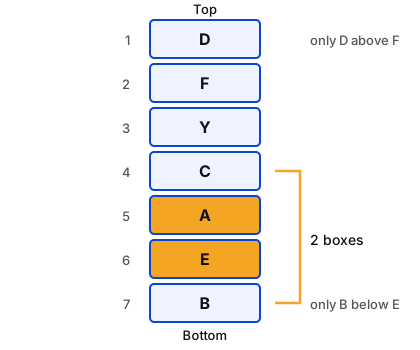
Seven boxes, A, B, C, D, E, F and Y, are kept one over the other but not necessarily in the same order. Only D is kept above F. Only three boxes are kept between D and A. Only B is kept below E. Y is not kept immediately above A. How many boxes are kept between C and B?
सात बक्से, A, B, C, D, E, F और Y, एक के ऊपर एक रखे गए हैं, लेकिन जरूरी नहीं कि इसी क्रम में हों। F के ऊपर केवल D रखा है। D और A के बीच केवल तीन बक्से रखे हैं। E के नीचे केवल B रखा है। Y, A के ठीक ऊपर नहीं रखा है। C और B के बीच कितने बक्से रखे हैं?
  1. AFourचार
  2. BThreeतीन
  3. CTwoदो
  4. DOneएक
Show answer

Concept: Fix the definite clues first (top and bottom), then place the rest.

  1. Only D above F → D at 1 (top), F at 2.
  2. Only B below E → B at 7 (bottom), E at 6.
  3. Three boxes between D and A → A at 5.
  4. Y not immediately above A → Y not at 4, so Y at 3 and C at 4.
  5. Between C (4) and B (7): A and E, i.e. two boxes.

Trick: "Only X above Y" means X is at the very top and Y is just below it.

Answer: (C) Two

अवधारणा: पहले निश्चित संकेत (सबसे ऊपर और सबसे नीचे) लगाएँ, फिर बाकी।

  1. केवल D, F के ऊपर → D स्थान 1 (सबसे ऊपर), F स्थान 2।
  2. केवल B, E के नीचे → B स्थान 7, E स्थान 6।
  3. D और A के बीच तीन बॉक्स → A स्थान 5।
  4. Y, A के ठीक ऊपर नहीं → Y स्थान 3, C स्थान 4।
  5. C (4) और B (7) के बीच A और E, यानी दो बॉक्स।

ट्रिक: "केवल X, Y के ऊपर" का अर्थ है X सबसे ऊपर और Y उसके ठीक नीचे।

उत्तर: (C) दो

RRB NTPC Graduate CBT 1General Intelligence and ReasoningBox arrangementRRB NTPC Graduate CBT 1 2024 · 21 Jun Shift 1 →
Q869.
If 2 is added to each even digit and 1 is subtracted from each odd digit in the number 4123957, what will be the difference between the greatest and smallest digits in the new number thus formed?
यदि संख्या 4123957 में प्रत्येक सम अंक में 2 जोड़ दिया जाए और प्रत्येक विषम अंक में से 1 घटा दिया जाए, तो इस प्रकार बनी नई संख्या में सबसे बड़े और सबसे छोटे अंक के बीच का अंतर क्या होगा?
  1. A6
  2. B4
  3. C2
  4. D8
Show answer

Concept: Change every digit by the given rule, then compare the largest and smallest digits.

  1. Digits 4 1 2 3 9 5 7.
  2. Even digits +2: 4→6, 2→4. Odd digits −1: 1→0, 3→2, 9→8, 5→4, 7→6.
  3. New number 6042846; greatest digit 8, smallest 0.
  4. Difference =8−0=8.

Trick: Only the extremes matter: largest odd 9 becomes 8, smallest odd 1 becomes 0.

Answer: (D) 8

अवधारणा: नियम से हर अंक बदलें, फिर सबसे बड़े और सबसे छोटे अंक की तुलना करें।

  1. अंक 4 1 2 3 9 5 7।
  2. सम अंक +2: 4→6, 2→4। विषम अंक −1: 1→0, 3→2, 9→8, 5→4, 7→6।
  3. नई संख्या 6042846; सबसे बड़ा अंक 8, सबसे छोटा 0।
  4. अंतर =8−0=8।

ट्रिक: केवल चरम अंक देखें: 9 → 8 और 1 → 0।

उत्तर: (D) 8

RRB NTPC Graduate CBT 1General Intelligence and ReasoningNumber operationsRRB NTPC Graduate CBT 1 2024 · 21 Jun Shift 1 →
Q870.
What should come in place of the question mark (?) in the given series?
356, 333, 300, ?, 204, 141
दी गई श्रृंखला में प्रश्नचिह्न (?) के स्थान पर क्या आना चाहिए?
356, 333, 300, ?, 204, 141
  1. A237
  2. B247
  3. C257
  4. D227
Show answer

Concept: Look at the differences between consecutive terms.

  1. 356−333=23, 333−300=33: differences rise by 10.
  2. Next difference 43: 300−43=257.
  3. Check: 257−53=204 and 204−63=141 ✓.

Trick: Differences 23, 33, 43, 53, 63 form an AP with common difference 10.

Answer: (C) 257

अवधारणा: क्रमागत पदों का अंतर देखें।

  1. 356−333=23, 333−300=33: अंतर 10-10 बढ़ रहा है।
  2. अगला अंतर 43: 300−43=257।
  3. जाँच: 257−53=204, 204−63=141 ✓।

ट्रिक: अंतर 23, 33, 43, 53, 63 समांतर श्रेणी में (सार्व अंतर 10)।

उत्तर: (C) 257

RRB NTPC Graduate CBT 1General Intelligence and ReasoningNumber seriesRRB NTPC Graduate CBT 1 2024 · 21 Jun Shift 1 →
Q871.
Which of the following letter-clusters should replace # and % so that the pattern and relationship followed between the letter-cluster pair on the left side of :: is the same as that on the right side of :: ?
# : XFL :: KSY : %
निम्नलिखित में से कौन-से अक्षर-समूह # और % को प्रतिस्थापित करेंगे, ताकि :: के बाईं ओर के अक्षर-समूह युग्म के बीच अनुसरित पैटर्न और संबंध वही हो, जो :: के दाईं ओर है?
# : XFL :: KSY : %
  1. A# = SAG, % = PID
  2. B# = TAG, % = PXD
  3. C# = SAG, % = PXD
  4. D# = SAG, % = PXO
Show answer

Concept: Find the shift between the two clusters of a pair and apply the same on the right side.

  1. Try # = SAG: S+5 = X, A+5 = F, G+5 = L gives XFL, so the rule is +5.
  2. Right side: K+5 = P, S+5 = X, Y+5 = D (after Z we restart at A), so % = PXD.

Trick: Y+5: Z, A, B, C, D. Option D (PXO) fails on the last letter, option B (TAG) on the first.

Answer: (C) # = SAG, % = PXD

अवधारणा: जोड़ी के दोनों समूहों के बीच का अंतर ज्ञात कर दाईं ओर लागू करें।

  1. # = SAG लें: S+5 = X, A+5 = F, G+5 = L → XFL, यानी नियम +5।
  2. दाईं ओर: K+5 = P, S+5 = X, Y+5 = D (Z के बाद फिर A से), अतः % = PXD।

ट्रिक: Y+5: Z, A, B, C, D। विकल्प D (PXO) अंतिम अक्षर पर और B (TAG) पहले अक्षर पर गलत।

उत्तर: (C) # = SAG, % = PXD

RRB NTPC Graduate CBT 1General Intelligence and ReasoningLetter analogyRRB NTPC Graduate CBT 1 2024 · 21 Jun Shift 1 →
Q872.
In a certain code language, ‘CARD’ is coded as ‘4681’ and ‘DOGS’ is coded as ‘3219’. What is the code for ‘D’ in the given code language?
एक निश्चित कूट भाषा में, 'CARD' को '4681' के रूप में कूटबद्ध किया जाता है और 'DOGS' को '3219' के रूप में कूटबद्ध किया जाता है। दी गई कूट भाषा में 'D' के लिए कूट क्या है?
  1. A1
  2. B2
  3. C4
  4. D3
Show answer

Concept: In such codes the digits may be jumbled; the letter common to both words gets the digit common to both codes.

  1. CARD and DOGS share only the letter D.
  2. 4681 and 3219 share only the digit 1.
  3. So D = 1.

Trick: Common letter ↔ common digit.

Answer: (A) 1

अवधारणा: ऐसे कूट में अंक क्रम में नहीं होते; दोनों शब्दों के उभयनिष्ठ अक्षर का कूट दोनों कूटों का उभयनिष्ठ अंक होता है।

  1. CARD और DOGS में केवल D उभयनिष्ठ है।
  2. 4681 और 3219 में केवल 1 उभयनिष्ठ है।
  3. अतः D = 1।

ट्रिक: उभयनिष्ठ अक्षर ↔ उभयनिष्ठ अंक।

उत्तर: (A) 1

RRB NTPC Graduate CBT 1General Intelligence and ReasoningCoding – common letterRRB NTPC Graduate CBT 1 2024 · 21 Jun Shift 1 →
Q873.
A group of numbers and symbols is coded using letter codes as per the codes given below and the conditions that follow. Study the given codes and conditions and answer the question that follows.
Note: If none of the conditions apply, then codes for the respective number/symbol are to be followed directly as given in the table.
Number/Symbol4#$7926@3&5+
CodeBWQCATJNPDGE
Conditions:
(i) If the first element is a number and the last element is a symbol, then the codes for the first and last elements are to be interchanged.
(ii) If the first element is divisible by 2 and the last element is divisible by 3, then the first and last elements are to be coded as *
(iii) If the first element is a symbol and the last element is an even number, then their codes (i.e. first and last element) are to be changed to the code for 3.
Identify the code for the following.
56#4+
संख्याओं और प्रतीकों के एक समूह को नीचे दिए गए कोड और उसके बाद दी गई शर्तों के अनुसार अक्षर कोड द्वारा कूटबद्ध किया गया है। दिए गए कोड और शर्तों का अध्ययन करें और उसके बाद दिए गए प्रश्न का उत्तर दें।
नोट: यदि कोई भी शर्त लागू नहीं होती है, तो संबंधित संख्या/प्रतीक के लिए तालिका में दिए गए कोड का सीधे पालन करना है।
Number/Symbol4#$7926@3&5
CodeBWQCATJNPDG
शर्तें:
(i) यदि पहला तत्व एक संख्या है और अंतिम तत्व एक प्रतीक है, तो पहले और अंतिम तत्व के कोड आपस में बदल दिए जाने हैं।
(ii) यदि पहला तत्व 2 से विभाज्य है और अंतिम तत्व 3 से विभाज्य है, तो पहले और अंतिम तत्व को * के रूप में कूटबद्ध किया जाना है।
(iii) यदि पहला तत्व एक प्रतीक है और अंतिम तत्व एक सम संख्या है, तो उनके कोड (अर्थात पहले और अंतिम तत्व के) को 3 के कोड में बदल दिया जाना है।
निम्नलिखित के लिए कोड ज्ञात कीजिए।
56#4+
  1. AEJWBG
  2. BGJWBG
  3. CGJWBE
  4. DEJGBE
Show answer

Concept: Code each element from the table, then check which condition applies to the first and last elements.

  1. Elements: 5, 6, #, 4, +. Direct codes: 5 = G, 6 = J, # = W, 4 = B, + = E.
  2. Condition (i): first element 5 is a number and last element + is a symbol → interchange the codes of first and last.
  3. Condition (ii) fails (5 is not divisible by 2); (iii) fails (first is not a symbol).
  4. Code: E J W B G.

Trick: Always test the conditions only on the first and last elements; the middle ones are coded directly.

Answer: (A) EJWBG

अवधारणा: तालिका से प्रत्येक तत्व का कूट लिखें, फिर देखें कि पहले और अंतिम तत्व पर कौन-सी शर्त लागू होती है।

  1. तत्व: 5, 6, #, 4, +। सीधे कूट: 5 = G, 6 = J, # = W, 4 = B, + = E।
  2. शर्त (i): पहला तत्व 5 संख्या है और अंतिम + प्रतीक है → पहले और अंतिम के कूट आपस में बदलें।
  3. शर्त (ii) लागू नहीं (5 सम नहीं); (iii) भी नहीं (पहला तत्व प्रतीक नहीं)।
  4. कूट: E J W B G।

ट्रिक: शर्तें केवल पहले और अंतिम तत्व पर जाँचें; बीच वाले सीधे कूटित होते हैं।

उत्तर: (A) EJWBG

RRB NTPC Graduate CBT 1General Intelligence and ReasoningCoding with conditionsRRB NTPC Graduate CBT 1 2024 · 21 Jun Shift 1 →
Q874.
Refer to the following number and symbol series and answer the question that follows. Counting to be done from left to right only.
(Left) 1 5 & 3 * $ 4 @ % 2 7 # 9 ^ # ⋟ 6 8 (Right)
If all the symbols are dropped from the series, which of the following will be fourth from the right?
निम्नलिखित संख्या और प्रतीक श्रृंखला को देखिए और नीचे दिए गए प्रश्न का उत्तर दीजिए। गिनती केवल बाएँ से दाएँ की जानी है।
(बाएँ) 1 5 & 3 * $ 4 @ % 2 7 # 9 ^ # ⋟ 6 8 (दाएँ)
यदि श्रृंखला से सभी प्रतीकों को हटा दिया जाए, तो निम्नलिखित में से कौन-सा दाएँ से चौथा होगा?
  1. A2
  2. B4
  3. C9
  4. D7
Show answer

Concept: Remove all symbols and write only the digits in their order.

  1. Digits left to right: 1 5 3 4 2 7 9 6 8.
  2. From the right: 8 (1st), 6 (2nd), 9 (3rd), 7 (4th).

Trick: After dropping symbols, count from the right end of the digit-only list.

Answer: (D) 7

अवधारणा: सभी प्रतीक हटाकर केवल अंक क्रम में लिखें।

  1. बाएँ से दाएँ अंक: 1 5 3 4 2 7 9 6 8।
  2. दाएँ से: 8 (पहला), 6 (दूसरा), 9 (तीसरा), 7 (चौथा)।

ट्रिक: प्रतीक हटाने के बाद केवल अंकों की सूची में दाएँ से गिनें।

उत्तर: (D) 7

RRB NTPC Graduate CBT 1General Intelligence and ReasoningNumber-symbol seriesRRB NTPC Graduate CBT 1 2024 · 21 Jun Shift 1 →
Q875.
Based on the English alphabetical order, three of the following four letter-cluster pairs are alike in a certain way and thus form a group. Which letter-cluster pair DOES NOT belong to that group?
(Note: The odd one out is not based on the number of consonants/vowels or their position in the letter-cluster.)
अंग्रेज़ी वर्णमाला क्रम के आधार पर, निम्नलिखित चार अक्षर-समूह युग्मों में से तीन किसी निश्चित तरीके से एकसमान हैं और इस प्रकार एक समूह बनाते हैं। कौन-सा अक्षर-समूह युग्म उस समूह से संबंधित नहीं है?
(नोट: असंगत युग्म, व्यंजनों/स्वरों की संख्या या अक्षर-समूह में उनके स्थान पर आधारित नहीं है।)
  1. ARV – TB
  2. BGK – JQ
  3. CMQ – OW
  4. DEI – GO
Show answer

Concept: Check the gap inside each cluster and between the first letters of the two clusters.

  1. RV – TB: R+4 = V; R+2 = T; T+8 = B (V+6 = B).
  2. MQ – OW: M+4 = Q; M+2 = O; Q+6 = W. EI – GO: E+4 = I; E+2 = G; I+6 = O.
  3. GK – JQ: G+4 = K but G+3 = J (not +2), so it breaks the pattern.

Trick: Pattern: (+4) – (+2, +6). Only GK – JQ has +3 between first letters.

Answer: (B) GK – JQ

अवधारणा: प्रत्येक समूह के अंदर और दोनों समूहों के पहले अक्षरों के बीच अंतर देखें।

  1. RV – TB: R+4 = V; R+2 = T; V+6 = B।
  2. MQ – OW: M+4 = Q; M+2 = O; Q+6 = W। EI – GO: E+4 = I; E+2 = G; I+6 = O।
  3. GK – JQ: G+4 = K पर G+3 = J (+2 नहीं), इसलिए यह अलग है।

ट्रिक: पैटर्न: (+4) – (+2, +6)। केवल GK – JQ में पहले अक्षरों का अंतर +3 है।

उत्तर: (B) GK – JQ

RRB NTPC Graduate CBT 1General Intelligence and ReasoningOdd one out – letter pairsRRB NTPC Graduate CBT 1 2024 · 21 Jun Shift 1 →
Q876.
This question is based on the five, three-digit numbers given below.
(Left) 411 559 916 247 769 (Right)
(Example- 697 – First digit = 6, second digit = 9 and third digit = 7)
(NOTE: All operations to be done from left to right.)
What will be the resultant if the first digit of the lowest number is subtracted from the first digit of the highest number?
यह प्रश्न नीचे दी गई तीन अंकों वाली पाँच संख्याओं पर आधारित है।
(बाएँ) 411 559 916 247 769 (दाएँ)
(उदाहरण- 697 – पहला अंक = 6, दूसरा अंक = 9 और तीसरा अंक = 7)
(नोट: सभी संक्रियाएँ बाएँ से दाएँ की जानी हैं।)
यदि सबसे छोटी संख्या के पहले अंक को सबसे बड़ी संख्या के पहले अंक में से घटाया जाए, तो परिणाम क्या होगा?
  1. A7
  2. B11
  3. C5
  4. D9
Show answer

Concept: Find the highest and lowest numbers, then work with their first digits.

  1. Numbers: 411, 559, 916, 247, 769.
  2. Highest = 916 (first digit 9); lowest = 247 (first digit 2).
  3. 9−2=7.

Trick: For highest/lowest of three-digit numbers, compare the first digits first.

Answer: (A) 7

अवधारणा: सबसे बड़ी और सबसे छोटी संख्या पहचानकर उनके पहले अंकों पर संक्रिया करें।

  1. संख्याएँ: 411, 559, 916, 247, 769।
  2. सबसे बड़ी = 916 (पहला अंक 9); सबसे छोटी = 247 (पहला अंक 2)।
  3. 9−2=7।

ट्रिक: तीन अंकों की संख्याओं में बड़ी/छोटी पहचानने के लिए पहले अंक की तुलना करें।

उत्तर: (A) 7

RRB NTPC Graduate CBT 1General Intelligence and ReasoningThree-digit number operationsRRB NTPC Graduate CBT 1 2024 · 21 Jun Shift 1 →
Q877.
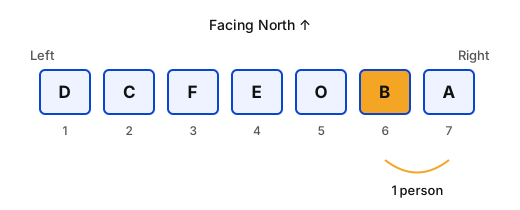
Seven friends, A, B, C, D, E, F and O, are sitting in a row facing north. Only two people sit to the left of F. Only three people sit between F and A. Only one person sits between A and O. D sits to the immediate left of C. E is not an immediate neighbour of A. How many people sit to the right of B?
सात मित्र, A, B, C, D, E, F और O, एक पंक्ति में उत्तर की ओर मुख करके बैठे हैं। F के बाईं ओर केवल दो व्यक्ति बैठे हैं। F और A के बीच केवल तीन व्यक्ति बैठे हैं। A और O के बीच केवल एक व्यक्ति बैठा है। D, C के ठीक बाईं ओर बैठा है। E, A का निकटतम पड़ोसी नहीं है। B के दाईं ओर कितने व्यक्ति बैठे हैं?
  1. AFourचार
  2. BOneएक
  3. CTwoदो
  4. DThreeतीन
Show answer

Concept: All face north, so left and right are the viewer's left and right. Place F first.

  1. Only two people left of F → F at position 3.
  2. Three people between F and A → A at 7.
  3. One person between A and O → O at 5.
  4. D immediately left of C → D at 1, C at 2. E not a neighbour of A → E at 4, B at 6.
  5. Row: D C F E O B A; only A is to the right of B.

Trick: "Only two to the left" fixes an exact position (3rd from left); start with such clues.

Answer: (B) One

अवधारणा: सभी उत्तर की ओर मुख किए हैं, इसलिए बायाँ-दायाँ हमारे बाएँ-दाएँ जैसा ही है। पहले F को रखें।

  1. F के बाईं ओर केवल दो → F स्थान 3।
  2. F और A के बीच तीन → A स्थान 7।
  3. A और O के बीच एक → O स्थान 5।
  4. D, C के ठीक बाएँ → D 1, C 2। E, A का पड़ोसी नहीं → E 4, B 6।
  5. पंक्ति: D C F E O B A; B के दाईं ओर केवल A है।

ट्रिक: "केवल दो बाईं ओर" जैसा संकेत सटीक स्थान देता है; उसी से शुरू करें।

उत्तर: (B) एक

RRB NTPC Graduate CBT 1General Intelligence and ReasoningLinear seating arrangementRRB NTPC Graduate CBT 1 2024 · 21 Jun Shift 1 →
Q878.
What should come in place of the question mark (?) in the given series based on the English alphabetical order?
GUR QEB AOL KYV ?
अंग्रेज़ी वर्णमाला क्रम के आधार पर दी गई श्रृंखला में प्रश्नचिह्न (?) के स्थान पर क्या आना चाहिए?
GUR QEB AOL KYV ?
  1. AFIU
  2. BUFI
  3. CFUI
  4. DUIF
Show answer

Concept: Track the first, second and third letters of each cluster separately (positions A = 1 … Z = 26).

  1. First letters: G, Q, A, K → each +10 (cyclic) → next K+10 = U.
  2. Second letters: U, E, O, Y → +10 → Y+10 = I.
  3. Third letters: R, B, L, V → +10 → V+10 = F.
  4. Next cluster: UIF.

Trick: +10 cyclic is the same as −16; e.g. Y(25)+10 = 35 − 26 = 9 = I.

Answer: (D) UIF

अवधारणा: प्रत्येक समूह के पहले, दूसरे और तीसरे अक्षर को अलग-अलग देखें (A = 1 … Z = 26)।

  1. पहले अक्षर: G, Q, A, K → हर बार +10 (चक्रीय) → K+10 = U।
  2. दूसरे अक्षर: U, E, O, Y → +10 → Y+10 = I।
  3. तीसरे अक्षर: R, B, L, V → +10 → V+10 = F।
  4. अगला समूह: UIF।

ट्रिक: +10 चक्रीय = −16; जैसे Y(25)+10 = 35 − 26 = 9 = I।

उत्तर: (D) UIF

RRB NTPC Graduate CBT 1General Intelligence and ReasoningLetter seriesRRB NTPC Graduate CBT 1 2024 · 21 Jun Shift 1 →
Q879.
SUZD is related to ZBGK in a certain way based on the English alphabetical order. In the same way, UWBF is related to BDIM. To which of the following options is PRWA related, following the same logic?
अंग्रेज़ी वर्णमाला क्रम के आधार पर SUZD एक निश्चित तरीके से ZBGK से संबंधित है। उसी प्रकार, UWBF, BDIM से संबंधित है। समान तर्क का अनुसरण करते हुए, PRWA निम्नलिखित में से किस विकल्प से संबंधित है?
  1. AWDHY
  2. BWYHD
  3. CWDUH
  4. DWYDH
Show answer

Concept: Compare letter by letter.

  1. S→Z, U→B, Z→G, D→K: each letter +7.
  2. Check: U→B, W→D, B→I, F→M ✓ (+7).
  3. PRWA: P+7 = W, R+7 = Y, W+7 = D, A+7 = H → WYDH.

Trick: Options A and C fail at the second letter (R+7 = Y); B fails at the third.

Answer: (D) WYDH

अवधारणा: अक्षर-दर-अक्षर तुलना करें।

  1. S→Z, U→B, Z→G, D→K: हर अक्षर +7।
  2. जाँच: U→B, W→D, B→I, F→M ✓ (+7)।
  3. PRWA: P+7 = W, R+7 = Y, W+7 = D, A+7 = H → WYDH।

ट्रिक: विकल्प A और C दूसरे अक्षर (R+7 = Y) पर, B तीसरे अक्षर पर गलत है।

उत्तर: (D) WYDH

RRB NTPC Graduate CBT 1General Intelligence and ReasoningAnalogy (letter shift)RRB NTPC Graduate CBT 1 2024 · 21 Jun Shift 1 →
Q880.
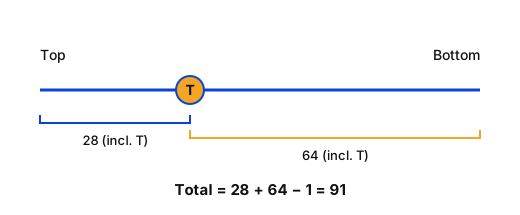
Taran ranked 28th from the top and 64th from the bottom in his class. How many students are there in his class?
तरन की अपनी कक्षा में ऊपर से 28वीं और नीचे से 64वीं रैंक है। उसकी कक्षा में कितने विद्यार्थी हैं?
  1. A90
  2. B92
  3. C93
  4. D91
Show answer

Concept: Total = rank from top + rank from bottom − 1 (the person is counted twice).

  1. Rank from top = 28, rank from bottom = 64.
  2. Total =28+64−1=91.

Trick: Add both ranks and subtract 1.

Answer: (D) 91

अवधारणा: कुल = ऊपर से रैंक + नीचे से रैंक − 1 (व्यक्ति दो बार गिना जाता है)।

  1. ऊपर से रैंक 28, नीचे से 64।
  2. कुल =28+64−1=91।

ट्रिक: दोनों रैंक जोड़कर 1 घटाएँ।

उत्तर: (D) 91

RRB NTPC Graduate CBT 1General Intelligence and ReasoningRankingRRB NTPC Graduate CBT 1 2024 · 21 Jun Shift 1 →