Question bank

Q&A: practice questions with answers

Search questions on any topic. Filter by exam category, exam, subject and topic, try the question, then open the answer and explanation.

Courses – airGurukul

7,077 questions found.

Q941.
If a + b = 32 and (a − b)2 = 372, find the value of product of a and b.
यदि a + b = 32 और (a − b)2 = 372 है, तो a और b के गुणनफल का मान ज्ञात कीजिए।
  1. A145
  2. B163
  3. C161
  4. D261
Show answer

Concept: (a+b)2−(a−b)2=4ab.

  1. (a+b)2=322=1024.
  2. 4ab=1024−372=652.
  3. ab=6524=163.

Trick: Remember 4ab=(a+b)2−(a−b)2 – no need to find a and b separately.

Answer: (B) 163

अवधारणा: (a+b)2−(a−b)2=4ab।

  1. (a+b)2=322=1024।
  2. 4ab=1024−372=652।
  3. ab=6524=163।

ट्रिक: 4ab=(a+b)2−(a−b)2 याद रखें – a, b अलग से निकालने की ज़रूरत नहीं।

उत्तर: (B) 163
RRB NTPC Graduate CBT 1MathematicsAlgebraic IdentitiesRRB NTPC Graduate CBT 1 2024 · 20 Jun Shift 3 →
Q942.
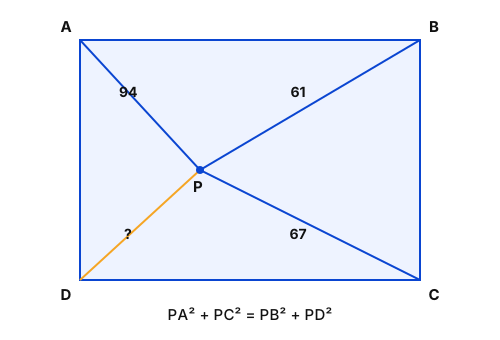
P is any point inside the rectangle ABCD. If PA = 94 cm, PB = 61 cm and PC = 67 cm, then the length of PD (in cm) is:
P आयत ABCD के अंदर कोई बिंदु है। यदि PA = 94 cm, PB = 61 cm और PC = 67 cm है, तो PD की लंबाई (cm में) कितनी है?
  1. A95
  2. B96
  3. C98
  4. D102
Show answer

Concept: For any point P inside rectangle ABCD: PA2+PC2=PB2+PD2 (opposite corners pair up).

  1. PA2+PC2=942+672=8836+4489=13325.
  2. PD2=13325−PB2=13325−612=13325−3721=9604.
  3. PD=9604=98cm.

Trick: Diagonally opposite corners go together: A with C, B with D.

Answer: (C) 98

अवधारणा: आयत ABCD के अंदर किसी भी बिंदु P के लिए: PA2+PC2=PB2+PD2 (विपरीत कोने साथ)।

  1. PA2+PC2=942+672=8836+4489=13325।
  2. PD2=13325−612=13325−3721=9604।
  3. PD=9604=98cm।

ट्रिक: विकर्णतः विपरीत कोने साथ: A के साथ C, B के साथ D।

उत्तर: (C) 98

RRB NTPC Graduate CBT 1MathematicsGeometry – Rectangle (British Flag Theorem)RRB NTPC Graduate CBT 1 2024 · 20 Jun Shift 3 →
Q943.
At what rate (in percentage) per annum simple interest will a sum of money triple itself in 8 years?
साधारण ब्याज की किस वार्षिक दर (प्रतिशत में) पर कोई धनराशि 8 वर्षों में तीन गुनी हो जाएगी?
  1. A24
  2. B37.5
  3. C25
  4. D36.5
Show answer

Concept: SI=P×R×T100.

  1. Amount =3P, so SI =3P−P=2P.
  2. 2P=P×R×8100.
  3. R=2008=25%.

Trick: Becomes n times in T years: R=(n−1)×100T=2×1008=25.

Answer: (C) 25

अवधारणा: SI=P×R×T100।

  1. मिश्रधन =3P, अतः SI =2P।
  2. 2P=P×R×8100।
  3. R=2008=25%।

ट्रिक: T वर्षों में n गुना: R=(n−1)×100T=2×1008=25।

उत्तर: (C) 25

RRB NTPC Graduate CBT 1MathematicsSimple InterestRRB NTPC Graduate CBT 1 2024 · 20 Jun Shift 3 →
Q944.
Reena, Naveen and Arpita started a business in partnership, investing in the ratio of 5 : 6 : 13, respectively. At the end of the year, they earned a profit of ₹36,400, which is 14% of their total investment. How much did Naveen invest (in ₹)?
रीना, नवीन और अर्पिता ने क्रमशः 5 : 6 : 13 के अनुपात में निवेश करके साझेदारी में एक व्यवसाय शुरू किया। वर्ष के अंत में, उन्होंने ₹36,400 का लाभ अर्जित किया, जो उनके कुल निवेश का 14% है। नवीन ने कितना निवेश (₹ में) किया?
  1. A₹65,000
  2. B₹65,105
  3. C₹64,769
  4. D₹64,818
Show answer

Concept: Total investment =Profit14%; split it in the investment ratio.

  1. Total investment =36400×10014=260000.
  2. Ratio 5:6:13, total parts =24.
  3. Naveen =624×260000=65000.

Trick: 624=14 – Naveen has exactly one-fourth of the total.

Answer: (A) ₹65,000

अवधारणा: कुल निवेश =लाभ14%; फिर निवेश अनुपात में बाँटें।

  1. कुल निवेश =36400×10014=260000।
  2. अनुपात 5:6:13, कुल भाग =24।
  3. नवीन =624×260000=65000।

ट्रिक: 624=14 – नवीन का हिस्सा ठीक एक-चौथाई।

उत्तर: (A) ₹65,000

RRB NTPC Graduate CBT 1MathematicsPartnershipRRB NTPC Graduate CBT 1 2024 · 20 Jun Shift 3 →
Q945.
The population of a town in the year 1956 was 2,07,300. If its population increased in two successive decades by 20% in each decade, the population of the town in the year 1976 was:
वर्ष 1956 में एक शहर की जनसंख्या 2,07,300 थी। यदि इसकी जनसंख्या लगातार दो दशकों में प्रत्येक दशक में 20% बढ़ी, तो वर्ष 1976 में शहर की जनसंख्या कितनी थी?
  1. A2,98,513
  2. B2,98,512
  3. C2,98,511
  4. D2,98,507
Show answer

Concept: Pn=P(1+r100)n.

  1. 1956 to 1976 = two decades, 20% each.
  2. P=207300×1.2×1.2=207300×1.44.
  3. =298512.

Trick: Two successive 20% rises = 20+20+20×20100=44% net increase.

Answer: (B) 2,98,512

अवधारणा: Pn=P(1+r100)n।

  1. 1956 से 1976 = दो दशक, प्रत्येक में 20%।
  2. P=207300×1.2×1.2=207300×1.44।
  3. =298512।

ट्रिक: दो बार 20% वृद्धि = 20+20+20×20100=44% कुल वृद्धि।

उत्तर: (B) 2,98,512

RRB NTPC Graduate CBT 1MathematicsPopulation GrowthRRB NTPC Graduate CBT 1 2024 · 20 Jun Shift 3 →
Q946.
The simplified value of 285 - 6 × (23 + 19) + 83 is:
285 - 6 × (23 + 19) + 83 का सरलीकृत मान क्या है?
  1. A110
  2. B106
  3. C107
  4. D116
Show answer

Concept: BODMAS: Brackets → Multiplication → Addition/Subtraction (left to right).

  1. 23+19=42.
  2. 6×42=252.
  3. 285−252+83=33+83=116.

Trick: Never subtract before multiplying: 285−6 first would be wrong.

Answer: (D) 116

अवधारणा: BODMAS: कोष्ठक → गुणा → जोड़/घटाव (बाएँ से दाएँ)।

  1. 23+19=42।
  2. 6×42=252।
  3. 285−252+83=33+83=116।

ट्रिक: गुणा से पहले घटाव न करें: पहले 285−6 करना गलत होगा।

उत्तर: (D) 116

RRB NTPC Graduate CBT 1MathematicsSimplification (BODMAS)RRB NTPC Graduate CBT 1 2024 · 20 Jun Shift 3 →
Q947.
Find the greatest number by which when the numbers 247 and 189 are divided, it leaves remainders 3 and 6, respectively.
वह बड़ी से बड़ी संख्या ज्ञात कीजिए, जिससे 247 और 189 को विभाजित करने पर क्रमशः 3 और 6 शेषफल प्राप्त होते हैं।
  1. A62
  2. B63
  3. C61
  4. D64
Show answer

Concept: Required number =HCF(247−3,189−6).

  1. 247−3=244=4×61.
  2. 189−6=183=3×61.
  3. HCF =61 (and 61>6, the larger remainder).

Trick: Subtract the remainders, then take HCF; check the answer exceeds every remainder.

Answer: (C) 61

अवधारणा: अभीष्ट संख्या =HCF(247−3,189−6)।

  1. 247−3=244=4×61।
  2. 189−6=183=3×61।
  3. HCF =61 (और 61>6, सबसे बड़ा शेषफल)।

ट्रिक: शेषफल घटाकर HCF लें; उत्तर हर शेषफल से बड़ा होना चाहिए।

उत्तर: (C) 61

RRB NTPC Graduate CBT 1MathematicsHCFRRB NTPC Graduate CBT 1 2024 · 20 Jun Shift 3 →
Q948.
Two taps can fill a cistern in 3 hours and 36 hours, respectively. A third tap can empty it in 4 hours. How long (in hours) will it take to fill two-third of the empty cistern, if all of them are opened together?
दो नल एक टंकी को क्रमशः 3 घंटे और 36 घंटे में भर सकते हैं। एक तीसरा नल इसे 4 घंटे में खाली कर सकता है। यदि तीनों नल एक साथ खोल दिए जाएँ, तो खाली टंकी का दो-तिहाई भाग भरने में कितना समय (घंटों में) लगेगा?
  1. A24
  2. B18
  3. C6
  4. D12
Show answer

Concept: Net rate = sum of filling rates − emptying rate (tank per hour).

  1. Net rate =13+136−14=12+1−936=436=19.
  2. Full tank in 9 hours.
  3. 23 tank: 23×9=6 hours.

Trick: LCM method: capacity 36 units; rates 12+1−9=4 units/h; 23×36=24 units → 6 h.

Answer: (C) 6

अवधारणा: शुद्ध दर = भरने वाली दरों का योग − खाली करने की दर (प्रति घंटा)।

  1. शुद्ध दर =13+136−14=12+1−936=19।
  2. पूरी टंकी 9 घंटे में।
  3. 23 टंकी: 23×9=6 घंटे।

ट्रिक: LCM विधि: क्षमता 36 इकाई; दर 12+1−9=4 इकाई/घंटा; 23×36=24 इकाई → 6 घंटे।

उत्तर: (C) 6

RRB NTPC Graduate CBT 1MathematicsPipes and CisternRRB NTPC Graduate CBT 1 2024 · 20 Jun Shift 3 →
Q949.
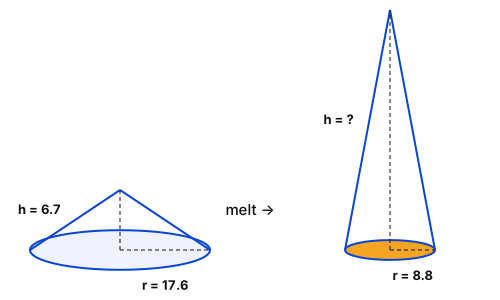
A right circular cone is 6.7 cm high, and the radius of its base is 17.6 cm. It is melted and recast into a new right circular cone with a base radius of 8.8 cm. Find the height (in cm) of the new cone.
एक लंब वृत्तीय शंकु 6.7 cm ऊँचा है, और इसके आधार की त्रिज्या 17.6 cm है। इसे पिघलाकर 8.8 cm आधार त्रिज्या वाले एक नए लंब वृत्तीय शंकु में ढाला जाता है। नए शंकु की ऊँचाई (cm में) ज्ञात कीजिए।
  1. A34.5
  2. B25.5
  3. C37.5
  4. D26.8
Show answer

Concept: Volume stays the same on melting: 13πr12h1=13πr22h2.

  1. 17.62×6.7=8.82×h.
  2. h=(17.68.8)2×6.7=22×6.7.
  3. h=26.8cm.

Trick: Radius halved → height becomes 4 times.

Answer: (D) 26.8

अवधारणा: पिघलाने पर आयतन समान रहता है: 13πr12h1=13πr22h2।

  1. 17.62×6.7=8.82×h।
  2. h=(17.68.8)2×6.7=4×6.7।
  3. h=26.8cm।

ट्रिक: त्रिज्या आधी → ऊँचाई 4 गुना।

उत्तर: (D) 26.8

RRB NTPC Graduate CBT 1MathematicsMensuration – Cone (Recasting)RRB NTPC Graduate CBT 1 2024 · 20 Jun Shift 3 →
Q950.
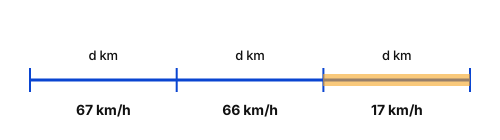
One-third of a journey is covered at a speed of 67 km/hr, the next one-third of the journey is covered at a speed of 66 km/hr, and the remaining journey is covered at a speed of 17 km/hr. The average speed (in km/hr, rounded off to one decimal place) for the entire journey is:
किसी यात्रा का एक-तिहाई भाग 67 km/hr की चाल से, अगला एक-तिहाई भाग 66 km/hr की चाल से, और शेष यात्रा 17 km/hr की चाल से तय की जाती है। पूरी यात्रा के लिए औसत चाल (km/hr में, एक दशमलव स्थान तक पूर्णांकित) कितनी है?
  1. A43.7
  2. B28.6
  3. C33.7
  4. D29.6
Show answer

Concept: Equal distances: Avg speed=31v1+1v2+1v3.

  1. Let each third =d. Total time =d(167+166+117).
  2. 167+166+117≈0.014925+0.015152+0.058824=0.088901.
  3. Average =30.088901≈33.75→33.7km/h.

Trick: Average speed is pulled towards the slowest speed (17), so it must be well below the simple mean 50.

Answer: (C) 33.7

अवधारणा: समान दूरियाँ: औसत चाल=31v1+1v2+1v3।

  1. प्रत्येक तिहाई =d। कुल समय =d(167+166+117)।
  2. 167+166+117≈0.088901।
  3. औसत =30.088901≈33.75→33.7km/h।

ट्रिक: औसत चाल सबसे धीमी चाल (17) की ओर खिंचती है, अतः साधारण औसत 50 से काफी कम।

उत्तर: (C) 33.7

RRB NTPC Graduate CBT 1MathematicsAverage SpeedRRB NTPC Graduate CBT 1 2024 · 20 Jun Shift 3 →
Q951.
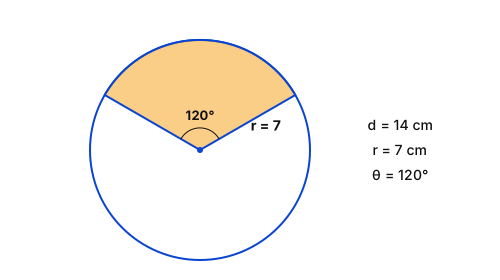
Find the area of the sector of a circle with diameter 14 cm, if the arc of the sector makes an angle of 120° at the centre of the circle. (Use π=227)
14 cm व्यास वाले एक वृत्त के त्रिज्यखंड का क्षेत्रफल ज्ञात कीजिए, यदि त्रिज्यखंड का चाप वृत्त के केंद्र पर 120° का कोण बनाता है। (π=227 का प्रयोग कीजिए)
  1. A5113cm2
  2. B5112cm2
  3. C150cm2
  4. D154cm2
Show answer

Concept: Area of sector=θ360∘×πr2.

  1. r=142=7cm.
  2. πr2=227×49=154.
  3. Area =120360×154=1543=5113cm2.

Trick: 120∘ is one-third of the circle: 1543.

Answer: (A) 5113cm2

अवधारणा: त्रिज्यखंड का क्षेत्रफल=θ360∘×πr2।

  1. r=142=7cm।
  2. πr2=227×49=154।
  3. क्षेत्रफल =120360×154=5113cm2।

ट्रिक: 120∘ वृत्त का एक-तिहाई है: 1543।

उत्तर: (A) 5113cm2

RRB NTPC Graduate CBT 1MathematicsMensuration – SectorRRB NTPC Graduate CBT 1 2024 · 20 Jun Shift 3 →
Q952.
If a sum of ₹9,10,000 is invested for a year at 2% per annum compounded half yearly, then find the compound interest.
यदि ₹9,10,000 की राशि को 2% वार्षिक दर पर अर्धवार्षिक रूप से संयोजित चक्रवृद्धि ब्याज पर एक वर्ष के लिए निवेश किया जाता है, तो चक्रवृद्धि ब्याज ज्ञात कीजिए।
  1. A₹18,291
  2. B₹20,081
  3. C₹17,125
  4. D₹18,828
Show answer

Concept: Half-yearly compounding: rate is halved and time (periods) doubled.

  1. Rate per half-year =22=1%, periods =2.
  2. A=910000×(1.01)2=910000×1.0201=928291
  3. CI=928291−910000=18291

Trick: For 2 periods at r%, effective rate =2r+r2100=2.01%; 910000×0.0201=18291.

Answer: (A) ₹18,291

अवधारणा: अर्धवार्षिक चक्रवृद्धि में दर आधी और अवधि (periods) दोगुनी हो जाती है।

  1. प्रति छमाही दर =22=1%, अवधियाँ =2
  2. A=910000×(1.01)2=928291
  3. CI=928291−910000=18291

ट्रिक: 2 अवधियों के लिए प्रभावी दर =2r+r2100=2.01%; 910000×0.0201=18291

उत्तर: (A) ₹18,291

RRB NTPC Graduate CBT 1MathematicsCompound Interest (half-yearly)RRB NTPC Graduate CBT 1 2024 · 20 Jun Shift 3 →
Q953.
The mode of the observations 21, 27, 25, 31, 21, 35, 23, 25, 32, 27, 21, 29, 32, 29 and 31 is:
प्रेक्षणों 21, 27, 25, 31, 21, 35, 23, 25, 32, 27, 21, 29, 32, 29 और 31 का बहुलक क्या है?
  1. A27
  2. B31
  3. C25
  4. D21
Show answer

Concept: Mode = the value that occurs most often.

  1. Count: 21 → 3 times; 25, 27, 29, 31, 32 → 2 times each; others once.
  2. Highest frequency is 3, for 21.

Trick: Tally just the repeated values; ignore the singles.

Answer: (D) 21

अवधारणा: बहुलक (mode) = सबसे अधिक बार आने वाला मान।

  1. गिनती: 21 → 3 बार; 25, 27, 29, 31, 32 → 2-2 बार; बाकी एक बार।
  2. सबसे अधिक बारंबारता 3 है, जो 21 की है।

ट्रिक: केवल दोहराए गए मानों को गिनें।

उत्तर: (D) 21

RRB NTPC Graduate CBT 1MathematicsStatistics – ModeRRB NTPC Graduate CBT 1 2024 · 20 Jun Shift 3 →
Q954.
Which of the following numbers is divisible by 11?
निम्नलिखित में से कौन-सी संख्या 11 से विभाज्य है?
  1. A2118
  2. B1440
  3. C2652
  4. D1749
Show answer

Concept: A number is divisible by 11 if (sum of alternate digits) − (sum of other digits) is 0 or a multiple of 11.

  1. 2118: (2+1)−(1+8)=−6 ✗
  2. 1440: (1+4)−(4+0)=1 ✗; 2652: (2+5)−(6+2)=−1 ✗
  3. 1749: (1+4)−(7+9)=−11 ✓ (1749=11×159)

Trick: Difference of alternate-digit sums must be 0,±11,…

Answer: (D) 1749

अवधारणा: कोई संख्या 11 से विभाज्य है यदि एकांतर अंकों के योग का अंतर 0 या 11 का गुणज हो।

  1. 2118: (2+1)−(1+8)=−6 ✗
  2. 1440: (1+4)−(4+0)=1 ✗; 2652: (2+5)−(6+2)=−1 ✗
  3. 1749: (1+4)−(7+9)=−11 ✓ (1749=11×159)

ट्रिक: एकांतर अंकों के योग का अंतर 0,±11,… होना चाहिए।

उत्तर: (D) 1749

RRB NTPC Graduate CBT 1MathematicsDivisibility by 11RRB NTPC Graduate CBT 1 2024 · 20 Jun Shift 3 →
Q955.
Find the possible value of x.
x4−17x2+60=0
x का संभावित मान ज्ञात कीजिए।
x4−17x2+60=0
  1. A−6
  2. B−2
  3. C−3
  4. D−12
Show answer

Concept: Put x2=t to turn x4−17x2+60=0 into a quadratic.

  1. t2−17t+60=0⇒(t−12)(t−5)=0
  2. t=12 or t=5, so x=±12 or x=±5.
  3. Among the options only −12 fits.

Trick: Check options: x2=12⇒144−204+60=0 ✓.

Answer: (D) −12

अवधारणा: x2=t रखकर x4−17x2+60=0 को द्विघात बनाएँ।

  1. t2−17t+60=0⇒(t−12)(t−5)=0
  2. t=12 या t=5, अतः x=±12 या x=±5
  3. विकल्पों में केवल −12 सही बैठता है।

ट्रिक: विकल्प जाँचें: x2=12⇒144−204+60=0 ✓

उत्तर: (D) −12

RRB NTPC Graduate CBT 1MathematicsBiquadratic EquationsRRB NTPC Graduate CBT 1 2024 · 20 Jun Shift 3 →
Q956.
There are two sections A and B of a class, consisting of 22 and 44 students,
respectively. If the average weight of section A is 40 kg and that of section B is 37 kg, find the average weight of the whole class (in kg).
एक कक्षा के दो वर्गों A और B में क्रमशः 22 और 44 विद्यार्थी हैं।
यदि वर्ग A का औसत भार 40 kg और वर्ग B का औसत भार 37 kg है, तो पूरी कक्षा का औसत भार (kg में) ज्ञात कीजिए।
  1. A37.5
  2. B38
  3. C38.5
  4. D39
Show answer

Concept: Combined average =n1a1+n2a2n1+n2.

  1. Total weight =22×40+44×37=880+1628=2508
  2. Average =250866=38 kg

Trick: Ratio 22:44=1:2, so average =40+2×373=1143=38.

Answer: (B) 38

अवधारणा: संयुक्त औसत =n1a1+n2a2n1+n2

  1. कुल भार =22×40+44×37=880+1628=2508
  2. औसत =250866=38 kg

ट्रिक: अनुपात 22:44=1:2, औसत =40+2×373=38

उत्तर: (B) 38

RRB NTPC Graduate CBT 1MathematicsAverage – Combined GroupsRRB NTPC Graduate CBT 1 2024 · 20 Jun Shift 3 →
Q957.
A woman travelled at a speed of 20 m/min for 80 min, and at a speed of 65 m/min for 70 min. Her average speed (in m/min) is:
एक महिला ने 80 min तक 20 m/min की चाल से और 70 min तक 65 m/min की चाल से यात्रा की। उसकी औसत चाल (m/min में) कितनी है?
  1. A47
  2. B45
  3. C41
  4. D34
Show answer

Concept: Average speed =total distancetotal time.

  1. Distance =20×80+65×70=1600+4550=6150 m
  2. Time =80+70=150 min
  3. Average =6150150=41 m/min

Trick: Never average the two speeds directly (20+652=42.5 is wrong) – weight them by time.

Answer: (C) 41

अवधारणा: औसत चाल =कुल दूरीकुल समय

  1. दूरी =20×80+65×70=1600+4550=6150 m
  2. समय =80+70=150 min
  3. औसत =6150150=41 m/min

ट्रिक: दोनों चालों का सीधा औसत (42.5) गलत है – समय से भारित करें।

उत्तर: (C) 41

RRB NTPC Graduate CBT 1MathematicsAverage SpeedRRB NTPC Graduate CBT 1 2024 · 20 Jun Shift 3 →
Q958.
The successive discounts of 24%, 18% and 20% are equivalent to a single discount of: (Rounded up to two decimal places.)
24%, 18% और 20% की क्रमागत छूटें किस एकल छूट के बराबर हैं? (दो दशमलव स्थानों तक पूर्णांकित)
  1. A51.51%
  2. B52.84%
  3. C49.27%
  4. D50.14%
Show answer

Concept: Successive discounts multiply the remaining fractions.

  1. Remaining =0.76×0.82×0.80
  2. 0.76×0.82=0.6232; 0.6232×0.8=0.49856
  3. Single discount =1−0.49856=0.50144≈50.14%

Trick: Two at a time: a+b−ab100: 24,18→37.68; 37.68,20→50.144.

Answer: (D) 50.14%

अवधारणा: क्रमिक छूट में बची हुई भिन्नों का गुणा होता है।

  1. शेष =0.76×0.82×0.80
  2. 0.76×0.82=0.6232; 0.6232×0.8=0.49856
  3. एकल छूट =1−0.49856=50.144%≈50.14%

ट्रिक: a+b−ab100: 24,18→37.68; 37.68,20→50.144

उत्तर: (D) 50.14%

RRB NTPC Graduate CBT 1MathematicsSuccessive DiscountsRRB NTPC Graduate CBT 1 2024 · 20 Jun Shift 3 →
Q959.
A booster pump can be used for filling as well as for emptying a tank. The capacity of the tank is 1800 m3. The emptying capacity of the tank is 10 m3/min higher than its filling capacity, and the pump needs 6 minutes lesser to empty the tank than it needs to fill it. What is the filling capacity of the pump in m3/min?
एक बूस्टर पंप का उपयोग टंकी को भरने के साथ-साथ खाली करने के लिए भी किया जा सकता है। टंकी की धारिता 1800 m3 है। टंकी को खाली करने की क्षमता उसे भरने की क्षमता से 10 m3/min अधिक है, और पंप को टंकी खाली करने में उसे भरने की तुलना में 6 मिनट कम लगते हैं। पंप की भरने की क्षमता m3/min में कितनी है?
  1. A65
  2. B27
  3. C50
  4. D18
Show answer

Concept: Time =capacityrate. Let filling rate =x, emptying rate =x+10 (m3/min).

  1. 1800x−1800x+10=6
  2. 1800×10=6x(x+10)⇒x(x+10)=3000
  3. x2+10x−3000=0⇒(x+60)(x−50)=0⇒x=50

Trick: Option check: 180050=36, 180060=30, difference 6 ✓.

Answer: (C) 50

अवधारणा: समय =क्षमतादर; भरने की दर =x, खाली करने की दर =x+10 (m3/min)

  1. 1800x−1800x+10=6
  2. 1800×10=6x(x+10)⇒x(x+10)=3000
  3. x2+10x−3000=0⇒x=50

ट्रिक: विकल्प से: 180050=36, 180060=30, अंतर 6 ✓

उत्तर: (C) 50

RRB NTPC Graduate CBT 1MathematicsPipes and CisternsRRB NTPC Graduate CBT 1 2024 · 20 Jun Shift 3 →
Q960.
The population of a village was 1,10,000. It increased by 5% in the first year and increased by 30% in the second year. Its population after two years is _______.
एक गाँव की जनसंख्या 1,10,000 थी। पहले वर्ष में इसमें 5% की वृद्धि हुई और दूसरे वर्ष में 30% की वृद्धि हुई। दो वर्ष बाद इसकी जनसंख्या _______ है।
  1. A1,50,150
  2. B1,15,500
  3. C1,48,500
  4. D1,43,000
Show answer

Concept: Successive % increases multiply: P×(1+r1100)(1+r2100).

  1. After year 1: 110000×1.05=115500
  2. After year 2: 115500×1.30=150150

Trick: Net increase =5+30+5×30100=36.5%; 110000×1.365=150150.

Answer: (A) 1,50,150

अवधारणा: क्रमिक प्रतिशत वृद्धि: P×(1+r1100)(1+r2100)

  1. पहले वर्ष बाद: 110000×1.05=115500
  2. दूसरे वर्ष बाद: 115500×1.30=150150

ट्रिक: कुल वृद्धि =5+30+5×30100=36.5%; 110000×1.365=150150

उत्तर: (A) 1,50,150

RRB NTPC Graduate CBT 1MathematicsPopulation GrowthRRB NTPC Graduate CBT 1 2024 · 20 Jun Shift 3 →