Question bank

Q&A: practice questions with answers

Search questions on any topic. Filter by exam category, exam, subject and topic, try the question, then open the answer and explanation.

Courses – airGurukul

7,077 questions found.

Q961.
Kavita buys 2 apples and 5 mangoes for ₹239. When the cost of an apple is decreased by 50% and that of a mango remains the same, then the cost of 2 apples and 4 mangoes is ₹184. What is the original cost of 8 apples and 8 mangoes?
कविता ₹239 में 2 सेब और 5 आम खरीदती है। जब एक सेब का मूल्य 50% कम हो जाता है और आम का मूल्य समान रहता है, तब 2 सेब और 4 आम का मूल्य ₹184 होता है। 8 सेब और 8 आम का मूल मूल्य क्या है?
  1. A₹438
  2. B₹440
  3. C₹436
  4. D₹441
Show answer

Concept: Let apple =a, mango =m (in ₹).

  1. 2a+5m=239
  2. Apple at half price: 2×a2+4m=184⇒a+4m=184
  3. Double it: 2a+8m=368; subtract: 3m=129⇒m=43, a=184−172=12
  4. 8a+8m=8×55=440

Trick: You only need a+m=55, then multiply by 8.

Answer: (B) ₹440

अवधारणा: सेब का मूल्य =a, आम =m (₹ में)।

  1. 2a+5m=239
  2. सेब आधे दाम पर: a+4m=184
  3. दोगुना करें: 2a+8m=368; घटाएँ: 3m=129⇒m=43, a=12
  4. 8a+8m=8×55=440

ट्रिक: केवल a+m=55 चाहिए, फिर 8 से गुणा।

उत्तर: (B) ₹440

RRB NTPC Graduate CBT 1MathematicsLinear EquationsRRB NTPC Graduate CBT 1 2024 · 20 Jun Shift 3 →
Q962.
If 600 bananas were distributed among three monkeys in the ratio 114:12:93 respectively, how many bananas did the third monkey get?
यदि 600 केलों को तीन बंदरों में क्रमशः 114:12:93 के अनुपात में बाँटा गया, तो तीसरे बंदर को कितने केले मिले?
  1. A506
  2. B505
  3. C503
  4. D504
Show answer

Concept: Clear fractions by multiplying by the LCM of denominators.

  1. 114:12:93=114:12:3
  2. Multiply by 14: 1:7:42, total =50 parts
  3. Third monkey =4250×600=504

Trick: 600÷50=12 per part; 42×12=504.

Answer: (D) 504

अवधारणा: हरों के LCM से गुणा कर भिन्न हटाएँ।

  1. 114:12:93=114:12:3
  2. 14 से गुणा: 1:7:42, कुल =50 भाग
  3. तीसरा बंदर =4250×600=504

ट्रिक: एक भाग =600÷50=12; 42×12=504

उत्तर: (D) 504

RRB NTPC Graduate CBT 1MathematicsRatio and ProportionRRB NTPC Graduate CBT 1 2024 · 20 Jun Shift 3 →
Q963.
Which of the following ratios is greatest?
निम्नलिखित में से कौन-सा अनुपात सबसे बड़ा है?
  1. A18 : 37
  2. B23 : 25
  3. C25 : 26
  4. D13 : 32
Show answer

Concept: Convert each ratio to a decimal (or compare with 1).

  1. 1837≈0.49, 1332≈0.41 – both below 12.
  2. 2325=0.92, 2526≈0.96
  3. Greatest: 25:26

Trick: For fractions just below 1, the one with the smaller gap from 1 is bigger: 126<225.

Answer: (C) 25:26

अवधारणा: प्रत्येक अनुपात को दशमलव में बदलें।

  1. 1837≈0.49, 1332≈0.41 – दोनों 12 से कम
  2. 2325=0.92, 2526≈0.96
  3. सबसे बड़ा: 25:26

ट्रिक: 1 के निकट भिन्नों में जिसका 1 से अंतर कम, वह बड़ा: 126<225

उत्तर: (C) 25:26

RRB NTPC Graduate CBT 1MathematicsComparison of RatiosRRB NTPC Graduate CBT 1 2024 · 20 Jun Shift 3 →
Q964.
The sum of the perimeter of two cubes, the length of whose edges are x cm and y cm, respectively, is 300 cm and the product of edges x and y is 156 cm2. Find the sum of the volume of both cubes.
दो घनों, जिनके किनारों की लंबाई क्रमशः x cm और y cm है, के परिमापों का योग 300 cm है और किनारों x और y का गुणनफल 156 cm2 है। दोनों घनों के आयतनों का योग ज्ञात कीजिए।
  1. A2968 cm3
  2. B2178 cm3
  3. C1756 cm3
  4. D3925 cm3
Show answer

Concept: A cube has 12 equal edges, so its perimeter (total edge length) =12a. Use x3+y3=(x+y)3−3xy(x+y).

  1. 12x+12y=300⇒x+y=25; xy=156
  2. x3+y3=253−3×156×25
  3. =15625−11700=3925cm3

Trick: x+y=25, xy=156 gives x=13, y=12: 2197+1728=3925.

Answer: (D) 3925cm3

अवधारणा: घन के 12 बराबर किनारे होते हैं, अतः परिमाप (कुल किनारा लंबाई) =12a; सूत्र x3+y3=(x+y)3−3xy(x+y)

  1. 12x+12y=300⇒x+y=25; xy=156
  2. x3+y3=253−3×156×25
  3. =15625−11700=3925cm3

ट्रिक: x+y=25, xy=156 से x=13, y=12: 2197+1728=3925

उत्तर: (D) 3925cm3

RRB NTPC Graduate CBT 1MathematicsMensuration – Cubes (Algebra)RRB NTPC Graduate CBT 1 2024 · 20 Jun Shift 3 →
Q965.
If 3tanA=4, then find the value of (1−secA)(1+secA)(1−cosecA)(1+cosecA).
यदि 3tanA=4 है, तो (1−secA)(1+secA)(1−cosecA)(1+cosecA) का मान ज्ञात कीजिए।
  1. A649
  2. B25681
  3. C8027
  4. D169
Show answer

Concept: (1−a)(1+a)=1−a2; sec2A−1=tan2A, csc2A−1=cot2A.

  1. Expression =1−sec2A1−csc2A=−tan2A−cot2A=tan4A
  2. tanA=43
  3. tan4A=25681

Trick: tan2Acot2A=tan4A – no need to find sec or cosec.

Answer: (B) 25681

अवधारणा: (1−a)(1+a)=1−a2; sec2A−1=tan2A, csc2A−1=cot2A

  1. व्यंजक =1−sec2A1−csc2A=−tan2A−cot2A=tan4A
  2. tanA=43
  3. tan4A=25681

ट्रिक: tan2Acot2A=tan4A – sec या cosec निकालने की ज़रूरत नहीं।

उत्तर: (B) 25681

RRB NTPC Graduate CBT 1MathematicsTrigonometric IdentitiesRRB NTPC Graduate CBT 1 2024 · 20 Jun Shift 3 →
Q966.
Select the pair which follows the same pattern as that followed by the two set of pairs given below. Both pairs follow the same pattern.
AJK : BEG
JIL : KDH
उस युग्म का चयन कीजिए जो उसी पैटर्न का अनुसरण करता है जिसका अनुसरण नीचे दिए गए दो युग्मों द्वारा किया गया है। दोनों युग्म एक ही पैटर्न का अनुसरण करते हैं।
AJK : BEG
JIL : KDH
  1. ARLO : SIK
  2. BBKK : CFH
  3. COHF : PCC
  4. DKKQ : LFM
Show answer

Concept: Compare each letter of the first cluster with the matching letter of the second by its alphabet position.

  1. AJK → BEG: A +1 = B, J −5 = E, K −4 = G.
  2. JIL → KDH: J +1 = K, I −5 = D, L −4 = H.
  3. KKQ → LFM: K +1 = L, K −5 = F, Q −4 = M ✔. (RLO → SIK fails: L −3 = I.)

Trick: Pattern (+1,−5,−4); check only the 2nd letter first – it eliminates most options fast.

Answer: (D) KKQ : LFM

अवधारणा: पहले समूह के प्रत्येक अक्षर की तुलना दूसरे समूह के संगत अक्षर से (वर्णमाला स्थान) करें।

  1. AJK → BEG: A +1 = B, J −5 = E, K −4 = G।
  2. JIL → KDH: J +1 = K, I −5 = D, L −4 = H।
  3. KKQ → LFM: K +1 = L, K −5 = F, Q −4 = M ✔। (RLO → SIK में L −3 = I, गलत)

ट्रिक: पैटर्न (+1,−5,−4); पहले केवल दूसरा अक्षर जाँचें – अधिकतर विकल्प तुरंत हट जाते हैं।

उत्तर: (D) KKQ : LFM

RRB NTPC Graduate CBT 1General Intelligence and ReasoningLetter AnalogyRRB NTPC Graduate CBT 1 2024 · 20 Jun Shift 3 →
Q967.
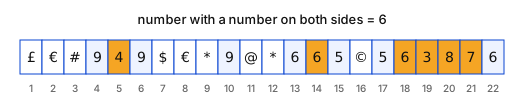
Refer to the number and symbol series given below and answer the question that follows. Counting to be done from left to right only.
(NOTE: All numbers are single digit numbers only.)
(Left) £ € # 9 4 9 $ € * 9 @ * 6 6 5 © 5 6 3 8 7 6 (Right)
How many such numbers are there, each of which is immediately preceded by a number and also immediately followed by a number?
नीचे दी गई संख्या और प्रतीक श्रृंखला को देखिए और उसके बाद दिए गए प्रश्न का उत्तर दीजिए। गिनती केवल बाएँ से दाएँ की जानी है।
(नोट: सभी संख्याएँ केवल एक-अंकीय संख्याएँ हैं।)
(बाएँ) £ € # 9 4 9 $ € * 9 @ * 6 6 5 © 5 6 3 8 7 6 (दाएँ)
ऐसी कितनी संख्याएँ हैं, जिनमें से प्रत्येक के ठीक पहले एक संख्या है और ठीक बाद भी एक संख्या है?
  1. A7
  2. B5
  3. C8
  4. D6
Show answer

Concept: Look for the pattern number–number–number (three consecutive digits); the middle one is counted.

  1. Digit runs in the series: "9 4 9", "6 6 5", "5 6 3 8 7 6".
  2. "9 4 9" → 4 counted (1). "6 6 5" → middle 6 counted (1).
  3. "5 6 3 8 7 6" → 6, 3, 8, 7 counted (4); the end digits of a run never count.
  4. Total =1+1+4=6.

Trick: In a run of k consecutive digits, k−2 digits qualify: (3−2)+(3−2)+(6−2)=6.

Answer: (D) 6

अवधारणा: संख्या–संख्या–संख्या (लगातार तीन अंक) का पैटर्न देखें; बीच वाला अंक गिना जाता है।

  1. श्रृंखला में अंकों के समूह: "9 4 9", "6 6 5", "5 6 3 8 7 6"।
  2. "9 4 9" → 4 (1)। "6 6 5" → बीच का 6 (1)।
  3. "5 6 3 8 7 6" → 6, 3, 8, 7 (4); समूह के किनारे वाले अंक नहीं गिने जाते।
  4. कुल =1+1+4=6।

ट्रिक: k लगातार अंकों के समूह में k−2 अंक मान्य: (3−2)+(3−2)+(6−2)=6।

उत्तर: (D) 6

RRB NTPC Graduate CBT 1General Intelligence and ReasoningNumber-Symbol SeriesRRB NTPC Graduate CBT 1 2024 · 20 Jun Shift 3 →
Q968.
If 2 is added to each even digit and 1 is subtracted from each odd digit in the number 26347591, what will be the sum of the second digit from left and third digit from right in the new number thus formed?
यदि संख्या 26347591 में प्रत्येक सम अंक में 2 जोड़ा जाए और प्रत्येक विषम अंक में से 1 घटाया जाए, तो इस प्रकार बनी नई संख्या में बाएँ से दूसरे अंक और दाएँ से तीसरे अंक का योग क्या होगा?
  1. A14
  2. B10
  3. C8
  4. D12
Show answer

Concept: Change each digit separately: even +2, odd −1.

  1. 2 6 3 4 7 5 9 1 → 4 8 2 6 6 4 8 0.
  2. Second digit from left =8.
  3. Third digit from right (from 4 8 2 6 6 4 8 0) =4.
  4. Sum =8+4=12.

Trick: Only transform the two positions asked: 2nd from left is 6 → 8; 3rd from right is 5 → 4.

Answer: (D) 12

अवधारणा: हर अंक अलग से बदलें: सम अंक +2, विषम अंक −1।

  1. 2 6 3 4 7 5 9 1 → 4 8 2 6 6 4 8 0।
  2. बाएँ से दूसरा अंक =8।
  3. दाएँ से तीसरा अंक (4 8 2 6 6 4 8 0) =4।
  4. योग =8+4=12।

ट्रिक: केवल पूछे गए स्थान बदलें: बाएँ से दूसरा 6 → 8; दाएँ से तीसरा 5 → 4।

उत्तर: (D) 12

RRB NTPC Graduate CBT 1General Intelligence and ReasoningNumber OperationsRRB NTPC Graduate CBT 1 2024 · 20 Jun Shift 3 →
Q969.
If 1 is added to each odd digit and 2 is subtracted from each even digit in the number 1847653, what will be the sum of the highest and lowest digits in the number thus formed?
यदि संख्या 1847653 में प्रत्येक विषम अंक में 1 जोड़ा जाए और प्रत्येक सम अंक में से 2 घटाया जाए, तो इस प्रकार बनी संख्या में सबसे बड़े और सबसे छोटे अंकों का योग क्या होगा?
  1. A11
  2. B14
  3. C12
  4. D10
Show answer

Concept: Odd digit +1, even digit −2, applied to every digit.

  1. 1 8 4 7 6 5 3 → 2 6 2 8 4 6 4.
  2. Highest digit =8, lowest digit =2.
  3. Sum =8+2=10.

Trick: Odd digits become even after +1, so the new number has only even digits – quick check.

Answer: (D) 10

अवधारणा: विषम अंक +1, सम अंक −2, हर अंक पर।

  1. 1 8 4 7 6 5 3 → 2 6 2 8 4 6 4।
  2. सबसे बड़ा अंक =8, सबसे छोटा =2।
  3. योग =8+2=10।

ट्रिक: विषम में +1 और सम में −2 से सभी अंक सम बनते हैं – जल्दी जाँच।

उत्तर: (D) 10

RRB NTPC Graduate CBT 1General Intelligence and ReasoningNumber OperationsRRB NTPC Graduate CBT 1 2024 · 20 Jun Shift 3 →
Q970.
This question is based on the five, three-digit numbers given below.
(Left) 657 435 578 659 619 (Right)
(Example- 697 – First digit = 6, second digit = 9 and third digit = 7)
(NOTE: All operations to be done from left to right.)
What will be the resultant if the second digit of the highest number is added to the third digit of the lowest number?
यह प्रश्न नीचे दी गई तीन-अंकीय पाँच संख्याओं पर आधारित है।
(बाएँ) 657 435 578 659 619 (दाएँ)
(उदाहरण- 697 – पहला अंक = 6, दूसरा अंक = 9 और तीसरा अंक = 7)
(नोट: सभी संक्रियाएँ बाएँ से दाएँ की जानी हैं।)
यदि सबसे बड़ी संख्या के दूसरे अंक को सबसे छोटी संख्या के तीसरे अंक में जोड़ा जाए, तो परिणाम क्या होगा?
  1. A10
  2. B11
  3. C12
  4. D9
Show answer

Concept: First find the highest and lowest numbers, then pick the asked digits.

  1. Numbers: 657, 435, 578, 659, 619. Highest =659, lowest =435.
  2. Second digit of 659 =5; third digit of 435 =5.
  3. 5+5=10.

Trick: Compare first digits first (6 vs 4 or 5), then second digits only among ties.

Answer: (A) 10

अवधारणा: पहले सबसे बड़ी और सबसे छोटी संख्या ज्ञात करें, फिर पूछे गए अंक लें।

  1. संख्याएँ: 657, 435, 578, 659, 619। सबसे बड़ी =659, सबसे छोटी =435।
  2. 659 का दूसरा अंक =5; 435 का तीसरा अंक =5।
  3. 5+5=10।

ट्रिक: पहले पहला अंक तुलना करें, बराबरी होने पर ही दूसरा अंक देखें।

उत्तर: (A) 10

RRB NTPC Graduate CBT 1General Intelligence and ReasoningThree-Digit NumbersRRB NTPC Graduate CBT 1 2024 · 20 Jun Shift 3 →
Q971.
Based on the English alphabetical order, three of the following four letter-clusters are alike in a certain way and thus form a group. Which letter-cluster DOES NOT belong to that group?
(Note: The odd one out is not based on the number of consonants/vowels or their position in the letter-cluster.)
अंग्रेज़ी वर्णमाला क्रम के आधार पर, निम्नलिखित चार अक्षर-समूहों में से तीन किसी निश्चित प्रकार से एकसमान हैं और इस प्रकार एक समूह बनाते हैं। कौन-सा अक्षर-समूह उस समूह से संबंधित नहीं है?
(नोट: असंगत अक्षर-समूह, उस अक्षर-समूह में व्यंजनों/स्वरों की संख्या या उनके स्थान पर आधारित नहीं है।)
  1. ASXBE
  2. BBGKN
  3. CFYUB
  4. DFKOR
Show answer

Concept: Find the gaps between consecutive letters (alphabet positions, wrap-around after Z).

  1. SXBE: S +5 X +4 B +3 E.
  2. BGKN: B +5 G +4 K +3 N; FKOR: F +5 K +4 O +3 R.
  3. FYUB: F → Y is not +5 (it is +19), Y −4 U, U +7 B – pattern broken.

Trick: Check only the first gap (+5): F → Y fails immediately.

Answer: (C) FYUB

अवधारणा: क्रमागत अक्षरों के बीच अंतर (वर्णमाला स्थान, Z के बाद फिर A) ज्ञात करें।

  1. SXBE: S +5 X +4 B +3 E।
  2. BGKN: B +5 G +4 K +3 N; FKOR: F +5 K +4 O +3 R।
  3. FYUB: F → Y, +5 नहीं है (+19), Y −4 U, U +7 B – पैटर्न टूटा।

ट्रिक: केवल पहला अंतर (+5) जाँचें: F → Y तुरंत असफल।

उत्तर: (C) FYUB

RRB NTPC Graduate CBT 1General Intelligence and ReasoningOdd One Out – LettersRRB NTPC Graduate CBT 1 2024 · 20 Jun Shift 3 →
Q972.
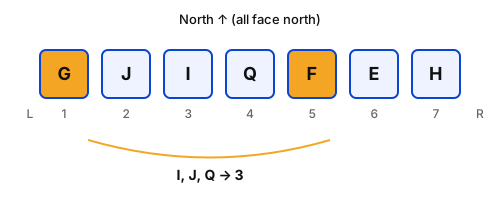
Seven friends, E, F, G, H, I, J and Q, are sitting in a row facing north. Only three people sit to the left of Q. Only H sits to the right of E. Only three people sit between E and J. I sits at some place to the left of F but at some place to the right of G. How many people sit between G and F?
सात मित्र, E, F, G, H, I, J और Q, उत्तर की ओर मुख करके एक पंक्ति में बैठे हैं। Q के बाईं ओर केवल तीन व्यक्ति बैठे हैं। E के दाईं ओर केवल H बैठा है। E और J के बीच केवल तीन व्यक्ति बैठे हैं। I, F के बाईं ओर कहीं बैठा है, लेकिन G के दाईं ओर कहीं बैठा है। G और F के बीच कितने व्यक्ति बैठे हैं?
  1. ATwoदो
  2. BThreeतीन
  3. CFourचार
  4. DOneएक
Show answer

Concept: Seven seats 1–7 from left (all face north, so left = our left).

  1. Three people left of Q → Q at 4.
  2. Only H right of E → E at 6, H at 7.
  3. Three between E and J → J at 2.
  4. Seats 1, 3, 5 remain for G, I, F with G < I < F → G 1, I 3, F 5. Between G and F: J, I, Q = 3.

Trick: Fix the "only" clues first – they pin exact seats.

Answer: (B) Three

अवधारणा: सात सीटें बाएँ से 1–7 (सभी उत्तर की ओर मुख, अतः बायाँ = हमारा बायाँ)।

  1. Q के बाएँ तीन लोग → Q स्थान 4।
  2. E के दाएँ केवल H → E 6, H 7।
  3. E और J के बीच तीन → J स्थान 2।
  4. बचे 1, 3, 5 पर G, I, F जहाँ G के दाएँ I और I के दाएँ F → G 1, I 3, F 5। G और F के बीच: J, I, Q = 3।

ट्रिक: "केवल" वाले संकेत पहले लगाएँ – वे सटीक स्थान तय करते हैं।

उत्तर: (B) तीन

RRB NTPC Graduate CBT 1General Intelligence and ReasoningLinear Seating ArrangementRRB NTPC Graduate CBT 1 2024 · 20 Jun Shift 3 →
Q973.
In the following number-pairs, the second number is obtained by applying certain mathematical operation(s) to the first number. Select the number pair in which the numbers are related in the same way as are the numbers of the following pairs. (NOTE: Operations should be performed on the whole numbers, without breaking down the numbers into their constituent digits. E.g. 13 – Operations on 13 such as adding to/subtracting from/multiplying with 13 can be performed. Breaking down 13 into 1 and 3 and then performing mathematical operations on 1 and 3 is not allowed.)
78, 91
94, 107
निम्नलिखित संख्या-युग्मों में, पहली संख्या पर कुछ गणितीय संक्रिया/संक्रियाएँ करके दूसरी संख्या प्राप्त की जाती है। उस संख्या-युग्म का चयन कीजिए जिसमें संख्याएँ उसी प्रकार संबंधित हैं जिस प्रकार निम्नलिखित युग्मों की संख्याएँ संबंधित हैं। (नोट: संख्याओं को उनके घटक अंकों में तोड़े बिना, संक्रियाएँ पूर्ण संख्याओं पर की जानी चाहिए। उदाहरण के लिए 13 – 13 पर संक्रियाएँ जैसे 13 में जोड़ना/13 में से घटाना/13 से गुणा करना आदि की जा सकती हैं। 13 को 1 और 3 में तोड़कर फिर 1 और 3 पर गणितीय संक्रियाएँ करने की अनुमति नहीं है।)
78, 91
94, 107
  1. A82, 105
  2. B86, 99
  3. C71, 74
  4. D99, 114
Show answer

Concept: Find the single operation linking each pair.

  1. 78+13=91; 94+13=107 → rule: add 13.
  2. 86+13=99 ✔.
  3. 82+23=105, 71+3=74, 99+15=114 – do not fit.

Trick: Just subtract: second − first must be 13.

Answer: (B) 86, 99

अवधारणा: प्रत्येक युग्म को जोड़ने वाली संक्रिया ज्ञात करें।

  1. 78+13=91; 94+13=107 → नियम: 13 जोड़ें।
  2. 86+13=99 ✔।
  3. 82+23=105, 71+3=74, 99+15=114 – मेल नहीं।

ट्रिक: बस घटाएँ: दूसरी − पहली = 13 होना चाहिए।

उत्तर: (B) 86, 99

RRB NTPC Graduate CBT 1General Intelligence and ReasoningNumber Pair AnalogyRRB NTPC Graduate CBT 1 2024 · 20 Jun Shift 3 →
Q974.
Which of the following letter-clusters should replace # and % so that the pattern and relationship followed between the letter-cluster pair on the left side of :: is the same as that on the right side of :: ?
# : OWF :: VDM : %
निम्नलिखित में से कौन-से अक्षर-समूह # और % के स्थान पर आने चाहिए ताकि :: के बाईं ओर के अक्षर-समूह युग्म के बीच का पैटर्न और संबंध वही हो जो :: के दाईं ओर के अक्षर-समूह युग्म के बीच है?
# : OWF :: VDM : %
  1. A# = TBK, % = QYU
  2. B# = TBM, % = QYH
  3. C# = TBK, % = QYH
  4. D# = TYK, % = QYH
Show answer

Concept: The same shift must take # to OWF and VDM to %.

  1. Try # = TBK: T −5 = O, B −5 = W, K −5 = F → rule "−5 each letter".
  2. Apply to VDM: V −5 = Q, D −5 = Y, M −5 = H → % = QYH.
  3. Only option (C) has both TBK and QYH.

Trick: Moving 5 back: A–V, B–W, C–X, D–Y, E–Z (wrap-around pairs).

Answer: (C) # = TBK, % = QYH

अवधारणा: एक ही बदलाव # को OWF में और VDM को % में बदलेगा।

  1. # = TBK लें: T −5 = O, B −5 = W, K −5 = F → नियम "हर अक्षर −5"।
  2. VDM पर: V −5 = Q, D −5 = Y, M −5 = H → % = QYH।
  3. केवल विकल्प (C) में TBK और QYH दोनों हैं।

ट्रिक: 5 पीछे: B → W, D → Y (Z के बाद घूमकर)।

उत्तर: (C) # = TBK, % = QYH

RRB NTPC Graduate CBT 1General Intelligence and ReasoningLetter AnalogyRRB NTPC Graduate CBT 1 2024 · 20 Jun Shift 3 →
Q975.
If 1 is added to each odd digit and 2 is subtracted from each even digit in the number 1385724, then how many digits will appear more than once in the new number thus formed?
यदि संख्या 1385724 में प्रत्येक विषम अंक में 1 जोड़ा जाए और प्रत्येक सम अंक में से 2 घटाया जाए, तो इस प्रकार बनी नई संख्या में कितने अंक एक से अधिक बार आएँगे?
  1. A0
  2. B2
  3. C3
  4. D1
Show answer

Concept: Odd digit +1, even digit −2, then count repeated digits.

  1. 1 3 8 5 7 2 4 → 2 4 6 6 8 0 2.
  2. 2 appears twice, 6 appears twice; 4, 8, 0 appear once.
  3. Digits appearing more than once: 2 and 6 → 2 digits.

Trick: Count distinct digits that repeat, not the number of repetitions.

Answer: (B) 2

अवधारणा: विषम अंक +1, सम अंक −2, फिर दोहराए गए अंक गिनें।

  1. 1 3 8 5 7 2 4 → 2 4 6 6 8 0 2।
  2. 2 दो बार, 6 दो बार; 4, 8, 0 एक-एक बार।
  3. एक से अधिक बार आने वाले अंक: 2 और 6 → 2 अंक।

ट्रिक: दोहराने वाले भिन्न अंकों की संख्या गिनें, दोहराव की नहीं।

उत्तर: (B) 2

RRB NTPC Graduate CBT 1General Intelligence and ReasoningNumber OperationsRRB NTPC Graduate CBT 1 2024 · 20 Jun Shift 3 →
Q976.
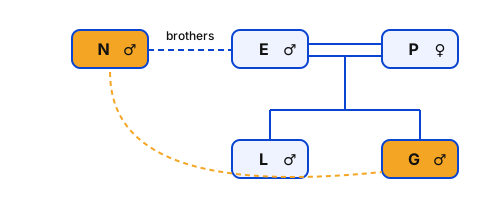
N is the brother of E. E is the husband of P. L and G are sons of P. How is N related to G?
N, E का भाई है। E, P का पति है। L और G, P के पुत्र हैं। N का G से क्या संबंध है?
  1. AHusband's brotherपति का भाई
  2. BFatherपिता
  3. CFather's brotherपिता का भाई
  4. DFather's fatherपिता के पिता
Show answer

Concept: Draw the family tree step by step.

  1. E is the husband of P; L and G are sons of P → E is the father of G.
  2. N is the brother of E → N is the brother of G's father.
  3. So N is G's father's brother (uncle).

Trick: Brother of father = paternal uncle (chacha).

Answer: (C) Father's brother

अवधारणा: चरणबद्ध पारिवारिक वृक्ष बनाएँ।

  1. E, P का पति है; L और G, P के पुत्र हैं → E, G का पिता है।
  2. N, E का भाई है → N, G के पिता का भाई है।
  3. अतः N, G का चाचा (पिता का भाई) है।

ट्रिक: पिता का भाई = चाचा।

उत्तर: (C) पिता का भाई

RRB NTPC Graduate CBT 1General Intelligence and ReasoningBlood RelationRRB NTPC Graduate CBT 1 2024 · 20 Jun Shift 3 →
Q977.
What should come in place of the question mark (?) in the given series?
413, 390, 357, ?, 261, 198
दी गई श्रृंखला में प्रश्न चिह्न (?) के स्थान पर क्या आना चाहिए?
413, 390, 357, ?, 261, 198
  1. A344
  2. B324
  3. C334
  4. D314
Show answer

Concept: Check the differences between consecutive terms.

  1. 413−23=390, 390−33=357: differences grow by 10.
  2. Next: 357−43=314.
  3. Check: 314−53=261, 261−63=198 ✔.

Trick: Differences 23,33,43,53,63 – an arithmetic pattern.

Answer: (D) 314

अवधारणा: क्रमागत पदों के अंतर देखें।

  1. 413−23=390, 390−33=357: अंतर 10-10 बढ़ता है।
  2. अगला: 357−43=314।
  3. जाँच: 314−53=261, 261−63=198 ✔।

ट्रिक: अंतर 23,33,43,53,63 – समांतर पैटर्न।

उत्तर: (D) 314

RRB NTPC Graduate CBT 1General Intelligence and ReasoningNumber SeriesRRB NTPC Graduate CBT 1 2024 · 20 Jun Shift 3 →
Q978.
Which of the following letter-number clusters will replace the question mark (?) in the given series to make it logically complete?
KO29 JN41 IM53 HL65 ?
निम्नलिखित में से कौन-सा अक्षर-संख्या समूह दी गई श्रृंखला में प्रश्न चिह्न (?) को प्रतिस्थापित करके उसे तार्किक रूप से पूर्ण करेगा?
KO29 JN41 IM53 HL65 ?
  1. AGK77
  2. BGL78
  3. CGK78
  4. DGL77
Show answer

Concept: Track the first letter, second letter and number separately.

  1. First letters: K, J, I, H → G (each −1).
  2. Second letters: O, N, M, L → K (each −1).
  3. Numbers: 29, 41, 53, 65 → 77 (each +12). Next term: GK77.

Trick: Split each term into three columns – each moves by a fixed step.

Answer: (A) GK77

अवधारणा: पहला अक्षर, दूसरा अक्षर और संख्या अलग-अलग देखें।

  1. पहले अक्षर: K, J, I, H → G (हर बार −1)।
  2. दूसरे अक्षर: O, N, M, L → K (हर बार −1)।
  3. संख्याएँ: 29, 41, 53, 65 → 77 (हर बार +12)। अगला पद: GK77।

ट्रिक: हर पद को तीन भागों में तोड़ें – हर भाग निश्चित कदम से बढ़ता है।

उत्तर: (A) GK77

RRB NTPC Graduate CBT 1General Intelligence and ReasoningAlphanumeric SeriesRRB NTPC Graduate CBT 1 2024 · 20 Jun Shift 3 →
Q979.
Based on the English alphabetical order, three of the following four letter-cluster pairs are alike in a certain way and thus form a group. Which letter-cluster pair DOES NOT belong to that group?
(Note: The odd one out is not based on the number of consonants/vowels or their position in the letter-cluster.)
अंग्रेज़ी वर्णमाला क्रम के आधार पर, निम्नलिखित चार अक्षर-समूह युग्मों में से तीन किसी निश्चित प्रकार से एकसमान हैं और इस प्रकार एक समूह बनाते हैं। कौन-सा अक्षर-समूह युग्म उस समूह से संबंधित नहीं है?
(नोट: असंगत अक्षर-समूह, उस अक्षर-समूह में व्यंजनों/स्वरों की संख्या या उनके स्थान पर आधारित नहीं है।)
  1. AWE – CJ
  2. BFN – LS
  3. CCK – JP
  4. DJR – PW
Show answer

Concept: Compare first letters with each other and second letters with each other across the pair.

  1. WE – CJ: W +6 = C, E +5 = J.
  2. FN – LS: F +6 = L, N +5 = S; JR – PW: J +6 = P, R +5 = W.
  3. CK – JP: C +7 = J, K +5 = P → breaks the (+6,+5) pattern.

Trick: Also inside each cluster gaps are +8 then +7; CK–JP gives +8 then +6 – same odd one.

Answer: (C) CK – JP

अवधारणा: युग्म में पहले अक्षरों की आपस में और दूसरे अक्षरों की आपस में तुलना करें।

  1. WE – CJ: W +6 = C, E +5 = J।
  2. FN – LS: F +6 = L, N +5 = S; JR – PW: J +6 = P, R +5 = W।
  3. CK – JP: C +7 = J, K +5 = P → (+6,+5) पैटर्न टूटा।

ट्रिक: हर समूह के अंदर अंतर +8 फिर +7; CK–JP में +8 फिर +6 – वही विषम।

उत्तर: (C) CK – JP

RRB NTPC Graduate CBT 1General Intelligence and ReasoningOdd One Out – Letter PairsRRB NTPC Graduate CBT 1 2024 · 20 Jun Shift 3 →
Q980.
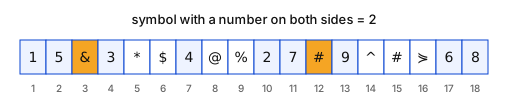
Refer to the following number and symbol series and answer the question that follows. Counting to be done from left to right only.
(Left) 1 5 & 3 * $ 4 @ % 2 7 # 9 ^ # ⋟ 6 8 (Right)
How many such symbols are there, each of which is immediately preceded by a number and also immediately followed by another number?
निम्नलिखित संख्या और प्रतीक श्रृंखला को देखिए और उसके बाद दिए गए प्रश्न का उत्तर दीजिए। गिनती केवल बाएँ से दाएँ की जानी है।
(बाएँ) 1 5 & 3 * $ 4 @ % 2 7 # 9 ^ # ⋟ 6 8 (दाएँ)
ऐसे कितने प्रतीक हैं, जिनमें से प्रत्येक के ठीक पहले एक संख्या है और ठीक बाद भी एक अन्य संख्या है?
  1. AOneएक
  2. BTwoदो
  3. CNoneकोई नहीं
  4. DThreeतीन
Show answer

Concept: Look for the pattern number–symbol–number.

  1. 5 & 3 → counted.
  2. 7 # 9 → counted.
  3. Others fail: 3 * $, 4 @ %, 9 ^ #, # ⋟ 6 (a symbol on one side). Total =2.

Trick: Scan only symbols that have digits on both sides – underline them in one pass.

Answer: (B) Two

अवधारणा: संख्या–प्रतीक–संख्या का पैटर्न देखें।

  1. 5 & 3 → गिना गया।
  2. 7 # 9 → गिना गया।
  3. बाकी असफल: 3 * $, 4 @ %, 9 ^ #, # ⋟ 6 (एक ओर प्रतीक)। कुल =2।

ट्रिक: केवल वे प्रतीक देखें जिनके दोनों ओर अंक हों – एक बार में चिह्नित करें।

उत्तर: (B) दो

RRB NTPC Graduate CBT 1General Intelligence and ReasoningNumber-Symbol SeriesRRB NTPC Graduate CBT 1 2024 · 20 Jun Shift 3 →