Question bank

Q&A: practice questions with answers

Search questions on any topic. Filter by exam category, exam, subject and topic, try the question, then open the answer and explanation.

Courses – airGurukul

7,077 questions found.

Q1041.
Which of the following numbers is divisible by 81?
निम्नलिखित में से कौन-सी संख्या 81 से विभाज्य है?
  1. A5265
  2. B5854
  3. C4678
  4. D5232
Show answer

Concept: 81=34; divide directly (digit-sum test of 9 is necessary but not sufficient).

  1. Digit sums: 5265 → 18, 5854 → 22, 4678 → 25, 5232 → 12; only 5265 is divisible by 9.
  2. 5265÷81=65 exactly (81×65=5265).

Trick: First drop options failing the 9-test, then divide.

Answer: (A) 5265

अवधारणा: 81=34; सीधे भाग दें (9 का अंक-योग परीक्षण आवश्यक है, पर्याप्त नहीं)।

  1. अंक-योग: 5265 → 18, 5854 → 22, 4678 → 25, 5232 → 12; केवल 5265 ही 9 से विभाज्य है।
  2. 5265÷81=65 पूर्णतः (81×65=5265)।

ट्रिक: पहले 9 के नियम से विकल्प हटाएँ, फिर भाग दें।

उत्तर: (A) 5265
RRB NTPC Graduate CBT 1MathematicsDivisibilityRRB NTPC Graduate CBT 1 2024 · 20 Jun Shift 2 →
Q1042.
The selling price of 20 books is equal to the cost price of 6 books. Find the loss or gain percentage.
20 पुस्तकों का विक्रय मूल्य 6 पुस्तकों के क्रय मूल्य के बराबर है। हानि या लाभ प्रतिशत ज्ञात कीजिए।
  1. A70% gain70% लाभ
  2. B507% gain507% लाभ
  3. C507% loss507% हानि
  4. D70% loss70% हानि
Show answer

Concept: Compare SP and CP of the same number of articles.

  1. SP20=CP6⇒SPCP=620.
  2. SP < CP, so it is a loss.
  3. Loss%=20−620×100=70%.

Trick: Loss%=differencegoods sold×100=1420×100.

Answer: (D) 70% loss

अवधारणा: समान संख्या की वस्तुओं के विक्रय मूल्य और क्रय मूल्य की तुलना करें।

  1. SP20=CP6⇒SPCP=620।
  2. SP < CP, अतः हानि है।
  3. हानि%=20−620×100=70%।

ट्रिक: हानि%=अंतरबेची गई वस्तुएँ×100=1420×100।

उत्तर: (D) 70% हानि

RRB NTPC Graduate CBT 1MathematicsProfit and lossRRB NTPC Graduate CBT 1 2024 · 20 Jun Shift 2 →
Q1043.
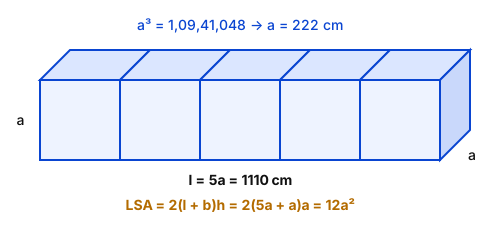
Five solid cubes, each of volume 1,09,41,048 cm3, are joined end to end to form a cuboid. What is the lateral surface area (in cm2) of the cuboid?
पाँच ठोस घनों, जिनमें से प्रत्येक का आयतन 1,09,41,048 cm3 है, को सिरे से सिरा मिलाकर एक घनाभ बनाया जाता है। घनाभ का पार्श्व पृष्ठीय क्षेत्रफल (cm2 में) कितना है?
  1. A5,91,408
  2. B5,91,310
  3. C5,91,663
  4. D5,91,312
Show answer

Concept: Joining 5 cubes of edge a gives a cuboid 5a×a×a.

  1. a3=10941048⇒a=222cm.
  2. Lateral surface area =2(l+b)h=2(5a+a)a=12a2.
  3. 12×2222=12×49284=591408cm2.

Trick: Cube root: ends in 8 → unit digit 2; 10941≈223 → 222.

Answer: (A) 5,91,408

अवधारणा: भुजा a वाले 5 घन जोड़ने पर 5a×a×a का घनाभ बनता है।

  1. a3=10941048⇒a=222cm।
  2. पार्श्व पृष्ठीय क्षेत्रफल (LSA) =2(l+b)h=2(5a+a)a=12a2।
  3. 12×2222=12×49284=591408cm2।

ट्रिक: घनमूल: अंत में 8 → इकाई अंक 2; 10941≈223 → 222।

उत्तर: (A) 5,91,408

RRB NTPC Graduate CBT 1MathematicsMensuration – cube and cuboidRRB NTPC Graduate CBT 1 2024 · 20 Jun Shift 2 →
Q1044.
Find the roots of x−4−10x−2+9=0.
x−4−10x−2+9=0 के मूल ज्ञात कीजिए।
  1. A±1, ±14
  2. B±1, ±23
  3. C±1, ±15
  4. D±1, ±13
Show answer

Concept: Substitute u=x−2 to get a quadratic.

  1. u2−10u+9=0⇒(u−1)(u−9)=0.
  2. u=1⇒x2=1⇒x=±1.
  3. u=9⇒x2=19⇒x=±13.

Trick: Put x=13: 81−90+9=0 ✔.

Answer: (D) ±1, ±13

अवधारणा: u=x−2 रखकर द्विघात समीकरण बनाएँ।

  1. u2−10u+9=0⇒(u−1)(u−9)=0।
  2. u=1⇒x2=1⇒x=±1।
  3. u=9⇒x2=19⇒x=±13।

ट्रिक: x=13 रखें: 81−90+9=0 ✔।

उत्तर: (D) ±1, ±13

RRB NTPC Graduate CBT 1MathematicsQuadratic equationsRRB NTPC Graduate CBT 1 2024 · 20 Jun Shift 2 →
Q1045.
If 3tanA=3sinA, find the value of (23cosecA×tanA).
यदि 3tanA=3sinA है, तो (23cosecA×tanA) का मान ज्ञात कीजिए।
  1. A6
  2. B3
  3. C23
  4. D2
Show answer

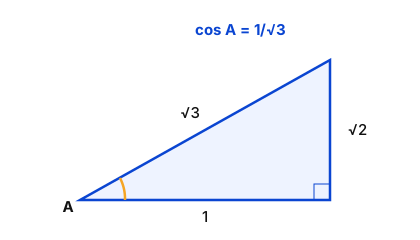
Concept: tanA=sinAcosA and cosecA=1sinA.

  1. 3sinAcosA=3sinA⇒cosA=33=13.
  2. cosecA×tanA=1sinA×sinAcosA=secA=3.
  3. 23×3=6.

Trick: cosecA×tanA=secA always.

Answer: (A) 6

अवधारणा: tanA=sinAcosA तथा cosecA=1sinA।

  1. 3sinAcosA=3sinA⇒cosA=33=13।
  2. cosecA×tanA=1sinA×sinAcosA=secA=3।
  3. 23×3=6।

ट्रिक: cosecA×tanA=secA हमेशा।

उत्तर: (A) 6

RRB NTPC Graduate CBT 1MathematicsTrigonometryRRB NTPC Graduate CBT 1 2024 · 20 Jun Shift 2 →
Q1046.
A man sold an article at a gain of 57%. If he had sold it for ₹238 more, he would have gained 82%. The cost price (in ₹) of the article is:
एक व्यक्ति ने एक वस्तु को 57% लाभ पर बेचा। यदि वह इसे ₹238 अधिक में बेचता, तो उसे 82% लाभ होता। वस्तु का क्रय मूल्य (₹ में) है:
  1. A955
  2. B952
  3. C949
  4. D950
Show answer

Concept: A change in gain% equals the change in SP as a percent of CP.

  1. Extra gain =82%−57%=25% of CP.
  2. 25% of CP = ₹238.
  3. CP =238×10025= ₹952.

Trick: Difference of percents ↔ difference of amounts.

Answer: (B) 952

अवधारणा: लाभ% में परिवर्तन = विक्रय मूल्य में परिवर्तन (क्रय मूल्य के प्रतिशत के रूप में)।

  1. अतिरिक्त लाभ =82%−57%=25% क्रय मूल्य का।
  2. क्रय मूल्य का 25%= ₹238।
  3. क्रय मूल्य =238×10025= ₹952।

ट्रिक: प्रतिशत का अंतर ↔ राशि का अंतर।

उत्तर: (B) 952

RRB NTPC Graduate CBT 1MathematicsProfit and lossRRB NTPC Graduate CBT 1 2024 · 20 Jun Shift 2 →
Q1047.
Evaluate: 81 × 112
मान ज्ञात कीजिए: 81 × 112
  1. A9072
  2. B9062
  3. C9082
  4. D9172
Show answer

Concept: Split 112 as 100+12.

  1. 81×100=8100.
  2. 81×12=972.
  3. 8100+972=9072.

Trick: Unit digit 1×2=2 and 81×112≈9000 → only 9072 fits.

Answer: (A) 9072

अवधारणा: 112 को 100+12 में तोड़ें।

  1. 81×100=8100।
  2. 81×12=972।
  3. 8100+972=9072।

ट्रिक: इकाई अंक 1×2=2 और 81×112≈9000 → केवल 9072।

उत्तर: (A) 9072

RRB NTPC Graduate CBT 1MathematicsMultiplicationRRB NTPC Graduate CBT 1 2024 · 20 Jun Shift 2 →
Q1048.
Mahesh withdrew ₹3,100 from a bank. He received a total of 34 notes of ₹50 and ₹100 denominations. The number of ₹50 notes received by him was:
महेश ने एक बैंक से ₹3,100 निकाले। उसे ₹50 और ₹100 मूल्यवर्ग के कुल 34 नोट प्राप्त हुए। उसे प्राप्त ₹50 के नोटों की संख्या थी:
  1. A6
  2. B16
  3. C13
  4. D4
Show answer

Concept: Form two equations: number of notes and total value.

  1. x+y=34 (x = ₹50 notes, y = ₹100 notes).
  2. 50x+100y=3100⇒x+2y=62.
  3. Subtract: y=28, so x=6.

Trick: If all 34 were ₹100 notes: ₹3400; shortfall ₹300 ÷ ₹50 =6 notes of ₹50.

Answer: (A) 6

अवधारणा: दो समीकरण बनाएँ: नोटों की संख्या और कुल राशि।

  1. x+y=34 (x = ₹50 के नोट, y = ₹100 के नोट)।
  2. 50x+100y=3100⇒x+2y=62।
  3. घटाएँ: y=28, अतः x=6।

ट्रिक: यदि सभी 34 नोट ₹100 के होते: ₹3400; कमी ₹300 ÷ ₹50 =6 नोट ₹50 के।

उत्तर: (A) 6

RRB NTPC Graduate CBT 1MathematicsLinear equationsRRB NTPC Graduate CBT 1 2024 · 20 Jun Shift 2 →
Q1049.
The mean of a data is 42 and its median is 53. The mode (using empirical relation) of the data is:
एक आँकड़े का माध्य 42 और माध्यिका 53 है। आँकड़े का बहुलक (आनुभविक संबंध का उपयोग करके) है:
  1. A169
  2. B75
  3. C24
  4. D100
Show answer

Concept: Empirical relation: Mode=3Median−2Mean.

  1. Mode =3×53−2×42.
  2. =159−84=75.

Trick: Mo=3Md−2M.

Answer: (B) 75

अवधारणा: आनुभविक संबंध: बहुलक=3माध्यिका−2माध्य।

  1. बहुलक =3×53−2×42।
  2. =159−84=75।

ट्रिक: Mo=3Md−2M।

उत्तर: (B) 75

RRB NTPC Graduate CBT 1MathematicsStatistics – empirical relationRRB NTPC Graduate CBT 1 2024 · 20 Jun Shift 2 →
Q1050.
What is the median of the following data?
19, 98, 77, 24, 99, 71, 70, 56, 80, 12, 88
निम्नलिखित आँकड़ों की माध्यिका क्या है?
19, 98, 77, 24, 99, 71, 70, 56, 80, 12, 88
  1. A71
  2. B70.5
  3. C72
  4. D71.5
Show answer

Concept: Arrange in order; for odd n the median is the (n+12)th value.

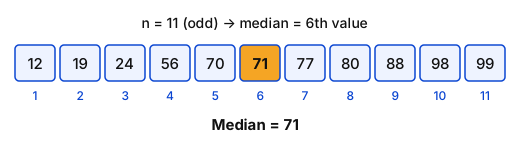
  1. Ascending: 12, 19, 24, 56, 70, 71, 77, 80, 88, 98, 99.
  2. n=11, so median = 6th value.
  3. 6th value =71.

Trick: Odd count → no averaging needed; options 70.5 and 71.5 are traps.

Answer: (A) 71

अवधारणा: आँकड़ों को क्रम में लगाएँ; विषम n पर माध्यिका (n+12)th पद है।

  1. आरोही क्रम: 12, 19, 24, 56, 70, 71, 77, 80, 88, 98, 99।
  2. n=11, अतः माध्यिका = छठा पद।
  3. छठा पद =71।

ट्रिक: विषम संख्या → औसत लेने की ज़रूरत नहीं; 70.5 और 71.5 जाल हैं।

उत्तर: (A) 71

RRB NTPC Graduate CBT 1MathematicsStatistics – medianRRB NTPC Graduate CBT 1 2024 · 20 Jun Shift 2 →
Q1051.
The product of two numbers x and y is 45 and their sum is 14. Find the sum of their cubes.
दो संख्याओं x और y का गुणनफल 45 है और उनका योग 14 है। उनके घनों का योग ज्ञात कीजिए।
  1. A675
  2. B586
  3. C854
  4. D759
Show answer

Concept: x3+y3=(x+y)3−3xy(x+y).

  1. (x+y)3=143=2744.
  2. 3xy(x+y)=3×45×14=1890.
  3. x3+y3=2744−1890=854.

Trick: Here x=9, y=5: 729+125=854.

Answer: (C) 854

अवधारणा: x3+y3=(x+y)3−3xy(x+y)।

  1. (x+y)3=143=2744।
  2. 3xy(x+y)=3×45×14=1890।
  3. x3+y3=2744−1890=854।

ट्रिक: यहाँ x=9, y=5: 729+125=854।

उत्तर: (C) 854

RRB NTPC Graduate CBT 1MathematicsAlgebraic identitiesRRB NTPC Graduate CBT 1 2024 · 20 Jun Shift 2 →
Q1052.
A boat takes 39 minutes to go 27.9 km upstream. The ratio of the speed of the boat in still water to that of the stream is 9 : 4. How much total time (in hours) will the boat take to go 18.9 km upstream and 51.3 km downstream?
एक नाव को धारा के प्रतिकूल 27.9 km जाने में 39 मिनट लगते हैं। शांत जल में नाव की चाल और धारा की चाल का अनुपात 9 : 4 है। नाव को धारा के प्रतिकूल 18.9 km और धारा के अनुकूल 51.3 km जाने में कुल कितना समय (घंटों में) लगेगा?
  1. A4.3
  2. B0.9
  3. C2.6
  4. D1.9
Show answer

Concept: Upstream =B−S, Downstream =B+S.

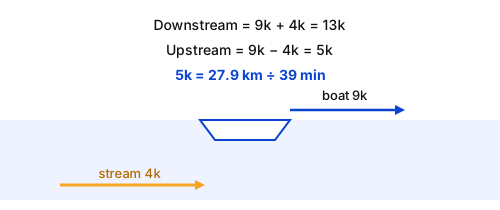
  1. B=9k, S=4k → upstream 5k, downstream 13k.
  2. 5k=27.939×60=167439km/h, so 13k=167415=111.6km/h.
  3. Upstream time =18.9×391674≈0.44 h; downstream =51.3111.6≈0.46 h.
  4. Total =0.9 hours.

Trick: In minutes: upstream 18.927.9×39=26.4 min; downstream =26.4×51.318.9×513=27.6 min; total 54 min =0.9 h.

Answer: (B) 0.9

अवधारणा: ऊर्ध्वप्रवाह (upstream) =B−S, अनुप्रवाह (downstream) =B+S।

  1. B=9k, S=4k → ऊर्ध्वप्रवाह 5k, अनुप्रवाह 13k।
  2. 5k=27.939×60=167439km/h, अतः 13k=167415=111.6km/h।
  3. ऊर्ध्वप्रवाह समय =18.9×391674≈0.44 घंटा; अनुप्रवाह =51.3111.6≈0.46 घंटा।
  4. कुल =0.9 घंटा।

ट्रिक: मिनट में: ऊर्ध्वप्रवाह 18.927.9×39=26.4 मिनट; अनुप्रवाह =26.4×51.318.9×513=27.6 मिनट; कुल 54 मिनट =0.9 घंटा।

उत्तर: (B) 0.9

RRB NTPC Graduate CBT 1MathematicsBoats and streamsRRB NTPC Graduate CBT 1 2024 · 20 Jun Shift 2 →
Q1053.
If the average of 6 consecutive odd numbers is 30, the difference between the largest and the smallest numbers is:
यदि 6 क्रमागत विषम संख्याओं का औसत 30 है, तो सबसे बड़ी और सबसे छोटी संख्या के बीच का अंतर है:
  1. A15
  2. B16
  3. C10
  4. D18
Show answer

Concept: Consecutive odd numbers differ by 2; for n such numbers, largest − smallest =2(n−1).

  1. Average =30, so the six numbers are 25,27,29,31,33,35 (centred on 30).
  2. Largest − smallest =35−25=10.
  3. Check with formula: 2(6−1)=10.

Trick: The average is not even needed: difference =2(n−1) for consecutive odd/even numbers.

Answer: (C) 10

अवधारणा: क्रमागत विषम संख्याओं में अंतर 2 होता है; n संख्याओं के लिए सबसे बड़ी − सबसे छोटी =2(n−1).

  1. औसत =30, अतः छह संख्याएँ 25,27,29,31,33,35 हैं।
  2. सबसे बड़ी − सबसे छोटी =35−25=10.
  3. सूत्र से जाँच: 2(6−1)=10.

ट्रिक: औसत की ज़रूरत ही नहीं: क्रमागत विषम/सम संख्याओं में अंतर =2(n−1).

उत्तर: (C) 10

RRB NTPC Graduate CBT 1MathematicsAverage of Consecutive NumbersRRB NTPC Graduate CBT 1 2024 · 20 Jun Shift 2 →
Q1054.
A bag contains 50 Paisa, 25 Paisa and 10 Paisa coins in the ratio 16 : 8 : 20, amounting to ₹384. Find the number of 10 Paisa coins.
एक थैले में 50 पैसे, 25 पैसे और 10 पैसे के सिक्के 16 : 8 : 20 के अनुपात में हैं, जिनकी कुल राशि ₹384 है। 10 पैसे के सिक्कों की संख्या ज्ञात कीजिए।
  1. A660
  2. B668
  3. C640
  4. D696
Show answer

Concept: Convert the ratio of number of coins into a ratio of values, then find one unit.

  1. Let coins be 16k,8k,20k.
  2. Value in ₹: 16k×0.5+8k×0.25+20k×0.1=8k+2k+2k=12k.
  3. 12k=384⇒k=32.
  4. Number of 10 paisa coins =20×32=640.

Trick: Value ratio =8:2:2 (12 parts = ₹384, 1 part = ₹32); 10 paisa share = ₹64, so coins =640.1=640.

Answer: (C) 640

अवधारणा: सिक्कों की संख्या के अनुपात को मूल्य के अनुपात में बदलें, फिर एक इकाई निकालें।

  1. सिक्के 16k,8k,20k मानें।
  2. मूल्य (₹): 16k×0.5+8k×0.25+20k×0.1=12k.
  3. 12k=384⇒k=32.
  4. 10 पैसे के सिक्के =20×32=640.

ट्रिक: प्रत्येक प्रकार का मूल्य-अंश निकालकर जोड़ें; कुल से k तुरंत मिल जाता है।

उत्तर: (C) 640

RRB NTPC Graduate CBT 1MathematicsCoins and RatioRRB NTPC Graduate CBT 1 2024 · 20 Jun Shift 2 →
Q1055.
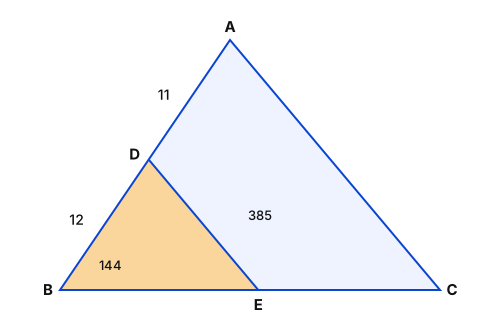
In △ABC, DE∥AC, where D and E are the points on sides AB and BC, respectively.
If BD = 12 cm and AD = 11 cm, then what is the ratio of the area of △BDE to that of the trapezium ADEC?
△ABC में, DE∥AC है, जहाँ D और E क्रमशः भुजाओं AB और BC पर स्थित बिंदु हैं।
यदि BD = 12 cm और AD = 11 cm है, तो △BDE के क्षेत्रफल और समलंब ADEC के क्षेत्रफल का अनुपात क्या है?
  1. A623 : 199
  2. B385 : 144
  3. C390 : 413
  4. D144 : 385
Show answer

Concept: If DE∥AC, then △BDE~△BAC and the ratio of areas = (ratio of sides)2.

  1. BA=BD+DA=12+11=23cm.
  2. ar(BDE)ar(BAC)=(1223)2=144529.
  3. Trapezium ADEC=529−144=385 parts.
  4. Required ratio =144:385.

Trick: Small triangle : trapezium =a2:(b2−a2) where a=BD, b=BA.

Answer: (D) 144:385

अवधारणा: यदि DE∥AC हो, तो △BDE~△BAC और क्षेत्रफलों का अनुपात = (भुजाओं का अनुपात)2.

  1. BA=BD+DA=12+11=23cm.
  2. ar(BDE)ar(BAC)=(1223)2=144529.
  3. समलंब ADEC=529−144=385 भाग।
  4. अभीष्ट अनुपात =144:385.

ट्रिक: छोटा त्रिभुज : समलंब =a2:(b2−a2), जहाँ a=BD, b=BA.

उत्तर: (D) 144:385

RRB NTPC Graduate CBT 1MathematicsSimilar Triangles – Area RatioRRB NTPC Graduate CBT 1 2024 · 20 Jun Shift 2 →
Q1056.
If a sum of ₹6,70,000 is invested for a year at 2% per annum compounded half yearly, then find the compound interest.
यदि ₹6,70,000 की राशि को 2% वार्षिक दर पर अर्धवार्षिक रूप से संयोजित चक्रवृद्धि ब्याज पर एक वर्ष के लिए निवेश किया जाता है, तो चक्रवृद्धि ब्याज ज्ञात कीजिए।
  1. A₹12,805
  2. B₹13,467
  3. C₹11,545
  4. D₹13,630
Show answer

Concept: For half-yearly compounding, rate is halved and time (in periods) is doubled: CI=P[(1+r100)n−1].

  1. Rate per half-year =22=1%, periods =2.
  2. (1.01)2−1=0.0201.
  3. CI=670000×0.0201=13467.

Trick: For 2 periods at r%, effective rate =2r+r2100=2.01%.

Answer: (B) ₹13,467

अवधारणा: अर्धवार्षिक चक्रवृद्धि में दर आधी और समय (अवधियाँ) दुगुना होता है: CI=P[(1+r100)n−1].

  1. प्रति छमाही दर =22=1%, अवधियाँ =2.
  2. (1.01)2−1=0.0201.
  3. CI=670000×0.0201=13467.

ट्रिक: 2 अवधियों के लिए प्रभावी दर =2r+r2100=2.01%.

उत्तर: (B) ₹13,467

RRB NTPC Graduate CBT 1MathematicsCompound Interest (Half-yearly)RRB NTPC Graduate CBT 1 2024 · 20 Jun Shift 2 →
Q1057.
The average of 10 observations is 40. It was realised later that an observation was misread as 32 in place of 43. Find the correct average.
10 प्रेक्षणों का औसत 40 है। बाद में ज्ञात हुआ कि एक प्रेक्षण को 43 के स्थान पर गलती से 32 पढ़ लिया गया था। सही औसत ज्ञात कीजिए।
  1. A44.1
  2. B41.1
  3. C42.1
  4. D40.1
Show answer

Concept: Correct sum = wrong sum − wrong value + correct value.

  1. Wrong sum =10×40=400.
  2. Correct sum =400−32+43=411.
  3. Correct average =41110=41.1.

Trick: Change in average =43−3210=1.1, so 40+1.1=41.1.

Answer: (B) 41.1

अवधारणा: सही योग = गलत योग − गलत मान + सही मान।

  1. गलत योग =10×40=400.
  2. सही योग =400−32+43=411.
  3. सही औसत =41110=41.1.

ट्रिक: औसत में परिवर्तन =43−3210=1.1, अतः 40+1.1=41.1.

उत्तर: (B) 41.1

RRB NTPC Graduate CBT 1MathematicsAverage – CorrectionRRB NTPC Graduate CBT 1 2024 · 20 Jun Shift 2 →
Q1058.
If a + b = 24 and (a − b)2 = 268, find the value of product of a and b.
यदि a + b = 24 और (a − b)2 = 268 है, तो a और b के गुणनफल का मान ज्ञात कीजिए।
  1. A77
  2. B110
  3. C68
  4. D140
Show answer

Concept: (a+b)2−(a−b)2=4ab.

  1. (a+b)2=242=576.
  2. 4ab=576−268=308.
  3. ab=3084=77.

Trick: Product =(sum)2−(difference)24.

Answer: (A) 77

अवधारणा: (a+b)2−(a−b)2=4ab.

  1. (a+b)2=242=576.
  2. 4ab=576−268=308.
  3. ab=3084=77.

ट्रिक: गुणनफल =(योग)2−(अंतर)24.

उत्तर: (A) 77

RRB NTPC Graduate CBT 1MathematicsAlgebraic IdentitiesRRB NTPC Graduate CBT 1 2024 · 20 Jun Shift 2 →
Q1059.
If a : b :: b : c; c = 4a and b = 18, find the positive value of c.
यदि a : b :: b : c; c = 4a और b = 18 है, तो c का धनात्मक मान ज्ञात कीजिए।
  1. A36
  2. B34
  3. C38
  4. D31
Show answer

Concept: If a:b::b:c, then b2=ac.

  1. b2=a×4a=4a2⇒b=2a.
  2. 18=2a⇒a=9.
  3. c=4a=36.

Trick: c=4a means b=2a and c=2b – directly c=2×18=36.

Answer: (A) 36

अवधारणा: यदि a:b::b:c हो, तो b2=ac.

  1. b2=a×4a=4a2⇒b=2a.
  2. 18=2a⇒a=9.
  3. c=4a=36.

ट्रिक: c=4a हो तो सामान्य अनुपात 2 है, अतः c=2b=2×18=36.

उत्तर: (A) 36

RRB NTPC Graduate CBT 1MathematicsMean ProportionalRRB NTPC Graduate CBT 1 2024 · 20 Jun Shift 2 →
Q1060.
Find the simple interest (in closest integral ₹) on ₹3,000 at 6% per annum rate of interest for the period from 9 February 2024 to 10 April 2024.
₹3,000 पर 6% वार्षिक ब्याज दर से 9 फ़रवरी 2024 से 10 अप्रैल 2024 तक की अवधि के लिए साधारण ब्याज (निकटतम पूर्णांक ₹ में) ज्ञात कीजिए।
  1. A29
  2. B28
  3. C30
  4. D31
Show answer

Concept: Count days (exclude the first day, include the last) and use SI=P×R×T100 with T in years.

  1. 2024 is a leap year: February days after 9th =29−9=20, March =31, April =10; total =61 days.
  2. T=61366 year.
  3. SI=3000×6×61100×366=10980366=30.

Trick: Note 366=6×61, so 61366=16 year → SI=3000×6100×6=30.

Answer: (C) ₹30

अवधारणा: दिन गिनें (पहला दिन छोड़ें, अंतिम दिन जोड़ें) और SI=P×R×T100 लगाएँ, T वर्षों में।

  1. 2024 लीप वर्ष है: फ़रवरी में 9 के बाद =29−9=20, मार्च =31, अप्रैल =10; कुल =61 दिन।
  2. T=61366 वर्ष।
  3. SI=3000×6×61100×366=30.

ट्रिक: 366=6×61, अतः 61366=16 वर्ष → SI=30.

उत्तर: (C) ₹30

RRB NTPC Graduate CBT 1MathematicsSimple Interest – DaysRRB NTPC Graduate CBT 1 2024 · 20 Jun Shift 2 →