Question bank

Q&A: practice questions with answers

Search questions on any topic. Filter by exam category, exam, subject and topic, try the question, then open the answer and explanation.

Courses – airGurukul

7,077 questions found.

Q1061.
The present cost of a house is ₹1,23,016. After a year, its cost will increase to ₹1,40,203. The percentage increase (rounded off to the nearest integer) in the cost of the house is:
एक मकान का वर्तमान मूल्य ₹1,23,016 है। एक वर्ष बाद, इसका मूल्य बढ़कर ₹1,40,203 हो जाएगा। मकान के मूल्य में प्रतिशत वृद्धि (निकटतम पूर्णांक तक पूर्णांकित) है:
  1. A10%
  2. B14%
  3. C8%
  4. D17%
Show answer

Concept: Increase%=New−OldOld×100.

  1. Increase =140203−123016=17187.
  2. 17187123016×100≈13.97%.
  3. Rounded to the nearest integer =14%.

Trick: 10% of 123016 ≈ 12302, 4% ≈ 4921; together ≈ 17223 – very close to 17187, so ≈ 14%.

Answer: (B) 14%

अवधारणा: वृद्धि%=नया−पुरानापुराना×100.

  1. वृद्धि =140203−123016=17187.
  2. 17187123016×100≈13.97%.
  3. निकटतम पूर्णांक =14%.

ट्रिक: 123016 का 10% ≈ 12302, 4% ≈ 4921; योग ≈ 17223 – 17187 के बहुत पास, अतः ≈ 14%.

उत्तर: (B) 14%

RRB NTPC Graduate CBT 1MathematicsPercentage IncreaseRRB NTPC Graduate CBT 1 2024 · 20 Jun Shift 2 →
Q1062.
The successive discounts of 28%, 20% and 10% are equivalent to a single discount of:
28%, 20% और 10% की क्रमिक छूटें किस एकल छूट के समतुल्य हैं?
  1. A50.59%
  2. B48.16%
  3. C46.1%
  4. D46.69%
Show answer

Concept: Single equivalent discount =100− final price when the marked price is 100.

  1. After 28%: 100×0.72=72.
  2. After 20%: 72×0.8=57.6.
  3. After 10%: 57.6×0.9=51.84.
  4. Single discount =100−51.84=48.16%.

Trick: For two discounts use a+b−ab100: 28,20→42.4; then 42.4,10→42.4+10−4.24=48.16.

Answer: (B) 48.16%

अवधारणा: अंकित मूल्य 100 मानें; एकल समतुल्य छूट =100− अंतिम मूल्य।

  1. 28% के बाद: 100×0.72=72.
  2. 20% के बाद: 72×0.8=57.6.
  3. 10% के बाद: 57.6×0.9=51.84.
  4. एकल छूट =100−51.84=48.16%.

ट्रिक: दो छूटों के लिए a+b−ab100: 28,20→42.4; फिर 42.4,10→48.16.

उत्तर: (B) 48.16%

RRB NTPC Graduate CBT 1MathematicsSuccessive DiscountsRRB NTPC Graduate CBT 1 2024 · 20 Jun Shift 2 →
Q1063.
A woman travelled at a speed of 20 m/min for 80 min, and at a speed of 65 m/min for 64 min. Her average speed (in m/min) is:
एक महिला ने 80 मिनट तक 20 m/min की चाल से और 64 मिनट तक 65 m/min की चाल से यात्रा की। उसकी औसत चाल (m/min में) है:
  1. A40
  2. B44
  3. C46
  4. D33
Show answer

Concept: Average speed=Total distanceTotal time.

  1. Distance 1 =20×80=1600m; distance 2 =65×64=4160m.
  2. Total distance =5760m; total time =144min.
  3. Average speed =5760144=40m/min.

Trick: Never average the two speeds directly unless the times are equal.

Answer: (A) 40

अवधारणा: औसत चाल=कुल दूरीकुल समय.

  1. दूरी 1 =20×80=1600m; दूरी 2 =65×64=4160m.
  2. कुल दूरी =5760m; कुल समय =144min.
  3. औसत चाल =5760144=40m/min.

ट्रिक: समय बराबर न हो तो दोनों चालों का सीधा औसत कभी न लें।

उत्तर: (A) 40

RRB NTPC Graduate CBT 1MathematicsAverage SpeedRRB NTPC Graduate CBT 1 2024 · 20 Jun Shift 2 →
Q1064.
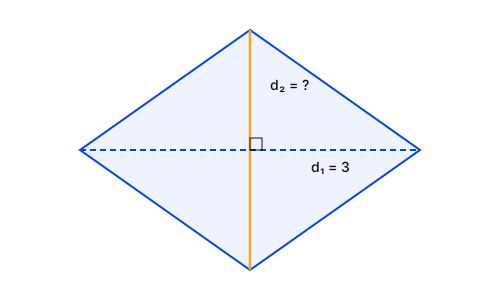
The diagonals of a quadrilateral are perpendicular bisectors of each other. If the length of one diagonal is 3 cm and the area of the quadrilateral is 180 cm2, find the length (in cm) of the other diagonal.
एक चतुर्भुज के विकर्ण एक-दूसरे के लंब समद्विभाजक हैं। यदि एक विकर्ण की लंबाई 3 cm है और चतुर्भुज का क्षेत्रफल 180 cm2 है, तो दूसरे विकर्ण की लंबाई (cm में) ज्ञात कीजिए।
  1. A128
  2. B120
  3. C115
  4. D112
Show answer

Concept: A quadrilateral whose diagonals are perpendicular bisectors of each other is a rhombus; Area=12d1d2.

  1. 180=12×3×d2.
  2. d2=3603=120cm.

Trick: Product of diagonals =2× area =360, so other diagonal =3603.

Answer: (B) 120

अवधारणा: जिस चतुर्भुज के विकर्ण एक-दूसरे के लंब समद्विभाजक हों वह समचतुर्भुज है; क्षेत्रफल=12d1d2.

  1. 180=12×3×d2.
  2. d2=3603=120cm.

ट्रिक: विकर्णों का गुणनफल =2× क्षेत्रफल =360.

उत्तर: (B) 120

RRB NTPC Graduate CBT 1MathematicsRhombus – AreaRRB NTPC Graduate CBT 1 2024 · 20 Jun Shift 2 →
Q1065.
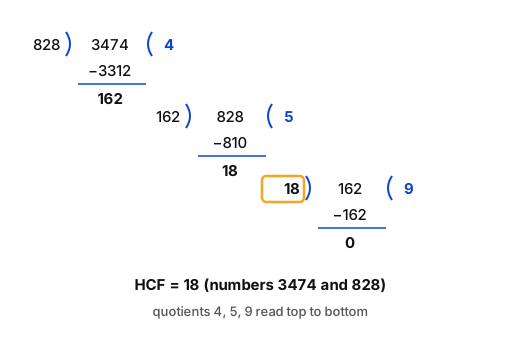
In finding the HCF of two numbers by division method, the quotients are 4, 5, and 9, respectively, and the last divisor is 18. What is the LCM of the two numbers?
भाग विधि द्वारा दो संख्याओं का HCF ज्ञात करने में, भागफल क्रमशः 4, 5 और 9 हैं, और अंतिम भाजक 18 है। दोनों संख्याओं का LCM क्या है?
  1. A159806
  2. B159807
  3. C159804
  4. D159803
Show answer

Concept: In the division method the last divisor is the HCF; rebuild the numbers backwards using dividend = divisor × quotient + remainder. Then LCM=a×bHCF.

  1. Last step: divisor 18, quotient 9, remainder 0 → dividend =18×9=162.
  2. Middle step: divisor 162, quotient 5, remainder 18 → dividend =162×5+18=828.
  3. First step: divisor 828, quotient 4, remainder 162 → dividend =828×4+162=3474.
  4. Numbers 3474 and 828; LCM=3474×82818=3474×46=159804.

Trick: The LCM must be divisible by the HCF 18: only 159804 is even with digit sum 27.

Answer: (C) 159804

अवधारणा: विभाजन विधि में अंतिम भाजक ही HCF होता है; भाज्य = भाजक × भागफल + शेषफल से पीछे की ओर संख्याएँ बनाएँ। फिर LCM=a×bHCF.

  1. अंतिम चरण: भाजक 18, भागफल 9, शेष 0 → भाज्य =18×9=162.
  2. बीच का चरण: भाजक 162, भागफल 5, शेष 18 → भाज्य =162×5+18=828.
  3. पहला चरण: भाजक 828, भागफल 4, शेष 162 → भाज्य =828×4+162=3474.
  4. संख्याएँ 3474 और 828; LCM=3474×82818=159804.

ट्रिक: LCM, HCF 18 से विभाज्य होना चाहिए: केवल 159804 (सम, अंकों का योग 27) ऐसा है।

उत्तर: (C) 159804

RRB NTPC Graduate CBT 1MathematicsHCF by Division MethodRRB NTPC Graduate CBT 1 2024 · 20 Jun Shift 2 →
Q1066.
If 2 is added to each even digit and 2 is added to each odd digit in the number 4713562, what will be the sum of the last two and first two digits in the new number thus formed?
यदि संख्या 4713562 में प्रत्येक सम अंक में 2 जोड़ा जाए और प्रत्येक विषम अंक में 2 जोड़ा जाए, तो इस प्रकार बनी नई संख्या के अंतिम दो और पहले दो अंकों का योग क्या होगा?
  1. A23
  2. B27
  3. C29
  4. D25
Show answer

Concept: Every digit (even or odd) gets +2.

  1. 4713562→6935784 (each digit +2).
  2. First two digits: 6+9=15; last two digits: 8+4=12.
  3. Sum =15+12=27.

Trick: Since both even and odd digits get +2, simply add 2 to every digit.

Answer: (B) 27

अवधारणा: हर अंक (सम या विषम) में +2 जोड़ना है।

  1. 4713562→6935784 (हर अंक +2)।
  2. पहले दो अंक: 6+9=15; अंतिम दो अंक: 8+4=12।
  3. योग =15+12=27।

ट्रिक: सम और विषम दोनों में +2 है, तो सीधे हर अंक में 2 जोड़ दें।

उत्तर: (B) 27

RRB NTPC Graduate CBT 1General Intelligence and ReasoningNumber operationsRRB NTPC Graduate CBT 1 2024 · 20 Jun Shift 2 →
Q1067.
Select the pair which follows the same pattern as that followed by the two set of pairs given below. Both pairs follow the same pattern.
PNQ : QQO
UQR : VTP
उस युग्म का चयन कीजिए जो उसी पैटर्न का अनुसरण करता है, जिसका अनुसरण नीचे दिए गए दो युग्म करते हैं। दोनों युग्म समान पैटर्न का अनुसरण करते हैं।
PNQ : QQO
UQR : VTP
  1. AOHM : PKK
  2. BVHQ : WKN
  3. CQSX : RUV
  4. DUCT : VFS
Show answer

Concept: Compare letter positions: 1st, 2nd and 3rd letters change by fixed amounts.

  1. PNQ → QQO: P+1=Q, N+3=Q, Q−2=O.
  2. UQR → VTP: U+1=V, Q+3=T, R−2=P.
  3. OHM: O+1=P, H+3=K, M−2=K → PKK ✔.

Trick: Pattern (+1,+3,−2) — check only the option whose third letter fits first.

Answer: (A) OHM : PKK

अवधारणा: अक्षरों के स्थानों की तुलना करें: तीनों अक्षर निश्चित अंतर से बदलते हैं।

  1. PNQ → QQO: P+1=Q, N+3=Q, Q−2=O।
  2. UQR → VTP: U+1=V, Q+3=T, R−2=P।
  3. OHM: O+1=P, H+3=K, M−2=K → PKK ✔।

ट्रिक: पैटर्न (+1,+3,−2) — विकल्पों में यही जाँचें।

उत्तर: (A) OHM : PKK

RRB NTPC Graduate CBT 1General Intelligence and ReasoningLetter analogyRRB NTPC Graduate CBT 1 2024 · 20 Jun Shift 2 →
Q1068.
Select the pair that follows the same pattern as that followed by the two pairs given below. Both pairs follow the same pattern.
MWC : JYA
KUR : HWP
उस युग्म का चयन कीजिए जो उसी पैटर्न का अनुसरण करता है, जिसका अनुसरण नीचे दिए गए दो युग्म करते हैं। दोनों युग्म समान पैटर्न का अनुसरण करते हैं।
MWC : JYA
KUR : HWP
  1. APAY : MGT
  2. BWTH : PUR
  3. CJVP : GXN
  4. DSLV : QPS
Show answer

Concept: Find the change in each letter position.

  1. MWC → JYA: M−3=J, W+2=Y, C−2=A.
  2. KUR → HWP: K−3=H, U+2=W, R−2=P.
  3. JVP: J−3=G, V+2=X, P−2=N → GXN ✔.

Trick: Pattern (−3,+2,−2).

Answer: (C) JVP : GXN

अवधारणा: हर अक्षर के स्थान में परिवर्तन देखें।

  1. MWC → JYA: M−3=J, W+2=Y, C−2=A।
  2. KUR → HWP: K−3=H, U+2=W, R−2=P।
  3. JVP: J−3=G, V+2=X, P−2=N → GXN ✔।

ट्रिक: पैटर्न (−3,+2,−2)।

उत्तर: (C) JVP : GXN

RRB NTPC Graduate CBT 1General Intelligence and ReasoningLetter analogyRRB NTPC Graduate CBT 1 2024 · 20 Jun Shift 2 →
Q1069.
What should come in place of the question mark (?) in the given series?
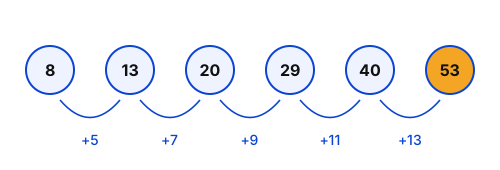
8 13 20 29 40 ?
दी गई श्रृंखला में प्रश्नचिह्न (?) के स्थान पर क्या आना चाहिए?
8 13 20 29 40 ?
  1. A65
  2. B61
  3. C53
  4. D57
Show answer

Concept: Check the differences between consecutive terms.

  1. Differences: 5,7,9,11 — consecutive odd numbers.
  2. Next difference =13.
  3. 40+13=53.

Trick: Terms are n2+4: 4+4,9+4,16+4,25+4,36+4,49+4=53.

Answer: (C) 53

अवधारणा: क्रमागत पदों का अंतर देखें।

  1. अंतर: 5,7,9,11 — क्रमागत विषम संख्याएँ।
  2. अगला अंतर =13।
  3. 40+13=53।

ट्रिक: पद n2+4 हैं: 4+4,9+4,16+4,25+4,36+4,49+4=53।

उत्तर: (C) 53

RRB NTPC Graduate CBT 1General Intelligence and ReasoningNumber seriesRRB NTPC Graduate CBT 1 2024 · 20 Jun Shift 2 →
Q1070.
Refer to the following number and symbol series and answer the question that follows. Counting to be done from left to right only.
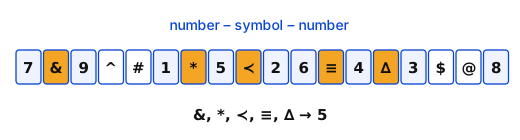
(Left) 7 & 9 ^ # 1 * 5 ≺ 2 6 ≡ 4 ∆ 3 $ @ 8 (Right)
How many such symbols are there, each of which is immediately preceded by a number and also immediately followed by another number?
निम्नलिखित संख्या और प्रतीक श्रृंखला को देखिए और उसके बाद दिए गए प्रश्न का उत्तर दीजिए। गिनती केवल बाएँ से दाएँ की जानी है।
(बाएँ) 7 & 9 ^ # 1 * 5 ≺ 2 6 ≡ 4 ∆ 3 $ @ 8 (दाएँ)
ऐसे कितने प्रतीक हैं, जिनमें से प्रत्येक के ठीक पहले एक संख्या है और ठीक बाद में भी एक अन्य संख्या है?
  1. AThreeतीन
  2. BOneएक
  3. CMore than threeतीन से अधिक
  4. DTwoदो
Show answer

Concept: Look for the pattern number – symbol – number.

  1. 7 & 9 ✔, 1 * 5 ✔, 5 ≺ 2 ✔, 6 ≡ 4 ✔, 4 ∆ 3 ✔.
  2. ^ (9 ^ #), # , $ (3 $ @) and @ fail.
  3. Count =5, i.e. more than three.

Trick: Scan the series once, marking each symbol that sits between two numbers.

Answer: (C) More than three

अवधारणा: संख्या – प्रतीक – संख्या का पैटर्न खोजें।

  1. 7 & 9 ✔, 1 * 5 ✔, 5 ≺ 2 ✔, 6 ≡ 4 ✔, 4 ∆ 3 ✔।
  2. ^ (9 ^ #), #, $ (3 $ @) और @ शर्त पूरी नहीं करते।
  3. कुल =5, अर्थात तीन से अधिक।

ट्रिक: श्रृंखला को एक बार देखें और दो संख्याओं के बीच वाले प्रतीक गिनें।

उत्तर: (C) तीन से अधिक

RRB NTPC Graduate CBT 1General Intelligence and ReasoningSymbol-number seriesRRB NTPC Graduate CBT 1 2024 · 20 Jun Shift 2 →
Q1071.
Which of the following letter-clusters should replace # and % so that the pattern and relationship followed between the letter-cluster pair on the left side of :: is the same as that on the right side of :: ?
# : UEQ :: QAM : %
निम्नलिखित में से कौन-से अक्षर-समूह # और % को प्रतिस्थापित करेंगे, ताकि :: के बाईं ओर के अक्षर-समूह युग्म के बीच का पैटर्न और संबंध, :: के दाईं ओर के अक्षर-समूह युग्म के समान हो?
# : UEQ :: QAM : %
  1. A# = FMY, % = ISE
  2. B# = CMY, % = ISO
  3. C# = CMY, % = ISE
  4. D# = CMY, % = IUE
Show answer

Concept: Find the shift from the first cluster to the second.

  1. Try # = CMY: C−8=U, M−8=E, Y−8=Q → UEQ ✔ (shift −8).
  2. Apply −8 to QAM: Q−8=I, A−8=S, M−8=E → ISE.
  3. So # = CMY, % = ISE.

Trick: Backward shift wraps round: A(1)−8→19=S.

Answer: (C) # = CMY, % = ISE

अवधारणा: पहले समूह से दूसरे समूह तक का खिसकाव (shift) निकालें।

  1. # = CMY लें: C−8=U, M−8=E, Y−8=Q → UEQ ✔ (shift −8)।
  2. QAM पर −8: Q−8=I, A−8=S, M−8=E → ISE।
  3. अतः # = CMY, % = ISE।

ट्रिक: पीछे जाने पर चक्र घूमता है: A(1)−8→19=S।

उत्तर: (C) # = CMY, % = ISE

RRB NTPC Graduate CBT 1General Intelligence and ReasoningLetter-cluster analogyRRB NTPC Graduate CBT 1 2024 · 20 Jun Shift 2 →
Q1072.
What should come in place of the question mark (?) in the given series based on the English alphabetical order?
YRU WPS UNQ SLO ?
अंग्रेज़ी वर्णमाला क्रम के आधार पर, दी गई श्रृंखला में प्रश्नचिह्न (?) के स्थान पर क्या आना चाहिए?
YRU WPS UNQ SLO ?
  1. AQIM
  2. BQJN
  3. CQJM
  4. DQIN
Show answer

Concept: Track each letter position separately.

  1. 1st letters: Y, W, U, S → Q (−2).
  2. 2nd letters: R, P, N, L → J (−2).
  3. 3rd letters: U, S, Q, O → M (−2).

Trick: All three positions move −2 each step.

Answer: (C) QJM

अवधारणा: हर स्थान के अक्षर को अलग से देखें।

  1. पहला अक्षर: Y, W, U, S → Q (−2)।
  2. दूसरा अक्षर: R, P, N, L → J (−2)।
  3. तीसरा अक्षर: U, S, Q, O → M (−2)।

ट्रिक: तीनों स्थान हर बार −2 खिसकते हैं।

उत्तर: (C) QJM

RRB NTPC Graduate CBT 1General Intelligence and ReasoningAlphabet seriesRRB NTPC Graduate CBT 1 2024 · 20 Jun Shift 2 →
Q1073.
Based on the English alphabetical order, three of the following four letter-cluster pairs are alike in a certain way and thus form a group. Which letter-cluster pair DOES NOT belong to that group?
(Note: The odd one out is not based on the number of consonants/vowels or their position in the letter-cluster.)
अंग्रेज़ी वर्णमाला क्रम के आधार पर, निम्नलिखित चार अक्षर-समूह युग्मों में से तीन किसी निश्चित प्रकार से समान हैं और इस प्रकार एक समूह बनाते हैं। कौन-सा अक्षर-समूह युग्म उस समूह से संबंधित नहीं है?
(ध्यान दें: असंगत का निर्धारण व्यंजनों/स्वरों की संख्या या अक्षर-समूह में उनकी स्थिति के आधार पर नहीं है।)
  1. ARV – XE
  2. BDH – IQ
  3. CNR – TA
  4. DXB – DK
Show answer

Concept: Check the gap inside each cluster and between clusters.

  1. RV – XE: R+4=V, V+2=X, X+7=E.
  2. NR – TA: +4, +2, +7; XB – DK: +4, +2, +7.
  3. DH – IQ: +4, +1, +8 → breaks the pattern.

Trick: Write gaps as a triple; the odd triple is the answer.

Answer: (B) DH – IQ

अवधारणा: हर समूह के अंदर और समूहों के बीच का अंतर देखें।

  1. RV – XE: R+4=V, V+2=X, X+7=E।
  2. NR – TA: +4, +2, +7; XB – DK: +4, +2, +7।
  3. DH – IQ: +4, +1, +8 → पैटर्न टूटता है।

ट्रिक: अंतरों को तिकड़ी के रूप में लिखें; अलग तिकड़ी ही उत्तर है।

उत्तर: (B) DH – IQ

RRB NTPC Graduate CBT 1General Intelligence and ReasoningOdd one out – lettersRRB NTPC Graduate CBT 1 2024 · 20 Jun Shift 2 →
Q1074.
A group of numbers and symbols is coded using letter codes as per the codes given below and the conditions that follow. Study the given codes and conditions and answer the question that follows.
Note: If none of the conditions apply, then codes for the respective number/symbol are to be followed directly as given in the table.
Number/symbol$%&*246@#3+897
CodeTUPSDFJKZCVBNM
Conditions:
(i) If the first element is a symbol and the last a number, the codes for these two (the first and the last elements) are to be interchanged.
(ii) If the first element is an odd number and the last an even number, the first and last elements are to be coded as ©.
(iii) If both second and third elements are perfect cubes, the third element is to be coded as the code for the second element.
What will be the code for the following group?
3 9 8 *
संख्याओं और प्रतीकों के एक समूह को नीचे दिए गए कूटों और उसके बाद दी गई शर्तों के अनुसार अक्षर कूटों का उपयोग करके कूटबद्ध किया जाता है। दिए गए कूटों और शर्तों का अध्ययन कीजिए और उसके बाद दिए गए प्रश्न का उत्तर दीजिए।
ध्यान दें: यदि कोई भी शर्त लागू नहीं होती है, तो संबंधित संख्या/प्रतीक के लिए तालिका में दिए गए कूटों का सीधे अनुसरण किया जाना है।
संख्या/प्रतीक$%&*246@#3+897
कूटTUPSDFJKZCVBNM
शर्तें:
(i) यदि पहला तत्व एक प्रतीक है और अंतिम तत्व एक संख्या है, तो इन दोनों (पहले और अंतिम तत्वों) के कूट आपस में बदल दिए जाने हैं।
(ii) यदि पहला तत्व एक विषम संख्या है और अंतिम तत्व एक सम संख्या है, तो पहले और अंतिम तत्वों को © के रूप में कूटबद्ध किया जाना है।
(iii) यदि दूसरा और तीसरा, दोनों तत्व पूर्ण घन हैं, तो तीसरे तत्व को दूसरे तत्व के कूट के रूप में कूटबद्ध किया जाना है।
निम्नलिखित समूह के लिए कूट क्या होगा?
3 9 8 *
  1. ACNNS
  2. BCNBS
  3. CSNBC
  4. DCBBS
Show answer

Concept: Test each condition in order; if none applies, code directly.

  1. Codes: 3 → C, 9 → N, 8 → B, * → S.
  2. Condition 1 fails (first element 3 is a number); condition 2 fails (last element * is not a number).
  3. Condition 3 fails: 9 is not a perfect cube (8 is, but both are needed).
  4. Direct coding: CNBS.

Trick: Check the first and last elements' type first — it rules out conditions 1 and 2 instantly.

Answer: (B) CNBS

अवधारणा: हर शर्त क्रम से जाँचें; कोई लागू न हो तो सीधे कोड करें।

  1. कोड: 3 → C, 9 → N, 8 → B, * → S।
  2. शर्त 1 लागू नहीं (पहला तत्व 3 संख्या है); शर्त 2 लागू नहीं (अंतिम तत्व * संख्या नहीं है)।
  3. शर्त 3 लागू नहीं: 9 पूर्ण घन नहीं है (8 है, पर दोनों चाहिए)।
  4. सीधा कोड: CNBS।

ट्रिक: पहले और अंतिम तत्व का प्रकार पहले देखें — शर्त 1 और 2 तुरंत हट जाती हैं।

उत्तर: (B) CNBS

RRB NTPC Graduate CBT 1General Intelligence and ReasoningCoding-decoding with conditionsRRB NTPC Graduate CBT 1 2024 · 20 Jun Shift 2 →
Q1075.
Select the set in which the numbers are related in the same way as are the numbers of the following sets.
(NOTE: Operations should be performed on the whole numbers, without breaking down the numbers into their constituent digits. E.g. 13 – Operations on 13 such as adding to/subtracting from/multiplying with 13 can be performed. Breaking down 13 into 1 and 3 and then performing mathematical operations on 1 and 3 is not allowed.)
(19, 39, 44)
(13, 27, 32)
उस समुच्चय का चयन कीजिए जिसमें संख्याएँ उसी प्रकार संबंधित हैं, जिस प्रकार निम्नलिखित समुच्चयों की संख्याएँ संबंधित हैं।
(ध्यान दें: संक्रियाएँ संख्याओं को उनके घटक अंकों में विभाजित किए बिना, पूर्ण संख्याओं पर की जानी चाहिए। उदाहरण के लिए, 13 – 13 पर संक्रियाएँ जैसे 13 में जोड़ना/13 में से घटाना/13 से गुणा करना आदि की जा सकती हैं। 13 को 1 और 3 में विभाजित करना और फिर 1 और 3 पर गणितीय संक्रियाएँ करना वर्जित है।)
(19, 39, 44)
(13, 27, 32)
  1. A(29, 49, 54)
  2. B(24, 45, 50)
  3. C(11, 23, 28)
  4. D(35, 61, 66)
Show answer

Concept: Find how the 2nd and 3rd numbers come from the 1st.

  1. 19×2+1=39, 39+5=44.
  2. 13×2+1=27, 27+5=32.
  3. 11×2+1=23, 23+5=28 ✔ (others fail, e.g. 29×2+1=59≠49).

Trick: Third − second =5 in all; then test 2a+1.

Answer: (C) (11, 23, 28)

अवधारणा: देखें कि दूसरी और तीसरी संख्या पहली से कैसे बनती है।

  1. 19×2+1=39, 39+5=44।
  2. 13×2+1=27, 27+5=32।
  3. 11×2+1=23, 23+5=28 ✔ (अन्य विफल, जैसे 29×2+1=59≠49)।

ट्रिक: हर समूह में तीसरी − दूसरी =5; फिर 2a+1 जाँचें।

उत्तर: (C) (11, 23, 28)

RRB NTPC Graduate CBT 1General Intelligence and ReasoningNumber set analogyRRB NTPC Graduate CBT 1 2024 · 20 Jun Shift 2 →
Q1076.
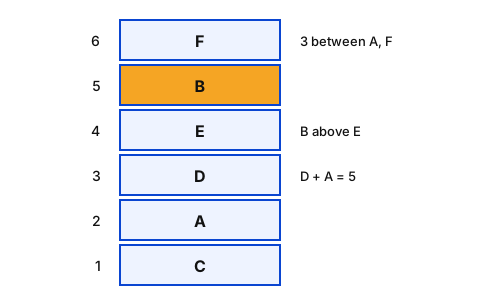
A, B, C, D, E and F live on six different floors of the same building. The lowermost floor in the building is numbered 1, the floor above it, number 2 and so on, till the topmost floor is numbered 6. D lives on an odd numbered floor but not 5. The sum of floors on which D and A live is 5. Only 3 people live between A and F. B lives immediately above E. How many people live above B?
A, B, C, D, E और F एक ही इमारत की छह अलग-अलग मंज़िलों पर रहते हैं। इमारत की सबसे निचली मंज़िल की संख्या 1 है, उसके ऊपर वाली मंज़िल की संख्या 2 है और इसी प्रकार आगे, सबसे ऊपरी मंज़िल की संख्या 6 है। D एक विषम संख्या वाली मंज़िल पर रहता है, परंतु 5 पर नहीं। D और A जिन मंज़िलों पर रहते हैं, उनका योग 5 है। A और F के बीच केवल 3 व्यक्ति रहते हैं। B, E के ठीक ऊपर रहता है। B के ऊपर कितने व्यक्ति रहते हैं?
  1. A3
  2. B4
  3. C2
  4. D1
Show answer

Concept: Fix the fixed clues first (D, A, F), then place the pair B–E in the remaining floors.

  1. D is on an odd floor except 5, so D = 1 or 3.
  2. D + A = 5: if D = 1, A = 4; if D = 3, A = 2.
  3. Exactly 3 people between A and F: A = 4 gives no valid F (needs 0 or 8), so D = 3, A = 2, F = 6.
  4. Floors left: 1, 4, 5. B is immediately above E, so E = 4, B = 5 and C = 1.
  5. Only F (floor 6) is above B, so 1 person.

Trick: In floor puzzles, test both cases of a sum clue; the case that breaks the "gap" clue is rejected at once.

Answer: (D) 1

अवधारणा: पहले निश्चित संकेत (D, A, F) लगाएँ, फिर बची मंज़िलों में B–E की जोड़ी रखें।

  1. D विषम मंज़िल पर है पर 5 नहीं, अतः D = 1 या 3.
  2. D + A = 5: D = 1 हो तो A = 4; D = 3 हो तो A = 2.
  3. A और F के बीच ठीक 3 लोग: A = 4 पर F संभव नहीं, अतः D = 3, A = 2, F = 6.
  4. बची मंज़िलें 1, 4, 5. B ठीक E के ऊपर है, अतः E = 4, B = 5, C = 1.
  5. B के ऊपर केवल F (मंज़िल 6) है, यानी 1 व्यक्ति।

ट्रिक: योग वाले संकेत के दोनों केस आज़माएँ; जो केस "बीच में लोग" वाले संकेत को तोड़े, उसे तुरंत हटा दें।

उत्तर: (D) 1

RRB NTPC Graduate CBT 1General Intelligence and ReasoningFloor PuzzleRRB NTPC Graduate CBT 1 2024 · 20 Jun Shift 2 →
Q1077.
Read the given statements and conclusions carefully. Assuming that the information given in the statements is true, even if it appears to be at variance with commonly known facts, decide which of the given conclusion(s) logically follow(s) from the statements.
Statements:
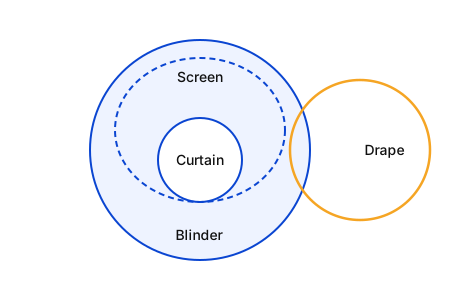
All curtain are screen.
All curtain are blinder.
Some blinder are drape.
Conclusions:
(I) Some drape are curtain.
(II) Some blinder are screen.
दिए गए कथनों और निष्कर्षों को ध्यानपूर्वक पढ़िए। यह मानते हुए कि कथनों में दी गई जानकारी सत्य है, भले ही वह सामान्य रूप से ज्ञात तथ्यों से भिन्न प्रतीत होती हो, निर्णय कीजिए कि दिए गए निष्कर्षों में से कौन-सा/से निष्कर्ष कथनों का तार्किक रूप से अनुसरण करता है/करते हैं।
कथन:
सभी कर्टेन, स्क्रीन हैं।
सभी कर्टेन, ब्लाइंडर हैं।
कुछ ब्लाइंडर, ड्रेप हैं।
निष्कर्ष:
(I) कुछ ड्रेप, कर्टेन हैं।
(II) कुछ ब्लाइंडर, स्क्रीन हैं।
  1. ANeither conclusion (I) nor (II) followsन तो निष्कर्ष (I) और न ही (II) अनुसरण करता है
  2. BBoth conclusions (I) and (II) followनिष्कर्ष (I) और (II) दोनों अनुसरण करते हैं
  3. COnly conclusion (I) followsकेवल निष्कर्ष (I) अनुसरण करता है
  4. DOnly conclusion (II) followsकेवल निष्कर्ष (II) अनुसरण करता है
Show answer

Concept: Draw the least-overlap Venn diagram; a conclusion follows only if it is true in every possible diagram.

  1. All curtain are screen and all curtain are blinder, so the curtain circle lies inside both screen and blinder.
  2. Hence some blinder (the curtain part) are screen – Conclusion II definitely follows.
  3. Drape only overlaps blinder; it can lie completely outside curtain, so "Some drape are curtain" is not certain – Conclusion I does not follow.

Trick: Two "All" statements with the same subject (All A are B, All A are C) always give "Some B are C".

Answer: (D) Only conclusion (II) follows

अवधारणा: न्यूनतम ओवरलैप वाला वेन आरेख बनाएँ; निष्कर्ष तभी सही है जब वह हर संभव आरेख में सत्य हो।

  1. सभी curtain, screen हैं और सभी curtain, blinder हैं, अतः curtain का वृत्त screen और blinder दोनों के अंदर है।
  2. इसलिए कुछ blinder (curtain वाला भाग) screen हैं – निष्कर्ष II निश्चित रूप से सही।
  3. Drape केवल blinder से जुड़ा है; यह curtain के पूरी तरह बाहर हो सकता है, अतः निष्कर्ष I निश्चित नहीं।

ट्रिक: एक ही subject वाले दो "All" कथन (सभी A, B हैं; सभी A, C हैं) से हमेशा "कुछ B, C हैं" निकलता है।

उत्तर: (D) केवल निष्कर्ष (II) अनुसरण करता है

RRB NTPC Graduate CBT 1General Intelligence and ReasoningSyllogismRRB NTPC Graduate CBT 1 2024 · 20 Jun Shift 2 →
Q1078.
What should come in place of the question mark (?) in the given series?
1012 1010 1000 998 988 ? 976
दी गई श्रृंखला में प्रश्नचिह्न (?) के स्थान पर क्या आना चाहिए?
1012 1010 1000 998 988 ? 976
  1. A985
  2. B988
  3. C987
  4. D986
Show answer

Concept: Look at the differences between consecutive terms.

  1. Differences: 1012−1010=2, 1010−1000=10, 1000−998=2, 998−988=10.
  2. Pattern alternates −2,−10; next is −2: 988−2=986.
  3. Check: 986−10=976 ✓.

Trick: Alternating differences are common – always verify with the term after the blank.

Answer: (D) 986

अवधारणा: क्रमागत पदों के अंतर देखें।

  1. अंतर: 1012−1010=2, 1010−1000=10, 1000−998=2, 998−988=10.
  2. पैटर्न −2,−10 बारी-बारी; अगला −2: 988−2=986.
  3. जाँच: 986−10=976 ✓.

ट्रिक: बारी-बारी वाले अंतर आम हैं – रिक्त स्थान के बाद वाले पद से जाँच अवश्य करें।

उत्तर: (D) 986

RRB NTPC Graduate CBT 1General Intelligence and ReasoningNumber SeriesRRB NTPC Graduate CBT 1 2024 · 20 Jun Shift 2 →
Q1079.
This question is based on the five, three-digit numbers given below.
(Left) 983 986 481 941 167 (Right)
(Example- 697 – First digit = 6, second digit = 9 and third digit = 7)
(NOTE: All operations to be done from left to right.)
What will be the resultant if the third digit of the highest number is subtracted from the first digit of the lowest number?
यह प्रश्न नीचे दी गई तीन अंकों वाली पाँच संख्याओं पर आधारित है।
(बाएँ) 983 986 481 941 167 (दाएँ)
(उदाहरण- 697 – पहला अंक = 6, दूसरा अंक = 9 और तीसरा अंक = 7)
(ध्यान दें: सभी संक्रियाएँ बाएँ से दाएँ की जानी हैं।)
यदि सबसे बड़ी संख्या के तीसरे अंक को सबसे छोटी संख्या के पहले अंक में से घटाया जाए, तो परिणाम क्या होगा?
  1. A−4
  2. B−2
  3. C−5
  4. D−3
Show answer

Concept: Identify the highest and lowest numbers, pick the asked digits, then operate in the stated order.

  1. Numbers: 983, 986, 481, 941, 167. Highest =986, lowest =167.
  2. Third digit of highest =6; first digit of lowest =1.
  3. "6 subtracted from 1" means 1−6=−5.

Trick: "X subtracted from Y" =Y−X – read the order carefully.

Answer: (C) −5

अवधारणा: सबसे बड़ी और सबसे छोटी संख्या पहचानें, माँगे गए अंक लें, फिर बताए क्रम में संक्रिया करें।

  1. संख्याएँ: 983, 986, 481, 941, 167. सबसे बड़ी =986, सबसे छोटी =167.
  2. सबसे बड़ी का तीसरा अंक =6; सबसे छोटी का पहला अंक =1.
  3. "1 में से 6 घटाना" =1−6=−5.

ट्रिक: "X को Y में से घटाएँ" =Y−X – क्रम ध्यान से पढ़ें।

उत्तर: (C) −5

RRB NTPC Graduate CBT 1General Intelligence and ReasoningNumber OperationsRRB NTPC Graduate CBT 1 2024 · 20 Jun Shift 2 →
Q1080.
This question is based on the five, three-digit numbers given below.
(Left) 951 474 717 497 127 (Right)
(Example- 697 – First digit = 6, second digit = 9 and third digit = 7)
(NOTE: All operations to be done from left to right.)
What will be the resultant if the first digit of the highest number is subtracted from the third digit of the lowest number?
यह प्रश्न नीचे दी गई तीन अंकों वाली पाँच संख्याओं पर आधारित है।
(बाएँ) 951 474 717 497 127 (दाएँ)
(उदाहरण- 697 – पहला अंक = 6, दूसरा अंक = 9 और तीसरा अंक = 7)
(ध्यान दें: सभी संक्रियाएँ बाएँ से दाएँ की जानी हैं।)
यदि सबसे बड़ी संख्या के पहले अंक को सबसे छोटी संख्या के तीसरे अंक में से घटाया जाए, तो परिणाम क्या होगा?
  1. A−4
  2. B−3
  3. C−2
  4. D−1
Show answer

Concept: Identify the highest and lowest numbers, pick the asked digits, then operate in the stated order.

  1. Numbers: 951, 474, 717, 497, 127. Highest =951, lowest =127.
  2. First digit of highest =9; third digit of lowest =7.
  3. "9 subtracted from 7" means 7−9=−2.

Trick: "X subtracted from Y" =Y−X; a negative answer is expected here.

Answer: (C) −2

अवधारणा: सबसे बड़ी और सबसे छोटी संख्या पहचानें, माँगे गए अंक लें, फिर बताए क्रम में संक्रिया करें।

  1. संख्याएँ: 951, 474, 717, 497, 127. सबसे बड़ी =951, सबसे छोटी =127.
  2. सबसे बड़ी का पहला अंक =9; सबसे छोटी का तीसरा अंक =7.
  3. "7 में से 9 घटाना" =7−9=−2.

ट्रिक: "X को Y में से घटाएँ" =Y−X; यहाँ ऋणात्मक उत्तर अपेक्षित है।

उत्तर: (C) −2

RRB NTPC Graduate CBT 1General Intelligence and ReasoningNumber OperationsRRB NTPC Graduate CBT 1 2024 · 20 Jun Shift 2 →